Quietism, the ‘vacancy’ of Formal Art

Ad Reinhardt Abstract painting
 xxxxxxx
          6.42    And so it is impossible for there to be propositions of ethics.

          Propositions can express nothing that is higher.         

          6.421  It is clear that ethics cannot be put into words.

          Ethics is transcendental.

          (Ethics and aesthetics are one and the same.)

         Ludwig Wittgenstein: Tractatus Logico-Philosophicus

Wittgenstein argues in this seminal early text that “Ethik und Ästhetik sind Eins”.  The statement has an unequivocal ring about it.  It’s the outcome of a flat denial that language can claim to speak of the ineffable, since that would be a pretension, a raid on conjecture that can have no application where words – which are “pictures of facts” – are concerned.  It is thus that the Tractatus effectively shuts the door on metaphysical discourse as a viable branch of philosophy.

Later texts by Wittgenstein may have sought to push that door ever so slightly ajar again and to water down an insistence which science has subsequently taken for granted.  It is worth remembering, however, that Bertrand Russell considered the Tractatus the only book written by Wittgenstein that had any relevance to the development of philosophy.  For Wittgenstein recanted, so far as Russell was concerned.  He bowed to pressure from the respectable Viennese establishment, who were bent on maintaining the status quo with god-fearing wives and clergymen of a philosophical turn-of-mind.  Logical positivism was all very well for the British, but in Austria religious matters had to be allowed into at least the pen-umbra of modern enlightenment.  So Wittgenstein modified the views hammered out on the anvil of his youthful mind, just as Sigmund Freud had felt obliged to retract ‘the seduction theory’, under similar pressure from the city fathers.  Wittgenstein’s subsequent note-books are worth picking over if you wish to indulge in romantically aphoristic nonfinito.  Still, in my opinion, they dilute the essential theory of the Tractatus and allow conjecture to seep back into the cranium of the “handmaid of science” – the epithet the author originally chose for ‘Philosophy’, were she to be emancipated from metaphysics.  Thereafter, by allowing this “bleed” back towards conjecture, as the later notebooks make permissible, it was once again feasible to assert that ‘meaning’ mattered more than form.

But, if ethics and aesthetics are indeed one and the same, as the Tractatus maintains, what does this imply?  Does it mean that both concepts have become redundant, given that both may now seem flawed by the meanings which accrued to them before their synonymy was established?  Since their equation, form is not quite form, as in form alone; and meaning not quite meaning anymore, in so far as we suppose meaning only to concern some ethical issue.  Instead of either, we now have some other stuff compounded by the fusion of both. 

What are these older meanings?  The O.E.D. defines form first as “the visible aspect of a thing”, then as “an image, likeness or representation of a thing,” (we can say we saw his form moving through the mist).  And, apparently, in philosophy, form has come to mean “the essential determinant principle of a thing, that which makes anything a determinate species or kind of being.”  An aesthetic definition of form is the essential creative quality of a thing, or “the particular mode in which a thing exists or manifests itself.”  For artists, this ‘particular mode’ is a key notion:  it suggests that form can mean medium.

Ethics, on the other hand, is a term which relates to morals.  Ethics can be the science of morals, “the science of human duty in its widest extent”.  Thus ethics concern content – they are, or used to be the message:  that principle of duty or responsibility which one may be trying to put across.  It should be noted, though, that the O.E.D. defines content in a rather different way, essentially as “that which is contained: the tenor or purport (or meaning) of a document” – in the last sense therefore the message.  But since content initially means the substance or matter contained, what we are saying etymologically, when we say that we are ‘contented’, is that we are full – ‘contentedness’ concerns our satisfaction, in the sense that a good dinner fills us up.  However, in Freud’s homeostatic theory of the Pleasure Principle, we may be contented when we have relieved ourselves, thus disburdening ourselves of a pressure that was disturbing our equilibrium – in which sense our contentment would relate to our emptying ourselves.

Leaving the last notion aside, for now, we can hear Marshall McLuhan reinterpreting this statement from the Tractatus as “the medium is the message”, for it is clear that, at the level of their primary definitions, form and content have the relationship that a jug has to the water it contains.  However, the Wittgenstein of the Tractatus is saying something like ‘the jug is the water that it carries.’

If we take his insight to heart, we must make tangible the notion that the terms form and content are a unity. This strikes resonances with the mind-and-body debate.  For surely mind is body, and these two terms should never have been split?  Yet with both diodes, form/content, body/mind, their discovered unity must fundamentally alter our notion of the terms – in that we may no longer oppose them, in that we must find a way of working with an imaginary word, in each case, which represents their fusion, their coming together.

Of course many artists still purport to have a message, and they remain keen to find a form through which to get their message across.  For them, form occupies a subservient position to content.  Content is the master; form the mere vessel carrying content blithely along.  In mischievous mode, I may suggest that there is a feminist aspect to this.  Those who have the feeling that their views have been gagged for millennia may feel an urgency to communicate.  On the (supposedly) male side, however, it might be argued that those biologically deprived of wombs may simply wish to bring something into the world.  Frank Auerbach, for instance, speaks of ‘bringing something new to life’.  Here the imaginary womb of form is predominant, indifferent to the import of its progeny. You could say that form is humanity: content a mere product.  In the case of the political artist, on the other hand, or of the politicised feminist artist, content is invested with all the humanity, while form is an inanimate object, no more than a method of transport.

However, it is my purpose here to breathe more life into the notion of form, since it would appear relatively easy to bring home the humanity we expect from content.  Form remains the figure moving through mist, and I will try to dispel some of that term’s ethereal moisture.  One of the clearest exponents of its meaning is the German critic and playwright, Gotthold Lessing, who wrote his little book, Laocoön, or the Limits of Painting and Poetry in 1766.  Lessing was trying to establish which came first, a passage in Virgil’s Aeniad, describing the death of the Trojan priest, Laocoön, and his sons, in the coils of serpents raised by Neptune – or the Hellenic statue showing this event in marble:  in other words, was the statue inspired by the poem or vice versa?  During this academic enterprise, Lessing discerned a need to define the difference between poetry and visual art.  Of Homer’s description of an archer in the Iliad, which he termed a “poetical picture”, he wrote:

“From the seizing of the bow to the very flight of the arrow every moment is depicted, and all these moments are kept so closely together, and yet so distinctly separate, that if we did not know how a bow was to be managed we might be able to learn it from this picture alone.  Pandarus draws forth his bow, fixes the bowstring, opens his quiver, chooses a yet unused, well-feathered shaft, sets the arrow on the string, draws back both string and arrow to the notch, the string is brought near to his breast and the iron head of the arrow to the bow; back flies the great bent bow with a twang, the bow-string whirrs, off springs the arrow flying eager for its mark.”

(Gotthold Lessing, Laocoön, page 54)

But it’s misleading to call this ‘a picture’.  Better to call it ‘a telling’ – for Homer is not showing us, in two or three dimensional space, how an archer shoots; instead he is telling us how it is done.  Were we listening to his voice, and given we understood it, the telling would be entering us invisibly, through our ears, but rhythmically also, and spoken in time – just as the action described happens in time; in a sequence unfolding in the poet’s mind.  ‘Sequence’ is the operative word, for the archer is engaged in a series of actions, actions which succeed each other, “step by step in succession of time”.  How different this would be if it were a genuine picture, for if it were, it would resemble one of those photographic sequences by Edward Muybridge – a visible yet arrested set of actions, the different parts only occurring side by side in space. 

Form considered as medium takes on significance when we realise that poetry deals most effectively with actions happening step by step in time, whereas painting deals most effectively with bodies occurring side by side in space.  Lessing goes on to elaborate this point, and in so doing provides us with an essay in the formal analysis of the difference between media.  And while the sculpture of the strangled priest and his sons can show us how the coils wound massively around the bodies of their victims, it cannot show us how this has come about nor that the other two victims are his sons – for these are facts and relationships which require telling rather than figuration.

Any shift from one medium to another will involve a change of characteristics.  Say you have created some pencil drawings employing the strategy of never removing the pencil’s point from the surface; then you try to make paintings based on these drawings.  However, a pencil is not a brush.  Until it goes blunt, the pencil will give you a continuous line, which speaks of its analogue nature, in the sense that it can leave an unbroken trace all the way up your forearm and around your hand.  Brush marks, on the other hand, come with a limited load.  The mark you make is punctuated by interruptions every time you break off, of necessity, in order to reload your brush.  It is only by contrivance that an image generated by a continuous mark can be translated into an image created by a number of parcelled loads.  A paint-stick might be the answer.

This is an example of formalism at work.  And, yes, it weights the opposition of form and content in favour of form – by turning to the foundations of making, to art’s first principles, and endeavouring to define the essential characteristics of the media concerned in any operation.  It then may ask, What sort of content can this medium deal with most effectively?  Wittgenstein raised this question himself when he turned his hand to architecture.  Designed in accordance with the modernist principles of Adolf Loos, for whom all decoration was a ‘crime’ because extrinsic to the essential structural function of a building, the house Wittgenstein designed in Vienna in 1928 is significant for its lack of embellishment.  Flat-roofed, composed of right-angles, with  tubular steel railings, the house was conceived as a ‘laboratory for living’.  Living is therefore the ‘content’ of the ‘form’, house.  Nothing extrinsic to the service of this content is allowed.  For its designer, the living is the house, and, for the modernist of the nineteen-twenties, this entails Spartan simplicity: shadeless light-bulbs, unpainted corner-fitted radiators and latches engineered specifically to serve their purpose.  The house was perfectly suited to the austere life-style of Wittgenstein’s sister Gretl, for whom it was built, and therefore the medium is the most effective one for dealing with its content, or so it seemed at the time.

witthou2

But the question – What content can the medium deal with most effectively? – is not a one asked exclusively in the modern age or only since the Enlightenment.  Well before Lessing, Piero della Francesca had understood how appropriate painting was for dealing with space.  In the Brera Madonna, an egg hovers above the head of the Virgin, but at a distance behind her, since it hangs down from the apex of a shell in the half-dome at her back, which makes up a niche. 

Madonna and Child with Saints4

Not only does the egg signify that this birth is the beginning of a new story – as the Latin tag ab ovo signifies, not only does its unbrokenness strike a chord with the intactness of a virgin birth:  quite palpably, it locates the painter’s subject in space, pushing her forward, and making that space above her and behind her as present as the lady herself.

Brera Madonna 1Fig-8

Painting deals with matters perceived in space, poetry deals with matters unfolding in time; though of course it’s possible to posit a more paradoxical state-of-affairs – painting dealing with matters of time as perceived in space, for instance, or poetry dealing with space as affected by time.   Essentially, however, each art contends with problems appropriate to its nature, and thus each medium gathers to itself a repertoire of formal characteristics.  The quest to identify these in music finds its paradigm in the work of Johan Sebastian Bach.  But if Lessing has helped us to differentiate between poetry and painting by seeking to define their capabilities, we now need to differentiate between poetry and music by taking our definition of poetry a stage further, for this may help us to grasp the nature of that formal endeavour which lay behind the construction of Bach’s favourite musical structure, the fugue.

While the Korean language uses semi-tones for semantic purposes in speech, European languages do not.  Each European language is a one-note samba:  rhythm is the main component, though  there may be a certain quantitive variety to the length of our syllables – moon sounding longer than tick.  A European language has qualities which are half-melodic, allowing for syllable colour, rhythmic variation and consonant variety, but without the fully melodic properties of music.  On the other hand, a word has two sides – its signifier and its signified – the former, to put it very simply, being the object that the word comprises in itself and the latter being the object to which that word refers.  The many meanings generated by metaphor and by ambiguity will vary the nature of the signified, just as variations in spelling will have altered the signifier over time.  But language is encoded, even when not written down, in a way which differs from music.  For while the notes written down on the stave may refer to a specific sound, the sound of the note itself has no object signified specifically by its being called forth, in the way that a word has when enunciated.  There are exceptions to this definition – the cuckoo’s call, the sound of the hunting-horn – but essentially a string of notes is not a statement in code.  Instead the notes celebrate qualities of tone, length and rhythm for their own sake, and we read the structure of a melody by registering the relation of the notes in it to each other not by translating them into referential meanings.

And whereas language is predominantly linear, even when spoken in chorus, and even when an abstract purpose is avowed, music is more often multi-linear, concerned with the resonances of chords as much as with the contiguities of melody.  Indeed we can speak of vertical and horizontal music.  Melody may be considered as horizontal, and we can follow it, in time, just as the eye can travel along the line of the horizon in space.  The harmonies, the chords struck along the way, may be considered as vertical music, since these chords occur when simultaneous agreements are generated with notes above or below that in the melody.  Now although language occurs ‘one word at a time’, these concepts of horizontality and verticality ‘strike a chord’ with Roman Jakobson’s analysis of what he conceives of as the two poles of language, a notion put forward in 1956.

Jakobson suggests that there are two methods of ontological or linguistic arrangement: metaphor and metonymy.  Metaphor is vertical:  it selects through the relation of similarity, being defined as a likeness between dissimilar things (a phrase which could define a chord).  Metonymy, though, is horizontal:  it defines words through the relation of contiguity, i.e. it puts words next to each other, lines them up – as a melody lines up its notes.  These may be the two most fundamental linguistic operations.  The French psychoanalyst, Jacques Lacan, has sought to relate Jakobson’s theory to Freud’s notion of the workings of the brain revolving around poles of condensation (several meanings accruing to one object) and of displacement (one object being substituted for another, or pushed out of the way by another).  It is music which can demonstrate such structures so that they become tangible to us through the particular medium of sound.

Counterpoint is a technique involving the simultaneous sounding of two or more parts or melodies.  It’s a technique best exemplified by the fugue, and the adjective derived from it is contrapuntal.  J. S. Bach was one of the early exponents of the fugue, and perhaps the most celebrated exponent of a form which plays with these notions of horizontality and verticality and develops a paradox about their natures.  Beyond one prerequisite, there is no set form for a fugue, which may be thought of as a texture rather than a structure.  But while the passion which informs Bach’s compositions shows his fugues to be more than mere exercises in contrapuntal writing, nevertheless the passion resides in the structuring of the music.  Tradition articulates some general rules about that structure.  In simple terms, a fugue may be thought of as an elaboration of a cannon:  that is, a song or melody which is overlapped by the same song or melody starting a little later – like runners started at different times who will run the same course.  A third or a fourth repetition of the melody may also be started before the first version reaches its conclusion, and any of these repetitions may be sung or played at a pitch higher or lower than that of the original.  Modifications and counter-melodies develop, but in essence it is the notes of the same tune (the horizontal sequence) started at different times which coincide to form the chords of the vertical coincidences binding these separate yet identical threads together.   Thus a note occurring in the horizontal progression of one strand becomes part of a chord occurring in vertical relation to a note occurring in another strand.  All the notes are therefore in both a horizontal and a vertical relation to each other.

A similar dualism affects the metaphorical and metonymical relationships of language and the condensations and displacements of the psyche.  Anthropologists have shown that the narrative thread of a myth or popular story can reveal ‘chords’ similar to those of a fugue, chords generated by the single strand of the tale when its central incidents are folded back on themselves:  repetitions become evident, and meaningful reversals – suggesting a contrapuntal element in the social mediation which informs myth-making, story-telling and plot construction.  The dynamic of a narrative is thus supplied by the twists in it, though the twists are a formal element.  For all that, in most literary works, the words happen one at a time, though rhyme and repetition may cause many of these words to resonate with our memory of others, whereas, in music, the harmony can happen simultaneously.

Perhaps Bach’s manipulation of horizontal and vertical structure was his way of getting across his notion of divinity, and perhaps that sense of the divine mattered more to him than composition for its own sake.  It is more likely though that he conceived of composition as divine, and here we are once more in a situation where ethics and aesthetics are one and the same, where the jug is the water it contains.

*        *        *        *

This posits jug and water as a unity.  Jug and water are one.  When defining tragedy, Aristotle identified three unities: unity of time, unity of space, unity of action.  The action had to unfold at a single time, though within that time, characters might relate what had happened at a time prior to that action, and the action had to occur in a single location – in the Greek camp outside Troy, for instance, or in the town of Thebes, but it couldn’t move from one location to another.  The action itself had to concern one related chain of events, and the theme of this had to be sublimely dreadful, in order for it to be worthy of a truly purgative catharsis.  The conjunction of these three unities brought about that intensification which is the hallmark of a fine Greek tragedy.

When assessed in Aristotle’s terms, the plays of William Shakespeare are revealed as displaying a tendency towards mannerism rather than adhering to the unities of classical drama.  They were after all written in the mannerist era, when antique theory was being called into question.  Their action often occurs at a variety of times, as in Macbeth, for instance;  the scene changes to a diversity of locales, as in Hamlet; and they abound in subplots, as in A Midsummer Night’s Dream.  Where the classical strictures of antiquity encouraged speech that was strictly concerned with its subject and pared down to the action – a fine example of this being Philoctetes by Sophocles – another mannerist tendency in Shakespeare is the love of embellishment, for he favours elaborate figures of speech in his nicely balanced exchanges, and employs a fair amount of ornament in his grand addresses and soliloquies.

Mannerism merits some attention here, for it seems to share certain traits with formalism while possessing others which clearly distinguish it from formalism.  The harmonious classicism  that formalism resembles – exemplified by the proportions of Greek temples – was what the mannerists felt qualified to question.  While purporting to respect the past, they valued variety over the unities of antiquity.  They also had an aversion to heavy subject-matter, for while their pyro-technicians delighted in creating extravagant hells, these were designed to amuse by their ingenuity rather than move their audience to repentance.  The pastoral intrigues enacted on the mannerist stage were the soaps of their time, and were derived from comedies, satyr plays and pretty Greek stories – such as Daphnis and Chloe – rather than from the great tragedies of the past.

Where Shakespeare differs from mannerist practice is in his subject matter – which is far too powerful for any dyed-in-the-wool mannerist or for a mannerist audience – which would have been exclusively courtly, and rather too caught up with the refinement of manners.  However, that doesn’t make him a classicist either, for classicism taught that the “suspension of disbelief” – to use Coleridge’s much later phrase – was better served by reported violence than by tomato ketchup spilt on the stage: it was indeed another dictum of Aristotle’s that the violent action, the tragic outcome of the play, should occur offstage.  Thus the great tragedians – Aesculus and Sophocles – dealt with the most ghastly horrors in a comparatively restrained way.   Shakespeare follows the ‘off-stage violence’ rule in Macbeth, where Lady Macbeth makes an exit to murder King Duncan – but he then follows the murder with some mannerist comic relief from the porter, and in other plays it is clear that he valued sensation too much to abide, at all times, by this classical piece of advice: for instance, he has the eyes of the earl of Gloucester squeezed out on stage in King Lear (in 1606), thus kicking off a sensationalist tendency that has subsequently become the rule for Hollywood blockbusters.  The mannerists of the sixteenth century generally did away with horrors altogether and created pastoral dramas divorced from the serious tensions of reality.  Mannerist writers preferred the daintily crafted sonnets of Petrarch (1304-74) to the more direct verse of Dante (1265-1321).  Mannerism is the stylish style and will countenance nothing so gross as the brutality of Cornwall’s violent attack on Gloucester.  One is not meant to be affected by a mannerist pastoral or by a mannerist poem: one is meant to be amused by it.

In literature, during the Renaissance, Sir Philip Sidney was furthering the cause of mannerism when he chose a pastoral landscape for his major work, and identified the principle entity of prose writing as the sentence.  Sidney was improving on the precedent set by John Lyly’s Euphues, published some ten years earlier, which utilised every device of rhetoric, in particular antithesis, which is pursued with a dandyish disregard for sense – the book gave rise to the term ‘Euphuism’, that is, an ornately florid style of writing bordering on abstraction.  Edmund Spenser’s The Faery Queen, published in 1589, was another influence on Sidney.  In The Duchesse of Pembroke’s Arcadia, published in 1590, Sydney demonstrated that finely constructed sentences contained a power of  appropriateness – the right word next to another – that was particular to prose.  Here Zelmane, an heroic knight disguised as an Amazon, is enabled, through this feminine disguise, to look on while his beloved Philoclea undresses and takes a bath in the river Ladon, aided by her dumpish servants Miso and Mopsa.  The knight is always referred to as ‘she’:

Zelmane would have put to her helping hand, but she was taken with such a quivering, that she thought it more wisedome to leane her selfe to a tree and looke on, while Miso and Mopsa (like a couple of foreswat melters)  were getting the pure silver of their bodies out of the ure of their garments.  But as the rayments went of to receave kisses of the ground, Zelmane envied the happiness of all, but of the smocke was even jealous, and when that was taken away too, and that Philoclea remained (for her Zelmane only marked) like a Dyamond taken from out the rocke, or rather like the Sun getting from under a cloud, and shewing his naked beames to the full vew, then was the beautie too much for a patient sight, the delight too strong for a stayed conceipt: so that Zelmane could not choose but runne, to touch, embrace, and kisse her; But conscience made her come to her selfe, & leave Philoclea, who blushing, and withall smiling, making shamefastnesse pleasant, and pleasure shamefast, tenderly moved her feete, unwonted to feele the naked ground, till the touch of the cold water made a prettie kinde of shrugging come over her bodie, like the twinkling of the fairest among the fixed stars.  But the River it selfe gave way unto her, so that she was streight brest high; which was the deepest that there-about she could be: and once cold Ladon had once fully imbraced them, himselfe was no more so cold to those Ladies, but as if his cold complexion had bene heated with love, so seemed he to play about every part he could touch.

(Arcadia, Lib 2. Chap. 11)

A trite enough matter, this voyeur in travesty getting his eye-full by the river’s bank, yet an agreement binds these sentences together into a paragraph which echoes the sequence of events in much the same way as Homer follows Pandarus as he draws back his bow.  In addition, the high rhetoric of the passage causes agreements between inanimate objects which correspond to the human action, thus creating, through the medium of language, an imaginary world where the river is enamoured of its bathers and even their garments receive “kisses of the ground”.

These elegant, even ornate, sentences are the result of Sidney concentrating on what was appropriate to his form.  However, content here is reduced to a trite nothingness.  The nothingness in itself could still render the Arcadia eligible as a formalist work, however the contrivance of this pastoral world makes it a mannerist realm, invented for the sake of its sentences – and thus artificial, to my mind, rather than formal – for as Cervantes points out in his Dialogue between Two Dogs, authentic shepherds pass the greater part of the day in hunting up their fleas or mending their brogues:

…and none of them are named Amarillis, Filida, Galatea, or Diana; nor are there any Lisardos, Lausos, Jacintos, or Riselos; but all are Antones, Domingos, Pablos, or Llorentes.  This leads me to conclude that all these books about pastoral life are only fictions ingeniously written for the amusement of the idle, and that there is not a word of truth in them… 

(Exemplary Tales, 1613)

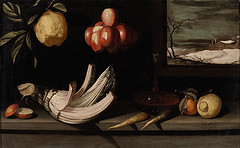
“Some stories are pleasing in themselves,” says one of these dogs of Cervantes, “and others from the manner in which they are told.”  Classical formalism mediates between these two positions, finding an ideal balance between truth and the way of telling it. In seventeenth century Holland, formal art flourished with the development of trompe l’oeil, which delighted in letter-rack paintings and still-lives, showing the humblest of fruit and vegetables – where the quality of the painting itself, the “way of doing it” is the primary issue, the content, if you like, as in the “humble” masterpieces of Adriaen Coorte.

opnamedatum: 2005-11-17

This tradition persists down to the time of Cezanne and then on. But in emphasising the manner of its execution, letter-rack and still life can seem overly concerned with their own genre, and sometimes unrepentantly mannerist. Art informed mainly by sincerity, that boots out porcelain pastorals, elegant arrangements of difficult-to-paint objects and contrived letter-racks – to replace them with down-to-earth peasantry, factory chimneys, brutal portrayals of poverty and how life is may be called ‘realism’.  Cervantes was a realist of the fifteenth century, mocking the nostalgia for courtliness and chivalry, and so indeed was Chaucer’s Wife of Bath, back in the fourteenth.  However, Realism emerged as a considered historical style in the eighteenth century and persisted though the nineteenth century. Its champions include Zola and Courbet, and at first sight it can appear to be the style-less style – diametrically opposed to mannerism – and characterized by a transparency which simply aspires to be the mirror of visual reality – although in historical terms, Realism comes imbued with a commitment to a scientific approach, and a sense of history, and it aspires to convey the ordinary lives of ordinary folk with a breadth of subject matter that studiously precludes the more limited genres of still-life, letter-rack and landscape.  Ironically, it was Realism with its emphasis on authenticity that ushered in Impressionism – ‘how things really struck the eye’ – which in turn led to cubism (via Cezanne) and, ultimately, to the emphasis placed by abstract painters on the material reality of the painted surface, just as abstract writers like Gertrude Stein stressed the material reality of the words on the page.  To sum up this digression:  realism with a small ‘r’ might be thought of as one of the banks of the river of formalism, with mannerism ranged on the opposite shore.

With committed art and trenchant realism, the balance between matter and manner can be shifted to far in favour of matter to be properly formal, but then artificiality of subject can push the slider over to such an aesthetic extreme that the work is far too proper, and becomes mannered rather than a fusion of form with content.  Formalism is poised between artiness and artlessness.  And very often the authentic subject of the formal work resides in a real-enough world, whether that reality be that of some apples spilt from a basket, as in the paintings of Cezanne, or the ennui of life far from Moscow, as in the plays of Chekhov. In public estimation, though, what does happen, when an author or an artist devotes his attention to the power of his medium, is that the content appears to grow correspondingly innocuous:  harmless, not hurtful or injurious – quiet, if you like – undramatic.  This may lead the spectator to scratch his head.  We all know that art can provoke scandal by serving up the scandalous: De Sade, the ‘divine Marquis’ constructing some novelistic Versailles of debauchery, Nijinsky seemingly masturbating on the scarf at the first performance of L’après midi d’un Faune or Duchamp exhibiting his urinal at the Armoury show.  But it may be that just as these bold arts of subversion and sabotage horrify innocuous people who simply want to get on with their harmless lives, so innocuous formal art scandalises bespattered saboteurs eager to witness great annoyances!  In point of fact, it doesn’t seem to work this way.  Carl André’s innocuous, but very formal, arrangements of bricks appear to have annoyed a fair number of respectably innocuous persons.  Very quiet art provokes just as much annoyance as very loud art.

In philosophical terms, quietness or emptiness in art has often seemed a matter not of vacancy but of depth.  When content, especially dramatic or figurative content, is removed, one is not left with nothing, nor is one left with nothing when the ‘human element’ is of minimal significance.  Rather one is left with an abyss.  The abyss which emerges out of figurative subtraction has sublime consequences which have had an effect on the history of abstract art.  Kant perceived that the imagination could experience release by the removal of the limitations imposed by figuration.  He saw abstraction as a ‘presentation of the infinite’ – (see Grandeur).  This notion informs the work of abstract artists from Malevich to Rothko, most of whom are formalists, though Rothko’s work has grandeur in it too.  The emancipation from figurative (or, in literature, narrative) constraint releases an intense enthusiasm which might have become fanatical or obsessive had it been prompted by some specific religious belief or fetishistic image.  In abstract guise however, it’s an enthusiasm which generates what may amount to a marriage of beauty and sublimity – harmonious form wedded to ineffable content.  However it is a union often brought about not by an advocation of the sublime, as with Kandinsky, for instance, but rather by a species of objectivity.  Here the artist follows Wittgenstein’s lead and eschews the metaphysics of Kant, Schlegel and the Romantics.  With pragmatic objectivity, Ad Reinhardt sees abstract modernism as a chance to emancipate the arts from each other, not as an excuse to produce the all-embracing organon.  This advocation of separatism is opposed to Aristotle’s dictum that all the arts aspire to the condition of theatre.  As we have noted, quietism is undramatic.  In visual art, it represents a down-to-earth concentration, a formal concentration, on the concrete properties of paint, line and shape, well exemplified by the work of Kenneth Martin.

*        *        *        *

But this is leaping ahead, before we progress too far in the art of painting, let us first go deeper into the innocuous tendency as it has affected poetry.  Quietism precedes formalism in the development of this medium, but there has always been a formal side to poetry in all literatures – indeed the rise of the ‘prose-poem’ in nineteenth century France was the result of an urge to emancipate poetic writing from metrical strictures which had become increasingly formulaic since the days of the Pléiade: that circle of poets in the sixteenth century whose verse reflected their veneration for the metres of antiquity.  Within antiquity itself, the pastoral lyrics of the Greeks, the Georgics of Virgil – with their measured descriptions of agricultural practices – constitute precursors in Europe, while the poetry of Li Po and Tu Fu indicates the strong vein of quietism which has always characterised Chinese poetry.  

Quietism has its roots in the idyllic pastorals of the Greek poet Theocritus, writing in the third century BC, and, later, in the Georgics of Virgil, which deal with agricultural subject-matter – stock raising and bee keeping – it’s a versified manual of husbandry: the inspiration for the peculiar Books of Good Husbandry (a translation from someone called Heresbachius) made in the 16th century by Barnabe Googe.  For me, the first person to write consciously quiet but intensely absorbing poetry in the West, was Statius, a professional poet of Greek extraction, who flourished in Rome between 48 and 96 AD.  His thirty-two Silvae were admired by Dante and Petrarch:  they constitute the best classical example of ‘occasional verse’ – that is, verse written for a patron or commissioned for an occasion such as a wedding (an ‘epithalamium’) or a death (an ‘epicedion’).  He also wrote poems on such humdrum subjects as country houses and private swimming pools – poems which are so meticulously descriptive that they are still referred to by architectural historians.  Ostensibly, he improvised these verses, when moved to pronounce them at a banquet given by a patron, and though this suggests a certain loose expressionism, this is never the case.  The emotions are expressed with tasteful dignity, and the poems actually obey exacting rules of metre, and of prefatory and concluding rhetoric, while the blandness of his subject-matter enables the reader to concentrate on the precision of his language and the aptness of each phrase.  But it needs to be reiterated that Statius is consciously quiet.  He is well aware how stylish he is.  Sometimes the syntax becomes almost willfully elaborate, and a poem may revel in mythical reference, piling these references on in a mannerist way that takes Statius beyond the standard classicism that had ensued in Rome after the death of Virgil.  So Statius is a ‘silver’ poet – rather than a poet of the ‘golden’ age, and this disqualifies him as a pure formalist.  Mannerism might be defined as an exaggerated deference to form; structure affected by caprice!

The poetry of Statius was nevertheless an influence on the first quietist in British poetry, William Drummond of Hawthornden (1585-1649), a Scot who was a friend of Ben Jonson.  It is high time that his poetry was re-evaluated, since in many ways it is revolutionary, considering the date when it was written; the sentiments expressed seeming closer to those of Keats, who was influenced by him, than to the metaphysical struggles of John Donne.  Drummond’s sonnet on sleep is very nearly a translation of a poem on the same subject by Statius:

    Sleep, Silence’ child, sweet father of soft rest,

Prince, whose approach peace to all mortals brings,

Indifferent host to shepherds and to kings,

Sole comforter of minds with grief opprest;

Lo, by thy charming rod all breathing things

Lie slumb’ring, with forgetfulness possest,

And yet o’er me to spread thy drowsy wings

Thou spares, alas!  who cannot be thy guest.

Since I am thine, O come, but with that face

To inward light which thou art wont to show,

With feigned solace ease a true-felt woe;

Or if, deaf god, thou do deny that grace,

Come as thou wilt, and what thou wilt bequeath,

I long to kiss the image of my death.

Note how the rhymes of the first quatrain are carried over into the second quatrain, emphasizing the musicality of the form.

Quietism continues as a largely unacknowledged stream in English poetry, but it gives us The Seasons, a long descriptive poem in four parts by James Thomson, inspired by the ‘immortal honey’ of Virgil’s Georgics.  The first collected edition of The Seasons was in 1730, so it was published right in the middle of the Augustan Age, whose baroque grandeurs, satires and philosophical tours de force, were not to Thomson’s taste.   His matter is simply the changes annually affecting the landscape, and these changes are conveyed with an unsurpassed attention to detail wonderfully sculpted into the requirements of his metre.  This is not to say that grandeur cannot be found in The Seasons, but it is natural and unaffected – the description of a wintry storm – or the all-embracing scope of the project itself.  The editor to the Oxford University Press edition of his works tells us that Thomson “cherished a passion for correcting and improving.  As long as he lived, and had the leisure (he never wanted the inclination), he was revising and altering.  He added and he modified, withdrew and restored, condensed and expanded, substituted and inverted, distributed and transferred.” 

Just such an urge to improve the work – engaging in it with the ardour of fetishism – distinguishes the practice of others working in a similar vein.  Take the French ‘rule-omaniac’ Raymond Roussel (1877-1933), whose poem called La Vue – published in 1904 to complete critical indifference – is reminiscent of The Seasons.  Roussel felt obliged to abandon several other poetic projects, ultimately; because the task of polishing the verse would have taken up several lifetimes.  Roussel’s concept of literary beauty was that the work should “contain nothing real, no observations on the world or the mind, nothing but completely imaginary combinations: these are already the ideas of an extra-human world.” The quote is from Dr. Pierre Janet’s observations of the author, pp. 175-183: The Psychological Characteristics of Ecstasy, in his book, De L’Angoisse a l’Exstase.  Perhaps this vaunted artificiality of subject matter should  disqualify Roussel.  Admittedly, in his elaborately contrived novels, his tendency is more mannerist than formalist.  Nevertheless, La Vue contains concise descriptions of an everyday scene on a real-enough beach.  The quite innocuous subject-matter is represented as a frozen moment caught in a tiny photograph mounted on a pen-holder that you can only see if you bend so close that the eye-lash brushes the surface of the photograph itself.  A boy is about to throw a stick for a dog and the dog is leaping up at him.  Roussel then goes on to describe every person and thing on the beach, returning, hundreds of lines later, to the boy, still in the act of throwing the stick.   His concern seems purely formal and his scansion is meticulous, but one might argue that his form is being put to an inappropriate use, since what we have here is really ‘a picture within a poem’.

Quietism informs the work of William Wordsworth, in the Romantic Era, and indeed amounts to a philosophy of stoicism and resolute inactivity – although his verse can also achieve a transcendental grandeur.  But in general quietism deals with the humdrum and the ordinary rather than with great romantic visions or subjective aspirations for the Absolute.  It makes objectivity its summum bonum, and humbly reiterates its small, downbeat mercies.  Thus it provides us with a masterpiece in Amours de Voyage by Arthur Hugh Clough, written in 1849, which deals with the letters of young people as they go flitting about Europe.  This is a poem of yearnings and ennui. Conceived as a series of letters in verse, it conveys little beyond the airy meanderings of conversational observation, which, however, it does with consummate wizardry, for it’s a pleasure to read the extended line the poet employs and to realise how skilfully he fits the epistolatory small talk of his butterfly characters into it.  In formal terms, the poem is devoted to this extended line, and to a need for lightness in its usage, so the lightness in the content is a product of this formal concern.

“Now supposing the French or the Neapolitan soldier

Should by some evil chance come exploring the Maison Serny

(Where the family English are all to assemble for safety),

Am I prepared to lay down my life for the British female?

Really, who knows? One has bowed and talked, till, little by little,

All the natural heat has escaped of the chivalrous spirit.

Oh, one conformed, of course; but one doesn’t die for good manners,

Stab or shoot, or be shot, by way of a graceful attention.

No, if it should be at all, it should be on the barricades there;

Should I incarnadine ever this inky pacifical finger,

Sooner far should it be for this vapour of Italy’s freedom,

Sooner far by the side of the d*d and dirty plebeians.

Ah, for a child in the street I could strike; for the full-blown lady-

Somehow, Eustace, alas! I have not felt the vocation.”

(Arthur Hugh Clough, Poems, p. 189)

In the twentieth century, this wry tendency towards the innocuous operates in the novels of Italo Svevo, Henry Green and Barbara Pym; in the experiments of Stéphane Mallarmé, in France; and in the poetry of William Carlos Williams:

THIS IS JUST TO SAY

x

I have eaten

the plums

that were in

the icebox

x

and which

you were probably

saving

for breakfast

x

Forgive me

they were delicious

so sweet

and so cold

(W. C. Williams, Collected Poems, p 187)

Quietism also comes into operation in certain poems by Laura Riding, and in the work of F.T. Prince and his admirer, John Ashbery.  With each of these authors, the subject matter often seems to be chosen for its lack of significance.  There is no political dimension, no emphatic moral promulgated by their writing.  But it is this very absence of import which allows us to appreciate the smoke-rings of language blown onto the page by Mallarmé, the dry wit of Svevo, the perfectly turned sentences of Green, the poetry within the prose of Pym, the spaced simplicity of Williams, the combinations of vocables in Riding, and the mastery of syntax and rhetoric that we find in the verse of Prince and Ashbery.  In all cases, the politics resides in the structure – form constitutes message.  Here is a poem called Proximity from a collection by Ashbery:

“It was great to see you the other day

at the carnival. My enchiladas were delicious,

and I hope that yours were too.

I wanted to fulfil your dream of me

in some suitable way. Giving away my new gloves,

for instance, or putting a box around all that’s wrong with us.

But these gutta-percha lamps do not whisper on our behalf.

Now sometimes in the evenings, I am lonely

with dread.  A rambunctious wind fills the pine

at my doorstep, the woodbine is enchanted,

and I must be off before the clock strikes

whatever hour it is intent on.

Do not leave me in this wilderness!

Or, if you do, pay me to stay behind.”

(John Ashbery, Wakefulness)

This poem is a masterpiece of mood: its syntax rises and falls.  It begins with words evocative of humour and excitement (carnival, enchiladas), trails into mournfulness and then the word rambunctious enters the poem as a threat in itself, unsettling the poem, which ends with a request as cold as a divorce settlement.  Yet this is all done by the words rather than through them, that is to say that the words do not signify some clear narrative or convey a sense of a specific image.  Formal properties, or the properties of the medium itself (in this case language), become topics for consideration whenever the creative instigator ceases to be concerned with what can be got across through the medium.  Through is the preposition apposite to the obligation to conceive of the medium as transparent, to be looked through, as through a window; the viewer intent on the content revealed.  Instead, the artist or writer concerned with form may focus attention on what the medium can do – in this case on what a word like rambunctious can ‘do’.  Of course the quietude of formalism, its constraint, is not something that can only be achieved through abstraction, and indeed the poem quoted above becomes less abstract the more you read it – and one finds oneself drawn in to its quietly melancholy subject.  

Italo Svevo and Barbara Pym are not in the least abstract:  they are both writers who accept the convention of narrative, just as did Clough.  The poetry of F.T. Prince alludes to specific subject-matter.  The quietist grouping concerns practitioners on both sides of the abstract/figurative or abstract/narrative divide.  What defines the grouping is their willingness to work within formal constraints – to concentrate on a genre, or to engage only in small-talk, or to make syntax their chief concern.

The British poet J. H. Prynne writes with such density of meaning that his poetry may be read as abstraction – and substituting figuration for narrative, much the same could be said of paintings of Auerbach.  In point of fact, Prynne refuses to constrain himself solely to the abstract, and a poem such as One way at any time is clearly narrative though it seems shorn of significance – a scene in a cafe described simply for the exercise of describing the variety of languages converging there – from ‘yokel talk’ to the ‘truly common’ dialect of a lorry’s rumbling to the language of gesture “an urban, movie-style flick of a nod”.  Other poems seem more removed from description, and more preoccupied with the metonymy of the words employed, though “the ghost of a meaning” can usually be detected.  But all of them are distinguished by a certain formal ordering: a taut rhythm structure and in many cases an almost regular verse-form.  Very often these verses lend the poems a closure which seems contradictory to their removal from simple narrative.  Take this passage from Rich in Vitamin C:

Under her brow the snowy wing-case

delivers truly the surprise

of days which slide under sunlight

past loose glass in the door

into the reflection of honour spread

through the incomplete, the trusted. So

darkly the stain skips as a livery

of your pause like an apple pip,

the baltic loved one who sleeps.

 x

Or as syrup in a cloud, down below in

the cup, you excuse each folded

cry of the finch’s wit, this flush

scattered over our slant of the

xxxday rocked in water, you say

xxxxxxthis much….

(J. H. Prynne, Poems, p. 188)

*       *        *        *

But it’s not so common for the formalist novel to engage in abstraction.  The evolution of the novel is very much bound up with the impetus towards realism that informed the work of Cervantes and increased during the enlightenment.  Fielding, Smollett, Austen, Trollope and Dickens are all engaged in negotiating reality.  However, Flaubert is a realist who inclines towards formalism, or vice versa, as is Goncharov.  Very often, when seeking out the subject appropriate to the medium, the novelist who is taken up with questions of form will turn away from adventure, abandon the notion of a stirring tale.  An exciting sequence of actions may detract from the sense of the way sentences are made and paragraphs unfold.  Instead, these novelists select characters notable for their inertia – Gonacharov’s Oblomov, for instance, who seldom gets out of his dressing-gown, or Flaubert’s Madame Bovary, who suffers terribly from boredom.  Inertia translates as ennui.  Then, again, reality may be defined rather than described, and this gives rise to the philosophical novel, which is much favoured by those with formal concerns.  Such a novel is Goethe’s Elective Affinities, in which nothing much happens.  The main characters are principally engaged in working with an architect to improve and extend their residence.  A formula is posited, related to the “Laws of Attraction”, a formula similar to the law of strong interaction which states that particles must maintain a distance in order to attract each other.  Goethe’s idea is that should couple AB encounter couple CD, A and C will be attracted to each other, and B and D will be attracted to each other, since strangeness is more fascinating than familiarity.  Taken up with her somewhat wistful thoughts along these lines, a young woman absent-mindedly allows a child to drown. 

This death disturbs the surface of the novel’s quietness, and in truth it is hard to come across the ‘purely quiet’ novel in quite the same way that a painting can be still.  After all, the form of the novel requires that the end should act as a lure, impelling the reader forwards, albeit ever so gently.  This creates a problem, for while a short poem may be enjoyed for the magic it generates in a line, such localised appreciation is at odds with the urge to read on.  In Loving, Henry Green can write about taking tea with buttered crumpets in such an exquisite way that one returns to the few sentences that deal with this episode again and again, and may lose any desire to get to the end of the book.  Readers may arrive at a similar impasse when reading the stories of Jane Bowles, or her one novel – Two Serious Ladies.  The narrative in any of these may set out quietly enough, but is often subject to disconcerting changes of direction, while the sentences that carry it seem to be fitted together in an unusual way, though the tone is pretty dead-pan.  It’s not that the sentences are artificial or overwrought: they follow each other naturally enough, but there’s never a cliche, and each sentence reads like a discovery, while the characters themselves are prone to capricious changes of mood.

If the writing of Jane Bowles mingles formalism with caprice, then the marvellous stories and novellas of Adolfo Bioy Casares adulterate their formal strength with a strong dose of the uncanny.  Much the same could be said for the uncanny writing of Gustav Meyrink, for his great novel The Golem is clearly the work of an author preoccupied by the form in which he was working.  Bioy Casares, however, is similar to Jane Bowles, in that he identifies surprise as an essential ingredient in writing; yet at the same time he acknowledges a force that contradicts the inconsistency generated by arbitrary inclusions and capricious twists and turns.  These two forces moving in opposed directions echo the conflict in any reader teetering between wanting to re-read a perfectly constructed paragraph and wanting to finish the book.  But then, with a really good book, one has no wish to get to the end.

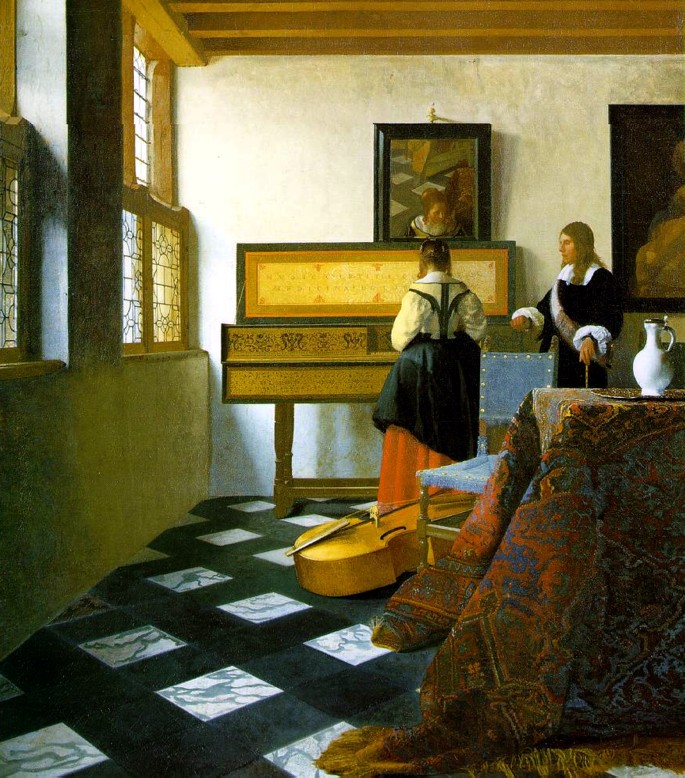
This brings me to an important element in the formal novel, which is, the power of delay. Just as Vermeer – very much a formalist painter – may deliberately delay the line of perspective leading the eye from foreground to background by interrupting it with blemishes such as the chips along the edges of a window-ledge, so the formal novelist understands that delay is of the essence: it is not so much a matter of what happens as a matter of how long can you put off it happening.  Oblamov puts everything off:  commitments, assignations.  In formally inclined romances, vacillation is the name of the game.

The Invention of Morel, by Bioy Casares, is a case in point.  Its narrator is trapped in an environment so bizarre that at first one imagines that one is engaged in reading some sort of abstract text that will go on shifting its scenery like a dream, as does surrealist novel Hebdomeros by De Chirico.  This turns out not to be so.  The narrator is a fugitive from justice who has escaped to a remote island furnished with a few strange buildings – a museum, a swimming-pool and a chapel on the high ground, a mill somewhere in the lowland marshes that get flooded at regular intervals.  We learn as much in the first few paragraphs of the novel, and for a while one senses that these paragraphs are simply repeating themselves, each time expanding on their content but allowing little to transpire.  Even in the first short section of the book we have been apprised of the fact that visitors have arrived on the island, and the rest of the book is taken up with who these visitors are and how the fugitive comes to terms with them.  Initially he hides from them, only to discover that they have no inclination to acknowledge his existence.  His predicament strikes me as being similar to that of a camera that has somehow developed its own conscious awareness while observing the actions of characters who feign not to recognise its existence.  Ingeniously, the author delays our discovery of the reason for this lack of acknowledgement – but it would be a shame to spoil the reader’s enjoyment of this brilliant novella by giving away any more of the plot.  Suffice it to say, that in this novel, delay conspires with repetition to create an astounding work of the imagination.

*        *        *        *

If we take up our theme of quietism again and apply it now more thoroughly to visual art, it will become clear that it pervades the content of much that is formal in painting – landscapes, still-lives and geometrical abstraction in particular.  While not falling into the mannerist trap – of espousing an artificially contrived content – formalism chooses to work with humble matter – a back-yard, a Meerschaum pipe, the simple fact of a colour or a shape – but this is because that content is only the ostensible subject, as the more genuine subject is a concern with some ordering of the surface and with the texture of that surface.  In figurative work, this retreat from significance may announce a world of reflections in crystal, or in fruit-segments, or reveal a preoccupation with geometrically considered interiors and narrowly defined genre scenes, though the Renaissance precursors of formalism – Piero della Franscesca and Uccello in particular – sometimes dealt with more obviously exciting subjects such as battles and prancing horses.  Nevertheless, there is a drawing of a vase by Uccello which passionately invests the study of perspective with the accuracy which we may expect from work inspired by contemporary design draftings – Richard Hamilton’s car-tire drawings for instance.

The objective formalism of the seventeenth century is epitomised by the Harlem painter, Pieter Saenredam.  This artist had no time for the enthusiasms of Catholicism.  Denying himself such transcendental visions as enabled his baroque counterparts to see up the skirts of floating choirs, he concentrated on the bricks and mortar which held up the religious structures he favoured.  So he came to specialise in church interiors, often rendered in shades of white punctuated by the occasional diamond shape of a shield on a pillar.  He made elaborate preparatory drawings, including fully worked out perspectival projections and diagrams.  Just one of his meticulous drawings could take six days to complete.  The accuracy with which he recorded these churches has few parallels in the history of art, yet what are we meant to get out of a subject as vacant as his View across the choir of the St. Bavokerk, Haarlem, which is in London’s National Gallery?

medium_saenredam_grote_kerk_haarlem

In the first place, the ‘vacancy’ is merely an appearance.  The artist’s eschewal of Catholic pomp and circumstance was a belief held with some intensity.  Miracles and angelic creatures were simplistic notions of the divine emphasising the extra-terrestial quality of an obsolete propaganda.  The natural laws were miraculous in themselves, the scientific basis of the universe an adequate reason to believe in God.  There was no need to clothe reality in fantastic raiment.  Reality was worthy of its maker.

Returning to the picture under discussion, we could embark on a more perverse reading.  The interior is a tall, sparsely furnished edifice, from which all Popish imagery has been removed.  Three massive pillars in the foreground utterly dwarf the few figures inhabiting the space, and since these pillars are brought very close to the surface of the painting, their weighty bases very nearly sitting on the bottom edge of the canvas, they serve to emphasise the building at the expense of the people in it – seemingly emptying the picture of any human interest whatsoever.  But now notice how the somewhat awkward view chosen begins to affect your gaze.  You are not looking through the three columns in any symmetrical way.  You are looking directly through the gap between the middle column and its neighbour on the left of the picture and only obliquely through the gap between that middle column and its neighbour on the right.  If you extend the geometry of the picture forward and out of its frame, you can find out exactly where you are standing, by computing where your direct line of sight will bisect the oblique line.  Thus you are standing at some distance from those pillars, as you can today, directly in front of the chapel beyond the central nave of Saint Baro’s church.  And what you may have noticed is that the little dog belonging to the toddler sitting among her baskets at the foot of the middle pillar has run away from her and is sniffing suspiciously at the dark figure of the preacher; whose shadowy front is hidden by the wooden pulpit directly in front of the little girl.   This unorthodox moment is emphasised by the comparative normality of the distant group of church-goers we perceive at the far end of our oblique line of sight, out of the corner of our eye, to the right.

Reading the tensions in the little figures contrives to give this formalist work an almost immoralist interpretation.  But apparently these figures were added to the painting at a later date, possibly to render the work more saleable!  Thus the immoralist reading is spurious, so far as Saenredam and his intentions are concerned. Yet in some way, the sheer innocuousness of formalism seems to attract such perverse additions and corrupt glosses.  Many will persist in seeing the slash which comprises some concetto spaziale by Lucio Fontana as a vaginal image for instance. Perhaps this desire to discover lurid content is inadvertently generated by the formal concerns of an artist: what you can see from here is what may be hidden from there.  Formalism purports to keep the lid on the perversities of content, but are we not sometimes impelled to peek beneath the lid at some hidden agenda?  Don’t illicit thoughts rush in to fill the vacuum created by content’s removal?  One of the effects of a constrained impetus may be that a concentration on structural qualities is capable of unearthing deeper and darker meanings than it might be plausible to consider within the context of appropriate content.  Indeed formal manoeuvres can operate as a lever, the long handle of the spade which carries out the job of psychological excavation – unearthing a content the conscious mind may resist.

Let us meditate here on the nature of what might be termed ‘the artistic oxymoron’, that is, on the fulfilment to be got from emptying oneself.  To be rid, at last, of one’s burden, or meaning, in creative terms, is to be liberated from imposed messages, obligations to one’s social roots, to one’s obsessions, or to the force of one’s will.  To let go of such content allows the subjective demand that stains judgement to be put aside so that the creative spirit can move forward with an impartial love; a love simply for the medium which has so often rewarded that spirit with engrossment; when the artist moves deeper into mysteries of process, oblivious to the self and consciousness.  This impartial joy in creativity, divested of extrinsic motive, is one of the rivers of art-making which has flowed through humanity since time immemorial, producing the Greek Kuoroi, and Dutch landscape painting, and the flower paintings of Fantin-Latour, as well as the minimal work of the nineteen-seventies.

An impartial delight in the interiors of chilly apartments is manifested in the work of the Danish artist Hammershoi, who was working towards the end of the nineteenth century.  His characteristic subject seems to be absence itself.  The whiteness of generally empty rooms, the way one door way opens to reveal another, the thin rectangle of light that we see when a door is slightly ajar, and the light itself a thin, Scandinavian light.  Small flaws in the architrave get meticulously recorded.  If there is a figure, the head is, as often as not, turned away and the body becomes a shape; a presence, yes, but a presence without physiognomy – though the back we see may ‘speak volumes’.  We become fascinated by the sheen of the polish reflecting what light there is on a circular table.  About his paintings, there is this feeling of rectitude, a rectitude more aesthetic than moral.   Each work is painted just as it should be.  The atmosphere in each interior is focussed on with an intensity which increases in our perception as we wander from work to work, but there is none of the violence of Van Gogh, no desire to promote some “shock of the new”.

Hammershoi sunbeamssmall2

*        *        *        *

In fact, very often, the quietist impulse in formalism reads as a betrayal of the avant-garde.  The artists who engage in it seem like throw-backs.  Svevo’s prose, for instance, is far less obviously innovative than his friend James Joyce’s.  If excessive in any way at all, Svevo’s narratives are excessively normal.  The originality of his novels – The Confessions of Zeno and As a Man Grows Older – resides in their inimitably dry tone, in the general debunking of high romance, in the deadpan nature of the author’s wit and in the psycho-analytical strategies which all to often impel the main character to do the opposite of what he has set out to do.  Action is so delayed that inaction and anti-climax end up being substituted for dramatic tension.  The writing is deeply ironic, even failure being seen as a species of strength which often carries the day.

Or take the quietist paintings of Otto Müller.  Often these are of emaciated nudes in natural surroundings.  Müller was a member of the expressionist group called the Brücke, but his skinny gypsies are rendered in a manner which is not in the least violent.  You could say that he betrayed expressionism and substituted suppressionism for it.  But in my view, suppression is at the heart of a formal concern.  Formalism proceeds by negation, what you leave out is more important than what you include.  Once you have established what is to be left out, what remains may well look after itself.  Müller’s work is intensely languid. It recalls the ‘Sumatrism’ of the Serbian writer Milos Crnjanski, a longing for far-awayness – though Müller did actually spend some years in the Far East, and was married to an Oriental woman.  The angles of the limbs find echoes in the angles of the branches of trees.  There is a bleak idealism about the paintings, the subjects seem underfed yet in paradise, inhabitants of a sad Utopia.

Otto-Müller-Two-Female-Nudes-in-a-Landscape-Two-Female-Nudes-in-a-Landscape

The portraits of Gwen John achieve an intensity often lacking in the work of her more celebrated brother Augustus.  She’s another exemplary quietist, and there’s an intriguing, dry ‘overallishness’ to the material surface of her canvases.

convalescent-gwen-john-1924

Speaking of Chardin, whom he admired, Giorgio Morandi emphasised “that quality known as matière” – the painted skin of the work.  Quiet formalists are generally obsessed by the paint, about finding some integrity to the composition of its matter on the canvas – a unique, personal density that informs every inch of its application.  This is very much the concern of Robert Ryman, whose white surfaces are all studies in such densities – for he has left out colour in order to concentrate on this issue of matière, and on the rich variety of ways that paint can be applied.  For the quietist, the paint of Rubens is too oily: its glossy, wet slipperiness suggests an adjectival excess, while the varnished finish is exaggeratedly lavish.  Rembrandt ends too thick, Courbet scumbles overmuch.  Formalist writers share such concerns and can level similar criticisms:  Shakespeare is too prolix, Conrad never manages to grasp the niceties of the English language, Joyce makes lazy sentences, substituting quantity for quality. The formalist writer may compare the verbal surface of poetry or prose to density of grain in different types of wood.  The compact density of ebony, the solid consistency of oak, the attractive grain in ash or maple – these may be contrasted to the looseness of deal.  The grain of deal is ubiquitous and uninteresting, yet, because it’s a soft wood, you can build elaborate structures with it easily enough – but these remain inveterately flimsy.  The humble structure perfectly fashioned out of oak has more integrity, more innate strength.  By their choices, contemporary readers demonstrate how little they appreciate the grain.

morandi_natura morta 3

Albert Marquet began as a Fauve, showing his work in the Paris exhibition of 1905, but this was a misleading debut.  He developed into an out-of-date impressionist, and until 1947, when he died, he was painting impressionist canvases.  Bear in mind that Degas died in 1917 – which makes Marquet a throwback by more than a few decades.  Yet his paintings have a quality possessed by no other artist of this movement.  He makes his own a species of limpidity.  The serene light, and the sense of depth that he manages to convey through his representations of sea and sky have never been rivalled.  In a sense, he paints the air.  As much as he may be a latter-day impressionist, he is also a precursor of minimalism since the views that become the subject matter of his canvases undergo a pruning – only the most necessary lines and shapes are retained.  Perhaps this makes him a reductionist rather than a minimalist, since he proceeds from the complex to the simple, whereas the average minimalist begins and ends with simplicity.

Marquetimages (1)

Marquet’s paintings operate under a strict economy, as if he were refining some exegesis of the formal concerns broached by the impressionist precedent.  His backsliding into impressionism was not a problem for his friend Henri Matisse, any more than the figurative (and quietist) conservatism of that fine painterly realist Fairfield Porter was a problem for his friend De Kooning – despite the difference in their styles, Porter helped instigate an interest in De Kooning and was a life-long admirer of his work.

moma-the-collection-fairfield-porter-flowers-by-the-sea-1965-1368145126_b

In his essay Redemption through Painting: Late Works of Morandi, Kenneth Baker wrote astutely about one of the most private of all painters, a painter whose initial metaphysical style was developed some eleven years after the demise of the Metaphysical movement in painting pioneered by Carra and De Chirico.    Thus Morandi can be dubbed a latter-day metaphysical painter; one who devoted his career to flower compositions, landscapes, and, in particular, to still-lives which deal repeatedly with common objects; vases, tins and beakers used over and over again.  However, Morandi’s pictures of these rather drab objects in a variety of groupings are only superficially similar to each other.  Working within the limitation of these still-lives, the artist executed every sort of painting: loose, extravagant treatments of his subject; romantic, lyrical ones; neatly etched classical ones; groups which make manifest their metaphysical origins – since they remind one of the collections of tailor’s dummies and mathematical instruments in the works of De Chirico.

In later years, Morandi made still-lives which seem more abstracted, where the little boxes and obscure containers seem ‘re-made’ in paint, recreated rather than merely represented. There are others where one vase may camouflage the contours of another – suggesting the ambiguity of appearances or relationships in collections of things that suggest families grouped together for photographs.  Other arrangements of objects may remind one of villages, or streets overlooked by apartments.  But one cannot always ‘humanise’ these still-lives through their affinities, for sometimes the group gets blocked together to form a cube of solids residing below the horizon line of the table’s edge – emphasising purely formal qualities.  Baker observes of this work:

“Its lack of obviously confrontational aspects causes some people to regard Morandi’s painting as a largely decorative or formal achievement.  This view ignores the exemplary character of Morandi’s art.  Every painter’s work is in fact a record of his use of time, and of a continually renewed commitment to the activity of painting.”

(Kenneth Baker, Redemption through Painting)

He goes on:

“Morandi’s art is proof that a man gave his time to painting.  It reiterates his choice of painting, practised as a discipline, to fill his days.”

Here the dedication to the activity becomes its very content, for when an art empties itself of matter which goes beyond the concerns of form a vacuum is caused, and, since we seek for meaning, meaning comes to fill this formal void.   As Kenneth Baker puts it, earlier in the same essay:

“Meaning results from our activity as well as from the artist’s.  While the artist is wholly responsible for the physical art object, we may make meaning from our experience of an artist’s work, even if he consciously intended none.  We usually assume that meaning is one ingredient of a painting, but the reverse is closer to the truth.  In making a painting, the artist lays a basis for meaning.  He or we can then construct meaning on this basis by giving an account of what we see, and of what we feel and think in response.  In the absence of such mindful activity on someone’s part, any work of art will be without meaning.  Physical objects persist in themselves, but meaning must be sustained by people to whom it matters:  it must be embodied to be real.  In speaking of paintings as if they contained meaning, we try to see them as its embodiment, try to project onto them our share of responsibility for the sense of what we see.  To speak and think in such terms is really to treat paintings as emblems of the meaning-making activity we are usually to hasty, lazy, or inhibited to perform.”

But art can stimulate in us a search for some message better than it can foist a message upon us.  Consider the fecund emptiness of Edward Hopper’s “Sun in an Empty Room”.

Hopper sun in empty room

Where there is a lack reiterated, the stimulus to seek to assuage it may gain in strength. This is readily felt when one comes across the paintings of Algernon Newton (1880-1968)..   

Known as the “Canaletto of the canals” – canals of North London, that is, there is an enigmatic vacancy to be found in Newton’s work: an empty field or two between trees, a simple house in Kentish Town. Dismissed as “peculiar” in his time, his work is steadily gaining status. It is as if a vacuum were created, in some of his finest work, which it seems our nature to fill, as there is in the art of Morandi and other quietists.

On the other hand, we may feel some coherent message as imposition.  This is where the politics resides in the structure.  However radical the message, if it is put to us too stridently it becomes imperious by its insistence.  For message-laden art is phallic in the sense that it projects the stiff authority of its meaning onto the passive recipient.  Often spectacular rather than dialogue-provoking, it usually demands little from its audience, beyond the endorsement of its message.  The emphatically issue-laden and committed art that gets foisted upon us from time to time by the Savanarola-tendency’ among academics, is populist rather than radical, for it is actually the staple fare of mass-culture and the entertainment industry.  Mass-culture invariably beats out a message, even if this is as banal as ‘Crime doesn’t pay’ or ‘Breaking up is hard to do’.  When the tax-payer’s bemusement is cited as a reason for cutting grants to artists or as the basis of a demand that the work should become more explicable, available and comprehensible, we are usually listening to some veiled justification for the banalities of mass-culture.  If we abdicate from the activity of seeking meaning and making it for ourselves out of the art we explore, we rapidly transmogrify into mass-culture’s passive objects; lolling open before it, our poor, dulled consciousness abused by its stridencies. 

*        *        *        *

More often than not, an avowed meaning will demand an onwards-rolling structure, a firmly advancing narrative – for meaning requires development.  Repetition, which is much favoured by formalists, either in the work itself or from work to work, usually calls such development into question, substituting for it an intensification of its preoccupations.   Gertrude Stein delighted in repetition when writing her abstract and near-abstract texts.  Formalist art in the latter part of the twentieth century has increasingly concerned itself not only with a reiteration of its own issues and an adept use of delay, but also with repetition for its own sake.

Alain Resnais and Alain Robbe-Grillet made sensational use of repetition’s capacity to generate filmic rhythm in L’Année dernière à Marienbad (1961) – as Robbe-Grillet already had in his nouveaux romans.  Both Resnais and Robbe-Grillet were inspired to collaborate on the script for this film by reading The Invention of Morel by Bioy Casares, and it’s fascinating to read this novella in the light of the film and realise how the book changed the course of film history; for Last Year at Marienbad – to give its title in translation – introduced the notion of a film in which nothing much happens, brilliantly exploited later by Michelangelo Antonioni, the director of L’Aventura.

Marienbadvlcsnap13969

In Marienbad, the use of repetition subjects the viewer to a constant reiteration of the same scenes: views of the baroque palace hotel where the action takes place, a game played with matchsticks, the corridors of the hotel, enigmatic confrontations between characters rigid with formality.  This resonates with a remark by the narrator of The Invention of Morel:

“I felt elated.  I thought I had made this discovery: that there are unexpected, constant repetitions in our behaviour.  The right combination of circumstances had enabled me to observe them.  One seldom has the chance to be a clandestine witness of several talks between the same people.  But scenes are repeated in life, just as they are in the theatre…”

(Bioy Casares, The Invention of Morel, NYRB edition, p. 41)

Little gets resolved in the plot of Marienbad, and it seems no more, and no less, than a fugue in celluloid, revelling in the silvery qualities of a stunning cinematography that takes full advantage of the starkly sculptural properties of black and white projection.  Yet the film has always provoked controversy:  “It’s either some sort of masterpiece or meaningless twaddle,” says The Time Out Film Guide, and less sophisticated commentators have no doubts about which of these it is.   In fact, the film was only developing a discovery of the dynamic qualities of repetition first made by Mondrian with his abstractions which came from his desire to achieve an art of pure plasticity: an art restricted to rectangles alone, since, structurally-speaking, this was the most stable angle, and a pallette restricted to the primary colours, since these were the irreducible elements of colour.  Many modernist buildings of the 1920s seem like the work of Mondrian, but scaled-up, extended into three dimensions and repeating the rectangle everywhere. 

mondrian

Repetition was a formal quality made further use of by Vasarély and Bridget Riley – who discovered its potential for inducing disconcerting optic shifts – while Frank Stella developed the repetition of stripes, ultimately achieving works of considerable grandeur.  Andy Warhol chose a soup-can for his innocuous subject when engaging in a seminal work celebrating the qualities of repetition, which also made a sly reference to supermarket displays.  Many of the minimalists made repetition the mainstay of their art – among them Sol Lewitt, Carl André and Walter de Maria, while minimalist music was pioneered by Steve Reich and Philip Glass: their compositions made use of systemic repetition and permutations that only gradually caused these permutations to deliver a significant change.  Most of these creative practitioners are perceived as emperors without clothes.  “But nothing happens!”  “It’s only stripes!” “Why should we look at mere bricks?”  These are the comments aroused, and one can see from them that the artists stand accused, not of provocation, but of innocuousness.

A play without a plot might seem equally innocuous, yet in Six Characters in Search of an Author (1921), Luigi Pirandello demonstrated that drama could also be seriously stimulating as a form concerned simply with its own issues.  In this play a bemused theatre director is confronted by six characters who interrupt his rehearsal of a play (thus this is also of relevance to the notion of plays within plays).  The characters are searching for some dramatic outcome to their roles, having been discarded by an author.  In order to ‘live’ they need to become the integrated parts in a work of art, since they can have no life other than this, being figments of an imagination, whereas once assembled in a play they might have a chance to live forever.  And yet because unformed, their motives prove immensely difficult to resolve into any unity, beside which, as the director points out, they are in themselves merely roles, with nothing to express and no means of expressing anything anyhow, unless actors step into them and give them body and form.  Pirandello’s play was one of the first examples of an abstract drama.

The quest for newness, or nowness, that modernism provoked, led to the promotion of abstraction in all media.  In dance, for instance, the American choreographer Georges Balanchine pioneered ballets such as Serenade which contain marvellous demonstrations of pattern in the changing configurations of the corps-du-ballet but remain devoid a narrative thread, such as we find in classics like Giselle and Coppelia.  This absence of plot scandalised traditionalist balletomanes.   More recently the American dancer and choreographer Mehmet Sander has created dances as rigorous as the visual permutations of Sol Lewitt by utilising a square wooden frame as the armature for one of his dances – Single Space.  The height of this frame is equal to the height of the performer.  Sander’s dance involves delineating the dimensions of the frame: its diagonals, its bisections, its verticals and horizontals.  At one point in the piece he clings to the upper length of the frame, and then simply drops, keeping his body horizontal as he falls through space, from ceiling to floor.  The piece demands an immense fund of energy.  Sander is HIV positive.  Increasingly, he has found that his creative drive obliges him to remove all direct reference to his condition from his dance work.  To shield himself from the onslaught of disease, he puts himself through a daily training course that takes many hours to complete.  The energy and the strength that he has built up in this way is employed in his dance.  For Sander, the energy is a message in itself.  Nothing else needs spelling out.

http://www.youtube.com/watch?v=d8bWLdIvpmY&feature=share  (Single Space)

Yet contemporary formalism is not a priori abstract.  Much underrated by the art-establishment, and all too often viewed as traitors to the avant-garde, the work of the super-realists – a term which includes certain painterly realists as well as photo-realists – deserves more serious attention than it has generally received.  There are several committed formalists working in this way, among them Philip Pearlstein and Ralph Goings.  As I have said, formalism is a matter of what you leave out.  Just as Ryman abolishes colour in order to focus the attention on handling and matière, so Pearlstein and Goings minimise the emphasis on handling and matière in order to focus on other, equally formal issues.  For Pearlstein, the framing of the image is crucial.  I have heard him described as the first figurative field painter.  His eye sweeps across the surface of the image as if it strove to emulate the dispassionate panning movement of some camera.  Heads may get severed by the edge of the painting, or feet – the very items which are usually the focal points of conventional painting.  Meanwhile mirrors placed within the figured space reflect alternative views of the subjects.  This leads us to read his figurative images in an abstract way, as patterns and parts of patterns rather than as bodies.

With Goings, as with several other photo-realists including John Kacere, Janet Fish and Richard McLean, a key issue is that of the subject.  What subject is appropriate to a bravura exposition of meticulous technique?   This is a preoccupation typical of mannerism as well as a question bound up with the history of illusion.  The meticulous realist understands that the choice of subject is as crucial now as it was to the Dutch masters of the still life.  Objects that gleam are called for, or reflections, or delicate, intricately decorated fabrics, or particulars of the contemporary world, the slight dreck we dismiss – oil-stains on a fore-court, for instance, or crud on a tire.  Goings concentrates on discovering such paintable details in everyday American realities:  pick-up trucks gleaming in the Sacramento sun, the dawn interior of diners, the still-life found on each Formica table-top – ketchup, serviette dispenser, personal creamer carton.  His intention is to deal with his subjects in a way which may look non-interpretive, though of course even such a dead-pan rendition of absolute reality can be read as an interpretation of that reality.  However, it is the void that his non-interpretation opens up, the absence of comment in the style, the absolute lack of expression, its innocuousness, which prompts that perverse contrariety in the viewer which will always seek for meaning, where meaning appears to have been removed, or more to the point, fill the lack this removal exposes with meaning.

In the same period as the minimalists and the super-realists, the medium of film concerned itself with a materialist approach to its subject, in that structural sense of the medium being the principal subject appropriate to it.  Avant-garde film-makers exploited the capabilities of the lens, of the projector and of the projection beam, as parts of the process which could generate possibilities to be looked at in their own right.  Films were made which constituted one continuous magnification of the image (Michael Snow), or which utilized looped film constantly repeating its frames as it winds through the projector (and in the case of Annabel Nicholson through a sewing machine as well, so that the frames became increasingly punctured and finally disintegrated).  Other film-makers, like Stan Brakhage and David Larcher, worked directly onto the frames of their film-stock.  In Line describing a Cone Anthony McCall increasingly delineated a circle with a white line etched into each frame of black celluloid, thus describing a cone in the projection beam and creating a sculpture out of smoky light.  More recent pieces may turn the cone vertical and engage in repetition to create interiors of luminescence.

McCall1069143_519272134810075_85478992_n

Tony Hill and Chris Welsby, constructed armatures to hold the camera and put it through innovative paces.  Often the scene filmed, if there was a scene, was one divested of actors or set – in Michael Snow’s case a bare room with a few windows at its far end was the subject of his exercise in diminishing perspective, while Chris Welsby’s camera pointed at a stream which it was crossing whenever the sun came out, and pointed towards the sun whenever that went behind a cloud.  The history of these experiments is well documented in Materialist Film by Peter Gidal.

When we view the work of Michael Craig-Martin we become very conscious that its content resides in its form.  Craig-Martin is a contemporary of Victor Burgin and Sol Lewitt.  He exploits the conceptual aspect of making art.   His work addresses questions raised by the formal qualities of his medium.  For instance, the issue of gesture and mark-making in painting.  Is the idiosyncrasy of matière, individual expressionism of surface, essential to painterly success?  These artists call this into question.  Burgin was at one time interested in making art which resided in a textual statement.  Lewitt has always been interested in achieving works which utilise the dynamic of minimalism without recourse to some supposed quality in his innate gesture.  His work can be considered as being in contradistinction to that of Robert Ryman, who, as I have said, paints for the most part in white so that every iota of attention can be focused on the gestural rhythm which informs the surface – sometimes as choppy as a Van Gogh, sometimes as smooth as Formica.

Rymanw7

But Burgin, Lewitt and Craig-Martin are opposed to the notion of genius as an ineffable quality, a sort of finger-print of style, unique to the creator, which dispels argument and simply convinces the viewer by its distinction.  It seems to them that such a notion simply pitches us back into the pen-umbra of aesthetic metaphysics.  Lewitt creates recipes for his works – one of these could be a certain number of lines of a specified length and of a specified curvature on a wall of specified size.  Having delivered these instructions to the gallery, Lewitt is happy for the work to be undertaken by an assistant.  In Craig-Martin’s case, it is a matter of urgency that the line in a drawing is not created by his own hand, for the work needs to succeed simply because it is conceptually sound.  Eschewing gesture therefore, Craig-Martin projects line drawings onto the wall.  Both the original drawings and the projections they generate are made with architectural tape which creates a strictly regular line.  Can a painting be achieved without gesture?  Lewitt and Craig-Martin have shown that it can be.  However, Seton Smith reverses this question in photography.   It would seem obvious that no gesture afflicts the quality of a photograph.  Anyone can press the button, and the button is a mechanism which reacts in the same way to everyone who presses it.  But Smith takes hand‑held photographs, and sometimes she feels shaky, or perhaps it is just the slight tremors that pervade existence which cause the doubled edge to the outlines of several of her images.  For her, taking a photograph is as much a gestural act as handling a paintbrush.  The image is seismographic, in a sense; registering how she feels that day ‑ fragile or firm, determined or distracted.

Serious art, aware of its form, and divested of obvious content, offers a more regressive lure than the intrusions of messages imposed upon the medium.  Its apparent void, its innocuousness or lack of meaning is a vacuum the consciousness is expected to fill.  The work is a stimulus to our ability to generate meaning.  It is designed to arouse us, to entice us into this meaning-making activity, so that we have some intercourse with art, as we attempt to penetrate its mysteries.  Such a void is wonderfully demonstrated in the work of the seventeenth century painter Claude Lorraine, whose work combines quietism with grandeur.  His paintings resemble stages where the actors take second place to the set and its backdrop.  Tiny figures retire into the tall trees which constitute the wings of his proscenium-frame.  The eye is led away from them into the distance that beckons the gaze to follow it over the horizon into the unknown land beyond.  Claude was orphaned young, and left France, his native land, to serve as an apprentice pastry cook with his uncle in Italy.  The emphasis in his paintings for a land beyond the country depicted suggests his own home-sickness and nostalgia for his childhood.

Claude_Lorrain_-_Landscape_with_Aeneas_at_Delos_-_WGA05015

Lacan has said that we “lay down our gaze” in front of a painting, in that we substitute the painter’s view for our own.  I think the situation is more complex.  With a formal work that presents us with species of vacancy that amounts to an absence, that absence acts as a lure, and our gaze rushes in to fill the vacuum of meaning with our own reading.  Thus our gaze is actually activated by such a picture.  The void created by the paintings of Claude allows my imagination (and my gaze) this exercise.  However, the strident impact of an advertisement does indeed demand that I lay down my gaze.  But this, along with the continuously exciting feature-film which thrusts its message at me may prove far less memorable than some ‘regressive’ painting by Claude.    Perceived this way, the demand that art should deliver its meaning in some immediate way becomes a heavy-handed, chauvinistic cry.

Anthony Howell, November, 2003.

Click this link to Introduction for a list of the eight essays that constitute the “Rivers of Art”

Posted in art, Essays | Tagged , , , , , , | 8 Comments

THE GREY SUIT INITIATIVE

CopenhagenMS_web_3773-med

The brilliant Grey Suit Issues 1-12 are now online! These are hour-long videos featuring poets, musicians, performance artists and film-makers. They were created in the 90s and are an essential record to live art and poetry in that era. Thanks to BFI, Elephant Trust, Ikon Gallery and ACE.  We did it! All from the Beta and Umatic masters, so the quality is very good indeed.

Here is the link to the videos at  Grey Suit Editions

And here is a link to a review of Grey Suit Editions’ chap-book – Early Morning – by Donald Gardner.

Our latest chap-book is Anchorage by Lorraine Mariner.

Loraine Mariner

New books and sales are now dealt with here – Grey Suit Editions UK

All chap-books cost £5 inclusive of postage within the UK and are available from Grey Suit Editions UK, 33 Holcombe Road, London N17 9AS.

Grey Suit Online

Grey Suit was a magazine on VHS videotape published under the auspices of the University of Wales Institute Cardiff and supported by Arts Council England.  It ran from 1993-1995.  During that time 12 issues came out (one a double issue) – all in all, 13 hours of material were published.

Poets: F.T. Prince, Hugo Williams, John Ashbery, Anne-Marie Albiach, Huang Xiuqi, Caroline Bergvall, Les Murray, Cris Cheek, Peter Didsbury, Liz Lochhead, Ifor Thomas and Kerry-Lee Powell. Performance artists: Stuart Sherman, Teemu Maki, Paul Granjon, Mike Stubbs, Mehmet Sander, Anne Seagrave, Stelarc, Station House Opera and Bobby Baker. Film-makers and musicians: Tony Hill, Kai Zimmer, Frigo, Harald Busch, Cathy Vogan, Catherine Elwes, Derek Bailey, Jayne Parker, Wineke Van Muiswinkel, Tanya Ury, Leighton Pierce, Martin Arnold, Anne Griffin, Tony Sinden, Chris Welsby and Abigail Child.

Chap-books published by Grey Suit editions are also available – featuring Fawzi Karim, Kerry-Lee Powell, Alan Jenkins, Donald Gardner, Rosanne Wasserman and Pamela Stewart. Here is a link to our chap-book authors

For more information, please contact howell.anthony1@googlemail.com (0208 801 8577). You may now watch all 12 issues of Grey Suit at

http://greysuiteditions.org/about/grey-suit-catalogue

Kerry-Lee Powell 2

Kerry-Lee Powell – currently co-editor of Grey Suit Editions.  Kerry-Lee is a poet and novelist.  More about Kerry-Lee Powell

******

The full title of the Magazine was Grey Suit: Video for Art and Literature.  It was inspired by the magazine Art and Literature that flourished in the 60s – edited by John Ashbery and Sonia Orwell.

Edited by myself, the magazine was a reaction to increased ghettoization in the arts (often promoted as specialisation).  My notion has always been that however much the artist specialises there is still a need for cross-fertilization from one art form to another.  I summarise my view in the ‘critical tirade’ that opens Issue 1.

The Grey Suit team in the 90s was Anna Petrie, Simon Sawyer, Nichola Schauerman and myself.

Grey Suit thanks the British Film Institute for their help and gratefully acknowledges support for this project from The Elephant Trust and Arts Council England.

*****

For archive purposes, I retain the statement below which shows how the proposal to get these videos online was first mooted to ACE and the Elephant Trust

VHS is now an obsolete format.

The British Film Institute have the complete archive of the U-matic and Beta masters on which Grey Suit was edited.   Generously waiving the fee, this institution has recently supplied me with a digi-beta master of Issue 1 and several sample DVDs.  These can now be authored and duplicated, so that Grey Suit: Video for Art and Literature can be re-issued on DVD and to an extent online (depending on permissions).

What purpose is served by this re-issue?

1.  Quality from the masters to the DVD or online is far higher than the original VHS!

2.  Many of the pieces included are unique (there are no other recordings of F.T. Prince, Anne-Marie Albiach and others reading their poetry for example).

3.  Grey Suit: Video for Art and Literature included some of the most significant UK artists and writers of the 90s – together with a comprehensive sampling of the work of their colleagues in USA, Europe, Africa, Asia and Australia.  Significantly, it placed UK artists and poets in an international context.

4.  Many of today’s young poets and artists have never viewed this archive of the art and literature of the 90s, while academic institutions with the VHS originals will have a chance to acquire a far higher definition version of the material.

5.  In conjunction with the DVD, the material will now be uploaded onto the internet, raising the possibility that it can be made available to an international audience.

A zip-file of Grey Suit Issue 1 is available for viewing.

PUBLIC ENGAGEMENT

The material gathered on the 13  hours of video footage generated by the original Grey Suit publication is of vital interest to young artists experiencing their own resurgence of enthusiasm for performance art, as well as to new generations of poets who may never have had access to the recordings of key figures in the poetry of the latter half of the last century.  This exposure is likely to inspire new work.  I am author of The Analysis of Performance Art (Routledge – contemporary theatre studies), 1999 – and I am constantly receiving enquiries by students as to where they may find footage of the performance artists referred to in this key reference work.  Grey Suit is certainly a source for the material that students of art and literature seek.

Reinventing the wheel seems a problem for many young performance artists.  The situation could be likened to that painters might find themselves in if there was no access to the works of Picasso.  All too often there is simply no documentation to be found for performance work of the eighties and nineties.  Grey Suit’s reissue will counter this tendency to repeat what has already been done.

Recently, Southampton University organised a one day symposium on the work of F.T. Prince and used a vhs upload of Grey Suit 1 to Youtube as the only access to footage of him reading his seminal poem “Soldiers Bathing” (there is no video or radio footage other than ours).  The DVD and online initiative will enable a far higher quality of this key material to be screened at similar Symposia. 

In order to make access more readily available to academics and to young artists and writers, we will instigate a big push in the direction of art schools and universities – departments and libraries: humanities, visual arts, creative writing courses, it will be our job to make them all know that the re-issue is available through mail outs and through electronic contact.  But of course the launches themselves are designed to underpin this initiative and create a focus for the enthusiasm for the project that we would seek to generate.  At the same time, we hope to create a platform for new performance art works, new poetry readings and material film screenings through the launches.

RECENT DEVELOPMENTS

In the last two years, three poets (two of whom were associated with the original Grey Suit) and two performance artist have started three successful initiatives online (on Facebook).  These are:

Grey Suit: Poem Stream

http://www.facebook.com/pages/Grey-Suit-Poem-Stream/326838530684320

Grey Suit: Critique

http://www.facebook.com/pages/Grey-Suit-Critique/414438731938538 and

Grey Suit: Performance and Film

http://www.facebook.com/GreySuitPerformanceAndFilm

Poets featured on the poem stream include Kerry-Lee Powell, Pamela Stewart, Jackie Wills, William Berkson, Fawzi Karim etc.  Performances include Prem Sarjo, Chicho Frumboli and Juana Sepulveda, Tango Schumann, Stuart Sherman etc.  The critique features articles from the Fortnightly Review, The Dark Horse Magazine, Writers Nobody Reads etc.  More than 1200 people regularly watch Grey Suit’s postings, and the number isgrowing weekly.  The stream features poems chosen by the three editors (myself plus Kerry-Lee Powell (UK/Canada) and Pamela Jody Stewart (UK/USA) – it can include poems from any epoch – from Sappho to Gertrude Stein and beyond.

The Critique collates essays on poetry to be found on the web.  The team has expanded to include a performance editor  – Robin Deacon (UK/USA) and a film editor  – Laurence Harvey (UK).  They now edit a Performance and Film page devoted to active art forms – dance, music, performance art and film.  Thus Grey Suit is a continuing presence in the promotion of poetry and performance.

The team has also launched a series of printed chap-books of poetry, the first of these was a new book of poems by Iraqi poet Fawzi Karim, in versions by myself (a collection of my versions of Mr Karim’s poems published by Carcanet was the Poetry Book Society’s recommendation for translation in 2011). A new book of my versions of his poems – Incomprehensible Lesson – has just come out (in January 2019). We have now published seven of our chap-books, and are teaming up with Phoenix Publishing House to bring out book-length projects in 2019.

The chap-books can be found on the website, alongside the video re-issues of Grey Suit: Video for Art and Literature.


Posted in Grey Suit Editions, Performance Art, Poetry | Tagged , , , , , | 1 Comment

ART AND ITS DARK SIDE – INTRODUCTION

sp102-050

Art and its Dark Side – The Eight Rivers of Art

A series of eight essays dealing with the ‘rivers of art’ – creative concerns which have the abiding power to preoccupy artists and writers, and which have always had currency in our cultural life.  These essays divide into two four-essay parts:

Introduction

Part 1: “Beauty and the Sublime”

1: The Picture within the Picture

2: Quietism: the “vacancy” of Formalism

3: Grandeur versus the Sublime

4: Non-Finito or the art of incompletion

Part 2: “Ugliness and the Abject”

 1: Immoralism

2: Grotesque: Ancient and Modern

3: Fetishism and the Uncanny

4: Caprice

I try to ensure that all the essays cover the history and development of the term under discussion in visual art, literature and film, and sometimes in music and architecture.  Thus “The picture within the picture” will also consider the “book within the book”, “the play within the play”, the “building within the building”.  Many of the essays delve far back in history for the roots of their subjects – to cave painting, Roman wall decoration etc.  So Homer is discussed as well as John Hawkes, Durer as well as Duchamp.  The essays should constitute a useful source for references.

To take my Immoralism essay as an example: this is a term I have used to identify a tendency in cultural activity to engage the reader/spectator in complicity with darker aspects of the psyche.  The term is taken from Andre Gide’s novel, The Immoralist.   I discuss the work of writers (James Hogg, Robert Browning, Andre Gide, John Hawkes, etc) and show how a similar tendency operates among painters (Lucian Freud, David Hockney, Ron Kitaj, Eric Fischl, David Salle etc) and among visual artists working in other media such as photography and film (Diane Arbus, Sally Mann, Jayne Parker, Nicolas Roeg, Tim Krabbe etc).

A more comprehensive description of the project can be found below in the introduction.  I have compiled images which might accompany the text. I see any prospective book of these essays not only as a dynamic new teaching tool but also as a lavishly illustrated ‘conversation book’.  It is at the same time a reappraisal of artistic terms employed in the pre-twentieth century parlance of artists’ studios and literary salons as well as a way forward from the now historical dialectics of the twentieth century.

I am very happy at the way these lectures have now developed a life of their own on the web!

The talks I have given on these eight subjects have proved popular with students, artists and writers.  Most of the terms are key-words which students feel that they need to investigate.  At the same time,  I hope the delivery of the essays is done in a light enough way to appeal to a more general public.  Equally, there is a serious contention being raised, so any publication should be expected to stimulate critical and theoretical debate as we move further into the twenty-first century (and in addition to these eight links cited above, I suggest that my essay – An Inquiry into the Sublime – is also of relevance to this view of art and its history).

Introduction

This book is an attempt to chart the extensive geography of pluralism.  It is concerned with affinities rather than derivations; and, in preference to chronological contiguity, it often offers metaphors which may seem aoristic.  These concerns should distinguish my essays from those of most art historians, for the attempt is one which seeks to disassociate itself from the sort of history that cites key works and their dates and constructs from these une histoire des événements, a narrative of events.  If I am engaged in history in any way whatsoever, it is more with that notion of the longue durée first articulated by Fernand Braudel; a sense that in large matters, things change rather slowly.

My project is more imaginative than scholarly.  I am accustomed to looking at the world of art from a creative standpoint.  Today I can go to the National Gallery and look at Bronzino’s Allegory.  Tomorrow, I can visit Rebecca Horn’s installation at the Tate Modern.  In the evening I may find myself at home, reading the poems of Rochester.  I get up and put on a tango cd, recorded in the 1930s.  There is no time, no history.  Each of these items is as present to me as the next.  I may indeed look at a Renaissance artist through contemporary eyes, just as I look at contemporary Japanese art through British eyes – whatever that means.  But I make no apologies for so doing, and readily accept my subjectivity.  Mine is a poetic view of the cultural context in which I find myself, and, as such, perhaps my method harks back to ways of looking at the arts that were more prevalent some four centuries ago.  As John Shearman puts it:

“The modern tendency towards increasing specialization in all branches of research and scholarship has discouraged comparative studies of the arts; and what we so seldom do we distrust.  But our distrust of analogies was not shared by the sixteenth century, which inherited from antiquity a habit of drawing parallels as a matter of course.”

(Mannerism, London, 1967, p. 32)

Correctly, from the point-of-view of his discipline, the contemporary art-historian places greater emphasis on the social context that causes a work to emerge than he does on its timeless affinities and the remarkability of its likenesses; averring that “a proper understanding” depends on an attempt to see art through the eyes of those present at the time it was made.  Realism, for instance, can be held up as a term exclusively attached to the late eighteenth and the nineteenth century, since it was in this epoch that “Realism” was utilised by artists to express their scientific attitude and their “epistemological agnosticism”.   In her book on this movement, Linda Nochlin maintains that:

“One of the ways in which Realism differs from the older arts concerned with verisimilitude is this important and all-embracing one: realism of this particular kind and degree was not possible or even conceivable until the nineteenth century.  Van Eyck painting Arnolfini or Caravaggio his Magdalene, no matter how scrupulous they might have been in reproducing the testimony of visual experience, were looking through eyes, feeling and thinking with hearts and brains, and painting with brushes, steeped in a context of belief in the reality of something other and beyond that of the mere external, tangible facts they beheld before them.  And even if certain artists, such as Velasquez and Vermeer, tried to break free of existing schemata of representation – which they certainly did, to a greater or lesser extent – in order to look at nature for themselves – they were still bound by the often unconscious ideological limitations of their own era, as indeed were the nineteenth-century Realists, of course…”

(Realism, London, 1971, p.45)

As indeed are twentieth century scholars.  Nochlin herself quotes Courbet, who wrote:  “The history of an era is finished with that era itself and with those of its representatives who have expressed it.”  He was referring to history painting, but no historian can escape their own time.  Those of the late twentieth-century may have placed too much faith in Jacques Derrida and his view that any work considered has to be deconstructed, and located in its various contexts.  By the same token, twentieth century historians must also be assigned to their own specialised context.  The trouble is, their scrupulous historicity is not how art is viewed by the public or how literature is read.  But then, the Kantian notion, that one can assess the intrinsic merit of a work by resolutely referring only to the work itself, the work within its frame, is, in its own way, equally suspect.

Merely a lover of art, I come to any work, whether it be a Bronzino or a Brancusi, and view it from my own point-of-view.  In other words, the work can be placed in a subjective context, and this is what art-lovers together with creative practitioners – artists, musicians and poets – tend to do.  When I see a meticulously executed basket of fruit by Carravaggio, I can certainly identify it as realist if not “Realist” – if the capitalised term refers to a specifically delineated historical period.   Because I have a whole gallery of paintings, sculptures, poems and pieces of music in my head, I need to assign an address to this basket of fruit; and, in terms of mental space rather than in terms of time, I may well place it next to a Chardin or even next to a Goings.  This is an act of personal curator-ship, rather than an art-historical duty.  A smidgen of knowledge may provide some anecdote that enriches my experience of the work in question, that is undeniable, but lack of historical knowledge should not impede the appreciation of a work of art.

*        *        *        *

Does art have to be defined by fashionable time-based shifts?  Can there ever be proscriptions – ways of making art which are right for one’s time?  In the recent past, some distinguished art critics have fought bitter battles over such issues.  Clement Greenberg, for instance, insisted that hard-edge abstraction was the correct thing to be doing in the nineteen-sixties.  Barbara Reise contested this. She maintained that artists were relevant when they pushed an issue to its extreme – any issue in any direction.  Her argument prevailed but she made enemies in the Greenberg camp, left New York and came to live in Kentish Town.  Barbara was an iconoclast – though she did more than overthrow the icons of abstract expressionism.  She introduced many new artists through her articles in Studio International.  Marcel Broodthaers was one, a Belgian artist who was also living in Kentish Town at the time.  There were many others: Jan Dibbets, Gilbert and George and Sigmar Polke, to name but a few.  Each pushed some issue to its extreme, exaggerated its potential – and Barbara identified that exaggeration as a mark of distinction in creativity – as Victor Hugo had done before her.

We saw this aesthetic of extremes in operation during The Sensation Show, the last important show of the twentieth century.  But the title is to some extent misleading because it suggests that all the artists in the show were actively engaged in “sensationalism”.  This is hardly the case, when one considers the cool, curved geometries of the mirror exhibited by Cerith Wyn Evans, or when one thinks a little about the work of Rachel Whiteread and compares it to the notorious image by Marcus Harvey of Myra Hindley – created with of the stencilled hands of children.

Marcus Harvey

Damien Hirst’s The Physical Impossibility of Death in the Mind of Someone Living – a tiger shark in a glass case filled with formaldehyde – has little in common with Hadrian Pigott’s Instrument of Hygiene – a sink contained in a velvet case as if it were a musical instrument.  And Marc Quinn’s Self – his portrait sculpted in blood and encased above the equipment which keeps this object frozen and preserved – has a feel to it that is quite different to the strident grotesques of Jake and Dinos Chapman, while these may or may not have anything in common with the fetishistic work of Sarah Lucas or the calm abstraction of Jason Martin’s Merlin – a big black painting where the brush-mark reads like a blown-up kink in a vinyl record.  I feel the need to differentiate between the various modes represented by this exhibition, or any other contemporary show.  It is not enough to group effects which are demonstrably operating on conflicting terms loosely together, and then to apply to them all the epithet “post-modernist”.

As I see it, there are several rivers running through art.  In the west, many of these rivers may be traced back to manifestations first encountered in antiquity – in the Graeco-Roman world in particular, which was in turn influenced by Egypt.  With certain rivers, the source goes back into prehistory.  The influence of the Far East also contributes to these rivers.  These are not rivers of influence so much as of precedent.  It is not a matter of imitation – more that similar impulses have existed for a very long time.

When I first started thinking about art this way, I found that I could identify one or two of these rivers, and because their waters seemed to have a rather esoteric flavour I imagined that beside them there was one main stream.  You could call it humanism, or moralism perhaps.  I saw this stream as awash with works of art generated by worthy, conscious causes: religious belief, belief in the glory of the state and its history, belief in revolution.  Its position was essentially the romantic one, with humanity at its core – it accounted for the music of Beethoven, for instance, officially intended to elucidate and to magnify our emotions, or the Sistine chapel, or the films of Stephen Spielberg.  The main stream seeks our engagement, I thought.   It solicits our emotional response.  It is clearly not an art about which “we can neither laugh nor cry” – this being Ortega y Gasset’s term for modernism in his brilliant 1925 essay on The Dehumanisation of Art.

There have been other attempts at identifying this “main stream”.  Out of the four types of art outlined in Arthur Clayborough’s The Grotesque in English Literature, the main stream is either “regressive positive” – a variety of art which is mythical and synthetic, which embodies archetypal imagery and somehow suggests the existence of a ‘greater reality’ or explains a mystery: or it is “progressive-positive” – that is, wholly at the disposal of directed thinking.  If it utilises distortion at all, in a “progressive-negative” way, the main stream takes up such distortion for pragmatic ends, such as satire or political caricature:  Picasso’s Guernica is an example of this.  Here the unconscious may produce distorted images and a world upside down, but it does so fully under the aegis of the consciousness.  Clayborough’s system is described in more detail in my essay on the Grotesque.

It seemed obvious that within this main stream a canonical order could be established; the names making up that cannon being well documented.  For this reason I decided that I was not going to discuss it.  John Ashbery has spoken of his enjoyment of the by-ways of literature.  I felt the need to concentrate on the smaller streams.  And I sensed that I might not cover all of these – only the ones that intrigued me.

*        *        *

My ideas moved on:  some of the streams I charted represented opposing concepts.  For instance, I argued “the picture within the picture” was in contradistinction to Non-finito or “incompletion”.  Whereas the picture within the picture has moved on beyond completion to the issue of framing and supplying the referential context to an image, with nonfinito the image is abandoned before it is finished.  It thus exhibits its process, and it has not transcended its materiality, indeed it still wrestles with that materiality as a slave by Michelangelo may wrestle to free himself of his stone. Contemporary philosophy offered extensions to my ideas.  Fashionably enough, Derrida invited perception to step outside or beyond the picture, or indeed beyond the picture within the picture, in The Truth in Painting, and to see the picture within its frame and the frame positioned in the gallery space – with all that this entails, both as regards its positioning it its own time and in its contemporary setting – together with its location  in several social contexts: its value then and now, for instance, or the employment it generated or its means of production.  In a sense, he continued the regressive series evoked by the picture within the picture, however he moved this away from its perspective’s vanishing point rather than towards it.  Nevertheless, Post-modernism could be seen as a swing towards “the picture within the picture” – with its concern for the hyper-real and for layers of reference – in reaction to the “raw” paint and the “incomplete” exercises in style which distinguished a very large chunk of mid-twentieth-century modernism.

One could also see “the picture within the picture” as a pre-occupation with doubles, thus revealing a tendency towards repetition; while “incompletion” seemed to lack consistency since it left off doing this in order to engage in that – take Leonardo, for instance.  So at a psychological level I found repetition confronting inconsistency in these opposing terms.

It struck me also that it is a commonplace to say that art can be shocking.  But what is often overlooked is that art can be shocking in different ways.  It can be shocking by dint of its “grotesque” distortions, its Rabalaisian rudeness – think of the shit pictures of Gilbert and George or the nose penises of Jake and Dinos Chapman.  But equally art can be shocking by dint of its “innocuousness” – as in art for art’s sake.  Here its formal qualities have emptied the work of extrinsic purpose, emptied it of meaning beyond the meanings art carries within itself. This “vacancy” may have reduced the work to a single issue which has the power to scandalise the public by its very emptiness – think of Carl André’s bricks.

Then, in opposition to that moralising over “humanitarian issues” which the main stream sought to drown us in, I saw that there was an aspect to art-making which might be called “immoralism”.  This term described the art that provoked us into some sort of pact with hidden appetites.  It was an art of complicity that placed us in an uneasy situation so far as our consciences are concerned.  Within immoralism we could also place “the Azure” – that amoral playfulness we associate with the laughing nymphs of Carpeaux and the late sketches of Picasso.

La_Danse_de_Carpeaux

Any of these issues might be carried to excess, indeed, Barbara Reise’s endorsement of extremism should lead us more and more to such excesses.  The eclectic (and esoteric) mixing of these rivers could lead to the uncanny – a formalism touched by the grotesque, say – but there is an opposition even within that river’s particular excesses.  Fetishism and the uncanny seemed like opposites which kept overlapping, merging.

*       *       *

My thoughts had evolved thus far when I fell into a river which proved difficult to name.  At first I supposed that I should call it “the Sublime”.  But this led to problems which threatened to overwhelm my other terms.  I do not wish to go to any great lengths to rehash the history of this term, but briefly, it grew out of Longinus’s interest in grandeur and the elevated tone: the tone used by Homer to describe the actions of heroes. His views on The Sublime were written sometime in the first century A.D.  The text can be found in Classical Literary Criticism.  Later, in the mid-eighteenth century, Edmund Burke expanded on this notion in A Philosophical Enquiry.  This dealt with the development “of our ideas into the origin of the sublime and the beautiful.”  Burke elucidated the physiological sensation of astonishment from a position of safety.  He believed that:

“…ideas of pain, sickness, or death, fill the mind with strong emotions of horror…  The passions therefore which are conversant about the preservation of the individual, turn chiefly on pain and danger, and they are the most powerful of the passions.”

(Section VI.  Of the passions which belong to Self-Preservation)

In Section VII he went on to say:

“When pleasure or pain press too nearly, they are incapable of giving any delight, and are simply terrible; but at certain distances, and with certain modifications, they may be, and they are delightful…”

 (Section VII.  Of the Sublime)

This was a restatement of an ancient idea.  The Greek tragedians understood that we could be entertained by tales of horror and suffering, deeply entertained indeed.  On a banal level, it is pleasant to witness torture from a position of safety, since it encourages an appreciation of our own comfort.  This held true for the shallow luxuries of the Colosseum.  And little has changed.  Seneca was as bored by the afternoon shows put on by the gladiators as we are by the afternoon’s television.  Yet in the main, we still like to be thrilled – by Hollywood blockbusters, or better still by the sufferings we can now see every night on the news.  Burke’s contribution was to establish the physical feelings induced by art: beauty producing a languorous softening effect, the sublime quickening the pulse, producing a gasp of astonishment which breaks the languor and wakes us up.  It was Burke’s conviction that at certain distances and with certain modifications terror can produce a delightful sensation which was taken up by Immanuel Kant in his Critique of Judgement, published in 1790.  This contains an “Analytic of the Beautiful” as well as its more famous “Analytic of the Sublime”.  For Kant, the issue becomes a moral one.

He saw boundlessness as represented by the sublime.  The sense of witnessing something beyond our grasp was what caused the thrill – for it did violence to the imagination. Only an educated person, possessed of finer feelings, could appreciate the sense of astonishment generated by the contemplation of what is great beyond all comparison, what is indescribable.   The less educated would flee in sheer terror.  Beauty was more bounded, but whether sublime or merely beautiful, it was essential that the work or the phenomenon should be without purpose and that the appraisal should be a disinterested one.  It was therefore a “moral” feeling.  The beautiful prepared us to love something in a disinterested way, even nature itself, or the rights of man.  The sublime prepared us to esteem something highly even in opposition to our own (sensible) interest – the sensation of the awesome being quickened by the view beyond the drop: a sensation familiar to the addict who believes that he can ride his habit.

But Kant’s motives were respectable.  He was seeking a logical way to achieve the harmony of everyone’s judgement in matters of taste.  It could not merely be a matter of consensus.  “The sublime consists merely in the relation by which the sensible in the representation of nature is judged available for a possible supersensible use,” he averred (my italics).  The supersensible perception was one concerning the reasoning process rather than one based on empirical feeling. “If you can keep your head while all about you!”  Cooly to be able to appreciate the breathtaking spectacle despite the hazardous nature of one’s foot-hold showed the existence of the sort of finer feelings he associated with the supersensible.  The sublime was a calculated risk.  And in a spirit akin to elation one gambled with one’s well-being to secure a moral empathy with natural magnificence.

Now Derrida has pointed out that Kant’s view of art presumed that the work stood for itself in a state of isolation or “purity”.  But how can a work of art be set apart from its context, and if its context has a purpose then surely that work fulfils it, so how therefore can the work ever be without purpose?   On the other hand, in his Lessons on the Analytic of the Sublime, Jean-François Lyotard defends Kant’s view that art is bound up with the sensation of the ineffable, the incomparable, the indescribable…

And now I was growing confused.  How was I to reconcile these high-flown notions with my own perceptions?      

*       *        *

I have problems of my own with Kant’s views.  In the first place I am wary of this empathy with nature business.  I think of the moment in Nicholas Roeg’s Castaway when Oliver Reed and Amanda Donohoe are both naked as nature intended on an island paradise in the Pacific – and having a blazing row into the bargain!  Enough of the correspondences of Baudelaire!  There’s something obsolete about the metaphorical empathy between man and nature, nature and art, art and man, which this theory presupposes.  It offends my own sensibility which was formed in the days of the nouvelle roman of Alain Robbe-Grillet and the “writing degree zero” of Roland Barthes.  We do not live in a world which mirrors our own feelings, nor do our feelings necessarily mirror our environment – the situation is far more alienated than Kant supposed.  And then there is the issue of judgement.

The Critique of Judgement analyses the notion of beauty and that of the sublime and purports to set out a method for establishing an a priori judgement as to whether such and such a thing may justifiably elicit the feeling that it is beautiful or the belief that it is sublime.  It does not question the notion of judgement itself and remains an aesthetic.  Now I am not convinced that we can judge art and come up with any a priori ruling.  Such a ruling concerns the craft of the matter only.  I am not so sure that, Yes, but is it art? is anything more than a trite media comment these days.

The issue of art is better expressed by Lyotard’s notion of the differend – a sort of gap between the feeling of the representation of the work and the sensation the work arouses in us, between what is represented or presented and what cannot be represented or presented.  And there are other gaps.  Art stimulates debate in a neat way by creating differences of opinion.  One person will make a case for a work, and another will present the antithesis to that case.  A synthesis may be possible, or they may agree to disagree.  But no arbitrator can make a final decision, for inevitably time will change that decision, context will change it, and the character of the viewer.  To my mind it is now less a matter of aesthetic judgement, more a matter of the analysis of a symptom.  The contemporary mode of analysis does not properly judge, rather it attempts to describe and to deconstruct the work, and we often find this non-judgmental activity satisfying in itself.

I decided to explore grandeur, but not to use the sublime as the name for one of my rivers.  Both Burke and Kant had used the term in contrast to the term beauty.  This divided all artistic production into two areas, whereas by now I was moving towards the charting of at least eight of my own terms (though these are often not so much invented by me as traditional terms that have lain neglected for some time).  Logically, the sublime would need to cover at least four of my rivers and this was clearly not the case.  In any case, Kant had insisted that the sublime was a sensation not a thing.  It could be stimulated by a work or by some phenomenon in the mind of the observer, given this was open to such finer feeling; but the work or the phenomenon was not sublime in itself.  After all, an anorexic can feel horrified by a tiny morsel of food, but in itself, that morsel is far from sublime.  Since I was engaged in the description of works and of phenomena, I saw no way to use the word for a feeling which could not technically be associated with an object – as opposed to the Uncanny, for instance, which can be associated with certain works or objects even if it is a feeling – though perhaps Derrida would argue that any object or item might be uncanny depending on its history and context.  I’m sure many writers of ghost-stories would agree with him.

*        *        *

I then saw that the two terms used by these philosophers were in themselves a  judgement, for while beauty might be contrasted with the sublime – pleasant feelings contrasted with astonished thoughts – the terms which opposed this pair of terms were excluded, and excluded without hesitation, since the territory which art was supposed to inhabit was more limited in the age of enlightenment than it is today, and perhaps than it was before that age came about.  It struck me that to beauty and the sublime we may oppose the terms ugliness and the abject.  This was not simply a question of a difference between forms.  Kant’s terms are intimately bound up with notions of goodness and nobility of spirit.  These notions needed to be opposed as well.  I thought of the poems of Rochester, the novels of the Marquis de Sade, Hans Bellmer’s doll.  Artists are not constrained to dealing with goodness.  And now I could draw up a table:

“Beauty and the Sublime”xxxxxxxxxxxxxxxxxxxx“Ugliness and the Abject”

The Picture within the PicturexxxxxxxxxxxxxImmoralism

QuietismxxxxxxxxxxxxxxxxxxxxxQxxxxxxxxxGrotesque: Ancient and Modern

GrandeurxxxxxxxxxxxxxxxxxxxxxxxxxxxxxxxFetishism and the Uncanny

Non-finito or the Art of IncompletionxxxxxxxCaprice

Please note that I have placed the two headings in italics.  They are being utilised as convenient tags.  They are not necessarily any more appropriate to the essays they describe than the epithet innocuous is for art bound up with formalism.  Such titles should be read as quips!  Perhaps the sublime may more appropriately reside on the cusp between grandeur and the grotesque – or grandeur and any other term – so long as the position held is pushed towards some absolute extreme.

It is thus though that I have managed to fit the titles of my various essays into two columns.  Each individual essay attempts to plot the course of one of art’s movements through time, not so much the time of concise derivation as the time of analogy and resonance.  What has been lost, left out by this model, is the subject of my conclusion.  Adjustments to the model can occur at the end, once we have an overview.  And it may appear as if I have now lost the contrast between the picture within the picture and non-finito, but that polarisation is still evident:  it simply resides within one column, rather than crossing from one column to the other.

Meanwhile other contrasts emerge.  Kant’s sense of the purposelessness of art and the disinterestedness of the spectator seem to hold true for the column of terms arranged below “Beauty and the Sublime”.  But purpose appears to infect the terms in the other column.  André Gide’s argument for “Immoralism” – which he puts forward in his introduction to The Private Memoirs and Confessions of a Justified Sinner by James Hogg – has as high a purpose as Kant’s sublime – and this is elucidated in the essay on that subject.  However, desire seems to have crept under the covers here, for ineluctably the terms arranged below “Ugliness and the Abject” all touch upon desire or antipathy, or greed, or the flesh, or willfulness, or sin if you like, in ways which the terms in the other column seem immune to, seem capable of avoiding.  But perhaps Kant’s noble ideal of a work without purpose is an illusion.  Certainly Derrida would maintain that this is the case.  The column concerning beauty and the sublime has as much purpose as that concerning ugliness and the abject, it is simply that the purpose is expressed through virtues rather than vices – harmony being apparent here, and representations of heroism, and purity of medium and so on.  Disinterestedness is also a purpose in fact.

*       *        *

So now I have come to feel that I might as well abandon the assumption that there is a main stream.  For the works of Michelangelo can be located within this terminology, as can the work of Van Gogh or Milton, or Hitchcock or Barnett Newman.  It is simply that I may choose to cite lesser known examples now.  But the diversity of art is such that masters appear among all these categories, there is not a separate category of the masterly.  What may be at issue is the notion of a master – but this is a matter for Derrida or Lacan.  Ultimately however, I feel relieved that there is not some brand of “moral humanism” to which all those deemed worthy of inclusion in the cannon adhere.  The situation is more various. “Moral humanism” is a disease which largely affects mass culture.  It is generally hypocritical and it drips copious sentiment or abounds with banal heroics.  I am heartily bored by “low culture for highbrows”.  This post-Marxist espousal of mass virtue is as bad for the planet as the private motor-car.  We need to endorse a non-privileged elite, avoid the obsolescent dinosaurs of Spielberg and support the small furry mammals who seek out John Ashbery’s by-ways.  I may have my doubts about finer feelings, but I’ve no problem with acquired tastes.  One of the joys of art is seeking out some remote work a friend has enthusiastically raved about.  For the same reason a walker may prefer the Long Mynd to Ben Nevis.  By all means let art be unpopular.  All too often it becomes emasculated by being dragged into the limelight by the matrons of art education.

Essay by essay, part by individual part, much of what follows may well have been considered by others.  For none of this is particularly original – neither the art nor the literature, nor indeed my thoughts about these matters.  Gide’s introduction to Hogg, Norman Bryson’s Looking at the Overlooked, Philip Thomson’s The Grotesque and Mike Kelley’s The Uncanny are far more thorough in their approach to any one issue, and I feel no need to hesitate before acknowledging their influence.  I hope that my contribution will have been to provide a framework for tackling the plurality of forms, genres and aesthetics which obtain today.  I have also attempted to keep the discussion wide enough in all instances to cover more than visual art and literature: so each essay attempts to make some reference to the history of film, music, performance and on occasion to architecture.  This may seem eclectic.  But it has always intrigued me that when Cage, Cunningham and Rauschenberg have come together to create a performance, they have done so not because they are all practitioners in the same medium.  They are palpably not – one is a composer, one a dancer, one a visual artist.  What they have shared is a philosophical point-of-view, an endorsement, in their case, of the operation of chance in creativity.

Duchamp saw no reason to be influenced by another painter, so he turned to Raymond Roussel, a writer.  A composer may see a way forward in his own work by looking at the work of a performance artist.  A poet may learn from a sculptor.  Our age has tried to turn the arts into ghettoized specialisations.  This is to the detriment of its forms.  At all high points in cultural activity a court society, a salon or a cafe society, has kept the arts in contact with each other.   Each artist or poet needs to refine their activity, but this refinement does not entail isolation in a specialised world where painters only talk to painters, poets to poets.   We follow such a road of specialisation into the murky world of the age-lasts, the dry sticks castigated by Rabelais:  shriveled academics, perpetrators of cluttered allegories, out-of-date perfectionists or, worst of all, the young fogeys.

My essays span more than a decade.  They began as fairly informal talks accompanied by slides, and some of that informality persists.  I wish to convey how ideas have grown in significance for me as the years have gone by, and it is thus that a gut-feeling becomes systematised.  But I have no wish to keep tinkering with the system which has evolved.  My book represents a hypothesis, and that is that the twenty-first century needs to get away from the terms which dominated so much of the twentieth. Nor do I wish my categories to be thought of as some system of wooden drawers.  Freud is right to draw our attention to our dogged propensity for clearly defined boundaries.  But surely most activity occupies transitional territory and liminal shores?  And the pluralism of our age – which began before it – though we tend to think that it’s become more abundant since the advent of modernism – extends to the individual.  Picasso had many changes of style – and he is already of a previous era.  Ashbery once told me that he wanted to have written every sort of poem.  New extremes are discovered by new transgressions, freshly unholy marriages, original ways of breaking the rules.  In many cases, artists who I may have cited as examples of one tendency turn up in other essays, exhibiting other tendencies.  Few artists, other than fetishists, bathe in one river only.  We deal with David Salle when “the picture within the picture” is under discussion, we deal with him again when our attention turns to “immoralism”.  This is as it will be.

Other artists and writers manifest themselves as irritants.  They can’t be fitted in.  Where do they fit?  Do they need a category of their own or are they simply a mixture I haven’t considered?  I am sure that readers will come up with their own exceptions.  And I am happy with this.  Again, this is for treatment in the conclusion.  For I don’t think that I am promoting my system as any form of radical and pragmatic adjustment.  I am simply trying to set out the cultural ambiance as it appears to me.  Maps are the result of journeys undergone by the cartographer.  I hope for no more than that my readers may enjoy accompanying me on my various journeys up and down these rivers through the arts.

Anthony Howell, November, 2003.

(Click here to get back to the beginning for links to all eight essays!)

Posted in art, Essays, Key Links | Tagged , , , , , , , , , , | 6 Comments

David Wall, my boyhood friend, has passed away. A truly noble dancer.

David Wall and Leslie Collier in Mayerling

Here he is as Lescaut

Posted in Uncategorized | Tagged , , | Leave a comment

My Review of Curious Exhibitions

http://fortnightlyreview.co.uk/2013/06/curiouser/

chldarmkk150

Posted in Essays | 1 Comment

Reading with Fawzi Karim

M3361S-3034

Back in 2013, Fawzi Karim and I had a new book of my translations of his poetry out from Carcanet – called Incomprehensible Lesson

Click for more details and a poem from the book

For reviews of Plague Lands and further details of this, our earlier publication, please click on the link below

http://www.anthonyhowell.org/PlagueLands.htm

In 2013 we took part in a debate about translation and reading at a Literary Festival at Middlesex University on Tuesday 24th March.

http://us6.campaign-archive2.com

Posted in Poetry | Tagged , , , , , , , | 1 Comment

ON THE NICETIES

I have spent the last two mornings thinking about a specific line or two of poetry. Did I choose a certain word simply because it rhymed with another? Does it matter if I did? Can the word in question be integrated naturally into the body of the poem, or will there always be a sense of strain about its presence? The problem is not so much with the word as with the phrase commonly associated with it. If I can’t fit the phrase into the poem then I’m not happy about using the word. And it’s no use tampering with the phrase. To do that would betray the inappropriateness of the word under scrutiny. I manage finally to use the entire phrase as it occurs in everyday speech, but this has an impact on the phrase that comes next. The integration of the phrase calls for an alteration of the articles that ensue: this personal adjective should be replaced by a definite article. However, we now have two definite articles in the phrase. So perhaps one of these could have an indefinite article substituted for it.

I believe such niceties matter. Licence is in general inadmissible. There is nothing poetic about it. Very good verse observes all the conventions of prose, while fine prose is often imbued with poetry, or at least as sensitive to its own rhythms as poetry is to the rhythms of verse. It is reasonable to put aside a word because its use brings about a clash of sibilants. An s at the end of one word will merge with an s at the start of the next, causing a slur in the diction. One of the great qualities of Alexander Pope’s couplets is that their accurate rhymes are embedded in the flow of an elegant and appropriate syntax. There is a satisfying irony about the prosaic tenor of successful verse that is akin to that of form contradicting content, as it does in the writings of the Marquis de Sade, of whom it has been said that he was capable of expressing the most gross indecencies in a style that remains a model for good manners. To put it another way, his prose is meticulous in its observation of the rules while he advocates the desecration of all values. In a similar way, poetry may employ the conventions of prosody to highlight a coincidental music that contradicts that aspect of the text.

It is more than a matter of behaving oneself on the page. Words are pictures of facts, and the integration of words into appropriate phrases serves to enhance the coherence of the picture. Tenses and numbers need to agree. A singular metaphor cannot serve a plural subject without considerable finessing. But as one gradually ‘gets things right’ a resonance starts to emerge from the lines. This is a quality which may go unrecognised but at least one knows that the job is being done.

Each niggle needs to be dealt with, for the poem’s final timbre is dependent on the stamina of the writer’s dissatisfaction. Getting things right is largely a matter of correcting what is wrong. The positive outcome, that resonance, is the result of a critical process that identifies drawbacks. One responds to one’s own ‘negative criticism’. Here the poem isn’t quite working because a rhyme is false or a phrase out of true or a rhythm poorly handled. Here words rooted in Latin predominate, calling for some pithy Anglo-Saxon substitutes. Here a number of extravagant lines need to be tempered by the interjection of an ordinary phrase. Here a simple conjunction has been used too often, or the preposition is the wrong one. Perhaps it is the look of the poem on the page that appears wrong. Each problem needs to be addressed, and, on being addressed, fresh wrongs may occur or become apparent.

It might be argued that, like a neat haircut, a poem cannot afford to have anything out of place. A phrase may even be rejected because it has already been used in some other poem. At the same time, one must bear Robert Herrick’s perception in mind. ‘A sweet disorder’ in the poem kindles a wantonness in the reader, who therefore asks for a little displacement. Those with not a hair out of place may look neatly turned out, spruce even, but that in itself can imply constraint and a merely meticulous effort. Craft is invoked, not art.

Everyone knows that in art ‘naturalness’ is a sophisticated device. The semblance of ease is hard won. But a certain insouciance is, paradoxically, de rigeur. Even so, while something may be fetchingly awry, it needs to occur within a context of awareness. The perceptive faculty capable of judging when a balance is achieved may well become dulled by excessive bouts of focussing. When this happens, one probably needs to put the poem away. After an interval, one may be able to ‘see’ the lines one is working on again. With a freshened eye and ear, they either jar or sound just right. Ultimately it is the little words that matter: the prepositions, the pronouns, the parts of auxiliary verbs.

Anthony Howell, unpublished note, 14/11/2004

Posted in Essays | 1 Comment

MODERNIST MANQUÉ

‘And when upon your gentle breasts I lie
(In due obedience to Nature’s laws)
It is in truth iniquity on high
That they should open out in chests of drawers…

…Surrealist love! For God’s sake change your form
Back to the splendours of the classic norm.’

These lines, taken from an early sonnet called Spleen, were written by Henry Reed in 1937. Clearly he had visited the International Surrealist Exhibition which had taken London by storm in 1936, with Sheila Legge stumbling around Trafalgar Square, her head covered entirely in roses, and Salvador Dalí nearly asphyxiating as he lectured inside a diving suit (rescued by David Gascoyne and a spanner!). To my mind, Spleen betrays the anxiety Reed experienced when confronting modernism.

As a schoolboy in the late fifties, I could quote him. Reed was appreciated by us all. Even the non-literary minded knew Naming of Parts. The poem was in all the anthologies. For boys, it has a fetching subject – for it deals with the parts of a rifle in a wartime lesson for enlisted men, but contrasts these details with those of the spring bursting sexily forth in the gardens nearby. When I was asked to write this piece, I set about finding a copy of his Collected Poems – my own being in storage since moving house.

Waterstones didn’t have a copy, nor did Foyles. It was out of print. John Sandoe’s search proved fruitless. It wasn’t available from the Poetry Library on the South Bank. I had to join the London Library to find it. Do boys still get to debate Naming of Parts or subject it to the sort of dissection favoured by I. A. Richards? Does anyone now, of a generation younger than my own, know of Henry Reed? I leafed through the edition I had at last secured. A question familiar from the past surfaced again. Had Reed written anything else of significance?

All too often, his verse remains mere verse because of his unwillingness to abandon ‘the splendours of the classic norm’, though these lack any reinvigorating sense of incongruity, mockery or paradox and prove as musty as the wardrobe for an abandoned production of La Belle au Bois Dormant. ‘Norm’ is unfortunately operative as the presiding spirit of the phrase it finishes off. Yet Naming of Parts and a companion piece, Judging Distances, comprise two of the best modernist efforts of the twentieth century, both of them being at the same time war poems, or rather poems opposed to war. Blessed, or maybe cursed, with a remarkable facility as regards verse-making, Reed could martial the forces of sardonic irony to devastating effect, could make innovative use of repetition and collage, and hone up a finely attuned sense of parody – when he wanted to. Though trammelled in the high-flown, he was capable of evoking the voices of personae that were alien or even repugnant to the somewhat fey, butterfly persona he had chosen for himself.

The irony is apparent in the humorously prosaic Dull Sonnet – another early work:

‘I have always been remarkably impressed
By the various sights and sounds of trees and birds
Respectively; have always thought that words
Could not express the beauties of the West
With much exactitude…’

This continues in a tone of witty, rather cold self-analysis. But the sonnet was preserved in a folder seemingly containing ‘rejects’ – not to be included in any collection. I sense that Reed was a poor judge of his own best qualities.

There’s always been this notion of a poet finding his voice. It would be better to speak of a poet finding his tone. The tone of voice Reed hits upon for Dull Sonnet may be cold, and it may be nonchalant, but it is, also, original, and imbued with a marvellous complacency – which is what the poem is about. On the other hand, the classic norm obliges one to write with a honking seriousness, an interminable reliance on a falling cadence that implies that everything is deeply felt – and felt in ancient Greece ages and ages ago. This is the tone that dominates a large number of Reed’s verse dramas written for the BBC.

When he falls back on this rather empty and rhetorical verse-making, he comes across as a twentieth century Swinburne, wielding free-verse as Algernon wielded the stanza, and employing repetition of phrase to spin out the sonorousness for as long as possible, as in Chrysothemis:

‘I cannot follow them into their world of death,
Or their hunted world of life, though through the house,
Death and the hunted bird sing at every nightfall.
I am Chrysothemis: I sailed with dipping sails,
Suffered the winds I would not strive against,
Entered the whirlpools and was flung outside them,
Survived the murders, triumphs and revenges.
Survived…’

In this passage ‘world’, ‘death’, ‘hunted’ and ‘survived’ get repeated, while ‘sailed’ and ‘sails’ is a near repeat, and, since the tone is that of the ‘norm’, this makes for fairly stultifying splendour. Were such poems all that Reed produced, he would be relegated to the second division, and decried as a mannerist; a poet trapped by his nostalgia for a redundant poesy, forever digging away at an over-tilled field incapable of bearing a robust crop. Reed may have been aware of this. Speaking of a field in a poem called Lives he says:

‘You cannot cage a field.
You cannot wire it, as you wire a summer’s roses
To sell in towns; you cannot cage it
Or kill it utterly. All you can do is to force
Year after year from the stream to the cold woods
The heavy glitter of wheat, till its body tires
And the yield grows weaker and dies…’

Reed could use repetition in a more convincing way when he abandoned his classicism in favour of a terser, more narrative style, such as is used in Hiding beneath the Furze, a strong poem which becomes ever more melodic as the repetitions of the last line of each verse – ‘And this can never happen, ever again’ – increase, eventually doubling, sestina-like, when Reed makes it the first line of the last verse. His repetitions are particularly apt when he adopts the tone of some contemporary voice such as that of the bumbling, religiose C.O. with a mangled vocabulary and a tendency towards reiteration who addresses his men in Psychological Warfare. Here Reed’s gift of mimicry is allowed free rein. The poem is a joy from start to finish, encompassing hilarious prejudices against masturbation, colour and ‘homo-sensuality’ – as finely modulated as the dicta currently emanating from a certain office in Slough.

Reed’s strength is apparent when he writes with ‘no echo, and no shadow, and no reflection’ (as he says in Morning). He is capable of employing a powerful ‘flatness’ that owes more to Montale than to Leopardi, as in The Sound of Horses’ Hooves (which has the power of a good, quiet short story) or in Bocca di Magra. His translations of Leopardi are fine, but Leopardi was an unhappy influence, for Reed is at his best when his symbolism is not symbolistic (in likely homage to Leopardi) but emerges without pretension from one image being juxtaposed against another. He achieves this through collage. But like so many English writers, he found the notion of collage difficult to embrace: it was, after all, ‘a surrealist love’.

The problem is encapsulated in a poem called Three Words – one of his finest works – when he finds that the words he ‘had always used/In a every poem were ‘suddenly’ and ‘forever’. He goes on:

Perhaps in one of those many vacancies
Of the shuttered mind, the eyes and mouth unsmiling,
And nothing to say, the damnation of nothing to say:
Perhaps it was then, as with pleading perhaps, the small word ‘silent’
Followed them…’

‘The damnation of nothing to say’ is crucial to any understanding of modernism. It is akin to the notion, expressed to me once by John Ashbery, that there ‘is no communication’. Three Words addresses this crisis, and identifies the mannerist recourse to utterance favoured by poesy and divinities swathed in timely mists. Reed was at his most honest with himself in this poem, which picks up on the existential angst of the twentieth century. What can be said has already been said. Meanwhile God is dead, and we are left gesticulating in a world of irrelevant contiguity, a world without approved order or meaning, in the post-metaphysical era heralded in by Wittgenstein’s Tractatus – where we must remain silent concerning that of which we cannot speak. It seems that Reed felt this most keenly in 1942, during his basic training in the Royal Army Ordnance Corps.
In the face of such angst, a modernist may take to collage. The technique enables one to utilise what has already been said and to shove it up against something else, thus bridging the omnipresent lacunae, and these bridges may come as violent adjustments or as seamless transitions. Pound and Eliot pioneered the method in England, and one can imagine Reed sitting in military lectures wrestling with how to use it. The tradition he had so longed to espouse was here exposed as a repository of blinkered institutionalisms epitomised by his sergeant major. This was not a time for nostalgia, other than that of a genuine longing for peaceful reality, the Japonica glistening ‘like coral in all of the neighbouring gardens’ – as in Naming of Parts – the ‘apparent lovers…at a distance of about one year and a half’ – as in Judging Distances.

But where Eliot placed fragments of ‘great literature’ on his shelf, Reed placed tone of voice next to inner meditation, bringing his capacity for mimicry to bear, as in Psychological Warfare, but adding to it an internal monologue informed by a contemporary and authentic lyricism at odds with the dull lecture on rifle maintenance or reconnaissance. In both poems, repetition is handled with expertise, manipulating the sense so that any statement is a reflection on the material that is alien to it. The two poems do, I hope, remain renowned – and the best of the set collected together under the title ‘Lessons of War’. After these were written, I get the sense that Reed attempted to emulate their success, particularly in Movement of Bodies and Returning of Issue – both written after the war – and thus became a mannerist again, but this time by imitating himself.

Anthony Howell, this essay first appeared in The London Magazine, Spring 2003

Posted in Essays, Poetry, Reviews | Leave a comment

The Picture Within the Picture

A Talk

I think there are serious drawbacks to terms like modernism and post-modernism.  They seem too large to do much good.  They’re generalisations; and they concern time rather than some way of making art.  Modernism is like saying ‘nowism’.  Post-modernism is like saying ‘after-nowism’.  Since we can’t help but live any sooner or later than ‘now’, the first term must embrace everything that has ever been done – after all, what has been done can only ever have ever been done in the “present” of its time, while the second term seems a nonsense.  On the other hand, I can make something of the word cubism in an art-making context because it refers to a specific way of visualising objects, and I understand what is designated by impressionism.  But, for me, terms like modernism and post-modernism are really more concerned with temporal chapters in the evolution of culture, and I think that’s something I’ve been kicking against.

For instance I’ve noticed how most of the modern artists who survived into the eighties were immediately appropriated by post-modernist theoreticians and called post-modern artists.  This went for the poets as well.  John Ashbery has been called a great modern poet as well as a great post-modern poet.  A friend of mine was telling me that Lyotard identified modernism as more or less ending by the 1920s, whereas certainly in my experience modernism was still going into the seventies.

So I find these terms problematic and instead I’ve been interested in identifying the various currents in art as if they were several rivers running through creativity from age to age.  One of these rivers might be termed the Grotesque, another might be Formalism, another Grandeur.  For a very long time indeed there seem to have been some artists preoccupied with each of these concerns.   Another river might be what I call Immoralism.   Artists tend to find themselves immersing themselves in one of these rivers in particular because it’s the river that appeals to something in their character, though some like to bathe in more than one river.  This is an antidote to thinking that one must do grotesque art because it has now become the fashion for all of us to do it or for all of us to do formalist art now that it’s trendy to do so – for thats a temptation that comes about when we see art in terms of a series of chronological ensuings.   I’m not sure that’s really what’s going on.  An artist called Michael Druks once suggested to me that what you’ve actually got is a tree with various branches coming up and if you cut horizontally across the tree at any one time you find that all these branches are going on growing and developing simultaneously.

OK, so another thing I’m interested in is talking about these rivers in a way that embraces more than one form and therefore bringing in literature as well as painting and in some cases film and in some cases music because I think quite often these tendencies among artists are found in different media.

So when we start thinking about the picture within the picture perhaps we might begin by looking at some of the literary equivalents to pictures within pictures, because if we were to think about it in literary terms we could be talking about books within books, or stories within stories, and I suppose one of the most commonly known stories within stories is Alice in Wonderland.   Alice through the Looking Glass too.  In both books, Alice begins in some sort of quotes reality.  In the first book, we find her lying down beside her nurse, and then she goes off to explore and falls down a rabbit hole into some other space – into another world in other words – out of this book which is the reality of a Victorian girl into the book of the dodo, the place of the walrus and the carpenter and the caterpillar smoking his hookah.  We find the same thing in the second part of her adventures when she goes through the mirror following the kitten into the garden and onto the strange chess-board which is Looking Glass Land.

Another set of books which have this tendency of taking you through the threshold are the Narnia stories. You remember The Lion, the Witch and the Wardrobe.  Here your first entry into Narnia is through the wardrobe and you begin pushing through fur coats and then gradually the fur coats turn into conifers and then suddenly you come out into a wonderful wood of wolves and witches.  And so the story within the story begins.  There is in contemporary literature – and particularly in children’s literature – quite an interest in what you might call novels with doors which lead into other worlds.

One of the great exponents of this was Raymond Roussel, a tremendous dandy and a precursor of surrealism whose books are almost like Egyptian tombs.  Each is contained in a sort of pyramid of writing and you open the lock of some intricate door in it to go into an environment of contraptions and contrivances.  These contrivances occur one after another.  Bear in mind also that the notion of a thing contained inside a thing is a key aspect of the culture of ancient Egypt – consider how, within its stone coffin, the mummy-case contains the figure which it purports to replicate.  M. L. d’Otrange Mastai traces the history of pictorial illusion back to the painted sarcophagi of Egypt in her comprehensive study, Illusion in Art.

I should also mention Steppenwulf by Herman Hesse – where again different layers are revealed – like an onion shedding its skin.  Steppenwulf is about a person who is terribly worried about his split personality and then as he pursues his anxiety about being split, he meets various other personalities.  One of them is Mozart, who laughs at him and says, My dear I’ve got at least twelve personalities and really everybody should have at least fourteen or fifteen personalities if not a hundred. And so again this idea of different realities – in this case of realities in the self – is brought up.

These are all twentieth century references. But where did it begin – this tendency to look at fictions which lead into other fictions, or pictures which lead into other pictures?  I want to trace it very rapidly through history, starting with the Romans, though, as I’ve already shown, it goes back at least to the Egyptians.

One of the first things to say about pictures within pictures is that we find them in nature.  We see ourselves reflected in each other’s eyes, and a landscape can be reflected in water.  We notice this in the Narcissus myth, where Narcissus falls in love with his reflection, and obviously the Romans were very much aware of it.

At Hadrian’s villa, in Tuscany, there is a pond which has been contrived so that the reflections of the arches surrounding it get reflected and duplicated in the water.  These arches are vestigial doorways – they don’t go anywhere, except where we already are.  Reflection is evident to us without us having to do very much to the world, and this was something that was clear to the Romans.  However there is a difference.  There is an unreality about that world we see in the water.  Narcissus, after all, drowned in his reflection.  And there is an uncanniness about figures carved in stone; life-like without being alive. Hadrian’s pond is encircled by stone heroes.  They stand in the surrounding arches.  Something that should be remembered about heroes is that they are always dead.  In Greek, the word for heroes is the same as the word for the dead.

Roman houses didn’t have many windows.  If you walked down the average street in ancient Rome, you wouldn’t see windows on the street.  You would see the secure front door of each villa set into a very tall wall.  They were even more anxious about burglars than we are.  And so you would see nothing else.  The house tended to open up into its courtyard in much the same way as Arabic houses do now if you are in Tangier.  And then inside their houses the dining room might have no windows at all.  We can understand how they then wished to create a sense of an outside by employing trompe l’oeil, that is by making illusory windows – after all a window is the most natural of all pictures within pictures.  Look at the decoration of any Roman villa and you will see operating two fundamental ploys that artists like to use – paintings painted on painted walls and the illusion of windows painted on those walls as well.

When one thinks of modern American artists such as James Rosenquist and David Salle one can see that what they’re doing is not so much new as a re-invention of what is as old as the villas of the Romans.  This is not to denigrate their work.   It’s simply that they use pictures as quotations in their paintings, and this is a time-honoured practice.  It’s intriguing to look through these fake windows on a villa’s interior wall because what we’re looking through to is fantastic!  I mean if that sumptuous view is outside your house you must be “a Maecenas” – a contemporary of Augustus, and one of the greatest millionaires of all time.  Out there, through that illusory opening, you’ve got this incredible set of porticos and unsupported stairs.  It’s an architecture that could never hold itself up.  So inside the idea that this is an illusion is a knowingness.  The illusion is being alluded to – it’s illusory architecture in itself.  When we see a painted Roman window we can tell that it’s not just a fictitious window – it’s knowingly so.  Inside its frame we get other frames, other windows opening out, which again lead the eye on, into some make-believe open air.  But these fantastic spaces are usually unpeopled.  Even depictions of statues are rare.  It’s uncanny.  There is something ghostly or deathly about these spaces.  If you like they are similar to those towns we could destroy with that new sort of bomb intended to destroy the people while leaving the architecture standing.  These deserted, grandiose urban landscapes refer to some land of the dead.  As soon as one starts dealing with illusion one knows obviously that one is not dealing with the real world. You cannot walk into that wall or through it.  There is a wall there.  It’s actually a wall.

And therefore it is a view into the beyond, and to some extent one is looking out at this illusory land and because illusory it is that land of the dead.  But it’s piquant.  It’s piquant to sit in that room.  Let us suppose it is a dining-room.  You’re eating masses of food, and as you eat that food, you’re looking out at the vanity of your human wishes, you’re looking out at mortality.  It gives tremendous flavour to an apple to think about the transitoriness of life.  This is acme of Epicureanism.

One of the great emblems of this comes from Pompeii – from the House of the Mysteries – you probably know the more famous frieze of the Dominatrix wielding the whip and you know there are countless enigmas concerning that mural.  But in that same house there is a painted illusion of a door.  And this has tremendous transcendental, metaphysical and even masonic significance.  I know of a masonic temple in Cardiff.  The front of it has a stone door.  It’s just a carving of a door.  You can’t get through it.  And so this symbol – I’m not very well versed in masonic iconography – but I guess there may be some definite theme connected with the idea of the illusory door, the door which seems to be there but is not there.  It’s a theme that we find running through Mithraic thinking in the Roman period, and we might expect it to persist among mysterious alchemical and secret societies in the Renaissance and among the Illuminati in revolutionary France.  And again if you like perhaps you could look at it as a sign of scepticism: here we are being promised eternal life, being promised a door into the beyond, but when you try the door you find that it’s a wall.

So one of the well-springs of the idea of the picture within the picture is this idea of doors and windows painted on walls.  But the Romans were exceedingly artful, so in certain frescos – for instance in a wall painting created in the cubiculum of the villa at Boscoreale – we get a double play.   This cubiculum, or room, is no longer at Boscoreale – it’s been moved lock, stock and barrel and is now in the Metropolitan Museum of Art in New York where it has been reconstructed.  But it’s here that we get a painting of a window onto an illusory garden, and next to it we get a real window looking out, originally, into the courtyard.  What we’ve got is a contest between the two forces, the real and the illusory, and so a sense of games with illusion comes in:  real window, illusion of window – and then there are often illusory pillars holding up the illusory building you should be leaning out of in order to peer into the illusory garden.

In Norman Bryson’s Looking at the Overlooked, our attention is drawn to a typical motif in these wall paintings.  It’s a motif which can also be seen as the start of still-life: the depiction of bowls of fruit in front of illusory windows.  These bowls of fruit or natural dairy products are called Xenias.  They perform the pictorial job of pushing back what lies behind them, increasing the overall depth of the image.  The Xenias may be fruit or bread or whatever, but on the whole they are raw objects rather than items which are cooked or bread which has been baked.  Xenia means a gift to the guest.  And often, in rather affluent houses, you wouldn’t just give your guest a bedroom, you’d give him a whole dining-room of his own.  One felt that it might be a trifle condescending to ask a guest to come and actually dine with you – as if he hadn’t got any food of his own, you know – embarrassing – so what you’d do is supply not only a bedroom but a dining-room, and then into the dining-room you would put some very natural things like figs and olives, things that the guest could have plucked from the tree himself – utterly natural – didn’t require any cooking – so that the guest would feel that he was just there living near the host in a state of nature, able to eat those natural fruits of the earth that required no contrivance.

Bryson draws our attention to a book called the Imagines by Philostratus, which is a book of prose descriptions, written in the third century AD.  Philostratus describes the paintings in an enormous art-gallery somewhere in Naples.  The art gallery doesn’t exist.  We don’t even know if it ever existed except as an idea for a book.  Philostratus goes into detail about a hundred paintings, none of which have survived or may have even existed.  Of these there are two of them which are interesting, according to Bryson, not only from the point of view of the picture within the picture but also when one considers the notions surrounding Levi-Strauss’s terms, ‘the raw and the cooked’.

The first Xenia to which Bryson refers begins “it is a good thing to gather figs and also not to pass over in silence the figs in this picture, purple figs dripping with juices.”  Now that Xenia has only very natural things in a natural state.  It has figs, chestnuts grapes – just the things that would be seen in the classical Xenia you offered to your guest so that he like you could partake of the fruits of nature.  Even the basket has been twisted out of the growing vine.  The description ends: “on another leaf there are bowls of milk not merely white but gleaming for cream floating upon it makes it seem to gleam” – again something very simply pulled from the udders of the cow.

In the second Xenia there’s a hare in a cage, and several other hares hanging up being drained of blood so that they can be cooked, and there’s bread which has been seasoned with fennel and parsley, and also with poppy seed. There are some plump geese ready to be put into the oven, and there’s also a compote called a palathè  which was a sort of sweetmeat.  In other words the second Xenia is totally different – it’s entirely made of things which are going to be roasted, boiled or cooked.  Its bread has already been kneaded and baked.  One meal is an absolutely simple meal – just things plucked from the tree – the other is a contrived meal, a meal which has to be prepared.  And the second meal is much more ostentatious than the first.  It’s nouveau riche.  It proclaims the affluence of the host and his vanity – that he has this marvellous palathè which is the best you’ll get anywhere.  So there’s already a very big difference in the type of subjects offered in these still-lives.

Still-life is one of the great tests for trompe l’oeil.  Can you make an apple or a pear look as if the viewer could sink his teeth into it?  Your grapes should fool the birds who should dive into the wall they are painted on.  Trompe l’oeil is a mistake of the eye.  It’s intended to mislead us.  Its subjects are often in disarray, arranged in some higgledy-piggledy fashion, carelessly, it seems, as if we had just come across this mess on a table – the detritus of an abandoned meal.  In many cases, we would be justified in supposing that there was no composition at all.  As Lacan points out, when we see there is always more than meets the eye.  There is always more in our eye than our eye can edit and compose in a painting.  But the art of showing off the skill of making things look alive often settles for an insouciant arrangement to bring out the feeling that it’s just like real life.  The viewer has to do the editing, to decide what’s there and choose with his eye.  Now I think that history of still-life is bound up very closely with that of the picture within the picture.  Already in the Boscoreale cubiculum, there is a Xenia balanced on top of a golden chest and the chest has a picture of a city on it.

This painted Xenia stands on a painted chest in between the actual window looking into the real courtyard of the villa and the illusory window painted on the same wall.  As usual the illusory window shows an absent world, a world devoid of the living, whereas the Xenia purports to be placed on an object in the room itself, a room filled with living viewers.  But the Xenia is as much an illusion as the painted window, as is the object it stands on.  So equally this beautiful bowl of fruit which is being offered is actually a gift from that absent world.   It is an illusion itself, and is therefore inedible, not of your living world.

Back to Philostratus.  His idea of creating a fictitious museum resonates in Locus Solus, a novel by Roussel which also describes a fictitious museum, where artists create kinetic contraptions with thousands of human teeth from the mouths of executed tribesmen.  Each art-object is the outcome of some extravagant tale dictated by Roussel’s method – which was to choose one sentence and then find a sentence which rhymed with the first in its entirety, and then, having hit upon this pair of rhyming sentences, to write a seamless narrative which began with the first sentence and ended with the last.  The resulting work is a cornucopia of stories – where one story often dovetails into the next: stories within stories.  Aside from the method, the conception of a described museum comes up in the third century AD and re-emerges in the period preceding surrealism.

We’ll move on to the late sixteenth century.  If we see raw food on a table it has one meaning.  As soon as its image gets transferred onto a flat surface its meaning changes.  Irony is introduced.  It is true that painting is almost always an emblem of affluence, for unless it self-destructs, a picture is a possession.  But a painting may also return our thoughts to the humblest products of the earth: carrots, peppers… ordinary fruit and vegetables which the artist has laboured over with love, to stress the marvel of God’s creations, which can be so incredibly beautiful however lowly their origins.  Still lives of the sort exemplified by the raw Xenia have a relationship to humility, often they have been painted in monasteries, as meditations on the vanity of grandeur.  In one painting by Van der Hamen y Leon, the humble still life is arranged in front of a window in winter. The chill landscape, though, presents us with an ambiguity we are always going to have to deal with – is it a window or is it a picture?  We don’t quite know.

If it’s a window we can assume that this is some sort of store for the winter and that the chill of the outside world makes it a useful pantry.  Quince, Cabbage, Melon and Cucumber – a painting by Juan Sanchez in the Fine Arts Gallery of San Diego – stresses the geometry which is innate to these very ordinary objects.  They are set in a strange space, a window ledge opening onto blackness.  Is this a cold-store where vegetable commodities are chilled by the night-air?  We’ve got a picture within a picture here.  Figuration, as exemplified by the fruit and the veg and the sill of the window is offset by the black abstraction beyond it – which is blacker than any Ad Reinhardt.  It’s a painting of nothing, but it’s still a painting set into that space behind the objects.  That’s at layer three: layer one would be a real melon set in front of this painting, as Braco Dimitrijevic used to set real fruit in front of Cezanne still-lives in the eighties.  The second layer is the painted melon, at one remove from us but inhabiting the same world as the sill, while the blackness partakes of the layer that lies beyond that painted sill.  In pictures within pictures we are always dealing with these step-backs from the surface.   There is also an irony about the the vaunted humility of the objects, presented by this Jesuit painter Cotán, for some of them are suspended from strings in order to display their fine geometry.  So in a sense the appearance of these objects is not as raw as their nature.  They have been cooked by the artist, cooked by the very act of their presentation to us as art.

Backtracking from the sixteenth century, an early fifteenth century illumination in the Biblioteque Nationale, (Paris ms. 13420, f.101) shows Marcia painting her self-portrait from Giovanni Boccaccio’s De Claris Mulieribus (Of famous women), written 1361. Boccaccio – more well-known as author of the Decameron – credits Marcia with inventing the self-portrait, utilising a mirror to paint herself; and, by the way, his book is entertaining; the first collection of biographies of famous women ever written! Boccaccio, incidentally, was a Euhemist, who believed that pre-Christian gods must have been actual people, as any true Christian should! So many of his first women are mythological but he writes about them as an atheist would, making-up real-life explanations for their shenanigans!

De_mulieribus_claris_-_Marcia

In Wolfgang Heimbach’s Woman Looking at a Table in the Staatliche Gemäldegalerie in Kassel, we begin to see how effectively the picture within the picture can operate when it comes to telling a story.  This picture is placed on the cover of Bryson’s book. The woman is staring in through a window.  It is winter.  Her breath mists the pane.  A magnificent spread of meats and fruit is displayed below the window.  But the window she is peering through is barred.  Remember the equation of humility and affluence with the raw and the cooked.  Here, among other luxurious items, we have a smoked ham, a compote, baked bread, and what looks like the most incredible cream cake just below the woman’s nose.  And meanwhile there is fruit, a natural thing, which has been thrust aside by the prepared delicacies, and almost pushed off the table to make room for the beer and the wine – beverages which demand the most elaborate processes before they are ready to be consumed. Another aspect to this painting is that it brings about a certain marriage of genres – still life with portraiture.  Mediation between genres is a distinct feature of the picture within the picture.  The misting of the glass emphasises the third layer in this work – the wall and the glazed window in it – which performs the act of separation and brings about the mediation of the genres in this case.

Christ in the House of Mary and Martha by Velasquez in the National Gallery is perhaps the finest example of mediation between genres.  Mary and Martha are the sisters of Lazarus.  Lazarus has been raised from the dead and is having an engrossing conversation with Christ and Mary, to the fury of Martha who has to prepare their meal.  Three different genres have been organised into this one painting.  There’s the still life of the meal with its humble commodities – raw fish, eggs, crude jug and clove of garlic.  Most of these objects gleam, including the mortar Martha is using – and on an abstract level these gleaming things take the eye on a tour of the picture’s various components which include a mirror hanging above the table.  Reflected in it, and thus placed at the other end of the room, we can see Christ with Lazarus sitting at his feet and his sister behind him – a finely composed religious painting replete with drapery – high art as opposed to the low exercise of food arrangements – for so still life was perceived.  But Martha’s business-like fist intrudes on the still life as she grinds away with the pestle in the mortar.  We are led up her arm to her resentful eyes, which seem to be looking out at us in accordance with the conventions of portraiture.  However, since we know that Christ is sitting in the place of the viewer, we become aware that her resentment is directed at him and at Lazarus and her sister.

There’s a debate about whether the reflection is just that or a scene viewed through an interior window occurring in another room.  The painting has been heavily restored so the answer is difficult to establish by examination.  However José Lopez-Rey argues for the image being a reflection seen in a mirror surrounded by a wooden frame.  The figures in the scene gesture with their left hands – indicating that it is actually a reflection – and this interpretation aptly locates the resentful sister’s gaze.  But the issue raises a fresh ambiguity about pictures within pictures.  In every case we have to ask ourselves, is this a painting, or is it a window, or is it a mirror?  In the case of the work we’re debating, the argument for the scene being reflected in a mirror is born out by the strategy Velasquez used for Las Meninas – where the Royals viewing the Infanta posing for her portrait with her maids-in-waiting and other attendants are viewed in a mirror at the back of the chamber.  In the first case, the picture within the picture places the viewer in the position of Christ – we see the incident through his eyes – thus Christ is in a sense within us.  In the second, the strategy places the viewer in the position of the King of Spain – and the regal spirit of Spain is within us.

Velasquez served his apprenticeship in the creation of bodegas – or tavern paintings – a Spanish term equated with the humble veracity of still-life.  In Christ in the House of Mary and Martha, the high value attached to religious or historical painting and the low value placed on the bodegas seem values that the painter has managed to subvert.  They appear reversed.  The humble is placed in the foreground.  The transcendental is situated in the background, made of lesser importance – although, if a mirror, it refers to the first level, that of the viewer’s reality.  The harsh stratum of society which Martha occupies is that of unremitting toil, it generates the potentially disruptive evil of resentment.  But Martha is grinding the garlic, a holy bulb, the solace of peasants and workmen, used to ward off the evil eye (Lazarus, after all, has only just returned from the underworld).  Garlic can also annul the spite of nymphs envious of pregnant women and engaged maidens.  Could this painting have been intended for a nunnery – and is Mary a precursor of a ‘bride of Christ’?  Is Martha crushing the garlic’s goodness out of it in her anger, or is she releasing its beneficent odours, despite her anger – thus sanctifying her labour as she prepares this meal for a sacred individual?  In this painting, the conflict between high and low art becomes a metaphor for the ambiguity of Christ’s incarnate nature, and it echoes his mediation between impoverished reality and transcendental glory.

When I first gave this talk, I found the image of this painting in the library and had it made into a slide.  The painting spanned two pages, so you could see the seam of the book running through it.  That added more layers to the image.  When my audience saw it they could tell that this was a slide of a reproduction in a book which showed a portrait impinging on a still life with a transcendental image behind it.  Had someone taken a photograph of me as I indicated to some area of the picture, yet more layers would have been added to the image.  None of this will surprise those of you who use Photoshop.

To return to the use of mirrors in the work of Velasquez.  Somehow we have come back to Narcissus and his reflection in the pool.  Many of the emblems and strategies with which the picture within the picture concerns itself are indicators of vanity.  The still life may be known as a Vanitas, showing the frailty of our wishes, its fruit attacked by worms, while weevils burrow into the biscuits, reminding us of our mortality.  Again, scenes with mirrors in, or naked females posing with mirrors, may signify vanity, or they may simply be a convenient way of presenting us with a view of a pretty face in addition to a view of a lovely posterior.

*        *        *        *

As well as preparing surprises in mirrors, pictures within pictures are preoccupied with that displacement of back for front which mirrors give, the scene reflected being in front of the canvas rather than residing in the background.  In Las Meninas (The Maids in Waiting), Velasquez presents us with the back of a painting.  We see the artist’s subjects, and we see the artist, but not the work which engages him, only a view of its canvas, from behind.  And then there’s that picture by Magritte – of the man looking into a mirror and seeing the back of his head, a work which denies reflection and substitutes a regressive series for its commonplace return of the gaze.  The notion of a regressive series permeates the art of Magritte.  It’s the universe of the mummy’s box inside its stone tomb, of Russian dolls, one inside the other:  the notion of the picture within the picture within the picture, the artist painting a painting of the artist painting a painting… and so on to infinity.

A few years ago I wrote a poem inspired by a lecture on Vermeer given by the painter Michael Crowther.  This is a picture within a poem, and it has some relevance to several of the issues we are considering here:

Mike, the bearded teacher of Fine Art,
Is talking on Vermeer, and in the darkened
Lecture theatre, carousel projectors
Aim at vacant wall space on each side
Of a bulky video monitor. His first
Illuminated slide comes up behind
The lectern where he scratches in his grey,
A trifle anxious, with so much to talk about.
The slide is of A Lady at the Virginals
With Cavalier.  Projected, it is blown
To more than twice its actual size, and Mike
Proceeds to show how form arrests an image
One is drawn towards by steep perspective
And the chequered floor invaded by
A sumptuous carpet thrown across the table
In the foreground.  He remarks how hastily
The floor tiles have been painted – rendered in
The cursory convention of some imitation
Marble, as opposed to the intensely
Focussed detail of the table’s corner
Covered by the carpet.  With a stick,
He points out how the woman at the deeper
End of the picture, standing at her virginals,
Her face reflected in the glass above,
Appears hemmed in by rectangles; by those
Of the instrument itself, its open lid,
The glass above her, and the faded blue
Chair before her, at the feet of which
A cello has been laid down on the floor.
Mike stresses how the artist took particular
Pains establishing the chair was worn,
Employing a paintbrush with a single hair
To indicate its over-sat-on edge.
As for the resplendent cavalier
Standing somewhat over-near the girl,
He rests a hand so elegantly on
His cane you’d think the hand did little else.
Mike says the lines which follow the perspective
Underneath the light-source to the left
Have been deliberately delayed by blemishes:
Chips along the edges of each window-ledge.
Indeed, the very pattern of the floor
Softens the corner, blurs the sharpness of
Its angle, stills the picture; to create
A less determined aura round the man
And the young woman whose alerted face
Is only seen reflected in the glass
Which seems inclined towards her hidden keys.
Finally, Mike mentions that the painting
One can only see a part of, which
Is hung behind the shoulder of the cavalier,
Would instantly be recognised by anyone
Contemporaneous with the artist as
A Roman Kindness, that is, of a maiden
Suckling her poor, distressed papa
Who may have left his cello on the floor.

The Roman Kindness refers to a senator of ancient Rome who was imprisoned without food.  His pregnant daughter visited him and permitted him to suck her breasts for her milk, thus keeping him alive.  The suggestion in Vermeer’s painting is therefore that the daughter of the house is sustaining her aged parent through her lucrative liaisons. Thus narrative is conferred to the painting via commentary on the room in which the scene occurs – a commentary provided by the painting hanging on its wall.

The simple idea of hanging up paintings on walls in pictures is another rich theme utilised by this genre.  We see it used by Hogarth.  If you look at the Rake’s Progress series, the pictures on the walls are satirically referring to the reality of what’s going on.  It’s a simpler way of using the picture within the picture than this idea of reflections and windows and doorways, but it’s still very much played on, particularly in the eighteenth century.

But if we leave Hogarth aside, and also turn from the austerities of Dutch painting to the more sumptuous styles of Italy, we will find other ways of creating pictures within pictures.  In Titians painting of Venus and Cupid with an Organist, for instance, there seems to be a certain synesthesia going on.  Is it a painting of her, or is she only incidental? – an excuse to reveal the window that looks out over an extravagant panorama, a landscape which might have been painted not by Titian but by Claude.  Wonderful space!

But there’s something about the musician who plays for her.  His position and the way that he’s looking at her suggests that he is painting her portrait in sound – his attitude is that of a painter.  The window is, in an imaginary sense, his canvas and he is turning towards his subject, drinking her in with his eyes.  She is his mythical landscape.  This brings us to the theme of the artist and his model which often creates situations in which pictures occur inside pictures.  In its own abstruse way, Las Meninas is a picture of the artist with his models.  Picasso created an entire series of works based on this work by Velasquez, and Picasso himself was preoccupied with depicting artists with models.

At the same time as Hogarth was painting in Britain, Pietro Longhi was painting in Venice.  In one of his works, The Painter in his Studio, a lady has come with her male companion to sit for her portrait.

Longhi is a master of the gaze.  In his small paintings, the eye-lines dart through the space, darning it, and connecting one character to another in visual dramas often based on situations to be found in the sparkling comedies of the Venetian playwright, Goldoni.  Some central personage is usually looking out of the picture, but someone inside the picture is looking at her, while someone else glances at him and observes how closely he watches.  The characters often wear masks.  In The Painter in his Studio, there are five faces but only three characters. We see the back of the artist, and his face is turned towards the lady.  In front of him is the portrait he is working on – and we get two views of her face – that of her actual presence in the studio and that of her portrait on the easel.  Hers is a vacant stare and a somewhat forced smile.  Her affluent companion stands behind her.  It’s hard to tell what he is looking at, since he stands to the rear of the easel, but the line of the painter’s marl-stick connects his patron’s rather absent-minded gaze to the pot of turps standing on a small paint-smeared work-bench beside the artist, and one notices that he is reaching for his wallet.  He is wearing a domino cape, a black three-cornered hat and a mask – suggesting that he has hidden his identity while coming to the studio.  But he has removed his white mask (the fifth face in the picture) and wears it now at the side of his face so that it stares in a deathly way up at the ceiling.  Further to the right, behind the couple, a pallette hangs against the wall and a cello is turned towards the wall.  The canvas on the easel looks as if it is finished.

Has the companion paid a surprise visit to the studio?  And has the probably costly painting been finished for some time?  Have these sessions being going on for a while now, accompanied by some pretty musical interludes?  Pictures within pictures lend themselves to narratives which are pieced together through all the various components made available to us.  But these various components result in a single story.

*        *        *        *

Now let’s turn to literature and consider the effect of stories within stories.  Two issues emerge here, that of referral and that of incompletion.  Referral concerns the conceit of attribution.   Plato refers to Socrates in his dialogues, as Carlos Castaneda gives us the thoughts of Juan.  On a banal level, this is a simple trick:  if I say that I sat at the feet of someone and heard him say something, I’m more likely to convince my listeners of the importance of the dictum, for I thus aver that I have been impressed by it, which is better than saying that I thought it up myself.  The chorus in a Greek drama fulfils a similar function to that of the author who refers to an authority, for the chorus is often a crowd of onlookers, and it mediates between spectator and action.  The chorus is in a sense a fictitious audience, and by being moved by the action it gives a lead to the audience – but whereas the audience may be watching a play the chorus is watching an event unfold – thus we have an audience looking at witnesses watching an action, and when that action involves a messenger reporting an action offstage to some main character – death must always occur offstage according to attic convention – another layer gets added to the series.

Incompletion concerns the perspective from which the subject is viewed:  it figures as another impulse, and it may cause stories to run parallel with each other rather than exist within each other.  No story is ever complete:  another view of it could always cause another aspect of it to emerge, and this is sometimes called perspectivism.  We feel this especially when the story seems important.  Perhaps the most obvious instance of this process is the four gospels – four different ‘versions’ of the life of Christ.  To tell one story from several points of view is a technique that William Faulkner explored in The Sound and the Fury, that Lawrence Durrell used in The Alexandria Quartet, and Milorad Pavic employed in The Dictionary of the Khazars.   It’s a species of literary cubism.  Pavic tells the story of a mythical race from a Jewish point-of view, an orthodox point of view and from an Islamic point of view.  There are also two versions, and indeed two editions of the book, one ‘male’ and one ‘female’.

Then there’s a whole genre of literature we might think of as “narratives of doors”.  One of the great examples of this genre is the 1001 Nights, the classic of Arabia. In many of these stories, a princess will meet three tailors, say, and each tailor meets a wizard, and everyone met has a story to tell and it all works out in the end.   Now this was called “a novel of boxes” – it’s very much like the Russian doll composed of shells within shells – within each story there’s another story.  It may be no accident that a Spaniard, that is, Velasquez, first refined the picture within the picture.  Consider the influence of the Moors on Spanish culture.  In their story-spinning, we must acknowledge the origins of the picaresque novel – that is, one written in episodes rather than one concerning a ruffian – though both varieties flourished early in Spain.  Moorish architecture, the Alhambra, for instance, actually realises many of the airy fantasies which are mere fictions in Roman wall painting: here we find windows within windows, arches within arches, vistas that take us through one chamber into another.  And just as the Marquis de Sade seems to have modelled the construction of certain of his books on Versailles – the east wing being devoted to flagellation, the west to sodomy – so the Arabs constructed a literature modelled on their palaces – or perhaps it’s the other way round.

In the 1001 nights, Scheherezade has to tell her husband the sultan a story every night.  The king is a homicidal insomniac.  If she doesn’t manage to tell a story her head will be cut off.  Each night she stops the story just before its end – leaving the sultan with a cliff-hanger.   The structure is essentially erotic.   It titillates.  A great deal of episodic writing can be traced back to this Oriental fund of bifurcating fairy-tales, and many European fairy-tales bifurcate in a similar manner.  In the Renaissance, novels comprising collections of stories were extremely popular, and of these the most renowned is the Decameron by Boccaccio.

The first part of Don Quixote by Cervantes contains several stories told to the knight by characters he meets during the course of his adventures.  Predicaments and quandaries revealed by these stories get resolved during the course of subsequent events.  This is a fairly standard procedure for the Renaissance story-teller to follow, but a far more sophisticated use of the story within the story strategy is brought into play when the first volume of these adventures figures as a dynamic element in the second volume – with the knight of the lugubrious aspect – as Don Quixote is called – furious that a spurious sequel to his initial errantry has been written by a spurious author.  Clearly, Cervantes must be acknowledged as a pioneer of the book within the book.   Don Quixote’s published past rapidly starts to influence his future.  When he sallies forth once more, on his gaunt steed Rosinante, with his barber’s bowl helmet on his head, and with the down-to-earth Sancho Panza tagging along beside him, the eccentric Don discovers that he has become a celebrity – that the majority of those he meets have read all about him in that already-published first volume!  They expect him to behave in an eccentric manner and indeed encourage him to do so, humouring him by contriving to make it possible for him to live out his illusions of being a knight errant and for his servant to realise his dream of becoming a governor.  It is worth noting that Cervantes makes out that the ‘authentic’ Don Quixote has been written by an Islamic author, and that Cervantes himself spent a number of years as a prisoner of the Moors after the battle of Lepanto in 1571, and almost certainly spoke Arabic.

Apart from Don Quixote, perhaps the finest example of stories within stories to be found in European literature is The Manuscript Found in Saragossa by Count Jan Potocki (1761-1815).  Potocki is a legendary figure, a Polish patriot, one of the first men to go up in an air-balloon, possibly a freemason, and an indefatigable traveller.  The manuscript concerns a young army officer called Alphonse van Worden who kept a diary of his experiences in the Sierra Morena in 1739.  Forty years later the book, sealed in a casket, is found by a French officer at the sack of the Saragossa.  He is so intrigued by its contents that he allows himself to be captured while reading it.  The manuscript itself is thus a feature in its own narrative – just as the first volume of Don Quixote’s adventures is a feature in the second.  It is also significant, given what I have said about the Moorish origins of picaresque literature, that the setting chosen for the action of The Manuscript Found in Saragossa is the Sierra Morena in Spain.  Potocki was a pioneering ethnographer and spoke fluent Arabic.  In demographic terms, we might speak of the Spanish condition as that of a culture within a culture, or indeed of there being three cultures there – one Christian, one Arabic and one Jewish.  This in itself resonates with the Balkan condition expressed with confusing clarity by Pavic in The Dictionary of the Khazars.

In Potocki’s labyrinthine novel – a veritable Garden of Forking Paths as described in the short story of that name by Jorge Luis Borges – the action consists of a cascade of stories.  The stories abound in witches, demons, bandits, sheikhs and dervishes. Each is complete in itself, we realise, once we discover its outcome.   However, these outcomes are forever being delayed, since each story is interrupted by a fresh story that some character encountered in the earlier story begins to relate, only to be interrupted in turn.  The novel is thus constructed as a series of parentheses enclosing other parentheses – a technique employed later in La Doublure– a poem by Raymond Roussel.  By the time we get to the ‘onion-skin’ centre of the ‘manuscript’, the interweaving of these stories has become so complex that even its characters have begun to complain – (click on the image below to watch a marvellous film of this novel made in 1964 by Polish director Wojciech Has).

Here we are dealing with delay, as we are in The 1001 Nights, and as we would be in abundantly erotic writing, when a character who is being rogered is asked to describe a previous act of wickedness while the rogering is going on.  Erotic literature abounds in stories within stories – for this method of telling leads to a culmination of simultaneous climaxes.  The jouissance of an achieved ending is constantly being put off – increasing the need for release and positing some ideal apotheosis of our pleasure, when all expirations ‘come together’ at the same time.  Equally, the structure of the picture within the picture can be viewed as both vaginal and regressive: an entrance revealing an entrance into an entrance (and the act of love being the outcome of an amatory act that was the outcome of another one).  However, when we move from painting to literature, we notice that the frame-within-frame technique seems to lead to dissimilar results.  In painting, it has been suggested, pictures within pictures generally result in a single narrative, a unified message.  It is only in the twentieth century that such unity gets flouted.  In writing, we discover that stories within stories have usually bring about a fracturing of the narrative, provoking interruption and delay – even if it all works out in the end.  And, when stories bifurcate, one senses a reminder of genealogy: how each of us has two parents, each of whom had two parents and so on.  Bear in mind, also, that because it exists in space we can see all of a picture “at the same time”, whereas, in a literary work, we can only entertain a new story by putting aside the story we are in – because the sentences occur in time.

Often the long-awaited culmination to an interrupted tale never gets delivered; the overwhelming urge to explore yet another side-track becoming the dominant process.  The narrative peters out eventually, losing itself in some swampy ground, which is what happens to The Arcadia, by Sir Philip Sidney, otherwise a marvellous compendium of heroes in travesty, knightly derring-do and breath-taking poetry, which will be discussed further in my next essay.  Alternatively a somewhat contrived ending is finally tacked on, in exasperation, by the exhausted author – as with The Manuscript Found in Saragossa.  Nevertheless, Potocki’s book is one of the key works for the American avant-garde.  John Ashbery is one of its admirers – he is also an expert on Raymond Roussel.

The story within the story often sets up contrasting worlds.  For instance, it was common in Victorian novels, to set up a framing reality as the environment in which to encounter the narrator, from which the narrator launched forth on his tale.  Alice embarks on her journeys into her dream-worlds from such environments.  This sets up a mock “reality” contrasting with the reported reality of the adventure.  It is not quite the case for Alice, since she is an adventurer rather than the narrator, but the framing reality out of which she falls still acts as a down-to-earth contrast to her fantastic adventures.  Since the tragic action must be carried out off stage, classical Greek drama relies heavily on the messenger.  Stories within stories must necessarily consist of reports. And in Elizabethan drama, Hamlet reacts to the most virtual of reports – that of a ghost.  He re-processes that received information by adapting it for the stage in the play within the play.

Stories within stories must consist of reports, but they generally hit on some unity of space and time in which to deliver their messages.  There are exceptions – Virginia Wolfe’s episodic Orlando travels through time and even changes sex, and in More Things in Heaven by Walter Owen, now forgotten, but still one of the greatest horror stories ever written, the ramifications of a curse are traced from the time of Alexander the Great to a climax in the twentieth century.  Potocki’s masterpiece has been called ‘a novel of frames’, and it has the Sierra Morena as its unifying setting.  This basic environment constitutes its all-enclosing frame.  In the work of Georges Perec, the Oulipian novelist, the all-enclosing frame may be an apartment building in which all his characters reside – as is the case for his Life, A User’s Manual.  Their flats may be drab or bizarre, their lives ordinary or exciting, and their stories may interlock – or they may not – just as if one were trying to put together a jigsaw puzzle and occasionally came across a piece which did not fit.  Indeed the jigsaw is the leitmotif  for this book – as a card-game is for Wonderland.  The leitmotif works as another framing device or unifying structure counteracting the tendency in novels of boxes towards fracture and dissolution.  In a work by Daniel Spoerri – The Anecdoted History of Chance – a still life comprising the objects found scattered on top of his desk on a particular day provides the environment for a sequence of descriptions – each article of the desktop described in minute detail.

But even when held together by some framing device, stories within stories still tend to cause a fracturing of the narrative. Uniquely perhaps, coherence of plot is maintained in Hamlet, despite the occurrence of a play within a play.  The inner play is after all a contrivance by the prince, designed to reveal his suspicions without him having to resort to direct accusation.  The play within the play is a sort of caricature, mirroring and mimicking the crime essential to the development of the play (which actually occurs before the play begins). Hamlet himself is very prone to deviate from his purpose.  His tragic ‘mole of nature’, the flaw in his character, is that of prevarication and delay.  Thus his awareness of himself, his self-consciousness, brings about its own set of parentheses contained within parentheses – as awareness of consciousness will – “I am aware of myself being aware of myself.”  When the American performance artist, Stuart Sherman, created his performance version of Hamlet, presented at the Mickery Theatre in Amsterdam in 1980, the cast consisted of some nine Hamlets.  The set was in part made up of cubes contained in hollow boxes.

A more recent use of the play within the play was The Prosecution and Assassination of Jean Paul Marat performed by the Play-acting Group at the Charenton Asylum under the Direction of the Marquis de Sade, written by Peter Weiss in 1964.  Here the revolutionary stridency of the views of the ideologue Marat are undermined by the subjective views of the intellectual de Sade, who can use the grotesque properties of the asylum inmates as his satirical tools, while being nevertheless committed to the asylum himself, and therefore deranged in the eyes of society.

As well as Sherman’s version of Hamlet, a recent performance art usage of this method of art-making was Station House Opera’s Roadmetal Sweetbread created in 2000In this work, the two artists – Julian Maynard Smith and Susan Hart – get filmed creating actions in the space in which they are to perform live later on.  In the subsequent show, they inter-act with their own virtual actions which are projected into the space in which they were filmed.  If not a performance within a performance, this is at least a film within a performance, and thus a development of what used to be called “expanded cinema”.  But it still relies on a base-frame reality in the present on which to display the “reported” reality of the past.  With it’s theoretical emphasis on the integrity of action for itself, it is difficult to see how performance art can set up the performance within the performance without turning into theatre, though a performance by one artist or group of artists might be employed to enclose the work of another artist.  There are, though, great possibilities for the play within the performance or the performance within the play – musicals being but one example.  Elements that figured in a narrative drama might also be used as functional objects contributing to an art performance later in the piece.

Theatres are interesting in themselves from the point of view of our subject.  For at its most conventional the theatre may resemble a doll’s house with one wall removed.  A theatre is a world within the world, a house within a house.  Palladio’s theatre at Vincenza takes this notion to its logical conclusion and creates an architectural set, a street scene, a set though that is made of stone – as permanent as the amphitheatre from which this set may be viewed – so here we have a street within a house.  The massive temple of Pergamon now resides within a museum in Berlin. Sir John Soane’s tomb for his son is a tomb entombed, a shelter residing below a shelter.  Guarini’s architecture for the cathedral in Turin is abstracted from baroque visions of layers of cloudy sky; sun-suffused, supporting angels, and progressing upwards from spheres of cherubim to that of the godhead.  In Guarini’s hands this notion becomes pure geometry – roof above roof above roof.  And the house within the house can come about almost by accident, as children may make dens beneath a table.   Conversely, it may come about by artistic design, as with the rooms within galleries created by Bruce Naumann – these are sometimes illusory, suggesting a rectangular structure when the actuality is triangular, or lifted an inch or so off the floor, as if the room were hovering in the air of the room which encloses it.

*        *        *       *

The items lying on Daniel Spoerri’s desk in The Anecdoted History of Chance are flattened out by writing into a text.   By 1885, it was fashionable to flatten still life out, onto a vertical plane.  As early though as 1623 a painter called Wallerand Vaillant had done a painting of a letter-rack – as Bryson points out – for by then there was a tendency to accumulate souvenirs on a flat surface, held in place by a cris-cross lattice of ribbons.  As we move towards the twentieth century, we move more and more towards the surface of the painting.  We know this at least about modernism – that it sought to “de-humanise art”, as Ortega y Gasset puts it, eschewing the “humanitarian” and “heroic” sentiment of some promoted figuration – as in Landseer’s The Monarch of the Glen – for the material stuff of painting’s making.  We know how modernism pioneered the actual mark on the canvas, placing its emphasis on what is termed matière.  But this impulse actually starts happening earlier, in a paroxysm of trompe l’oeil, urgently seeking its most arduous accomplishments (though it was the mannerists of the sixteenth century who first cited the overcoming of difficultà as proof of the artist’s virtù or talent).

A label on the back of a painting – can I paint it so that it fools you? – this was the question that obsessed Cornelius Norbertus Gijsbrechts who obsessively – and brilliantly – reproduced the back of a canvas.  This also indicates the rise of trompe l’oeil as a species of formalism since it shows the genre choosing the most humble and innocuous of subjects the better to set off its prowess.

In letter-rack painting, which became a genre in itself in the seventeenth and eighteenth centuries, we find images on flat surfaces and small artworks depicted – postcards, for instance, or feathers or cameo-broaches.  What is being introduced is the consciousness of what Baudrillard terms the “hyper-real”.  The image is no longer a representation directly realised from some living model.  Just as plays within plays and novels of frames or boxes are constantly pushing reality a step further back into fiction and then pushing that fiction back a step further again, so the depicted worlds, the reported worlds within our world, distance us from tangible reality.  Increasingly that reality is mediated via its reproductions – humanity and its actions, the world, the objects in that world – these all become emblems, cyphers, items of rapportage.  The only reality in letter-rack painting is the reality of painting these emblems, for even the rack itself is an illusion.  This tendency to copy what is already an image is an aspect of art which dominates the development of American painting, possibly because the “old world” was so often known to the descendants of immigrants only through its depictions and descriptions.  Outlaws in the wild west thumbed postcards of the Eiffel Tower.  The “old world” was very much a virtual one.

The letter-rack could be a portrait composed out of a dead-man’s belongings.  Here again the relationship between still life and mortality is reiterated.  Influenced by the Dutch tradition, early American painting often relied heavily on the effects of trompe l’oeil.  In Grandmother’s Fireplace by John Haberle, for instance, in the Detroit Institute of Arts, a very realistic warming pan has been hung in front of the frame, just as Crivelli sometimes places a fly or a fruit on the frame enclosing his picture. This fakery becomes actualised later in the work of Rauschenberg and Salle, where we may find a real object stuck onto the painting, intruding into the viewer’s space in an attempt to deny the virtuality of perceived existence – an attempt which is rendered impotent when the work gets reproduced.

The flattening out of the subject brings us ever closer to the surface of the canvas and the preoccupations of the twentieth century.  Each letter-rack is intended to be viewed as a reality, presumably, but we’re beginning to get objects stuck together and put up next to each other in the way that we later associate with collage.

In a portrait of Émile Zola by Edouard Manet we see that a reference to Manet’s own painting, his Olympia, has been propped up, it’s a sketch or a photograph, placed in front of a yellowed etching and a Japanese print – these items all arranged in a framed display similar to the letter-rack situation.  We have another point of focus in an area of still life with books piled up – more references – and with much attention given to the intensely painted ink-well – Zola after all is a writer – and in the writer’s hands there’s a book spread open which has a picture in it.  We see the writer almost in profile, so there’s a whole series of flat planes interplaying – his profile flattens him – thus the painting includes portraiture as well as still life and actual pictures within pictures, and behind the sitter’s chair there’s a Chinese screen.

Manet loved the wings, those flat scenic barriers on either side of the stage.  Though a “realist” – and a pioneer of impressionism – he enjoyed the flimsy fakery of a backdrop.  He liked costumes and disguises.  It’s an interest in layers of illusion.  We might not consider his Lunch in the Studio a picture within picture.  But I think it’s a picture contrived out of many pictures.  It seems a unified picture, but pictures within pictures need not work in an obvious way.  Many artists are interested in how they can employ the dynamic of this process.

One way to get to the dynamic without obviously dividing the picture into framed areas would be to disguise the fact that there’s actually more than one picture going on. In Manet’s Lunch in the Studio there are five principal points of interest: a military still life – sword, buckler, helmet – a young man posing for his portrait, a seated man, a coffee cup, and a woman who seems no more than a “serving wench” who has just brought in the coffee.  The woman seems like one of those menu people whose silhouettes one apologises to when bumping into them outside Parisian bistros.  Compared to the intense reality of the young man’s face, she’s like something merely painted.  The youth with the faraway eyes is immaculately dressed.  He’s probably hoping for a commission in the army since the still life area – of heroically military kit – is well realised, and worked on long after the departure of the persons in the painting, or perhaps before they arrived.  The young man is already dreaming of grandeur and glory.  No wonder the servant recedes in the way she does.  Her life is lived in one dimension.  It cannot compare to the sheer volume of this young man’s aspirations.  But meanwhile the third figure, an older, more experienced person, seems to have more a tangible issue at heart – his summum bonum is that cup of coffee set in front of him – another object laboured over with great diligence.  Manet lets the still life aspects epitomise the mental life of the characters.  So the painting brings together several pictures.

The ironies of his Lunch on the Grass are celebrated.  The more you look at it the more you wonder whether it really was painted on the grass.  More likely it was artificial turf!  Here is another disguised painting within a painting.  The forest background of the river bank is delineated by a line that suggests it is a backdrop and indeed it is coloured like a backdrop.  An opulent still life is placed in the foreground.  Manet’s impressionism is full of contrivance.  His female matador is not standing in a bull-ring but against a painted backdrop of a bull-ring.  It seems one painting.  But the foreground is one thing and the background is another.  The artist pulls down rolls for a background as if he were a photographer.

Now we are moving closer to our own time.  As one might expect, Magritte’s canvas, Personal Values, deals with many of the games we can play with pictures within pictures.  Clouds float about the room as if they were wallpaper but the ceiling is given reality by dint of the cracks in it, and the clouds and the massive bar of soap on the carpet get faithfully reflected in the mirror on the wardrobe door.  Trompe l’oeil is used artfully to alter scale.  The comb is enlarged by being propped on the bed and reaching nearly to the ceiling, but by the same token the bed becomes a bed in a doll’s house.

Then, in A Courtesan’s Palace, again by Magritte, we’re looking at a mirror.  It’s a painting for a man.  He can look at this painting and his great male tusk can be put aside.  He can look at himself in its mirror and he’s a woman.  All he has to do is go through the gap behind the painting.  But he can’t go through that gap because it’s simply been painted.  And so we get back to the Romans.   So many of Magritte’s works deal with issues already raised that to raise them again here would be to labour a point.

Instead, let us move on to the work of James Rosenquist.  Now we notice that many of the games concerning windows and mirrors have been put aside.  That flattening out we associate with the modern age has taken over.  Painting’s function as a picture window looking out or reflecting some fiction is denied.  Now the artist is concerned with cut-out reproductions.  Here a snippet gleaned from a fashion magazine, here the snapshot of a child: images taken from images.  The hyper-real has won.  The welter of received images overwhelms reality.

This is indicative of a shift away from that plein air to which many of the impressionists were devoted – though not Manet.  The simple effects of light and shade on river-bank, poplars and water suggest that the countryside can be taken in without recourse to language – an idealised, Arcadian notion which is a far cry from the sign-infested condition of urbanity.  Towns are negotiated by signs.  New Yorkers are quicker at switching channels than any folk, but they wouldn’t know from observing it on the box whether a cow was sick or not.  Shuffling images matters more now than conveying their intensity.  Rosenquist is more interested in butting pictures up against pictures than in dealing with pictures within pictures.  The fictional depth has gone.  But he is still intrigued by the notion of the still life.  In still life, objects are simply in conjunction with each other rather than placed inside each other.  But are we looking at a corner of the artist’s kitchen or is the image derived from a scrap of paper taken from a kitchen magazine?  We can’t be sure.

In truth it is not only in the twentieth century that artists have been concerned with flattening the image.  Early Christian mosaics, the works of Italian primitives and Persian miniatures often have areas of flatness, anamorphosis and patterning.  It is convenient to think of the Renaissance as inventing depth, volume and perspective, thus designating otherness in this respect to naivety rather than choice.  But in Venus with Mars and Cupid – a canvas with an immoral nuance by Paolo Veronese – we find a rectangle of blue, and a pasting on of shapes against a black plane, a horse’s head intruding into the picture – it seems to be coming down steps it could never actually negotiate – and these are hints at the fakery to come in Manet.  The work partakes of a directness, a flatness we might consider contemporary.  It’s an early example of image abutted against image.

Equally, earlier genres get replayed.  Richard Hamilton’s My Marilyn returns us to the letter-rack.  Photographs have been pinned up on some notice-board.  Some have been crossed-out and the best shot on the contact sheet has been identified with an arrow, then ticked and outlined emphatically with the word ‘good’ scrawled on it.  The markings on the images constitute energetic flurries of brushstrokes we can appreciate for their material qualities.

But however modern, this is still a sophisticated exercise in trompe l’oeil.  Its illusory games are engaging – just as they were in the days of Pompeii.  And while My Marilyn is a painting of photographs, photography itself has emerged as an ideal medium for the multiplication and juxtaposition of images – consider the multiple photo work of Jan Dibbets and later that of Hockney.  Photography in turn has inspired painting, and in a photo-realist work such as Tiptop by Robert Cottingham we get the picture within the picture perceived as a virtual objet trouvé, in this case a meticulous rendition of a segment of a New York Street, a segment replete with signs, labels, symbols and notices.  Here the juxtapositions are part of urban life.

When they actually occur within a painting, physical juxtapositions of flat surfaces get badly served by subsequent reproduction.  In David Salle’s works, for instance, reproduction renders important shifts undetectable.  One image may be set into a canvas showing another image.  The first image occupies a canvas of its own – thus contradicting my earlier assertion that with pictures within pictures we are always dealing with step-backs from the surface.  Where there is an overlay of images different media may have been employed – acrylic soaked into the canvas renders one image, while its overlay is achieved with thick oil paint which resides on top of the canvas.  He may also use stencils which cause a silhouette to reside on the skin of the canvas itself.  Then an actual object may be fastened to the surface.  This means that different images occupy different dimensions – it’s an alternative, a new option that replaces traditional methods of rendering depth.  And it means that his images seem uncluttered when viewed in a gallery.  They each occupy a sort of separate space.  However, these differences get annulled by reproduction and a sense of confusion prevails which is not the case in actuality.

The Bigger Credenza is a very simple double painting: one side a painting of minimalist art, the other a beaver shot.  Titles are important in Salle.  And one senses that his paintings show us some inner workings, that they represent a state of mind.  Say he’s been painting this minimal bastard for ages, but he’s really thinking about getting home to his girl.  Which does he believe in most?  The regressive series indicative of self-consciousness, the parentheses of Hamlet, have been superseded by simultaneity – “while I am doing this, I am thinking that.”

*        *        *        *

Take a look at Marking through Webern.  Salle’s wife is a dancer and choreographer.  Perhaps he was working on this painting while she was working out some ballet steps to a piece of music by Webern.  The painting projects a precarious sensation.  A key image is of a woman standing on her head which is then turned upside down, variations of which are repeated four times.  This series of images serves as a row of caryatids supporting the upper panel of the picture.  However, the reversed situation of these images creates a vertiginous unease, for in two of the images the feet are visible, dangling above the bottom edge of the picture and thus destabilizing their role as supports.  This causes us to feel that the upper panel is in danger of overbalancing and tipping towards us.  A wooden chair with a white pole stuck through its seat has been fastened to a board set into this upper panel, so that if we approach the surface to examine the work closely, this part of it actually hangs over us.  Displayed along the top panel are what might be called some twentieth century ikons.  Such ikons figure strongly in Salle’s work.  In some cases they refer to art, modern art and primitive art, high art and low art, in some cases they refer to the sphere of design or to photography, film or politics.  In the case of this painting, they refer to blackness.  One image is that of what looks like a ‘nigger’ money-box.  The term is used descriptively rather than pejoratively, for these items were innately mocking.  You placed a coin on the figure’s tongue and he swallowed it, rolling his eyes.  Further along the upper panel there are two other images, both of a primitive black head, one painted on a red oval, and then the same image or a very similar one painted on a blue oval next to an area which amounts to a ‘stain’ of blackness.  The other item in this frieze of ikons is the aforementioned chair with the pole protruding through it, unseating any sitter who would anyhow be sitting at a right-angle to the wall.  The pole is white – it would get shoved up the “arse” of the sitter if a sitter were to be there.  Inset into the lower part of the painting is a small canvas sketching out a cafe scene where a gent in a hat and a raincoat seems to be accosting a prostitute while a little girl behind him begs for money, and painted over the soaked acrylic image of one of the ‘caryatids’ is a nude with her vulva exposed in a reclining position – this painted in thick oil paint.

Essentially the painting is divided into two parts – the caryatid part and the panel above it.  All the lower images refer to issues concerned with feminist issues.  The artist has placed his female model in an undignified precarious position, he has upended her – as if to suggest, perhaps, that women aren’t the unacknowledged supports that hold up society, as might be maintained.  Far from it, they hold up nothing, they get it the wrong way round.  But because obliged to submit to the indignity of up-ended-ness, Salle’s model is oppressed: really no more than a ‘cunt’.  Basically the artist is treating her like a prostitute.

On the panel above, every image refers to blackness or to the denigration of black people and their oppression.  So does this amount to a meditation on a trite snippet of conversation, someone asserting that the history of women is a history of oppression just as the history of black Americans is a history of oppression.  Is this an argument that is about to topple over on itself?  Where does Webern, the intensely serial composer, fit in?  Didn’t he write musical palindromes – and isn’t there something palindromic about upending a headstand?  And hasn’t someone got the argument upside down? Like it’s not women who are oppressed like blacks but blacks who are oppressed like women – except that they get all the grants now and “lap up” the money like the darn money-box.  And wasn’t Webern shot by the Germans?  Doesn’t that make him oppressed?  So artists get oppressed too.  Yeah?

Well, I may be wrong.  Maybe it isn’t a money-box.  Readings of art-works as complex as this can only be a matter of throwing the viewer’s subjectivity against that of the artist.  Nevertheless, this is how work gets read, and the reading is always a mediation between subjectivities.

Salle’s ikons are “quotes” – and thus relevant to our topic.  They are a catalogue of our cultural values, but often they’re held up by some upside down reference to sexuality, or sexuality provides them with an enormous shadowy backdrop.  His pictures seem very male, ominous female posteriors abound, but inset into their massive privacies we may come across junk images of the female.  The joke ‘primitive sculpture’ of a woman perhaps – western man’s idea of Miss Basic-Afro-Earthiness with buns on (echoes of Robert Crumb) – or of Miss Lovely-Western-Piece-of-Ceramic.  Meanwhile a painted eye may be looking out at you, Buster.  Rather like an iceberg, five eighths of our thought concerns sex, according to Freud.  The dialogue Salle’s work sets up is less considered, more slangy than that of Velasquez.  But that’s the modern, or the post-modern, age.  It’s still working on the same lines.

Salle is a brave painter, I think, because I guess a lot of female artists have begun to examine their psycho-sexuality in a way that male artists have been too scared to do.  But Salle is an exception to this.  It’s easy to dismiss his pictures as macho, but they are actually exposing that machismo in all its vulnerability, in its rawness.  And then, Salle is as obsessed by art as he is about sexuality.  One can easily dismiss the inset image of an emphatically naked and vulnerable girl in Saltimbanques as simply poor painting.  What seems to be going on though is that here Salle is trying to paint an image by Lucian Freud from memory.  He is not actually trying to get it right, he is trying to paint it as he remembers it.  It’s like a vague image in his mind.   

Let’s make a further examination of the camouflaged picture within the picture, an issue we first touched upon in the work of Manet.  Art concerns betrayal as much as it concerns fidelity – this is at the crux of trompe l’oeil.   So as often as artists may show forth a fact or an action, their quest for new ways may pervert the course of such fidelity.  This is why we find artists disguising the fact that they’re dealing with such a complex thing as more than one picture at once.  It’s very well shown in the work of Eric Fischl – whose canvases are often so camouflaged – and I think the best way to get to this is to talk about one of his methods of working.  Basically, what he does is to take sheets of glacine paper – which is like tracing paper but more transparent – like acetate.  On one sheet, perfectly academically, he can draw a paddling pool.  And on another sheet he can draw this boy – who may have been peeing quite decently behind a bush.  But now the artist slides the two sheets of glacine paper together.  Thus three or four separate drawings can be slid over the top of each other to form a composition that never existed in reality.  In his Dying Woman, are we looking at some woman having a heart attack or have two fairly conventional life-drawings simply been juxtaposed?  The work includes an ordinary picture of a dog slid across a quite banal picture of a record-player.  Fischl does not move towards a symbolism he intends to promote.  But he slides his drawings around until they intensify.  When they hit that tension, he may not know what it means.  He knows that it causes this stress – either on the surface or in him.  Sometimes these juxtapositions may exert no particular psychological pull.  Where they do exert such a pull however – although for no concise reason – the artist will unify them into a painting.  He paints them to explore their significance, to dwell in their enigma.

Mark Tansey has a large painting of a life-sized cow looking at a painting of some life-sized cows.  The cow examining the painting, and the cows in the painting are surrounded by academicians.  The painting is called The Innocent Eye Test.  Here the picture within the picture scheme is being used satirically.  One supposes that the academicians are realists – one thinks of the scrupulous adherence to methods of getting observed phenomena onto canvas that typifies the work of William Coldstream.  These academicians want to ensure that the work presented is true to life, true enough to convince a cow that she is looking at another cow, a sublimely ridiculous test of the sincerity of realism, for, as Linda Nochlin puts it:

“The history of late eighteenth-and nineteenth-century art is indeed, as Gombrich declares, the story of the struggle against schemata; and the major weapon in this struggle was the empirical investigation of reality.  When Constable said that he tried to forget that he had ever seen a picture as he sat down to paint from nature, or Monet that he wished he had been born blind and then suddenly received his sight, they were not merely placing a high premium on originality.  They were stressing the importance of confronting reality afresh, of consciously stripping their minds, and their brushes, of second-hand knowledge and ready-made formulae.”

(Linda Nochlin, Realism, p.20)

Today’s eyes are anything but innocent.  Imagine a painting of a cow which is actually a collage, made up of snippets of separate cows.  The world itself is now so illusory that it has become sophisticated to disguise the illusion.  In my example, the illusory connections created by collage are camouflaged by a seeming unity.  The collaged cow might present us with an apparently seamless image.  Yet fractures will inevitably occur.  Fischl has a work called The Evacuation of Saigon.  It is made up of three separate canvases.  One is fixed to the wall and depicts a woman on a river-bank.  The others – a simple picture of a dinghy and a half submerged wicker basket – simply rest against that wall, slid into an alignment with each other which allows the bollards in one painting to marry those in another.  The low angle of the dinghy canvas confers reality to the sense that it floats in front of the isolated person on the bank.  So the painting represents a unified image.  But the unity is destroyed by the separation of the canvases.  Their angles go against the tendency to flatten everything into a unity of emblems.  As with Salle, in Fischl’s paintings, we are dealing with some psychological state.  This is a fractured reality.  The scene never took place, and the title probably came last.  But could this be how the American people felt, at the time of the evacuation; terribly distressed and naked on the side of some murky paddy-field?

In Bayonne, which comprises two canvases – one on the wall, one leaning against it and placed slightly at an angle to the wall – an aged woman is looking at a dancing child.  On the canvas that is flat to the wall, the woman is naked; and on the canvas in front of this the child is dressed in a tu-tu.  Is the woman looking at her grand-daughter rehearsing?  It’s unlikely that she would be naked if this were the case. Now the artist may not admit to knowing what is going on. He may have simply condensed the tensions he felt about this juxtaposition, and fashioned these into the image presented.  The viewer though is at liberty to hypothesise a meaning.  Is it that the woman is looking back at her own past?  When physically in front of this painting there’s a reversal of that notion of doors or windows into the land of the dead – since the memory image, the image of that which is gone, is located in front of the image of exhausted old age.  The child she was is more present now than the woman is to herself.  And the child is in an un-balletic posture.  Her feet are braced against the ground and she pushes something invisible back – mortality perhaps.

So all those themes of reversal which we noted in Velasquez are still going on today, though the interesting thing about such reversals is that perhaps they reflect the picture within the picture back on itself – as in Christ in the House of Mary and Martha.  This should enable the work to retain some homeostatic integrity, to remain an object in itself.  Or so it might seem.  But of course as soon as the work is witnessed, the viewer brings to it his or her individual contextualisation of it.  Not only that, the situation of the work may need to be taken into account.  Is it surrounded by a mount?  Why is it placed in this or that frame?  Why has the curator of the gallery positioned it next to this other picture or that?  The notion of “deconstruction” – which was pioneered by the French philosopher Jacques Derrida – see his book The Truth in Painting (published by the University of Chicago Press, Chicago and London, 1987) – should not be confused with any conventional act of analysis.  When I analyse a work such as Christ in the House of Mary and Martha, I keep as much as possible to its own terms.  I treat it as an object in itself.  At least, I think that that is what I am doing.  In fact I am bringing my own terms to bear on it.  More deliberately, deconstruction avows that its concern is to examine the components of a work in terms other than its own – perhaps in terms of its socio-historical background, in terms of its architectural context, or in terms of the artist’s sexuality, or the philosophical aura in which it was created or in which it is read today, or in terms of its value on the market.  These are simply instances.  Derrida would question whether anything can ever be read by referring only to itself.

Take the “nigger” money-box.  For Derrida, even a sentence needs to be framed by its context, in this case therefore framed by the fact that I am a white writer.  For me, the word “nigger” should be out-of-bounds.  The money-box was doubtless designed by white people for consumption by other whites.  This signifies that it is a racist item.  The same firm might have manufactured a red-faced British “bobby” money-box (though they didn’t).  If they had, this would not have been a racist act.  But if a “bobby” money-box had been manufactured by a black firm, then it could again be read as a racist item.  In the nineteen-thirties, Carl Van Vechten wrote an entertaining book called Nigger Heaven – describing the cultivated atmosphere of the “Harlem Renaissance”.  At one point some young black intellectuals express their aspirations: to do something truly great in cultural terms as other artists have done who have hailed from black backgrounds: and as examples, they cite Beethoven, Pushkin and Dumas.  The book was denigrated by blacks – who were scandalised by the fact that a white man had used the n-word; while white people dismissed the book because it appropriated supposedly white characteristics – intelligence and intellectuality – for the black community.  This shows that we do naturally deconstruct the products of creativity and the imagination, just as we do political statements and decisions in law.  A possible danger is, though, is that we tend now to contextualise before properly examining the text.

In conceptual terms, deconstruction turns all works into works within works, works within the work of presentation as well as the work of apprehension and comprehension.  We can see this operating (before the term was invented) in Marcel Duchamp’s Etants Donnés, which is a cross between a sculpture and an installation.  The viewer approaches the initial “appearance” of the work, an ancient door.   Through spy-holes in that door a dummy figure of a naked woman can be glimpsed with her legs spread, holding up the lamp supposed to illuminate her “private” parts.  This essay in voyeurism has its precedent in the peep shows devised by Samuel van Hoogstraten in 1660 – one of which can be seen in the National Gallery.  More recently, John Hilliard has created photographic works where the same image is shown from three different focus-points: with the foreground in focus, with the background in focus and with a mediation between both focal points.  In a deconstructive sense, his work is telling us that the view depends on our view of it, since the narrative figured within the frame seems to alter with the ways in which it is seen.  But isn’t the story incidental, isn’t the artist more concerned with drawing our attention to the nature of photography?  Thomas Struth’s photographs of galleries also express an awareness of deconstruction – for here we see the work (a painting, say, or at least part of it and possibly part of another work as well), together with its placing in the gallery, and its viewers.  But at the same time, Struth’s photograph is on a grand scale and immaculately presented – so it becomes the work – which is equally a deconstruction of the painting or paintings presented in the space and wholly or partly shown by his photograph.

But while deconstruction may be a new-ish term, it is by no means a new practice. We have seen that Duchamp had a de-constructive tendency.  But, long before, the iconoclastic Dominican Savonarola had effectively deconstructed the Renaissance from a moral standpoint.  Then Immanuel Kant deconstructed the art of his time by placing the emphasis on the sensation it aroused and analysing this rather than the nature or method of its making, (even if he still perceived the work as “standing alone” in a way that would irritate Derrida).  Deconstruction has been going on for as long as thought, just as the preoccupation with mortality and the illusory nature of appearances has persisted through the centuries – which is why I identify “The Picture within the Picture” as one of the streams of art that move through time.

We have discussed the play within the play and the fact that a theatre is a sort of illusory house within a house.  We should also note that the dramas of Tom Stoppard often concern plays which impinge on other plays – as in Rozencrantz and Guildenstern are Dead, with its backdrop being Hamlet, and, more recently, Shakespeare in Love – with its setting being the first production of Romeo and Juliet. Of course “The Picture within the Picture” affects film-making as well as painting, literature and theatre.  Wojciech Has’s filmed version of The Manuscript Found in Saragossa faithfully reproduces that novel of frames in frames of celluloid.  In her book of essays, The Emptiness of the Image, Parveen Adams has written at length on Peeping Tom, made in 1960 by Michael Powell.  This very much concerns a film within a film – in this case a “home movie” made by a cinema-obsessed voyeur who films his victims as he kills them, using a blade secreted in his tripod.

Dario Argento’s The Stendhal Syndrome (1996) is another good example of the movement from one world into another, for at one point in this film a character seems to walk into a picture she is looking at in the Uffizi Gallery. As she intrudes on the picture though, the picture intrudes on her.  Based on a quote from Stendhal, the “syndrome” in question applies to those so affected by a work of art that it causes them to swoon.  The viewer of the picture is found huddled up later, semi-comatose in the gallery.  Argento is working from a similar view-point to that of Thomas Struth in his photographs.  The characters within the photograph and the character within the film are essentially viewers, that is, they are all placed in the position of the spectator, while we view them from outside the frame of the photograph or the film.  Argento is sometimes described as the Italian Hitchcock.  I would guess that he read the stories of John Masefield when he was young, since he likes to use the covens of witches as his subject as did the now unduly neglected Masefield in The Midnight Folk and The Box of Delights.

In the Box of Delights an old Punch-and-Judy man escapes into a picture hanging on the wall of a cosy study.  He does so in front of the eyes of a small boy – so again we have a character cast in the role of a spectator:

“Master Harker, what is the picture yonder?”

“It is a drawing of a Swiss mountain,” Kay said.  “It was done by my grandfather.  It is called The Dents du Midi, from the North.”

“And do I see a path on it?” the old man said.  “If you, with your young eyes, will look, perhaps you will kindly tell me if that is a path on it.”

As they stared at the picture, it seemed to glow and to open, and to become not a picture but the mountain itself.  They heard the rush of the torrent.  They saw how tumbled and smashed the scarred pine-trees were among the rolled boulders.  On the lower slopes were wooden huts, pastures with cattle grazing; men and women working.

High up above there, in the upper mountain, were the blinding bright snows, and the teeth of the crags black and gleaming.  “Ah,” the old man said, “and yonder down the path come the mules.”

Down the path, as he said, a string of mules was coming.  They were led, as mules usually are, by a little pony with a bell about her neck.  The mules came in single file down the path: most of them carried packs upon their backs of fallen logs, or cheeses made in the high mountain dairies or trusses of hay from the ricks; one of them towards the end was a white mule, bearing a red saddle.

The first mules turned off at a corner.  When it came to the turn of the white mule to turn, he baulked, tossed his head, swung out of the line, and trotted into the room, so that Kay had to move out of his way.  There the mule stood in the study, twitching his ears, tail and skin against the gadflies, and putting down his head so that he might scratch it with his hind foot.

“Steady ther,” the old man whispered to him.  “And to you, Master Kay, I thank you.  I wish you a most happy Christmas.”

At that, he swung himself onto the mule, picked up his theatre with one hand, gathered the reins with the other, said, “Come, Toby,” and at once rode off with Toby trotting under the mule, out of the room, up the mountain path, up, up, up, till the path was nothing more than a line in the faded painting, that was so dark upon the wall.  Kay watched him till he was gone, and almost sobbed, “O, I do hope you’ll escape the wolves.”

A very, very faint little voice floated down to him from the mountain tops.  “You’ll see me again”; then the mule-hoofs seemed to pass onto grass.  They could be heard no more…

(John Masefield, The Box of Delights, pages 59-61)

Anthony Howell, 5 Oct, 2003.

See also https://anthonyhowelljournal.com/2021/11/19/the-hump-backed-bridge/

See also https://anthonyhowelljournal.com/2021/10/20/art-and-self-a-new-show-at-the-room-in-tottenham-ian-bourn-and-anthony-howell/

Posted in art, Essays | 15 Comments

Grey Suit: Critique

Haeckel_Stephoidea

This is a page on Face Book.

http://www.facebook.com/pages/Grey-Suit-Critique/414438731938538

It is a companion page to Grey Suit: Poem Stream

http://www.facebook.com/pages/Grey-Suit-Poem-Stream/326838530684320

There is also Grey Suit: Performance and Film

https://www.facebook.com/GreySuitPerformanceAndFilm

Grey Suit also has a website

Posted in Uncategorized | Tagged , , , | Leave a comment