‘Nonfinito’ or the Art of Incompletion

Venus_de_Milo_Louvre_Ma399_n3

Nonfinito or the Art of Incompletion

“Infinity, though of another kind, causes much of our pleasure in agreeable, as well as of our delight in sublime images. The spring is the pleasantest of the seasons; and the young of most animals, though far from being compleatly fashioned, afford a more agreeable sensation than the full grown; because the imagination is entertained with the promise of something more, and does not acquiesce in the present object of the sense. In unfinished sketches of drawing, I have often seen something which pleased me beyond the best finishing; from the cause I have just now assigned.”

xxxxxxxxxxxxxxxxxxxxxxxxxxxxxxxxxx(Edmund Burke, ‘Infinity in Pleasing Objects’,
xxxxxxxxxxxxxxxxxxxxxxxxxxxxxxxxxxA Philosophical Enquiry, p. 70)

Completion amounts to the ideal of homeostasis: a condition relieved from tension, all its parts being in equilibrium with each other. It is the goal of the pleasure principle. The work of art is perfected, and by being so perfected it is finished. However, in human terms, homeostasis is never more than a transient state. We satisfy our hunger, but very soon we begin to grow hungry again. We take our dirty clothes to the wash. But that night another pair of socks gets tossed into the wash-bag. Homeostasis averts tension, but only death can rid us of stress altogether. Certain religions take a dim view of too much completion, too much closure in art. Oriental carpets always contain a flaw, something that renders them incomplete, unlike the creations of Allah which are perfect. If a rug should happen to be perfect, on judgement day it would have to get up and walk!

Matter is for the most part inconsistent. As Descartes pointed out, wax is difficult to describe since what is hard and of a distinct shape one moment can become malleable at another moment or even fluid. One of the eternal polarities is that of repetition and inconsistency. Repetition seeks for a perfected object, its reiterations are rehearsals. Freud maintains that we repeat in order to get something right, something we can never get quite right. Inconsistency abandons the task before completion, recognises the unassailable flaws in any bid for perfection, moves on to another subject, a more likely subject, one which suggests initially that it can be perfected, only to reveal its own limitations as it is engaged, so that eventually this too gets abandoned, as was the previous subject.

The cave paintings of prehistory were never completed. There was no overall design as there was for the Sistine Chapel. Since there is no evidence of the soot from torches on the roofs of the caves, it is entertaining to hypothesize that the paintings were executed in the dark, perhaps by artists holding drawing implements in both hands, creating the image by feeling the process of making it, just as great dancers have little need to look in the mirror, since they retain an image of themselves through the sensations they experience in their bodies. The drawings in the caves were part of a larger process, the process of hunting and eating, and of making use of every commodity the prey afforded. A new hunt may have meant that a new drawing needed to be added to those already created. The caves were never completed. They were simply abandoned, perhaps when rockfall blocked an entrance, or simply when times changed and humans chose to live in different ways.

cave-_-animalscave2

Incompletion admits to being part of a process. In its very failure to perfect the image, it lets us to see how the image has been constructed. The archeology of that image is revealed, how it came about. With the twentieth century’s emphasis on the materiality of the medium, it is clear that for many modern artists engagement with a process is more important that the completion of some pre-ordained blue-print. Jackson Pollock would work on a drip painting until it was time to abandon it. There was nothing to perfect except the process. But artists have been aware of the power of incompletion for many centuries. It is by no means a merely contemporary phenomenon.

No dominant imperialist society can tolerate any culture other than its own. Thus in periods of triumphalism, and I speak for today as much as for yesterday, the sites lesser nations find sacred get demolished by the prevailing juggernaut. Out of such upheavals comes the detritus of fragments. The generic image for a piece of ancient sculpture might be that of some god bereft of his head or goddess bereft of her arms. Yet our search for the rare and the unobtainable cocoons such fragments in value – for in the fragment we may discover the modalities, the terms by which the masterpiece is made possible. And so the Venus de Milo achieves perfection in our eyes – even in her armless state. In her incompleteness she demonstrates the rules of her composition.

One part of the Roman empire was turning the marbles of rival kings to quicklime while another part of it was busy acquiring what fragments remained of some previously vanquished kingdom. That age was no more wilful than our own. The shards of antiquity are as highly regarded today as they were in the palaces of Rome and in the sophisticated courts of the renaissance, and at the same time we allow temples to be vandalised while our bombs bring about the destruction of frescoes. At no time have we simply been vandals. Contrary forces are at work in us. We appreciate perfection, yet a great deal of revolutionary art has only come about by its use of destructive strategies. Things can be left incomplete. Things can be fragmentary. Things can be destroyed.

Here we should recall the opposition of Dionysus to the harmonious rule of Apollo. Apollo is the sun, the supreme organiser of life: his products are well balanced, homeostatically sound, and reason supports their existence as complete entities. He is master of the mainstream. His creations lie below him like objects that the late Stuart Sherman, an American performance artist, might have manipulated on a small table. He presides over stately tragedies. Dionysus, on the other hand, composes in fits of intoxication. His followers tear the oxen limb from limb. His creations are free-wheeling, often farcical. He presides over satyr plays with their knockabout humour, and over mysteries and demented chanting. Apollo blesses construction. Dionysus inspires process. His followers are abandoned in their revels. In satiety, the wild pipes are simply thrown aside.

But incompletion has its own emblematic story. In Homer’s Odyssey, Penelope faithfully awaits her husband’s return. However, she is beset by importunate suitors who are all convinced that Odysseus has perished at sea. Penelope is an astute ruler of the court of the island of Ithaca, and she realises that she needs to be diplomatic, so she tells the suitors that she will marry one of them as soon as she has completed the tapestry she is working on. Every day, she sits working at her loom. But every night she creeps downstairs and unravels the work she has done the day before. Thus the tapestry is never finished. Penelope assuages her loneliness, dulls her longing for her husband’s not-very-likely return, by immersing herself in the process of weaving, abandoning herself to this process not only for its own sake, but also for the sake of fidelity to her “lost cause”.

The implications of process, both in life and in art, were first understood in philosophical terms by the pre-Socratic thinker Heracleitus (500 AD). The few fragments that survive of his thought are well worth studying, since they are as relevant today as they were in his own distant time. Though fragmented, they often read as aphorisms rather than fragments, providing the reader with the kernel of an idea. Rarely has such a small oeuvre exerted such a vast influence over succeeding generations. Both Hegel and Nietzsche have drawn on Heracleitus. It is difficult to close in on his thought, since enigma saturates his often terse statements. He loved paradox. For instance, he says that “The thunderbolt steers the universe.” On a simple level, this could mean that God, Zeus with his thunderbolt, rules the universe. It can also mean that fire causes everything to come about. Another fragment states that “This ordered universe, which is the same for all, was not created by any one of the gods or of mankind, but it was ever and is and shall be ever living Fire, kindled in measure and quenched in measure.”

Fire consumes, but it is also the source of heat, which is energy. This notion has implications for the grotesque view of life as epitomised by Mikhail Bakhtin in his book on Rabelais and the Middle Ages (Rabelais and His World): a view of nature – man, animals, plants – as entities continually dying yet springing to life at the same time. Heracleitus perceives of life as a continuum, “No man ever steps twice into the same river,” he says of this state of flux.

He also noted the energy to be derived from opposing forces. “All things are born through strife,” he says, and “From notes at variance comes the finest harmony.” He realised that sometimes concepts and things have more in common with their opposites than with some other pairing. As one fragment simply says: “Joints: whole and not whole, connected-separate, consonant-dissonant.” He seems indeed to be attempting to arrive at some point of balance between the Apollonian and the Dionysian positions, for he is not entirely of a Dionysian frame-of-mind. “If it were not in honour of Dionysus that they conducted the procession and sang the hymn to the male organ (the phallic hymn), their activity would be completely shameless,” he says. “But Hades is the same as Dionysus, in whose honour they rave and perform the Bacchic revels.” What he grasps is that the harmony favoured by Apollo requires something inappropriate to set it off and to bring about its greatest felicities. Structurally, the well-balanced bow and the well-tuned lyre are both products of opposing tension. “That which differs with itself is in agreement,” he says. And this is why the joint: whole and not whole is of such relevance to the understanding of nonfinito.

Nonfinito is not merely drunken rambling, or shoddy work someone has given up on, rather it is incompletion raised to the status of a completed thing.

A good case could be made for supposing that some of the greatest artists of the renaissance and their patrons were aware that a certain magic clings to the incomplete work. Sketches and drawings were valued even then: they were not dismissed as mere preparations for some airtight masterpiece. By 1520, collectors were prepared to purchase anything by a ‘name’ artist, as John Shearman points out in his book on Mannerism: “for no other reason than the desire of the patron to have, for example, a Michelangelo: that is to say an example of his unique virtù, or his art; the subject, size or even medium do not matter. This is the birth of the idea of a work of art made, in the first instance, to hold its place in a gallery.”(Mannerism, p. 44)

Referring to Raphael’s Transfiguration, Shearman goes on to say, “…there must also have been an interest in the creative genius that was totally isolated from other considerations such as subject matter. It would have been one thing for an engraving of the Transfiguration to be published; but it is surely startling when one appears, as it did about 1520, of a preparatory stage at which all the figures are drawn nude.” (Ibid, p. 48)

Drawings and sketches enhance an understanding of the artist’s method. In one study of a young girl’s head by Leonardo, we can see how the artist began a drawing with light brush-strokes of well-diluted ink and how he ended with precise lines made with a sharper instrument. Beginning and end are present in the same space. In this respect, incompletion is a process which echoes the figurative aims of the grotesque: “nothing completed, nothing calm or stable,” as Bakhtin puts it.

Leonardo head-of-a-girl

There’s debate about whether Piero della Francesca’s Nativity in the National Gallery is incomplete or not – perhaps it has simply been subject to the ravages of restoration. What it does do, certainly, is utilise the notion of incompletion. The Virgin kneels on a yellow ground which does not partake of the grey stone of the surrounding landscape. This allows her silhouette to become more distinct. Under the pointing shepherd there are traces of a nude roughly sketched in as an indication of structure. Piero seems to have enjoyed a look of incompletion in the completed work. This is true for an earlier work, The Baptism of Christ, also in the National Gallery. A fragment of sky is reflected in the water behind Christ’s feet – similar fragments of sky are to be found in the puddles on the ground in Piero’s frescoes at Arrezzo. The composition of The Baptism is punctuated by pale figures and a pale tree – it is as if the merely-drawn rubbed shoulders with the painted, or as if some of the figures were turning into sculpture.

A similar strategy informs The Flagellation of Christ in Urbino, where only three of the eight figures seem complete. These stand to the right, in the foreground, in front of a building so lightly sketched in it remains a drawing, a drawing inhabited by the figures central to the story – Christ and his tormentors – but since these figures are sketched in lightly as well, the incident remains a myth – with none of the tangible reality of the three figures to the left. Now the fall of Constantinople occurred in 1453 – just a year or so before Piero began work on this painting. One figure may represent a Byzantine emperor, one looks very like any of the angels we find everywhere else in the artist’s work (Piero loved to repeat themes and visages), and the third figure is richly dressed and may represent a powerful Italian prince. Is the angel attempting to mediate some termination of the rivalry between eastern and western branches of the church in the light of the disaster which has overtaken Byzantium? These are the key players, informed by Christ’s flagellation as a symbol for the tribulations of the church, but the incompleteness of that more distant scene relegates it to the dimness of history, and gives it some value as an emblem but none as a reality.

flagellation

I like to think of Leonardo as the Andy Warhol of the Renaissance – restless, innovative, as keen on his image and on his social milieu as on his work – indeed, like Warhol, he seems to have seen his cosmopolitan image as his work. Eager to be considered an inventor as well an artist, he experimented with an oil-based method of painting on walls. All the results were failures. Much of what has not failed in his oeuvre is nevertheless far from completion. A massive horse he made in clay no longer exists. He took so long trying to hit on the perfect method for casting the thing that in the end the bronze allocated to the task was used to make cannon for the defence of Milan. Yet we prize his cartoons and his unfinished pictures. The cartoons show a deepening of psychological power achieved by the process of drawing. His notebooks are as satisfying as those pictures which he did complete. On any page in these notebooks, we can follow the artist’s thought, from a complete view of a baby’s body to the detail of a baby’s foot, from a cat to a chimera. His was a technique of nonfinito – and his Adoration of the Magi, in the Uffizi, is intended to look incomplete. As Jean-Claude Frère puts it in his book on Leonardo:

“The figures and architectural elements boldly delineated and filled out in earth colours on the five boards that make up this panel anticipate the type of sketchwork that will characterise modern art. The picture is remarkable for its extreme concentration and power. Leonardo’s contemporaries erroneously assumed that it was unfinished.”

xxxxxxxxxxxxxxxxxxxxxxxx(Jean-Claude Frère, Leonardo – Painter, Inventor… p. 61)

This is the beginning, then, of subjectivity – the elements completed are those which the artist wished to focus upon. In this case, the most tangible elements are the leaves on the trees. Trees remain where they are. They are rooted. Humans may recline beneath a tree for a while and then move on. Their image fades from the grass and from the earth. In their rootlessness they are insubstantial. Nature prevails where our posturings and even our adorations prove ephemeral.

Michelangelo’s Entombment in the National Gallery is another work which demonstrates incompletion; and when put together with Leonardo’s Adoration and the earlier works of Piero, one begins to wonder whether or not there was a fad for nonfinito in the Florence of the Medicis. We should never suppose that earlier generations have been less mature in their appreciation of artistic processes. The painter of the Lascaux cave is not some toddler compared to the stripling of Greece and the mature figure of the Renaissance. Such an argument for progress renders us geriatric!

entombment-400

In the Entombment, Michelangelo has only painted objects which fulfil some function in the overall schema. Christ’s head is the distinct focus, distinguished by being viewed in outline only because the mantle of the figure supporting him has not been painted. A figure in the foreground has been left completely blank – thus it merely expresses the notion of a foreground. At the same time, art historians can deduce that this was intended for an image of his mother. If so much can be deduced, what need is there to fill her in? Elsewhere the non-painting creates diagonal and horizontal stripes which provide a counterpoint to the painting’s essentially vertical composition. Colour leaps out of context in the most modernist way: thus the red garment worn by Saint Peter is an element second in importance only to the bloodless figure of Christ. Saint Peter is the image of sanguinity; muscular, supporting Christ: the scarlet gown he wears emphasises the fact that he will become the life-blood of the Church.

Nonfinito is defined as a quality of suggestion implied in an unfinished work of art. According to my Penguin Dictionary of Art and Artists, “it is usually applied to sculpture, and the two leading exponents are Michelangelo and Rodin: the difference being that Michelangelo leaves the forms implicit in the stone, so far unrevealed by the sculptor’s awakening chisel, whereas Rodin (who was essentially a modeller, in spite of his training as a mason) imagines an ‘unfinished’ form which is then patiently carved by a mason or else he employs the torso as an emotive fragment, not wishing to realise the figure as a whole.”

Michelangelo’s Slaves draw attention to a “transitional” area. D.W. Winnicott speaks of transitional objects. These are objects which are neither entirely subjective nor entirely objective. In that period when the child is learning to differentiate itself from the mother (symbol of all ensuing differentiations), the breast of the mother may become such an object, both internalised and at the same time external. Similarly, the sculpted slave seeks to escape from the material out of which he is composed. Where does the stone end and the slave begin? Like the slave, in infancy, we attempt to emancipate ourselves from the very material which has engendered us. The slave is in the process of liberating himself from the material demands of ‘the other’. The matter of the stone is his master. Here the incompletion cannot be resolved, or not without a fundamental alteration of meaning – for a fully carved slave would effectively be free of the rock. As a finished work then, it would fail.

awakeslave

* * * *

What about the notion of nonfinito in literature? The Satyricon of Petronius (written in the latter half of the first century AD), exists only in fragmentary form. In essence it is a novel that describes the louche and loose living of the society of his time; its banquets, parvenus and creatures of the night. The fragmentary form of the work, as we know it, may be due to historical decay; but the book’s freewheeling style, its loose patching together of anecdotes and asides suggests that it was always in the process of being written, never emphatically completed. Something rather similar can be said of Petronius’s rather peculiar manner of dying. Instructed by Nero to commit suicide, this bon viveur duly opened his veins, but then sealed them up again with bandages and went around socialising for quite some time, every so often dying a bit more if he happened to be in the company of the emperor’s cronies.

Another equally open-ended classic is Gargantua and Pantagruel – published between 1532 and 1552 – a work of monstrous and grotesque genius which was never finished by its author Rabelais but “completed” by someone else.

The free-wheeling, discursive essays which Montaigne wrote in the 16th century were much appreciated by the authors of the Enlightenment, and, via Pascal’s Pensées, these essays helped bring about the romantic penchant for the fragmentary. Indeed the essays were considered to be extended fragments: reflective portions of thought, passages which remained from some unfinished meditation. After all, what is an essay but what the word implies, an attempt?

Is Tristram Shandy a book one could ever consider complete? And wasn’t James Thomson forever tinkering with The Seasons?

In 1798, Friedrich von Schlegel founded the Athenäum, a literary quarterly, with his brother August Wilhelm. This quarterly published the work of a circle of writers known as the Jena romantics. Influenced by Pascal – and by Champfort, another author of occasional observations – Schlegel developed a theory of literature which was at the same time all-embracing and fragmentary. An ironic tension seemed to dictate that the only way to express the ultimate unity of philosophy, art, mythology and religion was through piecemeal flashes of insight. Such a unity was sought for in the wake of Kant’s conception of philosophy “as the total and reflective auto-production of the thinking subject,” according to Philippe Lacoue-Labarthe and Jean-Luc Nancy, co-authors of The Literary Absolute. They consider the theory of literature developed by German romanticism to be crucial to an understanding of many of the pressing issues of contemporary theory.

Schlegel was the first writer since the latter days of Rome to see theory itself as literature – and vice versa: that the theory of the novel, for instance, must also be a novel. At the same time, he was averse to the stylistic unity of a coherent system. Philosophy, as demonstrated by Hegel or Kant, seemed a genre in itself, a machine for making philosophy. But each and every recognisable genre was limited to some specific purpose, when the romantic aim was to consolidate a variety of purposes into a unified endeavour, an all-embracing bible of science which was also to be a fusion of Homer and Goethe, a compound of art and life, of system and dialogue. Call it the ultimate visionary product.

This alchemical work was to bring about the union of Apollo and Dionysus, the marriage of calculation and ecstasy, ethic and aesthetic. It was Schlegel’s impulse to pursue the philosophical ideal within art but also to pursue the artistic impulse in philosophy – to live art, as it were. One needed to become one’s own paradigm. The goal was subjective fulfillment as much as artistic fulfillment.

In the same era, Lord Byron might assume the romantic persona of his own poetic characters, while Jean Jacques Rousseau might turn his life’s often sordid confession into enthralling literature.

Ultimately a striving for totality – the achievement of an apotheosis on earth – constituted the content that was destined to inspire the organon, the ultimate product of an absolute act of writing; but since life is incomplete while being lived, so this ideal literary act could never be completed. It is worth noting here that when the ‘grandeur‘ of our conception is pushed towards this absolute, when it attempts to become the sublime, when it strives to grasp that which is beyond reach, when it proves eager to grapple with that for which we may aim in our becoming but can never ultimately attain, then we are obliged come to terms with a work which must remain imperfect.

When our efforts aspire to unconditional idealism, their impulse toward the sublime is brought, by the very enormity of the undertaking, ineluctably towards nonfinito and incompletion.

It is the concept of a project so grand that it must remain unfinished which proves most appropriate to the notions of the sublime developed by Burke and by Kant. Sublimity bathes at the confluence of two of my rivers of art: grandeur and nonfinito.

A train of thought similar to this led Schlegel to produce and to promote the notion of the fragment. The fragment is a formless form, but, at the same time:

“A fragment, like a miniature work of art, has to be entirely isolated from the surrounding world and be complete in itself, like a hedgehog.”
xxxxxxxxxxxxxxxxxxxxxxxxxxxxxxxxxxx(Schlegel, Athenaum Fragments, p. 206)

Here we can sense an almost Heracleitan irony in the attempt to bring opposites together. As the authors of The Literary Absolute put it:

“…the detachment and isolation of fragmentation is understood to correspond exactly to completion and totality.”                                                                                                xxxxxxxxxxxxxxxxxxxxxxxxxxxxxxxxxxx(The Literary Absolute, p. 43)

However, the fragment quoted misleads us as to the nature of the fragment – for it suggests the homeostatic unity of an organism, or of an aphorism such as those written in France by La Rochefoucauld, more than a century earlier; the perfectly turned epithet which is at the same time a model of what a sentence should be – “It is a great act of wisdom to be able to conceal one’s being wise.” – (Moral Reflections, CCXLVI).

In its English version, this is only a couple of syllables over a haiku, and nothing could be stricter than that tiny, seventeen-syllable Japanese form. More pertinently, elsewhere, Schlegel says of the fragment that “with all its completeness, something must still appear to be missing, as if torn away” – (Athenäum Fragment 383).

Fragments are ejaculatory splashes. They resemble cells: the DNA in them should enable one to construct a whole, if only by hypothesis. They are brought to life by a lightning flash of wit. Fragments can be strung together like disparate jewels on a necklace, touching on a variety of subjects, and setting up dialogues with each other. Schlegel indeed perceived the dialogue as a fragmentary form. He admired the bantering dialogues of Plato more than the methodical systematisation of Aristotle. His Dialogue on Poetry describes a sort of ‘Last Supper’ of the Jena circle at the same time as it suggests an updating of Plato’s Symposium. Fragmentary snatches of dialogue, fragmentary descriptions and comments turn this into a conversation of fragments.

In 1797, one year before Schlegel founded the Athenäum, Samuel Taylor Coleridge produced an astonishing fragment, the result of a drug-induced dream or vision. This was his wonderful poem Kublai Khan. The story goes that his inspiration foundered when a servant knocked on the door to announce the arrival of “a person from Porlock.” However, Coleridge was the most axiom-driven of the English romantics, and well aware of the trends of thought current in Europe at the time. He may well have intended that his poem should exist only as a fragment. As such, it was, at the time, theoretically as it should be.

Fragments are literary seeds, according to the poet Novalis, another member of the Jena circle who wrote a series of fragments called Grains of Pollen. As a term, it also mediates between past and present, for we can trace the fragment back to Sappho. Hers are some of the finest shards of poetry. Thus the fragment can be a morsel of antiquity, a piece of a relic. However, it can also be a contemporary thumbnail sketch, a working, an item in the margin of a work that is to be.

F. T. Prince has written a fine essay in verse on Fragment Poetry. Appended to this poem is a small anthology of poetic fragments. Prince points out that there is a difference between a fragment and a short, finished poem. Here is Shelley’s fragment To the Moon:

xxxxx“Art thou pale for weariness
Of climbing heaven and gazing on the earth,
xxxxxWandering companionless
Among the stars that have a different birth –
And ever changing, like a joyless eye
That finds no object worth its constancy?”

And here is Prince’s comment:

“Shelley’s question to the Moon
xxxFloated up free on paper
First, in the Golden Treasury.
xxxLike a melting wisp of vapour
Two broken lines were dropped
xxxand left below. Tennyson
Or Palgrave saw what Shelley
xxxhad done, and cut the comment
He should never have begun -“

xxxxxxxxxxxxxxxxxxxxxxxxxxxxx(F.T. Prince, Fragment Poetry, p. 1)

But the fragmentary may not simply be the result of such pruning. Fragmentary enterprises may be massive undertakings. In the twentieth century, we should consider the jumbled, jangling heaps of phrases assembled by Ezra Pound, whose Cantos amount to something different to the sum of their parts. Pound promoted Imagism. Imagist poems concerned fleeting impressions. To some extent they were inspired by the haiku, but they paid no heed to the seventeen-syllable rule its specific form demands. The imagists owed much more to fragment poetry. Perhaps one of the most famous of all such poems is Pound’s In a Station of the Metro:

“The apparition of these faces in the crowd;
Petals on a wet, black bough.”

xxxxxxxxxxxxxxxxxxxxxxxxxx(Ezra Pound, Selected Poems, p. 113)

Written with the impetus of imagism, and employing the same technique of accumulating fragments as T.S. Eliot used for The Waste Land – a technique they pioneered together – Pound’s practically interminable Cantos represent a vast poetic junk-heap:

“As a lone ant from a broken ant-hill
from the wreckage of Europe, ego scriptor.”

xxxxxxxxxxxxxxxxxxxxxxxxxxxxxxxxxxxx(Ezra Pound, from the Pisan Cantos)

Thus intones the poet in 1945, some twenty years after having embarked on this poetic Odyssey. By now he is writing from his prison hut in Pisa, where he was incarcerated for treason after World War 2, having broadcast for the Axis in Italy during the war. These later cantos are practically “outsider art”, since Pound was more or less a lunatic by then – though the first sixteen cantos – which appeared in 1925 – are bravura manifestations of his skill. Pound’s process of becoming, in the romantic sense, was unfortunately a process of becoming more and more unhinged.

Junk-heap it may be, but to my mind there is much that is good in The Cantos. This vast rambling epic may have its longeurs, but it still comprises some of the finest poetry of its age. Firstly, because of its sense of a voice. The tone is of a fine sung timbre throughout, and though Pound takes off the voices of gods, goddesses, sailors and whores, the tone of the narrator never stumbles. It is said that the key to story-telling is that the narrator’s voice must always be convincing, for if we believe in that we can go along with any character the narrator may describe. Pound’s stories are broken snatches of stories. All the more, therefore, we require this sense of a voice. Here is part of Canto LXXIV:

“…eater of grape pulp
xxxxxxin coitu inluminatio
Manet painted the bar at La Cigale or at Les Folies in that year
xxxxxxshe did her hair in small ringlets, à la 1880 it might have been,
red, and the dress she wore Drecol or Lanvin
xxxxxxxxxxxxxxxxxxA great goddess, Aeneas knew her forthwith
by paint immortal as no other age is immortal
xxxxxxxxxxxxxxxxxxLa France dixneuvième
Degas Manet Guys unforgettable
a great brute sweating paint said Vanderpyl 40 years later of Vlaminck
xxxxxxxxfor this stone giveth sleep
xxxxxxxxxxxxxxxxstaria senzu più scosse
xxxxxxxxand eucalyptus that is for memory
xxxxxxxxunder the olives, by cypress, mare Tirreno,
xxxxxxxxPast Malmaison in field by the river the tables
xxxxxxxxSirdar, Armenonville
Or at Ventadour the keys of the chateau;
xxxxrain, Ussel,
To the left of la bella Torre xxxxxthe tower of Ugolino                                                              in the tower to the left of the tower
xxxxxxxxxxxchewed his son’s head
and the only people who did anything of any interest were H., and
xxxxxxxFrobenius der Geheimrat…”

Associations are established, then abandoned. The voice is the voice (or voices) in the mind being spoken. Names which mean something to us are mixed with names which mean nothing to us. We know the impressionists Pound mentions, and Ugolino was I believe imprisoned with his children without food – with the result that he ate his own offspring. There are references to the country of the troubadours, and a groundswell of mythic Mediterranean lyricism, but we can put little together. This is not some puzzle whose pieces will eventually make a unified picture. The picture is that of reflections in a broken glass. Its vision is one of collapse, of atrophy. The references simply pile up like books and then topple over. No canto is complete: each accumulates its own dross and is then abandoned, as the poet shambles on to another pile of detritus. All we have are the poignant cadences of the poem’s continuity, the wavering voice that cannot help but find the right pauses, the measured phrases of poetry, because the voice is steeped in the way of its verse.

Pound was a pioneering modernist. His battle cry was, Make it new! Other pioneers also immersed themselves in huge projects which could be wrestled with but never definitively completed – one such project is James Joyce’s Finnegan’s Wake. At a later date, we find a similar spirit of nonfinito informing the work of William Burroughs. Fold-back techniques and textual collage open one out to a process of making writing – a writing for which one need claim no responsibility. Burroughs has compared himself to a wireless below some antenna: he is simply an apparatus emitting signals picked up from air, relaying the messages on the waves. Christopher Isherwood had a similar notion when he titled one of his books, I am a Camera.

* * * *

The modernism of the late nineteenth century was innovative and inclined to obscurantism. Early modernists liked to modify or extend existing forms – as George Meredith extended the sonnet form from fourteen to sixteen lines in his excellent sequence Modern Love, published in 1862 – or at least Swinburne referred to these lyrics as sonnets. The modernism that came after the first world war was more savage. By then it had become a movement determined to overthrow old values and to seek for some Utopian alternative. The “closure” of completion indicated a world locked into its old ways, immutable, resistant to change. Thus, the varnished finish of pre-Raphaelite painting was anathema. Such perfected surfaces only served to convince viewers of the plausibility of windows which looked out onto illusions – dangerous illusions such as, Dulce et decorum est pro patria mori.

Prompted by the sketchy impressionism of artists such as Toulouse-Lautrec in the 1890s, incompleteness kept gaining adherents.

An impression cannot be completed. Many of the best works by minor painters of this period, such as the Norfolk painter Arnesby-Brown, are oil sketches executed al fresco in preparation for some finished canvas later. Such sketches, whether done in water-based media or in oils, go back far further than the epoch we associate with the impressionists. Chinese masters prided themselves on the spasm of energy that did no more than suggest a landscape of mist, willows and mountains in a swiftly-realised ink painting. Claude Lorraine made vibrant impressionist sketches in the seventeenth century. Fragonard dashed off a marvelous series of Portraites de Fantaisie: in these he would dress up his friends in theatrical costume and do the picture in one sitting, never taking longer than an hour. Was it a completed thing when the hour was up? In these works there are no deliberately uncompleted areas, but they do without the worked-over smoothness and the cold glazing of a “finished” subject. Each canvas epitomises painting con brio, executed with éclat in a fit of inspiration. Each is an impression – and each has a freshness of brush-stroke and a speed we might associate with Frans Hals, painter of The Laughing Cavalier.

musique_fragonard_gr

Even so, I doubt whether one can insist that a “dashed-off” portraite de fantaisie is incomplete. Among figurative modernists, Alex Katz is said to complete his canvases in a single day – and sometimes these canvases are pretty large: so here is a method which echoes that of Fragonard. But however thin it may be, a uniform layer usually ends up covering the surface. I think artists learn to cater to their own needs in the time allotted.

Perhaps the time-limited painting constitutes an answer to the problem of completion, but somehow I doubt it. With practice the artist learns to cover the whole surface at least, and develops some method with a beginning, a middle and an end.  But a specific time-limit (an hour, a day) rather militates against the open-endedness which is a pre-requisite of sublime nonfinito.

Willem de Kooning’s work seems less complete, although he might have spent far longer than Katz on getting the painting the way he wanted it. Take Woman on the Dune, painted in 1967. Is it the way he wanted it? The work abounds in ambiguity. It is abstract expression with strong figurative suggestions in it, but which way are we to read the two humps which could be steep dunes, could be knees, could be a raised knee and a raised torso, the figure seen in profile now? Then the red smear above these humps could be the smear of lipstick, lipstick adorning a loud grin below a fuzz of ginger hair, but another shape veers off from this, sucks down demonically at the upturned face of the woman supposedly in profile. The two readings are in conflict, and meanwhile the painting is all about the vigorous action of actually painting it. Blue stain, red gash, pink slippage, yellow ground. How many times have things been rubbed out, scraped off, re-applied? Could the artist resolve these readings in conflict, or is the work about conflicts, conflicts in ourselves when we look, dazed by intense sunlight on the dune? Ultimately, the painting seems abandoned in this condition of conflict. And that seems precisely the right time to “let it go”.

Woman on the Dunes, 1967 (oil on paper & canvas)

In the twentieth century, incompletion moved rapidly through impressionism and then entered abstract impressionism via the intense, compacted fields of late cubism. When we are moved by things other than matters at hand then we are said to be abstracted, under the spell. There is a trance-like aspect to action-painting. But then, a more conservative artist, Francis Bacon would have said that a painting was only as good as its last mark. One mark too many and it may be ruined. Could Jackson Pollock have said the same? Quite possibly, but in his case, it would still be a matter not of deliberation, but rather that the fit of actions should last no longer than seems right. Time seems a more urgent factor to wrestle with than some notion of perfection – the sense of how long can I let this work go through a process of becoming, how long can I afford to, how soon am I going to meet with some accident, not be here any longer to carry on?

Pollock’s negative desire, his wish never to see the curve and flurry of a drip take on a shape, might be contrasted with Richard Hamilton’s knowing nonfinito, which is a sort of nonfinito effect, and the comparison is similar to that already made between Michelangelo and Rodin. For Rodin to model a broken stump of arm in bronze is a form of finished unfinishedness. It’s arch, a species of mannerism, almost. Hamilton epitomizes the use of nonfinito in this ironic way. This makes him no less significant. For in this respect he seems closer to the notion the masters had of leaving a work in a knowing state of incompletion – as demonstrated by della Francesca, da Vinci and Michelangelo.

Perhaps there is a species of completion obtaining to the work of Pollock and other abstract expressionists. Their works are fields, after all. Field painting demands an all-overishness – it harks back to Cezanne. Unlike the designed compositions of a Poussin or, later, a Courbet, in the fields of modernism there are no subsidiary sections, no central incidents. Every part of the canvas is as important as every other part and has the same urgency and strength of texture. All-overishness informs the very notion of matière. In fact we find a preoccupation with matière long before modernism – in Chardin, for instance – and it persists; for we find it also in Morandi. As a modernist factor, it chimes with the non-hierarchical manifesto of Communism. There are no privileged areas, no merely servile backgrounds. So when the drips are everywhere on the canvas at an equal intensity, the canvas could be said to be complete. Thus a sense of there being some resolution can be confirmed in the field paintings of Pollock.

Jackson Pollock in action

With nonfinito we are pitched into the problem of resolving the work, but the problem is left open, our wrestling with it becomes the subject. This is most apparent in the work of Larry Rivers, who is a master of the incomplete. On a canvas of his we may see his many “stabs at the subject”, his erasures.

larry-rivers-the-red-beret

Mistakes make for energetic incidents. As opposed to the all-overishness of field-painting, here we find stretches of raw canvas, words drawing our attention to specific locations, splotches which become incidents, fragments of material, faintly drawn workings, scribbles. Another American, Cy Twombly, seemed, in his earlier work, to be inspired by blackboards, and the vestiges of previous exercises, rubbed away for the most part but with the fragment of a word still clinging to the chalk scuffed surface. The mind’s internal screen is often thought of as a sort of tabula rasa.

Since moving on from this series of works using thin, very much ‘hand-drawn’ white lines in a wide variety of configurations on black and grey smudged grounds, Twombly has developed a conditional style. It seems that he teeters in his drawings between articulation and depiction: letters fail to realise themselves and become shapes that are never quite resolved, as if the artist started out to spell a word and ended with the faint suggestion of a pine-forest. This seems a meditation on how things are in the mind; played out in sketch-books and on large spacey canvases, and tackled in a way that could not be more different to the way David Salle might deal with a similar issue. For Twombly, things seem to enter the mind as “wimages” – to coin a term by using Lewis Carroll’s method of creating one word out of two. Twombly’s letter-ish near-shapes are word/images; neither fully realised, and liable to float away before their sense or significance is grasped. This evokes a sort of visual day-dream. And then sometimes, the ghost of a phrase will threaten to emerge, like a line of poetry or a phrase out of a song that keeps coming back to one. The viewer gets a strong sense of process from the work, of tensions the artist struggles to resolve, of jottings on vast telephone pads, of tentative thought and abandoned journeys.

Self-portrait_1

Though dead of an overdose by 1988, Jean Michel Basquiat, who progressed from graffiti scrawled on the “D” train in 1976 to international art stardom, was influenced by Twombly; and by Jack Kerouac, the master of a sort of free-wheeling writing that drifts like the drifter he was. There is a “left-handedness” about Basquiat’s paintings, a maladroit forcefulness that chucks things together, sprays over them, adds words, loses them, adds more, crosses them out. He said in 1984, “I cross out words so that you will see them more: the fact that they are obscured makes you want to read them.” Basquiat understood defacement. In their violence, energy and crudity his pictures capture a sort street-life in two dimensions. Sometimes the work is grotesque, exuding intestines, teeth-bared, rising out of darkness, but I include it in nonfinito because the activity on any one canvas goes on only for as long as it feels like it should. One senses that the work has been created in a spasm of creativity – energetic scrawl sufficient to read as figure: add paint here and here. Enough! Basquiat had Haiti in his ancestry, and the sanguine ‘vodou’ art of that island informs his work, I feel. A last brooding photograph of Basquiat’s black face is as haunting as any image of the young Rimbaud. He’s holding Jack Kerouac’s novel The Subterraneans which was written in a “three day and three night Benzedrine-fuelled burst,” according to Kerouac’s biographer, Ann Charters.

Even today the spirits of Apollo and Dionysus preside over a fundamental division in the arts. We might call this the division between classicism and romanticism but this could prove misleading. The romantics of the seventeenth and eighteenth century were often perfectly classical when it came to finishing symphonies, novels and paintings. From an Apollonian height, they imposed their will on their material, and insisted that the material should reflect the human spirit. Art was pressed into the service of the emotions, and all the world’s surface served as a mirror for humanity. Thus the grand romantics rendered nature as matter imbued with pathos:  pathetique, as in Beethoven, or bathetic, as in Landseer.

For the modernists who came after them, material is nature: and in the twentieth century people thought a lot about the nature of sound, the nature of colour, of paint even, or the nature of language. This led to abstraction, but, actually, abstraction is a misleading term. It fails to point to the underlying reality, for there is a concrete reality about painting a white picture in white paint, as does Robert Ryman. Abstraction is material. And that material is the latent imagination of the artist in that particular medium. Language is the logos, the imagination of the poet; stone, or clay or bronze is the imagination of the sculptor. Action is the imagination of the performance artist. It’s what we believe we can get the material to do. A painter day-dreams in paint-tubes and linen: a video artist in key-edits and projectors. In other words, the imagination is the real, the as-yet-unformed and unexpressed that exists within the action, within the stone, within the language.

Prior to the twentieth century, big-time successes among the late romantics, had, while preaching spontaneity, set out to harness the imagination to human interest, while equating the human moods to the “moods” of nature and eliciting much popular applause. Some licence was accorded to Dionysus, but Apollo’s regular metres shaped each sentiment-laden project. And Apollo dictates that the will shall preside over the imagination, even when he sings about his feelings.

* * * *

In contrast, Dionysus is in spasm. As modernism began, so did the school of Spasmodic poetry. But the Spasmodics are rather dull – theirs was essentially Georgian poetry – epitomised by Sidney Dobell. His crowd intensified romantic content but remained Swinburnian in style, heavy on dated verse-forms; and they failed to break the frame of standard British verse. It was the destructive, abstract modernists who broke the frame and reversed the equation. For with Dionysus, the imagination steers the will, and steers it willy-nilly too – you never quite know where you’re going!

It comes out of Art for Art’s sake! We are stoned on art, as Dionysus was stoned on his grapes. In Marshall McLuhan’s terms, the medium is the message. In this game, nothing can ever be finished. It’s simply switched on or off.  “I am just doing some collaging.” Notice how wary even comparatively figurative artists such as Fischl and Salle are about assigning a considered meaning to their works, although anyone who can read a picture can elicit clear meanings from their canvases. It is really not fashionable among modernists to ascribe meaning to their processes. They like to think that they simply provide stimulation. They are servants of the visual, not pontiffs. This sort of disclaimer obtains even in these post-modernist times, so strong has been the grip of nonfinito on the twentieth century.

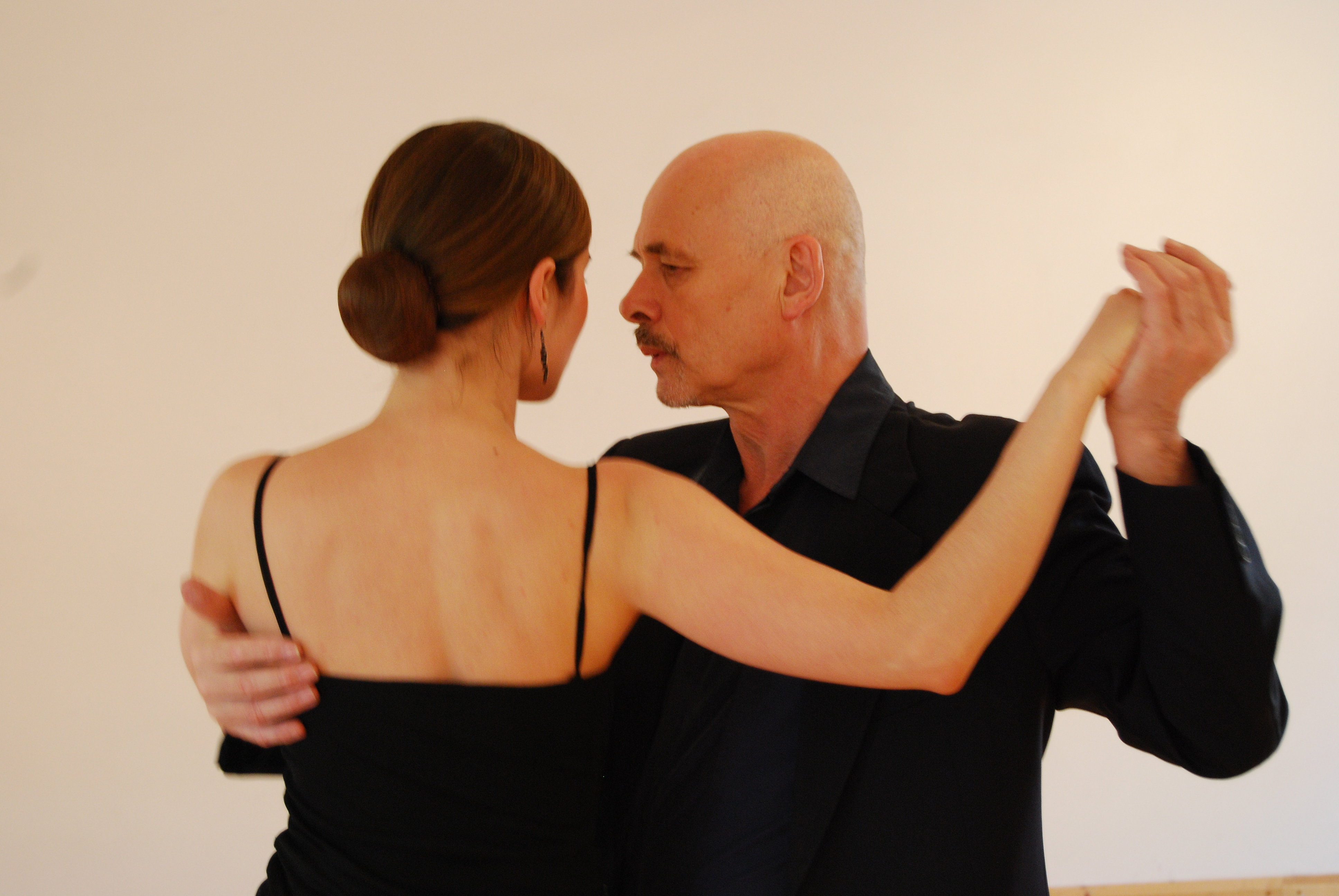
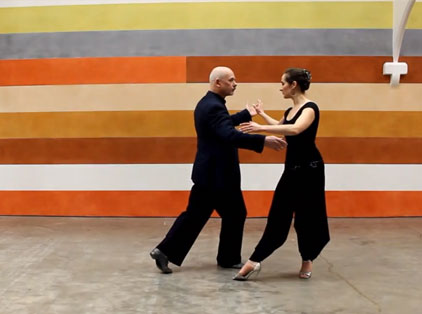
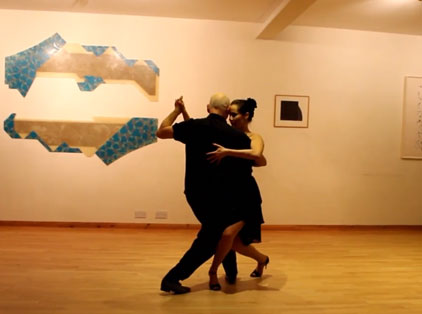
In music, nonfinito and incompletion gave rise to the emblematic music of that same century. Music as an engagement in playing rather than a finished composition has been epitomised by jazz, where improvisation is at the heart of the creative process. Improvisation is the time-based form of the unfinished. In television programmes documenting the nineteen-fifties and sixties, abstract expressionist painters are usually to be seen making their marks to the strains of Charlie Parker or John Coltrane. Larry Rivers initially made his name as a jazz saxophonist. Earlier, while jazz was emerging from the bars of North America, the tango had progressed from the brothels of Buenos Aires to fashionable salons throughout the world. The tango is as significant to the development of dance as jazz is to the development of music. For their respective arts, each is the improvisatory form par excellence. Each offers both a framework and a freedom. They emerge from similar conditions, from melting pots in the New World.

Whether you were in New Orleans, inviting someone to play music with you, or in Buenos Aires inviting someone to dance, the problem was the same, that is, there was, initially, a failure of language. Everyone came from different roots. Nobody knew the same songs or the same dances. The convergence of indigenous, enslaved and immigrant culture got everybody improvising, whether you improvised the roof over your head, the music you played with your neighbours or the dance you did when you met someone you fancied.

Outside the sphere of jazz, John Cage used chance as a process. He didn’t think that jazz went far enough. Jazz was improvisation within limits. It had a formal structure, for one thing, and it was also bounded by the consciousness of the musicians. Random procedures enabled more disconcerting surprises to occur. At the same time, Cage pushed technology to its limits, though here again the work was never concluded, since the technology kept evolving. Cage often created the sounds the great dancer Merce Cunningham would use for his pieces. Dancers would jump, twist, roll and writhe according to recipes for random movement suggested by the choreographer. If, by coincidence, a dance leapt in the air just as the music created a sudden stab of sound, the unison of action and sound was something that occurred by chance; and to Cage and Cunningham, such coincidences had a greater quality of simultaneity than when a dancer tried to “keep in time” to sounds heard milliseconds after they had been made. There was no finalised version of a piece, both sound and the sequence of actions altered every time it was performed. In this sense, the term “piece” is apt, since the work was never complete.

Derek Bailey (1930-2005), the British guitarist who pioneered a network of improvising musicians, can be located between these two positions in the polarisation of contemporary improvisation. His improvisation was free-form, not jazz. He wrote an excellent book on Improvisation, and his record-label, Orbis, was a source of the best improvised free-form. These improvisations would reach a certain pitch of intensity, and as that intensity waned the engagement with sound-making remained, but at last it would get abandoned. When Bailey played he seemed to get away from the derivative backdrops of familiar music – jagged Bartok, canto hondo – backdrops which sometimes weakened the playing of his colleagues. With Bailey, it sounded as if the guitar were filled with chalk. What did I say about Pollock, that he never wanted the curves and scurries of a drip to take shape? It’s as if Bailey never wanted noise to become tune. At the very ghost of a tune he averted his sound as Pollock averted his drip from a shape.

dbailey2006_2

In The Pleasure of the Text, Roland Barthes refers to the need for the shadow of a meaning in a text, however material that text may be in Gertrude Stein’s repetitive terms. Stein of course was just as important as Pound when it came to pioneering modernist nonfinito in literature. But just as the general atrophy of a defeated culture persists as the shadow of a meaning behind the cantos of Pound, there’s the shadow of a meaning behind many of Stein’s texts. The shadow may lurk in the title. Tender Buttons, for instance. Now that’s a marvellous title. It suggests nipples of course, but also cookery – as in tender button mushrooms. That’s enough shadow to keep a text busy for some time.

But incompletionists may make a fetish out of never allowing a shape to emerge, or out of suppressing narrative, or out of erasing the shadow. And it is here that abstraction runs the risk of becoming academic. Carol Robertson, the abstract painter, writes messages to herself on the canvas she means to cover. The message may be no more than a name. By the time she decides to leave the picture alone, the words have been lost beneath the paint. For her, the subsequently-hidden words have resonances in handling and colour. Her affects are attached to these words. They have given the work a shadow. But is this merely subjective? How can we feel that shadow? The L-A-N-G-U-A-G-E poets who followed the trail into abstract writing blazed by John Ashbery and Clark Coolidge in the sixties, often restrict themselves to writing down severely isolated words in excessively tight forms. I prefer at least the quandary expressed, or not, by Carol Robertson.

The poetry of the Clark Coolidge shares many of the formal abstract properties we have noted when discussing the work of J.H. Prynne in my essay on quietism and form. There is a similar abstract density, and a similar ambiguity of reading, for, like Prynne, Coolidge refuses to constrain himself to a purist endeavour so far as his abstraction is concerned. On the other hand, his poetry differs from Prynne’s in that he is less concerned with regular forms. Like Ashbery, he has written open-ended book-length poems. There is far less closure in his work than there is in Prynne’s, and one soon finds oneself reading quite specific content into the work, but, it’s a scrambled content, as if it had gone through the Moulinex mixer. As with Clough, we get a sense of the stress that goes along with all the niceties of living, but Coolidge has a respect for the jazz drummer and sometimes establishes a driving syncopated rhythm. His poems have more in common with the free-wheeling prose riffs of Jack Kerouac than with any of the above. Sometimes his oddly begun, oddly ended sentences read like a jazz solo, and a poem will evolve like a jazz session that just goes on until the dudes run out of steam. Here is a passage from Connie’s Scared – less than a third of the poem:

“The wind came up, the radishes died and
the peelings continued. No one could be
more hostile than a species enclosed in
a chimney for a century or so they told me.
The lighter fluid on the other hand might warm
your nails. We deserve overtime
for dealing daily with these mistreated burdens.
The milkweed pods for no reason in the world
we could see ignited and the frog is loose.
The mail at last arrived but you had better
proceed to lick your envelopes more heartily
as they all came empty. No one exactly states
but everybody thinks the whole world level
has been lowered and continues. If the flame
goes out the food will spoil, remember?

Then there is the problem of the stray moose
to be seen from the road or better not, bring
apples, take pictures, but the village idiot
had his son throw rocks….”

xxxxxxxxxxxxxxxxxxxxxxxxxxx(Clark Coolidge, Own Face)

Here we can sense more than a shadow of a meaning, surely? And Jackson Pollock retreated from the absolute materiality of his drip-actions and returned to the expressionistic figures which shadowed his abstraction in a later period – though one prior to his last paintings. These later Pollocks, in monochrome, are some of his most successful works, I feel, as they mediate precisely between the material imagination of abstraction – drips, actions – and the shadow of a gone figurative world last visited by Picasso: a distorted vision of that world perhaps, but it’s fitting that such shadows of meaning should emerge at the end, as a result of the improvisatory momentum, rather than be suppressed by some more arid concept of abstraction.

A good example of such improvisatory momentum leading quite casually to a deepening of significance is Frank O’Hara’s 1959 poem on the death of the jazz singer Billy Holiday (“Lady Day”). It’s called The Day Lady Died:

“It is 12.20 in New York a Friday
three days after Bastille Day, yes
it is 1959 and I go get a shoeshine
because I will get off the 4:19 in Easthampton
at 7: 1 5 and then go straight to dinner
and I don’t know the people who will feed me

I walk up the muggy street beginning to sun
and have a hamburger and a malted and buy
an ugly NEW WORLD WRITING to see what the poets
in Ghana are doing these days
xxxxxxxxxxxxxxxxxxxxxxxxxxxI go on to the bank
and Miss Stillwagon (first name Linda I once heard)
doesn’t even look up my balance for once in her life
and in the GOLDEN GRIFFIN I get a little Verlaine
for Patsy with drawings by Bonnard although I do
think of Hesiod, trans. Richmond Lattimore or
Brendan Behan’s new play or Le Balcon or Les Nègres
of Genet, but I don’t, I stick with Verlaine
after practically going to sleep with quandariness

and for Mike I just stroll into the PARK LANE
Liquor Store and ask for a bottle of Strega and
then I go back where I came from to 6th Avenue
and the tobacconist in the Ziegfeld Theatre and                                                                casually ask for a carton of Gauloises and a carton
of Picayunes, and a NEW YORK POST with her face on it

and I am sweating a lot by now and thinking of
leaning on the john door in the 5 SPOT
while she whispered a song along the keyboard
to Mal Waldron and everyone and I stopped breathing”

xxxxxxxxxxxxxxxxxxxxxxxxxxxxxxxxxxxxxx(Frank O’Hara, Lunch Poems)

F. T. Prince includes this in his anthology of fragments, and he remarks on the method of O’Hara – an insouciant “I do this, I do that.” Beyond the nonfinito of its casual tone, the poem is incomplete in a particular way – for the reader has to know a lot, has to be able to fill out the poem’s references – that the 5 SPOT is a jazz club, that “Lady” is Billie Holiday and so on – thus the poem is completed by the reader and, quite possibly, by the reader’s personal memories. A movement O’Hara was associated with in the sixties was the New York School, and he spoke of his poetry as employing “personalism”, that is, he wrote as if he were writing a personal letter, wrote his poems to someone, and perhaps mentioned things only that person would know of. Other poets in the New York School employed similar tactics, the privacy of their poems amounting to abstraction; others, such as Coolidge, Kenward Elmslie and Harry Matthews, were more conceptually abstract at that time. Of the writers associated with the school, Ashbery’s poems were the most elegantly abstract, Coolidge’s the most radically so, and O’Hara’s the most “improvised”.

Improvisation in film is well exemplified by the films of John Cassavetes. In A Woman under the Influence, a ganger has brought his crew back for lunch, and, while his wife cooks and they eat, the wife gets quietly plastered. In this scene the camera-work is consummate: every angle is explored, and every close-up, as the characters spontaneously rant at the table, rise from it, gesticulate. And somehow or other the cameras never get in the way, must swing out of our view somehow. However improvised, a huge amount of preparation must have gone into the shoot. Cassavetes made his money playing Johnny Staccato, a jazz-playing private eye. He was very hip. Improvisation is hip.

Clark Coolidge, as I may have mentioned, used to play the drums, and the syncopations and collisions of a drum-riff can certainly be heard in his poetry.

The French film-maker, Jacques Rivette, set his actors a peculiar task for his epic-length Out one: Spectre. Inspired by a novel by Balzac, The Society of Thirteen, which concerns a secret society working in sometimes villainous ways for the good of the community, Rivette told the actors that they were that secret society. He then filmed them in a serial way, in solos, duets and trios. These were all improvised. Each actor brought his or her interpretation to the otherwise-unstated role. For instance, one actor might simply be a member of a secret society who had just taken drugs and was having a bad trip, maybe the actor was just having a bad trip, while another actor might be be in a telephone box trying to find out more about what it meant to be a member of a secret society.

In the Danish director Lars von Trier’s The Idiots, we get the sense that we are the invisible witnesses to some docu-reality. We are part of a small group of disaffected yuppies, goading each other on by “spassing out” – that is, pretending to be retarded in public situations causing embarrassment to all who are not in on the joke. There’s a strong dose of immoralism working on us here, but the film is the wonderful outcome of hours of improvisation around this theme. When interviewed by Nigel Floyd for Time Out, von Trier had this to say:

“The good thing that came out of using video cameras was that some of the scenes in The Idiots are only one-and-a-half-minutes long, but they were one hour long when we shot them…”

The Idiots is a Dogma 95 film, a contemporary European movement in film which advocates rules that proscribe the use of studio sets, tripods and dollies, artificial lighting, introduced props and music not played and recorded in real time. All films should be shot on 35mm film stock. But for Von Trier, these rules are there to be broken – as Catholics are allowed to lapse:

“I had this notion that I wanted to go into films that were less controlled. The limitations that are within the material, and the limitations that are within the actors, are therefore the limitations of the film. I didn’t go in and force things. I didn’t film it, I just looked through the camera. That was the technique…”

Among British film-makers, David Larcher is someone deeply immersed both in the process of his work and in that of his own being. His moving images reveal the innate nature of film or of video, and his work is a constantly exploratory process. One of his early films, Monkey’s Birthday, is very much an extended fragment that reveals his Heracleitan approach to creativity. Almost every frame of this six hour offering is hand-painted, subjected to a practically alchemical barrage of procedures and treatments which have no reason to be brought to a conclusion: the tinting of frames, the scratching of celluloid, the addition of newly printed repetitions of previously shown takes could go on forever. In Granny’s Is, key-edits are superimposed on previously manipulated material, which may comprise imagery Larcher has shot of his grandmother, or material from old home-movies, or material from other films, and we get the sense that we are watching many films at once, each from a multiplicity of perspectives. Larcher studied anthropology and paleontology before embarking on his film career, and his films are many layered. One senses that his process is essentially an archeological one that is at the same time informed by psycho-analysis. Bear in mind that Freud was fascinated by Pompeii, and liked to compare the process of analysis to that of excavation.

david_larcher_monkeys_birthday

(see also http://making-light-of-it.blogspot.co.uk/2010/07/mares-tailmonkeys-birthday.html)

In more recent videos, Larcher has moved from the chemistry of film to the physics of the electronic matter he is now engaged with, and Videovoid seems to work from nothing, or rather from signal, static, screen snow – the inchoate stuff of the medium. During screenings of his work, Larcher may make his presence known by commenting on the piece as it gets projected, creating an accompanying performance by picking fights with the audience or getting drunk. Frank Auerbach speaks of the process of painting as “bringing something new to life.” For Larcher, it is as if the film or video were still in the process of being born, as if he were still in labour.

Critics may say that the work is “unresolved”, but I think that this irresolution is part of the meaning. Larcher is a structural romantic, immersed in the modernist obsession with the essential nature of each medium employed, but at the same time refusing to acknowledge a separation between his life and his art, or between science and psychology, or between film and poetry. He is attempting to create an organon in film, an all-embracing, ultimate work that must at the same time remain constantly in labour, forever emergent, never finally formed.

* * * *

Performance art itself is generally considered to be the most ephemeral of all art forms. In the sixties, its practitioners made a virtue of this, scornfully identifying objects which could be bought and sold with the “material values” of the art-world. First published in 1968, Richard Wolheim’s Art and its Objects called into doubt the hypothesis that works of art must inevitably possess some physical substance.

Wolheim cited music and literature as instances of insubstantial manifestation. He spoke of the “concept of art as a form of life.” Just such a concept has governed the form of performance art. It’s a method of working that emerged out of the art-world and its “happenings” rather than out of the world of the theatre, and initially, in the nineteen-sixties and seventies, it was taken up with visual, and essentially sculptural, issues, in an enthusiastic response to this concept of art as a form of life. The aim of performance art was to create a sculptural experience without producing a physical object. It could be argued though that the performers were always physical objects – even if they were objects that came and went with time – or one might maintain that the score, the documentation or the mapping-out of the performance, constituted such an object.

More interesting than the issue of its physicality, for our purposes, is the notion that the concept governing the performance may amount to an art object even if it is given no lasting physical form; and more interesting still is the notion that there may be no end to the performance, no final result sanctified by completion. This is true of the sculptural lives of Gilbert and George. Proclaiming themselves “Living Sculpture” in the late sixties, their concept of being statues of themselves is decidedly uncanny. To all intents, they dress each day in excessively formal suits and follow a strict routine that constitutes “being with art.” Their action seems highly controlled however, and, in a sense, sealed. The pair appear to be “complete”. Ultimately, however, their living sculpture will only be completed with their demise, but that is precisely when it will cease to exist, and, as the theorists of romanticism realised, death renders life incomplete. What will happen to George, if Gilbert dies before him, or to Gilbert, if George is the first to die? Will the survivor still be part of sculpture that Gilbert and George now constitute? Their work is intriguing precisely because it raises such issues, which are, after all, issues that concern most couples.

Julian Maynard Smith made a breath-taking attempt at a sublime performance (such aspirations must always remain essays or attempts) when his company Station House Opera created The Bastille Dances in Cherbourg’s historic Gare Maritime in 1989. This involved twenty-five performers creating a perpetually moving edifice, by manhandling some ten thousand breeze blocks. Architectural structures were invented, then these got transformed into new extravaganzas of construction. The performers “subjugated, released, supported and imprisoned each other to create a continuous mutation of forms: piles of rubble, walls, towers, arches, furniture, and pavements.” (Arts Admin – 20 Years – catalogue 1999). Here the performance was always in a state of flux – one is reminded of that Greek term phusis – meaning continuous change – which has been discussed in some detail in my essay on Grandeur. Station House’s concept was grandiose, and realised in a grand way. At the same time the polymorphous nature of the material created continuous change rather than a set task that spelled out completion. You could say that this performance achieved a species of sublimity, by attempting that fusion of grandeur and incompletion striven for earlier by the romantics at Jena.

1989-bastille-dances

Other performance artists may derive benefit from nonfinito when they improvise, for this compounds the ephemerality of their medium. Not only has it no physical constitution after it has been made, but it is also unrepeatable and unfinished. The process of making is all. It is not a secret. It is that very process made public. And as such, performance bears little resemblance to the dark-room activities of the photographer, though the performance artist Martin Burton – who has always been immersed in photography and its techniques – has created spooky performances which occur in the dark.

Over the years performance art has become increasingly structured and rehearsed. Yet since it is an art-form created from the living body of the artist, it ineluctably remains in thrall to incompletion, and, by dint of fatigue and ultimately mortality, it lends itself to the mode of nonfinito. This was understood by the artists who pioneered the “happenings” in the fifties and sixties, many of which were improvised within the bounds of some fairly loose concept or excuse for action which often had as its outcome a painting or a sculpture. These physical results constituted traces rather than completed artifacts. They were the results of the action, abandoned when the action was exhausted, and often these actions relied fairly heavily on improvisation. Performances, particularly in those days, were often devoid of narrative, and the artists reluctant to spell out their theme. Improvising performance groups discovered that the subjective projections stimulated in the audience by some enigmatic confluence of actions were well served by recourse to physical expressions and exercises informed by spontaneity. Such improvisations are very much the standard practice in workshops today and are sometimes called “free sessions”. In the same way as a free-form musician may practise scales and improve instrument tonality before improvising, the performance artist may “rehearse” by working on more structured exercises and improving physical and vocal potential, while avoiding prior planning before the free session itself. When the performers are highly attuned to each other, the results can “look” rehearsed to a high degree. But this “look of rehearsal” is not in conflict with the unfinished nature of the improvisation.

* * * *

Performance, which is so often perceived as an “ephemeral” form, seems an obvious candidate for nonfinito and for “making it up as you go along.” But even a form as seemingly stable as architecture can be improvised, as children improvise dens and camps in the woods.

Marvelous examples can be found of the architecturally incomplete. Near Agrigento, in Sicily, there are quarries that were used in antiquity where the fluted marble drums intended for the columns of temples have never been separated by any saw from the vein of marble they were hewn from there in the side of the hill. Doubtless intended for some abandoned project, they seem to have grown in the quarry of their own accord! Mention should be made also of the paintings of Thomas Jones, who worked on views of Rome in the period of neo-classicism. His work is meticulously realistic, highly finished, and informed by a quiet formality, but his subject matter includes buildings without roofs, and sometimes with incomplete walls. Critics (Wolheim in particular) have pointed to a certain timelessness about these canvases, since one cannot always tell whether the buildings shown are in a state of decay or in the process of being built.

In his entertaining and informative Art Chronicles John Ashbery brings the reader’s attention to Sarah Winchester’s Llanda Villa (begun in the 1880s) which “stands amid the sun-drenched gloom of a commercial strip on the outskirts of San Jose, California.” Maintained, and partly restored now, by private investment, which runs it primarily as a Winchester rifle museum, Sarah, the widow of William Wirt Winchester, whose father manufactured the repeating rifle that helped “win the West,” might, as Ashbery says, “have appreciated the respect shown by the restorers, who have gone so far as to leave unfinished parts of the house which may well have been intended to remain that way.”

mansion_mini

Sarah was convinced that she was haunted by the ghosts of dead Indians, victims of the rifle; the very ghosts who had already disposed of her infant daughter and of her husband. She was then told by a medium that she would only be safe “if she undertook to build a house on which work would continue eternally, night and day, in which case she could expect to live forever.” The traps and distractions for ghosts built into the house include a “stairway which rises to the ceiling and ends there.” Ashbery adds that “at one time there may have been as many as 750 rooms: since the workmen had to be kept busy, destruction, or perhaps de-construction, was as important an activity as building…”

“Some have suggested that the incongruities of the house are due to Sarah’s ineptitude as an architect. How else account for skylights built where the light of the sun could never strike them; for doors that open on blank walls or a sheer drop; for a chimney, connected to several fireplaces, that rises four stories and stops just inches short of the roof? Perhaps. But in my opinion neither the ghost-buster nor the hopeless-amateur theory can account for the house: one senses immediately on entering it that Sarah Winchester, with all her peculiarities, was an artist. For her house is an enchantment, and that could be exactly what she intended all along.”

xxxxxxxxxxxxxxxxxxxxxxxxxxxxxxxxxxxxxxxxx(John Ashbery, Reported Sightings, p. 341)

After working for some forty-two years on it (between 1884 and 1926), Antoni Gaudi died before his strange, intentionally skeletal cathedral, the Sagrada Familia, in Barcelona could be finished, but controversy rages as to whether it should ever be finished “properly”: attempts so to do have succeeded only in the installation of rather conventional conclusions in some areas, conclusions that many feel are the result of decisions reached by committee, utterly devoid of the capricious originality that was the hallmark of this architect.

Another architectural maverick, the eccentric millionaire Edward James, was a great supporter of surrealism. He spent a very large part of his fortune building a palace called Las Pozas (The Pools) in the jungle surrounding the hilltop town of Xilitla, Mexico, in San Luis Potosi state, near Tampico. The thirty-six fantastic structures that comprise Las Pozas are built around nine pools connected by extravagantly embellished waterfalls. This palace took some twenty-five years to construct and had he persisted in good health James would have doubtless continued to extend it. Some of the world’s finest orchids grow here – it was orchids that first brought James to Xilitla. The palace is infested with these, and with lianas, and vines and ferns, and with muscular trees which grow intertwined with the constructions.

Las Posas

It is likely that in the end the jungle will prevail and what was begun but never completed here will be overwhelmed and torn apart by rampant vegetation. But such a fate may have been predicted by the instigator. Andre Breton appreciated the surreal shapes naturally created by the jungle, and as a vast folly, a ruin submerged beneath huge green fans, slowly but inexorably being strangled by vegetal boa-constrictors, Las Pozas will achieve a destiny fitting its inception. As with the paintings of Thomas Jones, the unfinished enters into some strange affinity with the decayed.

Those who are drawn to Nonfinito are aware that their work will never be perfect, but equally it can never be ruined. It concerns itself with the attempt. In order to taste of the sublime, it may bite off more than it can chew. This is well shown in the work of Janine Antoni, a performance artist who has often managed to leave an object behind which is both evidence of her action and the artwork itself. Such a work is the giant cube of chocolate which she has nibbled at and chewed, but which remains for the most part intact. The piece is a wry dig at the Platonic perfection of forms which distinguishes the minimalism of artists such as Donald Judd and Walter de Maria. It is also a fine effigy of the incomplete. Is the cube complete except for the chewed edge of it? Or is it that the act of chewing has not yet been completed? And do these two opposed manifestations of nonfinito amount to a finished artwork?

Anthony Howell, December 2003.

.

Shelley: The Colosseum – a fragment
Hanne de Boven
Emma Hamilton’s improvisations
Bobby Baker’s roaming
Dibbets controlled fragment
Amikam Toren
Susan Hiller
Cypress corner posts
Firth of Forth

Posted in art, Essays | Tagged , , , , | 5 Comments

Grandeur versus the Sublime

I met a traveller from an antique land

Who said:  “Two vast and trunkless legs of stone

Stand in the desert. Near them on the sand,

Half sunk, a shattered visage lies, whose frown,

And wrinkled lip, and sneer of cold command,

Tell that its sculptor well those passions read

Which yet survive, stamped on these lifeless things,

The hand that mocked them, and the heart that fed.

And on the pedestal these words appear:

‘My name is Ozymandias, King of Kings:

Look upon my works, ye Mighty, and despair!’

Nothing besides remains. Round the decay

Of that colossal wreck, boundless and bare

The lone and level sands stretch far away.”

(Percy Bysshe Shelley, Ozymandias)

Some four thousand years ago, in Mesopotamia, a stone stele was erected to the Akkadian king Naram-Sin to commemorate his victory over the Lullubi.  The stele is now in the Louvre.  Naram-Sin ruled for thirty-seven years.  He introduced two innovations to royal inscriptions.  He took the title ‘king of the four quarters’, which suggests dominion over the whole world, and he favoured the use of the determinative hitherto reserved for the writing of divine names.  The stele is of particular interest because on it the king is depicted as being twice the size of anyone else.  Neither the defeated king nor his own troops can approach his stature.  He stands on the horizon, while otherwise only some spear-tips and a single helmet rise above it, and he shares this empty space with a tall mountain and with the stars.  This is one of the very first times that scale is used to denote mightiness.  And it is appropriate that this visual solution coincides with the adoption of an elevated tone where verbal reference to his majesty was concerned.

Naram Sin7735320998_f906b53263_o

Two issues are at stake here: what you describe and how you describe it.  They are issues which have always been associated with each other.  Grandeur itself has impressed us long before we built edifices of our own.  In the gorge of the Ardèche, the enormity of the natural stone arch known as the Arc de Vallon seems to have astounded people some 21,000 years ago, since a number of painted caves have been discovered in its vicinity including the Chauvet cave – which was only found in 1994.  This contains stunning drawings, of mammoths, and rhinos and lionesses, among other animals, and it is easy to imagine that these were inspired by suggestive outlines and bulges in the rock itself – just as Leonardo was inspired by blotches and blemishes on old walls.  The possibility of visualising these beasts in its crannies still haunts the massive bridge of rock spanning the river here.

Pont d'Arccouv06

We do not know very much about these people of the caves.  Did they send up chants to their gods or did they sing of their lives and their loves?  Their drawings are remarkable for their accuracy.  The attributes of the beasts seldom seem exaggerated and there is an absence of stylisation – as if these were representations rather than symbols – which leads one to doubt the religious significance usually foisted upon them.  The drawings appear abandoned rather than finished.  Created perhaps in an hour, they have a quality of nonfinito about them, despite the immense time-scale which has to be taken into account when considering life in the caves between ice-ages – but nevertheless the drawings remain stubbornly and remarkably akin to some modernist process – an act of perception rather than some sacred duty.  So perhaps their songs described life in a down-to-earth way.  Can we not be permitted to imagine the cave-people as being free of religion?  Why should we assume that religion is endemic to our condition?  Perhaps, like completion or perfection, religion is a secondary notion not a primary one.  Perhaps the assertion that there exists some superhuman power is a late development in the long history of man – an abstraction evolving out of his capacity to imagine himself as larger than life.

In the Chauvet cave, it looks as if the rhinos were wearing belts.  We are taught to think of the cave-people as girding up their loins to kill such beasts.  But plenty can happen in several thousands of years.  Perhaps they had tamed these rhinos. Did they perhaps place their bets on them at organised rhino tournaments?  Plenty of grandeur in that idea.  But apart from a few hand-prints, the image of man is not evident in the cave.  As the stele of Naram-Sin shows, the aggrandizing of man into god grows out of a stylization which creeps into the business of depicting his own image.  It occurs when man himself begins to think of himself as sublime, i.e. as something astonishing, something beyond his own grasp.

And then, beyond man, there is his mind.  When man moves into abstraction, he may merely be making a negative presentation of his own notional sublimity.  In his “Analytic of the Sublime”, Immanuel Kant saw it like this:

We need not fear that the feeling of the sublime will lose by so abstract a mode of presentation – which is quite negative in respect of what is sensible – for the imagination, although it finds nothing beyond the sensible to which it can attach itself, yet feels itself unbounded by this removal of its limitations; and thus that very abstraction is a presentation of the Infinite, which can be nothing but a mere negative presentation, but which yet expands the soul. Perhaps there is no sublimer passage in the Jewish law than the command, ‘Thou shalt not make to thyself any graven image, nor the likeness of anything which is in heaven or in the earth or under the earth,’ etc. This command alone can explain the enthusiasm that the Jewish people in their moral period felt for their religion, when they compared themselves with other peoples, or explain the pride which Mahommedanism inspires.

(Immanuel Kant, Critique of Judgement, p. 115)

Kant points out how easily we rise to enthusiasm, under the impetus of an unbounded imagination, when figurative symbols turn abstract in this way.  But enthusiasm may give way to obsession – in the eighteenth century it meant just that.  The more recent the religion, the more abstract its terms and its symbols, the more tyrannical its manifestations, and the more fanatical its followers.

It is this stele of Naram-Sin which introduces piety into the act of the sculptor.  Since the ruler has adopted the divine determinative, he must be shown in his representations to be above other men, larger than life.  By being enlarged he has become abstracted, a symbol, towering over the heads of his people.  To be larger than life is to be sublime.  As Rilke has it, “Every angel is terrible.”  Naram-Sin is an early hero, one of the first objects of hero-worship.  Now grandeur concerns our approach to the heroic.  Long before Kant put it so succinctly, there have been philosophers who have recognised that grandeur can convey a sense of the infinite, and this is why it gets associated with the sublime.  At the same time, though, on a more mundane level, we use grandeur to support our own confidence and to impress other people.  It is said that the Egyptians were accustomed to marching into battle very slowly, but still, with their chariots dripping gold, with their elephants ponderously swaying and their beast-headed effigies carried aloft on the shoulders of enslaved cohorts, they overwhelmed their enemies with awe and usually secured a surrender before any battle was joined.  This strategy failed against the Scythians, who rode as near as they dared towards this display army and then turned their horses away and galloped off, firing their arrows behind them.  Pretty soon it became obvious that the Egyptians were not as immortal as they appeared.

Kant agreed with other thinkers, and associated grandeur with the sublime, but, noting that size was always comparative, he considered sublimity to be a matter of the sensation aroused rather than a property of the object.  This sensation depends on the subject’s approach.  Only if the approach is right, will heroic scale deliver its grandiose goods.  Kant realised how crucial that approach can be when he differentiated between apprehension and comprehension, noting that we may sometimes perceive that which we cannot grasp.  Commenting on a certain traveller’s remarks on Egypt, he said:

…we must keep from going very near the pyramids just as much as we keep from going too far from them, in order to get the full emotional effect from their size.  For if we are too far away, the parts to be apprehended (the stones lying one over the other) are only obscurely represented, and the representation of them produces no effect upon the aesthetical judgement of the subject.  But if we are very near, the eye requires some time to complete the apprehension of the tiers from the bottom to the apex, and then the first tiers are always partly forgotten before the imagination has taken in the last, and so the comprehension of them is never complete.

(Ibid, p. 90)

It could be argued that incompleteness of comprehension, or our apprehending something that evades our ability to grasp the whole of it, is precisely what causes the spasm of awe and astonishment that should properly be identified as the sublime.  Here is the difference between what Edmund Burke calls a clear expression and a strong expression:

These are frequently confounded with each other, though they are in reality extremely different.  The former regards the understanding; the latter belongs to the passions.  The one describes a thing as it is; the other describes it as it is felt…

(Edmund Burke, A Philosophical Enquiry…. ‘How words influence the passions’, p. 159).

From the difference between thing as is and thing as felt, a more recent thinker, Jean Francois Lyotard develops his 1988 notion of “the differend”.  It is not an analogue relationship.  If a thing cannot fully be grasped ‘as is’, it may ‘as felt’ beget disproportionate wonder.  This is why we see so much of Godzilla’s foot, and the foot alone.  It is the “shattered visage” of Ozymandias, and  the “two vast and trunkless legs of stone” that Shelley uses as the triggers to arouse in us a sense of a sublime humiliation meted out by the omnipotent force of time.  The same sensation affects us when we wander into the vast ruins of the Colosseum.

This brings us back to a more mundane reading of grandeur.  The Romans were rather small compared to many of the barbarians they conquered, and they seem to have compensated for any sense of inferiority this engendered by valuing enormity in buildings.  Just as their battle-formations defeated the individual opponent by disciplined use of group strategies such as the “tortoise” shield formation, so they impressed the shackled thousands they led in triumph back to Rome by an en masse approach to the manifestation of power.  Even today, the immensity of the Colosseum imposes on its surroundings: when sold-out, it inspired such terror in its carnivores they were often incapable of mauling any victims.  By contrast, a Greek temple, such as that at Bassai, seems to work harmoniously with the landscape, indeed the vicinity has been taken into account, for often a Greek temple will be built in relation to a niche in the hills behind it, a cleft considered sacred.  However, the scale of Hellenic temples at Baalbek in the Lebanon, very much contrived by Rome, is intended to impress us, not to please us – and the columns do so even in the ruinous state they present to us today.  In the quarry at Baalbek, there is a rectangular cube of marble so massive that it could never be lifted out of that quarry – so that is where it remains.

Colossal_Hewn_Block,_Ancient_Quarries_Baalbek

The architectural orders which kept Greek architecture in harmony with musical resonances and poetic measures are distorted and finally abandoned by the Romans.  And so it is that a time-honoured disjuncture in the arts  – which differentiates the beautiful from the sublime – can be epitomised by this difference between Greek and Roman architecture.  Greek architecture epitomises beauty, and lies at the root of formalism.  It incorporates a world-view which supposes a coherent progression from what they perceived as harmonious relationships in nature to constructions such as temples; relationships such as the chords they discovered when they swept the strings of their lyres.   An elegant mathematics unified music, poetry and buildings, and the terms for their poetry also related back to the human shape – since the measure was the “foot” and the foot related to steps in the dance done to the sound of the lyre being swept.  The foot is an analogue measure, traced from our form.  We have lost such a relationship in our own measurements with the demise of the yard and the inch – the yard relating to our stride, the inch relating to our thumb.  The Roman centurion, in command of one hundred men, is an early product of digital, as opposed to analogue, thinking: he is, as his name implies, a number in a world divisible into numbers divisible by ten. Decimation, killing one out of ten of your enemies, is another Roman characteristic.  Later theoreticians of the beautiful and the sublime relate beauty to pleasure and the sublime to pain.  But beauty also concerns the appropriate.  It never sticks out like a sore thumb.  The pleasure to be derived from it consists in their being some perceived coherence which can place an object and its making within some wider system which concerns the natural world.

The Romans had no qualms about embracing decimalisation.  They worshipped efficiency rather than proportion since their own thumbs were, in all likelihood, too short to constitute an adequate measurement.  They favoured tens and tens of tens.  Buildings such as the Colosseum were designed to overwhelm and astonish other people.  Beauty was not the aim.  Grandeur was.  Longinus, the Romanised Greek who became the first theorist of grandeur, set down his thoughts on the subject in the time of the Antonine emperors, around 100 AD.  In his treatise On the Sublime, we find elevation clearly associated with an elevated tone, just as we do some two-thousand years earlier, in the time of Naram-Sin. Yet more often than not Longinus eschews Roman “aggrandisement” and chooses instead to cite a passage from his compatriot Homer’s Iliad as a truly resonant example of the grand manner; for instance, how Hector rushed at the Greek fleet:

And fell upon it like a wave high raised that then doth stoop

Out from the clouds, grows as it stoops with storms. Then down doth come

And cuff a ship, when all her sides are hid in brackish foam,

Strong gales still raging in her sails, her sailors’ minds dismayed,

Death being but little from their lives…

(The Iliad, Chapman’s 1611 translation)

Homer’s similes refer us away from the sphere of manly doings into the phusis.  This is often rather lazily translated as ‘nature’.  Phusis, the etymological ancestor of our ‘physics’, was defined by Aristotle as a “self‑blossoming emergence, opening up, unfolding:  that which manifests itself in such unfolding and preserves and endures in it” (Metaphysics 11‑12).  This wonderful word epitomises unceasing change, and it is similar to the tao, the Chinese notion of the ‘profound creative impulse of the universe’.   It constitutes the “absolute flow of becoming” which, according to Friedrich Nietzsche, existed before substance came into being.

In The Gay Science, Nietzsche asserted that “We are not subtle enough to perceive that probably absolute flow of becoming; the permanent exists only thanks to our coarse organs which reduce and lead things to shared premises of vulgarity, whereas nothing exists in this form. A tree is a new thing at every instant; we affirm the form because we do not seize the subtlety of an absolute moment.”  We can see what affinities this Heracleitan reading of the word has with the movement of atoms.  For the Greek poets, the notion was the source of similes that dealt with the turmoil of natural forces, crashing of waves, trees buffeted by tempests, swirling of clouds.  The similes in the Iliad become the protean substance, later, of the Romantic impulse in poetry.  In a sense, by the eighteenth century, the simile is reversed, and the roaring of the cataract is perceived as some rage in the doings of man.

But Homer’s poem is naive rather than sentimental in the romantic sense put forward by the German critic Schiller in his essay on Naive and Sentimental Poetry; that is, it concerns a straight-forward account of an action, not the poet’s “sentiment” concerning that action.  Its similes enhance the description, and the feeling of that description, not the poet’s feeling about what went on.  The “I” of the narrator has as yet no role to play in the homeostatic unity of the poem, and the simile is a straightforward likeness between dissimilar things, not some subjective comment.  Homer’s epic is considered a primary one, in the sense that it is, so far as we know, the original source of its story, though it may well have been the culmination of some bardic tradition – primary as opposed to secondary in the sense that Virgil’s Aeneid is secondary, that is, derivative, drawn from Homer’s tales and others, or as Milton’s  Paradise Lost, or indeed Joyce’s Ulysses, is secondary – Milton’s magnificently grand epic being derived from the bible and other sources, Joyce’s large, rather mannered novel being an ironic retelling of the Odyssey as if it all happened in Dublin to a little man called Bloom.

Of the two epics known to Longinus, Homer is more prone to the use of simile than Virgil and more likely to return to some key phrase or allusion – such similes and allusions are meant to amplify the narrative in an epic, and amplification is very much a prerequisite for grandeur according to Longinus.  Virgil sticks more closely to his story, delighting in a close description of an action and how it unfolds – Pandarus drawing his bow, for instance – cited by Lessing as the example of subject matter that is appropriate to the art of poetry (see my essay on Quietism).   Virgil’s metaphors are not always drawn from the phusis of natural phenomena, but from other events observed in daily life: for instance, this is how he describes Neptune quelling the winds that have caused a storm at sea:

“Just as so often happens, when a crowd collects, and violence

Brews up, and the mass mind boils nastily over, and the next thing

Firebrands and brickbats are flying (hysteria soon finds a missile),

That then, if they see some man whose goodness of heart and conduct

Have won their respect, they fall silent and stand still ready to hear him.”

(Virgil, The Aeneid, Book I, )

With an urban readership in mind, Virgil’s simile brings an up-to-date allusion to bear on the divine occurrence.  Homer would be more likely to compare a heroic action to some elemental force.  Thus Virgil prepares the ground for the novel.  His epic is less ornamental than Homer’s, and, while at times still elaborate, in general the style is more down to earth and less ornate.  Homer uses ornament to elevate the tone.  However, what Longinus seems to appreciate about the earlier author is that he never oversteps the mark, at least in the Iliad (Longinus is less favourably disposed towards the Odyssey which he sees as inclined towards the far-fetched and fantastic – in contradistinction to the gritty accuracy employed to speak of the fall of Troy).  The similes in the Iliad are to the point:  they magnify the action but do not carry it to such a pitch of extravagance that the language topples over into bombast or absurdity.  Even in the time of Longinus it was recognised that the sublime was not far removed from the ridiculous.  And incidentally, the difference between the two books is so striking that some critics have maintained that they are in fact written by different authors.  Robert Graves has made a case for claiming that the Odyssey was written by a woman, since it abounds in tales of shipwrecked sailors being welcomed at island courts presided over by women, and may have been popular with the ladies who stayed at home weaving and supervising the household, while the warriors went about their grim business somewhere across the sea.

*       *       *        *

The Iliad is written with the accuracy about wounds one might expect from the pen of an army surgeon.   The Odyssey is, as Longinus points out, a collection of fairy tales.  The Iliad has a dramatic unity, while the Odyssey is a picaresque stitching together of unrelated adventures.  Where the Iliad is a testament of life “in the trenches”, the Odyssey concerns court-life and court-intrigues and women managing state affairs in the absence of marauding husbands.  In all likelihood, one is the outcome of a male and one the outcome of a female tradition of recitation: or one is for a male and the other for a female audience.   Longinus clearly thought that the Iliad had more grandeur than the Odyssey, and he has a pretty clear idea of what constitutes the literary grandeur he dubs, for ensuing time, “sublimity”:

Sublimity is a kind of eminence or excellence of discourse.  It is the source of distinction of the very greatest poets and prose writers and the means by which they have given eternal life to their own fame.  For grandeur produces ecstasy rather than persuasion in the hearer; and the combination of wonder and astonishment always proves superior to the merely persuasive and pleasant.  This is because persuasion is on the whole something we can control, whereas amazement and wonder exert invincible power and force and get the better of every hearer.

(Classical Literary Criticism, page 143)

It is this matter of ecstasy versus persuasion which has highjacked any sober discussion of grandeur, I feel, for it leads us on into ever greater spasms of subjectivity.  Grandeur, it might be argued is perceptible, something that concerns the nature of the object, whereas, as Kant has pointed out, the sublime is not an attribute of the object itself, instead it is a sensation experienced by the beholder – though grandeur might give one an intimation of the infinite and thus give rise to the sublime affect – that is to the emotion associated with the idea of the sublime.  In these terms, grandeur can be conceived as an effect, whereas the sublime is more genuinely an affect.

It should be noted also that Longinus speaks about the “grandeur, magnificence and urgency…” of the sublime.  Here we should remind ourselves that poetry is an art which occurs in time, as Gothold Lessing emphasises in his Laocoon.  As greatness of scale is to space – in painting and sculpture – are we now able to associate grandeur with a certain quickening of pace when it relates to poetry and diction?  Paul Virilio’s studies of the power and influence of speed are of relevance here.  Virilio recognises the significance of speed in relation to heroic attitude:

For the Italian fascist passing directly from the athletic record to absolute war, the intoxication of the speed-body is total; it’s Mussolini’s ‘Poetry of the bomber’.  For Marinetti, after d’Annunzio, the ‘warrior-dandy’ is the ‘only able subject, surviving and savouring in battle the power of the human body’s metallic dream’.

(Paul Virilio, Speed and Politics, p. 116-7)

Other nations had built buildings as big as or bigger than those of the Romans – the Babylonians, for instance, and the Egyptians.  But in addition to building immense edifices the Romans moved faster than anyone had before.  Their roads are as significant as their amphitheatres – indeed they are more significant.  Speed of transport enables the rapid accumulation of materials in one place which produces architectural grandeur in a relatively short space of time.  My earlier, quite possibly apocryphal story, about the Egyptians suggests that another species of grandeur moved more slowly, and perhaps built more solidly, but built what?  A triangular edifice with no purpose to it beyond entombment.  The god within the Egyptian pile was a hidden one, a god of within-ness, esoteric and dysfunctional.   Roman grandeur was supremely functional: you could bathe in it, your omnipotence could be displayed in it, you could be entertained by it, and you could provide its bloody entertainment.

But the issue of speed brings other aspects of grandeur to the surface.  While Edmund Burke may define the sublime as “a sort of delightful horror, a sort of tranquillity tinged with terror; which, as it belongs to self-preservation, is one of the strongest of all passions,” the sublime may as well consist of several sensations at variance with this, as Francis Spufford points out in I May Be Some Time, an account of Edwardian polar exploration which adumbrates some of the varieties:

In the first half of the eighteenth century, the sublime meant a rush of noble emotion; you felt it when a play, or a poem, or a human action, displayed qualities so admirable that it became irrelevant to ask whether whatever-it-was had been well-expressed, or neatly bundled into a couplet of verse.  From the 1750s to the 1790s, partly because of Burke, it more often meant a sensation of wonder mixed with fear, a pleasurable encounter with forbidding landscape or the darker passions.  Among the Romantic poets, sublimity labelled the most elevated moments in the transactions between Nature and the human soul; while for the German philosopher Kant, increasingly important in England at the beginning of the nineteenth century, human reason generated the sublime as it reached for absolute ideas beyond the grasp of the senses.  Yet even these disgraceful summaries of complicated positions only hint at the wealth of different sublimes.  Over the period, besides the ‘natural sublime’, there were a negative, a positive, a mathematical, an ethical, a psychological, a religious, an egotistical, a rhetorical, an aesthetic, and a dynamic sublime – to name only some…

(Francis Spufford, I May Be Some Time, p.)

But if we turn in exasperation from the use of this term, and employ grandeur instead, as I keep intending to do in this essay, we will need to admit that grandeur itself can have several contrasting qualities.  It may be awesome, and evoke the terror which Burke takes as an initial prerequisite for the sublime; it may be fused with speed, as when the inundation supposed to have caused the Black Sea overwhelmed the Bosphorus in a flood equal to 10,000 Niagara Falls, its cascade of water travelling at 80 kilometres an hour.  But equally, grandeur may be serene.  The great sand-dunes of the Sahara move slowly and constantly, burying whatever lies in their path, it is true, but doing this at an Egyptian pace.  Greatness of size may evoke the body of the mother, not the abject taboo body, the ‘bad’ mother cited by Kristeva, but the good mother, the benign earth.  Grandeur here induces that sensation of beneficent generosity which we recall as a comfort because it was truly much larger than we were when we were infants.  We can fall asleep in a Jumbo jet.  The pyramids may seem astonishing at first sight, but were we to live in their proximity they might cease to be astonishing without losing much of their grandeur.

The urgency of tone Longinus refers to as an aspect of grandeur relates particularly to a quickening of the pace required in drama and dramatic poetry; a breathlessness which suggests that the thoughts are simply tumbling out of one and that one is overwhelmed by the experience one is attempting to describe.  However, Longinus deals with this in a perfectly cold-blooded way, asserting that such dramatic greatness was not entirely ineffable or innate.  On the contrary, much of it could be taught, being largely a matter of rhetorical tropes.   He listed the attributes necessary for dramatic greatness as the power to conceive great thoughts, and the possession of a strong and inspired emotion, which were both natural attributes: these however went hand in hand with certain specified figures of speech and thought; with noble diction, including an adept use of metaphor, and with elevated word arrangement.  Such touches all required art.  Longinus was well-aware too of the dangers of melodrama:

Some people often get carried away, like drunkards, into emotions unconnected with the subject, which are simply their own pedantic invention.  The audience feels nothing, so that they inevitably make an exhibition of themselves, parading their ecstasies before an audience which does not share them.

(Classical Literary Criticism, page 146)

Longinus also warns us that over-contrived metaphor leads to absurdity – often through anthropomorphism – though he blames this on the poet’s desire for novelty of thought.   Nevertheless, he is hardly against artifice and the list required for a successful elevation of tone is quite mind-boggling.  As well as the figures already described, it takes emulation, phantasia or visualisation (think of Walt Disney!), a quality of exaggeration, tropes which need to be drenched in emotional intensity if they are not to seem shallow and artificial, apostrophe, question and answer, and making the issue more actual, more credible, if you like, by sometimes letting the words tumble out without connection, in a kind of stream (asyndeton), as if hurried, by a certain disorder, and by an absence of conjunctions – causing a rapid fire of phrases, periphrasis, metaphor, hyperbole and so on.  Hyperbole, by its very nature, epitomises aggrandisement.

Still, there is one key sentence in his essay on the sublime which shows that despite his admiration for distinctly tumultuous scenes – raging seas and volcanoes, mighty rivers, monumental deeds – Longinus was clear about the need to give such effects some human purchase:  “Homer, or so it seems to me, has done his best to make the men of the Trojan war gods, and the gods men” (ibid, page 151).  Surely this is where the story of the grandeur parts company with that of the post-Kantian notion of the sublime?  Kant was intrigued by the problem of how we could manage to conceive of something beyond our perceptual comprehension.  In this sense he really was dealing with the absolute, and with our ability to at least posit the infinite.  Longinus is keen to point out that the brilliance of Homer consists in his ability to give the very gods a tangible humanity.  He manages to place them on the scale of things – very high up on that scale, it is true, but not actually beyond it.  Now the sublime in the sense of the infinite is outside scale, outside bigness or smallness, and while it can be sought at either end of that scale – it can never finally be found.  Nor has the sublime a place on the scale of fast or slow, for absolute stillness and infinite velocity oblige us to try to come to terms with our own inability to grasp their nature or non-nature, whereas the measurable can always elicit in us a sense of serene control, however infinitesimal or monstrous it may be.

Longinus is right to emphasise that in art, at least, it takes art to convey immensity.  Take the cadences which inform the loftiest passages of the Book of Job, or, to return to the Romans, the remarkable technique of Publius Papinius Statius.  In his more private poems, Statius is a quietist, making poetry for poetry’s sake.  He deals in innocuous subjects such as the opening of a friend’s swimming-pool, his own insomnia or his wish to retire to the country.  However, being active in Rome in 96 AD, he became a competition poet, and got taken up by the emperor Domitian.  This emperor was a competent bureaucrat, so far as the empire at large was concerned, but was also notorious for assassinating his dinner-guests.  Imagine how Statius must have felt when he got invited to a feast at the palace!  Statius was renowned for his improvisations on grand occasions.  But in this instance he was obliged to ad lib about a scene of imposing and gloomy splendour, without offending his host in the least particular.  It’s difficult to convey the gist of his poem without guying it:

The Royal feast of Sidonian Dido is sung

By him who brought great Aeneas

By the meadows of the Laurentine,

The banquet of Alcinous is recalled

In deathless verse by him who told the return

Over the seas of Ulysses, the wind-weathered one,

But I – to whom Caesar has only just now,

For the first time ever, afforded the right

To partake of the bliss of his holy banquet

In my own lifetime, and rise still alive,

From an Emperor’s table – how shall I sing

My resounding thanks, for the supper, I mean,

How tune my lyre to the theme of it?   Nay,

Though my brow be bound and blessed

With the fragrant bays of Smyrna and of Mantua,

Not even so shall my strains be enough.

I seem to be feasting right in the heart of

Heaven with Jove.  From the Trojan’s hand,

And not in mime, I receive immortal wine.

Eternal time!  How barren now the years

Before this!  Here am I announced!  My days begin.

This is the threshold of my life.

Ruler of the conquered planet, Father

Hope of mankind, love-object

Of the gods, dost thou appear to me

As I recline here?  Is is really thou?

And dost thou suffer me to see thy face,

Thy face, which is actually there, above the wine…

(Statius, Silvae IV, II – version by A.H.)

The poem continues for some time, ending with copious thanks of course (and the poet survived the meal).  But several of the tropes adumbrated by Longinus can be observed at work in it, and, more to the point, the grandeur described has nothing extra-terrestial about it – the knights and nobles seated at a thousand tables, the aura of power surrounding their host, the ceiling so high it vanishes into obscurity – this is mortal grandeur, and, despite the vaunted title, the only absolute is the absolutely corrupting power of the listening emperor.  The length of the poem is another prerequisite for grandeur, or so Longinus maintains.  At the same time as Statius was delivering his wordy addresses, another poet, Martial, was having a popular success with his terse, and often pretty caustic epigrams.  About these squibs, the humour is the only attribute anyone would care to term sublime.

Grandeur is one of the widest rivers of art.  It informs the work of the architects of the middle-ages, the gloomy and stupendous prisons celebrated in the prints of Piranesi.  We find very distinctly refined in the imaginary architecture of Giovanni Pannini, that master of caprice. Consider his Imaginary Museum, where fantastic architecture secretes imaginary paintings that abet its heights with illusory ones – in the manner of the trompe l’oeil favoured by baroque churches in Austria, where a column may begin in stone, and end in paint.

PanniniMusImagin

Foreshortening can have a role to play in attributing grandeur to a subject. Consider the portrait of Cardinal Richelieu by Philippe de Champaigne (1602-1674). It’s worth noting that we never see reality as it is: we see reality as it appears, and the ruling classes of the ancien regime were well aware of the need to exaggerate appearances. The great cardinal, virtual ruler of France, insists that the artist should view him from his feet up, as if sitting in the front row of the stalls before a raised stage. Thus the hem of his red robe is near enough for an appropriate kiss, but his head is, like a mountain peak, remote from the viewer, unreachable (and actually ridiculously tiny) – but Richelieu knew exactly what the message was that he wanted this portrait to get across.

Cardinal-Richelieu Philipe de Champagne

Grandeur is very evident in the sheer scale evoked in the poetry of Milton with its decidedly Latinate construction and elongated sentences which are paragraphs in themselves; and this is felt especially in the exhaustive catalogue of beasts – on land, in the sea, in the sky – as the poet describes the sheer wealth of creation. Here is just one sentence from Book VI:

Forthwith the sounds and seas, each creek and bay,
With fry innumerable swarm, and shoals
Of fish that with their fins, and shining scales,
Glide under the green wave, in sculls that oft
Bank the mid sea: part single, or with mate,
Graze the sea-weed their pasture, and through groves
Of coral stray; or, sporting with quick glance,
Show to the sun their waved coats dropt with gold;
Or, in their pearly shells at ease, attend
Moist nutriment; or under rocks their food
In jointed armour watch: on smooth the seal
And bended dolphins play: part huge of bulk
Wallowing unwieldy, enormous in their gait,
Tempest the ocean: there leviathan,
Hugest of living creatures, on the deep
Stretched like a promontory sleeps or swims,
And seems a moving land; and at his gills
Draws in, and at his trunk spouts out, a sea.

We should understand, that any emotion may be aggrandised. We witness grandeur of retribution when we view the giants overwhelmed by the ceiling at the Palazzo de Te in Mantua and the grandeur of vengeful patriotism in the terrifying close-ups of decapitations depicted by Artemesia Gentilleschi.  Meanwhile, natural grandeur is celebrated in paintings of ships crushed by ice, such as that of Caspar David Friedrich, and a host of polar and Alpinist painters.  Designed to take our breath away, the grandeur of fate and despair operates in The Raft of the Medusa by Géricault, and it is achieved by canvas scale, which emphasises the scale of the ocean, as well as by the desperation of its subject-matter.  A grand roguishness is instilled into the character of Mozart’s Don Giovanni: for here we have arrogance on a heroic scale.  Grandeur inspires the symphonies of Beethoven, Bruckner and Mahler and informs the sheer size of tomes by literary giants:  think of War and Peace, or La Recherche du Temps Perdu.  And when Victor Hugo’s misshapen bell-ringer of Notre Dame leaps on the bells, in Notre Dame de Paris (1831), we experience one of the grandest passages ever put down in words:

All of a sudden, the frenzy of the bell seized upon him; his look became extraordinary; he lay in wait for the great bell as it passed, as a spider lies in wait for a fly, and flung himself abruptly upon it, with might and main. Then, suspended above the abyss, borne to and fro by the formidable swinging of the bell, he seized the brazen monster by the ear‑laps, pressed it between both knees, spurred it on with his heels, and redoubled the fury of the peal with the whole shock and weight of his body. Meanwhile, the tower trembled; he shrieked and gnashed his teeth, his red hair rose erect, his breast heaving like a bellows, his eye flashed flames, the monstrous bell neighed, panting, beneath him; and then it was no longer the great bell of Notre‑ Dame nor Quasimodo: it was a dream, a whirlwind, a tempest, dizziness mounted astride of noise; a spirit clinging to a flying crupper, a strange centaur, half man, half bell; a sort of  horrible Astolphus, borne away upon a prodigious hippogriff of living bronze.

Today, we can experience grandeur in the ironically monumental sculptures and installations exhibited by Thomas Schutte.  Grandeur enthralled the Nazis, who celebrated it in the flaxen-haired character of their adopted “ancient hero” Armenius, at the sacred site of the Externstein, in itself a grand locale, with tales of knightly deeds resounding in the depths of the Teutoberg forest.  Terrible atrocities are committed in the name of grandeur when it comes decked in sublime ideals.  Grandeur in the guise of a racially pure heroics, an endorsement of uplifting myth, was the grail the Nazis hunted in their archeological and genetic researches – one can see it operating on their architects in the German pavilion at Venice.  Here, in the nineteen-eighties, Anselm Keifer plastered the enormous walls with prints which amounted to one giant woodcut depicting a vast wooden hall, an Asgard, legendary home of the Norse gods: an illusory hall far larger than the dimensions of the pavilion itself, the envisioned pavilion of fascist aims.  In 1999, Hans Haacke demanded that for his exhibition at the Biennale every single paving stone of the floor of this pavilion should be smashed to pieces.  In both cases, the artists were utilising grandeur to comment on its ominous heritage, the repercussions which have been so devastating that, for thinkers such Hannah Weil and Lyotard, we find ourselves rendered speechless by our inability to grasp the absolute of atrocity – or at least we must acknowledge that whatever is said about it can only be apprehensive, never comprehensive.  In this sense the Holocaust is sublime.

anselm-kiefer-germanys-spiritual-heroes1

But to me this only serves to show that we should identify the word sublime as an adjective rather than a noun.  Kant is right to claim that it has no material substance.  As “the sublime”, it assumes a spurious quantity whereas, as I have pointed out, in reality there is no quantifiable sublime.  As an adjective, it denotes a quality which can be applied to anything – from Martial’s humour to the unspeakable horror of Auschwitz.  However, there is nothing grand about either of these examples.

Adjectives are much resorted to by sentimental and affected writers.  In most cases they accentuate a quality already to be found in the noun they modify.  It is from its association with this melodramatic adjective – and perhaps most adjectives tend towards melodrama – that grandeur gets its reputation for descending into bombast.  Triumphalism always betrays itself by resorting to paroxysms of inflated rhetoric.  Freud has pointed out how exaggeration of something often veils an inclination towards its opposite.

However the material of grandeur can be turned against the totalitarian sublime.  And Keifer and Haacke are not the first artists to use grandeur itself to comment on the overweening attitude to be detected in that sublimity associated with conquerors.   Paulo Veronese’s great painting The Family of Darius before Alexander utilises all the techniques of grandeur.

The_Family_of_Darius_before_Alexander_by_Paolo_Veronese_1570

The canvas is an extensive panorama – similar to a cinemascope screen – 475 centimetres long and 236 centimetres high.  The work itself has a low viewing angle, the line of the edge of the terrace where the major figures of the subject are grouped at a shallow height above the lower edge of the painting.  This implies that our eyes are on a level with the knees of the principle characters.  The scene before us shows the wife of Darius, who Alexander has defeated at the battle of Issus, kneeling in subjugation before their conqueror.   We therefore share her view of him, as if we were kneeling beside her, as are her three daughters.  The elevation of this terrace where the mighty are gathered is further emphasised by the fact that the courtyard beyond is obviously some four feet below it, for only the helmeted head of a guard standing nearby, on the floor of this courtyard, can be seen above the terrace edge.  Underlings, henchman and horses in the background are practically transparent, insubstantial.  Clutching the stone globe terminating the parapet of the terrace a monkey glances down at the entourage of the suppliants – which includes a dwarf and some kneeling slaves with lap-dogs in their arms.  These are grouped to the left, behind the Persian princesses.  From the feet of the dwarf in the left hand bottom corner to the ear-tips of a horse raising its proud head in the right hand top corner of the foreground runs a diagonal that increasingly builds up the pomp and power of the occasion.  But the treatment of this subject is far from unambiguous.

Take the event itself.  The story goes that the terrified empress hastily knelt and made obeisance to Hephaistion, Alexander’s favourite, rather than to Alexander himself.  Hephaistion pointed out the real Alexander, but the great man diffused the embarrassment of the situation by gesturing back to Hephaistion, saying the Hephaistion was ‘another Alexander’.  Veronese shows an elegant young man in crimson and gold, whose cuirass looks more suitable for the court rather than for the battlefield, arresting the Empress’s entreaty with one hand while he gestures to the man beside him with his other hand.  This man wears a more sombre cloak and much more business-like armour.  Nevertheless, the finely-garbed young man seems to be the painting’s focus.  Even so, we cannot swear that he is Alexander and not Hephaistion, since we remain uncertain about who may be gesturing to whom.  Is this the moment of mistaken identity, or the moment when the mistake is rectified?  Confusion now impinges on the seeming simplicity of the subject.  How can we tell who is truly great?  Is showiness of dress a reliable indication?  Both knees of the resplendent young man are shown, one of his less showy companion.  Whose knees should she clasp?

Meanwhile much in the painting contrives to augment the splendour and power of these two prominent male figures.  A page to the right bends over a shield, his eyes on the trio of knees.  Pikes and hauberks rise above the two mens’ heads, above them and between them – does this indicate future rivalry and conflict between the two?  But at the same time a distraction to this main theme provides it with its counterpoint.  The youngest of the princesses has turned her head to look warily at the misshapen dwarf behind her or perhaps at the two lap-dogs he shrinks back against.  Here again, there are confused tensions.  Is she worried about the fate of the little dogs?  Has she always been rather frightened by the dwarf?  Yet he is a more lowly figure than her, as much beneath her, in rank and in form, as she is below the man who holds her fate, and the fate of her pets, in his hands.  At the same time, the monkey just above her head seems to be making a curious obeisance of its own – towards the dwarf!  The painting is in a sense Darwinian, pace the anomaly of its dating.  It constitutes a wry comment on the entire notion of superiority, since a fine chain of implications links the monkey to Alexander.

*       *        *        *

Having brought our attention to bear on the material qualities which make for grandeur in painting, we can return to the serenity it can evoke just as well as it may deal with the doings of the mighty.  In my essay on formalist art, which I described as innocuous, alluding to that quietness which often informs the subject-matter of the formalist, I have mentioned a species of void created in the works of Claude Lorraine.   Claude’s formalism very much concerns the art of invoking that serenity I see as an attribute of a calm and maternal grandeur.  He seldom allows his small figures to appear as silhouettes interrupting the horizon line.  If they did, they might interfere with the lure of the suggested distance.  An exception occurs in The Shooting of the Deer, where a small caravan of pack-animals can be discerned crossing a ridge in the middle distance beyond the stretch of water in the foreground.  But these animals are far smaller than the already small figures of the main protagonists of the subject in the lower left and the lower right of the painting, and so they serve to indicate the considerable stretch of space which separates them from the foreground, which in turn pushes the tiny sails in the gulf beyond further back – as these push the dim blue mountain beyond the gulf into a further realm of space which then transmutes and becomes another time.

Claude Lorrain-696883

But height is protracted in his works as much as depth.  In the same painting, the columns of the temple behind the hunters get their length elongated, so that the portico of the temple disappears out of the picture.  Here we see, in painting, the same level of artifice used to create grandeur as Longinus requires for the creation of elevated poetry.  This is the nub of my topic, for I am not dealing with the natural grandeur of the world at large but with the question of how grandeur is achieved in art.  This alone would separate the issue from any in-depth analysis of the sublime.  Sublimity clouds the subject with its enthusiasm: but we need to approach grandeur in the spirit of nil admirari.  Our concern is with the illusion of the large.  And what makes Claude so interesting is that the essential ingredient he uses to achieve grandeur is smallness.  Unlike the sublime, the successful evocation of grandeur in art must concern comparison and scale.  Claude’s paintings resemble a visual wedge that reverses the wedge of perspective.  A section of its thin end is presented to us, while its wide end amounts to the vast backdrop of the work.  Small figures inhabit the foreground to give us the sense of the immensity of the background.  They serve as its witnesses.   Exaggerated columns also in the foreground help to inform us that the mythic antiquity these figures inhabit is everywhere larger than they are.

In the nineteen-seventies, James Collins created minute villages meticulously constructed from minuscule bricks – primitive villages, often half ruined, suggesting habitations in South America perhaps.  These would be set into some cranny in actual masonry, as if they balanced precariously above precipices which also extended above them.  This made the ordinary brickwork of the real world seem immense.   A similar impulse informs some of the work of Joel Shapiro: in particular I recall a tiny bridge on the comparatively “vast” floor and a little ladder of his, leant up against the “huge” wall of a gallery.

Joel Shapiro at Paula CooperJS-38-SC_web_s400

Claude’s interest in a serene species of grandeur also finds plenty of contemporary echoes – in particular in the work of James Turrell.  Turrell has constructed a building in a desert renowned for the azure emptiness of its sky.  Within this building, there is a roofless room, opening, above one’s head, onto a square of indescribable blueness.  He has also purchased a crater.  To lie down in this crater and look up at the sky, one’s vision encircled by the widest possible circumference takes grandeur into the realm of the conceptual.  For here, the division between natural phenomena and art is annulled.  We are not entirely in the condition of being steeped in actuality, we may feel, since Turrell has identified the crater as his artwork, yet at the same time it is hard to be certain that here we are experiencing a ‘piece of art’.   The Spiral Jetty built in a lake by Robert Smithson has disappeared under water now, but was so large that it had a grandeur we would normally associate with some natural phenomenon in the landscape, and Richard Serra may have attempted to achieve a similar effect when he placed his monumental sculptures in the Bilbao Guggenheim.  The joke here is that the building which contains them is so big in itself that when one looks down on these sculptures from a balcony they appear quite petite.  This museum makes the paintings by Julian Schnabel, which appeared huge in the South London gallery, look a bit like postage stamps!  Derrida would probably make the point here that the grandeur implied by the work itself can easily be overwhelmed by the context it is placed in.  Kant makes a similar observation about natural phenomena in The Analytic of the Sublime.

Grandeur can be mingled with abundance – to offer us up the lavish flesh of a Rubens, as well as to engage us in the orgiastic sumptuousness of Fellini’s Satyricon.   It may sweep us away in some opera by Wagner, or captivate us with its resonance – as in Wordsworth’s ode – Intimations of Immortality from Recollections of Early Childhood:

What though the radiance that was once so bright

Be now for ever taken from my sight,

Though nothing can bring back the hour

Of splendour in the grass, of glory in the flower…

(Wordsworth, Poetical Works, p. 460-2)

This is very much the elevated tone of a philosophic grandeur working through ideas rather than things.  Its reality is its words…radiance, splendour, glory – to fit these into two couplets is truly a feat.  But what precisely is the “splendour in the grass”?   Is it a biblically inspired reference to the flesh?  Who cares?  Elia Kazan perhaps, who took it as the title for a steamy-enough tale of small town Kansas passion, in a film he directed starring Warren Beatty and Natalie Wood.  The phrase intrigues and inspires, and it partakes of the obscurity which Edmund Burke, in his Philosophical Enquiry, saw as practically a prerequisite for the sublime.  Despite my unwillingness to engage with the sublimity, I must pay some small obeisance to Burke, for his enquiry is full of empirical observations which hold true for grandeur:

…too great a length in buildings destroys the purpose of greatness which it was intended to promote; the perspective will lessen it in height as it gains in length; and will bring it at last to a point; turning the whole figure into a sort of triangle, the poorest in its effect of almost any figure, that can be presented to the eye. I have ever observed, that colonnades and avenues of trees of a moderate length, were without comparison far grander, than when they were suffered to run to immense distances…

(Edmund Burke, A Philosophical Enquiry… p. 70)

He goes on:

A true artist should put a generous deceit on the spectators, and effect the noblest designs by easy methods. Designs that are vast only by their dimensions, are always the sign of a common and low imagination. No work of art can be great, but as it deceives; to be otherwise is the prerogative of nature only.

(Ibid)

Burke also asserts that sublime feeling is a species of tension, a tension not quite amounting to pain, brought on by our senses “straining” to accommodate some excessively large phenomenon – often one consisting of “a uniform succession of great parts” which Burke terms the artificial infinite.  A repetition which pauses, and hesitates before continuing, increases the tension.  You could call that tension suspense.  For Burke this has to be achieved through succession and variation, since: “the view of a bare wall, if it be of a great height and length, is undoubtedly grand: but this is only one idea, and not a repetition of similar ideas; it is therefore great, not so much upon the principle of infinity, as upon that of vastness.”  (Ibid, p.129)

A sense of the grandeur achieved through repetition is well epitomised by the work of Colum McKinnon.  A few years ago, this artist exhibited a very large table at the Serpentine Gallery.  On it were placed thousands upon thousands of small grenade-like plastic shapes.  No single shape was exactly the same as any other.  A very small number of moulds were juxtaposed to create the upper and lower portions of each particular shape – and these produced a seemingly infinite variety in the array presented to the viewer.  Another fine use of repetition in this way, and this time on a more than monumental scale, is Walter de Maria’s Lightning Field.

Lightning Fieldtumblr_m6wsptn9DB1rsc2xho1_1280

Tall metal spikes are placed in the ground in a grid over a vast area.  If a storm brews up, lightning is supposed to strike these poles – a caustic Richard Serra observed that they never did though, or so I have heard.  However, if it does, no jagged crackle down the sky will ever be quite the same as the next – as in the plastic shapes on McKinnon’s table.  Repetition creates a stupendous result in a photograph of an Atlanta hotel, taken in 1996 by Andreas Gursky.

Another good use of grand repetition creates the optical hum in the work of Bridget Riley, though perhaps her work is better considered as an exposition of formalism rather than of grandeur.  However, with her larger pieces, an abstract of grandeur may result.  But Burke’s sense that greatness can come about “not so much upon the principle of infinity, as upon that of vastness” holds true of the blue paintings of Yves Klein and for some of the extra-large works of American Abstract painters – Ellsworth Kelly may deal in serene tracts of unvaried colour seemingly cut into a large single shape.  There’s a similar tendency in certain pieces by Barnett Newman, and, occasionally by Rothko, though in the latter’s case, it is almost as if the wedge-strategy of Claude had been inverted and then projected out of the picture, as swathes of colour overwhelm the eyes.

But what of the elevated tone in poetry?  Grandeur abounded in the Victorian age, and can be excellently handled by Shelley, and by Keats – look, for instance, at Keats’s Sonnet on First Looking into Chapman’s Homer.  There are magnificent passages of grandeur in the Choric Song of the lotus-eaters in Tennyson’s Ulysses.  But all too extensively, the high-flown style became a fashionable mannerism, the very tone of the age.  Those artful disjunctions advocated by Longinus were abandoned in favour of regular verse-forms, often elaborate, almost always long-winded.  Some of Swinburne is worth reading, Laus Veneris, for instance, but he wrote too much ‘of the same’, and the metaphors grow so conflated that it is hard to tell whether the poet is writing about a sunset or a sultry kiss – everything is bathed in the same roseate luminosity, and expression is drowned in orthometry.  Content suffered as well.  Pompous endorsements of imperialism gave way later to the over-rich lasciviousness of Georgian poetry.  With all of it, a little goes a long way.

It was left to an American to rescue grandeur and ensure its authenticity.  Walt Whitman maintains an elevated tone which retains the grittiness Longinus called attention to in the Iliad.  Whitman eschewed elaborate stanza-forms and the ‘trudgery’ of those conventional “Anglifications” of Greek metre which have subsequently doomed so many of his British contemporaries to oblivion.  Instead, he learnt much from biblical cadence.  His style is genuinely declamatory, and paved the way for the open form of free-verse and the inspired ranting of Allan Ginsberg:

I sing the body electric,

The armies of those I love engirth me and I engirth them,

They will not let me off till I go with them, respond to them,

And discorrupt them, and charge them full with the charge of the soul.

Was it doubted that those who corrupt their own bodies conceal themselves?

And if those who defile the living are as bad as they who defile the dead?

And if the body does not do fully as much as the soul?

And if the body were not the soul, what is the soul?

(‘Children of Adam’ – Walt Whitman, Leaves of Grass, p. 81)

or, he can approach the sublime by building up to it through a steady accumulation of phrases:

Out of the cradle endlessly rocking,

Out of the mocking bird’s throat, the musical shuttle,

Out of the nine-month midnight,

Over the sterile sands and the fields beyond, where the child leaving his bed wander’d alone, bareheaded, barefoot,

Down from the shower’d halo,

Up from the mystic play of shadows twining and twisting as if they were alive…

(‘Sea-Drift’ – Walt Whitman, Leaves of Grass, p.196)

But Whitman’s incantations and innovations proved unwelcome to everyone but Swinburne, who was a large enough writer to recognise the quality in a poetry which effectively destroyed his own.  Whitman ended his days as a custom-inspector, and voiced his bitterness over his rejection in “A Backward Glance O’er Travel’d Roads”, an essay appended to Leaves of Grass:

That I have not gain’d the acceptance of my own time, but have fallen back on fond dreams of the future – anticipations – (‘still lives the song, though Regnar dies’) – That from a worldly and business point of view Leaves of Grass has been worse than a failure – that public criticism on the book and myself as an author of it yet shows mark’d anger and contempt more than anything else – (‘I find a solid line of enemies to you everywhere,’ – letter from W. S. K., Boston, May 28, 1884) – And that solely for publishing it I have been the object of two or three pretty serious official buffetings – is all probably no more than I ought to have expected…

(Walt Whitman, Leaves of Grass, p. 433)

In the final years of the nineteenth century, a pioneer in Britain also attempted to challenge the conventional mode.  This exceptional poet was Gerald Manley Hopkins, whose long poem The Wreck of the Deutschland is a work of genuine pathos as well as of grandeur.  The twists and upheavals of the innovative ‘sprung verse’ that Hopkins favoured seem, as much as the tumultuous content, a verbal material instilled with the phusis of the Greeks.  The language is wrenched out of the ruts of ordinary usage by rhyme and by rhythmic necessity.  It becomes difficult and urgent at the same time.  His poetry influenced the protean incantations of Dylan Thomas, though to my mind Thomas softens the intensity of Hopkins to the point of mawkishness.

But the poetry of this pioneer remained unpublished, and it took the Great War to properly knock the stuffing out of conflated grandeur.  The “War Poets” – Owen, Sassoon et alia – eschewed all jingoism and returned to the scrupulous description of what war is actually like – taking their lead from Homer – in order to express the horrors of the trenches.  And so grandeur in the Victorian sense was as much a vanquished adversary of the period as anything else.  A new age finally dawned with the publication after the war of the poems of Manley Hopkins.

Ezra Pound could certainly muster up a depth of tone worthy of Homer, but his was not the tone which came to dominate the century.  Rather it was the dry, downbeat, rather light verse of Auden and his friends which became the new mannerism.  This is neatly descriptive, politically committed poetry, with down-to-earth, prosaic subjects rather than high-flown, celebratory ones.  It often uses a satirical clinching to make its point, while, with a retrograde Britishness, giving up on the rambling of free-verse in favour of a fairly regular stress, a fairly regular line-length, and the occasional use of silvery verse-forms similar to those used by light-hearted poets such as Carew and Prior, a couple of centuries earlier.  Ubiquitous today, this ‘standard modernism’ has none of the spirit of making it new that Pound demanded for genuine modernity.

In addition, the expression of meaning is now laden with ambiguities – William Empson described the varieties of such usage in his book Seven Types of Ambiguity.   Vaunted endorsement of high ideals is generally distrusted today, except when put to humorous or sarcastic use – thus irony has surfaced as the spirit of the our age.

*        *        *        *

So has the irony so prevalent in the twentieth century destroyed grandeur in poetry?  I think not.  Harte Crane has some poems which aptly convey the power of authentic grandeur.  But the grandeur here is, as with Hopkins, often tempered by difficulty:

– And yet this great wink of eternity,

Of rimless floods, unfettered leewardings,

Samite sheeted and processioned where

Her undinal vast belly moonward bends,

Laughing the wrapt inflections of our love;

x

Take this Sea, whose diapason knells

On scrolls of silver snowy sentences,

The sceptred terror of whose sessions rends

As her demeanors motion well or ill,

All but the pieties of lovers’ hands.

x

And onward, as bells off San Salvador

Salute the crocus lustres of the stars,

In these poinsettia meadows of her tides, –

Adagios of islands, O my Prodigal,

Complete the dark confessions her veins spell…

x

(‘Voyages II’ – Harte Crane, The Complete Poems… p. 36)

Crane is forever seeking the sublime phrase – through the use of an astonishing vocabulary, or through placing the verb at the end of a phrase, thus allowing descriptive words to impact and accumulate before it – “Her undinal vast belly moonward bends.”

Grandeur, like the other rivers of art, becomes a process in the twentieth century, becomes a way of doing, a ceremony of saying.  We feel this in the work of Harte Crane’s Australian equal Francis Webb.  And the elevated ceremony of the tone may be asserted when the content concerns the humility of our position in the face of the full might of phusis.  There is still difficulty too, but here, in a Burkian sense, the sense of life overwhelmed may be enhanced by a certain obscurity in the poem which is not in fact obscurity so much as density.  The twentieth century reacted to the profligate verse of its predecessor by a tendency towards linguistic economy, so even when grandeur was sought after it had to come about through some condensation of intensity:

Seventy-six lives foundered on this corner of the coast,

The lucky ones pulped on the rocks, the others pushing

At the soft clinging evil of water with flapping hands;

Their screams needled the drumming bass of the breakers,

Wild counterpoint of distress under a calm sky,

As the Ly-ee Moon, little forsaken nation

With a fool at the helm, went down. You look for tempests,

Guns, red abrasions notched on the sky,

Some camouflage drawn tightly as a skin,

The pinchbeck halo of a kind untruth,

When fire rubbles a city or a ship gives in,

Moulded to the trough of a wave, drifts limp and relaxed

As a fan spread out or a broken basket on the water.

But this, as our own disasters, comes unnamed.

Ungarnished by thunder, current or chivalry

To lift heroic capitals in a text.

There’s nothing to tower or dwarf the seventy-six,

Life-sized, huddled in their gulf – yet so close to us,

So slick and fine this molten barrier called life,

That imagination, that memory, like a huge bubble,

Brings a giant slow rupture and cleavage, and their gulf

Shakes open. Our eyes, timeless as stars,

Peer down again at their restless agonies…

(‘Disaster Bay’ – Francis Webb, Cap and Bells, p. 24)

Another poet who achieves grandeur in the twentieth century is Wallace Stevens.  His is of a serene nature, and this is a quality as much achieved through an agglomeration of words and phrases as through some transparent relationship to the subject-matter. Have a look at his poem entitled Sea Surface full of Clouds, where each section seems almost to mirror the section before it, though the content of each line has been changed – while the length of its words and its rhythm remains the same.  Here the serene event of the title is returned to again and again, but described in new ways each time, thus gaining its power from the accumulation of images – very much as Longinus might have advocated.  Stevens’s Anecdote of the Jar begins “I placed a jar in Tennessee.”  The jar placed there seems to occupy the entire state.   It’s the metonymy of the words, their proximity to each other, which creates this sensation, and it acts like a linguistic version of the miniature village placed in a gap in a real wall by James Collins.  But Stevens is well aware that grandeur is under attack.  It cannot be allowed to gain impact from its obscurity as Burke would have it do.  Lofty ideals expressed in a fuzzy way have too much to answer for still – the vagaries of the class-system, imperialism, religion and nationalism must now be dispelled by a bracing tonic:

Call the roller of big cigars,

The muscular one, and bid him whip

In kitchen cups concupiscent curds.

Let the wenches dawdle in such dress

As they are used to wear, and let the boys

Bring flowers in last month’s newspapers.

Let be be finale of seem.

The only emperor is the emperor of ice-cream…

(‘The Emperor of Ice-Cream’ – Wallace Stevens, Collected Poems, p.  64)

Despite the poem’s attempt to derogate grandeur, the hortatory tone it uses, together with its imperative tense and the repeat of “let” in the fourth, fifth and seventh line, generate a strong sense of mightiness.  Here we can see how irony has been brought to bear on the elevated tone.  But we should remember that this strategy can also be seen at work in the Renaissance – as I showed when discussing Veronese.  Dramatic irony was also employed by Robert Browning – see my essay on ‘Immoralism’.  So it’s not entirely a mode invented by the twentieth century, rather it has become prevalent since the Great War.

Nevertheless I can think of other poets who have retained a quality of elevation in their language – Edith Sitwell, for one, in her elegiac poem Colonel Fantock, for instance – though the veracity of what I am saying about contemporary taste can be judged by the extent to which her formidable oeuvre is out of fashion today.  Another unfashionable poet who deserves far more recognition than is extended to him is F. T. Prince.  Prince has several poems which employ grandeur in an convincing way.  An Epistle to a Patron is a fine example.  This is, in effect, a paraphrase of a letter sent to the duke of Milan by Leonardo da Vinci:

My lord, hearing lately of your opulence in promises and your house

Busy with parasites, of your hands full of favours, your statutes

Admirable as music, and no fear of your arms not prospering, I have

Considered how to serve you and breed from my talents

These few secrets which I shall make plain

To your intelligent glory. You should understand that I have plotted,

Being in command of all the ordinary engines

Of defence and offence, a hundred and fifteen buildings

Less others less complete: complete, some are courts of serene stone,

Some the civil structures of a war-like elegance as bridges,

Sewers, aqueducts and citadels of brick, with which I declare the fact

That your nature is to vanquish…

    (F.T. Prince, Collected Poems 1935-1992, p.13)

Mentioned elsewhere in the poem is the proposal for the colossal bronze horse Leonardo finally completed in clay in 1490 – but never managed to cast.  A version of this ambition was finally realised in 1999 and erected in Milan, though it wasn’t cast in its entirety upside-down in a pit, as Leonardo planned, so it remains doubtful whether Leonardo himself would feel satisfied with the result, since he could easily have cast it in parts, but casting it whole was integral to his conception of the grandeur of the undertaking.

Prince has another marvelous early poem called Words from Edmund Burke which glories in grand sentences which flow on and on, piling up ever more elevated phrases – Burke was not only an analyst of the sublime, he was also the most celebrated orator of his day.  Prince is astute is recognising the connection between Burke’s philosophical enquiry into sublimity and the sublimity of his oration.  Other grandiose poems of Prince’s deal with Apollo and the sibyl, the annals of the Zulu king Chaka and the old age of Michelangelo.  Many of these poems are, like the Epistle to a Patron, derived from historical texts – so in this sense, his work is very much a precursor of post-modernism.

How does grandeur affect the novel?   We have already mentioned some of the more grandiose exploits of the field.  But the question is daunting, since to admit the novel into my inquiry would necessitate a far longer essay than is intended.  Perhaps I can get round this by denying its relevance to the issue – if only to indulge in Mephistophelean advocacy rather than answer the question with the comprehension it deserves.  But it could be argued that where the use of words is concerned, grandeur, according to Longinus, has to do with his notion of the ‘elevated tone’.  This lifts speech above the ordinary – into high-flown poetry, in the case of Manley Hopkins – into oratory, or bombast in the case of Geoffrey Archer’s speech at the Tory party conference when seeking support for election as Lord Mayor of London.

While novels may seem grand in terms of their scope, or their sheer length, the novel is a form that has emerged largely as a reaction to such elevation of tone as was prescribed by Longinus.  Victor Hugo’s description of Quasimodo is exceptional – a poem in prose inset into more sober material.  Prose is chosen by fiction writers precisely because it is ‘prosaic’, down-to-earth, emancipated from the sublime.  Rabelais reveled in the language of the market-place, the gutter and the criminal fraternity, and he mixed this up with the grand Latin tags and nasal tones of the priesthood, the age-lasts and the pompous academics.  His street slang pulls down the trousers of the elevated.  His use of language is very often grotesque.  Cervantes’s Don Quixote may address his windmills in the grand manner, but the down-to-earth prose which describes what ensues has more in common with the view of Sancho Panza.  The novels of the romantic era are like the grand tours which inspired them – they proceed from low ground to high ground, and during some passage over the Alps of their emotional and dramatic engagement we may come across sublime passages, so in this context it’s worth reading Ann Radcliffe’s The Mysteries of Udolpho, first published in 1794.  Mrs Radcliffe had a talent for creating rebels in the grand manner, sublime criminals such as the monk Schedoni in The Italian, which she brought out, by popular demand, only three years later:

His figure was striking… it was tall, and, though extremely thin, his limbs were large and uncouth, and as he walked along, wrapt in the black garments of his order, there was something terrible in its air; something almost superhuman.  His cowl, too, as it threw a shade over the livid paleness of his face, increased its severe character, and gave an effect to his large melancholy eye, which approached to horror.  His was not the melancholy of a sensible and wounded heart, but apparently that of a gloomy and ferocious disposition.  There was something in his physiognomy extremely singular, and that cannot easily be defined.  It bore the traces of many passions, which seemed to have fixed the features they no longer animated.  An habitual gloom and severity prevailed over the deep lines of his countenance; and his eyes were so piercing that they seemed to penetrate, at a single glance, into the hearts of men, and to read their most secret thoughts; few persons could support their scrutiny, or even endure to meet them twice.

(Ann Radcliffe, The Italian, or the Confessional of the Black Penitents, p.)

A debased version of this sort of writing is the model for the ubiquitous schlock saturating the contemporary market.  The film industry has taken it for its own, and its heroic contemporary equivalent is Ayn Rand’s right-wing block-buster The Fountainhead.  The grandeur of fiction seems to have no authenticity – it lacks irony, can only shudder in horror or gasp in admiration.  It is flagrantly adjectival.  On the other hand, Mary Shelley’s Frankenstein is an anti-hero, his monster is a really a poignant failure – the book succeeds because it constitutes an attack on grandiose ambition.  For great novelists such as Hugo, Dostoevsky and Zola, a character may have grand passions, but the language utilised to describe them must be matter-of-fact, otherwise these passions will fail to convince us.  It seems to me that the novelists tend to substitute scope for grandeur – rather than adopt an artificial intonation, they expand the breadth of the canvas they choose to cover – as in Zola’s marvelous La Terre (Earth, Penguin Classics, 1986), or Balzac’s sequence of some thirty novels, La Commedie Humaine.

*        *        *        *

Nevertheless, through most other defiles, the river of grandeur flows on:  at a stupendous scale in the war-memorials of Yugoslavia; humorously, in the house-sized reclining figures of Niki de Saint Phalle – figures one can walk inside – far more interesting than the spurious monumentalism we’re subjected to inside the Millennium dome.  Another marvellously realised massive figure is Fernando Botero’s Broadgate Venus.

Broadgate Venus by Fernando Botero from 1990

She is so huge that it seems as if she has fallen out of the sky, as if the sky could no longer sustain her on its clouds.  At the same time she is herself as pneumatic as the most inflated cloud, and so she still partakes of the sky she gazes at from a site above the platforms of Liverpool Street Station.  She’s as large as any steam-engine, and her grandeur can be touched – there’s a distinct pleasure to fondling the plump monumentality of her toes and the soles of her stupendous feet.  Richard Serra’s Fulcrum is installed in the same complex.  This comprises five enormous metal rectangles which are upended and balanced against each other apparently hap-haphazardly but in fact they form a regular five-sided aperture far overhead.  This piece is far more impressive than his installation in Bilbao.

RichardSerra_Fulcrum2

Serra is one of America’s monumental minimalists.  Others include Walter de Maria, creator of the Lightning Field, and Robert Smithson, whose land art piece, the Spiral Jetty could be seen from space – until the waters in which it was located rose and hid its existence.  And no discussion of grandeur would be complete without mention of the justly celebrated projects of Christo which include his Valley Curtain and The Running Fence; projects which have already elicited plenty of commentary.

Stephen Cox’s Ganapathi and Davi is also at Broadgate: two massive blocks of stone, on the scale of Stonehenge. They face each other, rough-hewn and massive-shouldered: two eternal lovers, duly annointed.  One imagines them standing here, or perhaps one of them will have been toppled over, when the city is reduced to weeds and inchoate rubble.  Somehow one senses that they will remain intact.  Their grandeur is enhanced by the fact that that we get this strong intuition that they will endure, whatever may befall.  Even more impressive is his Hymn Sculpture in the grounds of Kent University.

Hymn Sculpture1521084_073c06da

Grandeur strikes us, with a certain morbidity, in the shark pickled in formaldehyde by Damian Hirst – which boasts the grandiose title The Physical Impossibility of Death in the Mind of Someone Living.   And I find that grandeur figures serenely in the photographs of the astronauts walking on the surface of the moon in the Apollo Mission photographs of the lunar landscape.  As images, these may appear less stupendous than some digitally enhanced fantasy, but they seem inscribed with the clumsiness, the slight tackiness of their own authenticity: this actually happened.  A similar sense of grandeur being convincing because the experience recorded is actual rather than invented affects us when we watch the video of the performance artist Stelarc suspended by hooks which pierce his skin swinging through the air from a crane some forty metres above the roofs of Copenhagen in his Copenhagen Suspension (Grey Suit Video for Art & Literature, Issue no 3), or above the breakers, off the coast of Japan.

CopenhagenMS_web_3773-med

Here it may seem that I have started to deviate from my resolve to limit my discussion to the manifestation rather than the feeling, for when we allow the consideration of an image’s authenticity to have weight with us, don’t we admit that the force of the image is being enhanced by our subjective understanding of it?  It’s certainly true that most people experience a profound astonishment, the very emotion that associates the sublime with grandeur, when they see a photograph of Stelarc actually suspended by hooks through his flesh above a busy street or a raging sea.  In my defence I might argue that the affect of the veracity of this action is the reason why a performance such as this should actually be seen at first hand.  And perhaps, even in a photograph or on video, its authenticity can be detected – it’s the lack of slickness which tells us that it is real.  The trouble is, that’s a naive assumption.  In these days of the dominance of Baudrillard’s hyper-reality, it is all too easy for the fantasy industry to contrive a clumsiness, a slight tackiness in the image – to manufacture fictive “authenticity”.

We can appreciate a ridiculous aspect to the ineffable awe of grandeur’s association with the sublime, albeit a trifle intellectually, in Joan Key’s painting entitled Boo (II) – where the second O seems to fade away – just as the word Boojum fades in the mouth of the swiftly and silently vanishing beholder at the end of Lewis Carroll’s The Hunting of the Snark – in itself a nonsensical critique of the quest for the sublimeThis painting by Key was exhibited in a recent exhibition on the sublime which featured works from the Arts Council Collection – Sublime: The Darkness and the Light.

Hollywood has redefined the epic in its own terms, and the size of the budget is reflected in the size of the mass of viewers for any spectacle.  But grandeur in film is so much the financial property of Hollywood that I prefer to pass over it; for here the grandeur seems conflated, and loosely humanist also.  Hollywood remains stuck in the aesthetic condition of the nineteenth century with its vast narratives larded with popular sentiment dressed up in togas or tinsel.  Mention should be made however of the films of Douglas Sirk, whose opulence appears so exaggerated that it comes over now as a critique of its subject: the oil-tycoon in Written on the Wind, with the scale model of an oil-derrick on his enormous desk which he sits behind, below an even more enormous portrait (in oils) of himself surrounded by his derricks – the scale model is later fondled by Dorothy Malone.

1297789815-written

Sirk is much admired by the painter David Salle, who can convey a sense of grandeur in his own work – particularly perhaps in the sets he painted for the dancer Karole Armitage, where hugely magnified portraits or isolated eyes may serve as a back-drop to the dancers who are easily dwarfed by the scene behind them – yet the set is so flagrantly not some illustrative accompaniment to the action that a strong tension gets set up between set and choreography, and this tension certainly has impact.

*        *        *        *

Finally to the architecture of Rem Koolhaas.  Airports built on artificial islands.  Buildings no longer things one has to go round but things which part automatically allowing you to pass through them, thus enhancing your sense of your own urgency and importance.  Swimming-pools neatly fitted onto domestic roof-tops: celebrations of each citizen’s private grandeur.  Each of us expending more horse-power in a day than Julius Caesar in his lifetime.  Acres of perpetually replenished sunlight.  A celebration of the to-hand requirements of urbanite sophistication rather than the uniform idealism of socially leveled modernism.  Micro-technology guiding smooth robotics.  Cities built to accommodate future population explosions.  The rural subsumed into the urban in a single recreational and industrial suburbia.  His book Delirious New York repentantly celebrating traffic-flow, escalator-flow.  And as for the future of the sky, let’s have some outright piercers now – rather than those humble scrapers of the twentieth century.

Koolhaas3396501023_ce8cce65a5_b

Another of his books, Small, Medium, Large, Extra Large is grand itself in the sheer quantity of its pages, diagrams, diatribes.  Koolhaas is an advocate of bigness.  He’s an architectural maestro, orchestrating international mega-centres at the nexus of tunnels, chunnels and flyovers; or museums designed to accommodate the most succinct electronic miniature, the new monument, the latest projection; or stations welcoming the arrival of speed-of-light express-trains to Gargantuan silvery malls.   His shells of clear polyester flecked with aluminum cover millions and millions of square feet at Euralille at the chunnel’s end; hard and reflective on the outside, translucent on the inside.  His work is neither modern nor post-modern, for while in many cases it exemplifies a disavowal of references to all previous models, it also does away with formalist dogma in order to deal head-on with the brute reality of our needs.  In a landscape of “increasing expediency and impermanence”, Koolhaas speaks of “the integration of the notion of cheapness to create sublime conditions” and perceives “the client as chaos”:

If there is to be a “new urbanism” it will not be based on the twin fantasies of order and omnipotence; it will be the staging of uncertainty; it will no longer be concerned with the arrangement of more or less permanent objects but with the irrigation of territories with potential; it will no longer aim for stable configurations but for the creation of enabling fields that accommodate processes that refuse to be crystallized into definitive form; it will no longer be about meticulous definition, the imposition of limits, but about expanding notions, denying boundaries, not about separating and identifying entities, but about discovering unnameable hybrids; it will no longer be obsessed with the city but with the manipulation of infrastructure for endless intensifications and diversifications, shortcuts and redistributions ‑ the re-invention of psychological space. Since the urban is now pervasive, urbanism will never again be about the “new”, only about the “more” and the “modified”. It will not be about the civilized, but about the underdevelopment. Since it is out of control, the urban is about to become a major vector of the imagination. Redefined, urbanism will not only, or mostly, be a profession, but a way of thinking, an ideology: to accept what exists. We were making sandcastles. Now we swim in the sea that swept them away.

To survive, urbanism will have to imagine a new newness. Liberated from its atavistic duties, urbanism redefined as a way of operating in the inevitable will attack architecture, invade its trenches, drive it from its bastions, undermine its certainties, explode its limits, ridicule its preoccupations with matter and substance, destroy its traditions, smoke out its practitioners. The seeming failure of the urban offers an exceptional opportunity, a pretext for Nietzschean frivolity. We have to imagine 1,001 other concepts of city; we have to take insane risks; we have to dare to be utterly uncritical; we have to swallow deeply and bestow forgiveness left and right. The certainty  of failure has to be our laughing gas/oxygen; modernization our most potent drug.  Since we are not responsible, we have to become irresponsible.

(Rem Koolhaas, What Ever Happened to Urbanism?)

This is grandeur perceived as non-finito – phusis with a vengeance – an urban phusis – for as Michael Craig-Martin once pointed out to me, the city is as much nature as any other nature.  Such an evolving, fluxile species of greatness is an adequate one for a century coming into being as the ‘gay science’ of process and transformation, re-emergent in the twentieth century, gains momentum in this new one, and grandeur moves into a state of mutability, preparing us for a flight into the stars when we finally abandon a planet ruined by our own small-mindedness…

Anthony Howell, December, 2003

Click the link for an Introduction and a list of all eight essays in this series “the rivers of art”

Posted in art, Essays | Tagged , , , , , , , , | 7 Comments

Quietism, the ‘vacancy’ of Formal Art

Ad Reinhardt Abstract painting
 xxxxxxx
          6.42    And so it is impossible for there to be propositions of ethics.

          Propositions can express nothing that is higher.         

          6.421  It is clear that ethics cannot be put into words.

          Ethics is transcendental.

          (Ethics and aesthetics are one and the same.)

         Ludwig Wittgenstein: Tractatus Logico-Philosophicus

Wittgenstein argues in this seminal early text that “Ethik und Ästhetik sind Eins”.  The statement has an unequivocal ring about it.  It’s the outcome of a flat denial that language can claim to speak of the ineffable, since that would be a pretension, a raid on conjecture that can have no application where words – which are “pictures of facts” – are concerned.  It is thus that the Tractatus effectively shuts the door on metaphysical discourse as a viable branch of philosophy.

Later texts by Wittgenstein may have sought to push that door ever so slightly ajar again and to water down an insistence which science has subsequently taken for granted.  It is worth remembering, however, that Bertrand Russell considered the Tractatus the only book written by Wittgenstein that had any relevance to the development of philosophy.  For Wittgenstein recanted, so far as Russell was concerned.  He bowed to pressure from the respectable Viennese establishment, who were bent on maintaining the status quo with god-fearing wives and clergymen of a philosophical turn-of-mind.  Logical positivism was all very well for the British, but in Austria religious matters had to be allowed into at least the pen-umbra of modern enlightenment.  So Wittgenstein modified the views hammered out on the anvil of his youthful mind, just as Sigmund Freud had felt obliged to retract ‘the seduction theory’, under similar pressure from the city fathers.  Wittgenstein’s subsequent note-books are worth picking over if you wish to indulge in romantically aphoristic nonfinito.  Still, in my opinion, they dilute the essential theory of the Tractatus and allow conjecture to seep back into the cranium of the “handmaid of science” – the epithet the author originally chose for ‘Philosophy’, were she to be emancipated from metaphysics.  Thereafter, by allowing this “bleed” back towards conjecture, as the later notebooks make permissible, it was once again feasible to assert that ‘meaning’ mattered more than form.

But, if ethics and aesthetics are indeed one and the same, as the Tractatus maintains, what does this imply?  Does it mean that both concepts have become redundant, given that both may now seem flawed by the meanings which accrued to them before their synonymy was established?  Since their equation, form is not quite form, as in form alone; and meaning not quite meaning anymore, in so far as we suppose meaning only to concern some ethical issue.  Instead of either, we now have some other stuff compounded by the fusion of both. 

What are these older meanings?  The O.E.D. defines form first as “the visible aspect of a thing”, then as “an image, likeness or representation of a thing,” (we can say we saw his form moving through the mist).  And, apparently, in philosophy, form has come to mean “the essential determinant principle of a thing, that which makes anything a determinate species or kind of being.”  An aesthetic definition of form is the essential creative quality of a thing, or “the particular mode in which a thing exists or manifests itself.”  For artists, this ‘particular mode’ is a key notion:  it suggests that form can mean medium.

Ethics, on the other hand, is a term which relates to morals.  Ethics can be the science of morals, “the science of human duty in its widest extent”.  Thus ethics concern content – they are, or used to be the message:  that principle of duty or responsibility which one may be trying to put across.  It should be noted, though, that the O.E.D. defines content in a rather different way, essentially as “that which is contained: the tenor or purport (or meaning) of a document” – in the last sense therefore the message.  But since content initially means the substance or matter contained, what we are saying etymologically, when we say that we are ‘contented’, is that we are full – ‘contentedness’ concerns our satisfaction, in the sense that a good dinner fills us up.  However, in Freud’s homeostatic theory of the Pleasure Principle, we may be contented when we have relieved ourselves, thus disburdening ourselves of a pressure that was disturbing our equilibrium – in which sense our contentment would relate to our emptying ourselves.

Leaving the last notion aside, for now, we can hear Marshall McLuhan reinterpreting this statement from the Tractatus as “the medium is the message”, for it is clear that, at the level of their primary definitions, form and content have the relationship that a jug has to the water it contains.  However, the Wittgenstein of the Tractatus is saying something like ‘the jug is the water that it carries.’

If we take his insight to heart, we must make tangible the notion that the terms form and content are a unity. This strikes resonances with the mind-and-body debate.  For surely mind is body, and these two terms should never have been split?  Yet with both diodes, form/content, body/mind, their discovered unity must fundamentally alter our notion of the terms – in that we may no longer oppose them, in that we must find a way of working with an imaginary word, in each case, which represents their fusion, their coming together.

Of course many artists still purport to have a message, and they remain keen to find a form through which to get their message across.  For them, form occupies a subservient position to content.  Content is the master; form the mere vessel carrying content blithely along.  In mischievous mode, I may suggest that there is a feminist aspect to this.  Those who have the feeling that their views have been gagged for millennia may feel an urgency to communicate.  On the (supposedly) male side, however, it might be argued that those biologically deprived of wombs may simply wish to bring something into the world.  Frank Auerbach, for instance, speaks of ‘bringing something new to life’.  Here the imaginary womb of form is predominant, indifferent to the import of its progeny. You could say that form is humanity: content a mere product.  In the case of the political artist, on the other hand, or of the politicised feminist artist, content is invested with all the humanity, while form is an inanimate object, no more than a method of transport.

However, it is my purpose here to breathe more life into the notion of form, since it would appear relatively easy to bring home the humanity we expect from content.  Form remains the figure moving through mist, and I will try to dispel some of that term’s ethereal moisture.  One of the clearest exponents of its meaning is the German critic and playwright, Gotthold Lessing, who wrote his little book, Laocoön, or the Limits of Painting and Poetry in 1766.  Lessing was trying to establish which came first, a passage in Virgil’s Aeniad, describing the death of the Trojan priest, Laocoön, and his sons, in the coils of serpents raised by Neptune – or the Hellenic statue showing this event in marble:  in other words, was the statue inspired by the poem or vice versa?  During this academic enterprise, Lessing discerned a need to define the difference between poetry and visual art.  Of Homer’s description of an archer in the Iliad, which he termed a “poetical picture”, he wrote:

“From the seizing of the bow to the very flight of the arrow every moment is depicted, and all these moments are kept so closely together, and yet so distinctly separate, that if we did not know how a bow was to be managed we might be able to learn it from this picture alone.  Pandarus draws forth his bow, fixes the bowstring, opens his quiver, chooses a yet unused, well-feathered shaft, sets the arrow on the string, draws back both string and arrow to the notch, the string is brought near to his breast and the iron head of the arrow to the bow; back flies the great bent bow with a twang, the bow-string whirrs, off springs the arrow flying eager for its mark.”

(Gotthold Lessing, Laocoön, page 54)

But it’s misleading to call this ‘a picture’.  Better to call it ‘a telling’ – for Homer is not showing us, in two or three dimensional space, how an archer shoots; instead he is telling us how it is done.  Were we listening to his voice, and given we understood it, the telling would be entering us invisibly, through our ears, but rhythmically also, and spoken in time – just as the action described happens in time; in a sequence unfolding in the poet’s mind.  ‘Sequence’ is the operative word, for the archer is engaged in a series of actions, actions which succeed each other, “step by step in succession of time”.  How different this would be if it were a genuine picture, for if it were, it would resemble one of those photographic sequences by Edward Muybridge – a visible yet arrested set of actions, the different parts only occurring side by side in space. 

Form considered as medium takes on significance when we realise that poetry deals most effectively with actions happening step by step in time, whereas painting deals most effectively with bodies occurring side by side in space.  Lessing goes on to elaborate this point, and in so doing provides us with an essay in the formal analysis of the difference between media.  And while the sculpture of the strangled priest and his sons can show us how the coils wound massively around the bodies of their victims, it cannot show us how this has come about nor that the other two victims are his sons – for these are facts and relationships which require telling rather than figuration.

Any shift from one medium to another will involve a change of characteristics.  Say you have created some pencil drawings employing the strategy of never removing the pencil’s point from the surface; then you try to make paintings based on these drawings.  However, a pencil is not a brush.  Until it goes blunt, the pencil will give you a continuous line, which speaks of its analogue nature, in the sense that it can leave an unbroken trace all the way up your forearm and around your hand.  Brush marks, on the other hand, come with a limited load.  The mark you make is punctuated by interruptions every time you break off, of necessity, in order to reload your brush.  It is only by contrivance that an image generated by a continuous mark can be translated into an image created by a number of parcelled loads.  A paint-stick might be the answer.

This is an example of formalism at work.  And, yes, it weights the opposition of form and content in favour of form – by turning to the foundations of making, to art’s first principles, and endeavouring to define the essential characteristics of the media concerned in any operation.  It then may ask, What sort of content can this medium deal with most effectively?  Wittgenstein raised this question himself when he turned his hand to architecture.  Designed in accordance with the modernist principles of Adolf Loos, for whom all decoration was a ‘crime’ because extrinsic to the essential structural function of a building, the house Wittgenstein designed in Vienna in 1928 is significant for its lack of embellishment.  Flat-roofed, composed of right-angles, with  tubular steel railings, the house was conceived as a ‘laboratory for living’.  Living is therefore the ‘content’ of the ‘form’, house.  Nothing extrinsic to the service of this content is allowed.  For its designer, the living is the house, and, for the modernist of the nineteen-twenties, this entails Spartan simplicity: shadeless light-bulbs, unpainted corner-fitted radiators and latches engineered specifically to serve their purpose.  The house was perfectly suited to the austere life-style of Wittgenstein’s sister Gretl, for whom it was built, and therefore the medium is the most effective one for dealing with its content, or so it seemed at the time.

witthou2

But the question – What content can the medium deal with most effectively? – is not a one asked exclusively in the modern age or only since the Enlightenment.  Well before Lessing, Piero della Francesca had understood how appropriate painting was for dealing with space.  In the Brera Madonna, an egg hovers above the head of the Virgin, but at a distance behind her, since it hangs down from the apex of a shell in the half-dome at her back, which makes up a niche. 

Madonna and Child with Saints4

Not only does the egg signify that this birth is the beginning of a new story – as the Latin tag ab ovo signifies, not only does its unbrokenness strike a chord with the intactness of a virgin birth:  quite palpably, it locates the painter’s subject in space, pushing her forward, and making that space above her and behind her as present as the lady herself.

Brera Madonna 1Fig-8

Painting deals with matters perceived in space, poetry deals with matters unfolding in time; though of course it’s possible to posit a more paradoxical state-of-affairs – painting dealing with matters of time as perceived in space, for instance, or poetry dealing with space as affected by time.   Essentially, however, each art contends with problems appropriate to its nature, and thus each medium gathers to itself a repertoire of formal characteristics.  The quest to identify these in music finds its paradigm in the work of Johan Sebastian Bach.  But if Lessing has helped us to differentiate between poetry and painting by seeking to define their capabilities, we now need to differentiate between poetry and music by taking our definition of poetry a stage further, for this may help us to grasp the nature of that formal endeavour which lay behind the construction of Bach’s favourite musical structure, the fugue.

While the Korean language uses semi-tones for semantic purposes in speech, European languages do not.  Each European language is a one-note samba:  rhythm is the main component, though  there may be a certain quantitive variety to the length of our syllables – moon sounding longer than tick.  A European language has qualities which are half-melodic, allowing for syllable colour, rhythmic variation and consonant variety, but without the fully melodic properties of music.  On the other hand, a word has two sides – its signifier and its signified – the former, to put it very simply, being the object that the word comprises in itself and the latter being the object to which that word refers.  The many meanings generated by metaphor and by ambiguity will vary the nature of the signified, just as variations in spelling will have altered the signifier over time.  But language is encoded, even when not written down, in a way which differs from music.  For while the notes written down on the stave may refer to a specific sound, the sound of the note itself has no object signified specifically by its being called forth, in the way that a word has when enunciated.  There are exceptions to this definition – the cuckoo’s call, the sound of the hunting-horn – but essentially a string of notes is not a statement in code.  Instead the notes celebrate qualities of tone, length and rhythm for their own sake, and we read the structure of a melody by registering the relation of the notes in it to each other not by translating them into referential meanings.

And whereas language is predominantly linear, even when spoken in chorus, and even when an abstract purpose is avowed, music is more often multi-linear, concerned with the resonances of chords as much as with the contiguities of melody.  Indeed we can speak of vertical and horizontal music.  Melody may be considered as horizontal, and we can follow it, in time, just as the eye can travel along the line of the horizon in space.  The harmonies, the chords struck along the way, may be considered as vertical music, since these chords occur when simultaneous agreements are generated with notes above or below that in the melody.  Now although language occurs ‘one word at a time’, these concepts of horizontality and verticality ‘strike a chord’ with Roman Jakobson’s analysis of what he conceives of as the two poles of language, a notion put forward in 1956.

Jakobson suggests that there are two methods of ontological or linguistic arrangement: metaphor and metonymy.  Metaphor is vertical:  it selects through the relation of similarity, being defined as a likeness between dissimilar things (a phrase which could define a chord).  Metonymy, though, is horizontal:  it defines words through the relation of contiguity, i.e. it puts words next to each other, lines them up – as a melody lines up its notes.  These may be the two most fundamental linguistic operations.  The French psychoanalyst, Jacques Lacan, has sought to relate Jakobson’s theory to Freud’s notion of the workings of the brain revolving around poles of condensation (several meanings accruing to one object) and of displacement (one object being substituted for another, or pushed out of the way by another).  It is music which can demonstrate such structures so that they become tangible to us through the particular medium of sound.

Counterpoint is a technique involving the simultaneous sounding of two or more parts or melodies.  It’s a technique best exemplified by the fugue, and the adjective derived from it is contrapuntal.  J. S. Bach was one of the early exponents of the fugue, and perhaps the most celebrated exponent of a form which plays with these notions of horizontality and verticality and develops a paradox about their natures.  Beyond one prerequisite, there is no set form for a fugue, which may be thought of as a texture rather than a structure.  But while the passion which informs Bach’s compositions shows his fugues to be more than mere exercises in contrapuntal writing, nevertheless the passion resides in the structuring of the music.  Tradition articulates some general rules about that structure.  In simple terms, a fugue may be thought of as an elaboration of a cannon:  that is, a song or melody which is overlapped by the same song or melody starting a little later – like runners started at different times who will run the same course.  A third or a fourth repetition of the melody may also be started before the first version reaches its conclusion, and any of these repetitions may be sung or played at a pitch higher or lower than that of the original.  Modifications and counter-melodies develop, but in essence it is the notes of the same tune (the horizontal sequence) started at different times which coincide to form the chords of the vertical coincidences binding these separate yet identical threads together.   Thus a note occurring in the horizontal progression of one strand becomes part of a chord occurring in vertical relation to a note occurring in another strand.  All the notes are therefore in both a horizontal and a vertical relation to each other.

A similar dualism affects the metaphorical and metonymical relationships of language and the condensations and displacements of the psyche.  Anthropologists have shown that the narrative thread of a myth or popular story can reveal ‘chords’ similar to those of a fugue, chords generated by the single strand of the tale when its central incidents are folded back on themselves:  repetitions become evident, and meaningful reversals – suggesting a contrapuntal element in the social mediation which informs myth-making, story-telling and plot construction.  The dynamic of a narrative is thus supplied by the twists in it, though the twists are a formal element.  For all that, in most literary works, the words happen one at a time, though rhyme and repetition may cause many of these words to resonate with our memory of others, whereas, in music, the harmony can happen simultaneously.

Perhaps Bach’s manipulation of horizontal and vertical structure was his way of getting across his notion of divinity, and perhaps that sense of the divine mattered more to him than composition for its own sake.  It is more likely though that he conceived of composition as divine, and here we are once more in a situation where ethics and aesthetics are one and the same, where the jug is the water it contains.

*        *        *        *

This posits jug and water as a unity.  Jug and water are one.  When defining tragedy, Aristotle identified three unities: unity of time, unity of space, unity of action.  The action had to unfold at a single time, though within that time, characters might relate what had happened at a time prior to that action, and the action had to occur in a single location – in the Greek camp outside Troy, for instance, or in the town of Thebes, but it couldn’t move from one location to another.  The action itself had to concern one related chain of events, and the theme of this had to be sublimely dreadful, in order for it to be worthy of a truly purgative catharsis.  The conjunction of these three unities brought about that intensification which is the hallmark of a fine Greek tragedy.

When assessed in Aristotle’s terms, the plays of William Shakespeare are revealed as displaying a tendency towards mannerism rather than adhering to the unities of classical drama.  They were after all written in the mannerist era, when antique theory was being called into question.  Their action often occurs at a variety of times, as in Macbeth, for instance;  the scene changes to a diversity of locales, as in Hamlet; and they abound in subplots, as in A Midsummer Night’s Dream.  Where the classical strictures of antiquity encouraged speech that was strictly concerned with its subject and pared down to the action – a fine example of this being Philoctetes by Sophocles – another mannerist tendency in Shakespeare is the love of embellishment, for he favours elaborate figures of speech in his nicely balanced exchanges, and employs a fair amount of ornament in his grand addresses and soliloquies.

Mannerism merits some attention here, for it seems to share certain traits with formalism while possessing others which clearly distinguish it from formalism.  The harmonious classicism  that formalism resembles – exemplified by the proportions of Greek temples – was what the mannerists felt qualified to question.  While purporting to respect the past, they valued variety over the unities of antiquity.  They also had an aversion to heavy subject-matter, for while their pyro-technicians delighted in creating extravagant hells, these were designed to amuse by their ingenuity rather than move their audience to repentance.  The pastoral intrigues enacted on the mannerist stage were the soaps of their time, and were derived from comedies, satyr plays and pretty Greek stories – such as Daphnis and Chloe – rather than from the great tragedies of the past.

Where Shakespeare differs from mannerist practice is in his subject matter – which is far too powerful for any dyed-in-the-wool mannerist or for a mannerist audience – which would have been exclusively courtly, and rather too caught up with the refinement of manners.  However, that doesn’t make him a classicist either, for classicism taught that the “suspension of disbelief” – to use Coleridge’s much later phrase – was better served by reported violence than by tomato ketchup spilt on the stage: it was indeed another dictum of Aristotle’s that the violent action, the tragic outcome of the play, should occur offstage.  Thus the great tragedians – Aesculus and Sophocles – dealt with the most ghastly horrors in a comparatively restrained way.   Shakespeare follows the ‘off-stage violence’ rule in Macbeth, where Lady Macbeth makes an exit to murder King Duncan – but he then follows the murder with some mannerist comic relief from the porter, and in other plays it is clear that he valued sensation too much to abide, at all times, by this classical piece of advice: for instance, he has the eyes of the earl of Gloucester squeezed out on stage in King Lear (in 1606), thus kicking off a sensationalist tendency that has subsequently become the rule for Hollywood blockbusters.  The mannerists of the sixteenth century generally did away with horrors altogether and created pastoral dramas divorced from the serious tensions of reality.  Mannerist writers preferred the daintily crafted sonnets of Petrarch (1304-74) to the more direct verse of Dante (1265-1321).  Mannerism is the stylish style and will countenance nothing so gross as the brutality of Cornwall’s violent attack on Gloucester.  One is not meant to be affected by a mannerist pastoral or by a mannerist poem: one is meant to be amused by it.

In literature, during the Renaissance, Sir Philip Sidney was furthering the cause of mannerism when he chose a pastoral landscape for his major work, and identified the principle entity of prose writing as the sentence.  Sidney was improving on the precedent set by John Lyly’s Euphues, published some ten years earlier, which utilised every device of rhetoric, in particular antithesis, which is pursued with a dandyish disregard for sense – the book gave rise to the term ‘Euphuism’, that is, an ornately florid style of writing bordering on abstraction.  Edmund Spenser’s The Faery Queen, published in 1589, was another influence on Sidney.  In The Duchesse of Pembroke’s Arcadia, published in 1590, Sydney demonstrated that finely constructed sentences contained a power of  appropriateness – the right word next to another – that was particular to prose.  Here Zelmane, an heroic knight disguised as an Amazon, is enabled, through this feminine disguise, to look on while his beloved Philoclea undresses and takes a bath in the river Ladon, aided by her dumpish servants Miso and Mopsa.  The knight is always referred to as ‘she’:

Zelmane would have put to her helping hand, but she was taken with such a quivering, that she thought it more wisedome to leane her selfe to a tree and looke on, while Miso and Mopsa (like a couple of foreswat melters)  were getting the pure silver of their bodies out of the ure of their garments.  But as the rayments went of to receave kisses of the ground, Zelmane envied the happiness of all, but of the smocke was even jealous, and when that was taken away too, and that Philoclea remained (for her Zelmane only marked) like a Dyamond taken from out the rocke, or rather like the Sun getting from under a cloud, and shewing his naked beames to the full vew, then was the beautie too much for a patient sight, the delight too strong for a stayed conceipt: so that Zelmane could not choose but runne, to touch, embrace, and kisse her; But conscience made her come to her selfe, & leave Philoclea, who blushing, and withall smiling, making shamefastnesse pleasant, and pleasure shamefast, tenderly moved her feete, unwonted to feele the naked ground, till the touch of the cold water made a prettie kinde of shrugging come over her bodie, like the twinkling of the fairest among the fixed stars.  But the River it selfe gave way unto her, so that she was streight brest high; which was the deepest that there-about she could be: and once cold Ladon had once fully imbraced them, himselfe was no more so cold to those Ladies, but as if his cold complexion had bene heated with love, so seemed he to play about every part he could touch.

(Arcadia, Lib 2. Chap. 11)

A trite enough matter, this voyeur in travesty getting his eye-full by the river’s bank, yet an agreement binds these sentences together into a paragraph which echoes the sequence of events in much the same way as Homer follows Pandarus as he draws back his bow.  In addition, the high rhetoric of the passage causes agreements between inanimate objects which correspond to the human action, thus creating, through the medium of language, an imaginary world where the river is enamoured of its bathers and even their garments receive “kisses of the ground”.

These elegant, even ornate, sentences are the result of Sidney concentrating on what was appropriate to his form.  However, content here is reduced to a trite nothingness.  The nothingness in itself could still render the Arcadia eligible as a formalist work, however the contrivance of this pastoral world makes it a mannerist realm, invented for the sake of its sentences – and thus artificial, to my mind, rather than formal – for as Cervantes points out in his Dialogue between Two Dogs, authentic shepherds pass the greater part of the day in hunting up their fleas or mending their brogues:

…and none of them are named Amarillis, Filida, Galatea, or Diana; nor are there any Lisardos, Lausos, Jacintos, or Riselos; but all are Antones, Domingos, Pablos, or Llorentes.  This leads me to conclude that all these books about pastoral life are only fictions ingeniously written for the amusement of the idle, and that there is not a word of truth in them… 

(Exemplary Tales, 1613)

“Some stories are pleasing in themselves,” says one of these dogs of Cervantes, “and others from the manner in which they are told.”  Classical formalism mediates between these two positions, finding an ideal balance between truth and the way of telling it. In seventeenth century Holland, formal art flourished with the development of trompe l’oeil, which delighted in letter-rack paintings and still-lives, showing the humblest of fruit and vegetables – where the quality of the painting itself, the “way of doing it” is the primary issue, the content, if you like, as in the “humble” masterpieces of Adriaen Coorte.

opnamedatum: 2005-11-17

This tradition persists down to the time of Cezanne and then on. But in emphasising the manner of its execution, letter-rack and still life can seem overly concerned with their own genre, and sometimes unrepentantly mannerist. Art informed mainly by sincerity, that boots out porcelain pastorals, elegant arrangements of difficult-to-paint objects and contrived letter-racks – to replace them with down-to-earth peasantry, factory chimneys, brutal portrayals of poverty and how life is may be called ‘realism’.  Cervantes was a realist of the fifteenth century, mocking the nostalgia for courtliness and chivalry, and so indeed was Chaucer’s Wife of Bath, back in the fourteenth.  However, Realism emerged as a considered historical style in the eighteenth century and persisted though the nineteenth century. Its champions include Zola and Courbet, and at first sight it can appear to be the style-less style – diametrically opposed to mannerism – and characterized by a transparency which simply aspires to be the mirror of visual reality – although in historical terms, Realism comes imbued with a commitment to a scientific approach, and a sense of history, and it aspires to convey the ordinary lives of ordinary folk with a breadth of subject matter that studiously precludes the more limited genres of still-life, letter-rack and landscape.  Ironically, it was Realism with its emphasis on authenticity that ushered in Impressionism – ‘how things really struck the eye’ – which in turn led to cubism (via Cezanne) and, ultimately, to the emphasis placed by abstract painters on the material reality of the painted surface, just as abstract writers like Gertrude Stein stressed the material reality of the words on the page.  To sum up this digression:  realism with a small ‘r’ might be thought of as one of the banks of the river of formalism, with mannerism ranged on the opposite shore.

With committed art and trenchant realism, the balance between matter and manner can be shifted to far in favour of matter to be properly formal, but then artificiality of subject can push the slider over to such an aesthetic extreme that the work is far too proper, and becomes mannered rather than a fusion of form with content.  Formalism is poised between artiness and artlessness.  And very often the authentic subject of the formal work resides in a real-enough world, whether that reality be that of some apples spilt from a basket, as in the paintings of Cezanne, or the ennui of life far from Moscow, as in the plays of Chekhov. In public estimation, though, what does happen, when an author or an artist devotes his attention to the power of his medium, is that the content appears to grow correspondingly innocuous:  harmless, not hurtful or injurious – quiet, if you like – undramatic.  This may lead the spectator to scratch his head.  We all know that art can provoke scandal by serving up the scandalous: De Sade, the ‘divine Marquis’ constructing some novelistic Versailles of debauchery, Nijinsky seemingly masturbating on the scarf at the first performance of L’après midi d’un Faune or Duchamp exhibiting his urinal at the Armoury show.  But it may be that just as these bold arts of subversion and sabotage horrify innocuous people who simply want to get on with their harmless lives, so innocuous formal art scandalises bespattered saboteurs eager to witness great annoyances!  In point of fact, it doesn’t seem to work this way.  Carl André’s innocuous, but very formal, arrangements of bricks appear to have annoyed a fair number of respectably innocuous persons.  Very quiet art provokes just as much annoyance as very loud art.

In philosophical terms, quietness or emptiness in art has often seemed a matter not of vacancy but of depth.  When content, especially dramatic or figurative content, is removed, one is not left with nothing, nor is one left with nothing when the ‘human element’ is of minimal significance.  Rather one is left with an abyss.  The abyss which emerges out of figurative subtraction has sublime consequences which have had an effect on the history of abstract art.  Kant perceived that the imagination could experience release by the removal of the limitations imposed by figuration.  He saw abstraction as a ‘presentation of the infinite’ – (see Grandeur).  This notion informs the work of abstract artists from Malevich to Rothko, most of whom are formalists, though Rothko’s work has grandeur in it too.  The emancipation from figurative (or, in literature, narrative) constraint releases an intense enthusiasm which might have become fanatical or obsessive had it been prompted by some specific religious belief or fetishistic image.  In abstract guise however, it’s an enthusiasm which generates what may amount to a marriage of beauty and sublimity – harmonious form wedded to ineffable content.  However it is a union often brought about not by an advocation of the sublime, as with Kandinsky, for instance, but rather by a species of objectivity.  Here the artist follows Wittgenstein’s lead and eschews the metaphysics of Kant, Schlegel and the Romantics.  With pragmatic objectivity, Ad Reinhardt sees abstract modernism as a chance to emancipate the arts from each other, not as an excuse to produce the all-embracing organon.  This advocation of separatism is opposed to Aristotle’s dictum that all the arts aspire to the condition of theatre.  As we have noted, quietism is undramatic.  In visual art, it represents a down-to-earth concentration, a formal concentration, on the concrete properties of paint, line and shape, well exemplified by the work of Kenneth Martin.

*        *        *        *

But this is leaping ahead, before we progress too far in the art of painting, let us first go deeper into the innocuous tendency as it has affected poetry.  Quietism precedes formalism in the development of this medium, but there has always been a formal side to poetry in all literatures – indeed the rise of the ‘prose-poem’ in nineteenth century France was the result of an urge to emancipate poetic writing from metrical strictures which had become increasingly formulaic since the days of the Pléiade: that circle of poets in the sixteenth century whose verse reflected their veneration for the metres of antiquity.  Within antiquity itself, the pastoral lyrics of the Greeks, the Georgics of Virgil – with their measured descriptions of agricultural practices – constitute precursors in Europe, while the poetry of Li Po and Tu Fu indicates the strong vein of quietism which has always characterised Chinese poetry.  

Quietism has its roots in the idyllic pastorals of the Greek poet Theocritus, writing in the third century BC, and, later, in the Georgics of Virgil, which deal with agricultural subject-matter – stock raising and bee keeping – it’s a versified manual of husbandry: the inspiration for the peculiar Books of Good Husbandry (a translation from someone called Heresbachius) made in the 16th century by Barnabe Googe.  For me, the first person to write consciously quiet but intensely absorbing poetry in the West, was Statius, a professional poet of Greek extraction, who flourished in Rome between 48 and 96 AD.  His thirty-two Silvae were admired by Dante and Petrarch:  they constitute the best classical example of ‘occasional verse’ – that is, verse written for a patron or commissioned for an occasion such as a wedding (an ‘epithalamium’) or a death (an ‘epicedion’).  He also wrote poems on such humdrum subjects as country houses and private swimming pools – poems which are so meticulously descriptive that they are still referred to by architectural historians.  Ostensibly, he improvised these verses, when moved to pronounce them at a banquet given by a patron, and though this suggests a certain loose expressionism, this is never the case.  The emotions are expressed with tasteful dignity, and the poems actually obey exacting rules of metre, and of prefatory and concluding rhetoric, while the blandness of his subject-matter enables the reader to concentrate on the precision of his language and the aptness of each phrase.  But it needs to be reiterated that Statius is consciously quiet.  He is well aware how stylish he is.  Sometimes the syntax becomes almost willfully elaborate, and a poem may revel in mythical reference, piling these references on in a mannerist way that takes Statius beyond the standard classicism that had ensued in Rome after the death of Virgil.  So Statius is a ‘silver’ poet – rather than a poet of the ‘golden’ age, and this disqualifies him as a pure formalist.  Mannerism might be defined as an exaggerated deference to form; structure affected by caprice!

The poetry of Statius was nevertheless an influence on the first quietist in British poetry, William Drummond of Hawthornden (1585-1649), a Scot who was a friend of Ben Jonson.  It is high time that his poetry was re-evaluated, since in many ways it is revolutionary, considering the date when it was written; the sentiments expressed seeming closer to those of Keats, who was influenced by him, than to the metaphysical struggles of John Donne.  Drummond’s sonnet on sleep is very nearly a translation of a poem on the same subject by Statius:

    Sleep, Silence’ child, sweet father of soft rest,

Prince, whose approach peace to all mortals brings,

Indifferent host to shepherds and to kings,

Sole comforter of minds with grief opprest;

Lo, by thy charming rod all breathing things

Lie slumb’ring, with forgetfulness possest,

And yet o’er me to spread thy drowsy wings

Thou spares, alas!  who cannot be thy guest.

Since I am thine, O come, but with that face

To inward light which thou art wont to show,

With feigned solace ease a true-felt woe;

Or if, deaf god, thou do deny that grace,

Come as thou wilt, and what thou wilt bequeath,

I long to kiss the image of my death.

Note how the rhymes of the first quatrain are carried over into the second quatrain, emphasizing the musicality of the form.

Quietism continues as a largely unacknowledged stream in English poetry, but it gives us The Seasons, a long descriptive poem in four parts by James Thomson, inspired by the ‘immortal honey’ of Virgil’s Georgics.  The first collected edition of The Seasons was in 1730, so it was published right in the middle of the Augustan Age, whose baroque grandeurs, satires and philosophical tours de force, were not to Thomson’s taste.   His matter is simply the changes annually affecting the landscape, and these changes are conveyed with an unsurpassed attention to detail wonderfully sculpted into the requirements of his metre.  This is not to say that grandeur cannot be found in The Seasons, but it is natural and unaffected – the description of a wintry storm – or the all-embracing scope of the project itself.  The editor to the Oxford University Press edition of his works tells us that Thomson “cherished a passion for correcting and improving.  As long as he lived, and had the leisure (he never wanted the inclination), he was revising and altering.  He added and he modified, withdrew and restored, condensed and expanded, substituted and inverted, distributed and transferred.” 

Just such an urge to improve the work – engaging in it with the ardour of fetishism – distinguishes the practice of others working in a similar vein.  Take the French ‘rule-omaniac’ Raymond Roussel (1877-1933), whose poem called La Vue – published in 1904 to complete critical indifference – is reminiscent of The Seasons.  Roussel felt obliged to abandon several other poetic projects, ultimately; because the task of polishing the verse would have taken up several lifetimes.  Roussel’s concept of literary beauty was that the work should “contain nothing real, no observations on the world or the mind, nothing but completely imaginary combinations: these are already the ideas of an extra-human world.” The quote is from Dr. Pierre Janet’s observations of the author, pp. 175-183: The Psychological Characteristics of Ecstasy, in his book, De L’Angoisse a l’Exstase.  Perhaps this vaunted artificiality of subject matter should  disqualify Roussel.  Admittedly, in his elaborately contrived novels, his tendency is more mannerist than formalist.  Nevertheless, La Vue contains concise descriptions of an everyday scene on a real-enough beach.  The quite innocuous subject-matter is represented as a frozen moment caught in a tiny photograph mounted on a pen-holder that you can only see if you bend so close that the eye-lash brushes the surface of the photograph itself.  A boy is about to throw a stick for a dog and the dog is leaping up at him.  Roussel then goes on to describe every person and thing on the beach, returning, hundreds of lines later, to the boy, still in the act of throwing the stick.   His concern seems purely formal and his scansion is meticulous, but one might argue that his form is being put to an inappropriate use, since what we have here is really ‘a picture within a poem’.

Quietism informs the work of William Wordsworth, in the Romantic Era, and indeed amounts to a philosophy of stoicism and resolute inactivity – although his verse can also achieve a transcendental grandeur.  But in general quietism deals with the humdrum and the ordinary rather than with great romantic visions or subjective aspirations for the Absolute.  It makes objectivity its summum bonum, and humbly reiterates its small, downbeat mercies.  Thus it provides us with a masterpiece in Amours de Voyage by Arthur Hugh Clough, written in 1849, which deals with the letters of young people as they go flitting about Europe.  This is a poem of yearnings and ennui. Conceived as a series of letters in verse, it conveys little beyond the airy meanderings of conversational observation, which, however, it does with consummate wizardry, for it’s a pleasure to read the extended line the poet employs and to realise how skilfully he fits the epistolatory small talk of his butterfly characters into it.  In formal terms, the poem is devoted to this extended line, and to a need for lightness in its usage, so the lightness in the content is a product of this formal concern.

“Now supposing the French or the Neapolitan soldier

Should by some evil chance come exploring the Maison Serny

(Where the family English are all to assemble for safety),

Am I prepared to lay down my life for the British female?

Really, who knows? One has bowed and talked, till, little by little,

All the natural heat has escaped of the chivalrous spirit.

Oh, one conformed, of course; but one doesn’t die for good manners,

Stab or shoot, or be shot, by way of a graceful attention.

No, if it should be at all, it should be on the barricades there;

Should I incarnadine ever this inky pacifical finger,

Sooner far should it be for this vapour of Italy’s freedom,

Sooner far by the side of the d*d and dirty plebeians.

Ah, for a child in the street I could strike; for the full-blown lady-

Somehow, Eustace, alas! I have not felt the vocation.”

(Arthur Hugh Clough, Poems, p. 189)

In the twentieth century, this wry tendency towards the innocuous operates in the novels of Italo Svevo, Henry Green and Barbara Pym; in the experiments of Stéphane Mallarmé, in France; and in the poetry of William Carlos Williams:

THIS IS JUST TO SAY

x

I have eaten

the plums

that were in

the icebox

x

and which

you were probably

saving

for breakfast

x

Forgive me

they were delicious

so sweet

and so cold

(W. C. Williams, Collected Poems, p 187)

Quietism also comes into operation in certain poems by Laura Riding, and in the work of F.T. Prince and his admirer, John Ashbery.  With each of these authors, the subject matter often seems to be chosen for its lack of significance.  There is no political dimension, no emphatic moral promulgated by their writing.  But it is this very absence of import which allows us to appreciate the smoke-rings of language blown onto the page by Mallarmé, the dry wit of Svevo, the perfectly turned sentences of Green, the poetry within the prose of Pym, the spaced simplicity of Williams, the combinations of vocables in Riding, and the mastery of syntax and rhetoric that we find in the verse of Prince and Ashbery.  In all cases, the politics resides in the structure – form constitutes message.  Here is a poem called Proximity from a collection by Ashbery:

“It was great to see you the other day

at the carnival. My enchiladas were delicious,

and I hope that yours were too.

I wanted to fulfil your dream of me

in some suitable way. Giving away my new gloves,

for instance, or putting a box around all that’s wrong with us.

But these gutta-percha lamps do not whisper on our behalf.

Now sometimes in the evenings, I am lonely

with dread.  A rambunctious wind fills the pine

at my doorstep, the woodbine is enchanted,

and I must be off before the clock strikes

whatever hour it is intent on.

Do not leave me in this wilderness!

Or, if you do, pay me to stay behind.”

(John Ashbery, Wakefulness)

This poem is a masterpiece of mood: its syntax rises and falls.  It begins with words evocative of humour and excitement (carnival, enchiladas), trails into mournfulness and then the word rambunctious enters the poem as a threat in itself, unsettling the poem, which ends with a request as cold as a divorce settlement.  Yet this is all done by the words rather than through them, that is to say that the words do not signify some clear narrative or convey a sense of a specific image.  Formal properties, or the properties of the medium itself (in this case language), become topics for consideration whenever the creative instigator ceases to be concerned with what can be got across through the medium.  Through is the preposition apposite to the obligation to conceive of the medium as transparent, to be looked through, as through a window; the viewer intent on the content revealed.  Instead, the artist or writer concerned with form may focus attention on what the medium can do – in this case on what a word like rambunctious can ‘do’.  Of course the quietude of formalism, its constraint, is not something that can only be achieved through abstraction, and indeed the poem quoted above becomes less abstract the more you read it – and one finds oneself drawn in to its quietly melancholy subject.  

Italo Svevo and Barbara Pym are not in the least abstract:  they are both writers who accept the convention of narrative, just as did Clough.  The poetry of F.T. Prince alludes to specific subject-matter.  The quietist grouping concerns practitioners on both sides of the abstract/figurative or abstract/narrative divide.  What defines the grouping is their willingness to work within formal constraints – to concentrate on a genre, or to engage only in small-talk, or to make syntax their chief concern.

The British poet J. H. Prynne writes with such density of meaning that his poetry may be read as abstraction – and substituting figuration for narrative, much the same could be said of paintings of Auerbach.  In point of fact, Prynne refuses to constrain himself solely to the abstract, and a poem such as One way at any time is clearly narrative though it seems shorn of significance – a scene in a cafe described simply for the exercise of describing the variety of languages converging there – from ‘yokel talk’ to the ‘truly common’ dialect of a lorry’s rumbling to the language of gesture “an urban, movie-style flick of a nod”.  Other poems seem more removed from description, and more preoccupied with the metonymy of the words employed, though “the ghost of a meaning” can usually be detected.  But all of them are distinguished by a certain formal ordering: a taut rhythm structure and in many cases an almost regular verse-form.  Very often these verses lend the poems a closure which seems contradictory to their removal from simple narrative.  Take this passage from Rich in Vitamin C:

Under her brow the snowy wing-case

delivers truly the surprise

of days which slide under sunlight

past loose glass in the door

into the reflection of honour spread

through the incomplete, the trusted. So

darkly the stain skips as a livery

of your pause like an apple pip,

the baltic loved one who sleeps.

 x

Or as syrup in a cloud, down below in

the cup, you excuse each folded

cry of the finch’s wit, this flush

scattered over our slant of the

xxxday rocked in water, you say

xxxxxxthis much….

(J. H. Prynne, Poems, p. 188)

*       *        *        *

But it’s not so common for the formalist novel to engage in abstraction.  The evolution of the novel is very much bound up with the impetus towards realism that informed the work of Cervantes and increased during the enlightenment.  Fielding, Smollett, Austen, Trollope and Dickens are all engaged in negotiating reality.  However, Flaubert is a realist who inclines towards formalism, or vice versa, as is Goncharov.  Very often, when seeking out the subject appropriate to the medium, the novelist who is taken up with questions of form will turn away from adventure, abandon the notion of a stirring tale.  An exciting sequence of actions may detract from the sense of the way sentences are made and paragraphs unfold.  Instead, these novelists select characters notable for their inertia – Gonacharov’s Oblomov, for instance, who seldom gets out of his dressing-gown, or Flaubert’s Madame Bovary, who suffers terribly from boredom.  Inertia translates as ennui.  Then, again, reality may be defined rather than described, and this gives rise to the philosophical novel, which is much favoured by those with formal concerns.  Such a novel is Goethe’s Elective Affinities, in which nothing much happens.  The main characters are principally engaged in working with an architect to improve and extend their residence.  A formula is posited, related to the “Laws of Attraction”, a formula similar to the law of strong interaction which states that particles must maintain a distance in order to attract each other.  Goethe’s idea is that should couple AB encounter couple CD, A and C will be attracted to each other, and B and D will be attracted to each other, since strangeness is more fascinating than familiarity.  Taken up with her somewhat wistful thoughts along these lines, a young woman absent-mindedly allows a child to drown. 

This death disturbs the surface of the novel’s quietness, and in truth it is hard to come across the ‘purely quiet’ novel in quite the same way that a painting can be still.  After all, the form of the novel requires that the end should act as a lure, impelling the reader forwards, albeit ever so gently.  This creates a problem, for while a short poem may be enjoyed for the magic it generates in a line, such localised appreciation is at odds with the urge to read on.  In Loving, Henry Green can write about taking tea with buttered crumpets in such an exquisite way that one returns to the few sentences that deal with this episode again and again, and may lose any desire to get to the end of the book.  Readers may arrive at a similar impasse when reading the stories of Jane Bowles, or her one novel – Two Serious Ladies.  The narrative in any of these may set out quietly enough, but is often subject to disconcerting changes of direction, while the sentences that carry it seem to be fitted together in an unusual way, though the tone is pretty dead-pan.  It’s not that the sentences are artificial or overwrought: they follow each other naturally enough, but there’s never a cliche, and each sentence reads like a discovery, while the characters themselves are prone to capricious changes of mood.

If the writing of Jane Bowles mingles formalism with caprice, then the marvellous stories and novellas of Adolfo Bioy Casares adulterate their formal strength with a strong dose of the uncanny.  Much the same could be said for the uncanny writing of Gustav Meyrink, for his great novel The Golem is clearly the work of an author preoccupied by the form in which he was working.  Bioy Casares, however, is similar to Jane Bowles, in that he identifies surprise as an essential ingredient in writing; yet at the same time he acknowledges a force that contradicts the inconsistency generated by arbitrary inclusions and capricious twists and turns.  These two forces moving in opposed directions echo the conflict in any reader teetering between wanting to re-read a perfectly constructed paragraph and wanting to finish the book.  But then, with a really good book, one has no wish to get to the end.

This brings me to an important element in the formal novel, which is, the power of delay. Just as Vermeer – very much a formalist painter – may deliberately delay the line of perspective leading the eye from foreground to background by interrupting it with blemishes such as the chips along the edges of a window-ledge, so the formal novelist understands that delay is of the essence: it is not so much a matter of what happens as a matter of how long can you put off it happening.  Oblamov puts everything off:  commitments, assignations.  In formally inclined romances, vacillation is the name of the game.

The Invention of Morel, by Bioy Casares, is a case in point.  Its narrator is trapped in an environment so bizarre that at first one imagines that one is engaged in reading some sort of abstract text that will go on shifting its scenery like a dream, as does surrealist novel Hebdomeros by De Chirico.  This turns out not to be so.  The narrator is a fugitive from justice who has escaped to a remote island furnished with a few strange buildings – a museum, a swimming-pool and a chapel on the high ground, a mill somewhere in the lowland marshes that get flooded at regular intervals.  We learn as much in the first few paragraphs of the novel, and for a while one senses that these paragraphs are simply repeating themselves, each time expanding on their content but allowing little to transpire.  Even in the first short section of the book we have been apprised of the fact that visitors have arrived on the island, and the rest of the book is taken up with who these visitors are and how the fugitive comes to terms with them.  Initially he hides from them, only to discover that they have no inclination to acknowledge his existence.  His predicament strikes me as being similar to that of a camera that has somehow developed its own conscious awareness while observing the actions of characters who feign not to recognise its existence.  Ingeniously, the author delays our discovery of the reason for this lack of acknowledgement – but it would be a shame to spoil the reader’s enjoyment of this brilliant novella by giving away any more of the plot.  Suffice it to say, that in this novel, delay conspires with repetition to create an astounding work of the imagination.

*        *        *        *

If we take up our theme of quietism again and apply it now more thoroughly to visual art, it will become clear that it pervades the content of much that is formal in painting – landscapes, still-lives and geometrical abstraction in particular.  While not falling into the mannerist trap – of espousing an artificially contrived content – formalism chooses to work with humble matter – a back-yard, a Meerschaum pipe, the simple fact of a colour or a shape – but this is because that content is only the ostensible subject, as the more genuine subject is a concern with some ordering of the surface and with the texture of that surface.  In figurative work, this retreat from significance may announce a world of reflections in crystal, or in fruit-segments, or reveal a preoccupation with geometrically considered interiors and narrowly defined genre scenes, though the Renaissance precursors of formalism – Piero della Franscesca and Uccello in particular – sometimes dealt with more obviously exciting subjects such as battles and prancing horses.  Nevertheless, there is a drawing of a vase by Uccello which passionately invests the study of perspective with the accuracy which we may expect from work inspired by contemporary design draftings – Richard Hamilton’s car-tire drawings for instance.

The objective formalism of the seventeenth century is epitomised by the Harlem painter, Pieter Saenredam.  This artist had no time for the enthusiasms of Catholicism.  Denying himself such transcendental visions as enabled his baroque counterparts to see up the skirts of floating choirs, he concentrated on the bricks and mortar which held up the religious structures he favoured.  So he came to specialise in church interiors, often rendered in shades of white punctuated by the occasional diamond shape of a shield on a pillar.  He made elaborate preparatory drawings, including fully worked out perspectival projections and diagrams.  Just one of his meticulous drawings could take six days to complete.  The accuracy with which he recorded these churches has few parallels in the history of art, yet what are we meant to get out of a subject as vacant as his View across the choir of the St. Bavokerk, Haarlem, which is in London’s National Gallery?

medium_saenredam_grote_kerk_haarlem

In the first place, the ‘vacancy’ is merely an appearance.  The artist’s eschewal of Catholic pomp and circumstance was a belief held with some intensity.  Miracles and angelic creatures were simplistic notions of the divine emphasising the extra-terrestial quality of an obsolete propaganda.  The natural laws were miraculous in themselves, the scientific basis of the universe an adequate reason to believe in God.  There was no need to clothe reality in fantastic raiment.  Reality was worthy of its maker.

Returning to the picture under discussion, we could embark on a more perverse reading.  The interior is a tall, sparsely furnished edifice, from which all Popish imagery has been removed.  Three massive pillars in the foreground utterly dwarf the few figures inhabiting the space, and since these pillars are brought very close to the surface of the painting, their weighty bases very nearly sitting on the bottom edge of the canvas, they serve to emphasise the building at the expense of the people in it – seemingly emptying the picture of any human interest whatsoever.  But now notice how the somewhat awkward view chosen begins to affect your gaze.  You are not looking through the three columns in any symmetrical way.  You are looking directly through the gap between the middle column and its neighbour on the left of the picture and only obliquely through the gap between that middle column and its neighbour on the right.  If you extend the geometry of the picture forward and out of its frame, you can find out exactly where you are standing, by computing where your direct line of sight will bisect the oblique line.  Thus you are standing at some distance from those pillars, as you can today, directly in front of the chapel beyond the central nave of Saint Baro’s church.  And what you may have noticed is that the little dog belonging to the toddler sitting among her baskets at the foot of the middle pillar has run away from her and is sniffing suspiciously at the dark figure of the preacher; whose shadowy front is hidden by the wooden pulpit directly in front of the little girl.   This unorthodox moment is emphasised by the comparative normality of the distant group of church-goers we perceive at the far end of our oblique line of sight, out of the corner of our eye, to the right.

Reading the tensions in the little figures contrives to give this formalist work an almost immoralist interpretation.  But apparently these figures were added to the painting at a later date, possibly to render the work more saleable!  Thus the immoralist reading is spurious, so far as Saenredam and his intentions are concerned. Yet in some way, the sheer innocuousness of formalism seems to attract such perverse additions and corrupt glosses.  Many will persist in seeing the slash which comprises some concetto spaziale by Lucio Fontana as a vaginal image for instance. Perhaps this desire to discover lurid content is inadvertently generated by the formal concerns of an artist: what you can see from here is what may be hidden from there.  Formalism purports to keep the lid on the perversities of content, but are we not sometimes impelled to peek beneath the lid at some hidden agenda?  Don’t illicit thoughts rush in to fill the vacuum created by content’s removal?  One of the effects of a constrained impetus may be that a concentration on structural qualities is capable of unearthing deeper and darker meanings than it might be plausible to consider within the context of appropriate content.  Indeed formal manoeuvres can operate as a lever, the long handle of the spade which carries out the job of psychological excavation – unearthing a content the conscious mind may resist.

Let us meditate here on the nature of what might be termed ‘the artistic oxymoron’, that is, on the fulfilment to be got from emptying oneself.  To be rid, at last, of one’s burden, or meaning, in creative terms, is to be liberated from imposed messages, obligations to one’s social roots, to one’s obsessions, or to the force of one’s will.  To let go of such content allows the subjective demand that stains judgement to be put aside so that the creative spirit can move forward with an impartial love; a love simply for the medium which has so often rewarded that spirit with engrossment; when the artist moves deeper into mysteries of process, oblivious to the self and consciousness.  This impartial joy in creativity, divested of extrinsic motive, is one of the rivers of art-making which has flowed through humanity since time immemorial, producing the Greek Kuoroi, and Dutch landscape painting, and the flower paintings of Fantin-Latour, as well as the minimal work of the nineteen-seventies.

An impartial delight in the interiors of chilly apartments is manifested in the work of the Danish artist Hammershoi, who was working towards the end of the nineteenth century.  His characteristic subject seems to be absence itself.  The whiteness of generally empty rooms, the way one door way opens to reveal another, the thin rectangle of light that we see when a door is slightly ajar, and the light itself a thin, Scandinavian light.  Small flaws in the architrave get meticulously recorded.  If there is a figure, the head is, as often as not, turned away and the body becomes a shape; a presence, yes, but a presence without physiognomy – though the back we see may ‘speak volumes’.  We become fascinated by the sheen of the polish reflecting what light there is on a circular table.  About his paintings, there is this feeling of rectitude, a rectitude more aesthetic than moral.   Each work is painted just as it should be.  The atmosphere in each interior is focussed on with an intensity which increases in our perception as we wander from work to work, but there is none of the violence of Van Gogh, no desire to promote some “shock of the new”.

Hammershoi sunbeamssmall2

*        *        *        *

In fact, very often, the quietist impulse in formalism reads as a betrayal of the avant-garde.  The artists who engage in it seem like throw-backs.  Svevo’s prose, for instance, is far less obviously innovative than his friend James Joyce’s.  If excessive in any way at all, Svevo’s narratives are excessively normal.  The originality of his novels – The Confessions of Zeno and As a Man Grows Older – resides in their inimitably dry tone, in the general debunking of high romance, in the deadpan nature of the author’s wit and in the psycho-analytical strategies which all to often impel the main character to do the opposite of what he has set out to do.  Action is so delayed that inaction and anti-climax end up being substituted for dramatic tension.  The writing is deeply ironic, even failure being seen as a species of strength which often carries the day.

Or take the quietist paintings of Otto Müller.  Often these are of emaciated nudes in natural surroundings.  Müller was a member of the expressionist group called the Brücke, but his skinny gypsies are rendered in a manner which is not in the least violent.  You could say that he betrayed expressionism and substituted suppressionism for it.  But in my view, suppression is at the heart of a formal concern.  Formalism proceeds by negation, what you leave out is more important than what you include.  Once you have established what is to be left out, what remains may well look after itself.  Müller’s work is intensely languid. It recalls the ‘Sumatrism’ of the Serbian writer Milos Crnjanski, a longing for far-awayness – though Müller did actually spend some years in the Far East, and was married to an Oriental woman.  The angles of the limbs find echoes in the angles of the branches of trees.  There is a bleak idealism about the paintings, the subjects seem underfed yet in paradise, inhabitants of a sad Utopia.

Otto-Müller-Two-Female-Nudes-in-a-Landscape-Two-Female-Nudes-in-a-Landscape

The portraits of Gwen John achieve an intensity often lacking in the work of her more celebrated brother Augustus.  She’s another exemplary quietist, and there’s an intriguing, dry ‘overallishness’ to the material surface of her canvases.

convalescent-gwen-john-1924

Speaking of Chardin, whom he admired, Giorgio Morandi emphasised “that quality known as matière” – the painted skin of the work.  Quiet formalists are generally obsessed by the paint, about finding some integrity to the composition of its matter on the canvas – a unique, personal density that informs every inch of its application.  This is very much the concern of Robert Ryman, whose white surfaces are all studies in such densities – for he has left out colour in order to concentrate on this issue of matière, and on the rich variety of ways that paint can be applied.  For the quietist, the paint of Rubens is too oily: its glossy, wet slipperiness suggests an adjectival excess, while the varnished finish is exaggeratedly lavish.  Rembrandt ends too thick, Courbet scumbles overmuch.  Formalist writers share such concerns and can level similar criticisms:  Shakespeare is too prolix, Conrad never manages to grasp the niceties of the English language, Joyce makes lazy sentences, substituting quantity for quality. The formalist writer may compare the verbal surface of poetry or prose to density of grain in different types of wood.  The compact density of ebony, the solid consistency of oak, the attractive grain in ash or maple – these may be contrasted to the looseness of deal.  The grain of deal is ubiquitous and uninteresting, yet, because it’s a soft wood, you can build elaborate structures with it easily enough – but these remain inveterately flimsy.  The humble structure perfectly fashioned out of oak has more integrity, more innate strength.  By their choices, contemporary readers demonstrate how little they appreciate the grain.

morandi_natura morta 3

Albert Marquet began as a Fauve, showing his work in the Paris exhibition of 1905, but this was a misleading debut.  He developed into an out-of-date impressionist, and until 1947, when he died, he was painting impressionist canvases.  Bear in mind that Degas died in 1917 – which makes Marquet a throwback by more than a few decades.  Yet his paintings have a quality possessed by no other artist of this movement.  He makes his own a species of limpidity.  The serene light, and the sense of depth that he manages to convey through his representations of sea and sky have never been rivalled.  In a sense, he paints the air.  As much as he may be a latter-day impressionist, he is also a precursor of minimalism since the views that become the subject matter of his canvases undergo a pruning – only the most necessary lines and shapes are retained.  Perhaps this makes him a reductionist rather than a minimalist, since he proceeds from the complex to the simple, whereas the average minimalist begins and ends with simplicity.

Marquetimages (1)

Marquet’s paintings operate under a strict economy, as if he were refining some exegesis of the formal concerns broached by the impressionist precedent.  His backsliding into impressionism was not a problem for his friend Henri Matisse, any more than the figurative (and quietist) conservatism of that fine painterly realist Fairfield Porter was a problem for his friend De Kooning – despite the difference in their styles, Porter helped instigate an interest in De Kooning and was a life-long admirer of his work.

moma-the-collection-fairfield-porter-flowers-by-the-sea-1965-1368145126_b

In his essay Redemption through Painting: Late Works of Morandi, Kenneth Baker wrote astutely about one of the most private of all painters, a painter whose initial metaphysical style was developed some eleven years after the demise of the Metaphysical movement in painting pioneered by Carra and De Chirico.    Thus Morandi can be dubbed a latter-day metaphysical painter; one who devoted his career to flower compositions, landscapes, and, in particular, to still-lives which deal repeatedly with common objects; vases, tins and beakers used over and over again.  However, Morandi’s pictures of these rather drab objects in a variety of groupings are only superficially similar to each other.  Working within the limitation of these still-lives, the artist executed every sort of painting: loose, extravagant treatments of his subject; romantic, lyrical ones; neatly etched classical ones; groups which make manifest their metaphysical origins – since they remind one of the collections of tailor’s dummies and mathematical instruments in the works of De Chirico.

In later years, Morandi made still-lives which seem more abstracted, where the little boxes and obscure containers seem ‘re-made’ in paint, recreated rather than merely represented. There are others where one vase may camouflage the contours of another – suggesting the ambiguity of appearances or relationships in collections of things that suggest families grouped together for photographs.  Other arrangements of objects may remind one of villages, or streets overlooked by apartments.  But one cannot always ‘humanise’ these still-lives through their affinities, for sometimes the group gets blocked together to form a cube of solids residing below the horizon line of the table’s edge – emphasising purely formal qualities.  Baker observes of this work:

“Its lack of obviously confrontational aspects causes some people to regard Morandi’s painting as a largely decorative or formal achievement.  This view ignores the exemplary character of Morandi’s art.  Every painter’s work is in fact a record of his use of time, and of a continually renewed commitment to the activity of painting.”

(Kenneth Baker, Redemption through Painting)

He goes on:

“Morandi’s art is proof that a man gave his time to painting.  It reiterates his choice of painting, practised as a discipline, to fill his days.”

Here the dedication to the activity becomes its very content, for when an art empties itself of matter which goes beyond the concerns of form a vacuum is caused, and, since we seek for meaning, meaning comes to fill this formal void.   As Kenneth Baker puts it, earlier in the same essay:

“Meaning results from our activity as well as from the artist’s.  While the artist is wholly responsible for the physical art object, we may make meaning from our experience of an artist’s work, even if he consciously intended none.  We usually assume that meaning is one ingredient of a painting, but the reverse is closer to the truth.  In making a painting, the artist lays a basis for meaning.  He or we can then construct meaning on this basis by giving an account of what we see, and of what we feel and think in response.  In the absence of such mindful activity on someone’s part, any work of art will be without meaning.  Physical objects persist in themselves, but meaning must be sustained by people to whom it matters:  it must be embodied to be real.  In speaking of paintings as if they contained meaning, we try to see them as its embodiment, try to project onto them our share of responsibility for the sense of what we see.  To speak and think in such terms is really to treat paintings as emblems of the meaning-making activity we are usually to hasty, lazy, or inhibited to perform.”

But art can stimulate in us a search for some message better than it can foist a message upon us.  Consider the fecund emptiness of Edward Hopper’s “Sun in an Empty Room”.

Hopper sun in empty room

Where there is a lack reiterated, the stimulus to seek to assuage it may gain in strength. This is readily felt when one comes across the paintings of Algernon Newton (1880-1968)..   

Known as the “Canaletto of the canals” – canals of North London, that is, there is an enigmatic vacancy to be found in Newton’s work: an empty field or two between trees, a simple house in Kentish Town. Dismissed as “peculiar” in his time, his work is steadily gaining status. It is as if a vacuum were created, in some of his finest work, which it seems our nature to fill, as there is in the art of Morandi and other quietists.

On the other hand, we may feel some coherent message as imposition.  This is where the politics resides in the structure.  However radical the message, if it is put to us too stridently it becomes imperious by its insistence.  For message-laden art is phallic in the sense that it projects the stiff authority of its meaning onto the passive recipient.  Often spectacular rather than dialogue-provoking, it usually demands little from its audience, beyond the endorsement of its message.  The emphatically issue-laden and committed art that gets foisted upon us from time to time by the Savanarola-tendency’ among academics, is populist rather than radical, for it is actually the staple fare of mass-culture and the entertainment industry.  Mass-culture invariably beats out a message, even if this is as banal as ‘Crime doesn’t pay’ or ‘Breaking up is hard to do’.  When the tax-payer’s bemusement is cited as a reason for cutting grants to artists or as the basis of a demand that the work should become more explicable, available and comprehensible, we are usually listening to some veiled justification for the banalities of mass-culture.  If we abdicate from the activity of seeking meaning and making it for ourselves out of the art we explore, we rapidly transmogrify into mass-culture’s passive objects; lolling open before it, our poor, dulled consciousness abused by its stridencies. 

*        *        *        *

More often than not, an avowed meaning will demand an onwards-rolling structure, a firmly advancing narrative – for meaning requires development.  Repetition, which is much favoured by formalists, either in the work itself or from work to work, usually calls such development into question, substituting for it an intensification of its preoccupations.   Gertrude Stein delighted in repetition when writing her abstract and near-abstract texts.  Formalist art in the latter part of the twentieth century has increasingly concerned itself not only with a reiteration of its own issues and an adept use of delay, but also with repetition for its own sake.

Alain Resnais and Alain Robbe-Grillet made sensational use of repetition’s capacity to generate filmic rhythm in L’Année dernière à Marienbad (1961) – as Robbe-Grillet already had in his nouveaux romans.  Both Resnais and Robbe-Grillet were inspired to collaborate on the script for this film by reading The Invention of Morel by Bioy Casares, and it’s fascinating to read this novella in the light of the film and realise how the book changed the course of film history; for Last Year at Marienbad – to give its title in translation – introduced the notion of a film in which nothing much happens, brilliantly exploited later by Michelangelo Antonioni, the director of L’Aventura.

Marienbadvlcsnap13969

In Marienbad, the use of repetition subjects the viewer to a constant reiteration of the same scenes: views of the baroque palace hotel where the action takes place, a game played with matchsticks, the corridors of the hotel, enigmatic confrontations between characters rigid with formality.  This resonates with a remark by the narrator of The Invention of Morel:

“I felt elated.  I thought I had made this discovery: that there are unexpected, constant repetitions in our behaviour.  The right combination of circumstances had enabled me to observe them.  One seldom has the chance to be a clandestine witness of several talks between the same people.  But scenes are repeated in life, just as they are in the theatre…”

(Bioy Casares, The Invention of Morel, NYRB edition, p. 41)

Little gets resolved in the plot of Marienbad, and it seems no more, and no less, than a fugue in celluloid, revelling in the silvery qualities of a stunning cinematography that takes full advantage of the starkly sculptural properties of black and white projection.  Yet the film has always provoked controversy:  “It’s either some sort of masterpiece or meaningless twaddle,” says The Time Out Film Guide, and less sophisticated commentators have no doubts about which of these it is.   In fact, the film was only developing a discovery of the dynamic qualities of repetition first made by Mondrian with his abstractions which came from his desire to achieve an art of pure plasticity: an art restricted to rectangles alone, since, structurally-speaking, this was the most stable angle, and a pallette restricted to the primary colours, since these were the irreducible elements of colour.  Many modernist buildings of the 1920s seem like the work of Mondrian, but scaled-up, extended into three dimensions and repeating the rectangle everywhere. 

mondrian

Repetition was a formal quality made further use of by Vasarély and Bridget Riley – who discovered its potential for inducing disconcerting optic shifts – while Frank Stella developed the repetition of stripes, ultimately achieving works of considerable grandeur.  Andy Warhol chose a soup-can for his innocuous subject when engaging in a seminal work celebrating the qualities of repetition, which also made a sly reference to supermarket displays.  Many of the minimalists made repetition the mainstay of their art – among them Sol Lewitt, Carl André and Walter de Maria, while minimalist music was pioneered by Steve Reich and Philip Glass: their compositions made use of systemic repetition and permutations that only gradually caused these permutations to deliver a significant change.  Most of these creative practitioners are perceived as emperors without clothes.  “But nothing happens!”  “It’s only stripes!” “Why should we look at mere bricks?”  These are the comments aroused, and one can see from them that the artists stand accused, not of provocation, but of innocuousness.

A play without a plot might seem equally innocuous, yet in Six Characters in Search of an Author (1921), Luigi Pirandello demonstrated that drama could also be seriously stimulating as a form concerned simply with its own issues.  In this play a bemused theatre director is confronted by six characters who interrupt his rehearsal of a play (thus this is also of relevance to the notion of plays within plays).  The characters are searching for some dramatic outcome to their roles, having been discarded by an author.  In order to ‘live’ they need to become the integrated parts in a work of art, since they can have no life other than this, being figments of an imagination, whereas once assembled in a play they might have a chance to live forever.  And yet because unformed, their motives prove immensely difficult to resolve into any unity, beside which, as the director points out, they are in themselves merely roles, with nothing to express and no means of expressing anything anyhow, unless actors step into them and give them body and form.  Pirandello’s play was one of the first examples of an abstract drama.

The quest for newness, or nowness, that modernism provoked, led to the promotion of abstraction in all media.  In dance, for instance, the American choreographer Georges Balanchine pioneered ballets such as Serenade which contain marvellous demonstrations of pattern in the changing configurations of the corps-du-ballet but remain devoid a narrative thread, such as we find in classics like Giselle and Coppelia.  This absence of plot scandalised traditionalist balletomanes.   More recently the American dancer and choreographer Mehmet Sander has created dances as rigorous as the visual permutations of Sol Lewitt by utilising a square wooden frame as the armature for one of his dances – Single Space.  The height of this frame is equal to the height of the performer.  Sander’s dance involves delineating the dimensions of the frame: its diagonals, its bisections, its verticals and horizontals.  At one point in the piece he clings to the upper length of the frame, and then simply drops, keeping his body horizontal as he falls through space, from ceiling to floor.  The piece demands an immense fund of energy.  Sander is HIV positive.  Increasingly, he has found that his creative drive obliges him to remove all direct reference to his condition from his dance work.  To shield himself from the onslaught of disease, he puts himself through a daily training course that takes many hours to complete.  The energy and the strength that he has built up in this way is employed in his dance.  For Sander, the energy is a message in itself.  Nothing else needs spelling out.

http://www.youtube.com/watch?v=d8bWLdIvpmY&feature=share  (Single Space)

Yet contemporary formalism is not a priori abstract.  Much underrated by the art-establishment, and all too often viewed as traitors to the avant-garde, the work of the super-realists – a term which includes certain painterly realists as well as photo-realists – deserves more serious attention than it has generally received.  There are several committed formalists working in this way, among them Philip Pearlstein and Ralph Goings.  As I have said, formalism is a matter of what you leave out.  Just as Ryman abolishes colour in order to focus the attention on handling and matière, so Pearlstein and Goings minimise the emphasis on handling and matière in order to focus on other, equally formal issues.  For Pearlstein, the framing of the image is crucial.  I have heard him described as the first figurative field painter.  His eye sweeps across the surface of the image as if it strove to emulate the dispassionate panning movement of some camera.  Heads may get severed by the edge of the painting, or feet – the very items which are usually the focal points of conventional painting.  Meanwhile mirrors placed within the figured space reflect alternative views of the subjects.  This leads us to read his figurative images in an abstract way, as patterns and parts of patterns rather than as bodies.

With Goings, as with several other photo-realists including John Kacere, Janet Fish and Richard McLean, a key issue is that of the subject.  What subject is appropriate to a bravura exposition of meticulous technique?   This is a preoccupation typical of mannerism as well as a question bound up with the history of illusion.  The meticulous realist understands that the choice of subject is as crucial now as it was to the Dutch masters of the still life.  Objects that gleam are called for, or reflections, or delicate, intricately decorated fabrics, or particulars of the contemporary world, the slight dreck we dismiss – oil-stains on a fore-court, for instance, or crud on a tire.  Goings concentrates on discovering such paintable details in everyday American realities:  pick-up trucks gleaming in the Sacramento sun, the dawn interior of diners, the still-life found on each Formica table-top – ketchup, serviette dispenser, personal creamer carton.  His intention is to deal with his subjects in a way which may look non-interpretive, though of course even such a dead-pan rendition of absolute reality can be read as an interpretation of that reality.  However, it is the void that his non-interpretation opens up, the absence of comment in the style, the absolute lack of expression, its innocuousness, which prompts that perverse contrariety in the viewer which will always seek for meaning, where meaning appears to have been removed, or more to the point, fill the lack this removal exposes with meaning.

In the same period as the minimalists and the super-realists, the medium of film concerned itself with a materialist approach to its subject, in that structural sense of the medium being the principal subject appropriate to it.  Avant-garde film-makers exploited the capabilities of the lens, of the projector and of the projection beam, as parts of the process which could generate possibilities to be looked at in their own right.  Films were made which constituted one continuous magnification of the image (Michael Snow), or which utilized looped film constantly repeating its frames as it winds through the projector (and in the case of Annabel Nicholson through a sewing machine as well, so that the frames became increasingly punctured and finally disintegrated).  Other film-makers, like Stan Brakhage and David Larcher, worked directly onto the frames of their film-stock.  In Line describing a Cone Anthony McCall increasingly delineated a circle with a white line etched into each frame of black celluloid, thus describing a cone in the projection beam and creating a sculpture out of smoky light.  More recent pieces may turn the cone vertical and engage in repetition to create interiors of luminescence.

McCall1069143_519272134810075_85478992_n

Tony Hill and Chris Welsby, constructed armatures to hold the camera and put it through innovative paces.  Often the scene filmed, if there was a scene, was one divested of actors or set – in Michael Snow’s case a bare room with a few windows at its far end was the subject of his exercise in diminishing perspective, while Chris Welsby’s camera pointed at a stream which it was crossing whenever the sun came out, and pointed towards the sun whenever that went behind a cloud.  The history of these experiments is well documented in Materialist Film by Peter Gidal.

When we view the work of Michael Craig-Martin we become very conscious that its content resides in its form.  Craig-Martin is a contemporary of Victor Burgin and Sol Lewitt.  He exploits the conceptual aspect of making art.   His work addresses questions raised by the formal qualities of his medium.  For instance, the issue of gesture and mark-making in painting.  Is the idiosyncrasy of matière, individual expressionism of surface, essential to painterly success?  These artists call this into question.  Burgin was at one time interested in making art which resided in a textual statement.  Lewitt has always been interested in achieving works which utilise the dynamic of minimalism without recourse to some supposed quality in his innate gesture.  His work can be considered as being in contradistinction to that of Robert Ryman, who, as I have said, paints for the most part in white so that every iota of attention can be focused on the gestural rhythm which informs the surface – sometimes as choppy as a Van Gogh, sometimes as smooth as Formica.

Rymanw7

But Burgin, Lewitt and Craig-Martin are opposed to the notion of genius as an ineffable quality, a sort of finger-print of style, unique to the creator, which dispels argument and simply convinces the viewer by its distinction.  It seems to them that such a notion simply pitches us back into the pen-umbra of aesthetic metaphysics.  Lewitt creates recipes for his works – one of these could be a certain number of lines of a specified length and of a specified curvature on a wall of specified size.  Having delivered these instructions to the gallery, Lewitt is happy for the work to be undertaken by an assistant.  In Craig-Martin’s case, it is a matter of urgency that the line in a drawing is not created by his own hand, for the work needs to succeed simply because it is conceptually sound.  Eschewing gesture therefore, Craig-Martin projects line drawings onto the wall.  Both the original drawings and the projections they generate are made with architectural tape which creates a strictly regular line.  Can a painting be achieved without gesture?  Lewitt and Craig-Martin have shown that it can be.  However, Seton Smith reverses this question in photography.   It would seem obvious that no gesture afflicts the quality of a photograph.  Anyone can press the button, and the button is a mechanism which reacts in the same way to everyone who presses it.  But Smith takes hand‑held photographs, and sometimes she feels shaky, or perhaps it is just the slight tremors that pervade existence which cause the doubled edge to the outlines of several of her images.  For her, taking a photograph is as much a gestural act as handling a paintbrush.  The image is seismographic, in a sense; registering how she feels that day ‑ fragile or firm, determined or distracted.

Serious art, aware of its form, and divested of obvious content, offers a more regressive lure than the intrusions of messages imposed upon the medium.  Its apparent void, its innocuousness or lack of meaning is a vacuum the consciousness is expected to fill.  The work is a stimulus to our ability to generate meaning.  It is designed to arouse us, to entice us into this meaning-making activity, so that we have some intercourse with art, as we attempt to penetrate its mysteries.  Such a void is wonderfully demonstrated in the work of the seventeenth century painter Claude Lorraine, whose work combines quietism with grandeur.  His paintings resemble stages where the actors take second place to the set and its backdrop.  Tiny figures retire into the tall trees which constitute the wings of his proscenium-frame.  The eye is led away from them into the distance that beckons the gaze to follow it over the horizon into the unknown land beyond.  Claude was orphaned young, and left France, his native land, to serve as an apprentice pastry cook with his uncle in Italy.  The emphasis in his paintings for a land beyond the country depicted suggests his own home-sickness and nostalgia for his childhood.

Claude_Lorrain_-_Landscape_with_Aeneas_at_Delos_-_WGA05015

Lacan has said that we “lay down our gaze” in front of a painting, in that we substitute the painter’s view for our own.  I think the situation is more complex.  With a formal work that presents us with species of vacancy that amounts to an absence, that absence acts as a lure, and our gaze rushes in to fill the vacuum of meaning with our own reading.  Thus our gaze is actually activated by such a picture.  The void created by the paintings of Claude allows my imagination (and my gaze) this exercise.  However, the strident impact of an advertisement does indeed demand that I lay down my gaze.  But this, along with the continuously exciting feature-film which thrusts its message at me may prove far less memorable than some ‘regressive’ painting by Claude.    Perceived this way, the demand that art should deliver its meaning in some immediate way becomes a heavy-handed, chauvinistic cry.

Anthony Howell, November, 2003.

Click this link to Introduction for a list of the eight essays that constitute the “Rivers of Art”

Posted in art, Essays | Tagged , , , , , , | 8 Comments

THE GREY SUIT INITIATIVE

CopenhagenMS_web_3773-med

The brilliant Grey Suit Issues 1-12 are now online! These are hour-long videos featuring poets, musicians, performance artists and film-makers. They were created in the 90s and are an essential record to live art and poetry in that era. Thanks to BFI, Elephant Trust, Ikon Gallery and ACE.  We did it! All from the Beta and Umatic masters, so the quality is very good indeed.

Here is the link to the videos at  Grey Suit Editions

And here is a link to a review of Grey Suit Editions’ chap-book – Early Morning – by Donald Gardner.

Our latest chap-book is Anchorage by Lorraine Mariner.

Loraine Mariner

New books and sales are now dealt with here – Grey Suit Editions UK

All chap-books cost £5 inclusive of postage within the UK and are available from Grey Suit Editions UK, 33 Holcombe Road, London N17 9AS.

Grey Suit Online

Grey Suit was a magazine on VHS videotape published under the auspices of the University of Wales Institute Cardiff and supported by Arts Council England.  It ran from 1993-1995.  During that time 12 issues came out (one a double issue) – all in all, 13 hours of material were published.

Poets: F.T. Prince, Hugo Williams, John Ashbery, Anne-Marie Albiach, Huang Xiuqi, Caroline Bergvall, Les Murray, Cris Cheek, Peter Didsbury, Liz Lochhead, Ifor Thomas and Kerry-Lee Powell. Performance artists: Stuart Sherman, Teemu Maki, Paul Granjon, Mike Stubbs, Mehmet Sander, Anne Seagrave, Stelarc, Station House Opera and Bobby Baker. Film-makers and musicians: Tony Hill, Kai Zimmer, Frigo, Harald Busch, Cathy Vogan, Catherine Elwes, Derek Bailey, Jayne Parker, Wineke Van Muiswinkel, Tanya Ury, Leighton Pierce, Martin Arnold, Anne Griffin, Tony Sinden, Chris Welsby and Abigail Child.

Chap-books published by Grey Suit editions are also available – featuring Fawzi Karim, Kerry-Lee Powell, Alan Jenkins, Donald Gardner, Rosanne Wasserman and Pamela Stewart. Here is a link to our chap-book authors

For more information, please contact howell.anthony1@googlemail.com (0208 801 8577). You may now watch all 12 issues of Grey Suit at

http://greysuiteditions.org/about/grey-suit-catalogue

Kerry-Lee Powell 2

Kerry-Lee Powell – currently co-editor of Grey Suit Editions.  Kerry-Lee is a poet and novelist.  More about Kerry-Lee Powell

******

The full title of the Magazine was Grey Suit: Video for Art and Literature.  It was inspired by the magazine Art and Literature that flourished in the 60s – edited by John Ashbery and Sonia Orwell.

Edited by myself, the magazine was a reaction to increased ghettoization in the arts (often promoted as specialisation).  My notion has always been that however much the artist specialises there is still a need for cross-fertilization from one art form to another.  I summarise my view in the ‘critical tirade’ that opens Issue 1.

The Grey Suit team in the 90s was Anna Petrie, Simon Sawyer, Nichola Schauerman and myself.

Grey Suit thanks the British Film Institute for their help and gratefully acknowledges support for this project from The Elephant Trust and Arts Council England.

*****

For archive purposes, I retain the statement below which shows how the proposal to get these videos online was first mooted to ACE and the Elephant Trust

VHS is now an obsolete format.

The British Film Institute have the complete archive of the U-matic and Beta masters on which Grey Suit was edited.   Generously waiving the fee, this institution has recently supplied me with a digi-beta master of Issue 1 and several sample DVDs.  These can now be authored and duplicated, so that Grey Suit: Video for Art and Literature can be re-issued on DVD and to an extent online (depending on permissions).

What purpose is served by this re-issue?

1.  Quality from the masters to the DVD or online is far higher than the original VHS!

2.  Many of the pieces included are unique (there are no other recordings of F.T. Prince, Anne-Marie Albiach and others reading their poetry for example).

3.  Grey Suit: Video for Art and Literature included some of the most significant UK artists and writers of the 90s – together with a comprehensive sampling of the work of their colleagues in USA, Europe, Africa, Asia and Australia.  Significantly, it placed UK artists and poets in an international context.

4.  Many of today’s young poets and artists have never viewed this archive of the art and literature of the 90s, while academic institutions with the VHS originals will have a chance to acquire a far higher definition version of the material.

5.  In conjunction with the DVD, the material will now be uploaded onto the internet, raising the possibility that it can be made available to an international audience.

A zip-file of Grey Suit Issue 1 is available for viewing.

PUBLIC ENGAGEMENT

The material gathered on the 13  hours of video footage generated by the original Grey Suit publication is of vital interest to young artists experiencing their own resurgence of enthusiasm for performance art, as well as to new generations of poets who may never have had access to the recordings of key figures in the poetry of the latter half of the last century.  This exposure is likely to inspire new work.  I am author of The Analysis of Performance Art (Routledge – contemporary theatre studies), 1999 – and I am constantly receiving enquiries by students as to where they may find footage of the performance artists referred to in this key reference work.  Grey Suit is certainly a source for the material that students of art and literature seek.

Reinventing the wheel seems a problem for many young performance artists.  The situation could be likened to that painters might find themselves in if there was no access to the works of Picasso.  All too often there is simply no documentation to be found for performance work of the eighties and nineties.  Grey Suit’s reissue will counter this tendency to repeat what has already been done.

Recently, Southampton University organised a one day symposium on the work of F.T. Prince and used a vhs upload of Grey Suit 1 to Youtube as the only access to footage of him reading his seminal poem “Soldiers Bathing” (there is no video or radio footage other than ours).  The DVD and online initiative will enable a far higher quality of this key material to be screened at similar Symposia. 

In order to make access more readily available to academics and to young artists and writers, we will instigate a big push in the direction of art schools and universities – departments and libraries: humanities, visual arts, creative writing courses, it will be our job to make them all know that the re-issue is available through mail outs and through electronic contact.  But of course the launches themselves are designed to underpin this initiative and create a focus for the enthusiasm for the project that we would seek to generate.  At the same time, we hope to create a platform for new performance art works, new poetry readings and material film screenings through the launches.

RECENT DEVELOPMENTS

In the last two years, three poets (two of whom were associated with the original Grey Suit) and two performance artist have started three successful initiatives online (on Facebook).  These are:

Grey Suit: Poem Stream

http://www.facebook.com/pages/Grey-Suit-Poem-Stream/326838530684320

Grey Suit: Critique

http://www.facebook.com/pages/Grey-Suit-Critique/414438731938538 and

Grey Suit: Performance and Film

http://www.facebook.com/GreySuitPerformanceAndFilm

Poets featured on the poem stream include Kerry-Lee Powell, Pamela Stewart, Jackie Wills, William Berkson, Fawzi Karim etc.  Performances include Prem Sarjo, Chicho Frumboli and Juana Sepulveda, Tango Schumann, Stuart Sherman etc.  The critique features articles from the Fortnightly Review, The Dark Horse Magazine, Writers Nobody Reads etc.  More than 1200 people regularly watch Grey Suit’s postings, and the number isgrowing weekly.  The stream features poems chosen by the three editors (myself plus Kerry-Lee Powell (UK/Canada) and Pamela Jody Stewart (UK/USA) – it can include poems from any epoch – from Sappho to Gertrude Stein and beyond.

The Critique collates essays on poetry to be found on the web.  The team has expanded to include a performance editor  – Robin Deacon (UK/USA) and a film editor  – Laurence Harvey (UK).  They now edit a Performance and Film page devoted to active art forms – dance, music, performance art and film.  Thus Grey Suit is a continuing presence in the promotion of poetry and performance.

The team has also launched a series of printed chap-books of poetry, the first of these was a new book of poems by Iraqi poet Fawzi Karim, in versions by myself (a collection of my versions of Mr Karim’s poems published by Carcanet was the Poetry Book Society’s recommendation for translation in 2011). A new book of my versions of his poems – Incomprehensible Lesson – has just come out (in January 2019). We have now published seven of our chap-books, and are teaming up with Phoenix Publishing House to bring out book-length projects in 2019.

The chap-books can be found on the website, alongside the video re-issues of Grey Suit: Video for Art and Literature.


Posted in Grey Suit Editions, Performance Art, Poetry | Tagged , , , , , | 1 Comment

ART AND ITS DARK SIDE – INTRODUCTION

sp102-050

Art and its Dark Side – The Eight Rivers of Art

A series of eight essays dealing with the ‘rivers of art’ – creative concerns which have the abiding power to preoccupy artists and writers, and which have always had currency in our cultural life.  These essays divide into two four-essay parts:

Introduction

Part 1: “Beauty and the Sublime”

1: The Picture within the Picture

2: Quietism: the “vacancy” of Formalism

3: Grandeur versus the Sublime

4: Non-Finito or the art of incompletion

Part 2: “Ugliness and the Abject”

 1: Immoralism

2: Grotesque: Ancient and Modern

3: Fetishism and the Uncanny

4: Caprice

I try to ensure that all the essays cover the history and development of the term under discussion in visual art, literature and film, and sometimes in music and architecture.  Thus “The picture within the picture” will also consider the “book within the book”, “the play within the play”, the “building within the building”.  Many of the essays delve far back in history for the roots of their subjects – to cave painting, Roman wall decoration etc.  So Homer is discussed as well as John Hawkes, Durer as well as Duchamp.  The essays should constitute a useful source for references.

To take my Immoralism essay as an example: this is a term I have used to identify a tendency in cultural activity to engage the reader/spectator in complicity with darker aspects of the psyche.  The term is taken from Andre Gide’s novel, The Immoralist.   I discuss the work of writers (James Hogg, Robert Browning, Andre Gide, John Hawkes, etc) and show how a similar tendency operates among painters (Lucian Freud, David Hockney, Ron Kitaj, Eric Fischl, David Salle etc) and among visual artists working in other media such as photography and film (Diane Arbus, Sally Mann, Jayne Parker, Nicolas Roeg, Tim Krabbe etc).

A more comprehensive description of the project can be found below in the introduction.  I have compiled images which might accompany the text. I see any prospective book of these essays not only as a dynamic new teaching tool but also as a lavishly illustrated ‘conversation book’.  It is at the same time a reappraisal of artistic terms employed in the pre-twentieth century parlance of artists’ studios and literary salons as well as a way forward from the now historical dialectics of the twentieth century.

I am very happy at the way these lectures have now developed a life of their own on the web!

The talks I have given on these eight subjects have proved popular with students, artists and writers.  Most of the terms are key-words which students feel that they need to investigate.  At the same time,  I hope the delivery of the essays is done in a light enough way to appeal to a more general public.  Equally, there is a serious contention being raised, so any publication should be expected to stimulate critical and theoretical debate as we move further into the twenty-first century (and in addition to these eight links cited above, I suggest that my essay – An Inquiry into the Sublime – is also of relevance to this view of art and its history).

Introduction

This book is an attempt to chart the extensive geography of pluralism.  It is concerned with affinities rather than derivations; and, in preference to chronological contiguity, it often offers metaphors which may seem aoristic.  These concerns should distinguish my essays from those of most art historians, for the attempt is one which seeks to disassociate itself from the sort of history that cites key works and their dates and constructs from these une histoire des événements, a narrative of events.  If I am engaged in history in any way whatsoever, it is more with that notion of the longue durée first articulated by Fernand Braudel; a sense that in large matters, things change rather slowly.

My project is more imaginative than scholarly.  I am accustomed to looking at the world of art from a creative standpoint.  Today I can go to the National Gallery and look at Bronzino’s Allegory.  Tomorrow, I can visit Rebecca Horn’s installation at the Tate Modern.  In the evening I may find myself at home, reading the poems of Rochester.  I get up and put on a tango cd, recorded in the 1930s.  There is no time, no history.  Each of these items is as present to me as the next.  I may indeed look at a Renaissance artist through contemporary eyes, just as I look at contemporary Japanese art through British eyes – whatever that means.  But I make no apologies for so doing, and readily accept my subjectivity.  Mine is a poetic view of the cultural context in which I find myself, and, as such, perhaps my method harks back to ways of looking at the arts that were more prevalent some four centuries ago.  As John Shearman puts it:

“The modern tendency towards increasing specialization in all branches of research and scholarship has discouraged comparative studies of the arts; and what we so seldom do we distrust.  But our distrust of analogies was not shared by the sixteenth century, which inherited from antiquity a habit of drawing parallels as a matter of course.”

(Mannerism, London, 1967, p. 32)

Correctly, from the point-of-view of his discipline, the contemporary art-historian places greater emphasis on the social context that causes a work to emerge than he does on its timeless affinities and the remarkability of its likenesses; averring that “a proper understanding” depends on an attempt to see art through the eyes of those present at the time it was made.  Realism, for instance, can be held up as a term exclusively attached to the late eighteenth and the nineteenth century, since it was in this epoch that “Realism” was utilised by artists to express their scientific attitude and their “epistemological agnosticism”.   In her book on this movement, Linda Nochlin maintains that:

“One of the ways in which Realism differs from the older arts concerned with verisimilitude is this important and all-embracing one: realism of this particular kind and degree was not possible or even conceivable until the nineteenth century.  Van Eyck painting Arnolfini or Caravaggio his Magdalene, no matter how scrupulous they might have been in reproducing the testimony of visual experience, were looking through eyes, feeling and thinking with hearts and brains, and painting with brushes, steeped in a context of belief in the reality of something other and beyond that of the mere external, tangible facts they beheld before them.  And even if certain artists, such as Velasquez and Vermeer, tried to break free of existing schemata of representation – which they certainly did, to a greater or lesser extent – in order to look at nature for themselves – they were still bound by the often unconscious ideological limitations of their own era, as indeed were the nineteenth-century Realists, of course…”

(Realism, London, 1971, p.45)

As indeed are twentieth century scholars.  Nochlin herself quotes Courbet, who wrote:  “The history of an era is finished with that era itself and with those of its representatives who have expressed it.”  He was referring to history painting, but no historian can escape their own time.  Those of the late twentieth-century may have placed too much faith in Jacques Derrida and his view that any work considered has to be deconstructed, and located in its various contexts.  By the same token, twentieth century historians must also be assigned to their own specialised context.  The trouble is, their scrupulous historicity is not how art is viewed by the public or how literature is read.  But then, the Kantian notion, that one can assess the intrinsic merit of a work by resolutely referring only to the work itself, the work within its frame, is, in its own way, equally suspect.

Merely a lover of art, I come to any work, whether it be a Bronzino or a Brancusi, and view it from my own point-of-view.  In other words, the work can be placed in a subjective context, and this is what art-lovers together with creative practitioners – artists, musicians and poets – tend to do.  When I see a meticulously executed basket of fruit by Carravaggio, I can certainly identify it as realist if not “Realist” – if the capitalised term refers to a specifically delineated historical period.   Because I have a whole gallery of paintings, sculptures, poems and pieces of music in my head, I need to assign an address to this basket of fruit; and, in terms of mental space rather than in terms of time, I may well place it next to a Chardin or even next to a Goings.  This is an act of personal curator-ship, rather than an art-historical duty.  A smidgen of knowledge may provide some anecdote that enriches my experience of the work in question, that is undeniable, but lack of historical knowledge should not impede the appreciation of a work of art.

*        *        *        *

Does art have to be defined by fashionable time-based shifts?  Can there ever be proscriptions – ways of making art which are right for one’s time?  In the recent past, some distinguished art critics have fought bitter battles over such issues.  Clement Greenberg, for instance, insisted that hard-edge abstraction was the correct thing to be doing in the nineteen-sixties.  Barbara Reise contested this. She maintained that artists were relevant when they pushed an issue to its extreme – any issue in any direction.  Her argument prevailed but she made enemies in the Greenberg camp, left New York and came to live in Kentish Town.  Barbara was an iconoclast – though she did more than overthrow the icons of abstract expressionism.  She introduced many new artists through her articles in Studio International.  Marcel Broodthaers was one, a Belgian artist who was also living in Kentish Town at the time.  There were many others: Jan Dibbets, Gilbert and George and Sigmar Polke, to name but a few.  Each pushed some issue to its extreme, exaggerated its potential – and Barbara identified that exaggeration as a mark of distinction in creativity – as Victor Hugo had done before her.

We saw this aesthetic of extremes in operation during The Sensation Show, the last important show of the twentieth century.  But the title is to some extent misleading because it suggests that all the artists in the show were actively engaged in “sensationalism”.  This is hardly the case, when one considers the cool, curved geometries of the mirror exhibited by Cerith Wyn Evans, or when one thinks a little about the work of Rachel Whiteread and compares it to the notorious image by Marcus Harvey of Myra Hindley – created with of the stencilled hands of children.

Marcus Harvey

Damien Hirst’s The Physical Impossibility of Death in the Mind of Someone Living – a tiger shark in a glass case filled with formaldehyde – has little in common with Hadrian Pigott’s Instrument of Hygiene – a sink contained in a velvet case as if it were a musical instrument.  And Marc Quinn’s Self – his portrait sculpted in blood and encased above the equipment which keeps this object frozen and preserved – has a feel to it that is quite different to the strident grotesques of Jake and Dinos Chapman, while these may or may not have anything in common with the fetishistic work of Sarah Lucas or the calm abstraction of Jason Martin’s Merlin – a big black painting where the brush-mark reads like a blown-up kink in a vinyl record.  I feel the need to differentiate between the various modes represented by this exhibition, or any other contemporary show.  It is not enough to group effects which are demonstrably operating on conflicting terms loosely together, and then to apply to them all the epithet “post-modernist”.

As I see it, there are several rivers running through art.  In the west, many of these rivers may be traced back to manifestations first encountered in antiquity – in the Graeco-Roman world in particular, which was in turn influenced by Egypt.  With certain rivers, the source goes back into prehistory.  The influence of the Far East also contributes to these rivers.  These are not rivers of influence so much as of precedent.  It is not a matter of imitation – more that similar impulses have existed for a very long time.

When I first started thinking about art this way, I found that I could identify one or two of these rivers, and because their waters seemed to have a rather esoteric flavour I imagined that beside them there was one main stream.  You could call it humanism, or moralism perhaps.  I saw this stream as awash with works of art generated by worthy, conscious causes: religious belief, belief in the glory of the state and its history, belief in revolution.  Its position was essentially the romantic one, with humanity at its core – it accounted for the music of Beethoven, for instance, officially intended to elucidate and to magnify our emotions, or the Sistine chapel, or the films of Stephen Spielberg.  The main stream seeks our engagement, I thought.   It solicits our emotional response.  It is clearly not an art about which “we can neither laugh nor cry” – this being Ortega y Gasset’s term for modernism in his brilliant 1925 essay on The Dehumanisation of Art.

There have been other attempts at identifying this “main stream”.  Out of the four types of art outlined in Arthur Clayborough’s The Grotesque in English Literature, the main stream is either “regressive positive” – a variety of art which is mythical and synthetic, which embodies archetypal imagery and somehow suggests the existence of a ‘greater reality’ or explains a mystery: or it is “progressive-positive” – that is, wholly at the disposal of directed thinking.  If it utilises distortion at all, in a “progressive-negative” way, the main stream takes up such distortion for pragmatic ends, such as satire or political caricature:  Picasso’s Guernica is an example of this.  Here the unconscious may produce distorted images and a world upside down, but it does so fully under the aegis of the consciousness.  Clayborough’s system is described in more detail in my essay on the Grotesque.

It seemed obvious that within this main stream a canonical order could be established; the names making up that cannon being well documented.  For this reason I decided that I was not going to discuss it.  John Ashbery has spoken of his enjoyment of the by-ways of literature.  I felt the need to concentrate on the smaller streams.  And I sensed that I might not cover all of these – only the ones that intrigued me.

*        *        *

My ideas moved on:  some of the streams I charted represented opposing concepts.  For instance, I argued “the picture within the picture” was in contradistinction to Non-finito or “incompletion”.  Whereas the picture within the picture has moved on beyond completion to the issue of framing and supplying the referential context to an image, with nonfinito the image is abandoned before it is finished.  It thus exhibits its process, and it has not transcended its materiality, indeed it still wrestles with that materiality as a slave by Michelangelo may wrestle to free himself of his stone. Contemporary philosophy offered extensions to my ideas.  Fashionably enough, Derrida invited perception to step outside or beyond the picture, or indeed beyond the picture within the picture, in The Truth in Painting, and to see the picture within its frame and the frame positioned in the gallery space – with all that this entails, both as regards its positioning it its own time and in its contemporary setting – together with its location  in several social contexts: its value then and now, for instance, or the employment it generated or its means of production.  In a sense, he continued the regressive series evoked by the picture within the picture, however he moved this away from its perspective’s vanishing point rather than towards it.  Nevertheless, Post-modernism could be seen as a swing towards “the picture within the picture” – with its concern for the hyper-real and for layers of reference – in reaction to the “raw” paint and the “incomplete” exercises in style which distinguished a very large chunk of mid-twentieth-century modernism.

One could also see “the picture within the picture” as a pre-occupation with doubles, thus revealing a tendency towards repetition; while “incompletion” seemed to lack consistency since it left off doing this in order to engage in that – take Leonardo, for instance.  So at a psychological level I found repetition confronting inconsistency in these opposing terms.

It struck me also that it is a commonplace to say that art can be shocking.  But what is often overlooked is that art can be shocking in different ways.  It can be shocking by dint of its “grotesque” distortions, its Rabalaisian rudeness – think of the shit pictures of Gilbert and George or the nose penises of Jake and Dinos Chapman.  But equally art can be shocking by dint of its “innocuousness” – as in art for art’s sake.  Here its formal qualities have emptied the work of extrinsic purpose, emptied it of meaning beyond the meanings art carries within itself. This “vacancy” may have reduced the work to a single issue which has the power to scandalise the public by its very emptiness – think of Carl André’s bricks.

Then, in opposition to that moralising over “humanitarian issues” which the main stream sought to drown us in, I saw that there was an aspect to art-making which might be called “immoralism”.  This term described the art that provoked us into some sort of pact with hidden appetites.  It was an art of complicity that placed us in an uneasy situation so far as our consciences are concerned.  Within immoralism we could also place “the Azure” – that amoral playfulness we associate with the laughing nymphs of Carpeaux and the late sketches of Picasso.

La_Danse_de_Carpeaux

Any of these issues might be carried to excess, indeed, Barbara Reise’s endorsement of extremism should lead us more and more to such excesses.  The eclectic (and esoteric) mixing of these rivers could lead to the uncanny – a formalism touched by the grotesque, say – but there is an opposition even within that river’s particular excesses.  Fetishism and the uncanny seemed like opposites which kept overlapping, merging.

*       *       *

My thoughts had evolved thus far when I fell into a river which proved difficult to name.  At first I supposed that I should call it “the Sublime”.  But this led to problems which threatened to overwhelm my other terms.  I do not wish to go to any great lengths to rehash the history of this term, but briefly, it grew out of Longinus’s interest in grandeur and the elevated tone: the tone used by Homer to describe the actions of heroes. His views on The Sublime were written sometime in the first century A.D.  The text can be found in Classical Literary Criticism.  Later, in the mid-eighteenth century, Edmund Burke expanded on this notion in A Philosophical Enquiry.  This dealt with the development “of our ideas into the origin of the sublime and the beautiful.”  Burke elucidated the physiological sensation of astonishment from a position of safety.  He believed that:

“…ideas of pain, sickness, or death, fill the mind with strong emotions of horror…  The passions therefore which are conversant about the preservation of the individual, turn chiefly on pain and danger, and they are the most powerful of the passions.”

(Section VI.  Of the passions which belong to Self-Preservation)

In Section VII he went on to say:

“When pleasure or pain press too nearly, they are incapable of giving any delight, and are simply terrible; but at certain distances, and with certain modifications, they may be, and they are delightful…”

 (Section VII.  Of the Sublime)

This was a restatement of an ancient idea.  The Greek tragedians understood that we could be entertained by tales of horror and suffering, deeply entertained indeed.  On a banal level, it is pleasant to witness torture from a position of safety, since it encourages an appreciation of our own comfort.  This held true for the shallow luxuries of the Colosseum.  And little has changed.  Seneca was as bored by the afternoon shows put on by the gladiators as we are by the afternoon’s television.  Yet in the main, we still like to be thrilled – by Hollywood blockbusters, or better still by the sufferings we can now see every night on the news.  Burke’s contribution was to establish the physical feelings induced by art: beauty producing a languorous softening effect, the sublime quickening the pulse, producing a gasp of astonishment which breaks the languor and wakes us up.  It was Burke’s conviction that at certain distances and with certain modifications terror can produce a delightful sensation which was taken up by Immanuel Kant in his Critique of Judgement, published in 1790.  This contains an “Analytic of the Beautiful” as well as its more famous “Analytic of the Sublime”.  For Kant, the issue becomes a moral one.

He saw boundlessness as represented by the sublime.  The sense of witnessing something beyond our grasp was what caused the thrill – for it did violence to the imagination. Only an educated person, possessed of finer feelings, could appreciate the sense of astonishment generated by the contemplation of what is great beyond all comparison, what is indescribable.   The less educated would flee in sheer terror.  Beauty was more bounded, but whether sublime or merely beautiful, it was essential that the work or the phenomenon should be without purpose and that the appraisal should be a disinterested one.  It was therefore a “moral” feeling.  The beautiful prepared us to love something in a disinterested way, even nature itself, or the rights of man.  The sublime prepared us to esteem something highly even in opposition to our own (sensible) interest – the sensation of the awesome being quickened by the view beyond the drop: a sensation familiar to the addict who believes that he can ride his habit.

But Kant’s motives were respectable.  He was seeking a logical way to achieve the harmony of everyone’s judgement in matters of taste.  It could not merely be a matter of consensus.  “The sublime consists merely in the relation by which the sensible in the representation of nature is judged available for a possible supersensible use,” he averred (my italics).  The supersensible perception was one concerning the reasoning process rather than one based on empirical feeling. “If you can keep your head while all about you!”  Cooly to be able to appreciate the breathtaking spectacle despite the hazardous nature of one’s foot-hold showed the existence of the sort of finer feelings he associated with the supersensible.  The sublime was a calculated risk.  And in a spirit akin to elation one gambled with one’s well-being to secure a moral empathy with natural magnificence.

Now Derrida has pointed out that Kant’s view of art presumed that the work stood for itself in a state of isolation or “purity”.  But how can a work of art be set apart from its context, and if its context has a purpose then surely that work fulfils it, so how therefore can the work ever be without purpose?   On the other hand, in his Lessons on the Analytic of the Sublime, Jean-François Lyotard defends Kant’s view that art is bound up with the sensation of the ineffable, the incomparable, the indescribable…

And now I was growing confused.  How was I to reconcile these high-flown notions with my own perceptions?      

*       *        *

I have problems of my own with Kant’s views.  In the first place I am wary of this empathy with nature business.  I think of the moment in Nicholas Roeg’s Castaway when Oliver Reed and Amanda Donohoe are both naked as nature intended on an island paradise in the Pacific – and having a blazing row into the bargain!  Enough of the correspondences of Baudelaire!  There’s something obsolete about the metaphorical empathy between man and nature, nature and art, art and man, which this theory presupposes.  It offends my own sensibility which was formed in the days of the nouvelle roman of Alain Robbe-Grillet and the “writing degree zero” of Roland Barthes.  We do not live in a world which mirrors our own feelings, nor do our feelings necessarily mirror our environment – the situation is far more alienated than Kant supposed.  And then there is the issue of judgement.

The Critique of Judgement analyses the notion of beauty and that of the sublime and purports to set out a method for establishing an a priori judgement as to whether such and such a thing may justifiably elicit the feeling that it is beautiful or the belief that it is sublime.  It does not question the notion of judgement itself and remains an aesthetic.  Now I am not convinced that we can judge art and come up with any a priori ruling.  Such a ruling concerns the craft of the matter only.  I am not so sure that, Yes, but is it art? is anything more than a trite media comment these days.

The issue of art is better expressed by Lyotard’s notion of the differend – a sort of gap between the feeling of the representation of the work and the sensation the work arouses in us, between what is represented or presented and what cannot be represented or presented.  And there are other gaps.  Art stimulates debate in a neat way by creating differences of opinion.  One person will make a case for a work, and another will present the antithesis to that case.  A synthesis may be possible, or they may agree to disagree.  But no arbitrator can make a final decision, for inevitably time will change that decision, context will change it, and the character of the viewer.  To my mind it is now less a matter of aesthetic judgement, more a matter of the analysis of a symptom.  The contemporary mode of analysis does not properly judge, rather it attempts to describe and to deconstruct the work, and we often find this non-judgmental activity satisfying in itself.

I decided to explore grandeur, but not to use the sublime as the name for one of my rivers.  Both Burke and Kant had used the term in contrast to the term beauty.  This divided all artistic production into two areas, whereas by now I was moving towards the charting of at least eight of my own terms (though these are often not so much invented by me as traditional terms that have lain neglected for some time).  Logically, the sublime would need to cover at least four of my rivers and this was clearly not the case.  In any case, Kant had insisted that the sublime was a sensation not a thing.  It could be stimulated by a work or by some phenomenon in the mind of the observer, given this was open to such finer feeling; but the work or the phenomenon was not sublime in itself.  After all, an anorexic can feel horrified by a tiny morsel of food, but in itself, that morsel is far from sublime.  Since I was engaged in the description of works and of phenomena, I saw no way to use the word for a feeling which could not technically be associated with an object – as opposed to the Uncanny, for instance, which can be associated with certain works or objects even if it is a feeling – though perhaps Derrida would argue that any object or item might be uncanny depending on its history and context.  I’m sure many writers of ghost-stories would agree with him.

*        *        *

I then saw that the two terms used by these philosophers were in themselves a  judgement, for while beauty might be contrasted with the sublime – pleasant feelings contrasted with astonished thoughts – the terms which opposed this pair of terms were excluded, and excluded without hesitation, since the territory which art was supposed to inhabit was more limited in the age of enlightenment than it is today, and perhaps than it was before that age came about.  It struck me that to beauty and the sublime we may oppose the terms ugliness and the abject.  This was not simply a question of a difference between forms.  Kant’s terms are intimately bound up with notions of goodness and nobility of spirit.  These notions needed to be opposed as well.  I thought of the poems of Rochester, the novels of the Marquis de Sade, Hans Bellmer’s doll.  Artists are not constrained to dealing with goodness.  And now I could draw up a table:

“Beauty and the Sublime”xxxxxxxxxxxxxxxxxxxx“Ugliness and the Abject”

The Picture within the PicturexxxxxxxxxxxxxImmoralism

QuietismxxxxxxxxxxxxxxxxxxxxxQxxxxxxxxxGrotesque: Ancient and Modern

GrandeurxxxxxxxxxxxxxxxxxxxxxxxxxxxxxxxFetishism and the Uncanny

Non-finito or the Art of IncompletionxxxxxxxCaprice

Please note that I have placed the two headings in italics.  They are being utilised as convenient tags.  They are not necessarily any more appropriate to the essays they describe than the epithet innocuous is for art bound up with formalism.  Such titles should be read as quips!  Perhaps the sublime may more appropriately reside on the cusp between grandeur and the grotesque – or grandeur and any other term – so long as the position held is pushed towards some absolute extreme.

It is thus though that I have managed to fit the titles of my various essays into two columns.  Each individual essay attempts to plot the course of one of art’s movements through time, not so much the time of concise derivation as the time of analogy and resonance.  What has been lost, left out by this model, is the subject of my conclusion.  Adjustments to the model can occur at the end, once we have an overview.  And it may appear as if I have now lost the contrast between the picture within the picture and non-finito, but that polarisation is still evident:  it simply resides within one column, rather than crossing from one column to the other.

Meanwhile other contrasts emerge.  Kant’s sense of the purposelessness of art and the disinterestedness of the spectator seem to hold true for the column of terms arranged below “Beauty and the Sublime”.  But purpose appears to infect the terms in the other column.  André Gide’s argument for “Immoralism” – which he puts forward in his introduction to The Private Memoirs and Confessions of a Justified Sinner by James Hogg – has as high a purpose as Kant’s sublime – and this is elucidated in the essay on that subject.  However, desire seems to have crept under the covers here, for ineluctably the terms arranged below “Ugliness and the Abject” all touch upon desire or antipathy, or greed, or the flesh, or willfulness, or sin if you like, in ways which the terms in the other column seem immune to, seem capable of avoiding.  But perhaps Kant’s noble ideal of a work without purpose is an illusion.  Certainly Derrida would maintain that this is the case.  The column concerning beauty and the sublime has as much purpose as that concerning ugliness and the abject, it is simply that the purpose is expressed through virtues rather than vices – harmony being apparent here, and representations of heroism, and purity of medium and so on.  Disinterestedness is also a purpose in fact.

*       *        *

So now I have come to feel that I might as well abandon the assumption that there is a main stream.  For the works of Michelangelo can be located within this terminology, as can the work of Van Gogh or Milton, or Hitchcock or Barnett Newman.  It is simply that I may choose to cite lesser known examples now.  But the diversity of art is such that masters appear among all these categories, there is not a separate category of the masterly.  What may be at issue is the notion of a master – but this is a matter for Derrida or Lacan.  Ultimately however, I feel relieved that there is not some brand of “moral humanism” to which all those deemed worthy of inclusion in the cannon adhere.  The situation is more various. “Moral humanism” is a disease which largely affects mass culture.  It is generally hypocritical and it drips copious sentiment or abounds with banal heroics.  I am heartily bored by “low culture for highbrows”.  This post-Marxist espousal of mass virtue is as bad for the planet as the private motor-car.  We need to endorse a non-privileged elite, avoid the obsolescent dinosaurs of Spielberg and support the small furry mammals who seek out John Ashbery’s by-ways.  I may have my doubts about finer feelings, but I’ve no problem with acquired tastes.  One of the joys of art is seeking out some remote work a friend has enthusiastically raved about.  For the same reason a walker may prefer the Long Mynd to Ben Nevis.  By all means let art be unpopular.  All too often it becomes emasculated by being dragged into the limelight by the matrons of art education.

Essay by essay, part by individual part, much of what follows may well have been considered by others.  For none of this is particularly original – neither the art nor the literature, nor indeed my thoughts about these matters.  Gide’s introduction to Hogg, Norman Bryson’s Looking at the Overlooked, Philip Thomson’s The Grotesque and Mike Kelley’s The Uncanny are far more thorough in their approach to any one issue, and I feel no need to hesitate before acknowledging their influence.  I hope that my contribution will have been to provide a framework for tackling the plurality of forms, genres and aesthetics which obtain today.  I have also attempted to keep the discussion wide enough in all instances to cover more than visual art and literature: so each essay attempts to make some reference to the history of film, music, performance and on occasion to architecture.  This may seem eclectic.  But it has always intrigued me that when Cage, Cunningham and Rauschenberg have come together to create a performance, they have done so not because they are all practitioners in the same medium.  They are palpably not – one is a composer, one a dancer, one a visual artist.  What they have shared is a philosophical point-of-view, an endorsement, in their case, of the operation of chance in creativity.

Duchamp saw no reason to be influenced by another painter, so he turned to Raymond Roussel, a writer.  A composer may see a way forward in his own work by looking at the work of a performance artist.  A poet may learn from a sculptor.  Our age has tried to turn the arts into ghettoized specialisations.  This is to the detriment of its forms.  At all high points in cultural activity a court society, a salon or a cafe society, has kept the arts in contact with each other.   Each artist or poet needs to refine their activity, but this refinement does not entail isolation in a specialised world where painters only talk to painters, poets to poets.   We follow such a road of specialisation into the murky world of the age-lasts, the dry sticks castigated by Rabelais:  shriveled academics, perpetrators of cluttered allegories, out-of-date perfectionists or, worst of all, the young fogeys.

My essays span more than a decade.  They began as fairly informal talks accompanied by slides, and some of that informality persists.  I wish to convey how ideas have grown in significance for me as the years have gone by, and it is thus that a gut-feeling becomes systematised.  But I have no wish to keep tinkering with the system which has evolved.  My book represents a hypothesis, and that is that the twenty-first century needs to get away from the terms which dominated so much of the twentieth. Nor do I wish my categories to be thought of as some system of wooden drawers.  Freud is right to draw our attention to our dogged propensity for clearly defined boundaries.  But surely most activity occupies transitional territory and liminal shores?  And the pluralism of our age – which began before it – though we tend to think that it’s become more abundant since the advent of modernism – extends to the individual.  Picasso had many changes of style – and he is already of a previous era.  Ashbery once told me that he wanted to have written every sort of poem.  New extremes are discovered by new transgressions, freshly unholy marriages, original ways of breaking the rules.  In many cases, artists who I may have cited as examples of one tendency turn up in other essays, exhibiting other tendencies.  Few artists, other than fetishists, bathe in one river only.  We deal with David Salle when “the picture within the picture” is under discussion, we deal with him again when our attention turns to “immoralism”.  This is as it will be.

Other artists and writers manifest themselves as irritants.  They can’t be fitted in.  Where do they fit?  Do they need a category of their own or are they simply a mixture I haven’t considered?  I am sure that readers will come up with their own exceptions.  And I am happy with this.  Again, this is for treatment in the conclusion.  For I don’t think that I am promoting my system as any form of radical and pragmatic adjustment.  I am simply trying to set out the cultural ambiance as it appears to me.  Maps are the result of journeys undergone by the cartographer.  I hope for no more than that my readers may enjoy accompanying me on my various journeys up and down these rivers through the arts.

Anthony Howell, November, 2003.

(Click here to get back to the beginning for links to all eight essays!)

Posted in art, Essays, Key Links | Tagged , , , , , , , , , , | 6 Comments

David Wall, my boyhood friend, has passed away. A truly noble dancer.

David Wall and Leslie Collier in Mayerling

Here he is as Lescaut

Posted in Uncategorized | Tagged , , | Leave a comment

My Review of Curious Exhibitions

http://fortnightlyreview.co.uk/2013/06/curiouser/

chldarmkk150

Posted in Essays | 1 Comment

Reading with Fawzi Karim

M3361S-3034

Back in 2013, Fawzi Karim and I had a new book of my translations of his poetry out from Carcanet – called Incomprehensible Lesson

Click for more details and a poem from the book

For reviews of Plague Lands and further details of this, our earlier publication, please click on the link below

http://www.anthonyhowell.org/PlagueLands.htm

In 2013 we took part in a debate about translation and reading at a Literary Festival at Middlesex University on Tuesday 24th March.

http://us6.campaign-archive2.com

Posted in Poetry | Tagged , , , , , , , | 1 Comment

ON THE NICETIES

I have spent the last two mornings thinking about a specific line or two of poetry. Did I choose a certain word simply because it rhymed with another? Does it matter if I did? Can the word in question be integrated naturally into the body of the poem, or will there always be a sense of strain about its presence? The problem is not so much with the word as with the phrase commonly associated with it. If I can’t fit the phrase into the poem then I’m not happy about using the word. And it’s no use tampering with the phrase. To do that would betray the inappropriateness of the word under scrutiny. I manage finally to use the entire phrase as it occurs in everyday speech, but this has an impact on the phrase that comes next. The integration of the phrase calls for an alteration of the articles that ensue: this personal adjective should be replaced by a definite article. However, we now have two definite articles in the phrase. So perhaps one of these could have an indefinite article substituted for it.

I believe such niceties matter. Licence is in general inadmissible. There is nothing poetic about it. Very good verse observes all the conventions of prose, while fine prose is often imbued with poetry, or at least as sensitive to its own rhythms as poetry is to the rhythms of verse. It is reasonable to put aside a word because its use brings about a clash of sibilants. An s at the end of one word will merge with an s at the start of the next, causing a slur in the diction. One of the great qualities of Alexander Pope’s couplets is that their accurate rhymes are embedded in the flow of an elegant and appropriate syntax. There is a satisfying irony about the prosaic tenor of successful verse that is akin to that of form contradicting content, as it does in the writings of the Marquis de Sade, of whom it has been said that he was capable of expressing the most gross indecencies in a style that remains a model for good manners. To put it another way, his prose is meticulous in its observation of the rules while he advocates the desecration of all values. In a similar way, poetry may employ the conventions of prosody to highlight a coincidental music that contradicts that aspect of the text.

It is more than a matter of behaving oneself on the page. Words are pictures of facts, and the integration of words into appropriate phrases serves to enhance the coherence of the picture. Tenses and numbers need to agree. A singular metaphor cannot serve a plural subject without considerable finessing. But as one gradually ‘gets things right’ a resonance starts to emerge from the lines. This is a quality which may go unrecognised but at least one knows that the job is being done.

Each niggle needs to be dealt with, for the poem’s final timbre is dependent on the stamina of the writer’s dissatisfaction. Getting things right is largely a matter of correcting what is wrong. The positive outcome, that resonance, is the result of a critical process that identifies drawbacks. One responds to one’s own ‘negative criticism’. Here the poem isn’t quite working because a rhyme is false or a phrase out of true or a rhythm poorly handled. Here words rooted in Latin predominate, calling for some pithy Anglo-Saxon substitutes. Here a number of extravagant lines need to be tempered by the interjection of an ordinary phrase. Here a simple conjunction has been used too often, or the preposition is the wrong one. Perhaps it is the look of the poem on the page that appears wrong. Each problem needs to be addressed, and, on being addressed, fresh wrongs may occur or become apparent.

It might be argued that, like a neat haircut, a poem cannot afford to have anything out of place. A phrase may even be rejected because it has already been used in some other poem. At the same time, one must bear Robert Herrick’s perception in mind. ‘A sweet disorder’ in the poem kindles a wantonness in the reader, who therefore asks for a little displacement. Those with not a hair out of place may look neatly turned out, spruce even, but that in itself can imply constraint and a merely meticulous effort. Craft is invoked, not art.

Everyone knows that in art ‘naturalness’ is a sophisticated device. The semblance of ease is hard won. But a certain insouciance is, paradoxically, de rigeur. Even so, while something may be fetchingly awry, it needs to occur within a context of awareness. The perceptive faculty capable of judging when a balance is achieved may well become dulled by excessive bouts of focussing. When this happens, one probably needs to put the poem away. After an interval, one may be able to ‘see’ the lines one is working on again. With a freshened eye and ear, they either jar or sound just right. Ultimately it is the little words that matter: the prepositions, the pronouns, the parts of auxiliary verbs.

Anthony Howell, unpublished note, 14/11/2004

Posted in Essays | 1 Comment

MODERNIST MANQUÉ

‘And when upon your gentle breasts I lie
(In due obedience to Nature’s laws)
It is in truth iniquity on high
That they should open out in chests of drawers…

…Surrealist love! For God’s sake change your form
Back to the splendours of the classic norm.’

These lines, taken from an early sonnet called Spleen, were written by Henry Reed in 1937. Clearly he had visited the International Surrealist Exhibition which had taken London by storm in 1936, with Sheila Legge stumbling around Trafalgar Square, her head covered entirely in roses, and Salvador Dalí nearly asphyxiating as he lectured inside a diving suit (rescued by David Gascoyne and a spanner!). To my mind, Spleen betrays the anxiety Reed experienced when confronting modernism.

As a schoolboy in the late fifties, I could quote him. Reed was appreciated by us all. Even the non-literary minded knew Naming of Parts. The poem was in all the anthologies. For boys, it has a fetching subject – for it deals with the parts of a rifle in a wartime lesson for enlisted men, but contrasts these details with those of the spring bursting sexily forth in the gardens nearby. When I was asked to write this piece, I set about finding a copy of his Collected Poems – my own being in storage since moving house.

Waterstones didn’t have a copy, nor did Foyles. It was out of print. John Sandoe’s search proved fruitless. It wasn’t available from the Poetry Library on the South Bank. I had to join the London Library to find it. Do boys still get to debate Naming of Parts or subject it to the sort of dissection favoured by I. A. Richards? Does anyone now, of a generation younger than my own, know of Henry Reed? I leafed through the edition I had at last secured. A question familiar from the past surfaced again. Had Reed written anything else of significance?

All too often, his verse remains mere verse because of his unwillingness to abandon ‘the splendours of the classic norm’, though these lack any reinvigorating sense of incongruity, mockery or paradox and prove as musty as the wardrobe for an abandoned production of La Belle au Bois Dormant. ‘Norm’ is unfortunately operative as the presiding spirit of the phrase it finishes off. Yet Naming of Parts and a companion piece, Judging Distances, comprise two of the best modernist efforts of the twentieth century, both of them being at the same time war poems, or rather poems opposed to war. Blessed, or maybe cursed, with a remarkable facility as regards verse-making, Reed could martial the forces of sardonic irony to devastating effect, could make innovative use of repetition and collage, and hone up a finely attuned sense of parody – when he wanted to. Though trammelled in the high-flown, he was capable of evoking the voices of personae that were alien or even repugnant to the somewhat fey, butterfly persona he had chosen for himself.

The irony is apparent in the humorously prosaic Dull Sonnet – another early work:

‘I have always been remarkably impressed
By the various sights and sounds of trees and birds
Respectively; have always thought that words
Could not express the beauties of the West
With much exactitude…’

This continues in a tone of witty, rather cold self-analysis. But the sonnet was preserved in a folder seemingly containing ‘rejects’ – not to be included in any collection. I sense that Reed was a poor judge of his own best qualities.

There’s always been this notion of a poet finding his voice. It would be better to speak of a poet finding his tone. The tone of voice Reed hits upon for Dull Sonnet may be cold, and it may be nonchalant, but it is, also, original, and imbued with a marvellous complacency – which is what the poem is about. On the other hand, the classic norm obliges one to write with a honking seriousness, an interminable reliance on a falling cadence that implies that everything is deeply felt – and felt in ancient Greece ages and ages ago. This is the tone that dominates a large number of Reed’s verse dramas written for the BBC.

When he falls back on this rather empty and rhetorical verse-making, he comes across as a twentieth century Swinburne, wielding free-verse as Algernon wielded the stanza, and employing repetition of phrase to spin out the sonorousness for as long as possible, as in Chrysothemis:

‘I cannot follow them into their world of death,
Or their hunted world of life, though through the house,
Death and the hunted bird sing at every nightfall.
I am Chrysothemis: I sailed with dipping sails,
Suffered the winds I would not strive against,
Entered the whirlpools and was flung outside them,
Survived the murders, triumphs and revenges.
Survived…’

In this passage ‘world’, ‘death’, ‘hunted’ and ‘survived’ get repeated, while ‘sailed’ and ‘sails’ is a near repeat, and, since the tone is that of the ‘norm’, this makes for fairly stultifying splendour. Were such poems all that Reed produced, he would be relegated to the second division, and decried as a mannerist; a poet trapped by his nostalgia for a redundant poesy, forever digging away at an over-tilled field incapable of bearing a robust crop. Reed may have been aware of this. Speaking of a field in a poem called Lives he says:

‘You cannot cage a field.
You cannot wire it, as you wire a summer’s roses
To sell in towns; you cannot cage it
Or kill it utterly. All you can do is to force
Year after year from the stream to the cold woods
The heavy glitter of wheat, till its body tires
And the yield grows weaker and dies…’

Reed could use repetition in a more convincing way when he abandoned his classicism in favour of a terser, more narrative style, such as is used in Hiding beneath the Furze, a strong poem which becomes ever more melodic as the repetitions of the last line of each verse – ‘And this can never happen, ever again’ – increase, eventually doubling, sestina-like, when Reed makes it the first line of the last verse. His repetitions are particularly apt when he adopts the tone of some contemporary voice such as that of the bumbling, religiose C.O. with a mangled vocabulary and a tendency towards reiteration who addresses his men in Psychological Warfare. Here Reed’s gift of mimicry is allowed free rein. The poem is a joy from start to finish, encompassing hilarious prejudices against masturbation, colour and ‘homo-sensuality’ – as finely modulated as the dicta currently emanating from a certain office in Slough.

Reed’s strength is apparent when he writes with ‘no echo, and no shadow, and no reflection’ (as he says in Morning). He is capable of employing a powerful ‘flatness’ that owes more to Montale than to Leopardi, as in The Sound of Horses’ Hooves (which has the power of a good, quiet short story) or in Bocca di Magra. His translations of Leopardi are fine, but Leopardi was an unhappy influence, for Reed is at his best when his symbolism is not symbolistic (in likely homage to Leopardi) but emerges without pretension from one image being juxtaposed against another. He achieves this through collage. But like so many English writers, he found the notion of collage difficult to embrace: it was, after all, ‘a surrealist love’.

The problem is encapsulated in a poem called Three Words – one of his finest works – when he finds that the words he ‘had always used/In a every poem were ‘suddenly’ and ‘forever’. He goes on:

Perhaps in one of those many vacancies
Of the shuttered mind, the eyes and mouth unsmiling,
And nothing to say, the damnation of nothing to say:
Perhaps it was then, as with pleading perhaps, the small word ‘silent’
Followed them…’

‘The damnation of nothing to say’ is crucial to any understanding of modernism. It is akin to the notion, expressed to me once by John Ashbery, that there ‘is no communication’. Three Words addresses this crisis, and identifies the mannerist recourse to utterance favoured by poesy and divinities swathed in timely mists. Reed was at his most honest with himself in this poem, which picks up on the existential angst of the twentieth century. What can be said has already been said. Meanwhile God is dead, and we are left gesticulating in a world of irrelevant contiguity, a world without approved order or meaning, in the post-metaphysical era heralded in by Wittgenstein’s Tractatus – where we must remain silent concerning that of which we cannot speak. It seems that Reed felt this most keenly in 1942, during his basic training in the Royal Army Ordnance Corps.
In the face of such angst, a modernist may take to collage. The technique enables one to utilise what has already been said and to shove it up against something else, thus bridging the omnipresent lacunae, and these bridges may come as violent adjustments or as seamless transitions. Pound and Eliot pioneered the method in England, and one can imagine Reed sitting in military lectures wrestling with how to use it. The tradition he had so longed to espouse was here exposed as a repository of blinkered institutionalisms epitomised by his sergeant major. This was not a time for nostalgia, other than that of a genuine longing for peaceful reality, the Japonica glistening ‘like coral in all of the neighbouring gardens’ – as in Naming of Parts – the ‘apparent lovers…at a distance of about one year and a half’ – as in Judging Distances.

But where Eliot placed fragments of ‘great literature’ on his shelf, Reed placed tone of voice next to inner meditation, bringing his capacity for mimicry to bear, as in Psychological Warfare, but adding to it an internal monologue informed by a contemporary and authentic lyricism at odds with the dull lecture on rifle maintenance or reconnaissance. In both poems, repetition is handled with expertise, manipulating the sense so that any statement is a reflection on the material that is alien to it. The two poems do, I hope, remain renowned – and the best of the set collected together under the title ‘Lessons of War’. After these were written, I get the sense that Reed attempted to emulate their success, particularly in Movement of Bodies and Returning of Issue – both written after the war – and thus became a mannerist again, but this time by imitating himself.

Anthony Howell, this essay first appeared in The London Magazine, Spring 2003

Posted in Essays, Poetry, Reviews | Leave a comment