

Click on image for my poem. More readings and performances here
But scroll down to foot of the linked page to pause audio tracks before choosing what to play.
Click on image for my poem. More readings and performances here
But scroll down to foot of the linked page to pause audio tracks before choosing what to play.

Two Women, Gwen John
Here’s a short review of Jane Bowles’ only novel, Two Serious Ladies: The book is amazing, a confounding, energetic picaresque suffused with sinister humor and dark delight. I read it knowing nothing about the plot on the recommendation of Ben Marcus, who described it as “so insane, so beautiful, and in some sense, unknowable to me. On the surface, it’s not really about much, but the arrangement of words does something chemical to me.” My recommendation is to dispense with the rest of my review and read Bowles’ novel.
“Unknowable” is a fair description, and Two Serious Ladies was met with bewilderment when it was first published in 1943, as Negar Azimi points out in the comprehensive essay “The Madness of Queen Jane”:
Edith Walton, writing in the Times Book Review, called the book senseless and silly: “To attempt to unravel the plot…
View original post 1,341 more words
Beautiful. I have always wanted to visit Libya.


At last a review! Scroll down on the link here to find it. And in print, there is now one in the latest Poetry Salzburg Review – which can be found by scrolling down to the end of this post.
SERMON
There was a crooked horse who kicked an ass
For being an ass, and down the line
He got stitched up by his mule. Here’s the moral:
Never disapprove, never harbour a scruple.
Cater to all tastes. One will help you rob
A bank-vault if you let him rape a little boy.
A ritual murder binds people together.
Where’s the chick as close as an accomplice?
Differentiate between being and appearance
And become as far as possible indistinguishable
From your mark. Love is not a problem. Love
Will find a way to provide you with an unassailable
Alibi. Robin Hood had it all wrong.
(First published in The Spectator)
“The novelty meets with neglect; neglect provokes attack; and attack demands a theory.”
xxxxxxxT. S. Eliot, Reflections on Vers Libre – an article published in the New Statesman, 22 May 2013
You don’t have to like the person in these poems. The person in these poems is no champion of rights; animal, vegetable or mineral. Views that many espouse are not his views. Those chosen to bestow awards must take the readership of this “many” into account. A poem is valued primarily for its humanity. Ideally there should be a theme that threads a few poems together. Here a touch of novelty is called for. Most important of all, there needs to be a person in them who comes over as likeable, decent and liberal. Add pathos, and you’re in on the game. Pathos goes down very well indeed.
None of this is the case with the person you encounter when you start From Inside. This is because the person in these poems is a mask. Just as the ancients wore masks that expressed the spirits who spoke through them, spirits of those who might have murdered their children, slept with their mothers or flouted authority, these poems speak through their personae. It’s a strategy more often to be found in fiction, for it is fictive. It’s a way of writing pioneered by Browning – My Last Duchess provides the standard example, but that is just one poem among many that utilize a dramatic monologue.
So, underneath, I may happen to be likeable, liberal etc, of course I may; but in my poems I speak through masks, come from another location and stand in another’s place. Or so I would have you believe.
There is also operating that irony that is inherent in speeches or in some situation set up in a play; an irony that is understood by the audience but not grasped by the characters in that play. In the same way, the person in these poems may not be aware of what the reader is aware.
Pound refined the technique; and now I try to take it further by reducing the distance between the voice of the spirit and my own. I am trying to resolve the enigma of how one may fetchingly express the unpleasant – make it readable, entertaining even – however, if the character bears little resemblance to my own experience, a distance weakens the impact. There is much to admire in the movies of Nicholas Roeg. In Bad Timing, a plausible young psychiatrist asserts the control over his girl that he has always hankered for by making love to her while she is in a coma – having adjusted the clock, to give himself time to rape her before he calls an ambulance. The action that enables him to seriously endanger her life is in itself an innocuous one, a movement of a finger on the minute hand. It seems a conceivable crime. I can imagine myself doing this. And that is what makes the film’s proposition so powerful.
In the same paragraph as contains the quotation above, Eliot goes on to suggest that “In a sluggish society, as actual societies are, tradition is ever lapsing into superstition, and the violent stimulus of novelty is required.” A violent stimulus is more than a touch, and I aspire to just such a jolt. I would revive satire, long out of fashion in poetry, but I can’t go along with Eliot when he asserts, in the same essay, that “we only need the coming of a Satirist – no man of genius is rarer – to prove that the heroic couplet has lost none of its edge since Dryden and Pope laid it down.” To my ear the couplet grows tedious, and seems nostalgically dated formally. Eliot was wrong about the sonnet too, which he thought long past its prime. In fact, the sonnet goes from strength to strength, but the Augustan couplet has lost its appeal.
Satire needs to discover a fresh and contemporary form.
The poems in this collection may feel uncomfortable. Often they may not possess a “point”. I hope however that they always find their presence in verse. For me, the harmonic presence of the poem itself must be equal to the presence of any meaning. As I attempt to resolve this inherent conflict between form and content, I find myself discovering the poem. Its presence, as that emerges, often overwhelms a neatly significant conclusion.
“All art constantly aspires to the condition of music.” Thus wrote Walter Pater when considering the paintings of Giorgione. Music does not concern itself with referential meaning. Here a further irony gets generated: the untoward, discomforting thoughts that may engage the person in these poems are offered to the reader as a music. Harmony is thus impressed into the service of the discordant.
Well, dear reader, as the Possum said, “neglect provokes attack; and attack demands a theory.”
To purchase a copy, here is a link to The High Window/From Inside
Can also be found here. For a critique of “humane art” see Ortega y Gasset
on The Dehumanisation of Art.
Click for my essay on Immoralism.
A Review of From Inside – by Colin Pink – published in Poetry Salzburg Review, 31 – Autumn 2017
There’s a lot of anger in Anthony Howell’s collection From Inside. It powers the poems like rocket fuel and like rocket fuel it can be hard to control and uncomfortable to handle. As Howell says: “Anger is only one letter away from danger.” (“Standfast”, 54) This is not an ingratiating book; these are not poems that want to be your friend; it’s a book that’s out to bite you and does so rather effectively. Anyone frustrated with the polite safeness and small ambition of much contemporary English poetry will find this book a refreshing change from the normal fare.
It is also a brave book; the poet inhabits a series of often repellent characters and tells it as it is from their perspective, as in “Sermon”:
Cater to all tastes. One will help you rob
A bank-vault if you let him rape a little boy.
A ritual murder binds people together.
Where’s the chick as close as an accomplice? (46)
Or the self-justifying cant of a paedophile sexual tourist in the ironically titled “Philanthropist”:
To alleviate the poverty in Bangladesh
You could do worse than to download
Families having it off. Or take Kinshasa:
If they don’t accommodate a Westerner,
The children who solicit your attention
Court abuse by sickness and starvation.
I crave the sharp, sour sweetness
Of the unripened being. That’s to my taste,
And if I can help some pretty young thing
Save up enough for an education
Why should I let my desires go to waste? (56)
Howell is acutely aware of power imbalances within society and around the world and never ceases to draw our attention to them in sharply satirical verse that reminds one of the acerbic wit of eighteenth-century poets such as Jonathan Swift and Alexander Pope.
The book is full of people lying to themselves and everyone else. In many respects the centre piece of this collection is a long satirical poem on the theme of deceit, a kind of miniature Dunciad for modern times, called “My Part in the Downfall of Everything” (31-40), which chronicles the last hundred years of deceitful history, where the self- justifying words of ruthless demagogues set the tone. For instance, a delegation of Jews is threatened by Goering for spreading ‘lies’ about the Nazi state:
One among the summoned pointed out
That bits of what the papers said were true,
Friends had been subjected to attacks,
Others murdered. ‘Use a plane
And shavings fall,’ said Goering. (31-40; 32)
It’s a chilling phrase, justifying oppression and murder in a metaphor, which is echoed later in the poem:
Prosper then, press forward with the plane
And let the shavings fall as bodies fall
From blazing towers. And blame it, blame it all
On those you use for torches. (31-40; 36)
The poem reflects on the so called “post-truth” age, suggesting that today:
All deal in falsity, taking on the uniform
Of the foe, doctoring the evidence.
The truth being simply what one cannot know. (31-40; 38)
Howell sums up the way many people feel, as a world full of ghastly events unfolds around them, when he says: “My part in the downfall of everything / Includes my inability to do anything / About all this […] (31-40; 38).
The final section of the book contains a sequence of brilliant and scathing political poems (“Dick”, “Terror and Tyranny”,“Commons”, “Chilcot”) reflecting on the Iraq War, the so-called War on Terror and its disastrous consequences.
*****
Launch reading was 31 May 2017 at 19:00-21:00 at Housmans Radical Booksellers, 5 Caledonian Road, London N1 9DX
FIVE FIGURE EXERCISE – Harpers & Queen, May 1979
I reckon this is a historic document, so re-publish it here.
On a still undefined boundary of modern art painter Sol LeWitt, dancer Lucinda Childs and composer Philip Glass are working together to produce new work. Stuart Sherman and Robert Wilson have already been acclaimed as outstanding performers. Anthony Howell, director of the English company the Theatre of Mistakes, reports on all five figures, some of whose work will be seen in Europe over the next few months.

Lucinda Childs, leader of her own New York dance company, practises alone to attain the ‘chiselled precision’ demanded by systemic dance.
Three qualities make for a city with a lively art scene. The first is that it can sell art, the second is that it can inspire art, and the third is that it can provide an environment where art can be made. On the first two counts, at least, New York beats every other city hands down. Art, good contemporary art, sells: rich collectors and museum curators from all over Europe and from all over America may be seen literally queuing up to purchase work from galleries uptown or in SoHo. At Paula Cooper’s gallery the atmosphere is politely hectic, with the gallery attracting the amount of business we might associate with a top beauty salon – yet Paula is not selling charm or sentiment or nostalgia, but fine modern art, from Linda Benglis to Joel Shapiro. Round the corner, John Gibson leans out of the window of his gallery on the second floor and shouts down at the disappearing head of an artist who has just left a book of xeroxes in the ante-room – Gibson likes the work, he’ll show it, and he does.
And New York is inspiring. Perhaps its inspiration is born of the sheer momentum of the city -hardly cerebral – you keep working for as long as your intensity lasts, and if you miss anything out, tack it on at the end. It is a force which may be a bit muddled and rather romantic, but still a driving force. Inspiration is everywhere, in the people you meet, in the architecture you confront, at the exhibitions, performances, recitals, happenings. On the third count, New York is not so hot. ‘Survival in New York is an art in itself,’ one poor Brit artist told me, as proud of her loft and her secretarial job as she would have been with a show at the Museum of Modern Art in Oxford. There is no adequate dole, the life support for British art-making. The funds allocated to the National Endowment for the Arts in America are proportionally smaller than those given to the Arts Council of Great Britain, the organisers of venues have a desperate fight to get money on top of their job of organising, and many good artists who might have stuck it out in England drift off into the pop world or the graphics industry. It’s a crazy place, savage, competitive and enthralling. Great bars to chat or jive in until the early hours of the morning – so long as you don’t get knifed commuting between one bar and the next. During one month when I was there, two artists were murdered going to some of the nicest downtown bars. Some of the artists and performers currently the toast of New York will be in Europe over the coming months, and if you happen to be in Amsterdam, Paris or London, you may get the chance to see their work.
LUCINDA CHILDS
Lucinda Childs is the first ‘systems’ dancer. Systemic music has already gained fair headway through the work of composers such as Steve Reich and Philip Glass in America, John White in England. In dance, Lucinda Childs will repeat a limited vocabulary of steps until every juxtaposition of the chosen steps has been shown. Modern performers often derive much of their aesthetic from the visual arts – the idea that a sculpture may have more than one side from which to be viewed – an idea expressed by cubism in painting. So the context of the movement, what it comes before, what it follows, still doesn’t tell the whole story – each variation needs to be seen from the front and from the back and from the sides. Like systemic music, the result is often hypnotic – seemingly endless spinning, long, hesitant, complex running steps, and glorious sweeping glides backwards. Often Lucinda Childs employs no music, allowing the repetitive pattern of the dance to set up a tune, her feet echoing the notes of an imagined piece of dance music – a Landler perhaps.
This is very much an art of ‘spin-off’, in the sense that, as one sits watching, the dance changes with the suggestions and associations that crowd into the head. Gertrude Stein maintained that no repetition is the same as another – it’s either earlier or later in a line of repetitions, and so one is less saturated with one image during early repetitions of it, more so later, and each repetition slightly changes one’s view. The ideas suggested first, fade, and deeper insights stir in the mind. During Lucinda Childs’s recent performance at the Riverside Studios, Hammersmith, I began by feeling like some Eastern potentate watching my favourite houri. Tall, impossibly, remotely beautiful, she danced alone, tensely; anyone looking at her with the eye of a balletomane would almost say stiltedly – there is a sort of tension in the neck and upper back muscles one often sees in American dancers. Rosella Hightower exhibited the same characteristic. In Childs’ case this tension seems appropriate. Modifying the houri idea, it gave the impression of a captured barbarian queen, a Boadicea; unbroken spirit rather than one whose mood was that of the erotic inveiglement affected by the ballerina tradition with its roots in the crush-bars of Russian opera houses, which were practically high-class bordellos.

The Lucinda Childs company: in collaboration with Philip Glass and Sol LeWitt, they will perform a new work in Brooklyn this year.
This seeming stiffness about Lucinda Childs, the chiselled precision of the steps themselves, counteracts any possible vertigo which might be brought on by the repetitive nature of the dance. Too much spinning in any piece of hers reminds me uncomfortably of the Sufis, who do it better, and of the dancing choreographed by Andy Degroat and others for Robert Wilson in works of his such as Letter to Queen Victoria and The Life and Times of Joseph Stalin. But then Childs has worked with Wilson on more than one occasion -with Wilson, Degroat and Philip Glass on the opera Einstein on the Beach, presented at the Metropolitan Opera in November 1976, and with Wilson alone in his two-act play, I Was Sitting on My Patio This Guy Appeared I Thought I Was Hallucinating, which recently toured the United States and Europe, and, wonder of wonders, came to the Royal Court in London for an all too brief week, last summer.
When the spinning does not predominate, her dancing affects me strongly. Having worked with one diagonal, presenting one side, approaching and retreating from one section of the audience, she will work with the other diagonal in the next piece, reversing the audience’s point of view. A variation will stop and start in unexpected places – there is a strong relationship between repetition and practising – the more one repeats anything the better one gets, improving initial expressions. The thoroughness of the activity brings something to her work which is almost like punctuation, as if she has dotted each i, employed semi-colons only where appropriate. And then come these marvellous glides backwards, as if to the starting point, with head askance to the audience, and in the midst of all this seemingly remote, practically mathematical work, all the atmosphere of high classical dance, Swan Lake, Sleeping Beauty, the impossibly regal ice queen of an enchanted world sweeping back in the ballroom; such images rush in upon the mind with this tiny action of the head.
Lucinda Childs is currently collaborating with Philip Glass and Sol LeWitt on a major evening-length work which will tour in Europe and the United States during the 1979-80 season, and while, for the moment, I prefer to watch her in the silence – affected only by the sound of her feet, I expect this work to be well worth attending.

Philip Glass: ‘as if we were listening to the music of mathematics.’
PHILIP GLASS
More about repetition. Repetition is often considered dull – but we cannot do without it: night and day repeat themselves endlessly, a street is a repetitive string of houses; we survive by eating again and again, breathing again and again. Artists have been preoccupied with repetition at all times: repetitive themes, colours, ways of making a brushstroke. What we often dismiss as repetition is not repetitive at all – one day is not necessarily like the next. The roses which make up the repetitive pattern printed on a fabric will alter when the fabric is made into a gown, becoming a riot of petals where the fabric folds, intact blooms where the fabric falls straight and sheer. It is one of the delights of repetition that through it we perceive differences. Philip Glass has come to understand this in music.
In his early works a single phrase may be chosen and then repeated, while minor changes are made to the phrase itself, until we have heard all the possible variations of it. It is as if we were listening to the music of mathematics. Again, this may sound dull, but remember, the same has been said about Bach. Watered-down renditions of systemic music have been heard on some pop albums, banalised by people like Terry Riley. It’s worth listening to Philip Glass for the real thing. It takes you further. The listener comes more to grips with the phenomenon of repetition, the ear becomes more attuned to the changes.
Glass employed electric organs and reed instruments in his early ensembles, with a singer bringing out new harmonies set up between the phrases being played by the instruments. Nowadays he often works with a choir. His recent solo organ music deals with more complex structures than before. It is not so easy to grasp the tune of the repetition, more like putting one’s head inside a bucket full of stars and feeling a variety of twinklings going off around, above, below, inside the head; a truly sublime sensation, the musical structure of which I hesitate to analyse. Glass wrote the music for Wilson’s opera Einstein. At present he is working with the writer Constance DeJong and the designer Bob Israel on a new opera, Satyagraha, based on incidents in the life of Gandhi, and apparently incorporating such figures as Leo Tolstoy, Martin Luther King and Rabindranath Tagore. This work has been commissioned by the City of Rotterdam for production by the Netherlands Opera in 1980. He is also working on the dance piece for Lucinda Childs which will have enormous projections by Sol LeWitt.
SOL LEWITT

Sol LeWitt: All Combinations of Arcs from Corners and Sides, Straight Lines, Not-Straight Lines and Broken Lines
Americans are often idealists. America itself is a sort of ideal – ‘the land of the free’. ‘Oh, my America, my New Found Land!’ exclaims John Donne, writing of his true-love. This may help us to understand why Sol LeWitt, one of the elite modern American artists, has founded his work on an idealism as high as that of Beata Angelico in the Renaissance. Just as Walt Whitman, in the nineteenth century, liberated American poetry from all the constraints of European precedents, LeWitt wishes to free painting of many of the time-honoured traditions still respected this side of the Atlantic. He was a pioneer of the minimal and conceptual movements of the Sixties.
LeWitt would do away with an art appreciated for the intelligence shown by the gestures made by the artist’s hand – dexterity, moment-to-moment decision-making – since this allows ‘caprice, taste and other whimsies’ to get in the way of the initial notion upon which the work is based. Many of his pieces are the methodically composed outcome of a recipe he has decided upon in advance. All Combinations of Arcs from Corners and Sides, Straight Lines, Not-Straight Lines and Broken Lines is the title of one such work. Ideally, anyone could create the piece, once they understood the instruction: a step along the road to the land where everyone can be an artist, sweeping away all European notions of genius, of artist as special case, removed from the rest of society. He uses the simplest ingredients in his cooking: cube and square, horizontal, vertical and parallel lines, and while he would not apply the word ‘systemic’ to himself he will pursue these basic units through endless permutations, and there are distinct similarities in the results he achieves and those arrived at in dance by Childs, and in music by Glass – so we can expect a fairly unified result from the Childs/Glass/LeWitt collaboration. I hope it will not prove too unified; artists sharing a similar taste are sometimes too willing to accommodate each other.
LeWitt’s work has been seen in this country at the Museum of Modern Art in Oxford in May 1977, in a show which included the work of Frank Stella and Hans Hofmann; at the Lisson Gallery in London during February this year and in the early part of 1978 a major retrospective of LeWitt’s work was held at the Museum of Modern Art in New York. My reaction to his cube-grid sculptures was ambiguous. They reminded me of models for factories outside Detroit. As such, I cannot make up my mind whether they represent a mirror or a manifestation of the nastier aspects of America. Ideals and opportunities go hand in hand. But I was impressed by his wall drawings, as usual created from simple rules, which exhibited the clarity of line I associate with the contours of the early Renaissance in Florence, which were themselves arrived at through the Florentines’ appreciation of the clarity of drawing to be discerned on a Greek vase. So LeWitt’s work is often rewarding, but rather because it inadvertently reasserts certain classical notions of fine draughtsmanship than because it has cast aside traditional methods.
STUART SHERMAN
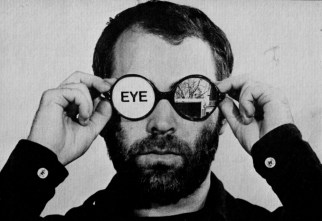
Stuart Sherman: ‘his work is based on a language of signs, words, sounds, actions and objects, the anecdotes suggested rather than stated’
Portrait of Places, a work by the performance artist Stuart Sherman, is being presented in a tiny loft in downtown SoHo, New York. On either side of the small stage is a heap of tat – plastic roses, artificial grass remnants, plastic macs, bits of card. My programme tells me that I’m about to witness approximately 30 vignettes of places – Amsterdam, Cairo, Coconut Grove, Copenhagen, so the list goes on through the alphabet. A little man, casually dressed, comes on to the stage, chooses various items from the heaps, sets up a camper’s table, touches something, scrubs this with that, holds both in front of his nose, puts away his table, exchanges the objects for fresh ones, glances at a list he removes from his breast pocket – presumably to see which country comes next opens an umbrella, sticks a plastic rose through a hole in the umbrella, answers the telephone, searches in his pockets, throws away the telephone and the rose, picks up another object, spins it, blows on it, unties a package, allows some small rubber balls to roll out on to the floor, places patent leather shoes under the legs of the newly erected table, turns on a tape, turns off a tape, dismantles everything, runs a film, does something else, does something else.
At the end of the performance I am nonplussed. I have never seen so much happen in so short a time, but I am unsure of what I have seen. I can’t say I recognised any of the places from the events which took place. Anyway, I go to a nearby bar to mull over what I remember. I have to make a phone call. I go to the phone, put down my drink on the ledge, pick up the phone, put it down while I unzip my jacket, search for my address book, my dime, my specs, pick up the phone, insert the dime, dial, pick up my drink – and there I am perceiving myself doing this, coping with the myriad procedures of living. Could these actions in a phone booth be my vignette of New York? When the work of an artist enables me to glimpse some new aspect of myself I know I have seen something original.
Walking out of the Rothko exhibition at the Hayward Gallery several years ago, I noticed that as I stood at the kerb I could see cars approaching in either direction without turning my head; being brought to comprehend the spread of vision because Rothko’s paintings had encouraged my eyes to fill with the entirety of each canvas, rather than swinging from one particular point to another.
Back to Sherman, while I might not have been able to identify the place from the vignette, I recall each vignette quite clearly. And where I can pin place to vignette there’s a sort of crazy aptness – even if these are distillations of quite personal events which may have taken place in the cities in question. A large white slice of foam rubber, for somewhere in Scandinavia, with holes cut to fit the objects employed in the sketch, including two spaces for Mr Sherman’s feet. I reckon Scandinavians do rather like to keep things in their proper places, even the foam-rubber-like snow. Sherman’s work resembles ‘Korf’s Joke’, celebrated by the German poet Morgenstern – you don’t understand it at the time, but a week later you wake up in the middle of the night, laughing like a drain. In Sherman’s work there are few repetitions, everything changes from moment to moment; an incredibly fast delivery of a string of action-jokes. His use of objects is revolutionary. I have never seen an actor who could pick up a candle without turning its article from indefinite to definite – it becomes ‘the candle’, or still worse, the vocative, ‘oh candle!’ Sherman handles objects for less time than they might be used in life, nothing becomes a symbol of itself, he might use a toothbrush only for as long as it would take to say ‘toothbrush’.
His performances are like a visit to the zoo where some highly intelligent animal chatters away at us in a language of signs, words, sounds, actions and objects: the anecdotes suggested rather than stated. In more recent works his stage is no more than the surface of a table, drawing from traditions such as the now almost forgotten flea circuses which used to be the marvel of every fair. He usually performs solo, but his work has nothing solitary about it. We eavesdrop on the struggles of love with death, time with money, erection with destruction, available to parents watching a child play.
Sherman is a puppeteer without puppets, with amazing capacity for surprise – just as we become engrossed in the events taking place on the table he may cough or slip sideways – impinging on the microscopic action like a giant or like the divinity. He is both powerful and original. He received a special citation from The Village Voice OBIE awards for his performances, and there is a chance that he may be performing at the Mickery Theatre in Amsterdam in May and at the ICA in late summer.
ROBERT WILSON

Robert Wilson: nothing is too large to attempt, too costly to organise, too revolutionary to be dared.
Robert Wilson is tall, brilliant, in his early thirties, and the most celebrated performance artist of the day. His large-scale, long-duration, hardly moving, visionary operas, mixing freemasonry with science fiction, Poussin with Saul Steinberg, sheer emptiness and lighting with special moments for casts of thousands; these works have won him prizes throughout the international theatre world. He pioneered theatre for the handicapped in America. Years ago, he took over a mountain near Persepolis with a piece which took a week to perform, and today, would make The Warp look like a piece of week-old jelly, dazzling only to the besotted eyes of some grey-bearded hippie. In London, his performances of I Was Sitting on My Patio This Guy Appeared I Thought I Was Hallucinating at the Royal Court last summer were greeted by non-comprehending notices.
But Wilson wears the laurels he has won abroad with aplomb, and with the approbation of all less parochial than ourselves. Not only is he an artist, but he is a king-maker among artists, a magician in the tradition of Diaghilev; nothing is too large to attempt, too costly to organise, too revolutionary to be dared. He has worked with many of the best of his contemporaries in the arts, including Lucinda Childs, in Patio, and Philip Glass, composer of Einstein on the Beach – the opera we in England have never been allowed to see. His smaller works, duets for himself and Christopher Knowles, or for himself and Childs, show an extraordinary grasp of the basic axioms of theatre, total theatre – if the term has not been belittled by incompetence here – the settings, pace, language, action, denouement of theatre, as well as bringing to light a new sort of dramatic irony and poetic melancholy. His achievement is too large, too various to be dealt with adequately here, spanning as it does surrealism and concept art.
Wilson is exhibiting video works at the Beaubourg, directing Shakespeare in Scotland, while a new piece has just opened in Berlin, entitled Death and Destruction in Detroit. Rumour has it that a new, large scale work is in the offing, with one or other of the greatest male classical dancers participating – that has to be Nureyev or Eric Bruhn, doesn’t it? What a shame the size-conscious Royal Ballet has sat on Wayne Sleep for so long or he could have been in the running for the role. Wilson’s work is extremely well received in Berlin, Paris, Amsterdam and New York, to name but a few places, and his lack of exposure to British audiences cannot be excused by the holes in our pockets and has to be put down to the envy of the British theatre establishment – who are scared stiff of him – and the sheer inadequacy of the British critical establishment who, saving perhaps Nigel Gosling, lack both the guts and the criteria to judge him. A.H.
I have tried to find the photos originally used wherever possible, and I think the images of Childs and Glass are by Nathaniel Tileston. I will add credits whenever notified.
My essay comparing attitudes to perversion then and now is to be found here
Books discussed:
What are Perversions? by Sergio Benvenuto, La-Bas (The Damned) by J.-K. Huysmans

DICK
Eight days after the invasion we were dealing with a country
That could actually finance its reconstruction by our own
Reconstruction contractors. A decade later, and we have a failed
State which is relatively easy to exploit, and that assessment
Could hardly have turned out to be any more auspicious for my company.
We have supplied more than a billion meals and more than twenty-four
Billion gallons of drinkable water, several icebergs of ice,
And everything from bodyguards to power plants and toilet paper.
Facing bankruptcy before, I found myself in the role of adviser
Advocating a policy by which we stood to gain by what ensued,
As indeed was readily understood – if we could only engineer
An excuse, if we could accuse a bastard worth bringing to his knees.
Evil is what is bad for you, said Spinoza. The war did me much good.
Prior to it, I prophesied the profit. Clearly, in my country’s eyes,
I have done my duty, having grown the stronger. And so I am proud
To have effectively delivered all and sundry to our martial forces.
We weathered the vicissitudes of conflict and ended up emphatically
Secure in a hostile climate where there were more private outfits
Plying for hire than in any previous war. A visionary, that’s me.
And my adherents (pioneers) perceive the Wild West as in the East.
Entrepreneurs, committed to development, they lead the way
In advocating the collapse of standards and the instigation of chaos,
Setting alight false beacons to lure your ships of state onto the rocks
From a liberal point of view; their torches freedom and democracy.
On savage shores my people serve the wreckers. Less of an endeavour
Than what was once required to colonise a source of blessed revenue.
Indeed, even our own government is redundant, and very soon we hope
To privatise war itself, just as some are seeking to copyright eternal life.
Anthony Howell, published in FROM INSIDE – a new collection of poems from The High Window Press March 2017

Grey Suit Issues 1-12 are now online! Thanks to BFI, Elephant Trust, Ikon Gallery and ACE. We did it!
Here is the link to the videos at Grey Suit Editions
Grey Suit Online
Grey Suit was a magazine on VHS videotape published under the auspices of the University of Wales Institute Cardiff and supported by Arts Council England. It ran from 1993-1995. During that time 12 issues came out (one a double issue) – all in all, 13 hours of material were published.
Poets: F.T. Prince, Hugo Williams, John Ashbery, Anne-Marie Albiach, Huang Xiuqi, Caroline Bergvall, Les Murray, Cris Cheek, Peter Didsbury, Liz Lochhead, Ifor Thomas and Kerry-Lee Powell. Performance artists: Stuart Sherman, Teemu Maki, Paul Granjon, Mike Stubbs, Mehmet Sander, Anne Seagrave, Stelarc, Station House Opera and Bobby Baker. Film-makers and musicians: Tony Hill, Kai Zimmer, Frigo, Harald Busch, Cathy Vogan, Catherine Elwes, Derek Bailey, Jayne Parker, Wineke…
View original post 1,177 more words
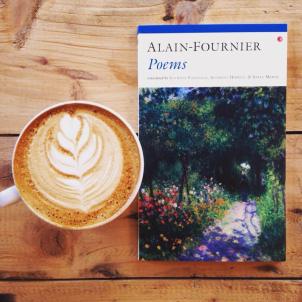
Finally, a review in the Manhattan Review of our versions of Alain-Fournier’s Poems
*
*
*
*
*
*
*
*
*
*
Here is a link to Alain-Fournier’s Poems
and here is my short essay on Alain-Fournier published by the Journal of Poetics Research .
(Versions by Anthony Howell)
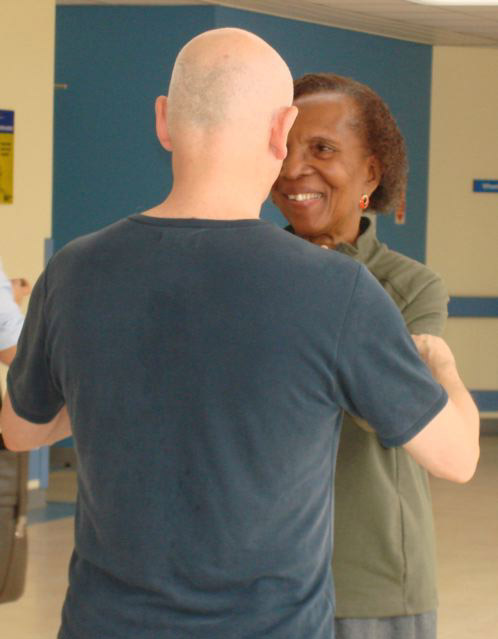
Tango is easy! Believe it or not, anyone suffering from Parkinson’s, M.S. or any other gait disability can get a lot out of these simple exercises which are always done with the your partner’s arms supporting you. Lovely music too!
Two teachers apart from myself, Lorna Stewart and Fay Laflin, are now qualified to teach Tango for Balance – a deeply thought-out exercise system I devised and trade-marked a few years ago. Only teachers with an EXTEND qualification for teaching movement to music for the elderly are qualified to teach it, plus they must have at least three years tango experience and have done a course in teaching my system with me.
Click for up-to-date news about Tango for Balance. These posts relate to Fay Laflin’s wonderful group classes and you can message her for more details. These days, I am prepared to teach individual lessons but I am not running a group class, unless invited by a group. You can ring 0208 801 8577 if you are in central London to arrange a lesson.
Here is our website.
We are working on a new brochure and will publish it here when completed. Meanwhile, here is a link to an earlier one. Read our brochure – contact details at the end.
Click here for our brochure:


 anthonyhowelljournal