On my 7th birthday we were in Austria and I wanted to climb a mountain. In the evening my mother and I climbed so high we couldn’t find the way down again and had to be rescued by eight guides and a rope!
What is the connection between Wallace Stevens and the Wallenberg family, I wonder. Esse non videri. That is as far as I’ve got.
Here is a link to a history of the Wallenbergs. Basically, they are the most powerful family in Sweden. Esse non Videri is their family motto. “Existing, but invisible.”
They were instrumental in helping Jews escape the Nazis in WW2. Fair enough, but contemporary events in Gaza cast such sympathy in an uncanny light.
x
Call the roller of big cigars,
The muscular one, and bid him whip
In kitchen cups concupiscent curds.
Let the wenches dawdle in such dress
As they are used to wear, and let the boys
Bring flowers in last month’s newspapers.
Let be be finale of seem.
The only emperor is the emperor of ice-cream.
x
Take from the dresser of deal,
Lacking the three glass knobs, that sheet
On which she embroidered fantails once
And spread it so as to cover her face.
If her horny feet protrude, they come
To show how cold she is, and dumb.
Let the lamp affix its beam.
The only emperor is the emperor of ice-cream.
x
Stevens was probably aware that this phrase happens also to be the motto of North Carolina. So far so good. But this is a quantum post; a post aligning dislocated facts simply for the sake of a phrase. So I’m interested in why the Nobel Peace Prize has just been awarded to a rabid Zionist and one intent on interfering in democratically-elected Maduro’s Venezuela. Alfred Nobel was another billionaire Scandinavian, one who invented cordite and dynamite. Like Mrs Winchester, widow of the rifle mogul, he suffered from a guilty conscience.
Sometimes it is Esse quam Videri – but the meaning seems broadly the same – well, up to a point. Esse quam videri is found in Cicero’s essay On Friendship (Laelius de Amicitia, chapter 98). Virtute enim ipsa non tam multi praediti esse quam videri volunt (“Few are those who wish to be endowed with virtue rather than to seem so”).
Just a few years after Cicero, Sallust used the phrase in his Bellum Catilinae (54.6), writing that Cato the Younger esse quam videri bonus malebat (“He preferred to be good rather than to seem so”).
Previous to both Romans, Aeschylus used a similar phrase in Seven Against Thebes at line 592, at which the scout (angelos) says of the seer/priest Amphiaraus: οὐ γὰρ δοκεῖν ἄριστος, ἀλλ᾽ εἶναι θέλει (ou gàr dokeîn áristos, all’ eînai thélei: “he doesn’t want to seem, but to be the bravest”). Plato quoted this line in Republic (361b). Cicero’s essay On Friendship (Laelius de Amicitia, chapter 98). Virtute enim ipsa non tam multi praediti esse quam videri volunt (“Few are those who wish to be endowed with virtue rather than to seem so”).
However, the phrase seems to have acquired some spooky overtones – “to do without being seen” appears to be one of them. It also seems to get reversed in much popular opinion – “to seem, rather than to be,” or, according to the Free People’s Movement in Sweden – “acting without being seen.” So like the moebius strip, it turns itself inside out while remaining a single surface. Reminds me of the motto of Mossad – “By way of deception, we have done war.”
There is a great video on Odysee.com by ImplodeX called Esse non Videri, but I can’t seem to upload it here.
Anyway, I got a poem out of this, which perhaps demonstrates the slipperiness of language. However, I keep altering it – and perhaps it’s the sort of poem that can never be resolved. The phrase epitomises the enigma of language; that meaning is all too often an assumption.
I have always maintained that to view culture (art, literature, music etc) chronologically – as if it were a narrative of effect followed by cause – is a rather daft way of interpreting things: a perception engendered by the twentieth century – hooked up to its belief in progress and modernity. My online project – Art and its Dark Side – is a series of eight essays dealing with the ‘rivers of art’ – creative concerns which have the abiding power to preoccupy artists and writers, and which have always had currency in our cultural life. Two novels one thousand eight hundred years apart constitute a testimony to this achronological view.
“Far we had not gone but we came to a river, the stream whereof seemed to run with as rich wine as any is made in Chios, and of a great breadth, in some places able to bear a ship, which made me to give the more credit to the inscription upon the pillar, when I saw such apparent signs of Bacchus’s peregrination. We then resolved to travel up the stream to find whence the river had his original, and when we were come to the head, no spring at all appeared, but mighty great vine-trees of infinite number, which from their roots distilled pure wine which made the river run so abundantly: the stream was also well stored with fish, of which we took a few, in taste and colour much resembling wine, but as many as ate of them fell drunk upon it; for when they were opened and cut up, we found them to be full of lees: afterwards we mixed some fresh water fish with them, which allayed the strong taste of the wine. We then crossed the stream where we found it passable, and came among a world of vines of incredible number, which towards the earth had firm stocks and of a good growth; but the tops of them were women, from the hip upwards, having all their proportion perfect and complete; as painters picture out Daphne, who was turned into a tree when she was overtaken by Apollo; at their fingers’ ends sprung out branches full of grapes, and the hair of their heads was nothing else but winding wires and leaves, and clusters of grapes. When we were come to them, they saluted us and joined hands with us, and spake unto us some in the Lydian and some in the Indian language, but most of them in Greek: they also kissed us with their mouths, but he that was so kissed fell drunk, and was not his own man a good while after: they could not abide to have any fruit pulled from them, but would roar and cry out pitifully if any man offered it. Some of them desired to have carnal mixture with us, and two of our company were so bold as to entertain their offer, and could never afterwards be loosed from them, but were knit fast together at their nether parts, from whence they grew together and took root together, and their fingers began to spring out with branches and crooked wires as if they were ready to bring out fruit: whereupon we forsook them and fled to our ships, and told the company at our coming what had betide unto us, how our fellows were entangled, and of their copulation with the vines. Then we took certain of our vessels and filled them, some with water and some with wine out of the river, and lodged for that night near the shore.”
Lucian’s True History – a novel by Lucian of Samosata – 2 nd century AD
“Where return? To the mines? Hebdomeros instinctively avoided these unhealthy areas where fever reigned unchecked all the year round and innkeepers place sulphate of quinine on the tables as elsewhere one places pepper and salt. Rather the boredom of a life adjusted to the hands of a watch but essentially logical and not lacking in poetry, full of unshed tears; the life on this road lined with houses from each of which rose the lament of pianos bothered by adolescents practicing their morning scales. All that would have been quite normal, after all, and Hebdomeros, not to mention his friends and disciples, would hardly have been averse to taking a few days’ rest in these monotonous, reposing surroundings, but something unusual drew their attention and made them realize that things were not as normal as they had at first thought. In front of each house was a small garden with cane benches and chaises longues; in each garden an enormous old man, made entirely of stone, was stretched out on one of the chaises longues; Hebdomeros was astonished that the chairs were able to support such a weight, and said as much to his companions, but when they drew nearer they saw that the armchairs which they had taken to be made of cane were in fact all metal, and the interweaving of the steel threads, painted a straw color, had been so well conceived that they could have withstood far greater pressures. These old men were alive, yes, alive, but only just; there was a very faint glow of life in their faces and the upper part of their bodies; at times their eyes would move, but their heads remained motionless; it was as if they were suffering from an eternal stiff neck and wished to avoid the slightest movement from fear of reawakening the pain. Sometimes a light flush spread over their cheeks and in the evening when the sun had disappeared behind the nearby wooded mountains they talked from one garden to the next, telling stories of long ago. They spoke of the days of hunts for roe deer and grouse in the forests that were damp and dark even at noon; they recalled how many times they had rushed upon one another, holding their rifles by the end of the barrel and brandishing them like clubs or grasping their hunting knives in their fists. The eternal cause of these brawls was a dead animal that two hunters at once claimed to have killed. But one evening the big stone men no longer spoke; specialists who were hastily called to examine them found that the tiny glimmer of life that had kept them alive until then had disappeared; even the top of the cranium was cold and their eyes had closed; then it was decided to have them taken away so that they shouldn’t uselessly encumber the little gardens of the villas; a man who called himself a sculptor was summoned; it was a man with a disquieting manner and a horrible squint; he mingled in his conversation stupid puns and coarse jokes and his breath stank of brandy from yards away. He arrived with a case full of mallets of various sizes and set to work right away; one after the other the old stone men were broken up and thrown into the valley, which soon began to look like a battlefield after the battle. The tide rose up to these pitiful fragments; down there behind the black cliffs whose silhouette looked like the figures of gothic apostles the moon rose; a pale, northern moon; it was fleeing on the clouds across the sky; Hebdomeros and his friends stood like shipwrecked men on a raft, looking toward the south…“
Hebdomeros by Giorgio de Chirico, written in France in 1929
Lucian, a Greek-speaking author of Assyrian descent, wrote his “true history” as a satire on far-fetched tales attributed to ancient sources. It includes travel to outer space, interplanetary warfare, fusions of myths and rumours, and has been described as “the first known text that could be described as Science Fiction.” The writing swings easily from mythic scene to futuristic imagery in very much the way that Hebdomeros – one of the few Surrealist novels – moves from one fantastic scene to the next. John Ashbery has said of it:
“Surrealism has probably been the most powerful single influence on the twentieth- century novel, yet it has produced few notable surrealist novels… The finest of them, however, is probably Hebdomeros, written by Giorgio de Chirico. His language, like his painting, is invisible: a transparent but dense medium containing objects that are more real than reality.”
The same could be said of the True History. So surrealism was not invented in the twentieth-century: that century merely gave it a name. It has manifested itself in some form or other since Roman times, as has abstraction, which can be found in several painters working in the Renaissance – an example being the work of Giovanni Battista Bracelli – look at his Bizzarie di Varie Figure created in 1624), and also Songues Drolatiques de Pantagruel – done in 1565- possibly by Francois Desprez. These illustrations to Rabelais should remind us that Rabelais also may be considered an author writing in the same fantastic vein.
Poet and editor of the esteemed Anvil Press Poetry list, now at Carcanet.
The Blessings and the Curse of the Bright Apple
What happens to books described as MINOR CLASSICS? I once asked a small-press publisher. They go out of print, he told me.
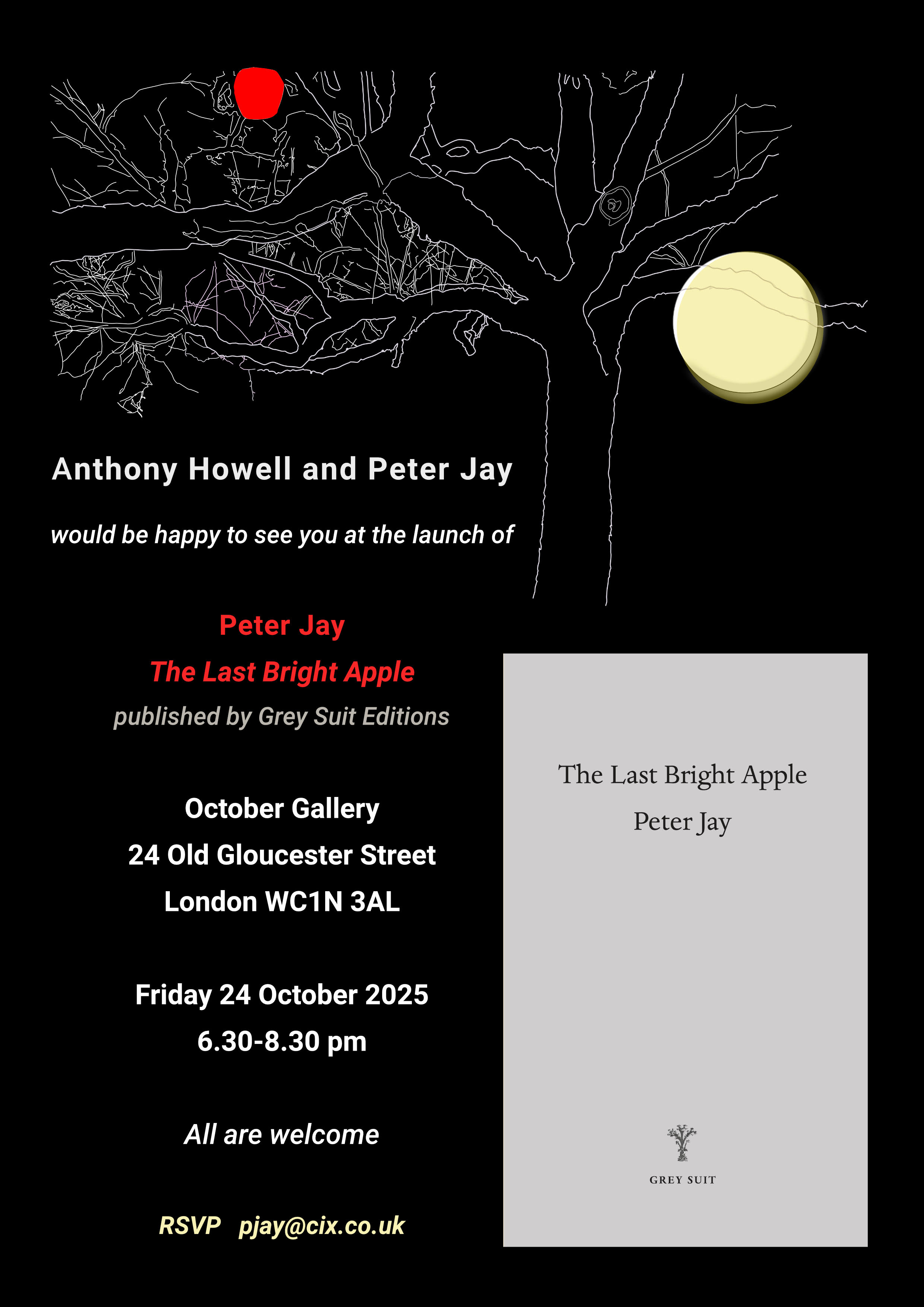
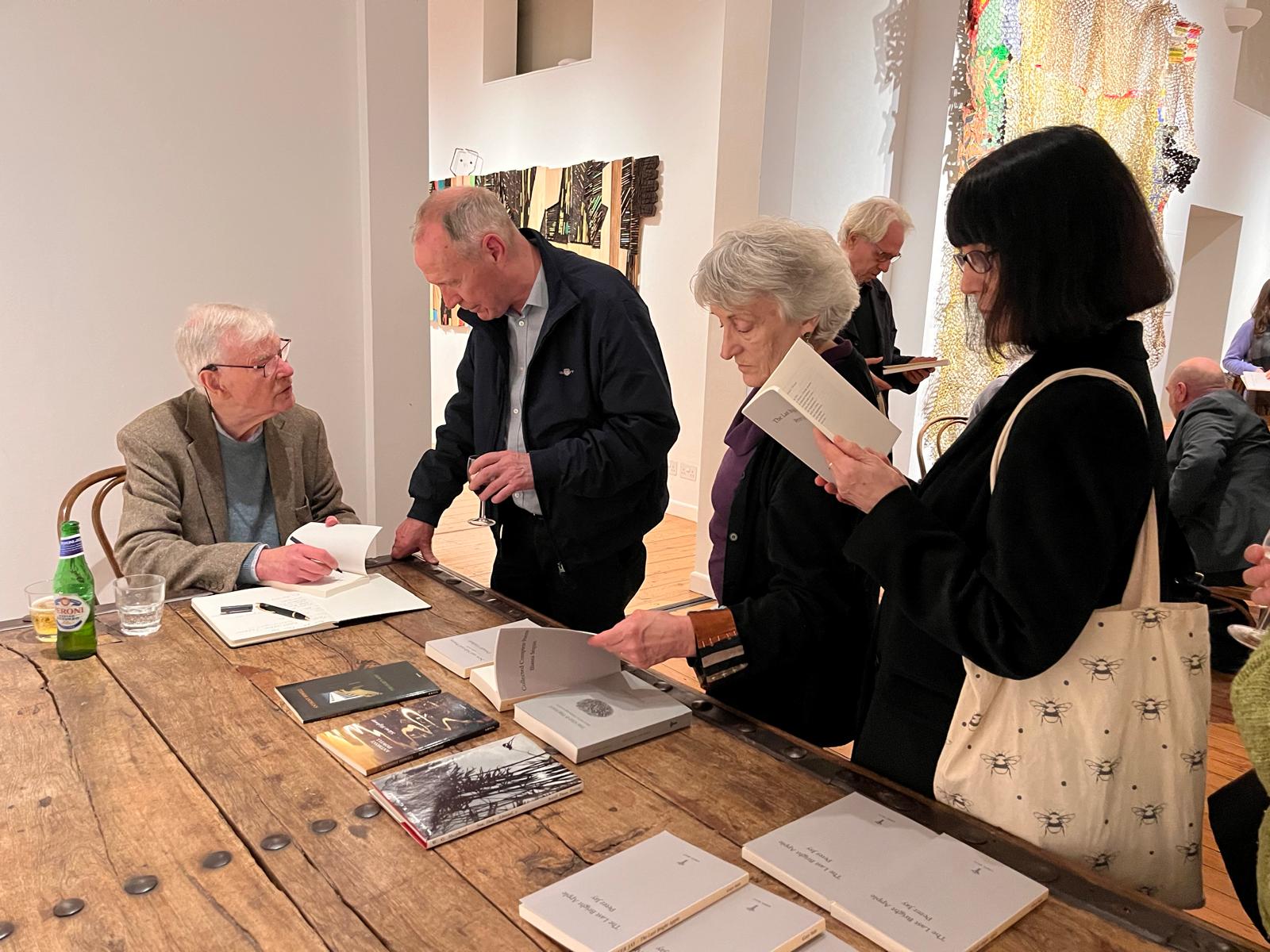
I thought of that remark this morning when I was looking again at a new book of poetry called The Last Bright Apple by the poet and publisher Peter Jay, a man best known for much of his working life as the founder and publisher of Anvil Press.
Anvil not only published a remarkable roster of poets, but also did so with some style. Peter Jay cared about how the books looked and felt in the hand.The paper on which the books were printed did not discolour after eighteen months.
I was first asked to review a book published by Anvil in 1984, when I was reviewing books of poetry for a monthly magazine called Books & Bookmen. The book was called Les Chimeres and its author was a 19th-century French art critic and poet called Gerard de Nerval. And its translator? Peter Jay, who was also its publisher.
Several things struck me about this book: that it had been published at all; that it was in hardback, which gave it a sense of authority that it deserved; and that it was such a beautiful object, so lovingly crafted.
I also thought this: only a dedicated madman would publish such a book as this in these inclement times. How many people will buy a book of poetry in translation?
But this gets us down to the nub of it. Publishers of poetry, those who establish and run small presses, generally are madmen. And mad women too. They have nothing to gain except to be known by a grateful few as publishers of poets who would often otherwise remain almost entirely unknown. Peter was one of those.
What is less known is the fact that Peter Jay was a fine poet in his own right, and this new book shows off his talents as a poet as never before, and a part of that talent was an ability to take off from, or perhaps to riff on, poets of the past, and they were usually much more temporally remote poets than Gerard de Nerval.
The book is slender. You can read it at a single evening sitting, as I did. It is a book of tender reserve, of wistfulness, of the reaching out for symphonic moments which, grasped after, often seem to recede into a mist of incomprehension or unknowing. It is also, needless to say, a book deeply informed by the history of poetry and its past.
Peter rather regrets the fact that there is not more of it, that he did not squeeze more of the poet out of himself.
That, of course, is one of the curses of being a small-press publisher, that a strange, selfless dedication to publishing the poetry of others comes first.
The Last Bright Apple is published by Grey Suit Editions at £15 – Review by Michael Glover
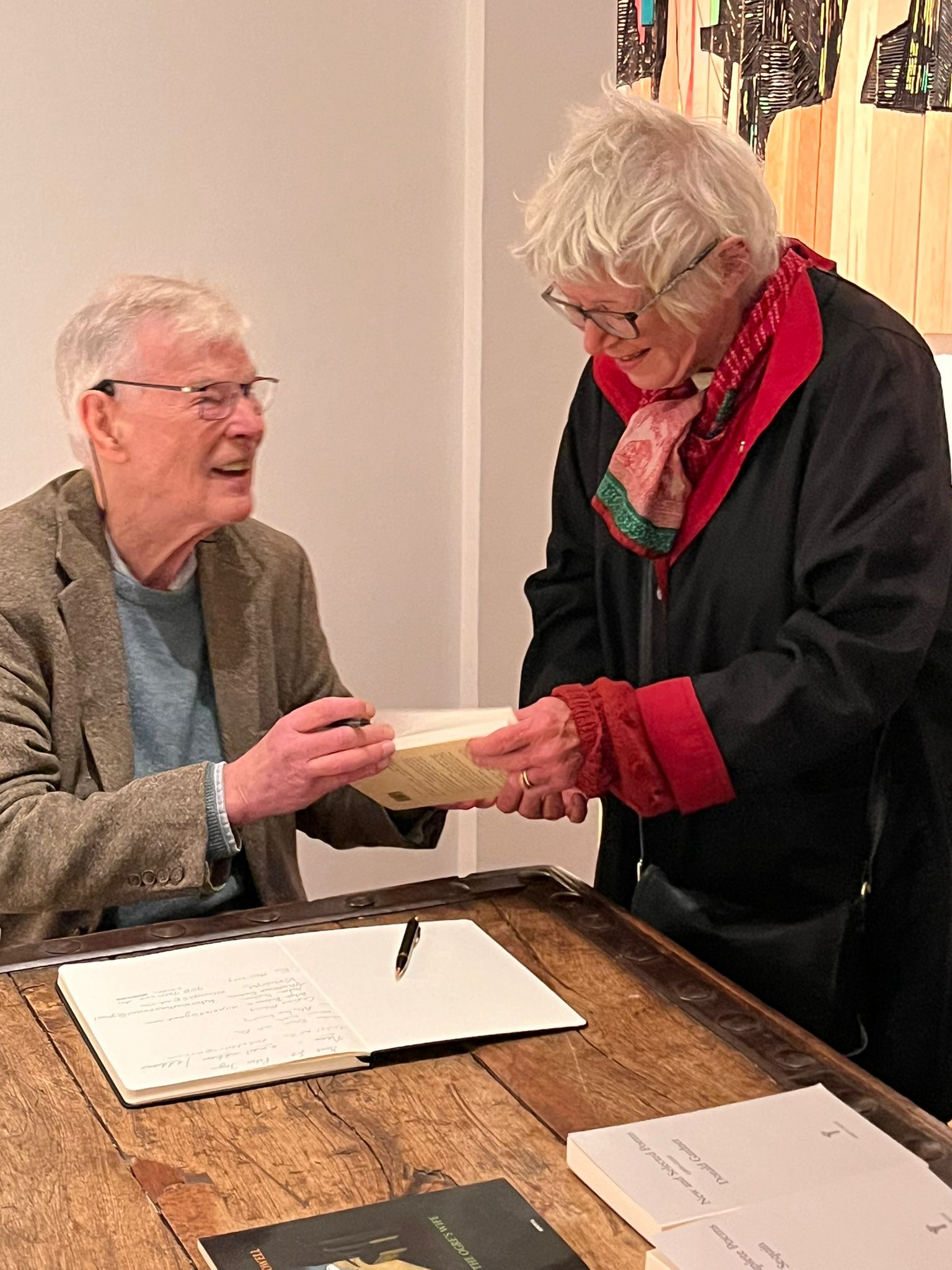
The launch went wonderfully well. Thanks to all who came and made it such a special occasion. Thanks to Tatiana for organising the event and Marian for organising the book sales.
Boy, was that a nasty experience. No joke. I got cancelled in Paris, teaching young women who were appalled that I showed performance art without a trigger warning. I was teaching 18 women, half under 30 and mainly from the USA and Canada, and half older and European. I had explained that I felt younger people were very concerned with their work having “meaning” – improving society, or making the person experiencing their art “feel better” – so, although I would introduce the basics of a performance grammar – stillness, repetition, inconsistency – I wasn’t going to stick to abstract performance aesthetics and technical know-how. We would address making art with deliberate intention, as well as therapeutic, political and moral art.
On the second day we did a “niceness” workshop – in groups of three. One witness to another person being nice to someone, then rotating the roles. It was suggested that the performers should increase the intensity of their niceness until it turned toxic. This workshop was a great success. Later I talked about the rivers of art – that art was not all niceness and beauty, that Aphrodite was depicted as with a curve from her vagina to her head as part of the Fibonacci curve, a platonic ideal, but below – well – Theseus established the brothel below the Parthenon, dedicated to Aphrodite as a whore. I explained that art was ambivalent, enigmatic in this way – not only could it be innocuously formal or classically grand, it could be immoral, grotesque, uncanny or capricious.
I had shown examples of my work each day, and on the third day I showed Objects – without a trigger warning. I deliberately showed it that way, as I don’t think trigger warnings are appropriate for performance art, and anyway I wanted to discuss what trigger warnings implied: a frame that contextualises the art prior to it being watched, which weakens its impact to my mind. Besides, I have never in my life given a trigger warning. As for meaning, I guess Objects appears to be about a ghoulish man who keeps floppy naked women in coffins while hypnotising fully dressed women into rigidity.
Scroll down on THIS LINK to watch ‘Objects’ on vimeo.
Half of the class, mainly the under 30’s, decided to walk out of this performance within a minute of its starting and cancel me with furiously justified vehemence because I had not given them that trigger warning – so the whole workshop became a battle-ground from then on. Since they all pay for their education, the student client culture now prevailing means that as a client you expect to get the education you prefer to get – just as one expects to get any item purchased in a shop. And today, young people have been groomed to be empathetic and extremely sensitive to each other’s sensitivities, gender needs, pronouns, previous traumas. Nowadays a young person’s authentic experience is more than equal to a teacher’s learning, and so, as a teacher, you are expected to teach only what young people already know, or want to know. So no empathy for the eighty-year old teacher who toddles off to Paris for the week, worried that his prostate will last out and that he can get his seizure medication.
Seeing it as my job to talk from the point of view of devising a performance (which was what the entire month’s workshop was ultimately about), I explained that when I made the performance I was broke, and so I had asked two performers to just let me move them around. No rehearsal. I paid for their transport. They agreed. I thought about humans as objects and came to the conclusion that people can be either floppy or rigid. So I decided on one of each. From here on the performance created itself – as the best performances do. It was obvious that it would become more loaded if the floppy object was naked, and if both were women. In other words, the significance accrued during the evolution of the piece from concept to result. Naturally this explanation offended those offended even more!
We went out onto the streets of Paris the next day, in order to explore protest as art, but discovered that there was a police station near every public space that might have been suitable, and the police told us that one had to apply for prior permission in order to perform or protest in public spaces in Paris. This in itself was a learning experience – though it seems that single singers in front of cafes are exempt from this edict.
By then I was well and truly ostracised by the offended group, which was half the entire class. It was pointed out that I had used the word “whore”. The person who pointed this out to me was the director’s airy-fairy and possibly anorexic assistant who was in the habit of making gazelle-like dance gestures as she talked. I came to feel she was actually in cahoots with the cancellation mob. She told me that the whole week had got off on the wrong foot because I had not initially asked everyone their names. I took that on board; but I never do it because I always forget names and feel embarrassed if I have previously asked for them. I often ask, when a question is raised, because then I can associate the name with the question. I also am very strict about answering all questions asked.
I began to feel like the one person in the class who is bullied and ostracized at school (well, I have a fairly-thick skin actually, but this very cancelling seemed part of the workshop’s subject matter as we had already talked about the “cancel culture”).
One of the students who had walked out had they/them as their pronouns. And the rest of these young people would all describe themselves as feminists, (and I guess they all support Palestine). However they get furious if you offend their “sensitivity” – or might have offended the sensitivity of some hypothetical other who might have had a trauma revived because of the absence of a trigger warning. It was as if they were “sensitive plants”. I said this to the lissom assistant, and she became tearful and hid her face in the organiser’s sympathetic shoulder. Is this the new feminism? Whoa! It’s more like the new femininity. It’s anti-feminist in my opinion – an insistence on a new gentility – and for women a retrograde step. I don’t think it would impress my suffragette grandmother who chained herself to the railings of Buckingham Palace, or Aunt Jean who went to prison for CND. After all this, I felt distinctly unwelcome. Luckily the older, European half of my class were very supportive – several did powerful performance solos on the last day, and one told me that she had become intensely irritated by this young clique that had dominated their month-long course. The rest of the last day’s performances were basically abstract contemporary dance. So performance art was cancelled as well as its teacher. Feedback was obviously not desired, though the individuals who had created solos came up to me privately and appreciated my response. And while the older students (over thirty-five) thanked me for what I showed them, the younger ones spent the remaining part of the week ignoring me – except for one Irish girl who thanked me for the issues I had broached and said it had given her much to think about.






 anthonyhowelljournal