-
Recent Posts
Categories
Archives
-
Join 743 other subscribers
Meta
x
THE SUMMER-HOUSE BURIED BY SNOW
x
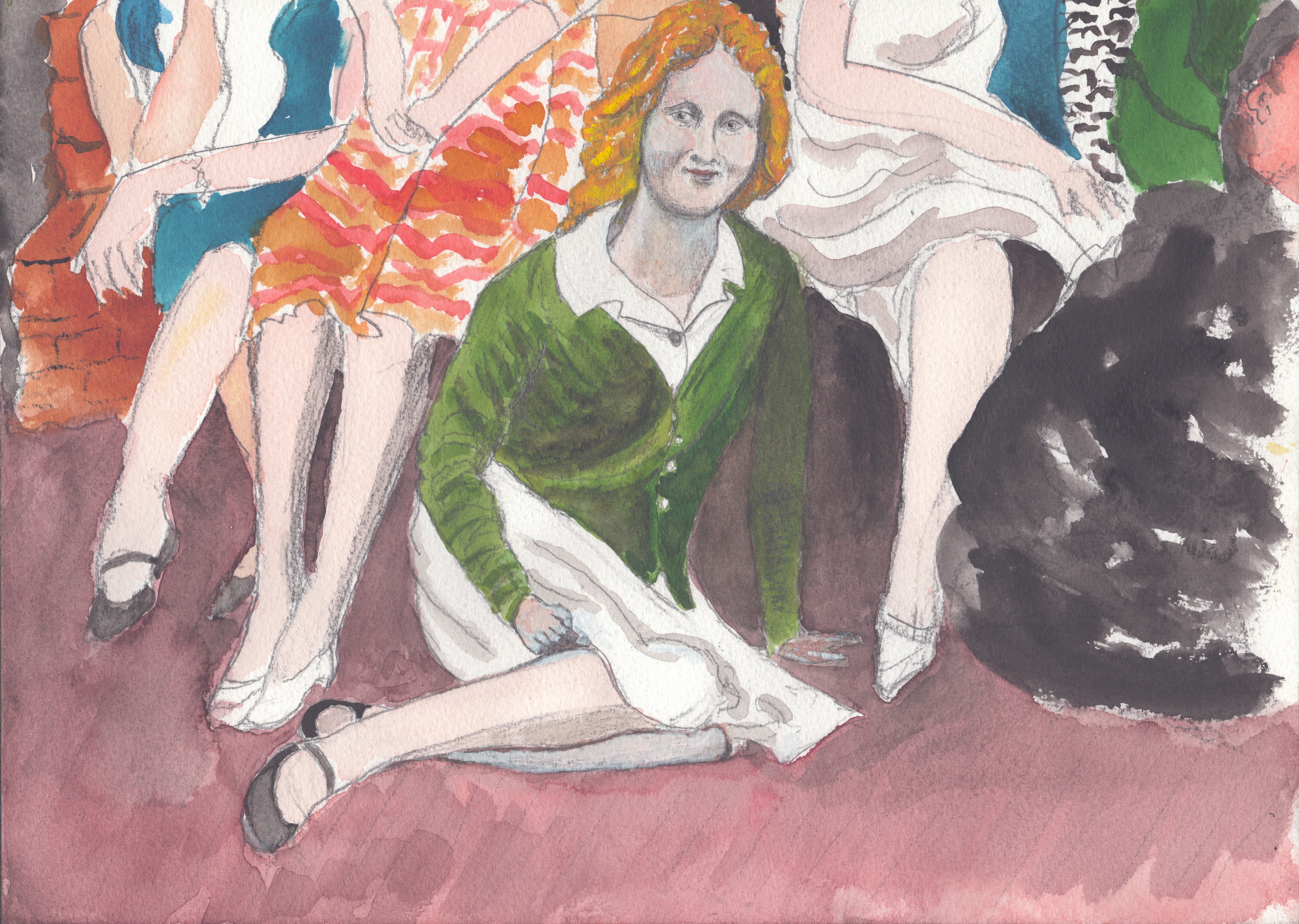
There were girls asleep on the beds, upstairs and down.
I was living in the dreams of Paul Delvaux.
When they woke up, it was slowly, slowly, and then
One hit another on the head for wanting to throw
A party. “I’m the one who does that,” she said.
x
When I went to Chinatown with Clemency
It was like going down the escalator next to a Botticelli.
That pallor – the girl was a manner of being,
Didn’t eat meat though, suffered from migraine,
Unlike the one like the wild honey on Capri
x
Who drove a Cortina and took me to dinner.
Later she lay on her stomach, a pillow beneath her,
While out on the court, a girl with the loveliest legs
(Clad in my turquoise running shorts)
Tossed up the ball to serve an ace.
x
Girls wrapped in towels, glimpsed on stairs,
Humming beneath their thick white turbans,
Girls in gym-slips, wedded to trapezes,
And tall African girls loping down corridors,
The flashing of their soles persisting
x
After their bodies have merged with the shadows.
Crinolines rustle and skirts with many sashes
Bob together in private like whispering bells,
Fans with ivory spines bicker in parlours,
But still the one in the boots tramps on down freezing streets.
x
She needs no applause. It doesn’t matter to her
What people think, and she is quite indifferent to the fact
That she smells of gardens, nuts in May, the creaminess of spring.
x
LOSSES
x
That crystal goblet – it had stood on my mother’s bedroom
Chest-of-drawers for ever, as Brigid had, her wooden cow
Kept since she was a child, head chewed by a dog though,
Body daubed with big red spots; gone, as have the Arnesby Browns:
The small one of the windmill, last seen in a storm across a field
Of corn, the larger one of cows in a sun-fumed pasture.
x
Gone, gone, as have the zoological volumes, ages old,
Illustrated with wood-cuts, the Senna kilim taken from my
Flat in Islington, the cricket bat with autographs of Hobbs and
The rest of the team, given me by Uncle Paul, who must
Have gone up and asked for them at the end of some long
Afternoon at Lords. Gone, along with his father’s Sandhurst
x
Sword of honour. Stolen, lost, or simply forgotten.
Absences that lose me sleep, as does that magnificent oak
Felled by some farmer who begrudged the shade it cast on his crop.
Not the death of my father, since that is simply an idea:
He had been killed before I was born, so never someone
Missed the way I missed my intellectual cousin Jean,
x
Found collapsed on the floor of her flat, and Clemency
Who stole my heart without intending it. She phoned me up
Years later, after I was married, then committed suicide,
As Nick did, as did Graham; and my tiny daughter Storm
Who crawled away delighted by my chasing her and then was gone,
Gone like the ball I watched at four float away down the Hudson.
x
To the memory of Clemency Clift, a wonderful dancer with the Royal Ballet back in the sixties. I was very much in love with her.
I just acquired 9 wonderful prints by Charles Fouqueray – a war artist I had never heard of.

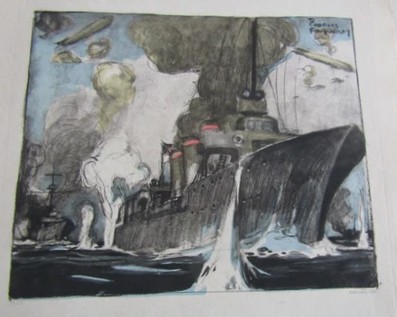
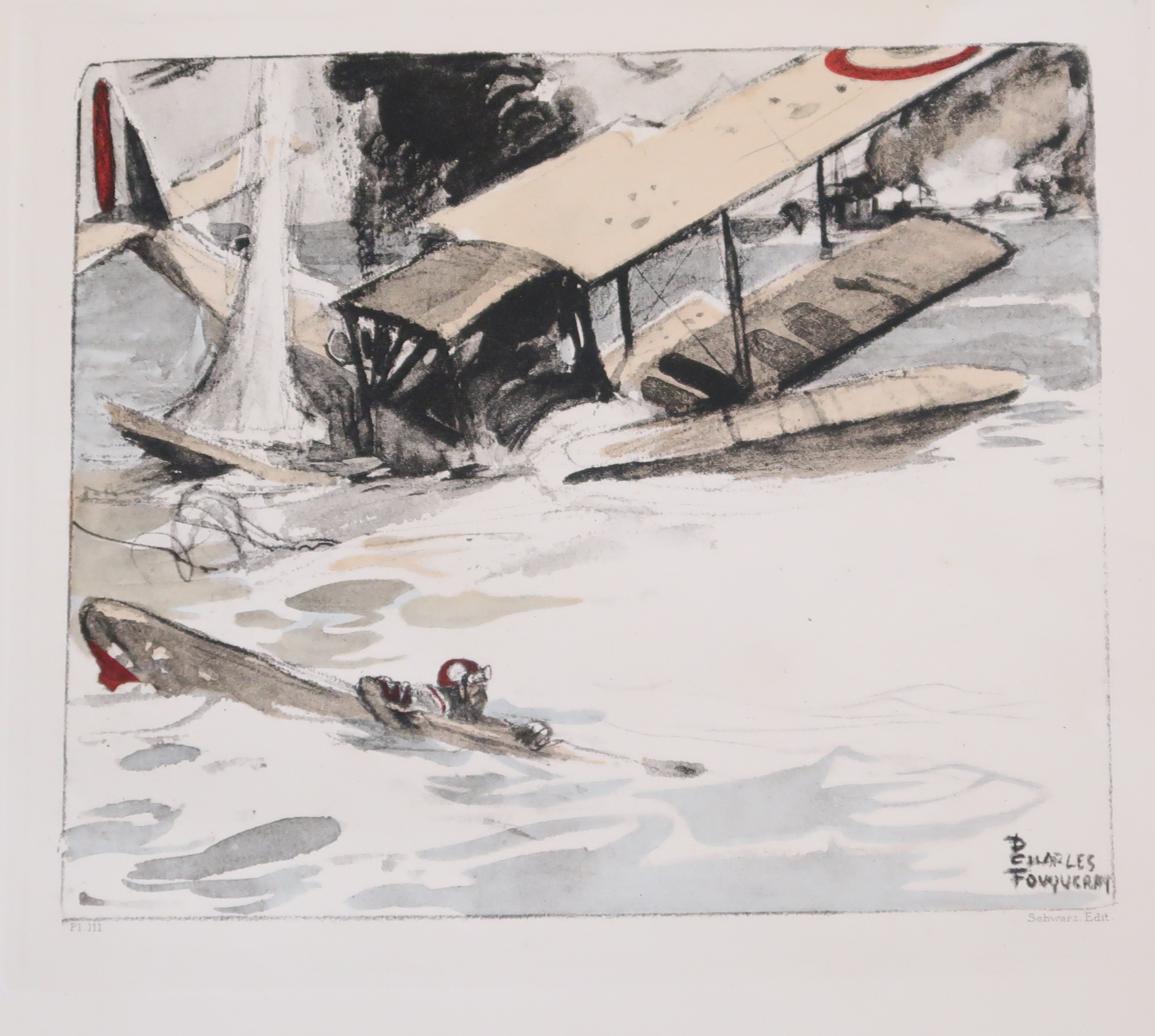

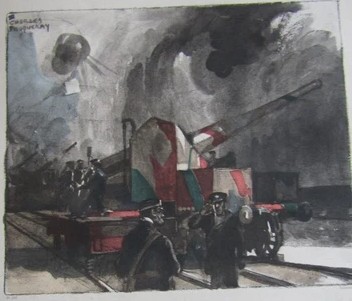

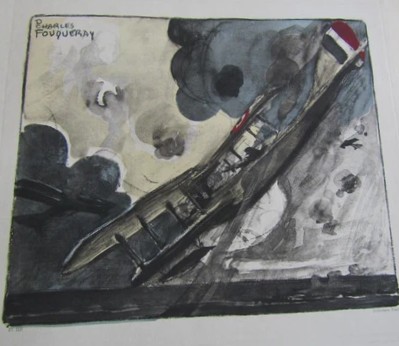
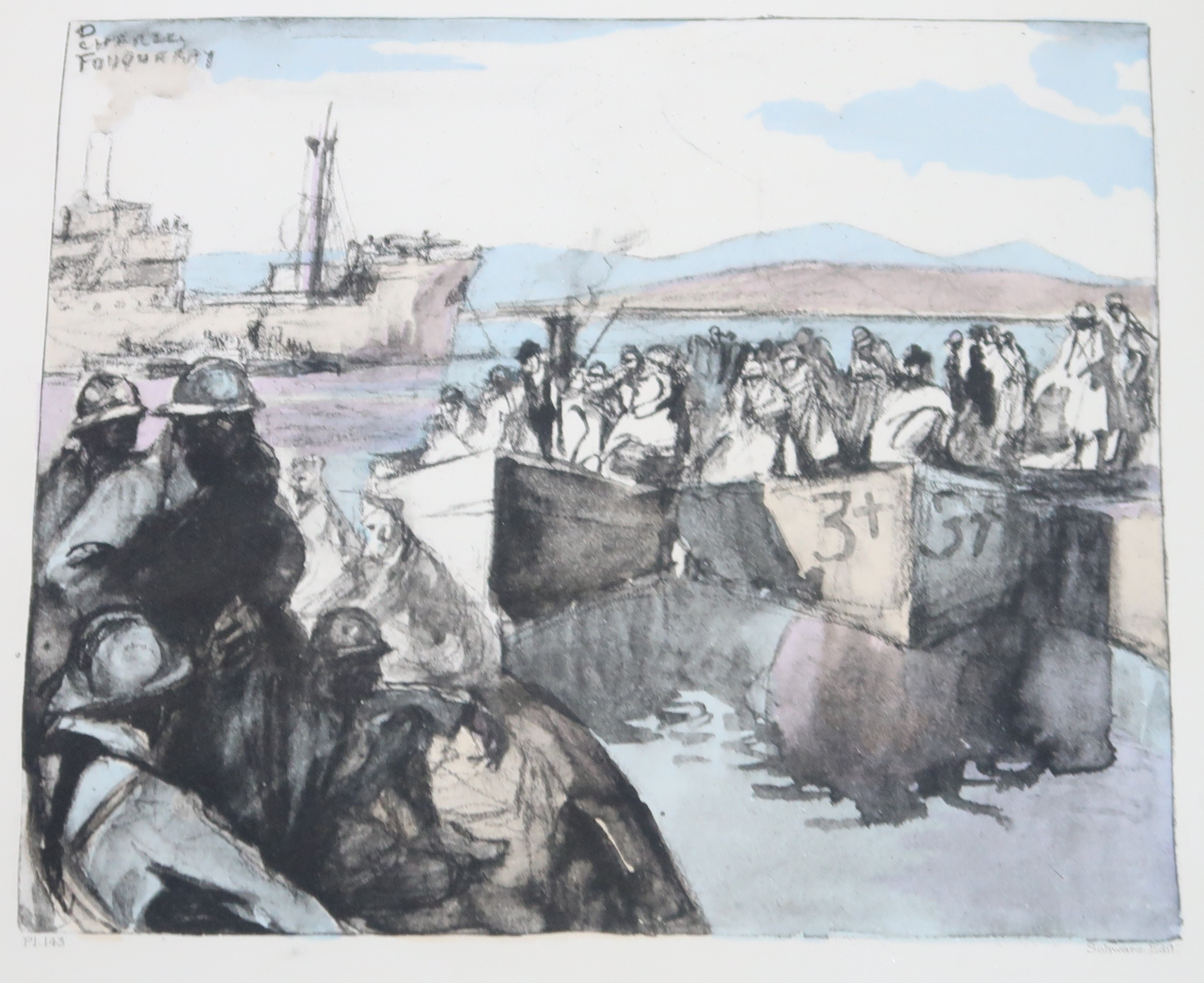
Charles Dominique Fouqueray (Le Mans, 23 April 1869 – 28 March 1956) was a French painter. He studied at the École des Beaux Arts in Paris under Alexandre Cabanel and Fernand Cormon. From 1908 he was Peintre de la Marine, following the career of his father, a naval officer. He was recipient of the 1909 Prix Rosa Bonheur, then in 1914 the first Prix de l’Indochine.
AUTUMN, a fragment of a diary in verse, has just been re-issued as a Grey Suit Heyzine edition
See also this list of all books presented in this format
CHAINLINK gave Autumn an excellent review, and did an interview with me – which has inspired me to present this work here, so that it can be read.
x
Uber delivers you your order from MacDonalds.
Now you can unwind and watch the game.
A pop trash white who has somehow risen to the top,
As monarch you might well be constitutional
But you’re not. Rather, you choose to do whatever crops up.
Where previous dictators offered bread and circuses
You publicly incarcerate some other head of state.
x
The strategy distracts from your fondling of pretty things:
Kids you permitted to touch your dick with gloves on
Because keeping clean afforded insulation from sin
While you turned into a god whose soul
You cut Mossad a deal for years ago:
All urine under the bridge, as it were.
These days, there is no international law.
x
Time may well fold inward,
Because you cannot drown the sun or not for long.
But at a stroke, your time has come.
And you are clearly one of our vicious new barbarians
Squatting on the pile below, taking a shit
When you feel like it, soiling your own throne.
But how to turn your shit into explosive?
x
Anger feels more blatant than forgiveness.
So advertise some anger, gladly in cahoots
With all the other puppeteers: uber-wealthy engineers
Of abductions, massacres, assassinations,
Lab-created plagues. Trash white with cash,
You may have been, but now you’re more inclined
To elevate your own genetic line:
x
Barbarian, re-branded as elite. In the eyes of its mother after all,
A cockroach is a gazelle. Thus there’s a wing
Of the White House demolished to accommodate your balls
Where clumsy curtseys demonstrate a tacky gilt aplomb.
Trash whites today are scum to be dumped with the trash.
Ordinary mortals? Ants, to be sprayed with Glyphosate.
We are mere pests to be rid of – abroad or at home.
x

WILDERNESS ROAD
x
While seagulls fight for lamp‑posts near the timber stores,
Inside the drawer, his folded airmail fades.
Behind those bricked-up windows, boarded doors,
His motor-bike once led your small parades.
x
You lost its little rider where the viaduct
Is just a name before some heavy plant.
What relics of his life comprise his dialect
Who wore his khaki envelope aslant?
x
That ancient biscuit tin was once a zoetrope
Which held the eyes of children to its whirl.
Its cogging wheel is rusted now, and cannot hope
To crank again the motions of his girl,
x
And in that jungle cutting by the railway tracks
A picture postcard curls among protectives.
There, behind the hoardings, where they drop their slacks,
The Bay of Naples tenders its perspectives.
x
His profile is the King’s, who never comes
To your place, though you know him by the coin
You find beneath the boards, among the crumbs,
And then you wonder will he come again?
x
There was a time you lived in rented rooms
And trundled caged-in balls across the floor.
When boys get sent to bed the lids of tombs
May open and their fathers re-appear.
x
He gave his epaulets to you in sleep,
And left the horse that gallops on the shelf.
Of rented rooms, there’s little but a heap
Of rubble, weed and cinder ‑ and yourself.
x
They flatten homes in order to provide
Sufficient job stability for marriage.
Her wartime hooves went flashing down the road.
She hoped that it would cause her a miscarriage.
x
Round the shed where one can hire a helicoil,
Some engineers have cleared another site.
The twanging of a line against a metal pole
Continues madly, far into the night.
x
Against an intercity‑shaken fence,
Forsaken ghosts may rip themselves to tatters.
His army knife will not be carried hence
While Morning Glory steals across these matters.
x
My father returned from internment in Australia and immediately trained as an engineering officer and joined REME – the Royal Electrical and Mechanical Engineers. He married my mother, and was sent out to Naples towards the end of 1944, leaving her pregnant with me. To learn more about their story, read The Best Deborah Stories
He was very proud of his bike with its side-car and travelled on it into Naples from the camp where he was stationed to go to the Teatro di San Carlo, having fallen in love with Italian Opera. Bikes with sidecars were notoriously dangerous. In Naples, most officers issued them died on them. My father was no exception. Bear in mind one was riding through traffic in a country one was occupying, so most truck drivers had been enemy combatants until a few months before. My father was squashed between two lorries. I was born a few weeks later. I used to love watching the zoetrope he had made out of a biscuit-tin, especially one animation of a naked girl walking towards one.
More about my father here.
Great to find this post today in THE HIGH WINDOW.
These are taken from what is now titled my Shorter Poems – which can be read on this Heyzine link.
Other works I have published on Heyzine can be read here
My COLLECTED LONGER POEMS are published by Grey Suit Editions UK
My thanks to David Cooke!
And wow! I can’t complain! Another review out today! This one for AUTUMN, a novel-length poem I published as a Manubook back in 2017. It’s here in CHAINLINK JOURNAL
PLUS, also in this issue, an interview I did with its editor, Neil Fulwood. My thanks to him. What a nice New Year’s day!

Terrific interview of Harley Schlanger by Garland Nixon.
See also The Geographical Pivot of History
Harley Schlanger is a prominent figure associated with the Schiller Institute, a political and economic think tank founded in 1984. He is known for his updates and newsletters related to the institute’s activities and its connection to the LaRouche movement.
x
…You will pay Alan your last respects. The date conflicts
With a meet proposed by a flirt. Two desires are thus at war
And their dispute wrenches you apart, surges like the current
In a battery being charged beneath the ground. Inexorably
The vortex drags you down, down into infernal regions.
x
Women’s voices there sound instructive but they interrupt each other.
One of them pronounces Manor House ‘Manna House.’
It’s bright for once, the manna scattered, spilling as if it were light;
The fiery pillars blazing overhead as the underground
Lurches through the underworld where all the blackness
Of night in the background shapes itself into grimaces.
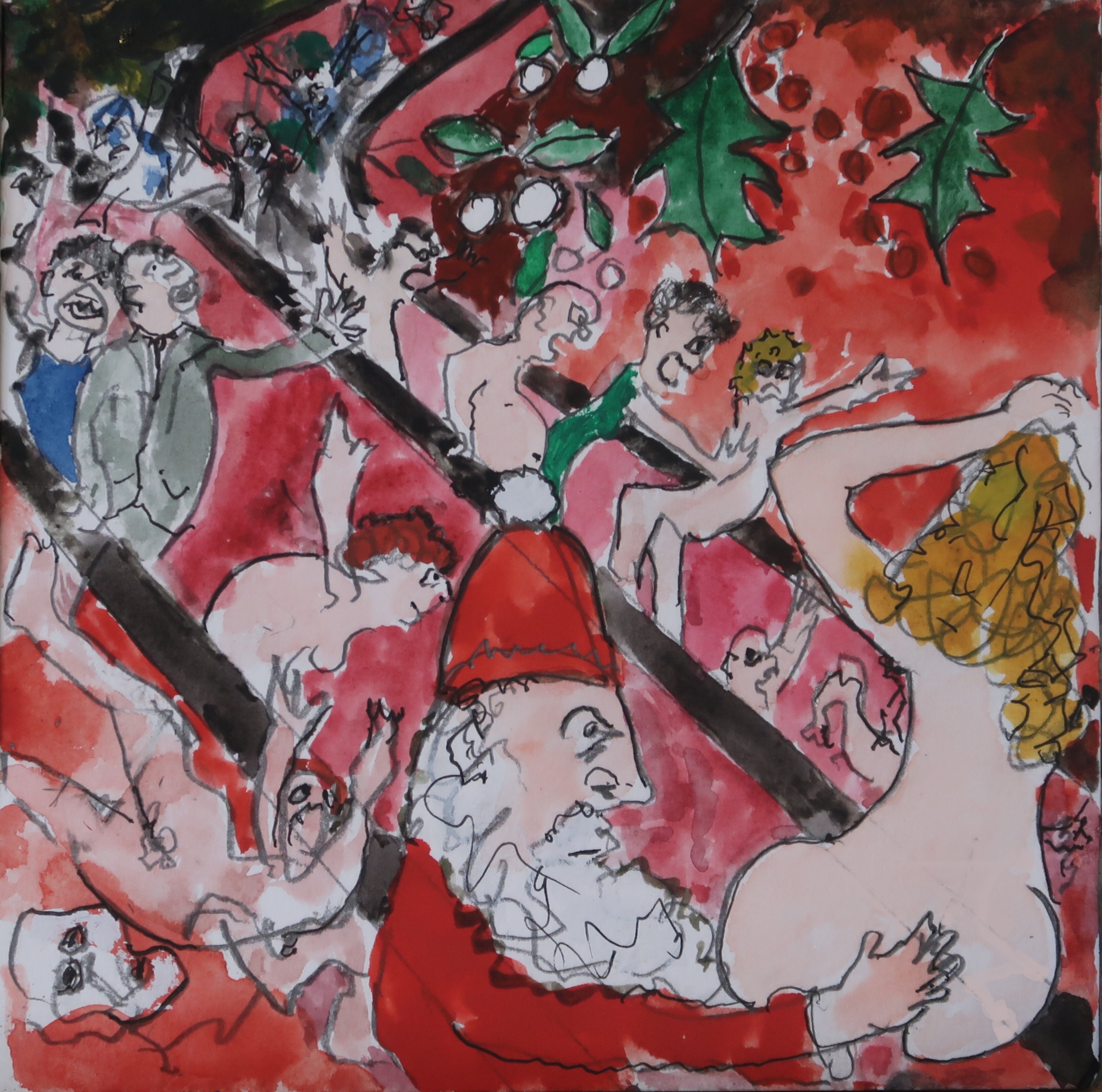
It’s Christmas every day down here, or rather Christmas Eve,
x
And packed with Father Christmases feeling up your bits.
Christmas Eve herself has naked hips. Her nipples spout
Red Bull. The tube becomes her snake, while the Stations
Of the Cross remain closed because of planned engineering work.
However, there are plenty of others at which to disembark,
Their escalators only going down. There is no “up”. You rub
Shoulders with pickpockets, ogle those exquisite girls
x
Who lend new meaning to ‘untouchable’. The underworld
Is full, all the rush-hours of a life spent commuting
Happening at once. How are you to find your mother here,
Your lost daughter, your love? An ancestor asks you
To join the dead fathers’ brigade. Baron Samedi and his sidekick
Are chopping up pricks to feed to the zombies. They ask for yours,
But you seem to have lost it along with your freedom pass.
x
Are you already a zombie? The stink of long dead rat
Suggests that you are not. After all, you can still smell it.
One day, one day you will ascend, and, roseate, throw off
The pall to emerge a girl in a choir, utterly above it all
In some pre-Raphaelite shoal. This girl is obviously your soul.
That’s why you needed that bath, back by the snake-infested shore,
For now you are cleansed, and cleaner than you ever were before.
x
From THE RUNIAD Book 6 – Loki

x
…Hence, although, before, some among you may,
Through ignorance of what was best for you, have been deceived
x
By the perfidious pledges of Rome, yet now that you have tried
Both freedom and servitude, grant me how great a mistake you made
In choosing an imported dictatorship over your ancestral way of life,
For you have now come to realize how much better is poverty
With no master to wealth within the shameful bonds of slavery.
For what treatment is there of the most grievous sort that we
Have not suffered ever since these monsters came to Britain?
x
Have we not been robbed of most of our property,
And that the most precious, while for what is left we pay taxes,
Besides pasturing and tilling for them all remaining land?
Do we not pay a yearly tribute for our very bodies?
How much better it would be to have been sold to masters
Once and for all, than, while clinging to mere titles of nobility,
To have to ransom ourselves every year! How much better
x
To have been attacked and finished off than to go about
Weighed down by taxes! And yet, why do I mention death?
For even dying is not free of cost with them; no, you know
What duties we deposit for our dead. Death should be no tythe.
Death frees even those who toil in slavery to others;
Only in the case of these Romans do the very dead remain alive
For their profit…
x
From The Runiad, book 21 – epic poem completed earlier this year.
x