Caprice

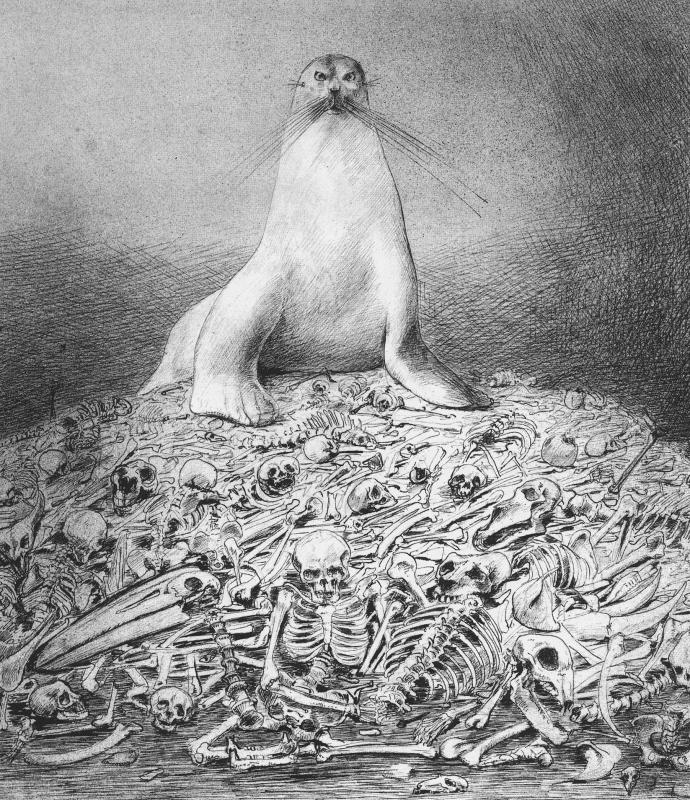
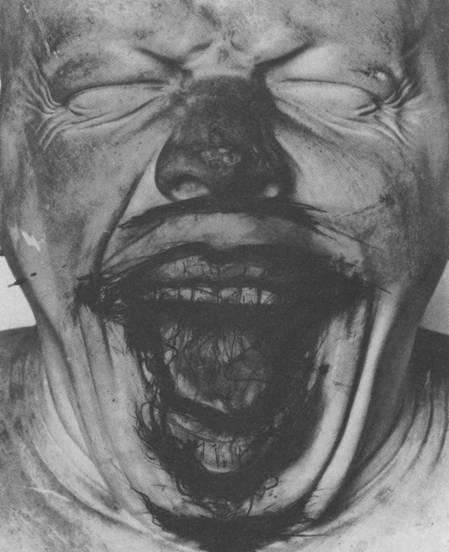
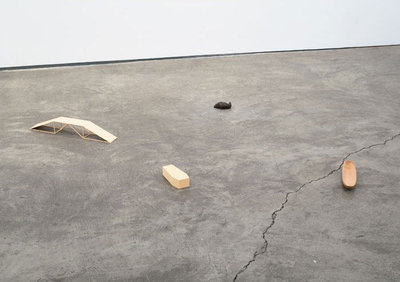
Animal Pyramid Bruce Nauman

There was an old man who said, ‘Hush!

I perceive a young bird in this bush!

When they said – ‘Is it small?’ He replied – ‘Not at all!

It is four times as big as the bush!’


xxxxxxxxxxxxxxxxxxxxxxxxxxxxxxxxxxx(Edward Lear)


There is something capricious about Pisanello’s painting The Vision of Saint Eustache, in the National Gallery.  And there’s a mystery to it as well.  Why does the scroll at the foot of the painting remain empty of inscription?  The Vallardi Codex (Paris, Louvre) contains this artist’s meticulous studies of animals.  It is one of the the most important surviving collections of fifteenth century drawings.  The painting of Saint Eustache sitting on his startled horse, staring at a strange stag with a cross between its antlers, demonstrates that he could put these studies to use since the painting abounds with wild life; pairs of birds and solitary birds, a bear, a lamb lost in a ravine, another stag and a hind.  In the foreground one greyhound courses after a hare.  But a second greyhound turns in alarm, her tail pressed close to her haunches.  Some nondescript dog is attempting to sniff her behind.

Pisanello

Is this why the scroll remains anonymous?  Did some prospective purchaser consider this well-observed overture a trifle too indelicate?  Perhaps Pisanello flatly refused to change it, arguing that this is how dogs are.  Pisanello was active in the first half of the fifteenth century, and he was an exponent of the style known as International Gothic.  These artists prided themselves on the sharpness of their visual recordings.  Theirs was a fresh approach to nature which concerned itself with precise details: just how the leaves hang from that particular tree, just how the villain hangs from that particular scaffold, just how the linen shows through the slashes in those embroidered sleeves, and just how dogs go about their eager business.

The realism of Pisanello’s sketches is one thing, but his choice of subject matter is another, and though this inclusion of doggy foreplay may hark back to the earthy laughter of the middle-ages, it may well have been viewed in a dim light by Platonically-minded Renaissance viewers.  Indeed, this unseemly caprice may have cost Pisanello a client.  For surely it is a caprice?  The matter is hardly appropriate, considering the sanctity of its subject.  It seems like some comment on that subject: that stags adorned with crosses are simply beyond belief!  The danger of some mongrel interfering with a bitch of fine pedigree is far more the concern of a hunter such as Eustache.  But where Pisanello’s scroll remained blank, other patrons seem to have welcomed such arbitrary innovation.  Holbein’s ambassadors, in the painting with that name, in the National Gallery, were the sort of men who valued esoteria.  They would have appreciated the anamorphic skull painted below their table.  It has very little to do with the rest of the painting.  It’s a demonstration of skill, and of the science of perspective.  Located well above head height, and viewed from the side, the skull is supposed to compact itself back into normality.
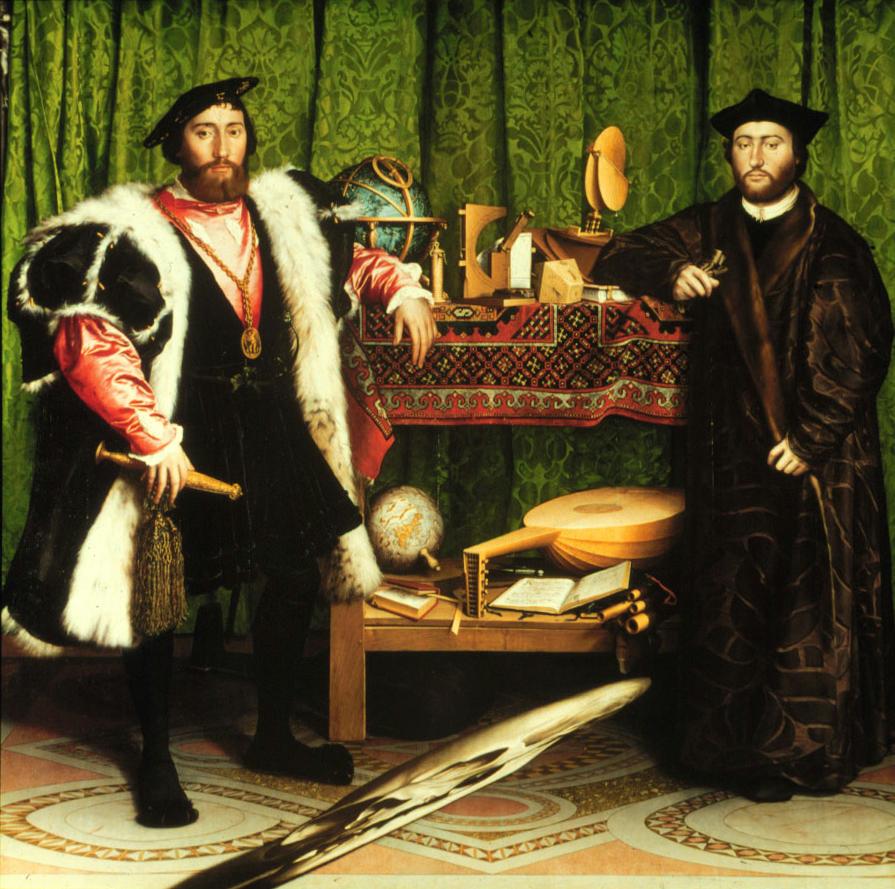
ambassadors

Jacques Lacan was fascinated by this detail – again, the caprice is a detail – and he saw anamorphosis as essentially the problem of the male genital; for the proud phallus becomes an imaginary object when flaccid, and anamorphosis is a species of flaccid geometry – similar to Claus Oldenburg’s floppy toilet.  After all, there’s a received opinion that has to have been derived from some rather Platonic view of women’s bodies.  These are supposed to be more harmonious than the bodies of men.  Women’s bodies are well rid of the capricious detail which dangles in front of the male form, forever an addendum extrinsic to its gestalt.   Caprice is all too often a wilful detail.  Bear in mind that ‘will’ was the Elizabethan word for the penis.

Caprice is a maverick phenomenon – and its willfulness is in direct conflict to the innocuous sense of things “fitting in”, which distinguishes the quietism of much formal reiteration.  Caprice interferes with quietude.  It cocks a snook at too constant an adherence to “genre”.  Where formalism favours consistency, caprice favours inconsistency, and as such it was esteemed by mannerist artists in the sixteenth century – Parmigianino, Rosso, Bologna – they all favoured variety over unity.  While respecting that Aristotle preferred a form trimmed to the needs of its content, the mannerists argued that the “taste of their time” was for variety and the display of artifice or skill.  Their “stylish style” is replete with novelty, effects for effects sake, exercises in style and capricious surprise.  Caprice turns the world upside down, but still it shrugs disparagingly at the belly-laugh of the grotesque.  More artful, it celebrates the carnivalesque in a knowing way, in the style of the Fête d’Amour, presented as an intermezzo in a court masque.

Historically speaking, the term seems to define a reaction to too rigorous an adherence to convention – as is also true for the topsy-turvy feasts of fools and celebrations of donkeys as dignitaries which typified the medieval carnival, but it’s carried through in a more dandy-ish “manner”.  It’s a knowing aberration rather than a naive one.  A Capriccio, for instance, is a genre of painting related to the Veduta.  The veduta is a painting or drawing of a place.  Essentially it is a “view”.  However, there are several possibilities which go beyond accuracy of representation.  A veduta ideata, for instance, is an imaginary view while a capriccio is often “architecturally accurate but fantastic in its juxtapositions.”

Piranesi, Canaletto and Guardi are well-known vedutisti.  Piranesi’s etchings of prisons are imaginary views, and a good British example of a veduta ideata is the picture painted for Sir John Soane which depicts all his architectural projects as if they had been built.  Giovanni Pannini, however, is the first master of caprice.  In Roman Capriccio, painted in 1734, he combined a selection of Rome’s ancient monuments in one image, creating an ideal Rome where its best sights could be seen from one (imaginary) vantage point.  Enthusiast of ruins, he created the taste for the “folly” – which is after all an architectural caprice.

Giovanni_Paolo_Panini_Ruines_avec_prédicateur

Pannini combined his caprice with grandeur, proving himself a master of two streams of art skillfully brought together.  In some works he juxtaposes contemporary events with historical ones.  His wilful assemblages of content, though they are all mediated through a single medium, prefigure the actual method of assemblage, and we can sense his influence in Paul Delvaux as well as in De Chirico.  William Marlow, who was painting in the late 18th and early 19th century, was also renowned for his capricci such as Saint Paul’s and the Grand Canal, which can be seen at the Tate Gallery.  Here Wren’s monumental cathedral is relocated to Venice.
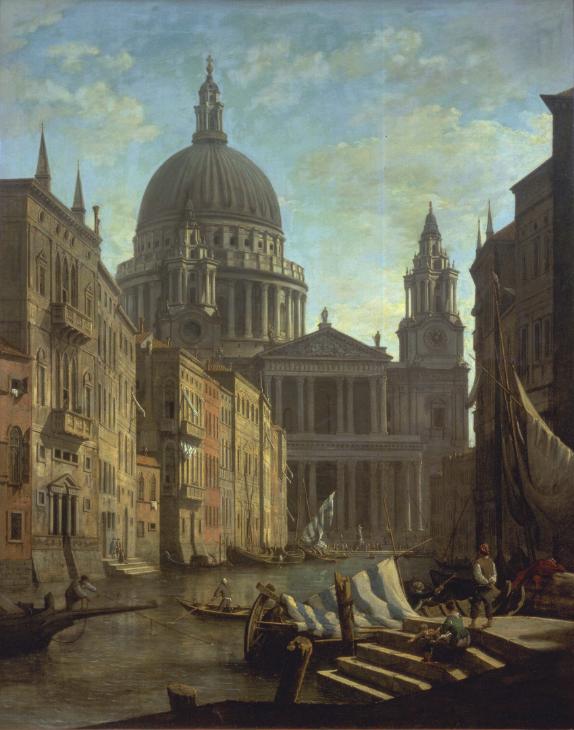
Capriccio: St Paul's and a Venetian Canal ?c.1795 by William Marlow 1740-1813

The roots of this irritating weed in the well-tended garden of our culture can be found in the capricious behaviour of the Greek divinities.  Aphrodite is especially whimsical.  It is a celebrated fact that she prefers to have intercourse over a bale of hay in the stable or under the stairs rather than in some appropriate marital bed.  Such behaviour heralds in the notion of the piquant, the especially tasty.  A little jab of savour.  In other words, to return to Lacan, a prick.  This relates to the  punctum – the inconsistency that enlivens a photograph – considered so highly by Roland Barthes in Camera Lucida.

To indulge in a certain activity in inappropriate surroundings is supposed to enhance the pleasure one gets out of the act.  It amounts to an aesthetic of juxtaposition, a strategy devised to end ennui.  Hercules is the divine patron of innocent bystanders.  This is because he bumped off so many of them by accident in the course of his labours.  At one point in his career he took up with Omphale.  Omphale was the daughter of the Lydian king, and the wife of Tmolus, after whose death she undertook the government herself.  She was well-known for her relaxedly sensuous life-style.  Hercules had just bumped off his entire family by mistake.  He had been possessed by the goddess of Madness at the time, who was carrying out the orders of an incensed Hera.  And so he needed a change of scene.  Because he had also inadvertently murdered his brother, he’d developed a painful form of psychological psoriasis, which an oracle told him could only be got rid of if he were to become a slave for some three years.  Hermes sold him to Omphale.  She dressed the muscular hero in luxurious feminine fabrics – while she took over his lion-skin.  He held out his hands for her skein of wool.  He became one of her hand-maids.  Francois Boucher has a painting of her making love to him.  The languid sensuality of his acquiescence in this is belied by the size of his biceps.
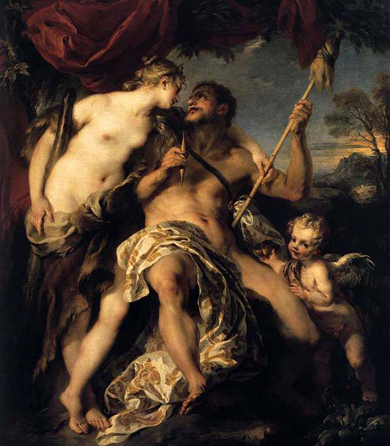
Hercules_and_Omphale_by_Francois_Le_Moyne

For Hercules, such a sojourn in the luxurious is a caprice.  It amounts to a denial of his nature, represents a spirit of mourning, remorse for his fit of madness, renunciation of his true nature.  Among the Farnese collection, in Naples there’s a statue of Omphale and Hercules.  He is dressed in her gown and he holds her spindle.  She is clad only in his lion-skin.  She holds his club.  There may have been a religious basis for this travesty.  In a ritual mentioned by Plutarch at Cos, the priest was dressed as a woman.  It appears that the spirit of travesty presides over caprice – think of Rrose Selavy!

Travesty concerns becoming what one is not.  But it should not simply be used to describe cross-dressing and the imitation of the opposite sex.  One might equally dress as an animal.  This is of relevance when we consider the myth of Hercules.  His normal attire is a lion’s skin.  In a sense, he is always in travesty. This might account for, or be accounted for by, his unhinged condition.  It suggests that he is never himself.  His problem is the opposite of Christ’s.  Not God as man, but man as God.  Divinity has been conferred upon him by his parent (Zeus), but the antipathy of Hera (the wife of Zeus) obliges him to labour on earth.  Hercules is the first civically-minded super-hero.  Like all super-heroes, he is capriciously attired.  He takes the skin of an animal (the “king of beasts” but an animal none the less), and thus wears the garb of what is more lowly than him, to signify that he must perform a role more lowly than that which befits his true nature.  He is forced to deny his divinity.  Thus he finds himself at the mercy of terrible forces, forces larger than the role he imposes on himself.  This is what makes him so unpredictable, and very much the prey to impulse and caprice.

Caprice exemplifies a horror of the predictable.  For instance, it can be predicted that we are going to need to eat every so often.  This offended the existential epicurianism of the Romans, who were often obliged to attend several feasts in a day.  In the Satyricon by Petronius a lavish feast is described.   Roman cookery was distinctly capricious.  Adepts at wielding pestle and mortar, the Romans turned everything they ate into something else.  We have seen, from the xenias described by Philostratus, that the ancients read their food as subtly as the structuralist Levi-Strauss reads it in his book, The Raw and the Cooked.

A modest meal of raw figs, nuts, a jug of milk and a salad perhaps, signifies a natural relationship with the earth: it harks back to some Golden Age where men and women plucked what they needed from the boughs or sucked it from the teat and dined al fresco, innocent in their own nudity. Food which is cooked requires preparation, implies service: the bread must be baked, the ham smoked, the rabbit hung – and so this food signifies a greater level of sophistication – kitchens, servant/master relationships and so on.  Roman festal cookery signifies conspicuous luxury, and more than that, the overthrow of ennui.  At the feast described in the Satyricon, the goose is not a goose but some “kind of stuff” molded into the shape of a goose.  It is too boring for something to taste like what it looks like.  There must be some dislocation, some astonishment, if we are to attain the gustatory sublime.  Trimalchio, who is the host, explains:

“My chef made it all from pork.  There couldn’t be a more valuable man to have.  Say the word and he’ll produce a fish out of a sow’s belly, a pigeon out of the lard, a turtle dove out of the ham, and fowl out of the knuckle.  So he’s been given a nice name I thought of myself – he’s called Daedalus…”

xxxxxxxxxxxxxxxxxxxxxxxxxxxxxxxx(Petronius, The Satyricon, page 80)

Daedalus was the mythical inventor and architect who designed the maze on Crete which housed the Minotaur.  King Minos broke this inventor’s leg – to prevent such an asset running away.  Daedalus contrived wings fastened to the arms with wax and escaped with his son, the ill-fated Icarus, by means of the sky.  Now the broken leg is the sign of the limping blacksmith.  Hephaistos, smith to the gods, was also crippled.  Those ill-equipped to fight design the tools of destruction.  As in parts of Africa today, the smiths were a cult, in ancient times, an esoteric priesthood – to some extent they were incarcerated in their villages.  After all, they fashioned all the weapons.  They inscribed runes on the blades, breathed spells on the spearheads.  Then as now, one had no wish for their abilities and secrets to become a property shared with some possibly hostile neighbour.  Bird-catchers contrive mazes of brushwood in which to catch partridges.  The partridge is the emblematic bird of the blacksmith sect.  It nests on the ground, and when its nest is threatened by an intruder, it runs away slowly, giving the appearance of suffering from a broken wing.  But this is pure contrivance.

To become involved in caprice is to see art as essentially artificial.  Thus one defines the artwork as a matter of contrivance.  A sculptor I knew maintained that art was all about doing something that nobody else had done.  He set great store by The Guinness Book of Records.  He spent several years designing a water-pistol which would squirt further than any water-pistol had ever squirted before.

And so one becomes a master of the game.  Remember that Daedalus had initially been responsible for making the wooden cow for Pasiphaë, the wife of Minos, who had become enamoured of the bull which came forth from the sea.  She hid inside the cow, another travesty, and the bull mounted her, and thus she conceived the minotaur.  The minotaur itself is a grotesque caprice – a monster with a human body and a bull’s head, or, according to others, with a bull’s body and a man’s head.   And surely Pasiphaë’s passion for the bull was a whim worthy of Aphrodite herself.  But let us not take such whims too lightly.  It was Poseidon, after all, who instilled the passion for the bull in Pasiphaë, furious that Minos had contrived not to sacrifice the bull to him, that is, to the sea.  Hercules is cursed by his psoriasis: and it’s the divine fume from the oracle which informs him that he must become a slave.  His “capricious” assassination of his own family is divinely inspired – it is Hera who sends madness to him, who sends him out of his mind.  So caprice may be a contrivance, the esoteric work of a sacred craftsman, or it may be a sudden catastrophic inconsistency meted out to some unfortunate by the divine will.  In both cases there is the sense that the anomalous act is a magic act, or an act signifying divine possession.  Whim may be too meagre a word to describe caprice.

Prehistoric man dressed in skins of animals, as did Hercules.  Travesty has a past which begins in shamanism.  It is thought that many of the labours of Hercules were concerned with sanitation – this is obvious when we think of the cleansing of the Augean stables, but the story of the many-headed hydra may actually relate to the notion of draining mosquito-infested marshes.  Were these operations blessed by a shaman wearing the pelt of a lion?  When we call some action capricious, or some tendency a caprice, in everyday intercourse, we mean that someone is acting without rational justification.  But since we are supposed to be rational beings it is surely feasible for us to suppose that we find it more easy to act rationally than to act irrationally.  The irrational has always been the domain of the possessed.  It is hard to be irrational, it takes some help from God – and naturally the irrational act proves a hard act to follow.

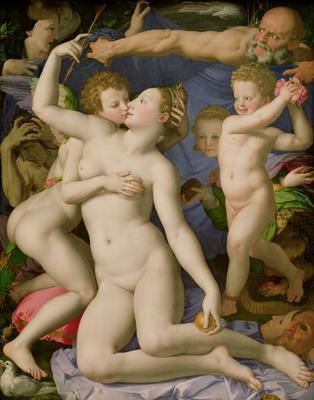
But, given the multiplicity of interpretations, analyses and deconstructions which can be brought to bear, when so many are trained to construct a meaning given the slightest provocation, or even given none, it is not in fact so easy to deliver a non sequitur.  The Mannerists distinctly disapproved of art where the whole was greater than the sum of its parts: they favoured allegories, a jumble of signs, each part executed marvellously well.  Look at Bronzino’s Allegory in the National Gallery, or Holbein’s The Ambassadors, or Durer’s Melancholy.  None of these pictures add up.  And this is as intended.
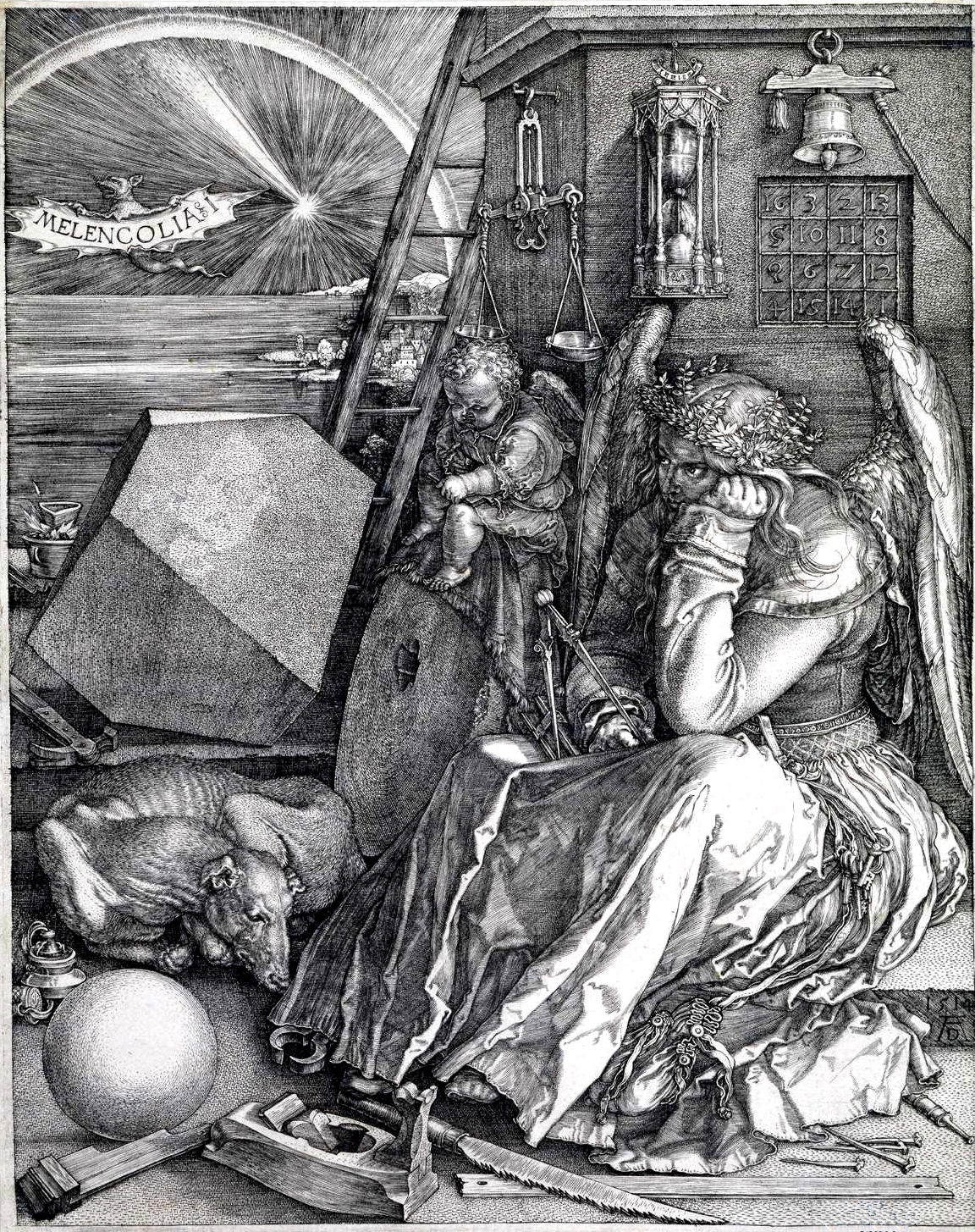
Melencolia_I_(Durero)

These days, though, confusion in the work may well be unintentional and due merely to lack of ability.  This is often camouflaged by some elaborate verbal screen, since it is now possible to construct a justification for anything.  There is also the chance that what might be construed as caprice may be accidental, or incidental, rather than wilful, as is indeed the case with the fits of Hercules.  Caprice may result when the formalist, for instance, takes some issue too far – when the preoccupation amounts to a perversion – and mannerism makes some progress along this route.  But mannerism as a tendency was already latent in earlier Renaissance art.  In Les Vies Imaginaires, written in 1896, Marcel Schwob asserts that Paolo Uccello (1396-1475) developed a mania for perspective:

“…Like the alchemist who bends over the mixtures of metals and reagents and watches their fusion in his furnace to find gold, Uccello poured all these forms into the crucible of form.  He united them, he combined them, he melted them together to bring about their transformation into the simple form upon which all others depended.  That is why Paolo Uccello lived like an alchemist in the inner rooms of his little house, He believed he could transmute all lines into one ideal aspect.  He sought to envisage the created universe as it was reflected in the eye of God, who sees all forms springing from a single centre…”

xxxxxxxxxxxxxxxxxxxxxxxxxxxxx(Marcel Schwob, The King in the Golden Mask

xxxxxxxxxxxxxxxxxxxxxxxxxxxxxxxxxand other Stories, p. 151)

Uccello left several drawings where his obsession with perspective becomes apparent – especially one of a goblet with a curved rim, whose volume is conveyed precisely through the lines describing it.  This in itself is a formal concern, but Uccello’s capricious intellect comes to value these forms far more than anything else.  In Schwob’s imaginary life, a young girl called Selvaggia comes to live at the house of the painter, but:

“…without a thought, for Selvaggia, Uccello seemed forever bent over the crucible of forms.

Meanwhile there was nothing to eat in Uccello’s house.  Selvaggia dared not tell Uccello or the others.  She held her tongue and she died.  Uccello depicted the stiffening of her body, and the folding of her thin little hands, and the line of her poor closed eyes.  He did not realise she was dead any more than he had realised she was alive.  But he tossed these new forms among those he had collected…”

xxxxxxxxxxxxxxxxxxxxxxxxxxxxxxxx(Ibid, p. 152)

Here caprice joins forces with the uncanny!

Another “pre-mannerist” who on one occasion at least seems to have allowed his preoccupation to develop into caprice is Antonio Pollaiuolo (1432-98).  His engraved study of a Battle between Naked Gods is a disturbing image.  So obsessed was the artist by his study of the articulations of the body – of its system of joints, tendons and sinews – that he did away with the armour which, common sense suggests, would normally have covered these fighting figures.  This has always been regarded as an anomaly.  However Seneca informs us that at poorly attended lunch-time shows at the Colosseum the gladiators were sometimes obliged to fight naked – with nothing but a weapon in the hand – in order to drum up business by increasing the rate of the mayhem.  But while this may provide a rational explanation for the etching by Pollaiuolo, at the same time, it points to a capriciousness on the part of the Colosseum managers and their public.

Antonio_Pollaiuolo_-_Battle_of_the_Nudes_-_Google_Art_Project

Still, in the work of Pisanello, Uccello and Pollaiuolo one senses that the caprice is unconscious – an accident produced by obsession, whether with natural detail, with perspective or with the body’s articulations.  This is a far cry from Pannini’s deliberate displacements, consciously termed caprices, as are those of Goya.  There is, though, something deliberately capricious about Leonardo turning up in Milan with a lute shaped like the head of a horse, and finding gainful employment not as a painter but as a musical entertainer.  Leonardo’s tendency to abandon his projects can also be seen as whimsical, while his religious scepticism and his willingness to explore conceptual hypotheses in his notebooks makes him the role-model for Marcel Duchamp.

In his book on Mannerism, John Shearman asserts that for the Mannerists, virtú consisted in the conquest of difficulty:

“…Around 1520, and thereafter, we find that works are commissioned for no other reason than the desire of the patron to have, for example, a Michelangelo: that is to say, an example of his unique virtù, or his art; the subject, size or even medium do not matter.  This is the birth of the idea of a work of art made, in the first instance, to hold its place in a gallery….In 1524 Castiglione is charged by Federico Gonzaga with obtaining anything from Sebastiano del Piombo, as long as it is not about saints, but graceful and beautiful to look at…”

xxxxxxxxxxxxxxxxxxxxxxxxxxxxxxxxxxxx(Mannerism, p. 44)

Bearing this in mind, another clue to the reason for Pollaiuolo’s Battle between Naked Gods may be gleaned from the publication in 1520 of an engraving by Raphael.  This is a study for a religious subject: The Transfiguration of Christ.  But it shows a preparatory stage, at which all the figures are drawn nude, testifying that the public was now more interested in the talent of the artist than in the subject of the work.

As a result of this vogue for their virtù, artists felt the need to demonstrate ability and, in particular, their ability to conquer difficultà; and so they constructed ever more serpentine figures:

“This manipulative ability was designed to be noticed.  Paolo Pino, in his Dialogo della Pittura, 1548, says that ‘the attitudes of figures should be varied and graceful…and in all your works you should introduce at least one figure that is all distorted, ambiguous and difficult, so that you shall thereby be noticed as outstanding by those who understand the finer points of art.’”

(ibid, p. 86)

This suggests that, by the middle of the sixteenth century, caprice had practically become institutionalised.

*        *        *        *

Caprice can be the outcome of a species of creative exasperation in the face of a superfluity of standard products, and it has often flourished at the end of “golden ages”: the golden age of Virgil’s Rome, or of Dante’s Florence – or, indeed, of Picasso’s Paris.  As if it were a debasement, historians say of the ensuing periods that they are “silver ages”.  Of course these ages overlap: silver poets can be found in golden ages, golden painters can be found in times of silver.  Whenever one has surfeited on standard classicism, standard high Renaissance, standard modernism, one turns to these more silvery times; times of mirrors, of reflection and deception – Mercurial times.  This mercurial element, that may well encourage caprice, can be aligned with the Renaissance notion of “Melancholy”.  Melancholy is inseparable from the Saturnine mysticism that permeates alchemy.  The ancient tradition that associates intellectual brilliance with this humour was attributed in the middle ages to Aristotle and promoted by the Neo-Platonist Marsilio Ficino, doyen of the Medici court, in his book De Vita Ivri Tres.

This brings us back to Albrecht Durer’s celebrated engraving Melancholia 1, executed in 1514, which is acknowledged as a compendium of Saturnine imagery: however, Durer’s mother died in the same year, so we cannot avoid a condensation of psycho-analytic interpretation accruing to the work at the same time.

Melancholy is the dark, dank spirit of artistic engrossment – the artist losing all sense of self in the fastidious intricacies of creativity.  Simultaneously it is the condition of manic-depression, mood-swing, elation followed by crushing ennui.  Thus the asymmetrical polyhedron, in this engraving, representing the base metal, lead, which is indispensable to the alchemical process, is both “the philosopher’s stone” and the leaden weight which “plumbs” the depth of mourning. The psychoanalyst Andre Green has argued cogently, in The Double and the Absent, that all literary endeavour is a species of mourning, since we write in order to “address” one who is absent.  After all, there is no need for a portrait if we have the presence, and perhaps this is as true for visual art as it is for writing.  Perhaps it is true for all art – or at least for art as representation.  We can posit that representation is an attempt to capture that which flows away down that river into which we never step twice.

Green has also written on The Dead Mother – not the mother whose actual death we may comprehend, but the mother who has turned from us in our infancy because of some deep personal pain which stultifies her feelings towards us at the time, so that she is “dead” to us.  One might hypothesise that this is the mother Leonardo mourned, having been wrested away from his natural mother within the first year of his birth – which possibly accounts for the “double mothers” in The Virgin and Child with Saint Anne.

Leonardo_da_vinci,_The_Virgin_and_Child_with_Saint_Anne_01 (2)

It is feasible to suppose that just as it may have lain at the heart of the madness of Hercules, the dead mother syndrome lies at the root of the work of many a capricious artist, generating displacements and substitutions as formidable as those strewn in such a resonant jumble around the figure of Durer’s Melancholia.  This mood-darkened figure might be the dead mother herself, while her comatose Cupid may represent the capricious artist; represented because already absent, already bored by the toys which he had intended to exhibit: like any neglected child, a little wanker – as is the maniken pis, or, better still, the boy peeing into the toddlers’ inflatable swimming pool in an early painting by Eric Fischl – a child obliged to create a magical aura about his transgressional indelicacies and masturbation substitutes.  Such a reading enables us to fuse the earlier interpretation of the capricious artist with this more sombre version: the capricious artist is a melancholy exhibitionist.  For the arcana of perversion can be construed as the perversity of the arcane.  Here the mythical element becomes some private allegory.

Eric-Fischl-Sleepwalker

That advocate of the sublime, Longinus, loathed caprice, or at least, he dismissed a large part of the Odyssey as being too far-fetched – “Homer is lost in the realm of the fabulous and the incredible.”  This first century theorist of the sublime values the dramatic realism of the Iliad and the unity of its theme, whereas, to his mind, the Odyssey is merely picaresque narrative, a loosely connected string of stories in which the mythical element predominates over the realistic:

“How easy it is for great genius to be perverted in decline into nonsense.  I mean things like the story of the wineskin, the tale of the men kept as pigs in Circe’s palace (‘howling piglets’, Zoilus called them), the feeding of Zeus by the doves (as though he were a chick in the nest), the ten days on the raft without food, and the improbabilities of the murder of the suitors.  What can we say of all this but that it really is ‘the dreaming of a Zeus’?

There is also a second reason for discussing the Odyssey.  I want you to understand that the decline of emotional power in great writers and poets turns to a capacity for depicting manners.  The realistic description of Odysseus’ household forms a kind of comedy of manners.”

(Longinus, On Sublimity, p. 153)

We can imagine with what ire Longinus would have castigated Alexander Pope’s Rape of the Lock, first published in its enlarged form in 1714.  This a spoof on the epic, and its plot is briefly described in the Oxford Companion to English Literature:

“Lord Petre having forcibly cut off a lock of Miss Arabella Fermor’s hair, the incident gave rise to a quarrel between the two families.  With the idea of allaying this, Pope treated the subject in a playful mock-heroic poem, on the model of Boileau’s Le Lutrin.  He presents Belinda at her toilet, a game of ombre, the snipping of the lock while Belinda sips her coffee and her demand that the lock be restored, the final wafting of the lock, as a new star, to adorn the skies…”

When Milord catches sight of Belinda’s graceful tresses, and resolves to snip them, he first makes a sacrifice to ensure his success in the enterprise, as any hero might.  However this hecatomb of his could hardly be more novel:

“For this, ere Phoebus rose, he had implor’d

Propitious heav’n, and ev’ry pow’r ador’d,

But chiefly Love – to Love an Altar built,

Of twelve vast French Romances, neatly gilt.

There lay three garters, half a pair of gloves;

And all the trophies of his former loves;

With tender Billet-doux he lights the pyre,

And breathes three am’rous sighs to raise the fire…”

(Alexander Pope, The Rape of the Lock, Canto II, lines 35-44)

Here again we are dealing in travesty – and this time its aim is to tease.  A travesty of the magnificent assaults we associate with the grand Homeric manner or with chivalric romances such as The Song of Roland is neatly handled when it comes to the game of Ombre:

“Now move to war her sable Matadores,

In show like leaders of the swarthy Moors.

Spadillio first, unconquerable Lord!

Led off two captive trumps, and swept the board.

As many more Manillio forc’d to yield,

And march’d a victor from the verdant field.

Him Basto follow’d, but his fate more hard

Gain’d but one trump and one Plebeian card…”

(Ibid, Canto III, lines 50-54)

Hyperbole is here turned against itself.  And it should be noted that several caprices seem inspired by parlour games – played perhaps at Christmas time, with the winner being given a prize of an apple or a pig made out of marzipan.  Lewis Carroll favoured cards and chess for Alice’s nonsensical adventures.  Marcel Duchamp seems to have preferred playing chess to making art – doubtless inspired by his spiritual mentor, Raymond Roussel, the inventor a notable chess gambit.  Duchamp also visited Monte Carlo, intent on devising a method for beating the house.  This suggests that while caprice may constitute a deliberate defiance of the convention that governs some discipline, it may adopt the strictures of some other discipline and adhere to these while operating within the parameters of the initial “game”.  Thus it may lift the rules from one activity and apply them to another, for it is in essence a tendency towards juxtaposition, transposition or displacement.  Capricious artists are often sticklers for the rules, and compelled to observe these in inappropriate conditions, or beyond the “call of duty”.   Lewis Carroll insisted that according to the rules of punctuation, shan’t should have two apostrophes – sha’n’t – since it constitutes an elision of shall and an elision of not, and technically speaking both elisions should be marked – (see Jean-Jacques Lecercle’s The Philosophy of Nonsense).

Laurence Sterne’s Sentimental Journey through France and Italy, published in 1798, is the product of capricious transposition.  The standard genre of a traveller’s journal is highjacked and becomes a vehicle for the relating of encounters with women – who in a sense become the sights experienced.  Thus the standard sights have been displaced, and re-placed by the fair.  In the Interpretation of Dreams, Sigmund Freud speaks about the “work of displacement”.  Displacement occurs when dreams are differently centred from the dream-thoughts which motivate them.  Such displacements can also govern our waking actions.  A banker with a tendency to abuse young girls would insist on having his bank notes ironed before making a payment.  He worried that germs might be transferred at the time the financial transaction was made, although, when Freud questioned him, he seemed to have no compunction about touching the genitalia of the girls.  Freud argued that his guilt about this abuse had become displaced, replaced by his fastidiousness regarding the possible infections which might be picked up by accepting a banknote from another hand.  The displacement permitted the banker to continue a practice he derived pleasure from, since the guilt was effectively suppressed by being displaced, that is, it could go disregarded when the matter to which it was appropriate was raised or about to be put into practice.

Thus, for Freud, displacement implies suppression, just as Hercules suppresses his strength when he hands his lion skin to Omphale.  Does suppression therefore operate on caprice?  Certainly caprice suppresses ennui.  It is also surely, I would reiterate, a form of exasperation, a spasmodic gesture of irritation directed against the conventional forms which generate ennui.

If we return to displacement in dreams, we can see caprice operating in a more deliberate way within the unconscious; bringing about reversals, for instance, such as when one dreams of burning or of being burnt – which Freud interprets as the suppression of the urge to wet the bed.  By the same token, a man might dream of trying to put on a hat that was too floppy as he experienced the burgeoning of an erection.  This strategy employed by dreams is the same as that of the chap-books  which deal with “The world turned upside down”.   These flourished from the sixteenth to the eighteenth century.  Designed ostensibly as pedagogical aids, they were woodcuts and prints that described a world of contrariety.  Here horses sat in coaches pulled by humans, women beat their husbands or children thrashed their parents, while pigs slit the throats of their butchers.
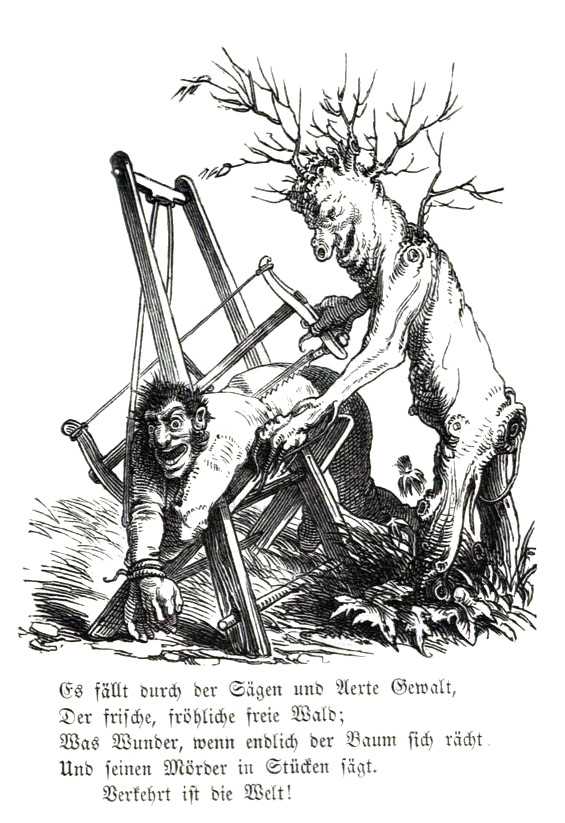
The world turned upside down fliegende_blatter_1852

Magritte’s painting of a daytime world lit by street-lamps (The Dominion of Light) embodies a similar contradiction.  As a teaching method, the images of the world turned upside down operated like crude intelligence tests.  What is wrong with this picture?  But the spirit of the world engendered by this displacement came to inhabit a reality of its own, a reality very akin to the world encountered in dreams, a world where nothing is predictable except the possibility of some reversal of the standard visual rhetoric, or some contradiction of the text of normality.
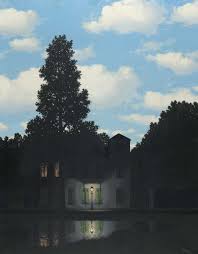
Magritte night day

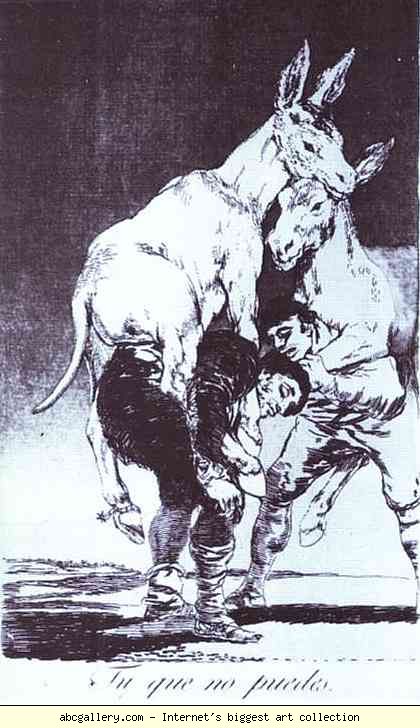
There is a nihilism which seems to promote this view.  Again we are talking about a product of ennui or some attempt to defeat it.  For it is as if the standard rhetoric were no longer convincing – in the sense that a picture of husbands beating their wives would no longer be read as normal, let alone acceptable.  A vegetarian might feel the same way about the restoration of the butchers to their approved role.  The accepted text is either too predictable to cause anything but boredom, or too spurious, given a shift in values, to be used as a cannon of conventional behaviour.  Many of the absurdities of such conventions were revealed by Goya in the Capprichos, his series of fantastic etchings whose violent displacements are underscored by the motto to what was originally going to be the prefatory etching: “the sleep of reason begets monsters.”   Goya seems to have perceived the title of this series as giving him licence to create whatever invention took his fancy.  Some of the resultant images are fantastic, many of them are grotesque, most deeply satirical.   They express an exasperation with the status quo.  One of them, with the motto You who cannot do it, exemplifies the sort of capriciousness which can be derived from the world turned upside-down.
goya87

Two donkeys are riding on the backs of men.  The men seem to accept the condition of being beasts of burden.  The donkeys appear contented too.  There is a Spanish proverb: You who are unable to do it, carry me on your shoulders.  It is interesting to formulate the logical antithesis to this: I who am able to do it ride on your shoulders.  Unfair taxes and exemptions reserved only for the nobility ensure that the poorer classes maintain the upper ones.  But this comes about through some acceptance of their condition on the part of the poor.  This print is one of six in the Capprichos dealing with human stupidity through the conceit of making donkeys do what humans do: a donkey teaching donkeys their lessons, a donkey applauding the serenades of a monkey, a donkey displaying his family tree, a donkey taking the pulse of a sick man, a grandiose donkey posing for his portrait and attempting to hide his ears in a wig.  Where men figure in this set, they appear more stupid even than the donkeys – since they allow donkeys to attend to their medical needs and permit them to ride on their backs.  The moral element in all this, though, together with the motto below each print, takes us into the realm of Aesop and his fables, and many of the satirical works of Goya properly belong in the genre of the fable – another great river of art, always deeply symbolic – traditionally so in order that the Mighty may be told their faults in some indirect way by comparison to the behaviour of an animal.

Even today, popular culture makes use of this mode.  Disney has made it his own, of course, and although they may not rely so heavily on symbolic camouflage, most big-budget films entail a moral outcome. To be convinced of a platitude is supposed to be uplifting.  But then, one of the dullest notions of art-education is that art should teach us something.  It’s a notion which can become dangerous since it ultimately operates as a form of censorship, screening out anything which is unedifying, or which fails to inform, or which has no moral point.  There is no denying that the fable is the source of a very wide river of art, but it isn’t one which interests me to any great degree.  The genuine caprice does not fall into the trap of insisting on some moral point – and thus becoming exactly the sort of homily that the capricious displacement was designed to subvert.   Caprice should be more nihilistic, as I have said.  It is more a matter of the displacement bringing about a cancellation, and the denial of any point whatsoever.

Any point, that is, that might seem proper to make in the circumstances: as the point in making a veduta ideata might be the splendour of the imaginary vista; as the point in a fine poem might be to move the reader, that is, to speak of the emotions in such a way that some participation in them is elicited.  This is the conventional view.  But Edward Lear’s nonsense poems, or the nonsense poems of Lewis Carroll, generally avoid such intentionality.  However, Lecercle points out – in The Philosophy of Nonsense – that these writers are nevertheless sticklers for the proprieties of usage.  The meaninglessness of the content enables the nonsense author to focus attention on the form of the writing, the quality of the syntax, the peculiarities of spelling.  In this sense it is profoundly Euphuistic, that is, taken up with style – and thus a bi-product of mannerism.

Equally, in nonsense, the nature of narration may be called into question – and so identified as a topic of interest – or the structural nature of debate.  Philosophy is alive to such issues, and the nonsense writer is often making some point, a point of deep interest to logicians or to grammarians.  And then, our capacity for sympathy comes into play when we read a good bit of nonsense, for we usually find that we experience at least the ghost of an emotion when reading about the Jumblies in their sieve, or the demise of the oysters, or the hunt for the elusive Snark.  We seem to be able to empathise, to feel something at least, even when the tangible content of a credible reality or the actuality of a character has been syringed out of the stanzas or paragraphs presented.  This is food for thought, and it has implications for Roland Barthes’ notion of the “shadow of a meaning” – which he touches on in The Pleasure of the Text.

*        *        *        *

In the twentieth century, caprice came into its own, Ronald Firbank being one of its foremost exponents.  His form of caprice is delightful; an extended vein of whimsicality which enables his novels to dance along as they choose, altering course, diverting themselves, deftly sketching the most extravagant characters.  He is one of the great “camp” writers of all time.  Nevertheless, the characteristic negation of import we associate with caprice is operative in his work, for lightness is all, and impression always fleeting.  One might complain that his books have no ballast.  But then, most books have so much ballast they sink.  At first glance, it may seem an ephemeral and essentially unserious style, but there is a finely-tuned lyricism to Firbank’s impudent nonsense, and this makes it wistful and haunting.  The characters in his books are sketched so lightly that they seem not to be composed of flesh and blood.  Everything is ephemeral – as fleeting as a summer evening.  At the same time, juxtaposition is adeptly used: the powdered culture of the English counties is constantly obliged to rub shoulders with meaty negresses – their heaviness only suggested as a matter of content.  The writing remains its frivolous self as it sketches a sultry but alien exoticism which impinges on the mild green pleasantry of the shires.  These caricatures are as exaggerated as those truckin’ down the sidewalks of America in the cartoons of Robert Crumb.  Critics with a propensity towards correctness have castigated Firbank for this, and their disapproval has contributed to his marginality.  Ardent socialists may also dismiss his work. He is after all the limp-wristed aesthete par excellence.  However, his fusty old dowagers anxiously vetting their own wrinkles are just as extravagantly drawn as his negresses.  Firbank is even-handed.  The world he paints so preciously in airy artful words is an absurd one, a world crammed with snobbery, overwhelmed by its overweening masseurs and overdressed sultanas.  At the same time, it is a delightfully colourful world, full of textiles and textures and the right words for particular dainty objects.  It’s a world of repartee, of parasols and bons mots, where a flippant vulgarity gets slipped in between some esoteric references: a world made lively by its chatter, which is practically endless, for his characters will continue prattling away to each other even as they traverse Acheron.

Above all, Firbank is inconsequential.  There is no significance to his conclusions. His novellas simply end – as if the pageant he describes has simply reached the edge of its canvas.  But this arbitrary shrug of the shoulders is in keeping with modernism’s concern with exercises in style – which we see operating in Picasso’s variations on Las Meninas by Velasquez and in the witty paragraphs on running for a bus in all possible manners composed by Raymond Queneau (Exercises in Style).  The point is that Firbank is not attempting to “move” us.  As Ortega Y Gasset puts it succinctly in his 1925 essay The Dehumanisation of Art (long out of print in English translation but actually quite crucial to any understanding of modernism) moving the listener – or art as empathy – might have been the concern of the romantic artist of a previous century, but:

“Modernists have declared that the intrusion of the human in art is taboo. Now, human contents, the component elements of our daily lives, possess a hierarchy of three ranks. First comes the order of persons, then that of other living creatures, and finally, that of inorganic things. Art today exercises its veto with an energy in proportion to the hierarchial altitude of the object. The personal, by being the most human of the human, is what is most shunned by the modern artist.

This can be seen very clearly in music and poetry. From Beethoven to Wagner, the theme of music was the expression of personal feelings. The lyric artist composed grand edifices of sound in order to fill them with his autobiography. Art was more or less confession. There was no other way of aesthetic enjoyment other than by contagion of feelings. Even Nietzsche said, ‘In music, the passions take pleasure from themselves’. Wagner injects his adultery with La Wesendonck into Tristan, and leaves us with no other remedy, if we wish to enjoy his work, than to become vaguely adulterous for a couple of hours. That music fills us with compunction, and to enjoy it we have to weep, suffer anguish, or melt with love in spasmodic voluptuousness. All the music of Beethoven or Wagner is melodrama. The modern artist would say that this is treachery; that it plays on man’s noble weakness whereby he becomes infected by the pain or joy of his fellows. This contagion is not of a spiritual order, it is merely a reflex reaction, as when one’s teeth are set on edge by a knife scraped on glass, an instinctive response, no more. It is no good confusing the effect of tickling with the experience of gladness. Art cannot be subject to unconscious phenomena for it ought to be all clarity, the high noon of cerebration. Weeping and laughter are aesthetically fraudulent. The expression of beauty never goes beyond a smile, whether melancholy or delight, and is better still without either. ‘Toute maitrise jette le froid’ (Mallarmé).”

(Ortega y Gasset, The Dehumanization of Art, P. 73)

Later, Ortega compares Wagner with Debussy:

“In Wagner, melodrama reaches its highest exaltation.  And as always happens, when a form attains its maximum its conversion into the opposite at once begins.  Already in Wagner the human voice is ceasing to be a protagonist and is becoming submerged in the cosmic uproar of the other instruments. A conversion of a more radical kind was inevitable; it became necessary to eradicate personal sentiments from music. This was the accomplishment of Debussy. Since his day it has become possible to hear music serenely, without rapture and without tears. All the variations and developments that have occurred in the art of music in these last decades tread upon that extra-terrestrial ground brilliantly conquered by Debussy. The conversion from the subjective to the objective is of such importance that subsequent differentiations disappear before it. Debussy dehumanized music, and for that reason the era of modern music dates from him.  His was the art of sound.”

(Ibid, p. 74-5)

Firbank is the Debussy of the conversation piece.  His work represents a defiance of significance – as modern a trait as abstraction.  His influence can be felt on the dry conversational brilliance of the novels of Henry Green – in Loving, and in Party Going – and in the Ashbery/Schuyler collaboration A Nest of Ninnies.  He is surely the most underrated novelist of his time – and the same could be said for Green a decade or so later.

But while Firbank was obliged to publish his capricious novels privately in a staidly melodramatic England, a more organised approach to caprice was being pursued in Paris by the surrealists. Ultimately it was surrealism which gained most from the legacy of the veduta ideata, for the notion of a collage mediated by a single medium in which diverse fragments, ruins or details could be marshaled into the same field certainly stems from the capricci of Pannini, but it achieves its culmination when the sheer force of displacement in its own right is recognised; when it’s acknowledged that there need not be some binding subject – such as the sights of Rome.  For caprice is ultimately the art of the transference, and its displacements attain a startling resonance when fused with the Freudian discovery of the unconscious, and inspired by the imagery found in dreams.

By capriciously applying the values of visual art to poetry, Guillaume Apollinaire brought about a revolutionary displacement that was to influence both fields – legitimising the use of text in painting and the use of shape in poetry.  His Calligrammes (first published in 1918) led to the school of concrete poetry, though it should be born in mind that these vertical lines, falling down the page like rain down the sky, were not the first poetic shapes to be made.  George Herbert had written Easter Wings, a poem shaped like a pair of wings, in the early seventeenth century, and later, in the Victorian age, Lewis Carroll had written his mouse’s tale – which “tails” off at the foot of the page.  Sterne also plays games with the look of the text in Tristram Shandy.  To many a traditionalist, such games seem heretical.  Concrete poetry allows a visual concern to govern the construction of a piece of writing.  It becomes difficult to establish criteria for judgement since if we say, it’s not a very good poem, the creator can turn round and say, ah but I had to take the shape into account, and if we say, it’s not a very good shape, the response may well be, yes, but I had to make it poetry.  It becomes impossible to criticise the work according to its own rules.  But then, it could be argued, nothing is affected simply by itself.  And there is no absolute edict dictating that all art should be governed by its own rules, or that homeostasis, or a well-balanced condition, is the sole requirement for it.  Poetry may be influenced by visual art, visual art by poetry

*        *        *        *

The laws governing apples concern gravity.  Perhaps the laws governing the universe concern something other than the universe.  We can hypothesise that some external pressure ensures that, every fifteen billion years or so, the dissolution of matter following a big bang reaches its fullest extension.  At that billi-second, there is nothing at the centre – and nothing anywhere else – as may have been the case before the big bang.  Then something like the opposite of the action of a catapult may occur – for whereas the catapult is drawn back relatively slowly, its release causes a rapid projection, while in this case, after the relatively slow extension of all matter away from other matter (a process which speeds up as the gravity at the centre becomes dispersed and therefore loses its hold), there may well be a sudden and immediate “pull back” of everything instantaneously into the centre – causing the next big bang.

Those who worshipped Mithras believed that there was a sun beyond the sun, and a god behind God, which they deduced from a shift in the equinoxes.  They thus surmised that there was a power capable of altering “God’s” universe, since it was able to bring about an alteration in the rotation of something as fixed as the stars comprising the Zodiac, a fact that was detected by Babylonian astronomers who had been keeping records over a period of some two thousand years.   Today the Mithras-worshippers may sound rather like free masons, and those critical of the police may mutter about “the firm within the firm”.   But artists and thinkers are at liberty to hypothesise a force external to our universe, a force which operates this reversed catapult which would ensure the eternal return of the bang.  No reason to suppose this force a “Being”.  It may be no more than it is, a force – the force exerted on our universe by adjacent universes – yet another manifestation of physics.  However, if this be the case, then Heracleitus has it right, and Nietzsche’s reiteration of his views can be endorsed.  Phusis is the nature of the universe – a state of constant change.  There is no absolute end, the big bangs constantly succeed each other at their vast intervals.  In this sense there is infinity.  However, there is no posterity, no immortal posterity, for everything, including the work of Phidias and Shakespeare, is destined to pass away, as humanity and the life-forms of this earth and this earth itself must also pass away.  Nor is there much chance of humanity passing the baton of its culture or life-form on to another habitable planet, since the universe is forever getting larger at a forever swifter pace.  By the time things have cooled down enough for us to have come into existence and to realise our need for contact, everyone else is too far away.

Meditations similar to the above have provided atheism with its concomitant nihilism.  There is no supreme being, no meaningful absolute, no immortality. And what occurs does so not according to the volition of the agent but according to laws governing the behaviour of the agent, laws concerning forces other than that agent.  Of these, chance and its contingencies – the laws of hazard, coincidence, possibility, serendipity, accident, aimlessness, probability and fortuity – seem to provide many artists with a better expression of our fate than any suggestion this destiny might be the outcome of the deliberations of some parental consciousness in the sky.  Our morality is not the issue.  We may wilfully ruin our planet, but this is simply to increase the pace of the atrophy.  The random laws of intergalactic physics have doomed the planet already.  Doomed it and us along with it.  We are at the mercy of chance and its caprices.  Chance is the force that many artists of the modern epoch have attempted to harness – since if chance has its way with us, perhaps we can have our way with chance.  This notion is given its first succinct expression in Lautreamont’s seminal and oft-quoted phrase: “Beautiful as the chance meeting on a dissecting table of a sewing machine and an umbrella.”

It is for this reason that the displacements in dreams become more interesting to represent than the realities of a too ephemeral world – because they throw up random conjunctions, rather than because they illustrate Freudian inevitabilities.   The attempt to work with chance and its contiguities and dislocations goes back to Mallarmé and to Apollinaire, continues through de Chirico and Duchamp, and persists till the end of the twentieth century and perhaps beyond it, taking in the collaborations of John Cage and Merce Cunningham – in music and in dance – and countless other examples of capricious operations instigated by artists.

the-uncertainty-of-the-poet-1913

Apollinaire was not only an innovative poet, he was also a critic who championed surrealism, and it was he who recognised the quality of the young Giorgio de Chirico who was living in Paris, drinking in its influences. This was just before the first world war, and the surprising juxtapositions we find in de Chirico’s work constitute fine examples of the surrealist tendency to insist upon “a drastic reshuffling of reality” (cf Giorgio de Chirico, James Thrall Soby, p. 75).  In The Song of Love, painted in 1914, a plaster cast Apollo Belvedere is hung next to a rubber glove on the wall of a building which is signed like a canvas.  It is twilight.  The dying light illuminates a cloud which slips behind the Apollo.  The portals of a nearby arcade are already dark.
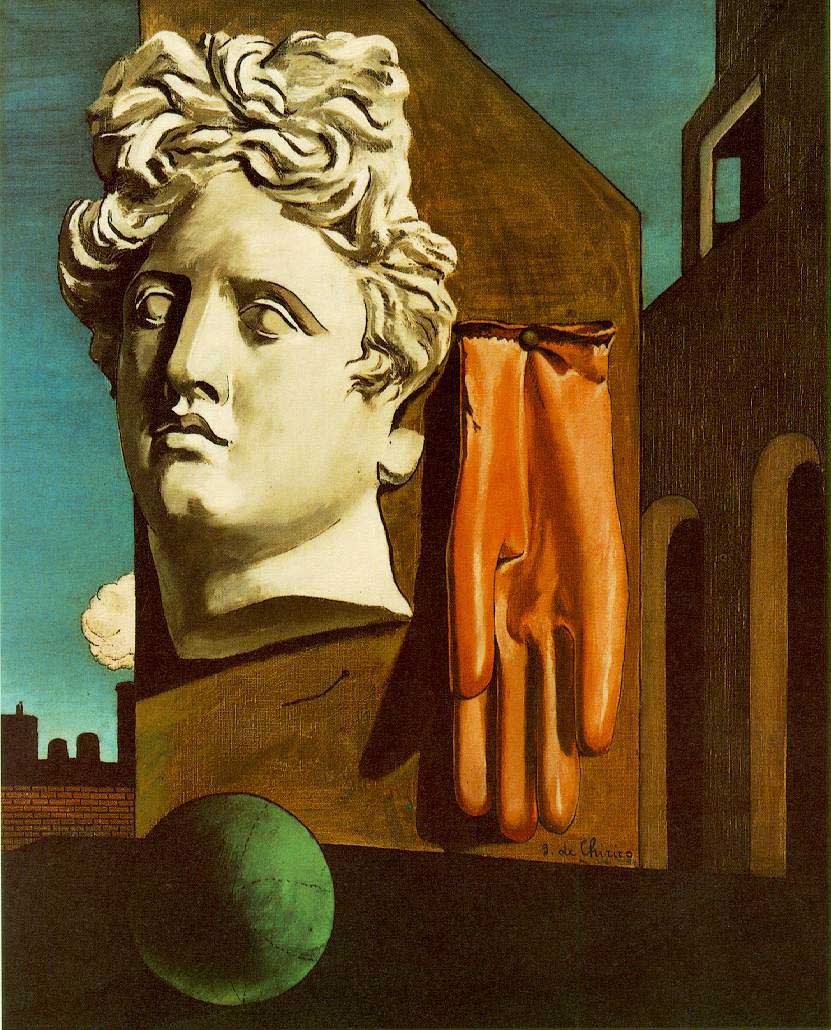
20060216002629!De_Chirico's_Love_Song

Much has been made of the glove.  It may symbolise the intestinal complaints suffered by the artist.  It also relates to the fantastic series of etchings by Max Klinger – Paraphrase on the Finding of a Glove – created in Berlin in 1881.  In this series (already discussed under the Uncanny), a glove dropped by a lady on an ice-rink is purloined by the artist.  The glove becomes the object of his fantasies which in turn get infected by his guilt at having failed to return the object to its owner.  Capricious juxtapositions occur throughout the series.  The glove becomes magnified.  Crocodile-like creatures track its peregrinations.  But de Chirico got more from Klinger than merely the glove, as he states in his own perceptive essay on Klinger, published in Valori Plastici magazine, which flourished in the 1920s – and de Chirico’s articles in it are reprinted in Commedia dell’arte moderna, Traguardi, Rome, 1945 :

“Out of modern life, out of the continuous development of man’s activities, out of the machinery, constructions and gadgets of everyday progress, Klinger managed to extract a romantic feeling, strange, yet deep.  What is this romanticism of modern life?  It is the breath of yearning that flows over the capitals of Europe, down the streets darkened by crowds, over the booming crossroads of cities…”

(James Thrall Soby, Giorgio de Chirico, p. 55)

One thing leads to another.  Caprice informs the writing of this essay, and so wilfully I pursue each lead.  Klinger also executed a series of etchings which depicted centaurs disporting in some mountainous Arcadia.  Like any chimera, the centaur is a capricious beast, or at least the outcome of caprice.  Thus the centaurs of the Elgin marbles become another source of this spirit in art.  The notion of a classical Arcadia is also of importance to de Chirico and later too to Paul Delvaux who capriciously merges it with that more everyday romance – the romance of railway stations and shipyards and tunnels under embankments – which de Chirico identifies as Klinger’s contribution.  But another influence on de Chirico was Arnold Böcklin – the Swiss-German painter active in the latter part of the eighteenth century.  Now Böcklin was as keen on centaurs as anyone.  In his book on de Chirico, Soby follows up this lead:

“Certainly one of Böcklin’s main accomplishments was to give fantasy the quick believability of everyday occurrence.  This aspect of his art attracted de Chirico most, as is altogether clear in the latter’s article on Böcklin published in Il Convengno in 1920.

The impact of surprise [de Chirico wrote] is especially strong in Böcklin’s painting, The Centaur at the Blacksmith’s.  The vision must have hit him suddenly.  The classical solemnity of the composition enhances the strangeness of the subject.  Peasants have come with their children to look at the centaur, and their figures have the ghostlike appearance of certain apparitions in Giotto and Uccello.  The body of the centaur is astonishingly realistic.  As you look at that perfect creature, who with his hoof on the block shows the blacksmith the work to be done, you do not think at all of the word “monster”; he is a likable person; he is nice

By the time this article was written, in 1920, de Chirico had been exposed to Guillaume Appollinaire’s theory that authentic modern art was distinguishable by the element of ‘surprise’.”

(Ibid, p. 25)
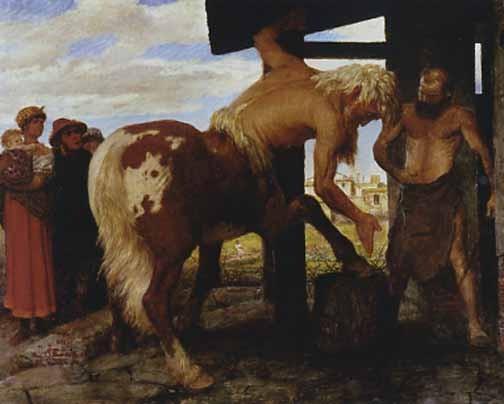
arnold_bocklin_centaur_village_blacksmiths_print

Now this element of surprise is essential to the spirit of caprice.  It is surely the key to the beauty of juxtaposition identified by Lautreamont.  Because it relates to the condition of the astonishing it carries with it an association with the sublime.  It also relates to the grotesque, however, through the surprising fusions which characterise the chimera, and through the confusion of emotions that the grotesque generates as to whether we should laugh or cry.  The confusion is well exemplified by the grotesque etchings of Alfred Kubin – whose coloured drawing Vision of Italy, executed in 1904-5, was clearly an influence on de Chirico.  Caprice incorporates opposing elements.  In its contrary way, it would benefit from the advantages to be gained by such a fusion at the same time as in its nihilistic moodiness it would cancel out all the gains that might accrue.  Thus it is both beautiful and grotesque, sublime and abject, subjective and objective, and, as we shall see, down-to-earth and metaphysical.  It makes a virtue of inconsistency.  It does not wish to be pinned down.

It’s the metaphysical aspect which de Chirico articulated most strenuously when the animosity of the Andre Breton caused him to break with the surrealists.  Breton, the power-broker of the surrealist movement, was to move on from the Freudian viscera of the dream-work to a Philistine and orthodox Marxism, taking the fine poet Paul Eluard with him, but alienating other artists and writers in the process.  De Chirico was one of the latter, and the interest in classicism which he had inherited from Böcklin was another factor which aroused an antipathy to his work among hard-line surrealists.  He reacted against the dogma of the two-dimensional limitations of the canvas – much espoused by modernists pushing towards abstraction – and emphasised instead an exaggeratedly deep perspective akin to that of humanism  – not, as Soby points out (de Chirico, p.41), “for reasons of plausibility or scientific accuracy, as with the mid fifteenth-century Italians, but as an instrument of poetic and philosophical suggestion.”

De Chirico was increasingly ostracised by the surrealists.  As the war broke, he returned to Italy.  By 1914 a different glove had begun to appear in his paintings – a glove de Chirico had seen as a store sign.  In Valori Plastici, he recalled his last months in Paris:

“All around me the international gang of modern painters slogged away stupidly in the midst of their sterile formulas and arid systems.  I alone, in my squalid studio in the rue Campagne-Première, began to discern the first ghosts of a more complete, more profound and more complicated art, and art which was – to use a word which I am afraid will give a French critic an attack of diarrhea – more metaphysical.

New lands appeared on the horizon.

The huge zinc coloured glove, with its terrible golden finger-nails, swinging over the shop door in the sad wind blowing on city afternoons, revealed to me, with its index finger pointing down at the flagstones of the pavement, the hidden signs of a new melancholy.”

(Giorgio de Chirico, “Zeusi l’esploratore,” p. 10)

But this new melancholy was not so far removed from the old melancholy engraved by Albrecht Durer.  We find a similar jumble of esoteric paraphernalia, a similar obsession with measurement, similar brooding figures and shadows.   It is also the lukewarm melancholy (that is neither hot nor cold) referred to by Ortega in his essay on modernism.  It exemplifies the paradox at the core of caprice.  This melancholy can be the domain of nihilists such as Duchamp or, more recently, Marcel Broodthaers; both of them logicians of the image, seeking a cool if ambiguous analysis of an ephemeral circumstance.  However its arcane territory can as easily be inhabited by artists like de Chirico or Delvaux, both of whom search for some spiritual subtlety.  Each of these factions demands surprise.  And equally each activates displacement.

For all these artists, titles are important.  The Uncertainty of the Poet, the Transformed Dream (de Chirico), Diurnal Propositions, The Anxious City (Delvaux), The Brawl at Austerlitz, The Bride Stripped Bare by her Bachelors, even (Duchamp), and Advertisement for the North Sea (Broodthaers).  There is almost always a dislocation between title and work.  Why does a plaster cast of a classic nude next to a bunch of bananas with a train passing in the twilit background express the anxiety of the poet?  Is there a pun that the brawl at Austerlitz fails to deliver in English: how does the brawl relate to a glass-panelled door, its panes covered in whitewash?  Admittedly, the titles of the Belgian artist Delvaux are more illustrative.  The figures crowding into the canvas of his Anxious City look anxious enough, and this was a painting begun in 1940, as Belgium came under German occupation.    
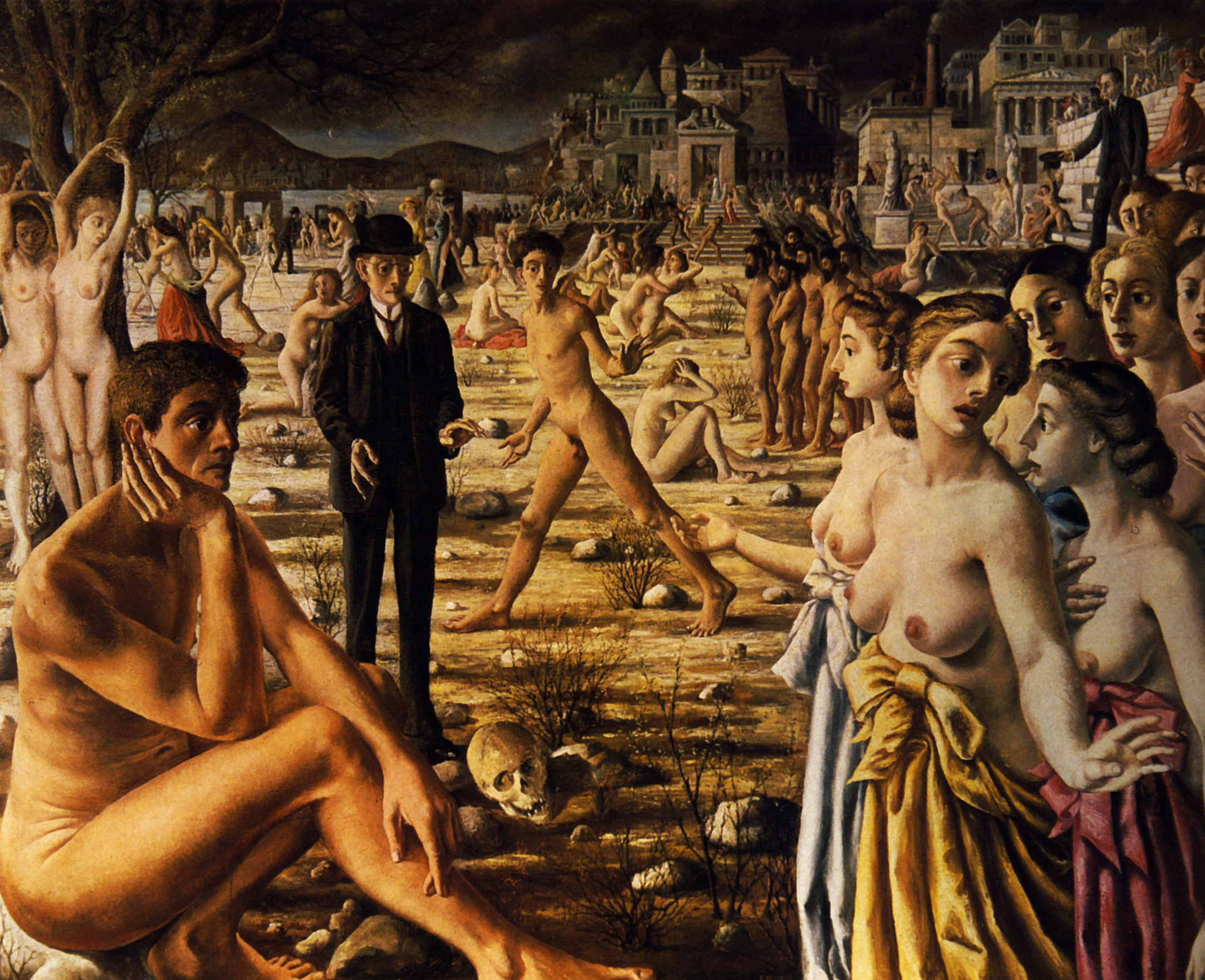
city-worried-1941

Delvaux’s art is in several ways less capricious than either de Chirico’s or Duchamp’s, and perhaps this makes it softer, more amenable at first glance, and ultimately weaker, since the paradox he deals with seems more comprehensible than those which appear in the work of the other two artists mentioned.  Remember that Friedrich von Schlegel, the brilliant theorist of Jena romanticism wrote an essay On Incomprehensibility.  Schlegel maintained that all art should be incomprehensible when viewed in its own time, and that ensuing generations should be able to discover meanings in the work that were unapparent to its initial audience, for this would extend the duration of its significance.  Certainly de Chirico expected his paintings to stimulate a multiplicity of meanings, maintaining that the exercise of making meaning was a salutary process, a metaphysical process, spiritually uplifting for the viewer.

What makes Delvaux’s work more comprehensible than de Chirico’s is his insistence on the inclusion of the naked figure.  It is an insistence which amounts to a fetishisation of the nude.  And we soon come to understand that Delvaux’s work engages with an anxiety concerning sexuality.  With de Chirico, the issue is less clear: the figures are more often manikins or plaster casts of statues than representations of living beings.  Even the little girl running along with her hoop in The Mystery and Melancholy of a Street (1914) is merely a shadow.  It is as if we are contemplating the consciousness of the street itself rather than that of anyone who uses it – in fact, nobody uses it.  It is deserted except for its suggestions. And it is this enigmatic avoidance of any direct representation of personal life, or of actual people, which gives de Chirico’s (early) work its haunting and abstruse resonance.  Schlegel would have approved.

Delvaux’s environment is puzzling, but far more tangible than de Chirico’s.  The issue is more specific. Games are constantly being played with disclosure – a woman may be nude except for her head which is hidden, or she may be partially hidden by the leaves of a small sapling, or her breasts may be hidden by a huge bow which also makes a present of her.  The naked male is shown also, and sometimes the artist portrays himself thus, though the nude male figures less and less as the work develops.  In many cases these males seem underdeveloped, flaccid, adolescent, or neurotically pensive.  But we are more likely to catch sight of the departing figure of the man in the street, suitably clothed and bowler-hatted, often engrossed in his newspaper, oblivious to the women flagrantly naked on either side of him.

PaulDelvaux-Themaninthestreet.JPG.scaled1000

It is Delvaux’s caprice to take this availability of the flesh out of any appropriate context and place it in the street, in the public park or in the city square; for his nudes inhabit that contemporary romantic landscape de Chirico describes when praising the work of Max Klinger and speaking of the breath of yearning that flows “over the geometry of suburban factories, over the apartment houses that rise like cement or stone cubes, over the sea of houses and buildings, compressing within their hard flanks the sorrows and hopes of insipid daily life…It is the nostalgia of railroad stations, of arrivals and departures…” (James Thrall Soby, Giorgio de Chirico, p. 55).  Delvaux’s naked figures expose themselves indecently.  They ought to be arrested – except that one cannot be sure that they are aware that they are naked, and then, again, none of the men in the street seem to look at them, nor do they seem aware of their existence.

Differing times seem juxtaposed in his paintings.  Classical porticos are contrasted with contemporary attire, while nudes draped classically wander down modern streets.  Interior activity occurs outdoors, as in Chrysis, painted in 1967, where a meek nude female holds a candle at the edge of a dark street.  We sense that she has just emerged from the little house which we can see behind her.  A red carpet leads up to its door.  But she is not standing on the pavement.  She is standing on what looks like a railway platform running down the centre of a street.  The little house has been constructed at the end of it.  And it’s as if Delvaux had taken a cluster of sentimental cliches and tried to visualise them as they would be if they actually occurred.  “I’ll always be there, holding out a candle for you, and if you come back, dear, you can be sure of the red carpet treatment.”

tumblr_mbcbpbJzE21rtruoso1_1280

But she is after all merely a suburban stopover.  It is true that the little house seems to have a larger extension built onto it where a light burns in the bedroom – but even so, he’ll just be passing through.

In many of Delvaux’s paintings we come across the figure of a long-nosed academic staring fixedly at a stone.  He epitomises the studied indifference of the male to the female sensuality surrounding him.  His sexual drive seems capriciously displaced onto this object of dubious scientific interest.  David Scott explains how Delvaux was influenced by Jules Verne when choosing to include this figure:

“The archaeological themes Delvaux explored in his neoclassical pictures of 1940 and 1941 are developed in a different but related way in the Phases of the Moon series of 1939-42, and in a number of allied paintings. The leitmotiv linking these works is Delvaux’s adaptation of the character Otto Lidenbrock as illustrated by Riou for the Hetzel edition (1867) of Verne’s Voyage to the Centre of the Earth.  In this adventure Lidenbrock, a geologist with an insatiable scientific interest in the origins and nature of the world, makes a journey, no doubt symbolic in import, in the company of his nephew, Axel, and the Icelandic guide Hans, into the bowels of the earth. (It was, perhaps, of special significance to Delvaux that only after this initiatory exploit was Axel able to return to Hamburg and marry the woman he loved.) The journey through the earth includes a trip on a subterranean sea, and ends in a symbolic rebirth, with the heroes ejected through Mount Etna’s mouth into the serene Antique world of Sicily. This novel, and others by Verne, provided Delvaux during his childhood years with a deep source of reverie concerning the origins of life and, less directly, of the nature of the unconscious mind. The theme of the Phases of the Moon is significant here for, as Lidenbrock observed during the voyage, the moon influences phenomena underground (that is to say, in the unconscious) as well those on the earth’s surface.

The Lidenbrock character first appeared in Delvaux’s work in 1939 as a minor detail in a painting entitled Nocturnes, turning up again later the same year in the foreground of two others, The Awakened Forest (private collection) and Phases of the Moon 1. In the former Lidenbrock appears, with the artist looking over his shoulder, in the prehistoric forest he explored in Voyage to the Centre of the Earth, in which giant versions of the earth’s more simple plant forms grow. In Delvaux’s painting, however, we discover not the pre-human giant of Verne’s tale but a Dionysiac troupe of naked men and women, some of whom are wreathed or swathed in leaves. In the latter painting, Phases of the Moon 1, all references to Verne have been dropped, except for the character of Lidenbrock, who appears, as remains the case for the next thirty years, as an isolated motif in juxtaposition with scenes entirely unrelated to his original fictional environments.”

(David Scott, Paul Delvaux, p.57)

One of Delvaux’s most intriguing pictures is The Musée Spitzner, painted in 1943 (Musée de l’Art Wallon, Liège).

the-musee-spitzner-1943

Here a trio of partially clothed figures occupy an architectural environment particular to the artist.  It’s a sort of veranda, one side of it open to the street, although the lamp hanging from its ceiling gives it the feel of an interior.  A woman with her breasts exposed appears to be sleep-walking.  She crosses this space, moving between a wide-eyed, naked adolescent and a skeleton whose hands are opened towards her, as if welcoming her approach.  Meanwhile, behind a clothed woman seated rather rigidly at a table, the flayed body of a male, a figure out of a textbook on anatomy, enters through a dark doorway.  Here the theme of disclosure mingles with that of life and death, animate and inanimate.  Outside this veranda there is a clothed male statue of a dignitary on a plinth, while a naked female caryatid helps to support the veranda roof.  Meanwhile a group of very realistically painted men occupy the foreground outside in the street.  So a fairly exhaustive list of layered states of being or non-being can be derived from this work: clothed male statue, unclothed female statue, clothed “real” men, a clothed if entranced woman, a female sleep-walker with her breasts exposed, a naked boy, a flayed man, a skeleton.  David Scott explains one amusing aspect of the work:

“Whereas Delvaux liked to work stripped to the waist or in an open-fronted, sleeveless shirt, most of his male contemporaries were obliged to set off for work at their offices formally, and fully, clothed.  This point is developed further by the inclusion of the portraits of five of Delvaux’s male friends – Paul-Gustave Van Hecke, Gérard Bertouille, Emile Salkin, Olivier Picard and Yvan Denis – who, dressed in their business suits, look on with uneasy expressions on their faces.”

(Ibid, p. 62)

So here the displacements are gloriously capricious, it is as if the artist had taken his friends and thrust them into a fantastic world where the drawing-room experiences the chill of the cold night air and where anatomies intrude on exposed privacies and where the time-honoured, and ultimately rather academic theme of “Death and the Maiden” gets enacted before the eyes of these respectable Belgian professionals.

*        *        *        *

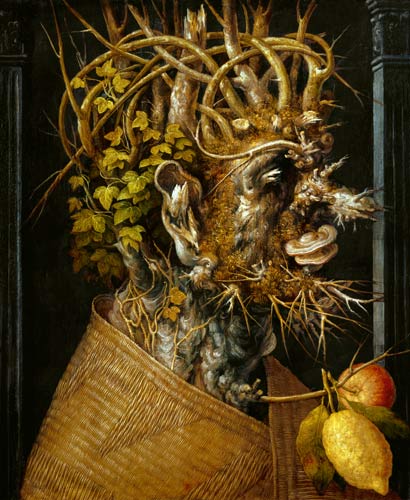
We have seen that caprice can be an exaggeration of some formalist nicety, an arrogant endorsement of wilful exhibitionism or the product of a melancholic displacement.  Equally it can be the desire to enter into a travesty of oneself or produce a mockery of some time-honoured and portentous form.  It can be a dislocation of the normative order born of ennui, or an endorsement of the modernist principle of surprise.  Caprice is inconsistency incarnate, so one might ask whether it can ever be consistent.  We may consider Arcimboldo’s faces composed of objects – fruit, books, bark and so on – to be grotesque or uncannily fetishistic, but are they capricious?  Surely he abides by his agenda with too much rigour, adheres to his mannerism too closely to be considered a capricious artist.  The same might be said of the perspectival illusions of Escher – the artist has chosen to stick to one specific gimmick.  This is professionalism, not caprice.

Perhaps the issue is less the constancy of the endeavour, and more a question of its rationale.  We can see the point to Arcimboldo and to Escher.  The reason they resort to their artifices and remain with them is because of the felicities that such artifices deliver.  Indeed, the success of these illusions is a little too obvious.  I don’t think that the same can be said of the strange mannerisms of Salvador Dalì.  Dalì’s brand of surrealism tended towards the grotesque, in the early years, rather than towards the capricious, but later he developed the strange habit of dislocating everything that would normally rest on something else.  It is difficult to comprehend why he found this so fascinating.  An obsession with illusion and trompe l’oeil may have been a contributing factor, of course. After all, there is something capricious, surely, about the painting of a back of a canvas by Dutch artist Cornelius Norbertus Gijsbrechts (1630 – 1675).
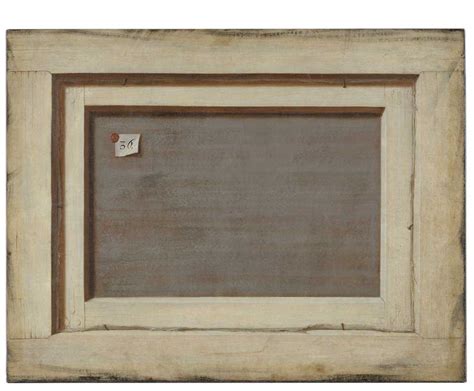
Gibrechts

Of course, the “canvas of a canvas” by Gijsbrechts can also be seen as partaking of the innocuousness of the quietism associated with formal art   – its caprice the result of the method of reductio ad finem being applied to illusion.  However, I find the dislocated realism of Dali genuinely capricious.  Dalì invites us into a world where the sea does not rest on the sand of the beach.  In fact it casts its shadow on the sand below it.  The throne does not rest on the ground, the queen does not sit on her throne, she hovers above it.  Finally even parts of the body become separated from each other – as in The Young Girl Auto-sodomised by her own Virginity.

Dali-00316-Salvador_Dali_Young Virgin Auto-Sodomized by the Horns of Her Own Chastity,1954

This world seems to be undergoing the process of its formation.  It is reminiscent of the diagrams which show one how to put together construction-kit furniture, or car-engines or model aeroplanes.

Another genuinely capricious work by Dalì is his painting Paranoiac Visage, derived from a photograph, of an African hut with an orchard in the background and a few people seated in front of it.
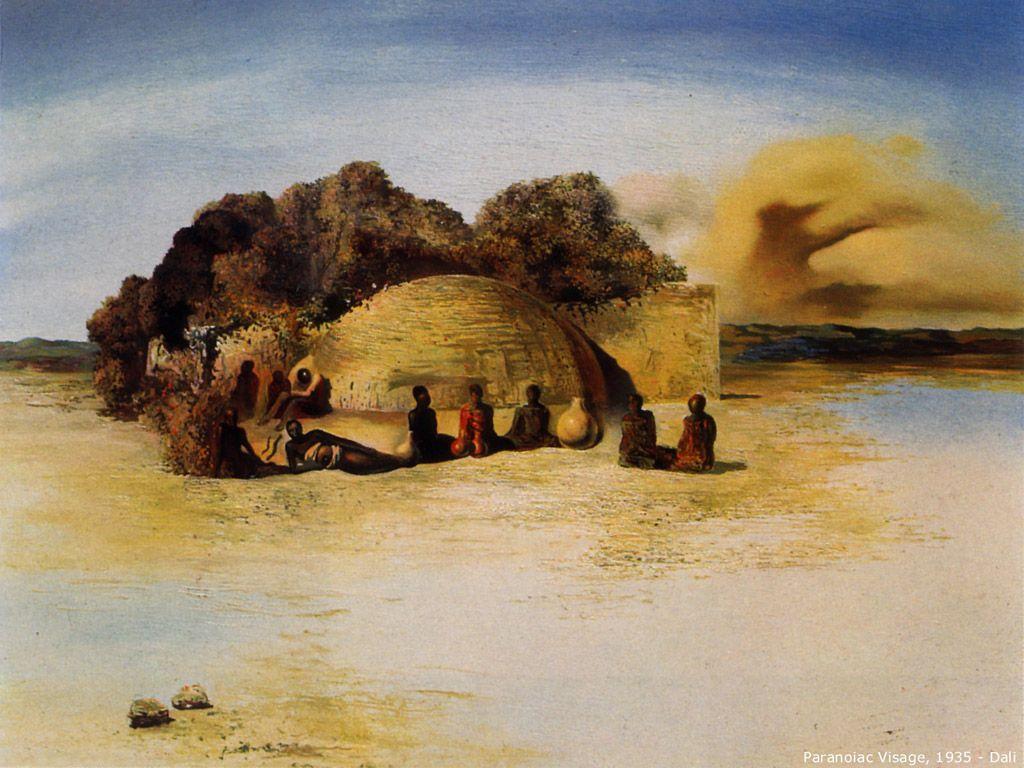
Paranoiac Visage

This reads as the face of a woman when one looks at it with one’s head tilted, and when one does this one reflects the position of the horizontal face which is to be found in the painting.  The work is a caprice, not only for its own wilfulness, but because it is out of series, a one-off.  Perhaps we should distinguish here between caprice and capriciousness.  It has been noted that Leonardo advertising himself as a musician was a capricious act on the part of the artist – and this is not to say that the music he played was anything but orthodox for its time however unorthodox the shape of his instrument – designed in all likelihood as a horse’s head in order to prompt that commission for the equestrian statue of Il Moro.

There have been other such acts: murders perpetrated by Caravaggio, Arthur Rimbaud giving up poetry and Verlaine and going off to Africa to become a gun-runner, Yves Klein (appearing to) fling himself from a high wall or using paint-daubed women to create impressions on his canvases, various well-orchestrated events by Manzoni, barking conversations by dadaists at the cabaret Voltaire, William Burroughs playing William Tell (with tragic results), the sustained uniformity of Gilbert and George – which perversely amounts to a caprice.   Some of these events occur in life: others constitute professional practice.  But the artist who made both caprice and capriciousness his life and his business was Marcel Duchamp.

Octavio Paz draws attention to the influence of Raymond Roussel on Duchamp:

“Duchamp himself has on various occasions referred to that memorable night in 1911 when – together with Apollinaire, Picabia and Gabrielle Buffet – he went to a performance of Impressions d’Afrique [a dramatized version of a novel by Roussel)… ‘It was fundamentally Roussel who was responsible for my glass, La Mariée mise à nue par ses célibataires, même…  This play of his which I saw with Apollinaire helped me greatly on one side of my expression.  I saw at once that I could use Roussel as an influence.  I felt that as a painter it was much better to be influenced by a writer than by another painter.  And Roussel showed me the way…’  The Bride is a transposition, in the sense that Mallarmé gave the word, of the literary method of Roussel to painting…”

(Octavio Paz, Marcel Duchamp, p. 8)

In How I wrote certain of my books, Roussel explains his method.  First he would devise two sentences which rhymed with each other in their entirety – that is, it was not just a question of the last word of one sentence rhyming with the last word of the second.  The sentences had to rhyme from the first word in each to the last, as “Simpletons defer ponds” rhymes – or nearly rhymes – with “Gentlemen prefer blondes”.  But both sentences would have to make sufficient sense for it to be possible to write a seamless short story which began with the first sentence and ended with the last.

Roussel’s method is capricious in itself.  Like Delvaux, he was a fan of Jules Verne, and like Duchamp a chess theoretician.  He probably suffered from the dead mother syndrome – for it’s clear that his mother was insensitive to his nature: after his death, she forbade the construction of the elaborate tomb he had designed for himself – which some enthusiasts believe would have constituted the key that would have revealed the arcane secret of his method.  He wrote, apparently, in a state of exhilaration, often followed by depression when his work was ignored or ridiculed – a typically melancholic mood-swing.  He preferred “the domain of conception to that of reality,” and his ambition was to write a work of pure imagination – in no way affected by observation or derived from day-to-day experience.   The rules he abided by in his writing enable the laws of chance to dictate the narrative that results.  Duchamp then compounds the caprice by taking this literary method and displacing it, transposing it into a work of visual art.  But what is a sentence in visual art?  What is a rhyme?  These are displaced questions, inappropriate to the medium, yet typical of caprice.

Duchamp’s act of drawing a moustache on the Mona Lisa is an isolated gesture.  He does not extend the notion into a series.  This is typical of capricious inconsistency. Paz touches on the issue when he discusses Duchamp’s invention of the ready-made:

“In art the only thing that counts is form.  Or, to be more precise, forms are the transmitters of what they signify.  Form projects meaning, it is an apparatus for signifying.  Now, the equipment that ‘retinal’ painting uses to signify is insignificant: it consists of impressions, sensations, secretions, ejaculations.  The ready-made confronts this insignificance with its neutrality, its non-significance.  For this reason it cannot be a beautiful object, or agreeable, repulsive or even interesting.  Nothing is more difficult than to find an object that is really neutral: ‘anything can become very beautiful if the gesture is repeated often enough; this is why the number of my ready-mades is very limited…’  The repetition of the act brings with it an immediate degradation, a relapse into taste – a fact which Duchamp’s imitators frequently forget.  Only for a moment: everything that man has handled has a fatal tendency to secrete meaning.  Hardly have they been installed in their new hierarchy, than the nail and the flat-iron suffer an invisible transformation and become objects for contemplation, study or irritation.”

(Ibid, p. 14)

Paz appends a note to this paragraph: “According to Duchamp all modern art is retinal – from Impressionism, Fauvism and Cubism to abstract art and op-art, with the exception of Surrealism and a few isolated instances such as Seurat and Mondrian.”  My eye-brows raise at the notion that Seurat and Mondrian are non-retinal – brainy, yes, but still retinal, in my opinion.  However, Paz also points out that the ready-made is a criticism of manual art, as well as of retinal art, and a criticism of the idea that art has something to do with some mastery of execution.  So here we come across another characteristic of caprice: it may act as a criticism of art itself, an “up-yours” response to its cliched notions, its dogmas, its trends and received opinions.  De Chirico’s portrait of himself in Renaissance garb, executed with a very painterly realism, is quite distinctly a capricious critical riposte to the Breton mafia, which had constrained surrealism to a formula, attacked any approach to classicism and denounced de Chirico’s politics.

Caprice could be said to be diametrically opposed to method, yet in the work of Duchamp it almost becomes a method.  Capriciously, the artist will posit the ready-mades as a criticism of execution while contradicting this position with meticulous execution when it comes to the making of the Large Glass.  But then I think it was Yeats who maintained that a poet had a right to change his mind every three weeks or so, and anyway, the value of execution gets brutally devalued when the glass breaks in transit to the United States – and the artist maintains that this enhances and even completes the work.  Capricious thinking seems to have allowed Duchamp to proceed from intuition to intuition.  He is never held back, never constrained by some vested interest in a standpoint maintained while creating a previous body of work. He can celebrate “the juxtaposition of mechanical elements and visceral forms” in the painting of the Bride of 1912 – which may be considered his last real painting.  It amounts to ironic cubism, a cubism couched in perspectival depth and comprising shapes which seem agglomerations of found objects, odd organs and rare bobbins.  It seems influenced by Leonardo da Vinci’s anatomical drawings together with his drawings of contraptions.  If Leonardo was the Warhol of the Renaissance, then Duchamp was the Leonardo of the twentieth century.  Leonardo, Roussel, Duchamp.  They are all grand masters, Prosperos, masons of some mystic lodge.  And then there is Uccello, the alchemist of perspective, labouring away at his drawing of what might be the holy grail.  Without a backward glance, Duchamp can move on from “painterly” painting and execute drawings worthy of any Renaissance master – Chocolate Grinder No. 1, for instance – for as Jean-Christophe Bailly points out:

“The inspiration for it was a real object, seen by chance in the window of a confectioner’s shop in Rouen.  Duchamp appropriated the image, more or less as it stood, in just the same way as he later ‘appropriated’ his ready-mades.  For him the procedure represented the ‘absolutely dry drawing’ it was one of his ambitions to achieve: a precise and meticulous record of the form of an object from a straight perspective, resembling the technical exercises or mazzochi beloved of the quattrocento masters Piero della Francesca and Uccello.  The only difference between the painted object and the real one is that Duchamp’s grinder had three rollers instead of two.”

(Jean-Christophe Bailly Duchamp)

Duchamp was not alone in identifying Roussel as a writer with an intriguing method.  Though relatively unknown to general readership, he exerted a considerable influence on the art and literature of the twentieth century.  As well as the surrealists, Roussel influenced the writers of the Oulipo, and many of the writers associated with “the New York School”.  I must confess that I get irritated by the artful whimsies of the Oulipo, the “workshop for creative literature” founded by Raymond Queneau and Francois Le Lionnais in 1960.  The fruits of this workshop may be found in the Oulipo Compendium edited by Harry Mathews and Alistair Brotchie (Atlas Press, London, 1998). To me, their adherence to strict forms of acrostic, lipogram and antonymy (to mention but a few of their devices) seems more fetishistic than capricious, and in general they institutionalise serendipity and restrict that progression from one intuition to the next which I admire in Duchamp and identify as a genuinely capricious way of developing one’s oeuvre.

The New York School is a group of writers which grew up more casually in New York in the sixties – and they interest me far more.  The writers associated with it might very well deny that there ever was a school – it was just a matter of there being a crowd of writers living for the most part in New York at the time who shared an interest in Gertrude Stein and Raymond Roussel, writers who had in common an enthusiasm for the work of contemporaneous painters and performers and did not simply relate to the institution of literature – as exemplified by the academic poets flocking to the standards of Roberts Frost and Lowell.   Many of these “artworld” writers appear in The New York School – an anthology edited by Ron Padgett and David Shapiro.  In it you can find the work of Padgett himself, and Peter Schjeldahl, Joseph Ceravolo, Clark Coolidge, Bernadette Mayer, Frank O’Hara, James Schuyler, John Ashbery, and other peculiar writers too numerous to name.  There’s plenty of caprice in Padgett as there is in most of these practitioners.  Ashbery is fascinated by Roussel – who has also been an influence on the work of the “capricious” American novelist Harry Mathews – a dedicated member of the Oulipo whose poems are also included in The New York School.  Mathews and Ashbery edited Locus Solus together, an avant-garde magazine which took its title from that of one of Roussel’s elaborately constructed novels.  His own novels are often elaborately plotted according to some pattern of requirements for each chapter.

Ashbery himself has written several immensely capricious poems – there’s Into the Dusk-Charged Air, for instance, from Rivers and Mountains, first published in 1966:

“Far from the Rappahannock, the silent

Danube moves along toward the sea.

The brown and green Nile rolls slowly

Like the Niagara’s welling descent.

Tractors stood on the green banks of the Loire

Near where it joined the Cher.

The St Lawrence prods among black stones

And mud.  But the Arno is all stones.

Wind ruffles the Hudson’s

Surface.  The Irrawaddy is overflowing.

But the yellowish, gray Tiber

Is contained within steep banks…”

xxxxxxxxx(John Ashbery, The Mooring of Starting Out, p. 173)

The poem flows on for many lines, each one mentioning the name of a river.  Then there is Farm Implements and Rutabagas in a Landscape, a sestina celebrating the exploits of Popeye.  Ashbery, as already mentioned, has also collaborated with James Schuyler on a capricious novel.  This is The Nest of Ninnies.  He once told me that he and Schuyler used to drive up to the Hamptons together, on Long Island, most weekends, separating on arrival in order to grace diverse dinner-parties with their presences.  On the way home, they would regale each other with the remarks they had overheard.  The novel is nothing more than a glorified anthology of such prandial felicities, some witty, some devastatingly not.  Ashbery and Schuyler took it in turn to write replies to the other’s contributions.  The plot, such as it is, concerns a group of friends who meet for dinner, on one occasion, and then continue to meet each other either by design or by coincidence, so that they end up dining together in various parts of the world.  The book could be seen as an updated version of Flaubert’s thoroughly whimsical Bouvard et Pecuchet, with its appended glossary of received opinions.

In previous essays, I have dealt with several authors and their pioneering innovations – and at their most extreme these innovations may well seem capricious: the novels and poems of Roussel, for example, and those of Georges Perec (both of whom were equally adept at handling the regressive technique of the story within a story).  I have also alluded to the poems, plays and texts of Gertrude Stein (the formalist pioneer who chose could be accused of emphasising the signifier over the signified).  Stein wrote an abstract poem called Tender Buttons – a fairly fanciful title – is she referring to nipples or to mushrooms?  The poem itself is both erotic and abstract at the same time.  Then there’s the work of Daniel Spoerri (who is also discussed as a teller of tales within tales).  Spoerri’s An Anecdoted Topography of Chance is also indubitably of interest as a capricious work, mixing line drawings with text, and treating the reader to an almost scientific description of the objects scattered at random on his desk while providing esoteric footnotes and (almost) private jokes.

No list of authors engaged in caprice should exclude the prose-poems of Rimbaud, nor that strange, open yet enigmatic poem by Mallarmé Un coup de des ne jamais obolira l’hazard – “A dice throw never abolishes chance” – nor the surreal poems of Paul Eluard, nor the violent and abusive simplifications of tragedy perpetrated in the Ubu plays by the dadaist Alfred Jarry – though these have a grotesque aspect to them as well as a capricious one.  Nor should it exclude the writing of de Chirico.  That a painter should write a novel seems capricious enough, that it should be one of the most interesting literary works of its century seems a caprice of fate.  This work, Hebdomeros, published in 1929, was described by Ashbery in Newsweek in 1982 – when the de Chirico retrospective opened in New York – as “a great dream novel”.  Its strange dislocated landscapes which dissolve into others – as do the landscapes and railway carriage interiors of Alice’s “Looking-glass world” – seem infused with a Nietzchean stimmung or atmosphere.  Ashbery identifies Nietzsche’s influence on de Chirico: “The philosopher’s greatest innovation, according to the artist, was ‘a strange and profound poetry, infinitely mysterious and solitary…based on the stimmung of an autumn afternoon when the sky is clear and the shadows are longer than in summer…’”

A similar atmosphere pervades the poetry of Georg Trakl – a friend of Ludwig Wittgenstein – who committed suicide in 1914.  But while there is a startling dislocation of images in Trakl – as well as an intense melancholy – the images seem magically appropriate to the subject of each poem.  They possess an ‘inner mystical construction’ which accounts their kinship with the metaphysics of de Chirico.  They allude to chaotic emotions, certainly, but they nevertheless retain a coherence of mood.  They are not engaged in a critique of narrative and make no attempt at wilful displacement.  Much admired by his philosopher friend, Trakl was a melancholy quietist rather than an exponent of caprice, though perhaps his suicide can be construed as a capricious act – since to terminate one’s life amounts to an irrevocable inconsistency.

But I have made no mention of two writers who strike me as engaged in literary caprice without creating displacements within their texts. The first of these is Marcel Schwob (1867-1905) – part of whose text on Uccello has already been quoted in this essay.  It is shameful how Schwob has been neglected in the English-speaking world.  Schwob, to appropriate the blurb on the cover of my copy of The King in the Golden Mask and other Writings by this author, was “the dedicatee of Jarry’s Ubu Roi and Valery’s Monsieur Teste; a friend of Wilde’s, a correspondent of Meredith and Stevenson, translator into French of Defoe and chief collaborator in the famous version of Hamlet made for Sarah Bernhardt, a man admired by Remy de Gourmont, Edmond de Goncourt and Apollinaire.”    On the first page of his introduction, Iain White, his able translator, quotes some contemporary reactions to Schwob:

“You are the most marvelous, the most hallucinatory resurrector of the past: you are the magical evoker of antiquity, of that Heliogabalesque antiquity to which fly the imaginations of thinkers and the brushes of painters, of mysteriously perverse and macabre decadences and of the ends of other worlds.”

Edmond de Goncourt, writing to Schwob on the publication of Le Roi au masque d’or.

“History, linguistics, poetry, prose, astrology, chemistry, criticism, English, German, Greek, Latin, Italian, Spanish, Hebrew – Schwob animates, sets in motion, orders, reconstitutes, associates all the branches of knowledge in his immense and precise imagination.  He evokes adventuring sea-captains with the exactitude of Quicherat and the verve of Cervantes.  He describes the customs and manners of prostitutes and pimps in the city rookeries as eloquently as he does those of sixteenth century scholars or Spanish conquistadores.  With all that goes a perfect taste; never a false move, never is anything over-stressed.  His whole attitude is summed up in pity, pity which he applies without distinction to criminals and saints, to traitors and to heroes.”

Leon Daudet

These are paeans in praise of a literary dandy.  Schwob’s caprice resides primarily in his choice of subject – which is remorselessly esoteric.  The displacement consists in lifting matter out of one discipline – history, for instance – and relocating it within literature.  Schwob is the supreme wizard of the surprising anecdote.  Paul Valery dedicated L’Introduction à la Méthod de Léonard de Vinci to Schwob, so one gets the strong impression that one is delving into the laboratory of another Prospero.  The short stories collected in Coeur Double, Le Roi au masque d’or and Vies imaginaires are also capricious in their brevity – since they tend to complete themselves in some four pages.  Why is brevity capricious?  Because it is the outcome of ennui.  The strategy of a writer who refuses to be bored, especially by his own writing.  Within that brevity, the intensity and the density of these pages is extraordinary.  They have about them also an aberrant and fantastic gloom very much akin to the phantasmagoria of Goya’s Caprichos. This means that we could also include them in our consideration of the grotesque (Schwob was influenced by Edgar Allen Poe).  There is no rule that prohibits an artist bathing in more than one river at the same time.

Iain White makes a good case for concluding that Schwob was an influence on Jorge Luis Borges, the second of these authors who maintain a capricious position without resorting directly to surreal displacement.  Borges admired Rafael Cansinos-Asséns, who translated Schwob’s Vies Imaginaires into Spanish.  In his Autobiographical Essay (included in The Aleph and Other Stories), Borges mentions Schwob directly:

“In my Universal History I did not want to repeat what Marcel Schwob had done in his Imaginary Lives.  He had invented biographies of real men about whom little or nothing is recorded.  I, instead, read up on the lives of known persons and then deliberately varied and distorted them according to my own whims… I did the same for Billy the Kid…and the veiled Prophet of Khorassan…”

In a prologue to Schwob’s La Croisade des enfants, Borges speaks of the French author as being the spectator of a dream of which he is the creator.  The characters in the almost aphoristically brief stories of Borges have a tendency to dream their own lives.  Consider the melancholy fate of Funes the Memorious, in the story of that name.  Funes has total recall.  He is incapable of forgetfulness.  He remembers each cloud formation he has ever seen.  The weight of his memory is so overwhelming that he can do nothing at all.

It is the fallen angel of Melancholy, with thoughts too weighty to be born by wings, who presides over caprice with darkened face in the engraving by Durer, and it is this spirit which impels certain authors and artists who engage in caprice to solicit the world of dreams in preference to suffering the ennui of predictable reality.  This is why caprice is so intimately connected with surrealism and metaphysical art, and why it embraces the stimmung of  Nietzche which poeticises reality by making it into a Protean phantom, a Heracleitan dream.

*        *        *        *

Though antithetical to realism and too restless for the quietude of formalism, caprice is not a mere tributary compared to other rivers of art.  It shows no sign of running dry.  Indeed it appears to have influenced the latter half of the twentieth century as strongly as that formalism that emerges with Mondrian and carries through to Elsworth Kelly.  Caprice comes to life in music with Eric Satie, and persists today in the equally fanciful music of John White (who has composed music for psalteries – so quiet you can hardly hear it – and for miniature pianos). It is celebrated in the wayward architecture of Gaudì and is a key feature of Richard Ghery’s Guggenheim in Bilbao, though it also flourishes in the fantastic architecture of the outsider architect Clarence Schmidt who constructed a seven storey house of mirrors in the Catskill mountains.  Laszlo Moholy-Nagy created a wonderful caprice in an untitled painting done in 1922/23 which features the fencer of figuration duelling with abstraction and found materials.  Marcel Broodthaers inherited the mantle of Duchamp and regaled the art-world with visual puns and fanciful juxtapositions of image and word.  Trevor Winkfield’s paintings take the displacements and juxtapositions of surrealism and transpose them into a bright, highly coloured, up-to-date world.  This is another melancholy, of comparatively recent provenance: it’s the melancholy of the chrome-edged diner, the crisp paucity of nouvelle cuisine – surely as capricious a genre of cookery as anything faked-up by Rome.  Winkfield’s images seem lifted off board games.  There’s a puzzle here, or a game we should be able to play.  If only we could solve that puzzle.  If only we knew the rules to his game.

Pierrot and Harlequin

Then there is a vein running through the work of Bruce Naumann which is quite resolutely capricious.  His animal pyramids are particularly startling, though a grotesque element creeps in by dint of the fact that these acrobatic creatures are docked of tails and ears.  Caprice informs the charming drawings of Francesco Clemente: they seem purposeless and yet clear at the same time.  It is surely capricious of Georg Bazelitz to insist that his paintings are meant to be viewed upside-down, on the grounds that, since they have been painted that way, they are the right way up!  And caprice is very much the dynamic that motivates the kinetic sculptures of Rebecca Horn as well as the equestrian subject-matter of Mark Wallinger.

It is also the dynamic that informs the work of the late Stuart Sherman, an unjustly neglected performance artist and film-maker.   Sherman created brief events on small tables.  Deftly his hands would manipulate a small assembly of capriciously chosen objects.  As with the work of Trevor Winkfield there was precision and there was enigma – in equal doses.  Sherman may have had concise reasons for his choice of objects. Yet the full significance of these objects was often lost to us, the manipulation happened so swiftly, rapidly followed by another.  Nevertheless, an atmosphere settled about the table, an aura of significance concentrated our focus on his small non-narrative dramas.  It was as if we were the Kleinian or Winnicotian analyst, watching a child play with a small collection of toys and waiting for an interpretation to dawn on us.  Sherman’s short films convey the same feeling.  For his Spaghetti Spectacle Sherman created some twenty performance vignettes, all of which used spaghetti as an ingredient.   He also reinvented some classic plays – Oedipus, Hamlet, Three Sisters – according to his whim, or so it might have seemed, though the neatly condensed results were the product of an intense meditation on each text.  Gradually each of these reinventions became less incomprehensible, for with each fresh view of it it was possible to get more out of it.

Eleventh Spectacle Stuart Sherman Right_Brain_SS_11spec_Mangolte

Finally, a very strong tendency to engage in caprice informs the work of Mark Tansey.  He paints exceptionally large canvases dedicated to the smallest jokes.  These are meticulously painted, but done in some limited hue, as if they were one swathe of a printing process.  Purity Test (1982) shows a band of “Red Indians” out of the nineteenth century (doubtless lifted from the work of some painter of the wild west).  These braves are gazing down at Robert Smithson’s Spiral Jetty.

mark-tansey-purity-test

The monochrome hue of the work smooths over the discrepancy and eases the displacement.  It permits us to dwell in the picture, to inhabit its imaginary time – for either they have come forward or the jetty has gone back in time, or perhaps both have shifted into this shared time which has an atmosphere of its own.  The atmosphere is one of contradiction however.  These two events cannot exist in the same time.  Tansey’s work is as capriciously contradictory in this sense as is that of Magritte with his image of a pipe above the painted statement, “This is not a pipe” – in The Treachery of Images, painted in 1929.  Again caprice is enabling us to escape the ennui of daily life by positing a world where one event can coexist with another occurring a century earlier.  For just as scientific method can posit a host of geometries working on principles other than the one which insists that the swiftest distance between two points is a straight line, so art can posit a host of times and spaces obeying other laws than those of chronology or scale.  Caprice enables these alternative laws to come into being.  At the same time, it mingles well with other rivers – consider Magritte’s image of a man looking at the back of his head (wonderfully entitled Not to be Reproduced) and how it fuses the capricious with the notion of the picture within the picture.

not-to-be-reproduced

Capricious displacements succeed best when the conservative authority of the chosen medium is handled with the respect required to “suspend our disbelief” and convince us of the veracity of alarming result.

Anthony Howell, November, 2003.

Links to all of my eight seminal essays on art can be found at Art and its Dark Side

as well as under essays
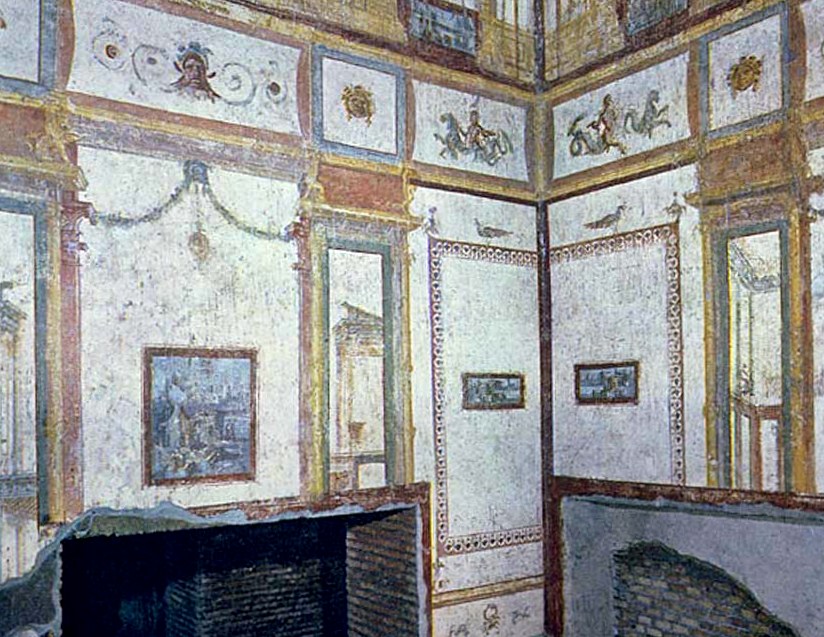
See also Psycho-Painting and what you see in it

Posted in art, Essays | Tagged , , , , , , | 6 Comments

Grotesque: Ancient and Modern

“In the famous Kerch terracotta collection we find figurines of senile pregnant hags. Moreover, the old hags are laughing. This is a typical and very strongly expressed grotesque.  It is ambivalent.  It is pregnant death, a death that gives birth.  There is nothing completed, nothing calm and stable in the bodies of these old hags. They combine a senile, decaying and deformed flesh with the flesh of new life, conceived but as yet unformed. Life is shown in its two-fold contradictory process; it is the epitome of incompleteness. And such is the grotesque concept of the body.”

xxxxxxxxxxxxxxxxxxxxxxxxxxx(Mikhail Bakhtin: Rabelais and His World)

The word “Grotesque” was originally employed to describe a late Roman style of decoration first uncovered in the excavations of Roman baths around 1500, and we can see it in the upper panels of Nero’s Golden House.

Golden House

Since then the term has evolved in numberless directions – a tendency similar to its own complex ramification.  A sense of the grotesque can also be detected in the excessively rounded figurines used in the fertility cults of the cave-dwellers, and in the erotic overstatement of those Sheila-na-Gigs that occupy the corbels of medieval churches; figures which hold their own vaginas wide open.   It is the confluence of these two rivers of influence, decoration and exaggeration, which has so enriched the idiom. Decoration certainly played a key role in the early development of the grotesque. Monks would doodle chimeras on the margins of illuminated manuscripts.

6a00d8341c464853ef019b016487ab970d-500wi

Chimeras are inventions composed of animal, human, vegetable and mineral elements – such as the “Tree-Man”of Hieronymus Bosch; a figure also to be found in Bruegel.  They can be found on the pottery of ancient Greece.  The fictive is as old as the real of course.  Mannerist artists in the sixteenth century employed the grotesque in their gardens to create “grottoes”- false caverns fronted perhaps by Satanic mouths, decorated with mother-of-pearl and provided with deliberately contrived areas of decomposition and decay.

ogre mouth

In Latin literature, Ovid’s Metamorphoses take us through all the transitions from one shape into another that abounded in Greek mythology: nymph into reed or tree, god into eagle or shower of coin; woman into bird, man into stag.  Grotesque progeny are the result of unnatural acts of procreation:  in order to be penetrated by the bull of Minos, Pasiphae installs herself in a wooden cow, and as a result gives birth to the Minotaur – a bull-headed man, or perhaps a man-headed bull.  Ovid’s poem reveals the age of myth as a teeming, unstable world where little retained its original shape, and where death led to immediate re-growth as some other form of life – often involving a transition from animal to vegetable.  We are all familiar with the majority of these the stories now, but when first heard each metamorphosis comes as a surprise, and that is an element essential to the grotesque – suddenness and surprise – according to an early theorist, Wolfgang Kayser.  He took the grotesque for the estranged world – the world of a ghastly Gothic darkness.  In a further attempt at definition he saw it as a play with the absurd.

But Mikhail Bakhtin would have objected to Kayser’s definition.  Bakhtin was a Soviet Russian scholar.  He specialised in the middle ages and, perhaps most notably, in the work of Rabelais, the sixteenth-century author of Gargantua and Pantagruel.  Bakhtin would have argued that the grotesque art of the middle ages was never afflicted by that aversion to laughter which served later to characterise the Gothic horror story of the Victorian era.  The Gothic style is basically a romantic view – of sublimely awful ancient ruins shrouded in vaporous mists, these to be viewed with appropriate shudders!  In Rabelais and his World, Bakhtin demonstrates how the middle ages still honoured laughter.  Medieval humanity perceived the grotesque nature of life without the shudder – laughter was provoked instead.  While the church of Rome was the only church, it incorporated its own abusive outlets.  At the Feast of the Ass, celebrating Mary’s flight into Egypt, each part of the mass was accompanied by the comic braying of “hinham”(or heehaw) instead of “Amen”.  During the Feast of Fools, the censer might be filled with offal, and the holy water sprinkled over the populace might turn out to be urine.  After the fasting days of Lent, the time of Easter laughter began, and priests would crack jokes from the pulpit. It was considered wise to give people the opportunity to give vent to their repressions, to let their hair down, one might say.

According to Bakhtin, it was only after the church had grown impoverished by the Crusades that laughter came to be frowned upon.  For the church started selling pardons for sins instead of providing their outlet or demanding genuine contrition.  Then the church split into factions and a far more dour period began; a period in which the grotesque was not allowed a role, though it was to re-emerge ultimately as satire and protest in the work of such artists as Hogarth and Goya.

But back in mediaeval times, the autumn feasts of Saint Martin and Saint Michael were Bacchanalian in tone, and on the feast of Saint Lazarus in Marseilles there were processions with every sort of animal, and with people masquerading and dancing in the streets, performing the great dance known as the Magnum Tripudium.  Hell and its devils, with their obscene quips, their rude pranks and arses letting out stinks, was always an indispensable feature of such carnivals.

FAUVEL2

Nor were the chimeras and fantastic inventions of the middle ages necessarily absurd to mediaeval eyes.  What Kayser may have read as incongruity for its own sake may well have meant more to those who participated actively in the middle ages. Bosch’s Tree-man, for instance, whose trunk-like legs grow up from boats frozen into icy waters at the fringes of Limbo, may well be a symbol of alchemy and man’s insolent quest for knowledge – indeed the epitome of the tree of knowledge.   An owl sits in his branches:  Athena’s bird, associated with intelligence.  Philosophers, mathematicians and artists come to admire the Tree-man.  Perhaps he is Jupiter, the banished deity to whom the oak is sacred because it is so often struck by lightning.  Jupiter’s wife is the moon-goddess Juno, known as Hera to the Greeks.  Her sacred tree is the willow, which is important to the “wicker”religion of the witches, since wicker comes from willow, and wicker thongs are used to bind their brooms.  On the road to Hell there is supposed to be an inn where travellers can sup and enjoy carnal and conversational pleasures for one last time before the devil comes to herd them on towards the blazing cauldrons.   It is perhaps this inn which is to be seen in the broken-open belly of the Tree-man (blasted open like a tree struck by lightning).

It’s small wonder that we find him in this state of rupture, for nothing is complete in the grotesque.  The essential feature of grotesque realism (a term Bakhtin uses) is degradation: the abasement of all that is high, spiritual, ideal or abstract.  It is a lowering of the tone, a transfer to the material level, to the sphere of earth and body in their indissoluble unity.  Bakhtin compares the mediaeval body with the body that’s preferred by the Renaissance.  The mediaeval body is unfinished and open (dying, bringing forth and being born).  It is not separated from the world by clearly defined boundaries; it is blended with the world, with animals and with objects:

“It is cosmic, it represents the entire material bodily world in all its elements. It is an incarnation of this world at the absolute lower stratum, as the swallowing up and generating principle, as the bodily grave and bosom, as a field which has been sown and in which new shoots are beginning to sprout.”

xxxxxxxxxxxxxxxxxxxxxxxxxxxxxxx(Rabelais and his World: Introduction)

The Renaissance on the other hand saw the body in relation to the Platonic principals of classical Greece, the literary and artistic canons of antiquity that would inspire the Venus of Botticelli:

“As conceived by these cannons, the body was first of all a strictly completed, finished product.  Furthermore, it was isolated, alone, fenced off from all other bodies.  All signs of its unfinished character, of its growth and proliferation were eliminated; its protuberances and offshoots were removed, its convexities (signs of new sprouts and buds) smoothed out, its apertures closed.  The ever unfinished nature of the body was hidden, kept secret; conception, pregnancy, childbirth, death throes, were almost never shown.”

 xxxxxxxxxxxxxxxxxxxxxxxxxxxxxx(Rabelais and his World: Introduction)

However, I find this a rather generalised account of the Renaissance since there were decollations aplenty (Artemisia Gentileschi’s Judith and Holofernes for example), and the torturers of Christ often provide an excuse for grotesque physiognomies.

The fact is that pluralism is by no means a phenomenon particular to contemporary culture.  There were already several audiences in the fifteenth and sixteenth centuries.  For instance, there was a courtly audience who appreciated and patronised the artists we associate with the “High Renaissance” while espousing idealised forms; and then there was a more general audience of monks and students who required something less ethereal.  Rabelais and Quevedo offered the latter more robust fare than was countenanced in the highest echelons.  However it is generally true that as far as the prevailing culture of the upper classes was concerned it was only the body of the masses that resembled a sort of earth-worm, eating at the same time as it defecated the matter of this world.  For those living in more stately circumstances, the body was immaculately presented – a neatly-bound package – too aloof from the business of living to examine its own contents.

Tentative steps towards a scientific approach that would come to typify the Enlightenment were taken by Leonardo da Vinci when he embarked on his series of anatomical drawings, but many of these are imaginative hypotheses rather than sketches derived from clinically observed phenomena.  In the society of merchant princes and condottieri, there was no place for the wide-open body of the Shiela-na-Gig.  The gangster autocrats of Florence and Milan were well aware that what they needed to project was respectability.  And thus the medieval body, the body connected to the soil, was supplanted by a sort of unbroken egg; the immaculate virgin Venus.

All notions of the grotesque in visual art are concerned with that earlier, more primitive body, with breaking the egg, as it were.   But by the time the Renaissance was on the wane, that earlier body had been almost completely suppressed, and the feasts of asses and fools had been condemned as the ceremonies of Black Magic.  Nevertheless laughter persisted.  Rabelais published his iconoclastic (and grotesque) novel Gargantua and Pantagruel in the middle of the sixteenth century – at the same time as the rise of Mannerism.  That just goes to show that pluralism is nothing new!  A brief look at the chronology of the sixteenth century may be appropriate here.  This was, after all, the century of Luther and schism, and there were clearly schisms in the art world as well as in religious circles.

Bosch had completed The Garden of Earthly Delights by 1485.  By 1501 Michelangelo was unveiling his pristine David, and one might suppose the “High Renaissance” to have reached its culmination; ushering in the age of mannerism.  However, Cranach the Elder, Altdorfer and Breugel are all working in the first part of the sixteenth century as well, promoting a far more medieval view, in Bakhtin’s terms.  A key moment is when Erasmus publishes In Praise of Folly in 1506, a thoroughly readable book cruelly satirising the vanities of ordinary people and princes and of their religious mentors. The book’s down-to-earth nature exerted a strong influence over Rabelais, but note that in the same year the Hellenic statue of the Laocoön was excavated in Rome, providing an example of sculptural contortion for its own sake that provided burgeoning mannerists with antique precedent.  This of course was hotly contested by High Renaissance traditionalists who still adhered to the unities of Aristotle and classicism.  Nevertheless, by then, mannerist architecture was in full swing, while sculptors were asserting the right of the artist to rely solely on their own virtú and create works of imaginative virtuosity.  In 1582, for instance, Giovanni Bologna completed a statue which exhibited a triple serpentine structure and showed that he could ably sculpt beautiful women, muscular men and aged persons, combining these forms in one work.  At the last minute, a title was appended to the piece – The Rape of the Sabine – and Bologna accepted the title with a shrug as he’d intended the piece simply to show off how he could handle the “difficulty” of the problem he had set himself.  But this points to only one aspect of the Zeitgeist of that age, for, on the other hand, Gargantua came out in 1532, and was much admired for more than a hundred years, at least by those who did not frown on humour, while Marston’s play, The Dutch Courtesan, appeared in 1605.  Both works present a far from ideal world.  Between these dates, sometime before 1590, Sir Philip Sidney was completing his mannerist masterpiece, The Duchess of Pembroke’s Arcadia, peopling this with effeminate knights and sanitised nymphs and shepherds described in deliciously complex sentences.

The first part of Don Quixote appeared in 1605, Quevedo’s Swindler in 1609 – and Shakespeare, whose work combines both mannerist (As You Like It) and grotesque (Henry IV) qualities, died in 1616.  Rosalind is the ideal heroine for a mannerist pastoral, whereas Falstaff, addicted to jests, good sack, the low life and exaggeration, is very much an emblem of the grotesque.  So these conflicting tendencies were at work throughout the age.

What they have in common is elaboration.  Both make a virtue of variety.  Both are contorted – twisted – though for different reasons; the former to show off the artist’s artistry, the latter to ridicule piety and present the world in all its messy complexity.  There is, as Bakhtin noted, an “is-ness”or a realism about the grotesque: after all, Falstaff is grossly real; and this realism was later to be utilised by Dickens. Falstaff has redeeming qualities but inhabits the low-life world of the ruffian and boasts a fair number of unsavoury acquaintances.

Several decades after Gargantua was published, Francisco de Quevedo described Hell with grotesque verve in his Visions.  As we have seen, he published The Swindler in 1608, a novel which featured a picaro, that is, a ruffian with no redeeming qualities. This is the origin of the term “picaresque”, though the picaro usually gets involved in a string of adventures, which is why the term is now applied to a book with episodic chapters.   Quevedo’s introduction to this novel is a tonic:

“Here you will find all the tricks of the low life or those which I think most people enjoy reading about: craftiness, deceit, subterfuge and swindles, born of laziness to enable you to live on lies; and if you attend to the lesson you will get quite a lot of benefit from it.  And even if you don’t, study its sermons, for I doubt if anyone buys a book as coarse as this in order to avoid the inclinations of his own depraved nature.”

xxxxxxxxxxxxxxxxxxxxxxxxxxxxxxxx(from Two Spanish Picaresque Novels)

This strikes a chord with much that is to be found in the Exemplary Novels of Cervantes which were published in 1613.  Cervantes pokes fun at all and sundry, and Rabelais and Quevedo are never less than irreverent:  they up-end all respectable values.  Ascetic pedagogues, gaunt crones and desiccated magistrates are their especial targets because, as Bakhtin points out, these types represent the worst aspect of the post-medieval concept of the body:  dried-up old sticks, husks and rinds of the flesh, squeezed of all natural juices.  Rabelaisian humour is that of some gigantic belly laugh; drowning armies in lakes of urine, farting and shitting and mixing up nonsense with wisdom.  Construction depends on momentum, since there is no particular aim, and any sort of digression serves the author for a theme – indeed, the last part of his erratic saga is considered to be by another hand precisely because it ties up so many loose ends.  In English we are particularly well served by the translation of Sir Thomas Urquhart, a Jacobean author who actually expanded upon the original and (some say) improved it.

In Quevedo, hunger is a theme constantly alluded to, and Pablos, the ruffianly main-character of The Swindler, is forever attempting to evade its grotesque clutches.  The author uses excessive descriptions to convey his implacable hatred of tight lips and narrow minds, of hair shirts and hypocrisy (in his Visions, he identifies hypocrisy as cause of all sin).  His work prefigures the horrific grotesqueries of Edgar Allan Poe’s King Pest and the descriptive caricatures of Charles Dickens.

Irreverence, blasphemy and exaggeration are the hall-marks of this brand of grotesque, as they are in the twentieth century for William Burroughs and for Kathy Acker.

Victor Hugo reckoned the grotesque nature of creative work to be a sign of genius, and that a genius such as Rabelais differed from a writer who was merely great by the exaggeration, excessiveness, obscurity and monstrosity of his images.  Incidentally, Hugo also maintained that beauty lay in the contrast of grotesque and sublime qualities rather than in the sublime alone: The Hunchback of Notre Dame (Notre Dame de Paris) provides a fine example of this contrast.

The self-deprecating Montaigne described the “discours”, of his own essays as grotesque, identifying thus a certain willfulness of invention.  But really it’s an exaggeration to use the term for so mild a purpose.  In English literature, the more violent works of Smollett, Swift and Sterne all make use of the grotesque idiom, but a lesser known, and earlier, exponent of the style is the playwright and poet John Marston, some of whose books were burned by an “order of conflagration”directed at immoral books in 1599.  As we have already seen, Marston was Quevedo’s near contemporary.  His play, The Dutch Courtesan, contains scurrilous and scatological passages which demonstrate his way with the grotesque:

Cocledemoy: The fox grows fat when he is cursed.  I’ll shave ye smoother yet!  Turd on a tile-stone!  My lips have a kind of rheum at this bowl – I’ll hav’t!    I’ll gargalise my throat with this vintner; and when I have done with him, spit him out.   I’ll shark!  Conscience does not repine.  Were I to bite an honest gentleman, a poor grogaran poet, or a penurious parson that had but ten pigs’ tails in a twelvemonth, and for want of learning but one good stool in a fortnight, I were damn’d beyond the works of supererogation.  But to wring the withers of my gouty, barm’d, spigot-frigging jumbler of elements, Mulligrub, I hold it as lawful as sheep-shearing, taking eggs from hens, caudles from asses, or butter’d shrimps from horses – they make no use of them, were not provided for them.  And therefore worshipful Cocledemoy, hang toasts!

As a result of insults offered the King in one of his plays, Marston fled London in order to escape the imprisonment which had already befallen his collaborators.  His work raised the hackles of the establishment.  Cocledemoy, the presiding ruffian in The Dutch Courtesan, is the English version of Quevedo’s picaro, a rascal we often see strolling along in asymmetrical leg-gear beside the executioners of Christ in the work of Lucas Van Leyden.  This fellow would get on better with the devil than with Saint Peter.  In Shakespeare he keeps company with Falstaff.  In Bosch he is that armed vagabond who makes his way to the Tree-man through the outer limits of limbo in the night which is the maw of the grotesque, stumbling over an icy fen where winds blow so freezing cold the orange fires of Beelzebub might be leapt into with joy.

*        *        *        *

Some critics have suggested that the impulse towards the grotesque comes from a regressive tendency in the artist, in the Jungian sense; progression being the movement of the libido to fulfil the demands of the conscious mind, regression being that movement which satisfies the demands of the unconscious.  In The Grotesque in English Literature, Arthur Clayborough outlines four types of art which depend on this relation to conscious or unconscious zones.  James Iffland sums them up in his introduction to Quevedo and the Grotesque: 

“… Regressive-positive is the variety of art which is mythical and synthetic, the art which embodies archetypal imagery and somehow suggests the existence of a ‘greater reality’ or explains a mystery.  The classic type of regressive-positive art would be the mythical tale in which the ‘numinous’ world of the dream-state is re-created. Though sometimes exceedingly strange, it is never purposely grotesque.”

Ovid’s Metamorphoses might be the example here, or Spring by Poussin.  Iffland continues:

“Regressive-negative art, to the contrary, is often intentionally grotesque, and in very much of a negative way.  The incongruity it embodies is a conscious attack on the reality of the everyday world, one with which the artist is fundamentally dissatisfied because of its shallowness, banality and so on.  This variety of art is very characteristic of the Romantics, who, in Clayborough’s opinion, resort to the grotesque for reasons of rebellion.”

Edgar Allan Poe’s King Pest might typify the above.

“Progressive-negative art is the sort which uses distortion for pragmatic ends, such as satire or political caricature.  Here the unconscious may produce distorted images and a world upside down, but does so fully under the aegis of the conscious, which is employing it for ‘justifiable’ reasons – moral or political reform for example.  The grotesque is meant to be taken as repulsive or ridiculous, and whatever the artist is attacking in the name of the cause he espouses is rendered grotesque so we, the public, will reject it…”

Hogarth’s prints, or Gilray’s savage cartoons and caricatures, might be used as examples here.

“Finally, progressive-positive art is wholly at the disposal of directed thinking; it is usually to be found in either non-fictional, expository form (such as historical, scientific or biographical works) in which everything presented is based on fact and in which aesthetic value is of secondary importance (if any whatsoever), or in artistic works in which familiar objects are depicted in the most true-to-life manner possible.  Here the artist indulges in an exercise of technique, trying to outdo the camera in presenting the ‘real world’ as it ‘actually is.’”

The work of several nineteenth-century “realists” falls into this final category.

In The Ludicrous Demon: Aspects of the Grotesque in German Post-Romantic Prose, Lee Byron Jennings considers the nature of that distortion of the ‘real world’ which we find in what Clayborough would term regressive-negative art, and touches on that degradation identified by Bakhtin:

“It is implied that there is a standard or original form which is changed and a force which does the changing. The manner in which the force exerts itself may be varied; there may be, for example, a change in size, a change in contour, an addition or subtraction of parts, or blurring of sharp outlines. Natural changes may be mimicked or inorganic ones imposed on organisms, and inert things may be animated and vice versa. It is understood, further, that the original form is not changed so completely that it is no longer recognizable; the new form reflects or suggests the old one. Finally, distortion is a negative term; it implies that the new form is in some way less desirable than the old one.  There is a change for the worse, a process of decay or disintegration – a progression from the beautiful to the ugly, the harmonious to the disharmonious, the useful to the useless, the meaningful to the meaningless, or the healthy to the diseased.”

Jennings goes on to say that “the grotesque object always displays a combination of fearsome and ludicrous qualities.” Even the figure of death in the typical Totentanz is one which combines mirthful and terrible characteristics, as seen in Holbein’s woodcuts, in which death is perceived as a mischievous picaro, or in the work of the nineteenth century Mexican engraver José Posada, who depicts skeletons going about the day-to-day business of life in flowery bonnets and business suits.

Nowadays the term “grotesque”may be applied not so much to the outright horrific or the utterly bizarre, but to what is in some way repulsive or distasteful and in some ways laughable at the same time.  This definition is upheld and elaborated by Philip Thomson in his excellent essay on The Grotesque, which also offers definitions for related terms such as the absurd, the bizarre, the macabre and so on.  Thomson maintains that the grotesque must be firmly planted in everyday life and in outward signs of reality.  For it to be truly effective the unreal must impinge on the real.  Thomson points out that even such a story as Kafka’s Metamorphosis is presented as part of the realm of the real.  He also emphasises (with Bakhtin) the physical nature of grotesque art, and then suggests the following:

“Certain problems are raised by this, the most important being the possibility that our laughter at some kinds of the grotesque and the opposite response – disgust, horror, etc – mixed with it, are both reactions to the physically cruel, abnormal or obscene; the possibility, in other words, that alongside our civilized response something deep within us, some area of our unconscious, some hidden but very much alive sadistic impulse makes us react to such things with unholy glee and barbaric delight.”

Here is another passage from the same essay:

“The unresolved nature of the grotesque conflict is important, and helps to mark off the grotesque from other modes or categories of literary discourse.  For the conflict of incompatibles, fundamental though it be, is not exclusively a criterion of the grotesque.  Irony and paradox depend on this sort of conflict or confrontation, and all theories of the comic are based on some notion of incongruity, conflict, juxtaposition of opposites, etc.  We shall later investigate more closely the distinctions between the grotesque and these other modes, but we may confidently take it that the lack of resolution of the conflict is a distinguishing feature of the grotesque.”

It is interesting how Thomson manages to distinguish between the grotesque and the ironic:

“Irony is primarily intellectual in its function and appeal, and the grotesque primarily emotional. This is somewhat baldly stated, but essentially true nevertheless.  The impact of the grotesque is characteristically one of sudden shock, which is likely to stun, bewilder or nonplus – the mind takes a few seconds to function dispassionately again.  Irony, on the other hand, depends very much for its effect on the reader’s being given the chance intellectually to make distinctions and connections.  In the extreme case, the grotesque writer will deliberately prevent a rational and intellectual approach to his work, demonstrating that the intolerable and inextricable mixture of incompatibles is a fact of life, perhaps the most crucial one.”

Elsewhere, Thomson puts it like this:

 “The most consistently distinguished characteristic of the grotesque has been the fundamental element of disharmony, whether this is referred to as conflict, clash, mixture of the heterogeneous, or conflation of disparates.  It is important that this disharmony has been seen, not merely in the work of art as such, but as in the reaction it produces and (speculatively) in the creative temperament and psychological make-up of the artist.”

Returning to that confusion of the real and the unreal which we find at the heart of the grotesque, it is worth noting that there are different types of this confusion, and that each type produces a different effect.  Bruegel’s plates of “the Thin and the Fat Kitchens”demonstrate the grotesque pushed in opposing directions.  Alternatively, compare Bosch to Kafka.  In Bosch, fantastic creatures cluster around natural objects such as knives, ears and birds (there is a confusion of scale), while in Kafka’s Metamorphosis, a very ordinary person inhabiting a strictly normal world is suddenly transformed into a cockroach.

The-Garden-of-Earthly-Delights-Hieronymus-Bosch-Detail-fine-art-16007702-589-600

*        *       *        *

Juxtaposition of scale (the minute inflated, the large diminished) is often a source of fascination. Richard Dadd, the unhinged painter of the nineteenth century, has affinities with Bosch, and his world is often a miniature one – executed with a wealth of detail – a world of fairies inhabiting a tall jungle of grass-blades.  It may not have been Bosch’s intention to diminish humanity, rather to enlarge the world of mice and robins; nevertheless the effect is one of shrinkage.

On the other hand, Kafka’s cockroach seems to remain on the scale of the person it once was.  Joseph K is a fully grown man trapped in the body of a cockroach. In Bosch, this diminution increases the fantastic aspect, and it may have been his intention to present the myriad forms of teeming humanity’s convolutions – in the cause of vice and folly – through the illustration of proverbs; but shrinkage diminishes the terror. Bosch appears to be taken up with trompe l’oeil, to some extent, and therefore he seems closer to a visual conjurer such as Arcimboldo (1527-93), who painted fantastic heads composed entirely of fruit, comestibles, fish etc, than he does to Bruegel, who can evoke ludicrous terror in paintings such as The Blind Leading the Blind, or plates such as The Magician’s Downfall.  Nor has Bosch the vertiginous quality of a reeling world that Bruegel conveys so strongly in The Land of Cockayne.

the-land-of-cockayne

This giddy aspect of the grotesque is referred to by James Iffland when he considers the theories of Lee Byron Jennings:

“… Anti-norms supplant the norms of our daily existence, which now seems inoperative.  The ‘demonic’ manifests itself in what seems to be the imminent collapse of an orderly world, while the ludicrous is present in the farcical atmosphere which often appears to be inherent in a situation gone out of control.  We become detached as we watch in wonder and amazement.  Because of this, Jennings claims that the disarming device is also at work here:  ‘the threat of chaos brings with it a terrifying vertigo and loss of footing, but the footing is regained as we attain the superior vantage point of the observer.’ ”

This last sentence could be used to describe a sublime experience such as a view from a precipice, but in the grotesque we contemplate the sublimely abject rather than the sublimely stupendous – which goes to show that the word sublime has more application as an adjective than as a noun.

The relation of grotesque art to realism is addressed by Bruegel with devastating effect in his Triumph of Death, where the landscape looks as if it has been drawn from observed scenes of massacre during the religious conflicts of his time.  Holbien and Callot contend with the same issue.  Callot’s engraving of a tree hung with corpses is thoroughly grotesque:  the corpses hang there like so many stoats strung up by a gamekeeper; thin, dry and divested of life; while the tree is tall and strong.

The_Hanging_by_Jacques_Callot

Callot’s eye is that of a reporter:  the mass-execution is something which he appears to have witnessed.  But his work suggests that the tree has derived its strength from the dead hanging from it; a fecund, generous, vegetable life, burgeoning upwards, undeterred by the tyrannical nature of its appetite.  One is reminded of the Tree-man, and the tree worship associated with Jupiter.  Miniaturisation, rather than aggrandisement, is employed by Callot, whose works are so small that at a recent exhibition at the Imperial War Museum magnifying glasses were provided to peruse them.  Miniaturisation tends to abase humanity by belittling it, and, as we have seen, according to Bakhtin, abasement is a grotesque prerogative.

A similar “hard-headed”use of the grotesque is employed by Jonathan Swift in A Modest Proposal – progressive-negative art in Clayborough’s terms – for in this satirical essay Swift presents a perfectly cogent solution to the problem of famine in Ireland.  It is that parents should eat their babies!  The realistic way his proposal is argued, coupled with the ‘modesty’ of the essay’s tone, brings about a strong feeling of the grotesque – since we do not know whether to laugh or be horrified.

The influence of the real on the grotesque should be considered alongside the influence of the grotesque on the real.  Take the appearance of insanity:  this has always provided subject matter for artists such as Bruegel – as testified by his prints depicting ergot-induced spasms for which the bagpipes were supposed a cure, in order that the delirium might be literally danced out of the sufferers. Then there is the heraldry of madness, as delineated in learned treatises on insanity – a playing-card or Tarot aspect – sectioning the subject, as he is sectioned more ominously today.  Savants had lots of fun quartering the madman into his various aspects:  half man, half woman, half sage, half fool.  Then the subject might be sliced diagonally (in satirical grotesqueries) by a sash upon which his enthusiasms are pinned – in the form of tracts and pamphlets.  But when one observes the plethora of its depictions, one realises that the grotesque genre has brought its exaggerations to bear upon these supposed “believe it or not”realities. Grotesque also are the obscene cures for madness, such as burning the sufferer’s head away entirely.  There is an emphasis in many of these “cures”on the back-passage (as if the rectum were the mouth in the topsy-turvy country of insanity) – which emphasis bears unconscious testimony to the anal and genital fixations later discerned by Freud.

rushchair

The various physiognomies of insane patients have often excited artistic interest. Hogarth and his contemporaries often went sketching in Bedlam. And a century later, having been committed to an asylum for murdering his father, Richard Dadd painted a wonderfully deranged (and moving) water-colour portrait of himself as “Crazy Jane”.

4479652233_6fb38e8402

Gothic romance gave a luminescent gloss to madness in the nineteenth century, and to violent crime as well, replacing the grotesque’s belly-laugh with a languorous shudder but retaining its baroque embellishment of detail where accounts of hideous murders and public executions were concerned.  This cult of the morbid gave rise to Gothic literature such as Mary Shelley’s Frankenstein:  it’s a cult well documented in The Romantic Agony by Mario Praz.  The romantics were suitably impressed by grotesque elements in the novels of the Marquis de Sade – the “divine Marquis”- as Praz likes to call him.  In poetry, as Praz has noted, the grotesque flowered in the latter half of the nineteenth century as a manifestation of symbolism and decadence.  Charles Baudelaire published his Fleurs du Mal in 1857, which included A Carrion.  This is a remarkable example of grotesque verse, describing as it does the decomposition of a woman’s body lolling on the earth in seemingly erotic abandon.  Later, the Georgian poet, Richard Le Gallienne, wrote Beauty Accurst – which conveys a strong sense of there being something “unhinged”about the imperious beauty who addresses us in its verses.  Beauty Accurst would constitute a fine example of the grotesque poem in English – were it not for the fact that a very large dose of possibly unintentional humour overbalances the piece and renders it more ludicrous than disturbing.  Here is how the poem concludes:

 “Lo! when I walk along the woodland way

Strange creatures leer at me with uncouth love,

And from the grass reach upward to my breast,

And to my mouth lean from the boughs above,

The sleepy kine move round me in desire

And press their oozy lips upon my hair,

Toads kiss my feet and creatures of the mire,

The snails will leave their shells to watch me there.

But all this worship, what is it to me?

I smite the ox and crush the toad in death:

I only know I am so very fair,

And that the world was made to give me breath.

I only wait the hour when God shall rise

Up from the star where he so long hath sat,

And bow before the wonder of my eyes

And set me there – I am so fair as that.”

(Richard Le Gallienne, English Poems, 1892)

A morbid fascination with madness and with the expressions and postures of mental torture continue to inspire plays such as The Marat/Sade, as well as today’s performance artists, just as they inspired the romantics.  In the first half of the twentieth century, images of mental unrest even touched an artist as seemingly cool as Magritte;  for his vulva-visaged woman bears a marked resemblance (in angle and hair-style) to the subject of a print showing the expression on the face of an hysteric (The Rape).

therape1

But now we sense the direct influence of Freud, as we can in the drawings of Hans Bellmer, where vulvas turn into bruised eyes.

bellmer151

Bellmer’s series of hand-tinted photographs that recorded his manipulations of a doll he constructed (which could be altered so that it could have more legs than arms or become headless) perhaps push the grotesque further into the abject than is entirely appropriate to the term.  There is an strong element of victimisation and abuse in his work that results in pathos more often than humour, and it is perhaps worth reiterating here that the grotesque is a mediation between horror and laughter.  The mediation between horror and pathos may be more the concern of the uncanny.

Before Freud, the relationship of the real to the grotesque is worth observing in Goya.  The Third of May – a painting depicting the death by firing-squad of groups of revolutionaries – is not grotesque in the least.  This panoramic canvas is intended to affect us, and it moves its subjects through time, showing their apprehension, their heroism and their grisly martyrdom.  His work is more genuinely grotesque when it deals with nightmares and visions, or when it depicts punishments which, though horrific, also show some wit – as in his sketch of two men sewn into a sack who have been thrown into a pool, both desperately struggling to pull out the plug at the bottom of the pool, or in that picture of the witches presenting dead babies to the devil where one woman’s head is placed directly in front of the devil’s loins, suggesting that she is sucking off her master.  Other works, such as the one where a poor man is garotted for the sake of a knife, reside in a more documentary area.  Similar ambivalence to documentary and to laughter can be found in the work of Otto Dix in the first world war, with his prints of hideously gassed victims; while in Georg Grosz we find a brand of satirical grotesque which has its roots in the work of Bruegel.  Georges Battaille’s Story of the Eye is a masterpiece of grotesque writing which sets an appalling sequence of events in a resolutely contemporary setting.  In contrast to the above, the surrealist, Salvador Dalí locates his brand of fantasy in a landscape so far divorced from reality as to scarcely merit consideration, so far as the grotesque is concerned.  There are, however, fine grotesques among the etchings of the surreal expressionist painter and etcher Alfred Kubin (who also wrote an uncanny novel called On the Marble Cliffs) – in particular, one of a well-fleshed walrus sitting on a mound of bones (Power).  Others incorporate a dream-like outlandishness that takes us back to the Goya’s chimeras, the term he used to describe his nightmares.

1455_m_power

*        *        *        *

What of the grotesque in the twentieth century and in contemporary art?  Frida Kahlo’s often violent imagery only occasionally offers us the humour that needs to accompany the horror for a work to qualify.  In A Few Small Nips (1955) a murderer has just finished off stabbing his female victim at least thirty-four times.  The picture is painted in oil on metal, and the blood has gone everywhere.  It even spatters the wooden frame of the work!

a_few_small_nips

In a possibly autobiographical image of a woman convulsed with pain, lying on a bed in The Henry Ford Hospital, six umbilical chords connect her to a curved torso rather like a tailor’s dummy, to a foetus, a snail, a machine, a flower and a bone.  Which has she just aborted?

Both these works generate amusement as well as an upsetting revulsion, and Kahlo’s understanding of laceration and the sensation of being cut open, where emotional lacerations are confused with Caesarian births, and these elided with unspeakably painful operations for other causes, can generate a truly grotesque sense of “playing with atrocity”which often gets delivered with a richly sardonic wit.  But other work proves less grotesque, since it does away with the humour, though not the unease, as with the Self Portrait with Shaven Head, where the artist sits shorn of hair and the shorn locks are everywhere, on the chair and all over the ground.  The piece is too solemn to be grotesque; though here the sense of the hair as a discarded fetish produces a distinctly uncanny atmosphere.

There are certainly photographs by Diane Arbus which reside in the grotesque category, though others prove to be documents of despair.  All too often, photography fails to capture the ambivalence required by the term. It is because they lack humour that photographs of atrocities or of foetuses in pickle-jars are not in themselves of necessity grotesque – many are simply what they are.  Nor are images from the further-flung shores of pornography (bestiality and scoprophelia, for instance) anything more than bizarre.  There is nothing very grotesque about a man with one leg.  However there is something grotesque about a man with one leg attempting to trample on grapes.  In the work of Arbus, there appears to be an unresolved tension between the comic and the poignant.  Her fine sense of the grotesque is most apparent in the images resulting from her last sessions, when she was working with the mentally handicapped.  As an image in this vein, I particularly admire that of a person hidden by a savage and comical mask, a mask which, when considered in the sequence of which it is a part, must certainly be covering the face of an idiot.

tumblr_m4ae4yRFZu1rvvyzmo1_1280

It may be incorrect to say so, but one senses that there is something ludicrous in the idea of such a person endeavouring to appear “more horrible that they really are”, when the horrifying fact of their lunacy is more dreadful than any costume.

Other images appear more documentary, in Arbus’s work, but they are less disturbing because what is deeply disturbing about truly grotesque art is that we do laugh.  This is why I would hesitate to place the work of the outsider genius Henry Darger in the category of the grotesque.  Many of his images are horrific – his naked, ambiguous Vivian girls being slaughtered in a variety of ways – but there is no contradictory force making humour out of their miseries.  I prefer to deal with his work when discussing the uncanny.

Arnulf Rainer’s work shows a fine sense of the grotesque as a contemporary idiom. It is evident that he has been influenced by insanity’s contortions – but the conscious action of his artistic choice locates these in an existential context.  From photographs of his own face in spasm, he moved on to the work of F.X. Messerschmidt, an eccentric who believed that only by making plaster-casts of his own contorted features could he ward off the attentions of the devil. These are grotesque in their own right, but Rainer has drawn over them, adding expressionist vehemence to enhance their latent tension. He has done similar overdrawing on the self-portraits of Van Gogh.

image002

Among contemporary British artists and film-makers, Judith Goddard is worth noting.  Her images on video take us back to the well-springs of the grotesque, since she uses the idea of grotesque margins to an established orthodoxy which recalls the doodles of the monks.  These images are often drawn from mediaeval catalogues of freaks and mythical beasts: eyes blinking at us out of navels and behinds.

goddard-celestialmonstrous

Jayne Parker’s 16 mm film of a woman vomiting intestine and then knitting it into a frock certainly makes a contribution to our understanding of the term, for in this work she explores the notion of externalizing the internal serpent residing inside us, the serpent Victor Hugo sees as “our bowels”.  In Hugo’s terms, this serpent, in its internal writhing, may tempt, betray or punish us.  Jayne Parker appears to be pulling it forth, and then gathering up the mess it becomes at her feet, in order to wear it on her surface as her art.  Such a notion is certainly ironic and leans towards the grotesque.  However, in popular cinema, the grotesque is the staple fare of a thousand and one cliches.  Of note, nevertheless, is Cronenburg’s The Brood (1979).

The Brood

Cronenburg delights in taking certain cliches and treating them quite literally.  In this horror film, his characters “externalise their anger”by “sprouting”monstrous children that are the direct result of the turbulence of their inner feelings.  Abel Ferrara’s The Addiction (1995) treats vampirism in the style of a gritty black-and-white documentary that gives it both the realism and the humour that are the grotesque’s prerequisites.   Brett Easton Ellis’s American Psycho pursues horror in the genre of the novel and manages to render it grotesque very successfully by juxtaposing it with descriptions of fashionable restaurants and his serial killer’s obsession with designer clothing and the look of his business cards.  The immaculately pristine surfaces of luxury condominiums are desecrated by blood splattered by slashes caused by a chain-saw, and yet the general “ambience”of the novel resides in the trite exchanges of fashionable people who are so interchangeable that no one can ever remember anyone’s name.  Were it not for the schlock-ketchup spilt in practically every chapter, American Psycho would read like A Nest of Ninnies – an innocuous classic of banal literature co-authored by John Ashbery and Jimmy Schuyler.

No discussion of contemporary grotesque would be complete without some reference to the work of Geoff Koons, whose recent pieces are inspired by an obsession with banality – though whether he feels loathing or love for the sentimental artifacts he works with gives the results an unsettling ambiguity.  Are his pieces regressive-negative satires on the kitsch aspects of his environment, or do they display a perverse attraction for cuddlesome values?  Koons’ art revels in exaggeration, creates surprise and engages with obscenity and humour – all of which are attributes of the grotesque, but in a sense his grotesque is “soft”.

koons

Discussing the films of Douglas Sirk, in an interview with Peter Scheldahl (see my essay Grandeur versus the Sublime), David Salle spoke of that director’s visual control which could call attention to how he felt about the subject matter without there being any apparent intrusion of objective morality into the context.  In a similar way, by inflating the sentiment he discerns, Koons may be making a statement about the degradation of contemporary experience; achieving this by creating banal objects which are even more banal than the products they ridicule.  The vulgarity of his creations is so blatant that >a wholesale rearrangement of the criteria governing contemporary sculpture has ensued.’  As the catalogue to the 1989 Whitney Biennial Exhibition puts it:

“Slavishly crafted by skilled European artisans, Koons’s pieces are overheated, sentimental, vigorously repulsive. Fashioned either in porcelain or in wood, they are polychromed to reinforce their status as pariahs … By substituting gloss for tactility, schmaltz for emotion, and ersatz titillation for lust, Koons, objects suffocate kitsch in their needy embrace of it.”

The mingling of animal with human in these works – blonde with pink panther, Buster Keaton and burro – calls to mind the work of Bosch, of damned souls carried away on the backs of mice and pigs, while the fusion of these elements into a single object recalls the chimeras of the middle ages. Koons clashes together the banal and the obscene with the pious, gilding the nipples of a piglet with the same brush that touched up the curls of John the Baptist.

The two nude and nubile children in his sculpture Naked differ from a thousand objects available in expensive bric-a-brac departments only in that their detail is far too meticulous, especially in the area of the genitals.  Also their triteness is vastly enlarged, indeed they seem larger than life, as if banality was a bigger, stronger world than any other. Such exaggeration of a malaise evident in our society takes an increasingly hideous and disturbing aspect of our time and derives from it a grim humour which belies the sugary encrustation of its surface.

Jeff-Koons-Naked-1985-11

In these works, Koons has managed to extend our notion of the term under discussion.  But perhaps the work ends up being too cosy in its suffocated kitsch to fully realise its grotesque potential.  Some of his best work, created with the porn star Cicciolina – lavishly finished paintings of penetrative intercourse and beautifully realised glass statuettes dealing with the same “obscene”subject matter –  seem better considered as immoralist than as grotesque, since we are drawn into an endorsement of the pornography through an appreciation of the craftsmanship.

If Koons’s grotesque borders either on kitsch or on immoralism, then Marc Quinn’s Self – a self-portrait rendered in his own congealed blood – may raise an amused eyebrow, but here the grotesque of this very powerful piece also borders on the uncanny.  Damian Hirst’s sense of the grotesque can certainly be associated with a grim humour, exemplified by a piece where flies enter one compartment to dine on poisoned meat, only to die in the next compartment; and it is also apparent in his automated pig that keeps moving after it has been sliced in half – echoes of the pig in Bruegel’s Land of Cocayne – walking contentedly along with a slice carved out of it and the knife still sticking into it.

For Jake and Dinos Chapman, the grotesque is the primary source of their inspiration.  It informs their excessively fertile imaginations, enabling them to mix the puerile with the obscene: school-girls with anus mouths and vagina ears about to be penetrated by their own Pinocchio-like noses; each nose a penis; each nosy nymphet tricked out in fashionable trainers.  There are also scaled-up effigies of atrocities first depicted by Goya; but most arresting are their dioramas – such as Great Deeds Against the Dead – detailing horrifically cruel events carried out by hordes of toy-soldiers interspersed with bizarre miniature oddities that prompt us to recall some detail in Breugel or Bosch.

These dioramas are created with the aid of war-game kits and the spongy green “oasis”used to make scenic trees by miniature railway enthusiasts.  They feature Nazis being herded into concentration camps by androgynous naked figures that are usually more than one body erotically fused with another – a species resembling a centaur, but with a human rear-end, is much in evidence, often wielding a whip.  Here the oppression is meted out on the oppressor in a sort of dream-like compensation for the events of history.   It reminds us also that “All demons are in pain,”as Christopher Walken’s experienced vampire puts it in The Addiction.  This in turn strikes a chord with Mephistophilis’ exclamation in The Tragedy of Doctor Faustus (1604) by Christopher Marlowe:

“Why this is hell, nor am I out of it.

Think’st thou that I that saw the face of God,

And tasted the eternal joys of heaven

Am not tormented with ten thousand hells,

In being deprived of everlasting bliss?

O, Faustus,leave these frivolous demands,

Which strike a terror to my fainting soul.”

xxxxxxxxxxxxxxxxxxxxxxxxx(Act I)

With the grotesque, nothing is elevated, and we are always dealing with abasement, with a fall from grace.  The notion that hell is on earth was popular with the Cathar heretics – who the esoteric Faustus might well have studied.  It’s a notion exploited neatly by the Chapmans in their glass cabinets half filled with mountainsides, where atrocities committed on earth seem repeated in some sphere of punishment reserved for war-criminals.  Still, it is inadvisable to extend to these dioramas too clear a reading – for, in some necks-of-the-woods, Nazis torture Nazis, in others, androgynes tear androgynes apart.  The works are fine examples of that confusion particular to the grotesque that goes way beyond any clearly ironic reading.  This confusion is compounded by the sheer number of tiny figures: hundreds of tortures and mutilations, thousands of heads on stakes and bodies in death-pits.

I’ve already drawn attention to the fact that at a recent exhibition of the etchings of Callot magnifying glasses were supplied, so that the myriad events depicted, all on a minuscule scale, could be more closely available to inspection.  The Chapman dioramas work with a similar understanding of the impact of making events seem smaller than they might be for the victims.  As we have noted, when discussing Bosch, scale has a bearing on the grotesque; and, to my mind, these teeming dioramas are more successful than their scaled-up Goya atrocities.  Why?  Because, to a degree, the grotesque is the clear opponent of grandeur.  Where grandeur concerns a heroic view, and indicates the sublime, the grotesque takes the part of the bystanders – of those killed by “friendly fire”- and emphasises the horror of “collateral damage”:  so it indicates the abject, rather than the sublime.  It’s concerned with the belittling of humanity, and its laugh is a mocking laugh.  Miniaturisation in a work such as Sum of All Evil compounds the abasement, since it detaches us from what we witness.   When we study terrible evils through a magnifying glass, as with Callot, it is as if we were studying a virus, or the behaviour of aberrant cells.

20130218-104325

Thus the dioramas are created with an understanding of the abasement brought about by diminution, and the events shown all emerge from the Chapman’s grotesque repertoire.  Their work is quite studiously post-modern and replete with art-historical references: to Goya, to Belmer and to Darger.  The significance of the Chapmans resides in a certain allusion to childhood play that takes their work into a dream-like, infantile realm, particularly in their toy-soldier killing fields.  This reminds us that a large part of childhood is taken up with a grotesque sense of the world, that children may tear the wings off flies, and often have as much cruelty in them as sweetness, and that exaggeration appeals to children and is very much the stuff of the best fairy-tales.

Another viable extension of the grotesque and its creatively decomposing spirit has been pioneered by those who explore the possibilities of body-art – in particular the art of tattooing.  The performance artist Marisa Carnesky exhibits a marvellous dragon tattooed onto her voluptuous back and backside during her show called Jewess Tattooess – which deals with the taboo on tattoos imposed by Jewish orthodoxy and ironically transgressed by the Nazis.

1135-fitandcrop-594x337

Film-maker and performer Tanya Ury has also explored this area.  She visited Cologne in the 1990s and insisted that a local tattooist inscribe a number on her, as if she were an inmate of a concentration camp.  He objected to doing this – and finally agreed to undertake her commission only if he could tattoo a bar code under the number.  The result now graces her behind!  And, because it’s laughable, it’s the bar code which renders this grotesque.

In most conventional artwork of this nature a kitsch aspect again surfaces.  And it seems inconceivable that anyone should undertake the skin-deep torture of this form of decoration for the sake of Mickey Mouse, though a tiger embedded in one’s back may certainly have as much impact as Koons’s pink panther.  In the biker-frequented collage of a tattoo-fest, cybernetic rods for legs (above appropriate socks) mingle with homespun sentiment.   Here cartoon high-jinx rub shoulders with lyrical beauty.  At the same time, decomposition is a popular motif in these needle-parlours, and the popular tattoos often delve back to the very roots of the grotesque in that they bear reference to the notion of the unfinished body, or to Bakhtin’s description of decaying and deformed flesh combining with the flesh of new life.

grey-ink-biomechanical-tattoo-on-left-leg

Some tattoos use trompe l’oeil to give the impression that energetic yet repulsive new forms are tearing their way out of the innards, ripping open the flesh and eating through the skin to give themselves an airing.  Meanwhile other tattoos waft us down on the curvaceous backs of winged ponies to discover an entrance into a lady via her sexual portals – doubtless we’ll find her full of angelic ponies once we get inside her.

Here again we’re encountering one of the favourite recipes of the grotesque:  animal mixed with human, outside bent on becoming inside – all flavoured with a liberal dose of kitsch and rococo embellishment – the humorous aspect made poignant by images permanently stitched into some gorgeous hide.

Who needs a needle?  Muscles themselves have a grotesque aspect to them, as much as they may fill one with pride.  Dynamic tension has shown us the way to use strength alone to embellish our bodies with exaggerated physique.  The humour and the horror this may evoke finds its best expression, or perhaps inclines its grotesque towards irony most strongly, when women body-builders demonstrate their prowess. Here, the male signature of physical strength inscribed on the female form incorporates a typical grotesque contradiction.  Lenda Murray and Kathy Unger may seem living grotesques to some – but look at it another way.  The grotesque so incorporated is the result of an engrossing pastime which is enabling young women to make a liberating reappraisal of their own physical capacities.  Primarily, it’s our appreciation of the grotesque which has permitted us to consider cross-dressing, female weight-lifting, mixing our sexes and experimenting with unlikely life-forms.

JB5_4679_VIGPFVBWAF

All the same, excessive exposure to the grotesque can induce a sense of having had a surfeit of the stuff.   This is true of surrealism – which has many grotesque elements to it.  Both the Reina Sophia Gallery in Madrid, and the Charles Saatchi Gallery in the City Hall, London, ultimately pall, because it is easy to tire of fantasy running riot.  The Saatchi Gallery, with its gloomy oak panelling, rapidly ceased to feel like a gallery at all.  Instead, it came over as a somewhat eccentric museum of cooky constructions, akin to Madame Tussauds.   The detachment that the grotesque may be dealing in evolves into a feeling that the work just leaves one cold.  The items on display are all too graphic, too figurative.  There’s little here to stretch visual perception, for only one’s moral perception is being tested.  Very soon, one ceases to be interested in seeing yet another grisly exhibit, having become inured to the bizarre.

But, as we have seen with Marisa Carnesky, the genuinely visceral experience of “live art”and performance can revitalise the shock-value of the grotesque and restore its sense of confusion.  New ways with the grotesque are indicated by the cyber-human performances of Stelarc, the surgical innovations of Orlan, the blood-letting of Franko B and the living crucifixions of Ron Athey.  All of these artists call into question the pristine completeness of the undesecrated body.  Even so, the body in most of these cases is something that has something done to it.  It abdicates from control over its own actions, and becomes a passive site.  Thus the body gets used as the canvas for the playing out of grotesque strategies.  This objectifies the artist, to some extent, and turns the artist’s body into an art “commodity”.

On the other hand, the grotesque still flowers luxuriously in the spirit of carnival, prompting the weird get-ups of the camp body sculptor Leigh Bowery and the over-the-top man-woman costumes of Andrew Logan.  Carnivalesque fuses with camp in the extravagant constructions displayed in Logan’s “alternative” Miss World contest, just as it does in the contemporary interest in fetishism, designer bodies and artificial realities.  An emancipatory aspect of this tendency is that it encourages the freakish and endorses the transvestite, whether that metamorphosis be from man into woman, from woman into creature, or from creature into tree.  The grotesque both enhances our dreams and sustains our most outlandish pursuits.

Anthony Howell, December, 2003

For links to my other 7 essays on “The Rivers of Art” please visit Art and its Dark Side: introduction

Posted in art, Essays | Tagged , , , , , , | 9 Comments

IMMORALISM


1044470_10200941677815634_1108682034_n

And having thus created me,
Thus rooted me, he bade me grow
Guiltless forever, like a tree
That buds and blooms, nor seeks to know
The law by which it prospers so …
 

André Gide refers to these lines – from Browning’s Johannes Agricola in Meditation – when elucidating the Antinomian heresy in his introduction to James Hogg’s The Private Memoirs and Confessions of a Justified Sinner (first published in 1824). This ‘justified sinner’ is, according to Gide, “in reality, unknown to himself, no doubt, an antinomian, one of the sect which, in about the year 1538, listened to the teaching of Johannes Agricola, as Pontanus informs us in his Catalogue of Heresies.”  And in the Dictionary of all Religions (London, 1704) we read as follows:

Antinomians, so denominated for rejecting the law, as a thing of no use under the gospel dispensation: they say that good works do not further, nor evil works hinder, salvation; that the child of God cannot sin, that God never chastiseth him, that murder, drunkenness, etc., are sins in the wicked but not in him, that the child of grace, being once assured of salvation, afterwards never doubteth … that God doth not love any man for his holiness, that sanctification is no evidence of justification etc…

The beautiful Julia Gonzaga was associated with the circle of Italian nobles who, at the ruthless height of the Renaissance, were intrigued by this theory of justification, a sort of licence to kill from God, obviously cheaper than any indulgence.  In his History of Piracy, Philip Gosse tells how Barbarossa attempted to capture this lady after he had sacked Reggio in 1534:

Stories that he heard on his progress of the lovely Julia Gonzaga, Duchess of Trajetto and Countess of Fondi, next tempted him to an exploit of a somewhat different character. The young widow was the most famous beauty in Italy; no fewer than two hundred and eight Italian poets had written verses in her honour and the device emblazoned on her shield was the Flower of Love. it occurred to the corsair that she would make an excellent token of his devotion to his new lord, Suleyman the Magnificent. The lady was at Fondi. Thither the pirate travelled, swiftly and by night. But the fame of his presence preceded him and the lady had just time to leap from her bed and gallop off on horseback dressed in the flimsiest of night garments and accompanied by one male attendant. She managed to escape, and afterwards condemned the attendant to death because, she alleged, he had been unduly familiar during that desperate nocturnal ride.

It can be seen, from this arrogant annulment, that the antinomians carried their repudiation of good works to the extent of maintaining that even bad works could be done with impunity by those who were predestined to salvation. In James Hogg’s novel we are led through the increasingly extravagant misdeeds of a character already bad who is egged on by this doctrine, and, as Gide avers,

the account of the  ‘bad works’, into which the ‘justified sinner’ complacently lets himself be drawn, is in itself passionately interesting …. we see him little by little yielding to the persuasion of a powerful friend whom he recognises, only when it is too late, as the very devil himself – though the devil is never actually named. One of the major interests of the book is the figurative portrayal of states of subjective consciousness and the slow exposition of the something possibly flattering in this progressive acquaintance with the Prince of Darkness.

Gide goes on,

No doubt it was necessary that this book should try or feign to be edifying … Otherwise it would not have been tolerated.  But I doubt whether Hogg’s personal point of view is that of true religion or whether it is not that of reason, common sense and a natural Tom Jones-like expansiveness, which is that of the justified sinner’s brother, whom the “justified” murders out of a jealous and brooding hatred and, moreover, with the desire of getting hold of the elder brother’s share of their father’s inheritance. All this he does with the inspired claim of committing not so much a murder as a pious deed … All fanaticism is capable of bringing forth similar dispensers of justice.

This story is revealed to us in the Editor’s narrative, which constitutes the first part of the book, simply by way of an account of a series of horrible and confusing events. In the second part, however, which contains the “justified sinner’s” Private Memoirs and Confessions, we enter into the mind of the perpetrator of these crimes, and we are invited to share his sense of mystic confirmation:

I wept for joy to be thus assured of my freedom from all sin, and of the impossibility of my ever again falling away from my new state.

Gide is convinced that Browning was aware of Hogg’s revolutionary novel, and was perhaps influenced by it in the creation of his dramatic soliloquies which so often invite the reader to identify with evil by following the introspection of some criminal mind. Consider much of The Ring and the Book, or My Last Duchess, or these lines from Porphyria’s Lover:

Happy and proud; at last I knew
Porphyria worshipped me; surprise
Made my heart swell, and still it grew
While I debated what to do.
That moment she was mine, mine, fair,
Perfectly pure and good: I found
A thing to do, and all her hair
In one long yellow string I wound
Three times her little throat around
And strangled her … 
 

This invitation to come into intimate contact with depravity, even to explore its innermost workings, can sometimes beguile the reader into sympathy with its practitioners.  It is a literary pleasure, in a Barthesian sense, a pleasure we take in the text, and this is subtly distinct from that fascination with the macabre celebrated so exhaustively in The Romantic Agony by Mario Praz.  Here, we are not concerned with the poet’s preoccupation with the ghoulish (essentially the envy of the non-participant), but with an inquiry into what makes wrong-doing so “human”, for surely it is an enigma that the lovers of violent criminals will often remain faithful to them even after they learn the details?

While by no means its inventor (consider Ferdinand Count Fathom by Tobias Smollett, or William Makepeace Thackeray’s Barry Lyndon), in the era we see fit to term ‘modern’, Gide himself is the foremost exponent of this genre, manifest in various arts, which we might call “Immoralism” – to coin a term from his most celebrated novel The Immoralist.

A bookish and sedentary young man called Michel, the immoralist of its title, starts to cough blood on his honeymoon. His wife Marceline nurses him carefully, and he struggles towards health. During that struggle he comes to realise that he has never lived with any appreciation of the pleasures of health, sunlight and bodily beauty in mind. Now he embraces a more hedonistic approach, recovers and becomes a changed personality, rebelling against the morality of self-sacrifice and social compromise enjoined by the Christian ethic of service.  Subsequently, Michel resolves to follow the dictates of his own desires in fervent admiration of crude but vigorous pleasures. He enjoys pure air and perfect objects. He gives a series of lectures in which he expounds his new theory of passionate engagement:

Speaking of the later Latin civilization, I depicted artistic culture as welling up in a whole people, like a secretion, which is at first a sign of plethora, of a superabundance of health, but which afterwards stiffens, hardens, forbids the perfect contact of the mind with nature, hides under the persistent appearance of life a diminution of life, turns into an outside sheath, in which the cramped mind languishes and pines, in which at last it dies. Finally, pushing my thought to its logical conclusion, I showed culture, born of life, as the destroyer of life.

Later, a sort of panic seizes him at a gathering of acquaintances:

Hubert and Louis were carelessly turning over some fine etchings from my father’s collection, entirely regardless of how they were creasing them. In the smoking-room, Mathias, the better to listen to Leonard, had put his red-hot cigar down on a rosewood table. A glass of curacao had been spilled on the carpet. Albert was sprawling impudently on the sofa, with his muddy boots dirtying the cover. And the very dust of the air one breathed came from the horrible wear and tear of material objects … A frantic desire seized me to send all my guests packing. Furniture, stuffs, prints, lost all their value for me at the first stain; things stained were things touched by disease, with the mark of death on them.

Later his wife falls ill, after a miscarriage; but whereas his wife nursed him with “Christian compassion”, Michel’s reaction to his wife’s illness is largely one of revulsion:

Meanwhile the horrible clot had brought on serious trouble; after her heart had escaped, it attacked her lungs, brought on congestion, impeded her breathing, made it short and laborious.  I thought she would never get well. Disease had taken hold of Marceline, never again to leave her; it had marked her, stained her.  Henceforth she was a thing that had been spoiled.

Michel admires the Barbarian empire of the Goths, especially the fifteen year old king Athalaric, who plunged “for a few years into a life of violent and unbridled pleasures with rude companions of his own age … dying at eighteen, rotten and sodden with debauchery.” The immoralist’s fetish of health thus becomes confused with a callous hedonism, but his contempt for anything that is not stainless and recognition of such fresh-blooded vigour as was originally the child king’s strikes a chord with the idealised primitivism of the Hitlerjungen – that fascist impulse to sweep away our old, tired civilization in order to create a violently raw new regime, Spartan in its nudity – for Michel says of Athalaric, “I recognised in this tragic impulse toward a wilder, more natural state, something of what Marceline used to call my ‘crisis’.”
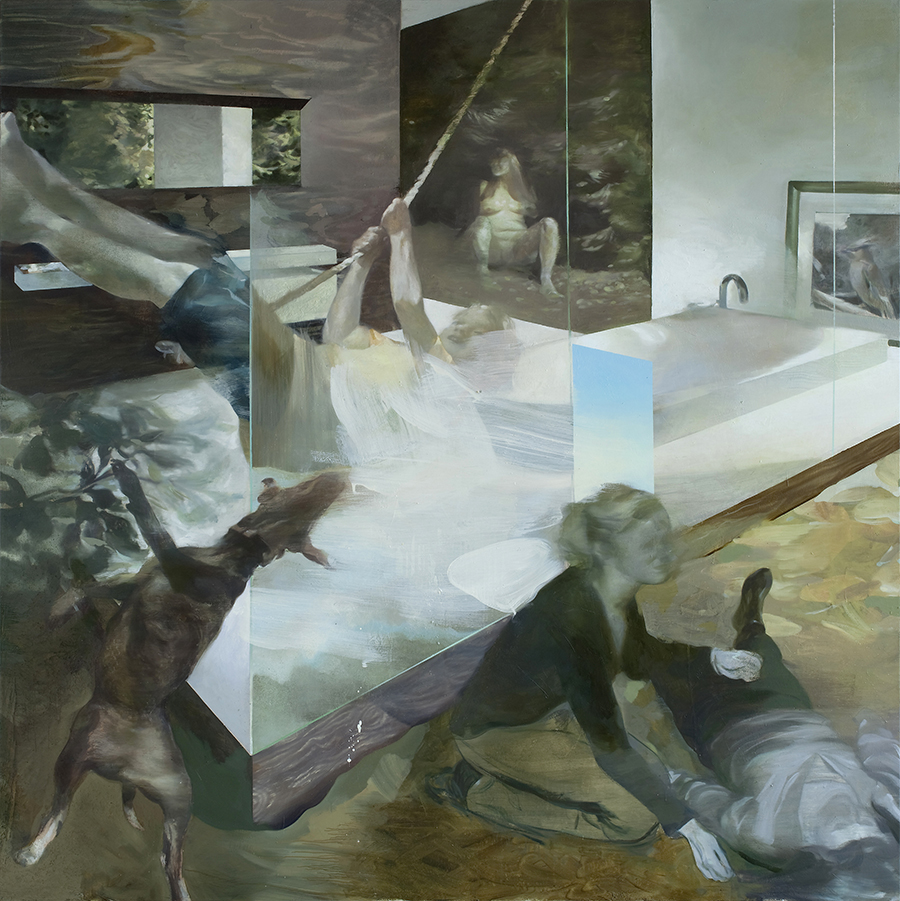
Michel is unable to nurse Marceline with the care she requires, and, finally, she fades.  In reading The Immoralist we may feel unable to forgive Michel for not preferring her to himself. Yet this is the crux of the dilemma presented to us; for despite ourselves we sympathise with Michel’s impulses, we identify strongly with his first person singular, we share his confession – his I.

Empathising with the arrogance of a character is one thing.  Empathising with the arrogance of an idea or some national perfidy is another.  Literary immoralism plays with the notion that what you are reading is suspect.  You shouldn’t be reading it. Perhaps we should bear in mind that books have often been associated with immorality, and this distrust of the book increased with the invention of the printing press.  Men have been hung for writing them, and books have been burnt on plenty of occasions. The writings of the Marquis de Sade may offend, certainly his mother disapproved (enough to incarcerate her son). The Nazis presided over holocausts of books as well as of people, while today the books they admired are not considered decent reading.  The Protocols of the Learned Elders of Zion seems readily available only on extremely right wing sites.  Written in the 19th century, it is fairly obviously a hoax, purporting to suggest that a Jewish secret society is plotting to subjugate the Goyim by means of their gold.  It is considered a master-piece of anti-Semitism and therefore not to be read, and definitely as off limits as Mein Kampf.  It’s intriguing to discover though that if you switch the word Goyim for “the masses” (or “the gullible”), a nifty portrait emerges of criminal philosophy.  And any reference to Jew?  Well, switch that word to “family”, and it doesn’t matter whose nationality it is. We have a crime-family, and the protocols come over as a crudely debased but entertaining version of mafia politics á la Machiavelli.

Creative authors may find rich pickings in this morally prohibited material just as they have always found in the Apocrypha – with its marvelous homo-erotic hymn of Jesus. And the trick is, to flip the material, so that we can see it “inside out”.
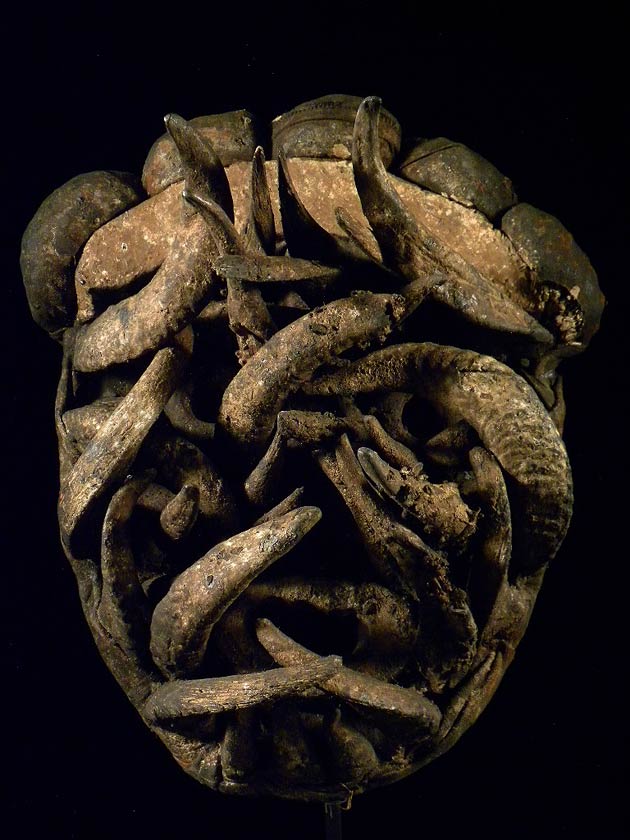
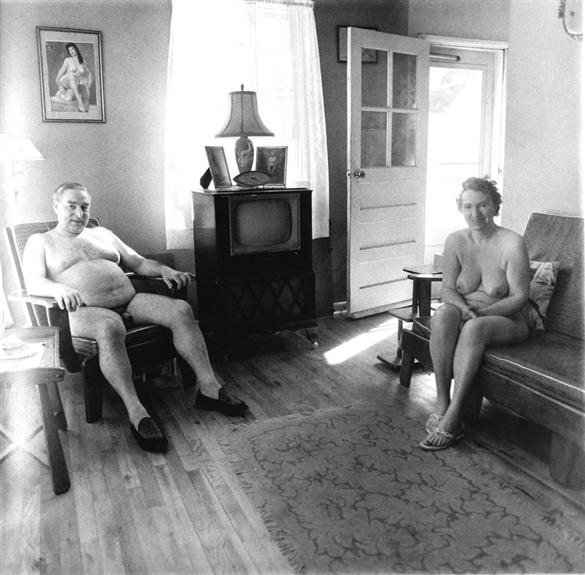
It is important here to distinguish between immoralism as a literary genre (the topic under discussion) and Nietzsche’s “Philosophy of Immoralism.”  While Nietzsche’s immoralism may have influenced the protagonist of Gide’s novel, his stance should not be confused with the genre I am attempting to describe.  Nietzche called himself an immoralist.  He was adopting a position designed to undermine traditional morality, which he considered corrupt. As an alternative to a morality of mores – the done thing to do – he developed a notion of affirmatively being in life, which was based on the “will to power”. He considered that instinctually we tap into this will to command rather than obey.  Good can be seen as that which “heightens the feeling of power in man, the will to power, power itself.”

Gide’s position is quite other than this.  In his introduction to The Justified Sinner, Gide prefaces all his remarks by stating his admiration for John Stuart Mill’s essay On Liberty, to which, in 1924, “current events and the menace of totalitarianism were then giving a renewal of topical interest.” It should hardly be necessary to point out that immoralism is not advocacy of a thuggish approach to life; on the contrary, it is a literary and artistic method of drawing attention to issues which many people may prefer not to entertain, and therefore it may require the reader to imagine himself inside the mind of a thug. Yet all too often the immoralist work of art is attacked for perpetrating its content.

Such a benighted attitude may explain the comparative neglect of John Hawkes, one of America’s most interesting contemporary authors. Reading Hawkes is to be placed in a condition of uncertainty. One is unsure whether the characters are good or bad, unsure of what one’s own attitude should be towards them, and finally one is unsure as to what the author’s attitude might be towards them, especially since, in the trilogy of novels comprising The Blood Oranges, Death, Sleep and the Traveller and A Travesty, the author is entirely absent, and, in each, a main character speaks throughout the text.

In The Blood Oranges, the character speaks with an overweening confidence in himself, in his sexual prowess, his fine physique, his looks. Though not a criminal, he is, one feels, at least a sinner, and his sin is orgueil, a bumptious vanity which ignores the state of affairs.  His is a self-consciousness which bathes in itself, blind ultimately to what may be going on in others, although he is quite prepared to judge others, usually with a withering contempt.   Needless to say, this character hardly shares the reader’s doubts about his worth; rather his belief in his own worth is absolute – so absolute that one comes to doubt one’s reading (This is the most nauseating character I have ever come across, though he doesn’t feel himself to be so: am I wrong, am I misjudging, have I misread the author’s intention?).   Even when his blithe, ham-fisted adherence to his pleasure-principle (or more properly self-worship) causes the suicide of one character and thereby induces a catatonic state in another, one remains in some doubt as to how to read the protagonist because there is no author to give one the pointer that Hogg supplies in his Editor’s Narrative and Gide gives in his preface to Hogg’s novel. The sole narrator here though is the main character; the arrogant shit whose confidence erodes one’s own judgement. So one is left with distaste, at the end – but is this distaste for the book, for the shit, or for the author?

Death, Sleep and the Traveller appears to be narrated by a victim, constantly dwelling on how he has been the object of much bantering from his wife and her sardonic, psychiatrist paramour.  He is less physically at ease than the narrator of The Blood Oranges, and he seems rather pathetically grateful for the affair he becomes engrossed by, and embroiled in, on ship-board, during the cruise he has been packed off on by his wife.  To some extent, one sympathises; but one also shares the contempt obviously felt by his largely-sexed tiger of a wife (or so she is seen by the hubby).  Sympathy is further undermined when the narrator lets slip that he has but recently been acquitted, after a lengthy trial, of the murder of the nymphet who took him to bed on board ship.  His guilt is never clearly established however, but then, nor is his affair – after all, it’s all his story. Is one sympathising with a murderer?  He asserts his innocence.  The reader remains in doubt.

In A Travesty this issue of the character’s villainy becomes indubitably established.  The narrator is driving a car down a long French road, his foot firmly pressed down on the accelerator, driving his passengers (and himself) inexorably towards destruction.  The story will end when they plunge off a viaduct.  Meanwhile one is subjected to the remorseless monologue of the murderer-to-be.  But though this situation may seem cut-and-dried, uncertainty creeps in as one continues reading (if one does, as I did).  For why continue reading such a text; the last hour or so of the ravings of a monomaniac?  If one persists, one has to admit that the narrator has secured an hypnotic hold.  Why is one so fascinated, especially since very little is eventually revealed, as it might be in a conventional thriller?

What grips the reader is the appalling situation, that and the hypothesis of the text which posits that it could be in actuality an extended parole delivered to the ultimate captive audience:  the narrator’s own daughter quietly vomiting in the back of the speeding car, and her lover (who is also the narrator’s wife’s lover) sitting beside the narrator – as well, of course, as the reader, who must either identify with one or other of these characters or accept the role of captive voyeur – and how often has one not wanted to “put one’s foot down” when the situation threatened to get out of hand, or indeed actually put one’s foot down, allowing the speedometer to register one’s rage?  Yet now the narrator is way beyond rage, and jealousy is emphatically denied as the motive (yet the denial comes from the perpetrator of the crime and therefore must remain suspect).  However, instead of jealousy, form without meaning is cited as motive – the mere imaginative possibility of the outcome, just as Mount Everest is climbed “because it is there”.  Echoes here of Gide’s interest in l’acte gratuit:  the crime committed for no reason other than to defy the law of cause and effect.  Is crime fascinating more because of its invitation than because of what it may facilitate?  Raskolnikov, in Dostoevsky’s Crime and Punishment, is lured on by the ease with which the job may be done – ultimately his hunger hardly matters. Hawkes’s novels in this trilogy are exercises in reading between the lines.  They do not mean what they say, or they may not.  Readers must make up their own minds about the worth of the characters, the worth of their author and the worth of their interest in reading his books.

Perhaps this is true of all literature, but rarely is the experience of reading so “confrontational” in these respects.  Nevertheless, if they coax the reader into persevering, there must be in them that pleasure that Barthes saw as crucial to the text.

All the characters loom a trifle too large.  In this sense, they resemble the portraits of Alex Katz. They are all Long Island types, whether they be Americans or Europeans.  Both attractive and vacuous, the enigmas they raise are those we encounter, if not among murderers, among our less colourful fellows.  For people do not go around with labels hung from their necks.  No narrator whispers to us, so-and-so is a villain, so-and-so is a victim.  We are forced to make up our own minds, though most of the time we may not, and we live among people doubting their worth and our own, and our own ability to judge. In his critical interpretation of Hawkes’s novella, The Owl (New York, 1954), Robert Scholes refers to Browning, as Gide did in his introduction to James Hogg:

It is relevant to think of Browning here, for Hawkes has come to specialise in the extended dramatic monologue. Like Browning, he is drawn to the strange and the perverse, and he delights in immersing his readers in the voice and vision of a character whose consciousness is disturbing to ‘normal’ sensibilities. The point of this immersion is to force readers to acknowledge a kind of complicity, to admit that something in us resonates to all sorts of monstrous measures, even as we recognise and condemn the evil consciousness for what it is. As a literary strategy this requires great delicacy and control.

xxxxxxxxxx(from Scholes’s “Introduction” to The Owl, first presented at Muhlenberg xxxxxxxxxxCollege, 1976.)

The latter half of this quotation could stand as a manifesto for immoralism. If we now bring the visual arts into the debate, it is interesting to note that a passage from this same introduction is quoted by Janet Kardon in an essay written to accompany the catalogue to a show by David Salle:

One is always aware of being in a powerful emotional and intellectual climate … The climate manifests itself in extreme diversities of appropriated subject, modes of attack, and, for want of a better word, anticomposition. Indeed, Salle’s work seems left-handed in a right-handed universe; it functions like antimatter in that it disposes of a great deal of what passes for art. That climate has literary analogues, and significant among them are the novels of John Hawkes whom Salle admires.

About Hawkes, Robert Scholes wrote: “Because he starts with images rather than a story, his work is different from intentionally plotted fiction – his method has always been to work with strong images that can be developed into scenes of nightmarish power and vividness, and then to seek some means of connecting these scenes in a coherent and developmental way.”

Here immoralism passes from the realm of subject to that of structure, for our century has given our handling of the medium the same status as content; and so immoralism shifts into this area as well, and the practitioner may well be accused of having committed crimes against ‘painting’.   Bad drawing, lack of unity, presentation of pornographic images – such are the sins ‘committed’ by the contemporary immoralist.  Yet as Janet Kardon goes on to say:

Illusions are being removed, and not gently. The work subverts the viewer’s desire to look away; it returns one constantly to the harsh task of looking and feeling.  A perception of the viewer is more or less implicit in every artist’s work. Catherine Millet has called Salle’s “a fallen viewer”, and I agree. To the idea of art making one feel better – one of the most offensive of art education’s constructs – is counterposed a set of images that almost can be interpreted as a string of curses.

Catherine Millet, the renowned editor of Art Presse, the foremost French art magazine, deserves mention in her own right in any essay on the subject of immoralism.  An informed commentator on contemporary art, she curated the French section of the 1989 Sao Paulo Biennale and the French Pavilion at the 1995 Venice Bienale.  But when her “confessions” – The Sexual Life of Catherine M. – were published in Paris in 2001 they caused a sensation.  Were they the actual experiences of this respected cultural figure, or were they inventions designed specifically pour épater les bourgeois?  To profess to them as experienced facts when they were in fact fictions would constitute a fairly immoralist strategy, but one suspects that the events described were indeed experienced.  Any one who opens this book becomes “a fallen reader”.  In ‘mandarin’ prose as elegant, in a present day context, as the fine sentences of the Marquis de Sade, her book explicitly details a life of casual sexual encounters, many anonymously engaged in:  threesomes, serial intercourse, orgies.  To enter into reading it and then to read on is to voyeuristically participate through the imagination in a life most of us are too prudish to entertain in reality.  And yet there is something abstracted about the narration.  These incidents have to do with control rather than with love, and in the case of Catherine M, it is the control required, paradoxically, to acquiesce to whatever comes.  The events are laid out for us with a dispassionate coolness under four headings: Numbers, Space, Confined Space and Details.  These provide an analytic framework for the examination of this intimate history, and they allow us to contemplate the eroticism alluded to from different conceptual perspectives.  Space, for instance, alludes to sex in the open air, whereas Confined Space deals with sex in cars or in corridors or very much in the proximity of others.  Anecdotes multiply and the imagery that rises like a sort of vapour from these condenses to form a melancholy film, a post-coital sadness, I suppose it is, that reminds me of the sad, shadowy spaces to be found in the paintings of De Chirico.

Perhaps all confessional writing has something immoralist about it, if ever it is more than some respectable auto-biography.  The posthumously published Confessions of Jean-Jacques Rousseau, written in the eighteenth century, do not baulk at describing early experiences of masturbation and the callous act of consigning the five illegitimate children he had with a chamber-maid to the Foundling Hospital.  But Rousseau writes with such a clear expression, with such an engaging tone, that we identify with his vicissitudes and, while we may not condone, we at least manage to accommodate his failings, and are far less appalled by his ‘real’ callousness than we are by the cruelties alluded to in the fictitious monologues of John Hawkes.

*       *       *        *

Doubts similar to those raised by our reading of Hawkes’s unappetising characters may well beset us when we find ourselves confronted by the exposed labia of a rather battered-looking blond, painted by Lucian Freud.  The woman is presented as so close to our eyes that we feel we are in the room with her, perhaps standing in the shoes of a photographer who has advertised for this thrill in some contact magazine.  In a sense, we possess her, or at least we possess our view of her, and this is an identification with the image which is similar to the identification with the character we experience in the work of Gide and Hawkes. Among American painters, Eric Fischl is an artist whose work has consistently drawn the viewer into it in just as powerful a way.  In his introduction to the paintings by this artist exhibited at the Mendel Art Gallery in Saskatoon, Canada, 1985, Jean-Cristoph Amman has said of Fischl’s viewpoint that it is:

 …as if one unexpectedly entered a room, as if one were looking from above through a window, as if one were off to the side in a beach chair, contemplating what was going on, as if one suddenly became aware of a situation in passing, as if one unexpectedly became witness to an event. Here the question immediately arises:  who is one?  The answer, “the artist of course,” hardly gets one further … I am of the opinion … that it is the view of a boy, a boy who has just recently reached puberty, who apprehends the grown-up world, but also his world, in the intermediate domain of erotic ambiguity.  How he sees this world, and to a lesser extent what he sees, is what is crucial.  Through his manner of seeing, the often altogether usual becomes specific to such a degree that the viewer of the painting, who almost inevitably adopts the perspective of the viewer substituted by the artist, is, in a subversive way, forced to adopt this manner of seeing.

84_057_large

Peter Schjeldahl has this to say in Parkett 5:

Daddy’s Girl, one of Fischl’s most disconcerting recent pictures, puts a question of guilt or innocence with jarring directness, casting the viewer as a passive participant in its scene of either a) innocuous playfulness in a family of sun-lovers, or b) incestuous abuse, exhibitionistically indulged. The trick is done by the placement of a glass of iced tea “within reach” of the viewer.   It is too far away from the man to be his and, with a slice of lemon, no drink for a child.  Thus: They are not alone.  Without the glass, one could observe the action in disinterested safety. With the complicity that it enforces, one is harried towards an emotional decision: What would one’s attitude be in this situation, were it actual?  Would one try to stop the ominous horseplay?  Walk away from it?  Pretend it wasn’t happening? Convince oneself of its innocence?  Be aroused by it?  The options are unpleasant and potentially anguishing – disappointing in the extreme – and make the painting hard to take. They also bear on the ethical befuddlement of the American middle class in the current, gradual catastrophe of its decline.

Both Freud and Fischl are “conservative immoralists” in that their immorality remains that of subject, while their painting is traditional, figurative, realist – and runs the risk of being considered too graphic (or illustrational) for modernist eyes accustomed to abstraction – whereas Salle can be disapproved of as a painter, since he ‘seems’ to be offering the immoralism of sloppy painting, clutter and inappropriate collage.  Actually, artists can be disapproved of in a myriad different ways.  Fischl is sometimes castigated for getting the proportions of his figures wrong – since on occasion they seem too big from the midriff down.  I see this as a method of suggesting that the figure, often engaged in some edgy, compromising activity or placed in a rather alarming pose in some incongruous place, is being seen by a child (and in this, I agree with Amman).  It is thus foreshortened by the child’s lower view of the adult – which increases the immoralism of the scene.  In other ways, Fischl is far from conservative (as I have already pointed out in The Picture within the Picture).  He has experimented with multi-panelled canvases sometimes propped against or built-out from the wall.

David Hockney has also painted several immoralist pieces – for instance, the sketch of his young friend Peter lying on a bed asleep with his bottom exposed – an invitation which may well offend those who consider it wrong to depict anyone as “a sexual object”.  In this work, his figuration is as conservative as Freud’s, but one should allow that a diligent adherence to figuration is generally helpful to the immoralist, just as an immoralist fiction needs to be clear about its narrative in order to convince us of the reality of what is going on.  Immoralism is loaded with content, and this may divorce it from the generally abstract thrust of twentieth century modernism.

tumblr_mg8roxC3AT1r8gntgo1_1280

Some women artists have also tackled immoralism – notably Sandra Fisher – a figurative painter who was courageous enough to reveal the aroused sexuality of her male models.  Sometimes in her canvases one senses a feminine eye surreptitiously travelling over the relaxed figure of a male sleeper, lingering here and there, luxuriating in the liberties afforded by some abandoned pose.  Perhaps more significantly, Diane Arbus deals with immoralism in photography.  Arbus often took photographs of dysfunctional individuals, those with sexual quirks and people with disabilities.  Here the immoralism of the shot has often tempted viewers into an indictment on the grounds of voyeurism, or that “it’s sick” to look at persons such as freaks, nudists, spastics, idiots, transvestites etc.  But can there be anything “sick” about looking?  This question remains crucial for the visual artist, and indeed for the punter.  Works of the imagination are one thing, photographs of children being abused are another.  To access the latter condones the violence done, although at a remove.  A wrangle similar to that attending the work of Arbus also persists around the images of Sally Mann.  Mann has occasionally taken photographs of young children, usually her own, in the nude.  But why is this abuse?  What is often more disturbing than the nakedness of the flesh is the expression on the face.

download

Jessie at 5 (photographed in 1987) stands with one hip fashionably askew.  She fixes us with a stare as hard and knowing as that of any street-walker.  Reading it as a man, I get the sense that she “knows where I’m at.”  Is this genuinely the case, or a chance illusion or trick of the moment when the shot was taken, or is it merely a projection on my part which others may not see or feel?  Jock Sturges also takes photographs of infantile models in the nude, but his work is far less alarming.  The  shots are too composed, too classical – he uses an antiquated box-camera and each photograph takes him a long time to achieve.  Ultimately he seems to be after a sculptural quality rather than “indulging” in immoralism.

It is questionable whether pop artists such as the American Tom Wesselmann or the British artist Allen Jones can properly be termed immoralist.  In both cases, it might be argued that stylised shapes, a flat manner of painting and graphic slickness interfere with the viewer’s entrance into the scene.  Allen Jones has created furniture though which is genuinely immoralist, and his glass coffee-table held up by a scantily clad female on her hands and knees positively invites the viewer’s participation, after that viewer has hung up his coat (the viewer must be a “he”, one presumes, before acknowledging the shallowness of presumption) on the equally scantily clad coat-hanger female. The notoriety of these two pieces is justly celebrated.

allen-jones-die-retrospektive-zum-75-0

However, it’s the vaunted arrogance of the work that makes it immoralist, especially since this is laced with eroticism; but it’s worth noting that immoralism is not merely a pseudonym for erotic art.  Many Indian miniatures are erotic, and yet they are by no means immoralist  on the contrary, at their most ecstatic they are deeply religious. On the other hand, certain works by Jeff Koons – such as his brilliant piece Naked – certainly have an immoralist feel to them. Naked shows us two children sculpted in a grotesquely kitsch way, which could be interpreted as a paedophile confection – yet at the same time it strikes one as steeped in art and its history, with its spooky reference to Bertel Thorvaldsen’s Cupid and Psyche. 

Jeff-Koons-Naked-1985-11Cupid and psyche

*        *        *        *

So far, I have concerned myself with comparatively recent examples of this artistic strategy.  But immoralism is by no means just a post-enlightenment phenomenon.  Hellenic sculpture in that luxurious section of the Roman empire that stretched from Paestum to the bay of Naples made a fetish of the depicting Pan going about several of his more scandalous exploits; several of these being now sequestered in the discrete chambers of the Museum of Archeology in Naples.  One shows the god ostensibly teaching the shepherd Daphnis how to play the syrinx.  Daphnis is an exceptionally pretty young man, very naked and vulnerable.  He shrinks somewhat from contact with the enthusiastic divinity who seems to have accosted him; a paradoxical divinity, to be sure, for the imagination is stretched to come up with anything less transcendental than this coarse, hairy, goat-shanked god with his battering-ram nose and emphatically sexualised member.  In sculptural terms we may, I suppose, struggle to appreciate the work dispassionately for the wonderfully smooth rendition of the skin of the young shepherd and the violence of the contrast between that and the hirsute brutishness brilliantly evoked by the figure of Pan, but this feels overwhelmingly like Sophistry: what we are looking at so coolly among the crowds respectably queuing to enter these chambers – though children must be accompanied by an adult – is the prelude to a rape, highly eroticised and concentrating its appeal on our own capacity for lasciviousness.  Another sculpture in the same collection shows Pan engaged in sexual intercourse with a nanny goat.  Pan is quite obviously enjoying himself, and there’s an ecstatic look on the face of the goat!

S22.2Pan

It seems likely that there were mixed reactions to Piero della Francesca’s Flagellation.  This is a work I’ve already discussed in my essay on nonfinito. The three figures in the foreground – an angel, an Italian Prince and a Byzantine emperor – seem far more important than the dimly depicted figure of Christ being whipped in the background.  Here Christ may symbolise the suffering of Christians in the east, after the fall of Constantinople.  But a cold reading of the painting might conclude that the rivalry of eastern and western powers is of much more importance than Christ’s suffering, for that’s just an old story, whereas the power-brokers of the world are the people who make all the decisions that matter.

Agnolo Bronzino’s sixteenth century Allegory: Venus, Cupid, Folly and Time in the National Gallery, London, is another example of immoralism at work.  This is a mannerist piece which features several tours-de-force which are executed with scant interest in the achievement of any over-all unity.  It is painted in a glacially precise way, and its nudes are extremely beautiful.  A cherub throws flowers at Venus, who is stealing an arrow out of her son Eros=s sheathe while he is taken up with fondling her just as a Lilith-like female snake offers them the apple of temptation.  A veneer of morality is given the picture by Folly clutching his head in enraged despair – either out of jealousy or from the onset of venereal disease – while a grizzled “Father Time” attempts to throw his blue cloak over everything.  The message of the allegory seems cynical, though, since Eros pokes out his rear end in a deliberately provocative manner, making him as much the object as the cause of desire, and this reads as an invitation to the viewer to actively participate in the proceedings and totally annuls all allegorical warnings.  That said, a more authentic message is perhaps being projected: how, when abetted by physical charm, desire has the capacity to overwhelm us unconditionally.  The painting generates that strange mixed-reaction particular to immoralism, since we feel uncomfortable before it.  We cannot read its warning without being corrupted by its allure.  This uneasy complicity is exactly what the immoralist artist is seeking to generate in his viewer.

allegory_with_venus_and_cupid-400

Amusement rather than ambivalence is prompted by that naughty painting known as The Biscuit by Fragonard, which shows a young girl romping on her bed while allowing her lap-dog’s tail to tickle her fanny.  In effect, this is more of a caprice than it is an immoralist work. For when we are confronted by a truly immoralist effort we get conflicting sensations, among them a sense that something is wrong, that we should not be witnessing what is placed before our eyes – in the case of Allen Jones, that we should not be placing our coffee on such a chauvinistically devised coffee-table.  Such work appears to touch on the dark side of our humanity.  There are quite a few canvases by Fragonard, however, which might conceivably be considered immoralist, were it not for the fact that their brand of ‘badness’ only rarely suggests that dark side.  In The Model’s Audition, a mother displays her daughter’s breast to the painter while he lifts the girl’s petticoats with his stick, more interested in seeing up her leg.  Yes, there is something uncomfortable about witnessing the prelude to what appears to amount to a pretty callous transaction, and equally the young man bolting the door so abruptly in Fragonard’s painting of The Rape (in the Louvre) seems intent on some swift and unscrupulous business – but this picture was the basis for an illustration to Lucinde, the novel by Friedrich von Schlegel which describes free-love rather than cold-hearted seduction.

Fragonard-modele

There is something “cold-blooded” about immoralism.  With cool skill it lays out its optional responses as if these were a hand at cards.  Schjeldahl points to a number of possible reactions to Daddy’s Girl.  Bronzino understood how to generate that plurality of effect; whereas the paintings of Fragonard have a less sickening undertone.  They offer a witty comment on salaciousness and are therefore more amoral than immoral.  This amoral strain in art was the basis for countless genre paintings in the eighteenth and nineteenth centuries: priests making untimely visits to the studios of artists and thus catching the model at her most exposed – as in Eduardo Zamacois y Zabala’s – The Inopportune Visit in the civic museum, Bilbao.  Then there are amorous forfeits demanded for losses at cards (as in Fragonard), and a host of indiscreet interruptions, accidents and intrusions.  This tributary of art merges with that of celebratory hedonism: Ganymedes abducted by eagles, bathers with rosy posteriors, countless depictions of an inebriated Silenus and visualisations of the rapes of Jupiter.

I think of this amoral strain as “Azure” – since there is something of the warm South about it, where it seems fitting to indulge in the pleasures of the flesh, to gratify the taste-buds, to endorse ripeness and fecundity.  Much of the work of Francois Boucher resides in this category, and much of Renoir.  It accounts for the erotic drawings of Rodin and the wonderful, light-hearted sketches of nymphs and satyrs, goats and naked goddesses done by an ageing Picasso at Antibes. However, the French painter Balthus has created pieces which are more immoralist than amoral, in my view.   His young girls hovering on the edge of puberty, suddenly exposed to sunlight, or seemingly basking in their own erotic dreams, invite us to pry.  When their panties are exposed by the somnolent abandon of their positions on couches or deep armchairs, the wedge of material veiling their privacies becomes the object of the gaze, and we are invited to see these adolescents through the eyes of voyeaurs.

thérèse-dreaming-1938

That we can be doing this in the cool space of an art gallery emphasises an important difference, and that is the difference between art and life.  Our imaginations are permitted access to places that are prohibited in reality.  Immoralist artists tempt us to venture into such places, but equally there are painters who work with the dark side, yet confront us with it rather than making some subtle attempt to draw us into a condition of complicity with its implications.  Francis Bacon, for instance, cannot really be considered an immoralist since, however bizarre and obscene it may appear, the surface of the painting and the energetic handling of the paint demand that we read the work as “a painting” in a thoroughly modernist sense, and this militates against our identification with the scene.  Instead of becoming witnesses to an event, we are in a sense abused by it or threatened by it as by the barrel of a gun, nor are we allowed to forget that we are after all visitors to a gallery, appreciating an appreciating commodity.  And so we are either thoroughly shocked by the experience or we approve of the work without risk – because we are not drawn in, not invited to participate in the transgression. Among Bacon’s generation of painters working in Britain, only Ron Kitaj can lay claim to an immoralism approaching the calibre of  Salle’s.

300-0

This is particularly the case with several of his drawings which are more directly figurative than many of his paintings; the paintings making use of compositional innovation by almost collaging his subjects together – though they are all painted – and this interferes with the work’s capacity to convince us that we are witnessing something in a specific location.  That said, among his sketches, there some fine examples of the way he can “lead us into temptation” with an immoralist strategy, especially when he places us in the position of a voyeur observing a voyeur – in a drawing where a man at a doorway peers in at a flagrant couple in a bedroom, which we seem to be witnessing from the landing above this room.  There are also works of Kitaj’s which mix “good” drawing with “bad”, or which “irresponsibly” confuse the terms of painting and drawing – and many of these predate the work of Salle.

*        *        *        *

Glancing again at literature, it’s worth noting that there’s a strong immoralist tendency in the work of many novelists aside from John Hawkes.  We can identify that complicity which is its salient feature in Lolita by Vladimir Nabakov, and, more recently, in The End of Alice by A. M. Homes.  It is less often to be found in poetry since the days of Browning – perhaps dramatic irony functions better when narrative prose allows it to evolve. Going back to earlier times, the Latin poet Martial certainly makes for reading that raises an eyebrow.  Martial perfected the epigram in the first century AD, and his brief pieces are for the most part sardonic squibs or invocations of amusing lewdness, though admittedly many of these are amoral rather than immoral.  This short poem slyly inveigles us into sharing his amusement at the discomfort of a fellow dinner guest:

I’ve noticed it before, whenever you rise from your chair,
Your unhappy tunics, Lesbia, turn into sodomites.
You try to pluck them back, with your right hand
Then with your left, and finally wrench
Them away with many a tear and a sigh.
The trouble is they get trapped in your enormous rump,
Entering Cyanean straits between those clashing buttocks.
Lesbia, do you wish to be delivered of this blemish?
I know what the answer is: never stand up or sit down.

 xxxxxxxxx(Martial, Epigrams, Book XI)

No study of immoralism would be complete without acknowledging Cecco Angiolieri as one of its earliest proponents. In my teens, I honed my skills in verse by reading D. G. Rossetti’s Dante and his Circle (Ellis & Elvey, London 1892).  The Vita Nuova spoke of courtly love, of a species of divine redemption achieved by an almost selfless worship of the one desired. It seemed as if the art of the sonnet aided and abetted love as faith – which is a pretty religious spin to put on the business.  Back then, I developed a crush on a girl I hardly even kissed, and studied Provencal in her name.  Finding myself in my seventies, I return to D. G. Rossetti, but now for the wonderful series of translations to be found there of Cecco, the outcast of Italian literature. A Sienese gentleman who was a contemporary of Dante’s, Angiolieri wrote sonnets which amount to a critique of “Courtly Love”:

OF WHY HE IS UNHANGED

WHOEVER without money is in love
Had better build a gallows and go hang;
He dies not once, but oftener feels the pang
Than he who was cast down from Heaven above.

And certes, for my sins, it’s plain enough,
If Love’s alive on earth, that he’s myself,
Who would not be so cursed with want of pelf
If others paid my proper dues thereof.

Then why am I not hanged by my own hands?
I answer: for this empty narrow chink
Of hope;—that I’ve a father old and rich

And that if once he dies I’ll get his lands;
And die he must, when the sea’s dry, I think.
Meanwhile God keeps him whole and me i’ the ditch.

Cecco’s sonnets set up the notion that he is in love not with some high born lady but with the daughter of a tanner, and she is at best indifferent to his advances and for the most part wishes him dead.  He blames this lack of reciprocity on the emptiness of his pockets. Only the death of his father will rescue him from his particular “inferno”.  In another sonnet he resolves “never to love any who are not already fond of him”.  The persona projected by these sonnets is that of a reprobate rascal who is dogged by misfortune. However, to love only those who are fond of you makes very good sense.  Critics have considered the sonnets autobiographical – and certainly Cecco got into trouble with the authorities on several occasions.  But in their well-researched English versions of this poet’s work, which contains a biography and comprehensive notes – including a story from Boccaccio’s Decameron in which Cecco (always the unfortunate) is falsely accused and ends up wearing only his shirt – (IX, 4) – Scott and Mortimer draw the reader’s attention to a burlesque current that stretches back at least a hundred years before Cecco – with Rustico Filippi among its exponents.

The truth is that the real distinction of these sonnets lies not in some extraordinary self-revelation, but in a remarkable balance between self-conscious literariness and comic realism.

(Sonnets – Cecco Angiolieri, One World Classics, 2008)

Cecco’s sonnets are all but forgotten, drowned in the shadow of Dante, just as Richard Lovelace’s poems – with their devastating oxymorons – have drowned in the shadow of John Donne. A firm belief system enables both Dante and Donne to flourish – it generates Vita Nuovas, Divine Comedies and Ecstasies. But for those poets who cast doubt on such firm assumptions, the wages of literary recognition are not forthcoming, and their work has been consigned to oblivion.

John Wilmot, Earl of Rochester wrote satires in the seventeenth century which became notorious for their defiant obscenity, but it might be argued that these are too directly confrontational to be considered immoralist since they lack that essential element of complicity and are not concerned with seducing the reader into any imaginative endorsement of his actions.  Rochester deals in cynicism, and his very ironic take on the nature of any union of form and content can be found in his lyrical poems which are always beautifully “turned” – and therefore delightful – despite the prevalent rudeness of the thought – which must qualify, surely, as an immoralist strategy?  Today we can find a similarly provocative spirit operating in some of the poems of Hugo Williams.  Here is Toilet, a poem that fools us into imagining that it is simply an innocuous, if nicely written lyric:

I wonder will I speak to the girl
sitting opposite me on this train.
I wonder will my mouth open and say,
“Are you going all the way
to Newcastle?” or “Can I get you a coffee?”
Or will it simply go “aaaaah”
as if it had a mind of its own?
 
Half closing eggshell blue eyes,
she runs her hand through her hair
so that it clings to the carriage cloth,
then slowly frees itself.
She finds a brush and her long fair hair
flies back and forth like an African fly-whisk,
making me feel dizzy.
 
Suddenly, without warning,
she packs it all away in a rubber band
because I have forgotten to look out
of the window for a moment.
A coffee is granted permission
to pass between her lips
and does so eagerly, without fuss.
 
A tunnel finds us looking out the window
into one another’s eyes.  She leaves her seat,
but I know she likes me
because the light saying TOILET
has come on, a sign that she is lifting
her skirt, taking down her pants
and peeing all over my face.
 

But while these examples may demonstrate that a tendency to express lascivious ideas in elegant language can be traced back to antiquity, and that a poetry making use of scurrilous imagery has been an option at times other than ours, I hesitate to identify Martial, Rochester or Williams with the essential spirit of immoralism, though their work certainly contains elements of this trope.  All three poets are intent on mischief and let us know that they are well aware of what is going on, whereas the cardinal quality of dramatic irony is a certain lack of awareness in the character of the persona adopted.  Angiolieri  alone seems to wish for his father’s demise almost “innocently” – as if it were perfectly natural so to do – just as in My Last Duchess, for instance, the Duke seems oblivious to his own murderous cruelty.  Browning keeps his own view well hidden.  Hogg’s justified sinner has his mind firmly fixed on his ends, the brutality of his means is incidental.  Nor should immoralism be reduced to the merely scandalous in either sexual or religious terms.  Something nastier is afoot.  The discomfort felt by the viewer or the reader, where a truly immoralist work is concerned, involves this blindness or indifference to the consequences: it plays games with intentionality, as in Flannery O’Connor’s short story A Good Man is Hard to Find where a grandmother’s self-interested stupidity brings about the murder of an entire family.  What immoralism examines most deeply is a character’s self-regard or self-projection, hubris if you will; and the way this can serve to camouflage from that character their own covetousness, their vanity or their propensity to bear false witness against others.  And we find it disturbing because, led on by a text that makes such duplicity its business, we may pick up on traces of duplicity in ourselves.

*        *        *        *

Where the immoralist strategy has been employed to great effect is in the film industry.  Perhaps one of the most interesting uses of it in contemporary cinema can be seen in Bad Timing by Nicholas Roeg, made in 1980.  Art Garfunkel stars as a personable psychoanalyst in Vienna who cannot control the sexual impulses of his girlfriend, Theresa Russell.  He breaks up with her, and sometime later she rings him to tell him she has taken an overdose of pills.  He goes over to her place and finds her in a coma.  Instead of ringing for an ambulance straight away, he adjusts the clock so that it looks as if he has arrived a while later than is actually the case.  He then makes love to her while she lies in a comatose state.  For once, he is in control: she can only receive him with an utterly passive, indeed unconscious, stillness.  The analyst is a plausible young man, a type with whom many intellectual professionals might identify, and his crime, which amounts to a callous murder attempt, is carried through not with a violent weapon but simply by the innocuous action of adjusting a hand on a dial – it’s hardly more than a white lie, a small malicious adjustment within the capability of any civilized person.

A more recent example is The Vanishing, a Dutch film, made in 1988, directed by George Sluizer, and closely based on The Golden Egg – a novel by Tim Krabbé.  On holiday in France, a young Dutch woman goes to the lavatory at a motorway stop and is never seen again.  This event is contrasted with the reminiscences of an enigmatic Frenchman who once threw himself off a balcony to prove that he could dismiss concern for self-preservation, that his will was more forceful than his conditioning.  Once again there are echoes here of Gide, and of his character Lafcadio, who throws a stranger out of a train simply to exercise free-will in his novel, The Vatican Cellars. The Dutch woman’s boyfriend persists in searching for her and is finally approached by the Frenchman who promises to reveal what happened to the girl provided he is trusted implicitly.  A droll rationality about the Frenchman’s manner offsets the sinister aspect of his proposals, and this convinces the boyfriend that there is something exceptional to be discovered.  On top of that there is a fascination about the way the man spins absurd stories about himself. Insatiable curiosity drives the Dutchman to place his life in the hands of the Frenchman, though the trust which has been built up between them is only based on the Frenchman’s version of what may have happened at the time of the girl’s vanishing.  Of course by this time the audience’s curiosity is also aroused, and we feel that we would also comply with the Frenchman’s demands in order to find out what happened.  I won’t divulge the horror of the end.  The film’s power has a lot to do with the accurate observation of typical circumstances.  At some time or other we have all waited for what seems like hours for someone to come out of a lavatory, and the motorway service-station where much of the main action takes place is a familiar setting for just such a delay.

Another great immoralist moment in film is when Gregory Peck raises the knife to slay Damian, the devil child in The Omen, directed by Richard Donner and made in 1976. Here is a man about to kill a baby, and yet the film has manipulated the emotions of the audience so adroitly that we all sit there at the edge of our seats willing him to plunge the knife home.

Mention should also be made of Le Bonheur, directed in 1965 by Agnès Varda.  A happily married man tells his wife that he is having an affair with another woman. Compliantly, the wife drowns herself immediately, leaving her husband free to find happiness with the other woman. The film is shot as if it were a glossy advertisement, and the sheen of its surfaces suggests nothing but an endorsement of the action.  Never has Dr Pangloss’s maxim, “All is for the best in the best of all possible worlds” received such a glowing commendation.

Artists and writers engage in this strategy at their peril.  As I’ve already pointed out when discussing photography, immoralism can get one into trouble.  The Revolutionary and Napoleonic regimes did away with that suppression of literary works before publication which had characterized the Ancien Regime.  As a result, the public and the authorities were often scandalised by what did get published, and censorship trials for literary works were a common occurrence in France in the 19th century.  Jules Barbey d’Aurevilly’s story Le Bonheur dans le Crime, from Les Diaboliques – in which a man and a woman get away with murder and live happily ever after – was one of these (the case was finally thrown out on grounds of insufficient cause in 1874). To an extent, the tale encapsulates that philosophy the Marquis de Sade ironically propounded through his two great novels, Justine and Juliette.  Justine, being resolutely decent, dies a ghastly death in abject poverty.  Juliette, her sister, being irredeemably wicked, ends up rich, happy and successful. The text of these books by de Sade may be more grotesque than immoralist, though in Juliette, the Pope’s justification of genocide (as a fecund replenishment of the earth’s resources) works well as an immoralist tract.

De Sade was incarcerated in a lunatic asylum because of the offence his writing caused.  Immoralism does more than ruffle feathers!  In the seventies, the women’s film-distribution service, Circles, refused to distribute the films of Jayne Parker, one of which was entitled Snig.  This film shows a number of eels writhing between bed-sheets: sheet after sheet is uncovered by a woman, revealing ever more eels.  The eels are then sewn by their noses to the sheets by the woman and the sheets are hung out on the line.  The eels stiffen in rigour mortis and straighten, and then each is snipped from its sheet.  This little film offended feminists.  It was cruel to eels.  It was wrong of the artist to show a woman being cruel.  A woman who showed a women engaged in a cruel act did not deserve to be distributed by Circles.

I think the film concerned an ambivalent reaction to sexuality: revulsion tinged with fascination, desire mingled with a cold curiosity.  It was very powerful.  It caused violent reactions, for and against it, and inadvertently it exposed the censorious bigotry then rampant in the women’s movement.

A video was shown at the 1990 AVE video festival in Arnhem called Ohne Pause (or “Non Stop”).  Made in 1986 by the Austrian artist, Erwin Puls, it presents found footage of very early pornographic films which are a delight in themselves, in terms of their humour, pace and absurdity.  Inter-cut with these is footage from home movies from the same epoch – the years between the wars – sometimes with disconcerting results such as when a very young boy starts to chase a pig just after a particularly torrid orgy.  A text runs continuously beneath the images dryly elaborating on the source of the footage, its aesthetics, the nature of the camera angles, the sociological background etc – thus providing an academic excuse for our witnessing images which might otherwise be considered obscene.  Once again we have been beguiled by an immoralist strategy.

Several works in the Post-Morality exhibition, curated by Mona Hatoum and shown in Cambridge in 1993, seemed to me to be of particular interest from an immoralist stand-point.  Jon Bewley’s Objects from the pockets of a man with more than one identity was a piece which presented us with a number of fairly personal possessions which the artist claimed came from the pockets of a man living a parallel life. These included a gold wedding-ring, spectacles, a penknife and several ten pound notes, as well as more trivial items. They were laid out on a mirror. Although the objects had supposedly been a gift to the artist, they were not without value, and presumably they would have been of considerable use to the original owner. One was intrigued by this piece, but at the same time one wondered what forms of coercion might have been employed to extract these items from the subject.  After all, those leading double lives may well be open to blackmail.  One imagined the satisfaction of the artist as he walked away from his duplicate victim, his pockets laden with spoils.  In witnessing his work, gloating over it perhaps, were we endorsing his intrigues?

In the same show, Jamie Thompson exhibited four photographs on glass shelves. Each was a portrait of a young man crying. But the tears dribbled down the cheeks of a face which appeared indifferent to them.  The result was that the expression became difficult to read.  Was this egotism, arrogantly proud of being a “new” man, able to express the signifiers for sensitive emotions without troubling with the emotions themselves?  Were the tears faked?  The high finish and fine presentation of these photographs also distanced the viewer from any deep experience of grief.  Was this a sardonic work, cynical about all visual expressions of emotional turbulence?  The young man seemed not to be crying about anything.  He was simply presenting his tears to the camera as a conceptual act.  This created complex reactions in the spectator.

Then there was Jamie Wagg’s Post-Gestural, Neo Geo Abstraction untitled No. 1, or, Two Young Boys Injured After a 1,000 lb Bomb Destroyed a House in Managua. They died Shortly After this Photograph was Taken.  The painting which Jamie Wragg exhibited under this title was most definitely an abstraction.  There was no hint of a photograph, or of the boys killed in Managua.  Had the artist chosen this title simply as a ploy to get this painting into the Post-Morality Show?  Certainly, without the title, his abstract work would have had no place in it.  What should we have done about this?  Should we have demanded that the work be withdrawn?  But doesn’t such a prohibitive and disapproving attitude place us in the position of censors?

It’s precisely this sort of dilemma that immoralism delights in. Conceptual art such as the works cited in this exhibition put me in mind of a performance by Marina Abramovic and Ulay, created in seventies, when the two artists stood naked on either side of an open doorway.  The audience were informed that their exhibition was located on the other side of the doorway.  In order to get into the exhibition, members of the audience had to squeeze past the artists, coming into contact with both their naked bodies at the same time.  There was of course no exhibition in the room the audience emerged into.  The performance generated that ambivalence of reaction that characterises immoralism.  Had the artists tricked the audience into an obscene intimacy?  Is there in fact anything particularly obscene about contact with a naked body?  Ah, but what about contact with two naked bodies at the same time?

There’s a problem, though, for performance art.  Generally it is differentiated from theatre because it is not about make-believe.  It concerns being not acting, and the integrity of an authentic performance task carries with it no fictional component.  A murder may be described in a novel, poem or short-story.  A painter may depict Judith slaying Holofernes.  For performance art, as opposed to theatre, the event must actually occur.  Jayne Parker’s films adhere to a similar truth to action, and come up against the same limitation.  The subject making things happen in such a film, or creating the piece of performance art, must actually be cruel, or spiteful or lecherous: it is not something that can be represented, since the medium is not a representational one.  This restricts performance art to fairly harmless levels of complicity.

But I do recall an immoralist piece perpetrated by two German artists on those who attended a festival in Amsterdam, about ten years ago.  They invited their audience to strip naked and be sequestered in a locked room for the duration of the performance.  At regular intervals the room was illuminated by the flash of a camera, otherwise they were kept in utter darkness.  The performance began at seven in the evening.  Gradually the room got colder and colder. Finally, at about two o’clock in the morning, the participants broke out of the room.  They had gone along with the will of the artists to incarcerate them, beguiled by them, as a reader might be beguiled by a character in an immoralist novel.  Finally they made their choice that enough was enough, and with a concerted effort they managed to escape.  The piece seemed to contain a message about taking responsibility for one’s own situation and, eventually, doing something about it.

Rebecca Horn showed how abstract sculpture could be used perversely a few years ago, in the nineties, when she created an installation for one of the pools at Bath Spa.  This pool was associated with the Regency rather than the Roman period in Bath’s history.  It is located outside the official baths and, in the days of Beau Brummel, it was, apparently, frequented by courtesans rather than by women of unblemished reputation.  Whatever its health-bestowing properties may have been, they were not what counted, in this instance, since this was a locale made notorious by dint of its assignations!  Rebecca Horn placed her sculpture in the pool itself.   This consisted of a number of thin copper rods through which the water was pumped, to be squirted back into the pool.  There were also conical funnels made of glass, which connected to pipes and fed back to the machines pumping water through the rods.  Some of the rods squirting water were placed with their ends below the pool’s surface, so that the squirt they emitted barely dented that surface.  Then a rod might squirt vigorously on its own.  Another might squirt well above the surface, its entire emission landing within one of the upended glass funnels.  Sometimes two well-aimed rods would squirt simultaneously into the same funnel.  Some might squirt bravely enough but miss the funnel they aimed for.  The work inveigled the spectator into seeing these permutations in erotic terms, aided and abetted by a sense of place.  Like Duchamp’s The Bride Stripped bare by her Bachelors, even, the piece suggested a mechanised erotics, and it was indeed a finely conceived exercise in sculptural pornography. A few years ago there was an advertisement for Highland Spring water, which showed a young woman sitting on a photo-copy machine, duplicating her behind, presumably to be sent off or faxed to various admirers.  Do we find the notion impossibly rude, or merely amusing?  Commercial art recognises the essential quality of immoralism: because it generates ambivalence in the viewer, it sticks in the mind.  The mind returns to the image – in order to debate its worth, its propriety.   Images that stick in the mind are just what the advertiser is after.

*       *        *        *

In conclusion, I’ll return to the work of David Salle. To my mind it is Salle who has carried immoralism further than any other contemporary artist. That phrase of Gide’s, concerning Hogg – “the figurative portrayal of states of subjective consciousness” – could well be applied to this American painter, for in works such as His Brain or Tennyson we are drawn into the work, as we are with Fischl, Hockney and Freud, but the work does not appear to represent any external reality.  Instead, we seem to have been taken into the interior, into some “clouded pool of personal symbols” – to utilise an expression used by the artist with reference to the work of Jack Goldstein, though it seems to apply just as aptly to the work of Salle himself.  But what are we really looking at here?

download (1)

In His Brain, we are basically confronted with a very large behind.  A female behind.  Why is it there?  Doesn’t this image denigrate women?  Is that his view? – that all a woman is is an arse?  Feminists have expressed their indignation about the work.  But Salle himself would probably be the last person to defend himself from their attacks by offering a coherent reading of a work such as His Brain.  But as a viewer, I am at liberty to come to his defence, and to offer as much of an interpretation as I see fit.

Looking at Salle’s art, we seem to enter that “pool of personal symbols” that he refers to, but the symbols are so personal that it’s hard to identify what it is that each symbol signifies.  “Personal images” might be a better way of putting it, images which exert a pull on the mind, that keep getting returned to, who knows why?  Immersed in the intercourse of these images, we may sense that they have no physical substance, no reference “out there”.  They are merely shadows.  And then it may occur to us that many refer to art, or to representations gleaned from reproductions. We watch the shadows playing in this clouded pool as Plato watched them in his cave, though now the floor of the cave appears to be strewn with turds and empty wine-bottles still in their paper-bags, while the wall of the cave has been covered with graffiti. This is the perverse effect, yet it is an effect achieved by a brilliantly controlled manipulation of the painterly medium, and by a subversion of modernism to subject.  Soaked acrylic, stencil, impasto. diptych and sculpture are each employed in turn to cope with a single item in His Brain – only the enormous, shadowy, female posterior is dealt with in acrylic, only the profile of Lincoln is dealt with by the stencil and so on.  It is thus that the images get to be superimposed while never seeming cluttered.

In Hogg, Gide and Hawkes, and in Browning’s My Last Duchess, the author takes on the persona of the unsavoury character.  The art then is, to write in such a beguiling way that the reader is charmed or coaxed into thinking along the same lines as that character by reading the text.  With painters, there can be a persona adopted by the artist, so that he paints as an unsavory character:  Carravagio really was one, being obliged to flee to Malta having stabbed someone to death in a brawl – although he painted of course with tremendous charm.  Bronzino’s icy style projects a certain arrogance in the painter himself which may have been an affectation.  Here was a courtier painting for courtiers.

To some extent, there is the same adoption of a persona in Salle’s work.  “The clouded pool of personal symbols” may not be as personal as all that.  Salle’s works are like internal monologues in paint.  The cheer ingenuity of his shifts of medium and that ability he has to surprise us by his juxtapositions, keeps us seeking for a key to the “character” of each painting, but the monologues he presents have an element of sleaze to them, and a certain glibness, a flip responsiveness to the zeitgeist, and to the smart backtalk of Manhattan, that suggests that a role is being played out – the inner world he presents could be that of a character in a novel by John Hawkes, whom he admires.  Nevertheless, it’s a world that strikes a powerful chord.  Perhaps there is something unsavory in each of us.

So whose brain are we in?  It seems to be the brain of a sex-maniac. And yet it is his brain. It’s the brain of his society, which is our society – so what is it full of?  Mainly of sex, with a film of politics, a large section for wallpaper and some nostalgic desire to get away from it all – for here is Monet’s houseboat:  memories of some weekend on a houseboat? – or simply the experience of reading John Ashbery’s collection of poems called Houseboat Days?  It is my brain.  It is yours.

Anthony Howell, October 2003, based on a lecture given during the Post-Morality Exhibition, Kettle’s Yard,1990.

See also Romain Slocombe

And a further note: Smollett’s immoralist writing, together with Thackeray’s, can also be seen as deriving from the picaresque tradition that I go into in some depth in another of these essays – Grotesque: Ancient and Modern.

Select Bibliography:

Jules Barbey d’Aurevilly, Les Diaboliques,

Roland Barthes, The Pleasure of the Text, London

Robert Browning, Collected Poems,

Marquis de Sade Justine,

Marquis de Sade Juliette,

Dostoevsky, Crime and Punishment,

André Gide, The Immoralist (originally published as L’Immoraliste, Paris, 1921)

André Gide, The Vatican Cellars

Philip Gosse, History of Piracy, London, 1932

John Hawkes, A Travesty, New York

John Hawkes, Death, Sleep and the Traveller, New York

John Hawkes, The Blood Oranges, New York, 1970

John Hawkes, The Owl, New York, 1954

James Hogg, The Private Memoirs and Confessions of a Justified Sinner first published in 1824, (reprinted with an introduction by André Gide)

A. M. Homes, The End of Alice, Anchor Fiction, London, 1997

Janet Kardon, Essay written to accompany the catalogue to a show by David Salle, Institute of Contemporary Art, University of Pennsylvania, 1986

Tim Krabbé, The Golden Egg,

Martial, Epigrams, Loeb Classical Library, Harvard Heinemann, London, 1920

Catherine Millet, The Sexual Life of Catherine M., Serpent’s Tail, London, 2002

Dictionary of all Religions, London, 1704

Flannery O’Connor, Stories,

Pontanus, Catalogue of Heresies,

Mario Praz, The Romantic Agony, The Fontana Library, London, 1960 – first published by OUP, 1933

Jean-Jacques Rousseau, Confessions,

Schlegel, Friedrich von, Lucinde – a novel,

Hugo Williams, Self-Portrait with Slide, Oxford University Press, Oxford, 1990

John Wilmot, Earl of Rochester, Poems

and more….

Posted in art, Essays | Tagged , , , , , , , , , , , , | 7 Comments

Lars Elling

game


Interesting artist!

More about him at http://www.larselling.no/

Posted in art | Tagged , | Leave a comment

Fetishism and the Uncanny

ac_6

Remember how the media presented Roentgen’s discovery of X-rays towards the end of the last century: the idea was that X-rays allow us to see a person who is still alive as if he were already dead, reduced to a mere skeleton (with, of course, the underlying theological notion of vanitas: through the Roentgen apparatus, we see “what we truly are,” in the eyes of eternity…). What we are dealing with here is the negative link between visibility and movement: in terms of its original phenomenological status, movement equals blindness; it blurs the contours of what we perceive: in order for us to perceive the object clearly, it must be frozen – immobility makes a thing visible.

xxxxxxxxxx(Slavoj Zizek, Fetishism and its Vicissitudes)

Item 1: in Bo Widerberg’s Love Lessons (aka All Things Fair), made in Sweden in 1995, a teenage boy has fallen in love with his teacher. In one scene, as a class ends, his teacher gets up from her chair, which is situated behind the table at the front of the class-room, and leaves. When all the pupils have gone as well, the boy kneels down and kisses the seat of the chair vacated by the object of his desire.

Item 2: when I was a small boy I once watched a hypnotist at work in a French fairground. He was able to put his colleague into a trance. The hypnotist then wrote on his subject’s eye-balls with a pencil.

Item 3: I once had a friend who had been a Churchill Fellow at Cambridge. He lost the fellowship because he took off all his clothes on Cambridge Station.

Something links these events. Fetishism and the uncanny are bound together. There is a commonality shared by 1) an object which has become invested with emotional magnetism, 2) the glazed gaze of someone who has been turned into an object and 3) the perceived vulnerability of a person who has become strange to us in some quite ordinary setting. All three conditions invoke unease in their witnesses. Freud speaks of the uncanny as being both familiar and unfamiliar – as if something known but hidden to us had come to light. It could be a suppressed memory or it could be some ancient superstition.

In each of my examples, the gaze is crucial to the sensation. In the first instance, the boy focuses on the chair. In the second, I recall that the hypnotist established the trance as much through his voice as through his gaze, but the subject gained a fixed, glassy stare. In the third, doubtless, the other people waiting on the platform felt the need to avert their gaze from the person who had taken off his clothes. Spiritual powers tell Dante that he stares too fixedly at the ghost of Beatrice, the dead girl who has become the object of his worship. When brought into the company of Medusa, we must be careful to avoid the “mortifying” effect of petrification, a state similar to that suffered by a bird whose ability to fly away gets frozen by the raised hood of a cobra.

An uncanny stare is abstracted. An angel passes overhead. In such a state, the subject confronts the real in Lacan’s usage of the term. The real, in this sense, is that which is barred to us, an area beyond the symbolic representation afforded by our words, beyond the projections afforded by our imagination. It’s the nitty-gritty we cannot consciously contemplate, the blind spot which is also the source of light. We cannot view this source: it would burn our eyes out – for the source is as petrifying as the sight of Medusa – and Mithraic belief placed Medusa in the sun. We can only witness the effect of light on surfaces, note the shadows cast by what it illumines. That which we cannot contemplate is the hideous ambiguity of life itself. The sun causes all things to grow, but growing brings them closer to oblivion. This is why Medusa is also the vagina. What emerges there must eventually meet death. Manifestations of the uncanny flip us into a transient awareness of this ambiguity: briefly we glimpse the real as we may glimpse the sun. Stare too long and we become transfixed by what we see, we become zombies – the living dead – as uncanny ourselves as the very fetishes that stand in for the real.

sp102-050

Fetishism is a word which is overdetermined. A number of meanings have condensed around the term and some of these are in conflict. As Zizek points out, through the title of his essay, it has its “vicissitudes”, its mutations, transformations. The uncanny sensation proper to fetishism travels from subject to object. In Love Lessons, the boy’s adoration of the chair is strange and it makes a strange thing of the chair. His action is overdetermined, for as well as kissing the seat of his beloved he is kissing the “seat of learning”. The transference of affection from person to object is easily made through language – in English at least – for the word seat can refer to a person’s bottom as well as to a chair. By kissing the seat of learning, is an equation being made between education and faeces? We are obliged to take in that which the teacher pushes out at us. Learning is an uncomfortable process – it causes aphanasis – a fading of what we were before we knew what we “know now.” After we have learned something we can never be the same again. So there is an unpleasant aspect to education – as a disaffected pupil might say, Education is shit! But later in the film, the boy will lose his virginity to this attractive teacher. An aphanasis devoutly to be wished, as his action of kissing the chair demonstrates. The scene is uncomfortable as much because of its hints at anal eroticism as because of its innate fetishism. It seems that each fetish occults its own barred subject.

Fetishism and the uncanny are terms which have different roots, yet they are related. Distinctions can be made between them, the one being an activity, the other being a sensation – yet they affect each other and their separate arenas can easily merge into one, though each preserves its own particular properties. Their overlapping is a factor which brings about some of their vicissitudes. Often it is the fetish object itself which prompts the uncanny sensation, however ordinary that object may be – a shoe for instance may feel uncanny to a shoe fetishist. Things are ordinary because they are familiar to us. Freud’s paper of 1919, identified Das Unheimlich as the unfamiliar, but recognised that the familiar is already strange. A witch’s mascots, her cats, toads and owls, are her “familiars”. And she is canny in her esoteric knowledge. In Totem and Taboo, Freud indicated the alienating properties of the familiar power-figure by pointing out the taboo against the mating of those who shared the same totem. In sharing the same secret, they have spoilt their chances of a relationship. It is as if each knows the other’s shame. In a similar way, siblings who have shared the bath together are unlikely to fall into an incestuous relationship. They know each other “too well.”

The vocabulary of religion and folk-lore allowed superstition to prevail in Western Europe until the age of Enlightenment. Charms were efficacious against evil thoughts. Note that African charm bracelets were identified as “fetishes” by seventeenth century Portuguese traders, and this was our first use of the term. In Europe, as in Africa, then, animism was still a familiar aspect of village life. Garlic gave protection from the devil – as is apparent in Christ in the House of Mary and Martha by Velasquez, which shows Martha grinding the garlic against possible emanations of the underworld accompanying her brother Lazarus on his return from the Dead. With illumination came internalization. Unreasonable superstition was outlawed. An enlightened Peter the Great (1672-1725) issued a decree stating that all prodigies and freaks of nature were to be sent to Saint Petersburg, since he wished to prove that these were not the work of the devil, nor due to the hexes of some witch, but rather they were the natural product of an expectant mother’s ill-feelings towards her progeny! It was thus that he filled his Kunst Kamera, his cabinet of curiosities, with aberrations and monstrosities. Thus, at the same time as it became internalised, superstition became manifest in the psyche, giving rise to uncanny affects – possessions, transformations at midnight. This was a sensation which was to abound in literary productions.  “Ghosts, vampires and the undead flourish at a time when we expect them to be dead and buried,” points out M. Dolar in I shall be with you on your Wedding-night, an essay on Lacan and the uncanny. It became fashionable in the eighteenth-century to visit Bedlam: for the weird could be experienced through the spasmodic contortions and grimaces of the insane, and the uncanny contemplated in their obsessive fixations which epitomised superstition. All the outmoded beliefs had been driven indoors.

This suggests a Dionysian spirit that has somehow been immobilised, frozen by the Medusan properties of Dionysus’s enemy, the sun, or enlightenment itself. The trance is a suspended paroxysm, and a trance depicted increases the immobility of the state. Sander L. Gilman’s Seeing the Insane provides us with plenty of evidence for the fetishism which surrounded, and still surrounds, lunatics. The preoccupation with madness is one the uncanny shares with the grotesque. Madness mediates between the demon and the dead.

The village idiot is also that village’s mascot – its “familiar”. Repeatedly the likenesses of demented persons have been captured, that is “arrested”, in drawings, in etchings, and more recently in photography – from the days of its inception to those of Diane Arbus. With idiocy, as with the naked man on the railway platform, the real, the thing that should remain unseen, has become visible. André Green’s essays on psychoanalysis have the title On Private Madness. We are all permitted to be mad privately, just as there is nothing odd about undressing in private. It is when we allow our madness to show that we become truly mad. By the same token, there is something uncanny not about nudity but about nudism. This can be seen in the uncomfortable photographs taken by Arbus of nudists in their sitting-rooms. If you have ever been to a nudist colony you may have felt this uncanniness as a sensation when queuing up naked for yogurts and salamis in the nudist shop. The sensation is markedly diminished on the beach where nudity seems more appropriate.

Diane_Arbus_retired-Custom1

All the tokens of the familiar made unfamiliar which characterize Das Unheimlich come into play when we become aware that a thing which may be done “legitimately” in private is being done in some inappropriate setting (herein lies the power of Duchamp’s Urinal exhibited in an art gallery). The immobilizing effect of the photograph capturing such a subject may increase the sense of unwelcome exposure, of the weirdness of the thing. When the subject appears to be quite distinctly unhinged, that thing becomes das Ding in psychoanalytic terms; another instance of the unviewable – the real – for madness is as difficult to contemplate as our own mortality.

At the same time as the Apollonian spirit of enlightenment was driving all manifestations of the miraculous into the soul’s interior (where they became manias), bargain hunters were beginning to penetrate the interior of Africa, that dark continent, in search of the outlandish. But here we should start to distinguish between fetishes and symbols. The Western tradition of witchcraft suggests that nails are stuck in effigies to cause hurt to an enemy. But this does not explain why one tribal power figure will become overwhelmed by nails. In fact, traditionally, many of these figures have a greater symbolic significance than a fetishistic one. A nail may be inserted to remind parties of an oath they have sworn to each other. Thus the power figure presides over ceremonial events, just as the cross presides over Christian ceremonies. Generally the cross is a symbol not a fetish, unless invested with unofficial animistic properties. It is said that the Mayans recognised that gold was the fetish of the conquistadors, not the cross behind which they marched. Here we return to notions of the hidden yet familiar. And by the same token, among the indigents of North America, it could be said that whiskey was their fetish rather than some totem-pole.

There is a perversity that governs the fetish. The fetish is a hidden god. It betrays your freak. Surreptitiously the Spaniards worshiped gold. Marx speaks satirically of the fetishisation of capital. And secretly the Indians worshipped “fire-water” – in that Dionysian longing to be subsumed into the larger Other which was not even their own large Other – the Other of their tribe and their environment – but an Alien Other, the Other of the colonial power destined to destroy them. Conversely, a gaoler may experience a vertiginous desire to commit a crime and become one of the inmates. It is thus that the fetish partakes of the death-wish. In the same way, we Europeans colonized by America have now made a fetish out of Friends. This is not to deny that the uncanny object can sometimes be used for a symbolic purpose – take the familiar sight of the budget-day box, which becomes strange by the weight of the importance vested in it, or the ceremony of wheeling a dusted-off mummy of Jeremy Bentham into the Annual Meeting at London University.

But the spirit of the uncanny, together with its kinship to the fetish, goes back before the internalization which occurred during the Enlightenment. It was a spirit that was recognised by the ancient Greeks, who wore masks with exaggerated expressions of grief or humour when performing their dramas. A mask renders an actor puppet-like, and there is a definite uncanniness about human beings pretending to be puppets or automatons, just as there is about life-like dolls such as Olympia in The Sandman, a tale by one of the masters of the uncanny, E. T. A. Hoffmann. Mike Kelley, in his excellent article on The Uncanny, goes further:

…the statue, because of its construction in permanent material, constantly evokes in the viewer its own mortality. This, indeed, could be said to be the point of Christian statuary: to rub people’s noses in their own mortality so that their minds were forever focused on the after-life. And this is probably why, in the Modern era, figurative sculpture is held in such low esteem. The aura of death surrounds statues. The origin of sculpture is said to be in the grave; the first corpse was the first statue. That was the first object that the aura of life clung to. Man, unwilling to accept the notion of himself as a material being of limited life span had to represent himself symbolically as living eternally, through representing himself in materials more permanent than flesh…

xxxxxxxxxxxxxxxxxxxxxx(Mike Kelley, The Uncanny, p. 19)

The emphasis on harmony in Greek sculpture renders it more sublime than uncanny, especially when placed high on the facade of a temple. But there is something distinctly uncanny about much Roman sculpture because it is so often taken up with portraiture and precise detail. In addition there is an uncanny absence of people in the airy urban views to be seen through many of the illusory windows the Romans liked to paint on their walls. This suggests that such windows looked out onto a land where life was absent, that is, the land of the dead.

In sculpture, it is precision of detail that renders a statue uncanny. A great deal of Greek sculpture was idealised rather than representative. This was particularly true in the golden age of Greek art. There were few portraits. The heroic mode had for its subject those who had entered or were about to enter the realm of the divine. Thus heroic sculpture was appropriately other-worldly, and often a little bit “larger than life.” It concerned immortals, ancestors; those who are no longer of this earth. Often it strove to bring a god to life. We admire heroic sculpture but we are not disturbed by it. Its idealised stature indicates that these are already beings from a mythic land. It is a depiction of the grandly dead, not a stiffening of the living.

Classical drama which, as we have noted, was always performed in masks – as, in many cases, it still is in the East – also occupies itself with this depiction of beings who are no longer with us, with ancestors and worthy precursors. The masks may render these dramas uncanny but this is not the case with idealised statuary. However, instead of striving to bring a god to life, the Romans strove to preserve the appearance of an actual person, to extend his presence beyond his time, and so, when the Romans sculpt a meticulous portrait of Caligula, or a bust of some courtesan that shows every ringlet in her crescent-moon inspired hair-do, idealism has clearly been sacrificed to the temporal, and what we have is an accurate portrait from life, a breathing being arrested. To step up to such a head, Caligula’s for instance, is practically to experience the threat emanating from this distinctly violent individual. If we were really standing this close to him we would have every reason to fear for our lives. And yet…he is only a thing of stone. Just as uncanny are full-length figures of empresses with portrait heads stuck on top of classically idealised bodies!

caligulaCaligula

The eerie property we are considering is well demonstrated by the work of the Danish neo-classicist Bertel Thorvaldsen (1770-1844). A great favourite with the Pope of his time, he accumulated wealth in Rome and built himself a fine collection of the best painters of the Danish Golden Age. Returning to Denmark for a hero’s welcome, he set about constructing his mausoleum in the Egyptian style and furnished its interior – he is buried in the courtyard – with the finest examples of his own immaculate sculpture. This is uncanny in itself. The works, especially those executed more for his private satisfaction than for the sake of some commission, are to some extent idealised – yet this is rendered strange by the sculptor’s handling of detail. The details are uncanny. Thorvaldsen is, like Jean-Léon Gérome, a dedicated Pygmalian. It is difficult to resist grasping an ankle to determine if it is warmed by a circulatory system – which is of course as fetishistic an act as kissing the forehead of a departed parent. His marble is actually smoother than flesh itself.

Thorvaldsen’s reputation has been in decline since the advent of modernism, but it is due for a revival. There has been a shift in our ways of looking at art, for where we were once aesthetic in our judgement we are now analytic. A digression is in order here, before we subject Thorvaldsen’s work to further scrutiny.

In art, psychoanalysis has proved of significance for having brought about this transition from the aesthetic to the analytic. Freud himself attempted to analyse the character of Leonardo da Vinci through his work, but today this is largely seen as a failure. More successful was his analysis of the novel, Gradiva, by Wilhelm Jensen – in itself a novel about a fetishist who admires a sculpted foot. In his essay on this work, Freud carries out an analysis of the fiction, not of its author.

The aesthetic approach is preoccupied with an assessment of the effect of a work of art on the consciousness of the viewer whereas the analytic one concerns a scrutiny of the work itself. A “polite society” – that is one sharing the same mores, manners and upbringing – may share an aesthetic reaction. Our society is now too diverse for us to be able to calculate what the effect will be. Besides which, the aesthetic approach emphasises the primacy of the consciousness, since for previous, more romantic generations, the cultivation of consciousness was an ideal pursuit, whereas nowadays… well, we are not so sure that consciousness is the goal of existence. Perhaps it is simply a by-product of evolution.

The contemporary work of art is as much a symptom as an edifice of our society. Analysis allows us to deconstruct the symptom – to identify its contradictions. We describe its surface to ourselves, as before, but we are also intrigued by the process which caused it to occur, by the symbolic language it releases, fully aware that the symbols it stimulates may not carry, or have carried, the same meaning for its creator. This hypothetical discrepancy proves intriguing, and may explain why currently we seem more interested in the biography of the artist than in our own reactions to his work. Aesthetic judgement concerned an appreciation of the object: analysis concerns a reading of it. There is appreciation still, but this includes the complete organisation of the work, its homeostasis, the resonance and the richness of the meanings it permits, together with its relation to the psychological, social and political environment in which it manifests itself – we could perhaps speak of its “integrity” – which may be anything but harmonious; which may be abusive rather than pleasing, disturbing rather than inspiring.

But these terms – abusive, pleasing, disturbing, inspiring – return us to the sphere of sensibility, and so indeed does the uncanny, since the uncanny is primarily a sensation aroused in the viewer. Thus, to some extent contemporary interest in the term marks a revival of interest in the aesthetics of judgement – in terms of registering how a piece affects our emotions. For all that, it is worth analysing the work of Thorvaldsen rather than merely appreciating it in an aesthetic way, for such analysis provides us with enlightening observations. For instance, we may imagine that we are far more aware of the erotic, and homoerotic, agenda to which he repeatedly applies himself than viewers might have been at the time. Take the case of his Jason. The educated viewer contemporaneous with this statue would have examined the feelings it inspired, would have judged it by its affects. The glance into the distance over the shoulder would have triggered the notion of the gaze of the Argonaut, it would have inspired a longing to travel and to see the world; the right foot set forward so heroically would have suggested determination. The breadth of the shoulders would provoke a sublime experience, the sensation of indomitable strength. The genitals, being small, evoke if anything a sense that one should really concentrate on matters of greater import, the lofty thoughts contained within the capacious helmet.

Jasão_e_o_Velo_de_ouro_-_Bertel_Thorvaldsen_-_1803Jason by Thorvaldsen

What we see now is a flagrantly naked young man. His penis, though small, resides at the solar centre of a system of properties. He leans against an enormous tree-stump, and this is draped in a cloth. In his right hand he holds a truncated spear, his helmet sprouts an erect crest of hair and under his left arm he wears a sword whose hilt supplies the dimensions his penis appears to lack. We note that he is sexualised by his accoutrements. The stump, the shorn-off spear are symbols of castration – as if the artist brought them in as a commentary; exasperated by a convention which demanded minuscule genitals – in accordance with some antiquated ideal. The cloth, and the fleece he carries folded over his left arm, are both symbols of the vagina, and we notice that the soft, vulva-like ear of the sheep has penetrated its own curled horn. Is this a comment on the emasculation of a phallic society by conventional sensibility, hedonism raped by social decency?

Thorvaldsen abided by the rules. Of course, in his smooth renditions of the female, we never get to see the “uncanny” vulva, however perfect his graces may be in every other part. But we sense his frustration with the convention which forbade the representation of female genitalia in the sharpened pencil his statue of Lord Byron pokes forcefully into his chin – this is a perfect substitution and makes its satirical point. It’s worth noting also that Thorvaldsen repeatedly returns to the theme of Cupid and Psyche, and his sculpture of this standing pair must be the model for Geoff Koons’s kitsch piece, called Naked – which is a painted ceramic sculpture of two children, one of them holding a bouquet, who glance down at each others’ details.

Detail reverses the law that the whole should be greater than the sum of its parts. In fetishistic work, as in mannerism, the detail should be greater than the whole. Much affected by the brutal realities of war – Charles Sargeant Jagger – the sculptor who constructed the war memorial at Hyde Park Corner – made a fetish of military kit: carefully modelling ammunition belts, shell-holsters, helmets and binoculars. The dead soldier, recumbent on the Royal Artillery Memorial is genuinely uncanny, compounded mainly of his uniform.

jagger_05

* * * *

It is this need to convey detail which leads the ultra-realist to paint the surface of a sculpture. Mike Kelley brings Gérome to our attention when he points out that classical sculpture was often painted. This obliges us to acknowledge that the idealism of Greek statuary must have been less apparent in its own age. It is really only since the Renaissance that the notion of such ultra-realism has been deemed repugnant: for it seems anti-essentialist – at variance with such high ideals as truth to material and integrity of form:

There is only the coloured sculpture of the academic Jean-Léon Gérome to break the general monochrome trend. Gérome’s The Ball Player of 1902 is a female nude carved from marble, tinted naturalistically and covered with wax giving the surface a skin-like quality. Gérome was an admirer of the painted figures found at Tanagra, which had further upset the myth of pure white Greek sculpture. Another tinted sculpture (though now bleached white) by Gérome is, appropriately, a version of the myth of Pygmalion and Galatea. The story, recounted by Ovid in the Metamorphoses, tells of a sculptor who falls in love with one of his statues, which is then brought to life by Venus.

xxxxxxxxxxxxxxxxxxxxxxxxxx(Mike Kelley, The Uncanny, p. 11)

Painted sculpture may be denounced as kitsch, but today it has either shrugged off that epithet or basks in it – as can be seen by the figurative sculpture of Duane Hanson, of John de Andrea, and more recently of Geoff Koons and Charles Ray. Degas’ dancer dressed in a ballet skirt made of real muslin may here be cited as a precedent. Recently, Vanessa Beecroft’s immaculate living women stood posed as manikins in the Gagosian gallery, many of them over six feet tall. These whippet-slim, professional models seemed to be masquerading as painted sculpture. However, despite appearances to the contrary they were alive, and of course they were also pretty uncanny.

It’s been noted that the uncanny is a sensation while the fetish is an object which may arouse that sensation. Pygmalion’s sculpture was just such an object, the precursor of Hoffmann’s mechanical doll Coppelia. John Marston (1575-1634), the Elizabethan dramatist, who explored the grotesque as well as the uncanny, has a long poem: The Metamorphosis of Pigmalion’s Image – which he published in 1598. This deals rather thoroughly with fetishism and demonstrates that it was as much a manifestation of his day as of ours:

…Why were these women made,
O sacred gods! And with such beauties graced?
Have they not power as well to coole and shade,
As for to heate mens harts? Or is there none,
Or are they all like mine – relentless stone?

With that he takes her in his loving armes.
And downe within a downe-bed softly layd her…

The love-making to which the sculptor subjects his statue is described in enthusiastic detail, while the love made after the transformation from effigy to breathing reality is pruriently glossed over. The notion of laying a statue down in a “downe-bed” is worthy of a contemporary film-maker. It suggests a fetishisation that reminds us of the dichotomy that differentiates the object from the thrill it arouses. Marston says that the statue was “dead, yet gave a life to death.” Thus this marble simulacrum has an uncanny power, and Pygmalion treats the thing like a sex-doll.

Back in the Renaissance, the Venetian painter, Vittore Carpaccio, produced a fine work which very aptly demonstrates the relation of the uncanny to the fetish – before either of these terms came into circulation. This is his painting of Two Venetian Ladies on a Balcony in the Museo Correr. An atmosphere of stillness and inertia overwhelms the picture. It is true that a dog tugs at a stick in a lady’s hand, but this action has arrived at a stale-mate, neither the dog nor the lady will let go. The stare of the two ladies in the picture is one of vacancy. A handkerchief hangs limp from another hand.

Dame

Tradition has it that these are ladies of ill-repute. La Bella Bona Roba was a term for a prostitute, and its implication is well-expressed in a poem with that title by the cavalier Richard Lovelace:

I cannot tell who loves the skeleton
Of a poor Marmoset, nought but boan, boan:
Give me a skeleton with her cloathes on…

These two dames are not skeletons, and yet they are death in frocks. They cannot be aroused. The only frizzed-up thing about them is their hair. They simply wait for their next clients. There is a letter under the paw of the dog tugging the stick. Is this a letter of assignation? A letter sent from some dog? He won’t offer more, but she won’t put out for less. Is this at the crux of the impasse? Impasse resides at the heart of the uncanny. It confers that immobility Zizek avers is a prerequisite for rendering the thing visible. A dwarf sneaks into the picture, and a pair of elevated shoes has been placed in front of him. They are not his shoes, but they suggest that he needs some elevation, that he lacks stature – is this a comment on the inadequacies of the other lady’s client? Otherwise, this picture is filled with pets. A second dog, very much a lap-dog, places its paws in the left hand of the lady tugging at the stick. Its position is abject. But it is the only thing in the picture which looks out at us. Invested with the ‘animism’ of their mistresses’ devotion, these pets are the fetishes of our two sexual zombies. They lack the capacity to love anything other than their four-footed or feathered familiars. With its emptied figures and its charged objects, this painting offers us both of the uncanny’s major aspects.

Giuseppe Arcimboldo is another precursor: a Milanese painter who specialised in fantastic heads composed of the fruits of the earth, or of flowers, or of dead branches and peeling pieces of bark. Naturally the surrealists have claimed him as a forerunner of their own pursuits. What is of interest here is that a face made out of flowers seems fairly uncanny – whereas a face made from books or from rotting trees can be located within the grotesque. The face made of books partakes of the satirical aspect of grotesque art – it is surely the face of an age-last, in Rabelaisian terms: some old stick who has spent too long in his library – while the face made from branches and bark returns us to the tree-man and the dryads of folk-lore, growing at the same time as they die.

1000533

There are overtones of the uncanny in many of the paintings of Pietro Longhi, who loved to paint the ridotto, that masked entertainment which characterised Venetian society in the eighteenth century. His figures often wear the dominos of masquerade, black cloaks, white masks with rather grotesque features, or masks like black ovals. Just as the domino costume was designed to hide the identity of the wearer, so it doubles and reduplicates its own characteristics. Throughout Longhi’s work we come across mirror images of couples we have seen in other pictures – but what we see are constructs of cloaks and masks. As Descartes doubted that figures passing below his window were human, since for all he knew they could have been hats dancing by on sticks, so we doubt the corporeal existence of anything behind these all-encompassing costumes. Their artificiality is emphasised when they mingle with the ordinary people of the streets – the apple sellers and fortune-tellers who accost them. They present a theatre of mortality, a sort of dance of death threading its way through everyday business. Their association with figures from the land of the dead seems intentional, part of the spirit of the carnivalesque. At the same time, the black ovals create a hole where the face should be. Just as the normally hidden can be exposed – to create an uncanny result – such as my friend created on Cambridge station; so the normally exposed can be hidden from us, creating a result which is equally uncanny. For just as the dead can rise from the earth, the living can be put into it.

pietro-longhi-ridotto

The doubling of the dominos in the work of Longhi draws attention to the fact that the uncanny has always been connected with the notion of doubles. Here we are dealing with mirror images, shadows, doppelgangers and imposters. The double links the uncanny inextricably with repetition, and with déjà vu – for to say, “I have been here before” is to assert that history is repeating itself. The very notion of the familiar implies a constant return, and memory functions by making some spectral duplication of the past. For Freud, the double is linked to primary narcissism, when the ego is at first undifferentiated from the Other, and then, with the first intimations of separation, perceived as the Other’s double, or rather, given the centrality of the ego itself, the Other is perceived as the double of the ego. D. W. Winnicot maintains that the mother is the child’s first mirror, since the mother fills the gaze and is for a while the only Other there is. Mirrors reside in the bellies of many African power figures.

Certain uncanny qualities in the work of Leonardo come to the surface when one considers the issue of mothers and doubles. Leonardo was separated from his natural mother at an early age and brought up by his paternal grandmother in his father’s house. It is thought, by Freud and others, that his Virgin and Child with Saint Anne is a subliminal representation of this condition of having two mothers, since Mary sits on Saint Anne’s lap and seems almost to be the same presence. The hue of Mary’s bodice is similar to that of Saint Anne’s gown, which causes the figures to merge. It is as if one figure were leaning out of the other.

Coppelia has already been mentioned. In the ballet with music by Delibes, choreographed by Arthur Saint-Léon in 1870, Swanhilda, the heroine of the tale, which is based on The Sandman by Hoffmann, doubles as the beautiful dancing automaton Coppelia. She dances as this doll in order to protect her boyfriend, whose blood is intended to bring life to the doll. Here we have the living about to give life to the inanimate, and the living doubling as the dead.

Twins have often been taken as emblems of the uncanny – long before Diane Arbus captured that characteristic in a photograph. Take the story of Alcmene, which Plautus uses in his comedy, Amphitryon.

Alcmene is the wife of a general of that name. While he is away at the wars, Zeus appears as the doppelganger of her husband and seduces her. In this nefarious act, he is aided and abetted by his servant, Hermes, who takes the form of Amphitryon’s servant, Sosia. In the staged drama, one actor takes two roles – since Zeus and Amphitryon never appear on stage at the same time – while a pair of twins are also required, since Hermes and Sosia appear on stage together. Soon Alcmene lies in the throes of labour – prevented from giving birth by the midwives of Hera, the jealous wife of Zeus. These midwives tie their bodies in knots – thus preventing the child’s arrival for seven days and nights. Finally Alcmene’s handmaid, Galanthis, holds up a veil between the midwives and the vagina of her mistress and cries out, “Oh, look, he’s arrived! There’s his little head!” Astonished, the midwives unravel their limbs and Alcmene gives birth to a child the size of a fully-grown wild boar.

The play of doubles at the start of this drama, and the use of the veil at its conclusion make this the archetype of vaginal tales. Doubling, as a prelude, invokes the labia, and the veil suggests a replacement of the hymen – which is probably what so disconcerts the midwives. This makes the birth of Hercules a virgin birth. He is of course the child in question, and the son of God – the Father. But this drama also suggests that there is some relation between the uncanny and the body of the mother.

According to the theories of Julia Kristeva, a primary source of the uncanny is our repressed awareness of the pleasures of the mother’s body. Consider Marcel Duchamp’s strange, installational piece of sculpture, Etants Données, with its abject, open female who is nevertheless removed from us – foreclosed in Lacanian terms. Prohibited by the conventions governing our maturity, this once familiar place is now the site of taboo. The figure may indeed be entirely hidden.   Take the strange images of draped women photographed by the psychiatrist Gaetan Gatian de Clérambault (1872-1934) – famous for having coined the term erotomania.  Here the female is entirely hidden in the folds of what might be apparel (or it might be merely a sheet).  The female becomes these folds, while the folds are themselves a vaginal symbol, so the drapery doubles as the hidden vagina – perhaps that of the prohibited mother.

Clerambault (2) p.JPG

Jouissance, that unbearable joy we experienced in our primary entanglement with this body, haunts our life as an elixir which can never be tasted again. Jouissance as the joy of orgasm is only its physical substitute; inevitably disappointing, according to this theory, for our exclusion from any ultimate oneness with the mother’s body embraces the mournful absence which constitutes the real. Kristeva describes the lure of our nostalgia for that body as that of a territory we are compulsively drawn to even as we assert our separation from it. The maternal body is the site of that which is …desirable, and terrifying, nourishing and murderous, fascinating and abject (my italics).

While the sublime may emerge from the confluence of grandeur and non-finito, her lowly sister, the abject, might be expected to be dredged up, sodden and water-logged, from the confluence of the grotesque and the uncanny. A certain abject quality characterises Hans Bellmer’s usage of a doll and Cindy Sherman’s employment of prosthetic limbs and other body parts in some of her photographs, as it also characterises the shit pictures of Gilbert and George and the supposedly injured girls incapacitated by their plaster-casts who feature in Romaine Slocombe’s photographic study, City of Broken Dolls. According to Kristeva, abjection concerns all that must be got rid of in order for a subject to become a subject – our bodily waste, our vomit, and eventually, in a mystic sense, as the soul frees itself, our corpse. Here, evidently, the uncanny starts to encroach on the domain of the grotesque. But the uncanny lacks the humour of the grotesque – the humour which proves so disconcerting in the midst of unmitigated horror. The abjection of the uncanny seems to me more connected with the servile. Its station is open to abuse.

tumblr_mhksgav4Ov1qi6b7vo1_500

Mike Kelley points out in his essay that many manikins are there simply to serve a purpose, and are subsequently discarded. He introduces this notion by describing the servile character of the ushabti figure buried with the mummified Egyptians:

The purpose of this figure was to do your labour for you; when you were called upon to work the ushabti answered. A kind of double was created, a shadow of yourself bound to perpetual slavery. All low sculpture has this plebeian quality, from votive sculpture, which is a representation of the person making sacrifice before a god, to the most mundane worker replacement like the scarecrow or shop-window mannequin. Votive sculpture, ranging from life-size full wax figures to small depictions of afflicted body parts that a person wants healed, could be said to symbolically represent the devotees themselves as a sacrificial offering to the god. Although these replacements are sometimes emotionally highly charged and this throw-away quality is repressed, they still have one foot in the garbage dump. In the fourteenth century it was not uncommon for the wealthy to have a life-size wax votive image of themselves set up in a church to perpetually mourn a dead loved one or to show reverence to a religious image. The churches became so crowded that these figures had to be hung from the rafters. This trash heap of devotees, of course, was eventually just tossed out. The life-size doll commissioned by Oskar Kokoschka of his obsession, Alma Mahler, was torn apart by the revelers at a drunken party after his desire waned. This fetish object, which had been the focus of his thoughts for years, became as dispensable as the inflatable fuck doll available at the corner sex shop. There are whole classes of figures designed especially to be destroyed in use: car crash test dummies, the effigies of hated political figures hung and burned at demonstrations, the mannequins that people the cities at nuclear test sites, and the electrified human decoys recently utilized in India to shock man-eating tigers into losing their taste for human flesh…

(Mike Kelley, The Uncanny, p. 20)

Kelley also has interesting things to say about Hans Bellmer, and deserves to be quoted at some length:

The Surrealist artist, Hans Bellmer constructed a life-size figure of a young girl in the early 1930’s. This figure was fully jointed and came apart in pieces in such a way that it could be put back together in innumerable ways. There were also extra pieces that could be added so that the figure could have, if desired, multiples of some parts. Bellmer’s playful dismantlings and reorganizations of this figure were documented in a series of photographs, most hand-tinted in the pastel shades of popular postcards. The doll is a perfect illustration of Bellmer’s notion of the body as anagram: the body as a kind of sentence that can be scrambled again and again to produce new meanings every time. He has written, “The starting-point of desire, with respect to the intensity of images, is not in a perceptible whole but in the detail … The essential point to retain from the monstrous dictionary of analogies/antagonisms which constitute the dictionary of the image is that a given detail such as a leg is perceptible, accessible to memory and available, in short is real, only if desire does not take it fatally for a leg. An object that is identical with itself is without reality.” The sentence of experience is recalled through the syntax of remembered moments. In Bellmer, the shifting of attention during the sex act from one body part to the next is presented in terms of a kind of Futurist simultaneity, all at once rather than through time. This flow of physical recollection is further intensified by the crossover of one body part into another, where one part becomes associated with or a stand-in for a different part. Freud calls this “anatomical transgression”, where certain parts of the body… “lay claim as it were, to be considered and treated as genitals.” This is even a part of “normal” sexual practice; the polymorphous perversity of infantile sexuality has found its way into a canon of socially-acceptable genital substitutes. “Partiality” to the lips, breasts and the arse, is not seen as strange at all. In fact, a number of years ago in Penthouse magazine there was a very popular series of letters supposedly documenting the interest of various men in female amputees, often explained by the fact that their mother was an amputee.

(Ibid)

hans_bellmer49

In the late 1920s, Alan Beeton eschewed living models and posed lay figures for some scrupulously worked paintings in a series entitled Behind the Screen. The titles for these works were Posing, Composing, Reposing, and Decomposing – the last being a depiction of a neglected dummy falling apart in a chair, an image imbued with abjection in Kristeva’s sense of the term.

Decomposing c.1929 by Alan Beeton 1880-1942

The pictures seem a commentary on the perverse voyeurism of academic painters of the model, who can never quite get away from the voyeurism associated with Susannah being spied on by her elders, but who camouflage this within the authority of a conservative technique; a situation satirised by Marcel Duchamp in Etants Données – which was one of his last pieces. Here the nude dummy can only be peeked at through a hole in a very old and dilapidated door. About Beeton’s depiction of the decomposing lay figure there is a sense that it is the genre itself which is deteriorating into a forbidding conformity, and thus becoming cadaverous, empty and lacking in any animation.

* * * *

Should we distinguish between artists who work with the materials of fetishism to produce uncanny works and artists whose obsessions are fetishistic? Is there a danger here that we could now be trespassing into the territory of art brut, or outsider art – which might be thought of as art created under compulsion, often by unhinged artists? Art brut is sometimes uncanny, but not always. The great circular cosmologies of Adolf Wölfli, a now well-known outsider artist, are no more uncanny than those of Tantric India, though they are certainly obsessive. On the other hand, the work of Henry Darger, an artist who was a cleaner for most of his life, has indeed got an uncanny aspect to it. In total privacy, he created large books and fantastic drawings on scrolls detailing a saga that concerned a war waged between a group of little girls – called the Vivian Girls – and violent adult forces. Often the little girls seem to possess the genitals of little boys. Darger may have given the little girls penises simply because he had no idea what little girls were really like. It is this anomaly which lends many of his fine panoramic drawings an uncanny aspect, though the violent amputations, decollations and tortures inflicted on his small heroines also impel his work towards the realm of the grotesque.

BDSM may be an erotic practice engaging in fetishism, but it is also generating genuinely uncanny images in which performance art fuses with photography to create art, as in the photo Shibari by Amaury Grisel.   The knotting and binding of the suspended body now develops an aesthetic of its own.  In these esoteric images knotting is often done in a repetitive manner, underlying the obsession, and the markings on the body when the bondage is removed are also highly appreciated for their patterns.

Shibari photo by Amaury Grisel

Obsessive art, fetishism and the uncanny have this in common: each is deeply concerned with repetition. It is when the reduplications of the picture within the picture reach such a pitch that they implode that we get the figure which is more real than life itself.

Obsessive art returns to the same subject and the same process by the very nature of its compulsion. The fetishist makes a repetition out of a singularity. He either makes a single object the site of his repetitious procedures – as an infant repeatedly sucks his thumb – or he accumulates a variety of objects which amount to repetitions by dint of their sharing a signifier. This would be the case for a shoe fetishist. In the first instance, that is, in thumb-sucking, the thumb has become a transitional object in Winnicott’s terms, as was the mother’s breast at a more infantile stage, that is, an object which is neither entirely subjective nor entirely objective. The transitional object is something utterly introjected and yet external, mediating between presence and absence, and crucial to the disillusioning process of weening, a process in which we must come to accept the mother’s nourishment as emanating from another, not from ourselves. Yet we need also to internalise her comforts as commodities we can expect, and commodities for which there are stand-ins. It is in this way that a thumb may stand in for a nipple and a shawl may stand in for maternal comfort – which is why the shawl becomes the emblem for the vagina.

Freud identified the fetish as the mother’s missing phallus, but this is only to say that loss has signed the entrance to the womb. It is not so much the phallus as the mother who has been cut off from us, in a psychical re-enactment of the severance of the umbilical chord. We cannot look at her vaginal entrance, which is now taboo – so instead our eyes may drop and come to rest on her shoe.

It was not a shoe but a glove though that became the fetishistic subject of a series of phantasmagoric etchings by Max Klinger which appeared in 1881. A glove is stolen, but then comes to haunt the young man who has stolen it. The glove provides the leitmotif to the series which was much admired by De Chirico. But the series seems more a capricious foray into fetishism rather than an uncanny example of fixation in itself. The artist seems more interested in displacement and in violent contradictions of scale. In his article on Klinger published in the Artnews Annual,October 1966, John Ashbery pointed out that in this series we find ordinary domestic furniture situated in a leafy landscape – a theme later developed by De Chirico.

It could be said that optical illusions became an obsession for Escher and that John Kacere, the American photo-realist, became obsessed by women’s underwear. But here we need to distinguish between obsession and the need to refine one’s work. If we discount that refinement, then we are forced to admit that all creative persons are obsessed by their own style. And this may be true. Take the case of Kacere. For many years he has painted women in their knickers, from the front or from the back. The paintings are immense. The area defined by the subject usually begins below the navel and ends above the knee. As an obsessive and uncanny act, this ties in with Kristeva’s theory concerning some repressed awareness of the pleasures of the mother’s body – and the immensity of the canvases may well encourage this reading, since naturally the infant feels that the mother’s body is that of a giant compared to his own diminutive size.

As a theory this is neat enough, I suppose, but it strikes me that, for a photo-realist, the many textures of lingerie make a good subject. The subtle nuances of difference between silk or satin or cotton or lycra require masterly handling, and after all, the folds and whimsies of drapery have always been considered a valid subject through which to demonstrate a consummate technique. The Greeks were aware of this, and so was Alma-Tadema, surely the most accomplished of the pre-Raphaelite artists. Kacere is his equal, and his painting compares very well with that of Ingres. Both artists have realised that the power of painting may be best demonstrated by its depiction of the flimsiest material, just as the power of poetry may be demonstrated in the description of some minor social event more than in the bombast of an epic:

She went, to plain-work, and to purling brooks,
Old-fashion’d halls, dull Aunts, and croaking rooks;
She went from Op’ra, park, assembly, play,
To morning walks, and pray’rs three hours a day;
To part her time ‘twixt reading and Bohea,
To muse, and spill her solitary Tea,
Or o’er cold coffee trifle with the spoon,
Count the slow clock, and dine exact at noon…

xxxxxxxxxxxxxxxxxx(Alexander Pope, Epistle to Miss Blount, on her leaving the Town xxxxxxxxxxxxxxxxxxafter the Coronation)

Kacere left off painting his specific and highly limited subjects for a while, in order to experiment with full-length reclining figures draped in satin. These were complete failures, in my estimation. He went back to painting the fanny. What scale lends these works is an immediate kinship with abstract field-painting. The subject occupies the entire field and is simply cut off by the edges of the canvas. Pearlstein is another realist who paints field paintings. But it’s no use pretending that there is no psychology to Kacere’s paintings. They differ fundamentally from Courbet’s famous painting of a vulva, known as The Origin of the World, which is most explicit. It is now in the Musée d’Orsay but was once owned by Lacan. By contrast, Kacere likes to veil his Medusa. His faith is orthodox – and the knickers are his iconostasis, screening the real and preserving its mystery. His “icon-station” – the panties – stop us from looking further into that mystery. In this sense, they bring about stasis, and we are back to the immobility of the uncanny. The underwear also provides many of the works with an elaborate abstract arrangement of flowing lines and cadenced colours, and this relates to Muslim prohibitions concerning figuration, since man is formed in the image of God, but God has not given any artist permission to make his likeness. Kacere is Lebanese. His work is figurative but his kernel of concern is hidden from us – as the eyes are hidden in otherwise explicit correspondence magazines. It is also the case that the figurative form is well diffused by decoration – namely the patterns on the panties or on the edge of the chemise – and diffusion of form by decoration is another tenet of Islamic art.

94_1994_oil-on-linen

But Kacere’s art involves stasis and it is repetitive and repetition suspends time. It slows narrative down. This will be readily admitted when we consider the cinematic experience of being compelled to watch an advertisement which has passed its “due-date”. We have seen it too many times. The key aspect of every shot is no longer of interest. Knowing full well what these are, we turn our exasperated attention to the pattern on the curtain in the background. We have the time to do it. Repetition has rendered the advertisement uncanny, just as slow-motion allows an uncanny aura to settle on the performances of Robert Wilson.

The uncanny therefore “puts things on hold.” It operates in immobile performances, where motionlessness increases the sensation of presence well beyond the norm – and thus confers to the normally active an enduring “sculptural” status. It is manifest in the performances of Gilbert and George. In Underneath the Arches, their seminal “singing sculpture”, first shown in 1969, and shown again two decades later – in 1991 at the Sonnabend Gallery – their frozen display of commonplace formal poses prompted by an exchange of glove and stick was punctuated by the need for one of them to descend from the table upon which these poses were displayed in order to turn over the sound-cassette in the small recorder placed in front of the table – which was playing an old music-hall song. Stick and glove were exchanged and new poses adopted only when the tape was turned, so the length of the tape dictated the length of the pose. There is something uncanny too about their life-lasting decision to dress in very similar suits and to conduct themselves as sculpture, exhibiting themselves initially at private views and then at their own exhibitions, but also to be found in their favourite east London cafe, still being Gilbert and George.

Tilda Swinton remains still for longer than the duration of an audio-cassette, sleeping through the day in a glass cabinet. Tanya Ostojic stands motionless for hours within a square of marble dust. She’s scrupulously shaven of all body hair, and covered in the marble dust herself. With life-like sculpture, we doubt whether the material is really inanimate. With living sculpture we doubt whether the being is really alive. There is, after all, a congealing quality about stillness. We speak of a stilled position as a freeze, and indeed there is an aspect to stillness which suggests coldness – not only the coldness of the lake turning to ice but also the coldness of statues, the coldness of stone, and of death. Heat speeds up molecules; while stillness suggests their inertia.

Coming back to the original meaning of unheimlich, what is familiar about such statuesque performances is that we are clearly observing living humans in precisely everyday poses: what is unfamiliar is their stillness. And it is the tension between these contradictory qualities which produces the uncanny effect. Stillness may suggest indifference to time – as a memorial may seem indifferent to the changes of the weather. We associate the memorial with the dead, and stillness is indicative of death. When the dead object proves “undead”, though, we experience goose-bumps, and thus the effect can be achieved by reversing the components – what can be more uncanny than dead things that move? Consider the voice of the statue of the murdered Commendatore in Mozart’s Don Giovanni.

* * * *

What of the literature of the uncanny? Can a book constitute a fetish? Certainly it can. Take a look at Arcimboldo’s painting of a book-worm, a man made entirely out of books. Most religious tomes are treated as objects of devotion, are credited with powers of divination and are used in esoteric rites by the faithful. In the popular imagination, the Talmud is regarded with a particular thrill of superstition because of its associations with the cabala – the ancient Jewish mystical system based on esoteric interpretation of Talmudic law and tradition. We find this featuring in countless ghost-stories. Of these, Walter Owen’s More Things in Heaven deserves to be reappraised. It is a novel which deals with a curse placed on Alexander the Great for burning down the library of Babylon, and it follows this curse down the generations. In one chapter, the mere reading of a certain document causes internal combustion within the head of a character who is perusing it – and this is a disconcerting thought for the reader of the novel itself. The plot deals with the document as a fetish and one that is charged with danger. It is also an interesting use of the strategy of telling a story within a story. Certainly it’s the best piece of haunted literature that I have ever read.

Esoteric teachings, and a sense of a mesmerising power existing in words, phrases or documents which may go beyond the materiality of the book or the content of what is signified gets well expressed in the writing of Borges – in a story such as The Zahir, for instance, which concerns a word which once heard can never be forgotten, a word which operates like a virus on all other words. Here, the reader is reduced to a condition of immobility, as if turned into a zombie by the text. But Borges is simply pointing out the uncanniness of all reading, for an arrested immobility is the condition which it usually induces. Reading is a sort of trance, and we find ourselves unable to read when restlessness refuses to let us enter into that condition.

Ghost stories also make use of the fragment, usually some relic – as in several of the Ghost Stories of an Antiquary by M. R. James. The literature of hauntings and possessions can be traced back to fairy tales such as those collected by the brothers Grimm, and beyond these to the curses on the tombs of the Romans and their prayers for use with sexual potions. Horace’s eighth satire and his fifth and his seventeenth epodes are early examples of writing about ghosts and witches. But that which is particular to the mode under discussion as often as not eludes the conventional fantasy or horror story. The fantasy becomes too fantastic, the horror too horrid. We escape into a world quite other than our own, whereas the point about the uncanny is that it concerns as certain sense of there being something distinctly unusual about something which is, at the same time, very familiar to us. If we narrow the focus to exclude the fantastic and the horrid, other items come more readily to light. One of these is a canzone by the twelfth century troubadour Bertran de Born, which fascinated Ezra Pound:

Anyone who has read anything of the troubadours knows well the tale of Bertran of Born and My Lady Maent of Montaignac, and knows also the song he made when she would none of him, the song wherein he, seeking to find or make her equal, begs of each pre-eminent lady of Langue d’Oc some trait or some fair semblance: thus of Cembelins her “esgart amoros” to wit, her love-lit glance, of Aelis her speech free-running, of the Vicomtess of Chalais her throat and her two hands, at Roacoart of Anhes her hair golden as Iseult’s; and even in this fashion of Lady Audiart “although she would that ill come unto him” he sought and praised the lineaments of the torse. And all this to make “Una dompna soiseubuda” a borrowed lady or as the Italians translate it “Una donna ideale”.

xxxxxxxxxxxxxxxx(Note prefacing Na Audiart in the Selected Poems of Ezra Pound)

The notion of “a borrowed lady” is certainly curious, and we find it persisting into the Renaissance when we come across sonnets which itemize the attributes of beloved objects: it is this which lends an uncanny aura to the sixteenth century reinterpretation of courtly love, indeed the way in which such literary adoration may objectify the beloved reveals a tendency to think of love as an embalming process or one which reverses the action of Pygmalion by attempting to turn a living being into a work of art. It is this tendency which is satirised by Shakespeare in one of his sonnets:

My mistress’ eyes are nothing like the sun;
Coral is far more red than her lips’ red;
If snow be white, why then her breasts are dun;
If hairs be wires, black wires grow on her head.
I have seen roses damask’d, red and white,
But no such roses see I in her cheeks;
And in some perfumes is there more delight
Than in the breath that from my mistress reeks.
I love to hear her speak, yet well I know
That music hath a far more pleasing sound;
I grant I never saw a goddess go;
My mistress, when she walks, treads on the ground:
And yet, by heaven, I think my love as rare
As any she belied with false compare.

Objectification is at work when the source of attraction becomes immobilised. As Zizek puts it, “immobility makes a thing visible.” It is thus that the uncanny becomes an influence on the tableaux vivants that became fashionable in the late eighteenth century through the improvised performances of Emma Hamilton in Naples. Such tableaux feature in Elective Affinities, the novel by Goethe in which a love-lorn woman absent-mindedly allows a child in her charge to drown. Her absent-mindedness reinforces the leitmotif of living statuary, in this case with a figure immobilised by her dreams. Then an arrested action, which turns the participant in a sexual ritual into an object of aesthetic appreciation, is a notable feature of flagellation scenes in Venus in Furs by Leopold von Sacher-Masoch. When the redoubtable Wanda raises her whip to beat her cowering lover, she will often hold this threatening gesture for a while, thus prolonging the threat, for in this ritual the agony of anticipation is more powerful than the pain that may actually be caused. For the masochist, the visualisation which the immobility facilitates helps to distill the potency of the perverse experience. A Freudian might argue that the uplifted arm also becomes phallic by dint of its rigidity – although it belongs to a female – and thus it constitutes the lost phallus of the mother which becomes the fetish. This notion is well expressed by Hans Bellmer:

In all probability no one has to this point seriously enough considered to what extent the image of a desirable woman is dependent on the image of the man who desires her, so that in the end it amounts to a series of phallic projections which progress from one segment of a woman to configure her entire image, whereby the finger, the arm, the leg of the woman, could actually be the man’s genitals – that it’s the male sex-organ in the woman’s firm, stockinged leg…

xxxxxxxx(Hans Bellmer, cited by Gilles Néret in Twentieth Century Erotic Art – page 21)

The fetishisation of love into an object or an agglomeration of objects thrives on exaggeration and, at its most distended, it gives rise to that fascination with freaks and with automata which the surrealists identified as a quality they termed the marvelous. The tendency to collect such marvels was already in vogue in the time of Catherine II (1729-1796) in Russia. Inside the Hermitage, a mechanical peacock flexes its neck then fans its actual feathers. It eyes the mechanical cock askance, likewise the automated owl. Everything is of gold and there’s a fascination with curiosities such as paintings made out of tiny bits of mosaic. Of course the collection of art in the Hermitage is stupendous, but still it’s the curios which prevail as the city’s epitome, and of these the most outlandish are brought together in the aforementioned Kunst Kamera, that museum of dubious anthropological significance founded by Peter the Great, Catherine’s predecessor; an enlightened repudiator of all witchcraft, who was a collector of marvels and monstrosities – as well as being a dentist who kept and exhibited the teeth he pulled.

Behind the hand imprint and death mask of the Chinese giant but beyond the branch which grows back into being a trunk, we find the heart and skeleton of another giant, the giant Bourgeois, and then, next to this, we come across strange toads and lizards with extra limbs – which place them more in the realm of the grotesque than in that of the uncanny. But Laevenhoek the microscopist, who was also the Kunst Kamera’s taxidermist, noticed that a dash of cochineal in the preservative made everything more life-like – placentae, arteries, blood vessels – and this explains the genuinely uncanny vivacity of pickled children with glass eyes, ruddy cheeks and openly sanguine brains. Along with mummified Siamese twins and Siamese twins in formaldehyde, these life-like fetishes gathered up by Peter have pride of place in a collection augmented by the fetishes found by later ethnographers. And there are still some scalps here, unlike New York’s Museum of the American Indian in Harlem which thinks it politically incorrect to display them.

The entire collection of these bizarre items gets exhibited across the Neva from the Hermitage – along with jews’ harps, rams’ horns, mbiras, sextants and compasses, alchemical dioramas and immense magnifying glasses. Most of the foetal marvels here wear little bonnets of lace, and the isolated arms and the little feet born without bodies have very fine cuffs and sit happily cushioned on their placentas, while in the engravings of the time, pathetic homunculus skeletons dry their tears on their placenta hankies.

The German romantic spinner of tales, Hoffmann, makes use of the marvelous with the story of his Olympia doll – which becomes Coppelia in the ballet – but in the nineteenth century, in her novel Frankenstein, Mary Shelley turned the borrowed lady into a borrowed man, and Gustav Meyrink (1868-1932) does the same in his truly uncanny novel, The Golem, which derives its inspiration from a figure out of Jewish folklore that seems to hark back to some memory of the Egyptian ushabti figure referred to by Mike Kelly: in this case a miraculously animated servant fashioned out of clay. As we read this brilliantly constructed novel we become aware that the narrator actually is the creation he describes. And this happens through the dawning of self-awareness in that unfortunate object. It is as if it is piecing its own construction together. The book has a thoroughly disquieting effect.

* * * *

The Invention of Morel, by Adolfo Bioy Casares, is equally disquieting, and its disquiet is also intimately bound up with its use of repetition, which, as we have seen, is often employed to uncanny effect. Its narrator is trapped in an environment so bizarre that at first one imagines that one is engaged in reading some sort of abstract text that will go on shifting its scenery like a dream, as does surrealist novel Hebdomeros by De Chirico. This turns out not to be so. The narrator is a fugitive from justice who has escaped to a remote island furnished with a few strange buildings – a museum, a swimming-pool and a chapel on the high ground, a mill somewhere in the lowland marshes that get flooded at regular intervals. We learn as much in the first few paragraphs of the novel, and for a while one senses that these paragraphs are simply repeating themselves, each time expanding on their content but allowing little to transpire. It is as if the book’s initial premise were constantly being reiterated, and were being expanded upon with each reiteration. Even in the first short section of the book we have been apprised of the fact that visitors have arrived on the island, and the rest of the book is taken up with who these visitors are and how the fugitive comes to terms with them. Initially he hides from them, only to discover that they have no inclination to acknowledge his existence. His predicament strikes one as being similar to that of an invisible camera that has somehow developed its own conscious awareness while observing the actions of characters who either feign not to recognise its existence or else exist in some dimension alien to it. Although they appear to be normal human beings, of flesh and blood, breathing, chatting naturally enough to each other, they endlessly repeat the same routine with a robotic precision. Ingeniously, the author delays our discovery of the reason for this routine, and for the lack of any acknowledgement of the protagonist – but it would be a shame to spoil the reader’s enjoyment of this brilliant novella by giving away any more of the plot. Suffice it to say, that in this novel, delay conspires with repetition to create an astounding work of the imagination.

Alain Resnais and Alain Robbe-Grillet made sensational use of repetition’s capacity to generate an uncanny filmic rhythm in L’Année dernière à Marienbad (1961) – a rhythm Robbe-Grillet had already exploited ingeniously in his nouveaux romans. Both Resnais and Robbe-Grillet were inspired to collaborate on the script for this film by reading The Invention of Morel, and it’s fascinating to read this novella in the light of the film and realise how the book changed the course of film history; for Last Year at Marienbad – to give its title in translation – introduced the notion of a film in which much gets repeated while nothing very much happens, a notion brilliantly exploited later by Michelangelo Antonioni, the director of L’Aventura.

Film_478_LastYearMarienbad_original

In Marienbad, the use of repetition subjects the viewer to a constant reiteration of the same scenes: views of the baroque palace hotel where the action takes place, a game played with matchsticks, the corridors of the hotel, enigmatic confrontations between characters rigid with formality. This resonates with a remark by the narrator of The Invention of Morel:

I felt elated. I thought I had made this discovery: that there are unexpected, constant repetitions in our behaviour. The right combination of circumstances had enabled me to observe them. One seldom has the chance to be a clandestine witness of several talks between the same people. But scenes are repeated in life, just as they are in the theatre…

xxxxxxxxxxxxxxxxxx(Bioy Casares, The Invention of Morel, p. 41)

Little gets resolved in the plot of Marienbad, and it seems no more, and no less, than a fugue in celluloid, reveling in the silvery qualities of a stunning cinematography that takes full advantage of the starkly sculptural properties of black and white projection. Yet the film presents us with characters who engage in their repetitive actions in what appears to be a deliberately stilted manner, though it may be that this mechanical quality is actually generated by the force of their repetitions. It is as if everyone is going about their business in a sort of trance, and this is what places the film in the realm of the uncanny, rather than in some quieter location. Marienbad, however, has always provoked the sort of controversy that is usually reserved for the innocuous where “nothing happens,” an accusation usually leveled at quietist art: “It’s either some sort of masterpiece or meaningless twaddle,” says The Time Out Film Guide, and less sophisticated commentators have no doubts about which of these it is.

* * * *

Both literature and film make use of the uncanny when they resort to shifts of scale – as in Albert Zugsmith’s The Incredible Shrinking Man – where the familiar domestic setting gradually becomes estranged from normality, as chairs seem, from the shrinking man’s point-of-view, to enlarge. Crucial here are the initial stages of this process, when the chair is just a bit overlarge. This is genuinely eerie, for the uncanny must always teeter between familiar and unfamiliar. Once the man has become minuscule, the particular frisson which constitutes uncanniness is no longer operative on our senses. We find the same to be true in visual art. Goya indulges in a massive scale shift in his painting of a giant – however there is more of the awesome in this than the uncanny. However, when the American artist Charles Ray brings a man, a woman, a boy and a girl to their mean average in size, altering the usual scaling down of a family group from maturity to infancy, and replacing it with an unfamiliar equality of height, our term is very well epitomised. We come across the uncanny also in the large-scale paintings of Chuck Close. In his early pieces, the meticulous photo-realism creates an eeriness out of the moment, for the now that the photograph was taken in is sustained beyond its time – and thus the expression becomes disconcertingly frozen. Nobody ever looks so precisely “like this” for as long as we can look at the work, and certainly they cannot look like it for as long as it has taken the artist to execute it. In his book on The Laocoon, Gothold Lessing maintains that the pre-Hellenic Greeks tended to avoid intensity of expression because they were aware that expressions were fleeting things. If a powerful expression were to be given immemorial extension in marble it would become a caricature of itself – like the frozen smiles on the faces of infant beauty queens – the tragically murdered four-year-old, Jon Benet Ramsay thus becomes her murderer’s fetish – and an icon of uncanny – by dint of the fact that she could hold a smile for longer than two minutes, without it turning into a grimace. In later pieces by Close, there is an unearthly feeling derived from the same effect of a specific expression sustained, but this is now compounded by the immensity of the scale and the oddity of the technique – which seems painterly and even expressionist though it still “adds up” to a photo-realist image. Thus familiarity and unfamiliarity combine to produce the weirdest of results.

I thought Ron Mueck’s Dead Dad was one of the more interesting pieces in the Sensation show at the Royal Academy. This is the sculpted image of an elderly man, prone, with his eyes closed, immobile, to all intents a corpse, accurate to the last pore, yet shrunk to less than human size. It epitomises the experience of memory when its living object is gone. Time has operated like perspective, so the object seems far away. But the shrinkage this entails intensifies the material. The memory becomes the more intense. Dead Dad is a distilled image. It has a power similar to that of South American shrunken heads. They too seem intensified by diminution. Mueck has also created a very accurate sculpture of a baby which is much larger than life. This proves as uncomfortable as Dead Dad but entails a fairly obvious reversal of a strategy that had meaning, and to my mind, with enlargement, the meaning disappears – grandeur is introduced, or rather aggrandizement, but to very little purpose. I have pointed out that Hercules was already the size of a fully grown wild boar by the time Alcmene gave birth to him, and one might argue that here, in this enlarged baby, there’s the suggestion that the child becomes larger than the mother, eventually replacing her. Infancy thus incorporates the body which will become taboo. This is a reading of sorts, but I find it contrived, and feel the same way about the piece.

In another distortion of scale, John Paul Evans makes larger-than-life photographic portraits of small military dolls. He shoots his images in daylight with black and white film, relying on natural shadows. Every nuance of the plastic features gets captured – accuracy seems to indicate depth of fascination in uncanny work. Yet in each of these “portraits”, the inanimate comes alive. At first glance, the distinctive face emerging from a surrounding opacity seems that of a living person: and unlike the laboured images of Chuck Close – where living expressions appear falsified by their prolongation – here the expression conveys the sense of a consciousness together with the psychological impulse behind that consciousness – or so one would swear. It is only when one takes a second look, when one moves closer to examine the image, that one notices that the eye-brow has been painted on. The realisation of such artificiality creates a transitional disturbance, the appearance of dementia, distraction – this person has painted on an eye-brow, not some fashioned, plucked concoction, but an ordinary eye-brow. It is only gradually that the doll emerges from behind the persona created by the light, by the angle, by that which the artist has sensed as a hint and projected onto it. This reminds one of childhood preoccupations – our toys are the tools of our projections, and it is through our projections that we play with them. Such a notion has implications for the act of love.

George 1

It is by no means inevitable, however, that scale-shifts will produce uncanny results. As already emphasized, the discrepancy has to be a subtle one. Gulliver’s Travels are not uncanny, nor is Gargantua. Despite Swift’s satirical intent, the various species visited by Gulliver prove too far out of scale to be convincing. We readily identify with the Lilliputians: they are irrepressibly lively, and too like us to suggest the dead. At the same time, in the fantastic realms visited by Gullliver, the scale is so far removed from our own that we feel that we are dealing with ants and then with giants, and then with talking horses who are too sensible to strike us as peculiar. As for the masterpiece by Rabelais, the world described is far more grotesque than it is uncanny. There is death in abundance, but it is redolent with buffoonery, whereas the uncanny concerns the “almost life-like”; being a very intense near-miss.

But the uncanny works well in the photographs of Safetyville by Miles Coolidge. This is a real town built to something like two thirds of the normal scale for the training of civic services. When we look at these images, they seem normal but not quite – the steps don’t exactly fit the bank they lead up to, the grass doesn’t look right somehow in front of the factory. The photographs show no people. So these uninhabited corners of a town which just looks “off” are uncanny; but the fabulous is something else, and, in their different ways, both Swift and Rabelais are dealing with fables, for they are demonstrating a moral, whether couched in barbed wit or a belly-laugh.

Swift’s Modest Proposal – that the problem of starvation could be solved if the starving were to eat their own children – is far more uncanny, since it is so politely argued that it seems serious, and strikes us, almost strikes us, as a sound suggestion. Ultimately though the satirical intent pitches us back into the grim humour of the grotesque. In terms of scale-shift, perhaps the most successful literary account of the experience of being at odds with the norm is Walter de la Mare’s Memoirs of a Midget. This account of how a tiny person is seduced into friendship by an attractive fully-grown woman, who ultimately betrays her in the most hideous way, plays on a difference of size in a genuinely uncanny manner. It is the accuracy of the detail summoned up by the author as he describes the midget’s life which creates the effect – the small steps inset into the normal stairs of her touring caravan, for instance – together with the careful location of the story in a convincingly ordinary world. In the memoirs, the empathy the author manages to achieve between his reader and his sixteen-inch narrator is quite phenomenal and only equalled by the sensation of being a rabbit in Watership Down.

While breathing in short, panting breaths down the warren it is worth noting that there is a distinct uncanniness about situations where animals are invested with anthropomorphic powers or behave in ways which deviate from their predictable patterns. We have already noted the strangeness of Carpaccio’s painting of the two courtesans surrounded by their pets, and that the notion of a pet is not so far removed from that of a ‘familiar’ – it is only that the witch’s familiar may be a creature few people feel much affection for – a toad perhaps – though I must admit I was pretty pleased with the toad I possessed in my adolescence (and Geraldine Chaplin liked it so much that she once kissed it on the nose – which was kind of uncanny, I guess). In conventional terms, nevertheless, a peculiar creature makes a bizarre pet, while to treat a pet as if it were capable of a human response is an everyday form of uncanniness which can be carried to uncommon extremes – dogs dressed in baby-clothes and paraded in prams, for instance, or cows who sleep on sofas, as in Appleby’s End by Michael Innes, or stuffed squirrels dressed as a class of schoolboys. And here the monumental puppy made out of flowers by Geoff Koons, and currently to be found in front of the Guggenheim in Bilbao, can be seen to derive from Arcimboldo and to share with that artist the sense of a facility carried to such an extreme that it becomes fetishistic – which in turn locates the puppy in the tradition of the uncanny, although you might say that the puppy is just too nice to have much to do with “the undead”.

When it comes to the animals themselves behaving in some unpredictable way, this aspect of the uncanny is well expressed in Alfred Hitchcock’s The Birds, based on a story by Daphne du Maurier, in which flocks of gulls, blackbirds and starlings attack a community on America’s West Coast. The film gives its director a chance to focus on ordinary people dealing with an extraordinary situation. It gains in force by there being no concise reason given for the aggression of the birds. True, the first attack we witness is carried out by a gull as Tippi Hedren carries a pair of caged lovebirds across the water of the bay in a small boat, and we might conclude that the gulls are enraged by the sight of this incarcerated pair being conveyed across the open sea, their own “territory”. But we learn soon after this that the chickens are refusing to eat their feed on more than one homestead. The birds’ rebellion seems to have begun before the arrival of the lovebirds. It’s more likely that the plot has been arrived at by a process of exaggeration. “Will they never leave off migrating!” opines one character irritably as the birds are seen flocking in a cloud on the horizon. This natural phenomenon is simply allowed to outgrow its natural proportions. It becomes a massing of a feathered force. At the same time, the violence that the birds do to their human victims refutes the sentimental role of the lovebirds and denies that nature is a benign influence with its birds and bees acting in harmony with Walt Disney to aid and abet our own relationships. The human relationship portrayed in this drama is in itself one fraught with Freudian tensions: the couple bickering, the mother hysterical, the daughter young enough to be the daughter of her sibling. The birds attack children and kill the one rival for Rod Taylor’s affections. But these incidents are permitted to remain enigmas. The film’s innuendo is that of bloody tragedy. One thinks of the savage tale of the hoopoe, the nightingale and the swallow in classical mythology. No such connection is actually drawn, it is just hinted at, but it is this elusiveness as to the rationale for the events described which gives the film its truly eerie quality.

* * * *

This essay risks turning into a catalogue, yet it hardly touches on the myriad examples which could be cited. There is a certain dummy-like figure that appears in some paintings of Balthus, and a frozen quality he sometimes utilises for street scenes. There are certain works by Sophie Calle which engage with fetishism, while the “secret gaze” she employs to haunt the lives of strangers certainly borders on the strange. There are the life-like sculptures of the nineteenth century American, Hiram Powers, and those in Roman Catholic Churches, from Vienna to Malta. There are death-masks, and there is the V. and A. cast-room – which demonstrates an architectural uncanniness by annulling time and gathering together monuments from all times and places in one locale. There are the hair-shirts of Jordan Baseman and the frozen sculptures of Marc Quinn. There are novels like Le Grand Meaulnes by Alain- Fournier and The Collector by John Fowles. There is a film called The Dybbuk, which I haven’t seen – but it sounds as if it might be uncanny. There is Jennifer Chamber Lynch’s excellent Boxing Helena, a much underrated film, with genuinely surreal images, though these do border on the grotesque. There are the bodyless legs of Robert Gober, the tumour-ridden furniture of Nina Saunders. Eve Dent makes the following observations about the work of Saunders in her essay, You are this, which is so far from you: an investigation into the uncanny:

Discarded pieces of furniture, mostly chairs and seats, are re-upholstered in a way that renders them profoundly disturbed and dysfunctional. Pure Thought (1995) is a broad armchair, upholstered with plastic and leatherette, held taut with small white buttons. However, a large swelling protrudes forward from the back panel, engulfing most of the seat. This large ball foils any sense of comfort and cosiness. There is also a sense of an unwell body, afflicted with swellings and blockages. Saunders relates these formations to a kind of repression. In Unfinished Opera (1996), a dainty dressing-table chair with rather a wide seat has a tube and funnel attached to it. The whole thing has been covered in furry fabric, so that it appears as if the chair has a tail that is swollen and wounded. I find this piece particularly unnerving, partly due to its animalistic references and also because I sense that the object is extending out beyond its “normal” boundaries.

In her defamiliarising of domestic objects, the chairs convey the contradiction of the uncanny. The homely and unhomely are mixed together. Because the works are so immaculately crafted they manage to attract and repel, comfort and exclude at same time and their awful swellings serve as an indication of an unknown presence hidden within.

Home as a place of being at ease with oneself and the world is undermined in this work as in Gober’s. Home is rooted in a disquiet that pulls us back to the uncanny and repressed infantile material. Home is also the place of the maternal body…
(Eve Dent, B.A. Dissertation, Cardiff, 1999)

I remain of the opinion that the fetish constitutes the object in which the “unknown presence” resides, while the uncanny constitutes the sensation provoked by our sense of that presence. Surface detail counteracts the uncomfortable realisation that our thoughts on the subject of that hidden existence are inchoate, and obscure – even to ourselves.

Anthony Howell, November, 2003.

Jorge Luis Borges, The Zahir in Fictiones,
Bioy Casares, The Invention of Morel, NYRB edition, NY, 2003
Walter de la Mare, Memoirs of a Midget
Eve Dent, Nina Saunders in B.A. Dissertation, U.W.I.C., Fine Art, 1999
M. Dolar , I shall be with you on your Wedding-night, an essay on Lacan and the uncanny published in October no. 58, Fall 1991.
Alain Fournier, Le Grand Meaulnes
John Fowles, The Collector
Sigmund Freud, On Leonardo da Vinci,
Sigmund Freud, Das Unheimlich, 1919
Sigmund Freud, Totem and Taboo,
Sander L. Gilman, Seeing the Insane, John Wiley and Brunner/Mazel, NY, 1982
Goethe, Elective Affinities,
André Green, On Private Madness,
E. T. A. Hoffmann, Tales,
Michael Innes, Appleby’s End, Penguin,
M. R. James, Ghost Stories of an Antiquary
Wilhelm Jensen, Gradiva (with Freud’s analysis of the text), Sun and Moon, San Francisco,
Mike Kelley, article on The Uncanny, published in conjunction with an exhibition organised by Sonsbeek 95, in the Gemeentemuseum Arnhem
Gothold Lessing, The Laocoon,
John Marston, The Metamorphosis of Pigmalion’s Image,
Gilles Néret, Twentieth Century Erotic Art, Taschen, Italy. 1993
Walter Owen, More Things in Heaven
Plautus, Amphitryon
Ezra Pound, Note prefacing Na Audiart in the Selected Poems of Ezra Pound,
Leopold von Sacher-Masoch, Venus in Furs,
William Shakespeare, Sonnets,

Romaine Slocombe, City of Broken Dolls, Velvet Publications, London
Swift, A Modest Proposal,
Slavoj Zizek, Fetishism and its Vicissitudes, in The Plague of Fantasies, Verso, London and New York, 1997
Watership Down

and many more…..

Posted in art, Essays | Tagged , , , , , , | 6 Comments

Prison, Pumping Iron and Performance

“It is only through imagination that men become aware of what the world might be.”

xxxxxxxxxxxxxxxxxxxxxxxxxxxxxxxxxBertrand Russell, Education and the Good Life.

These days, the emphasis of the penal system is on teaching inmates ‘functional skills’, abilities which are supposed to enhance prospects of getting a job ‘on the out’. I.T., Food-Safety, Industrial Cleaning and Graphics – these are examples of the training touted to those inside as the most likely to lead to employment after their sentence is served. In the spacious chapel to be found in any gaol, the governor may deliver a pep-talk to his staff. Employability is the word that keeps re-occurring. That is our purpose: to render these birds employable.

It wasn’t always the aim of the nick. In the England of Mayhew’s day, many were sentenced to Hard Labour. Enlightened intellectuals, some with engineering skills, were impressed by innovative thinking in the sphere of retribution, particularly by the guillotine – once described as a horizontal plane with a vertical extension, from which a triangular attachment is dropped to separate the rectangular from the round part of the body. So swift, so economic, so geometrical! These progressives, as respected in their day as Foucault is in ours, espoused the notion that for toil to be truly adamantine it should be perceived as such, not merely experienced as a grind.

Thus was born the theory of useless effort, promulgated by the treadmill, the crank machine and shot drill. Pointlessness was integral to the punishment. In some prisons the treadmill was underground – in a few cases it served a purpose, but more often it milled nothing, while the crank machine was simply a handle which the convict was obliged to turn 10,000 times a day. Behind a wall or within a box, it caused sand to be scooped up then dropped back into the same place. The screws to this handle could be adjusted as the officers thought fit – giving rise to the nickname that is still in use. Shot-drill involved moving a pile of cannon-balls from one corner of the yard to another, and then back again.

crank2_000

Effort was thus identified as being lighter when it had a goal. Building your own house or loading a cannon’s mouth takes the punishment out of an arduous task. The whole point about hard labour is that, like Sisyphus, you have laboured in vain.

We sewed the sacks, we broke the stones,

We turned the dusty drill:

We banged the tins, and bawled the hymns,

And sweated on the mill:

But in the heart of every man

Terror was lying still.

….

With midnight always in one’s heart,

And twilight in one’s cell,

We turn the crank, or tear the rope,

Each in his separate hell…


These two extracts from Oscar Wilde’s Ballad of Reading Gaol attest to the fact that he was sentenced to hard labour.

Here is a philosophy of time wasted, aimed ultimately at the destruction of the ego – this being the upstart that incarceration is dedicated to pulling down. To break the insurgent ego and thwart all ‘answering back’, another technique instituted was ‘the Silent System’. ‘Picking oakum’ involved separating the hemp fibre of rope remnants from accumulated tar – to gather the off-combings that were used for caulking the timbers of ships. Workshops of three to four hundred people would be engaged in this; an activity which went on for hours in strictly enforced silence. My ancestor Elizabeth Fry visited a ship full of female deportees and presided over an interval of silent worship, as is the Quaker way. The silence must have had ironic connotations.

Scripture however was a permissible addition to the treadmill, whose cohorts sometimes had their heads positioned so that they were obliged to take in a religious text as they trod. Does this contaminate the pointlessness? I don’t think so. The task itself remains without purpose. For a prisoner such as Oscar Wilde, being forced to read the same text over and over again must have constituted additional torture.

On the Treadmill2

The prisoners were required to:
“move their legs as if they were mounting a flight of stairs ; but with this difference, that instead of their ascending, the steps pass from under them, and, as one of the officers remarked, it is this peculiarity which causes the labour to be so tiring, owing to the want of a firm tread.”
xxxxxxxxxxxxxxxxxxxxxxxxxxxHenry Mayhew, ‘The Criminal Prisons of London’, 1862

Of course there are plenty of treadmills still in use today – in Fitness First and the Nuffield health centres and in any other gym. The difference is that you pay to go on the machine. The sweet and sour perfume of well-earned sweat – paid for by your earnings – pervades the subterranean halls where machines very similar to the crank and the mill encourage a sense of achievement. Biceps, dorsals and the abs – each subsequent inspection reveals the improvement to one’s temple which constitutes the product.

Rows of machines also generate the competitive conformity that gets our society’s endorsement. Actually competition functions best in a conformist context. Sport is epitomised by excellence in the activity duplicated by every other competitor in your heat. Parameters are precisely delineated. Our Olympic heroes progress to their apotheosis – a lucrative career in the advertising trade. My view is that competitions and prizes less successfully identify our best poets or the world’s finest tangueros.

For all that, the arts are far from providing an arena where repetitive action without direct functional outcome meets with disapproval. Shot drill could easily be performed in the ‘Tanks’ of the Tate Modern. Endurance pieces done for their own sake have proved a mainstay of performance art. Stuart Brisley once dug a hole in the ground for as far as he could go. Mehmet Sander has put himself through gruelling choreographic work-outs within wooden frames – building up the body in his personal fight against AIDS. Here the purpose is clear. But shot drill could well be done as ‘art for art’s sake’, liberated from the illustrative pre-condition of dance (i.e. not movement to music) – the sort of procedure that could be explored in order ‘to discover a reason’ – as Fiona Templeton once said of the repetitive drills of seventies performance art. Such practices are still current. The ‘action’ may be one that a particular artist has devised, setting up the rules by which it may be assessed, and as such far from conformist.

Thus the same movement can be a penance, an exercise or an artwork, depending on its context, as Foucault would be quick to point out.

Returning to the penal system, how far have things changed? The functional skills so popular today, (each taught via a sequence of intelligence tests where what is being tested seems to be one’s ability to understand the question), have set up an environment where prisoners are helped to feel employable. From hard labour where the pointlessness was emphasised, we have moved to emphasising the point – but of what? Trouble is, for all the certificates, functional skills are pretty banal, and on the out, well, there is no employment.

Prisoners get released into a harsh environment – that of freedom – and this is what they are not being trained to cope with, for functional skills (wash your hands before handling food) are pretty pointless when the job market for them doesn’t exist.

It might be better to prepare those detained at Her Majesty’s Pleasure for freedom itself – which may very well involve joblessness – in addition to promoting token gestures towards their employability.

Prison, by its nature, is occupied by unsuccessful felons who are poorly equipped to accept their release. All too easily led astray by their eagerness to conform, their low self-esteem leads to an anxiety that only acceptance by others can assuage. This conformity is reinforced by televisions in cells, the regime, the routine that trains them in incarceration. ‘Nonces’ and bent coppers have to be separated from the crims on the ‘main’ because that larger body of prisoners is notoriously homophobic – and, while it views the law with hostility it is scandalised nevertheless by a policeman’s misdemeanour. Traditional views of the family are strongly upheld, and are often authoritarian and sexist. Once outside, being accepted translates as doing what the gang expects of you (many of whom you may have met inside). All too often this results in you being nicked again, since once you have offended ‘the filth’ have your number, and expect you to be in a relaxed, celebratory and incautious mood for the first few months after release. Collared again, one finds oneself banged up once more.

Many inmates seem frightened of freedom. In the art-room, those enrolled will slavishly copy a photograph, never venturing into drawing from life or from the imagination. ‘Graphics’ – which has replaced ‘Art’ in most institutions – actively abets this conservative approach: prisoners scan an image onto a screen, print it out, cut it into a stencil and print it once more on a t-shirt. The Skills Council no longer supports art, creative writing or distance learning. Yet it is precisely these activities which encourage independence of thought and the genuine getting of knowledge: attributes which may enable one to strike out on one’s own, set up a business or occupy one’s time in a fruitful way when no work is forthcoming.

Freedom is a responsibility; one that many prisoners are loathe to take on, preferring to offend repetitively and in some cases to return to cells they have already occupied, as if a prior booking had been made.

Anthony Howell, April 2013

Posted in Essays, Uncategorized | Tagged , , , , , , , | 2 Comments

Writing a Book

By Vyvyan Holland

220px-Vyvyan_Holland

I found this article many years ago in the June 1958 edition of Harper’s Bazaar (in those days it still carried adverts in French!). Written by the son of Oscar Wilde, in an age before creative writing courses, it remains one of the most amusing accounts of how writing is done and deserves to be rescued from oblivion.

It has often been said that in the mind of everyone of us there is the material for at least one book, and there are few men and even fewer women of education who have not, at some period in their lives, contemplated trying their hands at authorship, particularly if they enjoy a reputation among their friends for wit, or for being good conversationalists and raconteurs. They do not realise how many differences there are between the spoken and written languages of civilised nations. Yet although the world abounds in Art Schools, Musical Academies and Schools of Dramatic Art, there are no serious establishments in which a man who aspires to be an author can learn even the rudiments of his trade; he has to rely upon his natural ability, if any, and to proceed by the method of trial and error; mostly, error.

There is no royal road to authorship. No two writers go about their business in the same way. Each develops along lines of his own until he eventually acquires what comes to be known as his individual style. Many popular authors seem to write to a kind of formula, the origin of which they have long since forgotten. Some authors, indeed, write almost automatically and can practically do it in their sleep; or so it would appear from their books. Unfortunately for the popular author, his public expects his work always to conform to the same pattern; I once asked Michael Arlen why he no longer wrote novels, and he replied that he was tired of writing about the same thing all the time. Authors who weave all their books round the same character or subject soon come to hate them so much that they cannot go on any more. Conan Doyle took such a poor view of Sherlock Holmes that at last, in desperation, he killed him; not that that caused him any lasting relief, as he was later bullied into reviving him.

Like any other manufacturing process, successful writing depends largely upon what is known in commercial circles as “know-how” and, judging from a great number of the books that are offered in the bookshops for sale, it is surprising how few modern authors seem to possess this. I have perhaps been fortunate in that I have known a great many writers, and I have always made a point of questioning them about their work; and I have found a vast difference between the ways in which they approach this very difficult business. For a very difficult business it is, and the more straightforward and simple a book appears to be, the more sure you may be that the writing of it has been most intricate and complicated, and that it has only been achieved by infinite pains. If a book appears to be a learned one by reason of its long and involved sentences, this is usually a sign that the author’s mind has been full of confused thoughts and ideas which he has not been able to sort out or unravel.

What is the urge that makes anyone want to write? Is it divine inspiration? Is it the desire for self-expression? I often feel it is merely a hankering after immortality. And yet a well-known author once confessed to me that the reason he wrote was because he admired his own handwriting so much that the mere tracing of the letters gave him a feeling of creation. It is a curious fact that authors have either extremely good or extremely bad handwriting. The worst hand-writing I ever came across was that of the late Professor George Saintsbury, who wrote so many good books on both English and French literature and, incident­ally, one of the best books on wine ever written, in his Notes from a Cellar Book. His hand-writing was so bad that no-one could read it, and he was eventually persuaded to buy an old typewriter and to learn how to use it. However, this did not really improve matters very much, because in the course of its vicissitudes the typewriter had lost its letter “E.” Nothing daunted, the Professor put an “x” wherever an “e” was needed, so that a word like “exceeding” started “xxcxx.”

It is a waste of time for the writer to sit down in front of a blank sheet of paper and wait for an inspiration. A friend of mine with literary ambitions once started writing a book with no particular scheme in view. The book began as a philosophical treatise, but it gradually degenerated into an autobiography. As he could remember very little of his past life, he had to turn the autobiography into a novel. Because of lack of sufficient material, the novel shrank to a short story. I never heard what happened to it in the end.

Alec Waugh tells me that when he starts on a new book he sees it as a long and rather pleasant walk to a charming castle on a distant hill. The castle itself is quite clear and well-defined and he even knows how it is decorated inside. And, which is more, he knows whom he is going to meet there, usually some irresponsible and exotic female. He has no very precise idea of whom or what he is likely to meet on his journey and he very often has to turn back and start again; but the objective—the “castle”— remains the same.

This brings me to the point that it is not only essential to know how your book is going to end, but that it is, in my opinion, a very good thing to write the end of your book first, so that you can never run the risk of losing sight of your castle, but can press eagerly on towards it. I have known several would-be novelists, mostly young ladies, who have succeeded in writing three-quarters of a novel and have then had to abandon it because they did not know how to finish it; which proves, of course, that they ought never to have begun it. In one case, I myself assisted a distraught young lady to finish a novel. I must admit that it was never actually published, but I like to think that was not because of the ending.

Having settled this, you return to the beginning. One of the most difficult tasks that many a writer has to face is getting started; particularly in the morning. He dawdles over his bath and his breakfast and even deludes himself into believing that it is bad for him to start work immediately after breakfast on the ground that it might interfere with his digestion. So he sits down and does the crossword puzzle that is best suited to his mental capacity; and the morning is half gone before he settles down to writing.

The artist has the same dread of getting started, but he is in a better position than the writer, as he probably has a model or a sitter arriving at a definite hour, so he simply has to get down to work. Indeed, members of almost every other profession have to work to time, as they have appointments to keep and clients to interview who cannot be kept waiting. But as any stick is good enough to beat a dog with, so almost any distraction will serve the author as an excuse for interrupting or not starting his work.

Of course, there are exceptions. Compton Mackenzie, when he lived in Herm, in the Channel Islands, never started work until after dinner, but he went on until the early hours of the morning. Some people do their best work before breakfast The main object to strive for is to work at regular hours and to keep to the same hours each day.

H. G. Wells had a writing hut built for him at the end of his garden. The windows of this hut were too high up for him to be able to look out of them, and the hut was completely bare save for a table, a waste-paper basket, a desk about three foot six in height at which he used to write standing up. When he was working, he hung a red disc, clearly visible from the house, on the door-handle of the hut; when that was displayed, no one was allowed within twenty yards of the hut, under pain of death!

H. G. Wells wrote his books right through and corrected them voluminously afterwards; indeed, his corrections and additions were often so numerous and so intricate that no one but his daughter-in-law, who was also his secretary, could read the final product, and when she was away he sometimes had to re-write large parts of it all over again. On the other hand, Arnold Bennett made practically no corrections on his original manuscript, and he once gave me a very valuable piece of advice, which was always to leave yourself an easy piece of writing for the morning. The tendency is, of course, for the tired writer to say to himself; when he comes to a sticky passage: “Oh! I’ll go back to it tomorrow.” But what happens in practice is that you worry over the passage for half the night, and that next morning you are so alarmed by the problem before you that you avoid the whole issue and go and play a couple of rounds of golf instead, leaving the sticky passage for the evening—in fact, starting exactly where you left off, but with a delay of twenty-four hours.

Eleanor Smith wrote all her novels in ordinary exercise books, with scarcely any corrections at all, having got the whole book clear-cut in her mind, almost word for word from the beginning to the end. And there is a story told of Thomas Hardy that one of his friends, seeing him sit idly for two hours at his desk, asked him when he was going to begin. “Begin?” he exclaimed. “Why, I’ve practically finished it. I’ve only got to write it!”

Somerset Maugham reads a chapter of Addison every morning before approaching his desk. He says that it puts him in the mood for writing good prose; I confess I do not quite understand this. Michael Arlen always copied out the last page he had written the day before, to get himself back into the swing of his story.

Anatole France’s wife used to lock him up without food or drink until he wrote; and I am sure that my own output would be even more slender than it is, if I did not have a loving wife continually digging me in the back with a metaphorical hat-pin.

Oscar Wilde seldom corrected his manuscripts, but he re­wrote a great deal. He wrote his first drafts in unruled exercise books, in hand-writing which was so scrawly that there were often not more than a dozen words to the page, and when he paused for thought he would tear little pieces off the page on which he was writing. This was really a primitive form of “doodling.” One can gauge the amount of difficulty he had over any particular passage by the condition of the page on which it was written. In subsequent drafts, the hand-writing became neater and the mutilations of the paper were less frequent. Like most other authors, my father would marshal his thoughts carefully before writing anything down, but once he got started he worked quickly. We have evidence of this from his own statement in De Profundis that the first Act of An Ideal Husband was written in a week and the remaining three Acts in about a fortnight.

The difference in the speed of writing of various authors is fantastic. You probably all know the story of Walter Pater appearing at dinner with a worried look on his face. When asked if he had had a busy day he replied: “Yes. I spent the morning putting in a comma and the afternoon taking it out.”

In contrast to this there is the story of Edgar Wallace receiving a cable from an American publisher on Wednesday morning, offering him a large sum of money if he could put the manuscript of a new novel on the mailboat sailing on the following Tuesday. As he had nothing ready, Edgar Wallace summoned two secretaries and began dictating. His wife, as was her custom, corrected the English, and a third secretary typed out the finished product, which duly travelled on the boat on Tuesday. The title of the book was The Strange Countess. It was by no means either his longest or his best written book, but it was a prodigious feat to have achieved.

Perhaps the most remarkable example of rapid book produc­tion occurred when Captain Lindbergh, as he was then, flew the Atlantic Ocean by himself. Before he landed in France on a Sunday, he was a completely unknown and obscure flying officer in the United States Army; but by the following Saturday a Life of Charles Lindbergh, 30,000 words in length, was on sale in the New York bookshops.

Some people, among whom I include myself, find that their ideas flow faster than the ink in their pens; so fast, indeed, that there is a danger of the ideas escaping and getting lost. So, for my part, I wield a very cunning scissors and paste. If I have a new idea, even in the middle of writing a sentence, I will grab a slip of paper and jot it down, and I may even interrupt that to make a third one, and so on, until, like the oysters in Alice Through the Loohing-Glass, “thick and fast they come at last, and more and more and more.” In this way, the ideas become tethered, and the slips of paper can all be sorted out later and pasted together to make a continuous narrative. Though one of the most frustrating checks that can happen to the jotter-down is to find subsequently that his notes have been so hurried and so sketchy that he has forgotten what he had in his mind when he wrote them.

If you use a typewriter, and I imagine that nearly all modern writers do use one, you should always take a carbon copy, even in the first rough draft. This may give you a little more trouble, but it pays in the long run, particularly if you are a scissors and paste writer; for, if you cut up your manuscript you may find that you have got your snippets mixed up, and then you become very grateful for an intact copy of the original. Also, you may find that you want to re-correct, or even to un-correct, certain passages, and that the top copy is in such a mess that you can do no more with it; here again your carbon copy becomes invaluable.

Do not try to correct each page as you write it; it is only waste of time. There is one thing of which most writers can be certain, and that is that when they come to the end, much of the beginning will have to be re-written. It often happens, for instance, that it suits you better for your heroine to be a blonde, instead of the brunette she was when she first appeared and it is a well-known fact that, in any given circumstances, blondes behave in a totally different way from brunettes!

I am sure that it is a mistake to try to write too much at a time. Two hours on end, without a break, is quite enough for any one; after which you need a rest or a drink or both; or, indeed, all three, if you have two drinks.

When I was a very young man, I knew Henry James quite well, and what little I know about writing I owe very largely to his teaching. The first short story I took to him he threw into the fire before he had reached the end; oddly enough, I have entirely forgotten what it was about, except that it was an attempt to be funny in a rather blatant way. The next story I showed him he sent to W. E. Barber, who was literary editor of the Morning Post and who printed it in his paper. Henry James was a severe critic, but he was always helpful and constructive. From advice given to me by him and by other literary men of his period I gathered the following principles concerning the art of writing:—

Chapters should be kept short, or, if they must be long, they should be broken up into sections. This enables your readers to interrupt their reading at any time that they want to do so. But in order to do this, you must keep your incidents short also; they can always be continued later on.

The rhetorical present should be avoided. This is usually only a device to tighten up tension, and must inevitably be followed by an anti-climax when you come down to the past tense again. Take this passage, as an example: “I look. What do I see? I am frozen with horror as I watch the blood oozing through the ceiling and dripping on the peaceful tea-table below.” You cannot immediately return to past tense from there. If your next sentence reads “I rushed to the telephone and rang up Scotland Yard,” it becomes an anti-climax. French authors use the rhetorical present a great deal, but it seems to fit better into their literary framework. Many translators do not realise this and, when translating from French into English, they fail to transfer the rhetorical present into the past, thereby making the passage sound artificial.

Beware of adjectives. Henry James told me that in descriptive writing, whether you are describing scenery, a battle, a cricket match or a human being, put in every adjective you can think of; then go through your manuscript again and cut them all out except those that are absolutely necessary. This is one of the best rules of all for good writing. Suppose you write:—”She was a big, proud, fine, upstanding, Junoesque type of English girl.” Your reader is apt to become confused about the clearly outstanding attractions of the lady. But if you say, simply:—”She was a big girl,” and leave it at that, your reader can conjure up the rest, and a lot more, in his imagination, and probably with more satisfaction to himself. Incidentally, when he comes to the end of the book he will think what a good descriptive writer you are!

Colloquialisms and current slang should be avoided, except in conversations. They will date your book and make it unreadable in a few years’ time.

The narrative should be kept clear, and too many characters should not be introduced early in the book. This is one of the most frequent errors into which even well-established and justly popular authors are sometimes apt to fall, and it is particularly noticeable in “thrillers,” in which the author often tries to conceal the identity of the actual criminal by surrounding him by a lot of irrelevant characters who all appear to be more suspect than the criminal himself. If, at the start of your book, a crime takes place in a country house in which a dozen people (not including the servants) are assembled, the reader will have great difficulty in keeping them separate and will have to waste time turning back the pages, in order to remember who they are. Whereas if you start with one or two characters and get them firmly established in your reader’s mind, he will have no such difficulty. The popular success of writers like Edgar Wallace, Sapper, Leslie Charteris and Peter Cheyney depends very much upon their simplicity in this respect. And it is even more appar­ent in the case of more serious writers like Thomas Hardy and Henry James.

All fictional conversations should be rehearsed out loud, with someone else taking the other part. That is the best way for you to discover whether they sound real or are stilted and artificial. And here I must repeat what I said at the beginning, namely that there is a great difference between the written and spoken languages, particularly in the matter of the telescoping of words, such as aren’t, don’t, shan’t and won’t, which should never be used in descriptive writing.

One most important point in good writing is always to use an Anglo-Saxon word in preference to one of Latin origin. Words like “commencement” and “termination” should not be used if “beginning” and “end” will do. Half the pedantic writing in the English language is due to the use of long words with a Latin source. Oddly enough, this does not apply nearly so much in the case of words originating in the Greek, for which there are often no Anglo-Saxon equivalents.

However depressed you may become in the course of writing your book, you may console yourself with the thought that of no profession more than that of writer is it more true to say that the darkest hour comes before the dawn. Just as you are beginning to despair of making your book sound convincing, all your characters suddenly leap into life and everything falls into place.

I have saved my most valuable piece of advice for the end. It is not my own. It was given to a young author by George Bernard Shaw, when he said: “No one but a fool ever wrote for anything but money.”

Posted in Essays | Tagged , , , | 4 Comments

Travel as it was – and as it can be

Tomb of Laurent-Desire Kabila

My review of books by Chloe Chard and Gwendolyn Leick

Travel as it was — and as it can be.

Posted in Essays | Tagged , , , , , | Leave a comment

‘Nonfinito’ or the Art of Incompletion

Venus_de_Milo_Louvre_Ma399_n3

Nonfinito or the Art of Incompletion

“Infinity, though of another kind, causes much of our pleasure in agreeable, as well as of our delight in sublime images. The spring is the pleasantest of the seasons; and the young of most animals, though far from being compleatly fashioned, afford a more agreeable sensation than the full grown; because the imagination is entertained with the promise of something more, and does not acquiesce in the present object of the sense. In unfinished sketches of drawing, I have often seen something which pleased me beyond the best finishing; from the cause I have just now assigned.”

xxxxxxxxxxxxxxxxxxxxxxxxxxxxxxxxxx(Edmund Burke, ‘Infinity in Pleasing Objects’,
xxxxxxxxxxxxxxxxxxxxxxxxxxxxxxxxxxA Philosophical Enquiry, p. 70)

Completion amounts to the ideal of homeostasis: a condition relieved from tension, all its parts being in equilibrium with each other. It is the goal of the pleasure principle. The work of art is perfected, and by being so perfected it is finished. However, in human terms, homeostasis is never more than a transient state. We satisfy our hunger, but very soon we begin to grow hungry again. We take our dirty clothes to the wash. But that night another pair of socks gets tossed into the wash-bag. Homeostasis averts tension, but only death can rid us of stress altogether. Certain religions take a dim view of too much completion, too much closure in art. Oriental carpets always contain a flaw, something that renders them incomplete, unlike the creations of Allah which are perfect. If a rug should happen to be perfect, on judgement day it would have to get up and walk!

Matter is for the most part inconsistent. As Descartes pointed out, wax is difficult to describe since what is hard and of a distinct shape one moment can become malleable at another moment or even fluid. One of the eternal polarities is that of repetition and inconsistency. Repetition seeks for a perfected object, its reiterations are rehearsals. Freud maintains that we repeat in order to get something right, something we can never get quite right. Inconsistency abandons the task before completion, recognises the unassailable flaws in any bid for perfection, moves on to another subject, a more likely subject, one which suggests initially that it can be perfected, only to reveal its own limitations as it is engaged, so that eventually this too gets abandoned, as was the previous subject.

The cave paintings of prehistory were never completed. There was no overall design as there was for the Sistine Chapel. Since there is no evidence of the soot from torches on the roofs of the caves, it is entertaining to hypothesize that the paintings were executed in the dark, perhaps by artists holding drawing implements in both hands, creating the image by feeling the process of making it, just as great dancers have little need to look in the mirror, since they retain an image of themselves through the sensations they experience in their bodies. The drawings in the caves were part of a larger process, the process of hunting and eating, and of making use of every commodity the prey afforded. A new hunt may have meant that a new drawing needed to be added to those already created. The caves were never completed. They were simply abandoned, perhaps when rockfall blocked an entrance, or simply when times changed and humans chose to live in different ways.

cave-_-animalscave2

Incompletion admits to being part of a process. In its very failure to perfect the image, it lets us to see how the image has been constructed. The archeology of that image is revealed, how it came about. With the twentieth century’s emphasis on the materiality of the medium, it is clear that for many modern artists engagement with a process is more important that the completion of some pre-ordained blue-print. Jackson Pollock would work on a drip painting until it was time to abandon it. There was nothing to perfect except the process. But artists have been aware of the power of incompletion for many centuries. It is by no means a merely contemporary phenomenon.

No dominant imperialist society can tolerate any culture other than its own. Thus in periods of triumphalism, and I speak for today as much as for yesterday, the sites lesser nations find sacred get demolished by the prevailing juggernaut. Out of such upheavals comes the detritus of fragments. The generic image for a piece of ancient sculpture might be that of some god bereft of his head or goddess bereft of her arms. Yet our search for the rare and the unobtainable cocoons such fragments in value – for in the fragment we may discover the modalities, the terms by which the masterpiece is made possible. And so the Venus de Milo achieves perfection in our eyes – even in her armless state. In her incompleteness she demonstrates the rules of her composition.

One part of the Roman empire was turning the marbles of rival kings to quicklime while another part of it was busy acquiring what fragments remained of some previously vanquished kingdom. That age was no more wilful than our own. The shards of antiquity are as highly regarded today as they were in the palaces of Rome and in the sophisticated courts of the renaissance, and at the same time we allow temples to be vandalised while our bombs bring about the destruction of frescoes. At no time have we simply been vandals. Contrary forces are at work in us. We appreciate perfection, yet a great deal of revolutionary art has only come about by its use of destructive strategies. Things can be left incomplete. Things can be fragmentary. Things can be destroyed.

Here we should recall the opposition of Dionysus to the harmonious rule of Apollo. Apollo is the sun, the supreme organiser of life: his products are well balanced, homeostatically sound, and reason supports their existence as complete entities. He is master of the mainstream. His creations lie below him like objects that the late Stuart Sherman, an American performance artist, might have manipulated on a small table. He presides over stately tragedies. Dionysus, on the other hand, composes in fits of intoxication. His followers tear the oxen limb from limb. His creations are free-wheeling, often farcical. He presides over satyr plays with their knockabout humour, and over mysteries and demented chanting. Apollo blesses construction. Dionysus inspires process. His followers are abandoned in their revels. In satiety, the wild pipes are simply thrown aside.

But incompletion has its own emblematic story. In Homer’s Odyssey, Penelope faithfully awaits her husband’s return. However, she is beset by importunate suitors who are all convinced that Odysseus has perished at sea. Penelope is an astute ruler of the court of the island of Ithaca, and she realises that she needs to be diplomatic, so she tells the suitors that she will marry one of them as soon as she has completed the tapestry she is working on. Every day, she sits working at her loom. But every night she creeps downstairs and unravels the work she has done the day before. Thus the tapestry is never finished. Penelope assuages her loneliness, dulls her longing for her husband’s not-very-likely return, by immersing herself in the process of weaving, abandoning herself to this process not only for its own sake, but also for the sake of fidelity to her “lost cause”.

The implications of process, both in life and in art, were first understood in philosophical terms by the pre-Socratic thinker Heracleitus (500 AD). The few fragments that survive of his thought are well worth studying, since they are as relevant today as they were in his own distant time. Though fragmented, they often read as aphorisms rather than fragments, providing the reader with the kernel of an idea. Rarely has such a small oeuvre exerted such a vast influence over succeeding generations. Both Hegel and Nietzsche have drawn on Heracleitus. It is difficult to close in on his thought, since enigma saturates his often terse statements. He loved paradox. For instance, he says that “The thunderbolt steers the universe.” On a simple level, this could mean that God, Zeus with his thunderbolt, rules the universe. It can also mean that fire causes everything to come about. Another fragment states that “This ordered universe, which is the same for all, was not created by any one of the gods or of mankind, but it was ever and is and shall be ever living Fire, kindled in measure and quenched in measure.”

Fire consumes, but it is also the source of heat, which is energy. This notion has implications for the grotesque view of life as epitomised by Mikhail Bakhtin in his book on Rabelais and the Middle Ages (Rabelais and His World): a view of nature – man, animals, plants – as entities continually dying yet springing to life at the same time. Heracleitus perceives of life as a continuum, “No man ever steps twice into the same river,” he says of this state of flux.

He also noted the energy to be derived from opposing forces. “All things are born through strife,” he says, and “From notes at variance comes the finest harmony.” He realised that sometimes concepts and things have more in common with their opposites than with some other pairing. As one fragment simply says: “Joints: whole and not whole, connected-separate, consonant-dissonant.” He seems indeed to be attempting to arrive at some point of balance between the Apollonian and the Dionysian positions, for he is not entirely of a Dionysian frame-of-mind. “If it were not in honour of Dionysus that they conducted the procession and sang the hymn to the male organ (the phallic hymn), their activity would be completely shameless,” he says. “But Hades is the same as Dionysus, in whose honour they rave and perform the Bacchic revels.” What he grasps is that the harmony favoured by Apollo requires something inappropriate to set it off and to bring about its greatest felicities. Structurally, the well-balanced bow and the well-tuned lyre are both products of opposing tension. “That which differs with itself is in agreement,” he says. And this is why the joint: whole and not whole is of such relevance to the understanding of nonfinito.

Nonfinito is not merely drunken rambling, or shoddy work someone has given up on, rather it is incompletion raised to the status of a completed thing.

A good case could be made for supposing that some of the greatest artists of the renaissance and their patrons were aware that a certain magic clings to the incomplete work. Sketches and drawings were valued even then: they were not dismissed as mere preparations for some airtight masterpiece. By 1520, collectors were prepared to purchase anything by a ‘name’ artist, as John Shearman points out in his book on Mannerism: “for no other reason than the desire of the patron to have, for example, a Michelangelo: that is to say an example of his unique virtù, or his art; the subject, size or even medium do not matter. This is the birth of the idea of a work of art made, in the first instance, to hold its place in a gallery.”(Mannerism, p. 44)

Referring to Raphael’s Transfiguration, Shearman goes on to say, “…there must also have been an interest in the creative genius that was totally isolated from other considerations such as subject matter. It would have been one thing for an engraving of the Transfiguration to be published; but it is surely startling when one appears, as it did about 1520, of a preparatory stage at which all the figures are drawn nude.” (Ibid, p. 48)

Drawings and sketches enhance an understanding of the artist’s method. In one study of a young girl’s head by Leonardo, we can see how the artist began a drawing with light brush-strokes of well-diluted ink and how he ended with precise lines made with a sharper instrument. Beginning and end are present in the same space. In this respect, incompletion is a process which echoes the figurative aims of the grotesque: “nothing completed, nothing calm or stable,” as Bakhtin puts it.

Leonardo head-of-a-girl

There’s debate about whether Piero della Francesca’s Nativity in the National Gallery is incomplete or not – perhaps it has simply been subject to the ravages of restoration. What it does do, certainly, is utilise the notion of incompletion. The Virgin kneels on a yellow ground which does not partake of the grey stone of the surrounding landscape. This allows her silhouette to become more distinct. Under the pointing shepherd there are traces of a nude roughly sketched in as an indication of structure. Piero seems to have enjoyed a look of incompletion in the completed work. This is true for an earlier work, The Baptism of Christ, also in the National Gallery. A fragment of sky is reflected in the water behind Christ’s feet – similar fragments of sky are to be found in the puddles on the ground in Piero’s frescoes at Arrezzo. The composition of The Baptism is punctuated by pale figures and a pale tree – it is as if the merely-drawn rubbed shoulders with the painted, or as if some of the figures were turning into sculpture.

A similar strategy informs The Flagellation of Christ in Urbino, where only three of the eight figures seem complete. These stand to the right, in the foreground, in front of a building so lightly sketched in it remains a drawing, a drawing inhabited by the figures central to the story – Christ and his tormentors – but since these figures are sketched in lightly as well, the incident remains a myth – with none of the tangible reality of the three figures to the left. Now the fall of Constantinople occurred in 1453 – just a year or so before Piero began work on this painting. One figure may represent a Byzantine emperor, one looks very like any of the angels we find everywhere else in the artist’s work (Piero loved to repeat themes and visages), and the third figure is richly dressed and may represent a powerful Italian prince. Is the angel attempting to mediate some termination of the rivalry between eastern and western branches of the church in the light of the disaster which has overtaken Byzantium? These are the key players, informed by Christ’s flagellation as a symbol for the tribulations of the church, but the incompleteness of that more distant scene relegates it to the dimness of history, and gives it some value as an emblem but none as a reality.

flagellation

I like to think of Leonardo as the Andy Warhol of the Renaissance – restless, innovative, as keen on his image and on his social milieu as on his work – indeed, like Warhol, he seems to have seen his cosmopolitan image as his work. Eager to be considered an inventor as well an artist, he experimented with an oil-based method of painting on walls. All the results were failures. Much of what has not failed in his oeuvre is nevertheless far from completion. A massive horse he made in clay no longer exists. He took so long trying to hit on the perfect method for casting the thing that in the end the bronze allocated to the task was used to make cannon for the defence of Milan. Yet we prize his cartoons and his unfinished pictures. The cartoons show a deepening of psychological power achieved by the process of drawing. His notebooks are as satisfying as those pictures which he did complete. On any page in these notebooks, we can follow the artist’s thought, from a complete view of a baby’s body to the detail of a baby’s foot, from a cat to a chimera. His was a technique of nonfinito – and his Adoration of the Magi, in the Uffizi, is intended to look incomplete. As Jean-Claude Frère puts it in his book on Leonardo:

“The figures and architectural elements boldly delineated and filled out in earth colours on the five boards that make up this panel anticipate the type of sketchwork that will characterise modern art. The picture is remarkable for its extreme concentration and power. Leonardo’s contemporaries erroneously assumed that it was unfinished.”

xxxxxxxxxxxxxxxxxxxxxxxx(Jean-Claude Frère, Leonardo – Painter, Inventor… p. 61)

This is the beginning, then, of subjectivity – the elements completed are those which the artist wished to focus upon. In this case, the most tangible elements are the leaves on the trees. Trees remain where they are. They are rooted. Humans may recline beneath a tree for a while and then move on. Their image fades from the grass and from the earth. In their rootlessness they are insubstantial. Nature prevails where our posturings and even our adorations prove ephemeral.

Michelangelo’s Entombment in the National Gallery is another work which demonstrates incompletion; and when put together with Leonardo’s Adoration and the earlier works of Piero, one begins to wonder whether or not there was a fad for nonfinito in the Florence of the Medicis. We should never suppose that earlier generations have been less mature in their appreciation of artistic processes. The painter of the Lascaux cave is not some toddler compared to the stripling of Greece and the mature figure of the Renaissance. Such an argument for progress renders us geriatric!

entombment-400

In the Entombment, Michelangelo has only painted objects which fulfil some function in the overall schema. Christ’s head is the distinct focus, distinguished by being viewed in outline only because the mantle of the figure supporting him has not been painted. A figure in the foreground has been left completely blank – thus it merely expresses the notion of a foreground. At the same time, art historians can deduce that this was intended for an image of his mother. If so much can be deduced, what need is there to fill her in? Elsewhere the non-painting creates diagonal and horizontal stripes which provide a counterpoint to the painting’s essentially vertical composition. Colour leaps out of context in the most modernist way: thus the red garment worn by Saint Peter is an element second in importance only to the bloodless figure of Christ. Saint Peter is the image of sanguinity; muscular, supporting Christ: the scarlet gown he wears emphasises the fact that he will become the life-blood of the Church.

Nonfinito is defined as a quality of suggestion implied in an unfinished work of art. According to my Penguin Dictionary of Art and Artists, “it is usually applied to sculpture, and the two leading exponents are Michelangelo and Rodin: the difference being that Michelangelo leaves the forms implicit in the stone, so far unrevealed by the sculptor’s awakening chisel, whereas Rodin (who was essentially a modeller, in spite of his training as a mason) imagines an ‘unfinished’ form which is then patiently carved by a mason or else he employs the torso as an emotive fragment, not wishing to realise the figure as a whole.”

Michelangelo’s Slaves draw attention to a “transitional” area. D.W. Winnicott speaks of transitional objects. These are objects which are neither entirely subjective nor entirely objective. In that period when the child is learning to differentiate itself from the mother (symbol of all ensuing differentiations), the breast of the mother may become such an object, both internalised and at the same time external. Similarly, the sculpted slave seeks to escape from the material out of which he is composed. Where does the stone end and the slave begin? Like the slave, in infancy, we attempt to emancipate ourselves from the very material which has engendered us. The slave is in the process of liberating himself from the material demands of ‘the other’. The matter of the stone is his master. Here the incompletion cannot be resolved, or not without a fundamental alteration of meaning – for a fully carved slave would effectively be free of the rock. As a finished work then, it would fail.

awakeslave

* * * *

What about the notion of nonfinito in literature? The Satyricon of Petronius (written in the latter half of the first century AD), exists only in fragmentary form. In essence it is a novel that describes the louche and loose living of the society of his time; its banquets, parvenus and creatures of the night. The fragmentary form of the work, as we know it, may be due to historical decay; but the book’s freewheeling style, its loose patching together of anecdotes and asides suggests that it was always in the process of being written, never emphatically completed. Something rather similar can be said of Petronius’s rather peculiar manner of dying. Instructed by Nero to commit suicide, this bon viveur duly opened his veins, but then sealed them up again with bandages and went around socialising for quite some time, every so often dying a bit more if he happened to be in the company of the emperor’s cronies.

Another equally open-ended classic is Gargantua and Pantagruel – published between 1532 and 1552 – a work of monstrous and grotesque genius which was never finished by its author Rabelais but “completed” by someone else.

The free-wheeling, discursive essays which Montaigne wrote in the 16th century were much appreciated by the authors of the Enlightenment, and, via Pascal’s Pensées, these essays helped bring about the romantic penchant for the fragmentary. Indeed the essays were considered to be extended fragments: reflective portions of thought, passages which remained from some unfinished meditation. After all, what is an essay but what the word implies, an attempt?

Is Tristram Shandy a book one could ever consider complete? And wasn’t James Thomson forever tinkering with The Seasons?

In 1798, Friedrich von Schlegel founded the Athenäum, a literary quarterly, with his brother August Wilhelm. This quarterly published the work of a circle of writers known as the Jena romantics. Influenced by Pascal – and by Champfort, another author of occasional observations – Schlegel developed a theory of literature which was at the same time all-embracing and fragmentary. An ironic tension seemed to dictate that the only way to express the ultimate unity of philosophy, art, mythology and religion was through piecemeal flashes of insight. Such a unity was sought for in the wake of Kant’s conception of philosophy “as the total and reflective auto-production of the thinking subject,” according to Philippe Lacoue-Labarthe and Jean-Luc Nancy, co-authors of The Literary Absolute. They consider the theory of literature developed by German romanticism to be crucial to an understanding of many of the pressing issues of contemporary theory.

Schlegel was the first writer since the latter days of Rome to see theory itself as literature – and vice versa: that the theory of the novel, for instance, must also be a novel. At the same time, he was averse to the stylistic unity of a coherent system. Philosophy, as demonstrated by Hegel or Kant, seemed a genre in itself, a machine for making philosophy. But each and every recognisable genre was limited to some specific purpose, when the romantic aim was to consolidate a variety of purposes into a unified endeavour, an all-embracing bible of science which was also to be a fusion of Homer and Goethe, a compound of art and life, of system and dialogue. Call it the ultimate visionary product.

This alchemical work was to bring about the union of Apollo and Dionysus, the marriage of calculation and ecstasy, ethic and aesthetic. It was Schlegel’s impulse to pursue the philosophical ideal within art but also to pursue the artistic impulse in philosophy – to live art, as it were. One needed to become one’s own paradigm. The goal was subjective fulfillment as much as artistic fulfillment.

In the same era, Lord Byron might assume the romantic persona of his own poetic characters, while Jean Jacques Rousseau might turn his life’s often sordid confession into enthralling literature.

Ultimately a striving for totality – the achievement of an apotheosis on earth – constituted the content that was destined to inspire the organon, the ultimate product of an absolute act of writing; but since life is incomplete while being lived, so this ideal literary act could never be completed. It is worth noting here that when the ‘grandeur‘ of our conception is pushed towards this absolute, when it attempts to become the sublime, when it strives to grasp that which is beyond reach, when it proves eager to grapple with that for which we may aim in our becoming but can never ultimately attain, then we are obliged come to terms with a work which must remain imperfect.

When our efforts aspire to unconditional idealism, their impulse toward the sublime is brought, by the very enormity of the undertaking, ineluctably towards nonfinito and incompletion.

It is the concept of a project so grand that it must remain unfinished which proves most appropriate to the notions of the sublime developed by Burke and by Kant. Sublimity bathes at the confluence of two of my rivers of art: grandeur and nonfinito.

A train of thought similar to this led Schlegel to produce and to promote the notion of the fragment. The fragment is a formless form, but, at the same time:

“A fragment, like a miniature work of art, has to be entirely isolated from the surrounding world and be complete in itself, like a hedgehog.”
xxxxxxxxxxxxxxxxxxxxxxxxxxxxxxxxxxx(Schlegel, Athenaum Fragments, p. 206)

Here we can sense an almost Heracleitan irony in the attempt to bring opposites together. As the authors of The Literary Absolute put it:

“…the detachment and isolation of fragmentation is understood to correspond exactly to completion and totality.”                                                                                                xxxxxxxxxxxxxxxxxxxxxxxxxxxxxxxxxxx(The Literary Absolute, p. 43)

However, the fragment quoted misleads us as to the nature of the fragment – for it suggests the homeostatic unity of an organism, or of an aphorism such as those written in France by La Rochefoucauld, more than a century earlier; the perfectly turned epithet which is at the same time a model of what a sentence should be – “It is a great act of wisdom to be able to conceal one’s being wise.” – (Moral Reflections, CCXLVI).

In its English version, this is only a couple of syllables over a haiku, and nothing could be stricter than that tiny, seventeen-syllable Japanese form. More pertinently, elsewhere, Schlegel says of the fragment that “with all its completeness, something must still appear to be missing, as if torn away” – (Athenäum Fragment 383).

Fragments are ejaculatory splashes. They resemble cells: the DNA in them should enable one to construct a whole, if only by hypothesis. They are brought to life by a lightning flash of wit. Fragments can be strung together like disparate jewels on a necklace, touching on a variety of subjects, and setting up dialogues with each other. Schlegel indeed perceived the dialogue as a fragmentary form. He admired the bantering dialogues of Plato more than the methodical systematisation of Aristotle. His Dialogue on Poetry describes a sort of ‘Last Supper’ of the Jena circle at the same time as it suggests an updating of Plato’s Symposium. Fragmentary snatches of dialogue, fragmentary descriptions and comments turn this into a conversation of fragments.

In 1797, one year before Schlegel founded the Athenäum, Samuel Taylor Coleridge produced an astonishing fragment, the result of a drug-induced dream or vision. This was his wonderful poem Kublai Khan. The story goes that his inspiration foundered when a servant knocked on the door to announce the arrival of “a person from Porlock.” However, Coleridge was the most axiom-driven of the English romantics, and well aware of the trends of thought current in Europe at the time. He may well have intended that his poem should exist only as a fragment. As such, it was, at the time, theoretically as it should be.

Fragments are literary seeds, according to the poet Novalis, another member of the Jena circle who wrote a series of fragments called Grains of Pollen. As a term, it also mediates between past and present, for we can trace the fragment back to Sappho. Hers are some of the finest shards of poetry. Thus the fragment can be a morsel of antiquity, a piece of a relic. However, it can also be a contemporary thumbnail sketch, a working, an item in the margin of a work that is to be.

F. T. Prince has written a fine essay in verse on Fragment Poetry. Appended to this poem is a small anthology of poetic fragments. Prince points out that there is a difference between a fragment and a short, finished poem. Here is Shelley’s fragment To the Moon:

xxxxx“Art thou pale for weariness
Of climbing heaven and gazing on the earth,
xxxxxWandering companionless
Among the stars that have a different birth –
And ever changing, like a joyless eye
That finds no object worth its constancy?”

And here is Prince’s comment:

“Shelley’s question to the Moon
xxxFloated up free on paper
First, in the Golden Treasury.
xxxLike a melting wisp of vapour
Two broken lines were dropped
xxxand left below. Tennyson
Or Palgrave saw what Shelley
xxxhad done, and cut the comment
He should never have begun -“

xxxxxxxxxxxxxxxxxxxxxxxxxxxxx(F.T. Prince, Fragment Poetry, p. 1)

But the fragmentary may not simply be the result of such pruning. Fragmentary enterprises may be massive undertakings. In the twentieth century, we should consider the jumbled, jangling heaps of phrases assembled by Ezra Pound, whose Cantos amount to something different to the sum of their parts. Pound promoted Imagism. Imagist poems concerned fleeting impressions. To some extent they were inspired by the haiku, but they paid no heed to the seventeen-syllable rule its specific form demands. The imagists owed much more to fragment poetry. Perhaps one of the most famous of all such poems is Pound’s In a Station of the Metro:

“The apparition of these faces in the crowd;
Petals on a wet, black bough.”

xxxxxxxxxxxxxxxxxxxxxxxxxx(Ezra Pound, Selected Poems, p. 113)

Written with the impetus of imagism, and employing the same technique of accumulating fragments as T.S. Eliot used for The Waste Land – a technique they pioneered together – Pound’s practically interminable Cantos represent a vast poetic junk-heap:

“As a lone ant from a broken ant-hill
from the wreckage of Europe, ego scriptor.”

xxxxxxxxxxxxxxxxxxxxxxxxxxxxxxxxxxxx(Ezra Pound, from the Pisan Cantos)

Thus intones the poet in 1945, some twenty years after having embarked on this poetic Odyssey. By now he is writing from his prison hut in Pisa, where he was incarcerated for treason after World War 2, having broadcast for the Axis in Italy during the war. These later cantos are practically “outsider art”, since Pound was more or less a lunatic by then – though the first sixteen cantos – which appeared in 1925 – are bravura manifestations of his skill. Pound’s process of becoming, in the romantic sense, was unfortunately a process of becoming more and more unhinged.

Junk-heap it may be, but to my mind there is much that is good in The Cantos. This vast rambling epic may have its longeurs, but it still comprises some of the finest poetry of its age. Firstly, because of its sense of a voice. The tone is of a fine sung timbre throughout, and though Pound takes off the voices of gods, goddesses, sailors and whores, the tone of the narrator never stumbles. It is said that the key to story-telling is that the narrator’s voice must always be convincing, for if we believe in that we can go along with any character the narrator may describe. Pound’s stories are broken snatches of stories. All the more, therefore, we require this sense of a voice. Here is part of Canto LXXIV:

“…eater of grape pulp
xxxxxxin coitu inluminatio
Manet painted the bar at La Cigale or at Les Folies in that year
xxxxxxshe did her hair in small ringlets, à la 1880 it might have been,
red, and the dress she wore Drecol or Lanvin
xxxxxxxxxxxxxxxxxxA great goddess, Aeneas knew her forthwith
by paint immortal as no other age is immortal
xxxxxxxxxxxxxxxxxxLa France dixneuvième
Degas Manet Guys unforgettable
a great brute sweating paint said Vanderpyl 40 years later of Vlaminck
xxxxxxxxfor this stone giveth sleep
xxxxxxxxxxxxxxxxstaria senzu più scosse
xxxxxxxxand eucalyptus that is for memory
xxxxxxxxunder the olives, by cypress, mare Tirreno,
xxxxxxxxPast Malmaison in field by the river the tables
xxxxxxxxSirdar, Armenonville
Or at Ventadour the keys of the chateau;
xxxxrain, Ussel,
To the left of la bella Torre xxxxxthe tower of Ugolino                                                              in the tower to the left of the tower
xxxxxxxxxxxchewed his son’s head
and the only people who did anything of any interest were H., and
xxxxxxxFrobenius der Geheimrat…”

Associations are established, then abandoned. The voice is the voice (or voices) in the mind being spoken. Names which mean something to us are mixed with names which mean nothing to us. We know the impressionists Pound mentions, and Ugolino was I believe imprisoned with his children without food – with the result that he ate his own offspring. There are references to the country of the troubadours, and a groundswell of mythic Mediterranean lyricism, but we can put little together. This is not some puzzle whose pieces will eventually make a unified picture. The picture is that of reflections in a broken glass. Its vision is one of collapse, of atrophy. The references simply pile up like books and then topple over. No canto is complete: each accumulates its own dross and is then abandoned, as the poet shambles on to another pile of detritus. All we have are the poignant cadences of the poem’s continuity, the wavering voice that cannot help but find the right pauses, the measured phrases of poetry, because the voice is steeped in the way of its verse.

Pound was a pioneering modernist. His battle cry was, Make it new! Other pioneers also immersed themselves in huge projects which could be wrestled with but never definitively completed – one such project is James Joyce’s Finnegan’s Wake. At a later date, we find a similar spirit of nonfinito informing the work of William Burroughs. Fold-back techniques and textual collage open one out to a process of making writing – a writing for which one need claim no responsibility. Burroughs has compared himself to a wireless below some antenna: he is simply an apparatus emitting signals picked up from air, relaying the messages on the waves. Christopher Isherwood had a similar notion when he titled one of his books, I am a Camera.

* * * *

The modernism of the late nineteenth century was innovative and inclined to obscurantism. Early modernists liked to modify or extend existing forms – as George Meredith extended the sonnet form from fourteen to sixteen lines in his excellent sequence Modern Love, published in 1862 – or at least Swinburne referred to these lyrics as sonnets. The modernism that came after the first world war was more savage. By then it had become a movement determined to overthrow old values and to seek for some Utopian alternative. The “closure” of completion indicated a world locked into its old ways, immutable, resistant to change. Thus, the varnished finish of pre-Raphaelite painting was anathema. Such perfected surfaces only served to convince viewers of the plausibility of windows which looked out onto illusions – dangerous illusions such as, Dulce et decorum est pro patria mori.

Prompted by the sketchy impressionism of artists such as Toulouse-Lautrec in the 1890s, incompleteness kept gaining adherents.

An impression cannot be completed. Many of the best works by minor painters of this period, such as the Norfolk painter Arnesby-Brown, are oil sketches executed al fresco in preparation for some finished canvas later. Such sketches, whether done in water-based media or in oils, go back far further than the epoch we associate with the impressionists. Chinese masters prided themselves on the spasm of energy that did no more than suggest a landscape of mist, willows and mountains in a swiftly-realised ink painting. Claude Lorraine made vibrant impressionist sketches in the seventeenth century. Fragonard dashed off a marvelous series of Portraites de Fantaisie: in these he would dress up his friends in theatrical costume and do the picture in one sitting, never taking longer than an hour. Was it a completed thing when the hour was up? In these works there are no deliberately uncompleted areas, but they do without the worked-over smoothness and the cold glazing of a “finished” subject. Each canvas epitomises painting con brio, executed with éclat in a fit of inspiration. Each is an impression – and each has a freshness of brush-stroke and a speed we might associate with Frans Hals, painter of The Laughing Cavalier.

musique_fragonard_gr

Even so, I doubt whether one can insist that a “dashed-off” portraite de fantaisie is incomplete. Among figurative modernists, Alex Katz is said to complete his canvases in a single day – and sometimes these canvases are pretty large: so here is a method which echoes that of Fragonard. But however thin it may be, a uniform layer usually ends up covering the surface. I think artists learn to cater to their own needs in the time allotted.

Perhaps the time-limited painting constitutes an answer to the problem of completion, but somehow I doubt it. With practice the artist learns to cover the whole surface at least, and develops some method with a beginning, a middle and an end.  But a specific time-limit (an hour, a day) rather militates against the open-endedness which is a pre-requisite of sublime nonfinito.

Willem de Kooning’s work seems less complete, although he might have spent far longer than Katz on getting the painting the way he wanted it. Take Woman on the Dune, painted in 1967. Is it the way he wanted it? The work abounds in ambiguity. It is abstract expression with strong figurative suggestions in it, but which way are we to read the two humps which could be steep dunes, could be knees, could be a raised knee and a raised torso, the figure seen in profile now? Then the red smear above these humps could be the smear of lipstick, lipstick adorning a loud grin below a fuzz of ginger hair, but another shape veers off from this, sucks down demonically at the upturned face of the woman supposedly in profile. The two readings are in conflict, and meanwhile the painting is all about the vigorous action of actually painting it. Blue stain, red gash, pink slippage, yellow ground. How many times have things been rubbed out, scraped off, re-applied? Could the artist resolve these readings in conflict, or is the work about conflicts, conflicts in ourselves when we look, dazed by intense sunlight on the dune? Ultimately, the painting seems abandoned in this condition of conflict. And that seems precisely the right time to “let it go”.

Woman on the Dunes, 1967 (oil on paper & canvas)

In the twentieth century, incompletion moved rapidly through impressionism and then entered abstract impressionism via the intense, compacted fields of late cubism. When we are moved by things other than matters at hand then we are said to be abstracted, under the spell. There is a trance-like aspect to action-painting. But then, a more conservative artist, Francis Bacon would have said that a painting was only as good as its last mark. One mark too many and it may be ruined. Could Jackson Pollock have said the same? Quite possibly, but in his case, it would still be a matter not of deliberation, but rather that the fit of actions should last no longer than seems right. Time seems a more urgent factor to wrestle with than some notion of perfection – the sense of how long can I let this work go through a process of becoming, how long can I afford to, how soon am I going to meet with some accident, not be here any longer to carry on?

Pollock’s negative desire, his wish never to see the curve and flurry of a drip take on a shape, might be contrasted with Richard Hamilton’s knowing nonfinito, which is a sort of nonfinito effect, and the comparison is similar to that already made between Michelangelo and Rodin. For Rodin to model a broken stump of arm in bronze is a form of finished unfinishedness. It’s arch, a species of mannerism, almost. Hamilton epitomizes the use of nonfinito in this ironic way. This makes him no less significant. For in this respect he seems closer to the notion the masters had of leaving a work in a knowing state of incompletion – as demonstrated by della Francesca, da Vinci and Michelangelo.

Perhaps there is a species of completion obtaining to the work of Pollock and other abstract expressionists. Their works are fields, after all. Field painting demands an all-overishness – it harks back to Cezanne. Unlike the designed compositions of a Poussin or, later, a Courbet, in the fields of modernism there are no subsidiary sections, no central incidents. Every part of the canvas is as important as every other part and has the same urgency and strength of texture. All-overishness informs the very notion of matière. In fact we find a preoccupation with matière long before modernism – in Chardin, for instance – and it persists; for we find it also in Morandi. As a modernist factor, it chimes with the non-hierarchical manifesto of Communism. There are no privileged areas, no merely servile backgrounds. So when the drips are everywhere on the canvas at an equal intensity, the canvas could be said to be complete. Thus a sense of there being some resolution can be confirmed in the field paintings of Pollock.

Jackson Pollock in action

With nonfinito we are pitched into the problem of resolving the work, but the problem is left open, our wrestling with it becomes the subject. This is most apparent in the work of Larry Rivers, who is a master of the incomplete. On a canvas of his we may see his many “stabs at the subject”, his erasures.

larry-rivers-the-red-beret

Mistakes make for energetic incidents. As opposed to the all-overishness of field-painting, here we find stretches of raw canvas, words drawing our attention to specific locations, splotches which become incidents, fragments of material, faintly drawn workings, scribbles. Another American, Cy Twombly, seemed, in his earlier work, to be inspired by blackboards, and the vestiges of previous exercises, rubbed away for the most part but with the fragment of a word still clinging to the chalk scuffed surface. The mind’s internal screen is often thought of as a sort of tabula rasa.

Since moving on from this series of works using thin, very much ‘hand-drawn’ white lines in a wide variety of configurations on black and grey smudged grounds, Twombly has developed a conditional style. It seems that he teeters in his drawings between articulation and depiction: letters fail to realise themselves and become shapes that are never quite resolved, as if the artist started out to spell a word and ended with the faint suggestion of a pine-forest. This seems a meditation on how things are in the mind; played out in sketch-books and on large spacey canvases, and tackled in a way that could not be more different to the way David Salle might deal with a similar issue. For Twombly, things seem to enter the mind as “wimages” – to coin a term by using Lewis Carroll’s method of creating one word out of two. Twombly’s letter-ish near-shapes are word/images; neither fully realised, and liable to float away before their sense or significance is grasped. This evokes a sort of visual day-dream. And then sometimes, the ghost of a phrase will threaten to emerge, like a line of poetry or a phrase out of a song that keeps coming back to one. The viewer gets a strong sense of process from the work, of tensions the artist struggles to resolve, of jottings on vast telephone pads, of tentative thought and abandoned journeys.

Self-portrait_1

Though dead of an overdose by 1988, Jean Michel Basquiat, who progressed from graffiti scrawled on the “D” train in 1976 to international art stardom, was influenced by Twombly; and by Jack Kerouac, the master of a sort of free-wheeling writing that drifts like the drifter he was. There is a “left-handedness” about Basquiat’s paintings, a maladroit forcefulness that chucks things together, sprays over them, adds words, loses them, adds more, crosses them out. He said in 1984, “I cross out words so that you will see them more: the fact that they are obscured makes you want to read them.” Basquiat understood defacement. In their violence, energy and crudity his pictures capture a sort street-life in two dimensions. Sometimes the work is grotesque, exuding intestines, teeth-bared, rising out of darkness, but I include it in nonfinito because the activity on any one canvas goes on only for as long as it feels like it should. One senses that the work has been created in a spasm of creativity – energetic scrawl sufficient to read as figure: add paint here and here. Enough! Basquiat had Haiti in his ancestry, and the sanguine ‘vodou’ art of that island informs his work, I feel. A last brooding photograph of Basquiat’s black face is as haunting as any image of the young Rimbaud. He’s holding Jack Kerouac’s novel The Subterraneans which was written in a “three day and three night Benzedrine-fuelled burst,” according to Kerouac’s biographer, Ann Charters.

Even today the spirits of Apollo and Dionysus preside over a fundamental division in the arts. We might call this the division between classicism and romanticism but this could prove misleading. The romantics of the seventeenth and eighteenth century were often perfectly classical when it came to finishing symphonies, novels and paintings. From an Apollonian height, they imposed their will on their material, and insisted that the material should reflect the human spirit. Art was pressed into the service of the emotions, and all the world’s surface served as a mirror for humanity. Thus the grand romantics rendered nature as matter imbued with pathos:  pathetique, as in Beethoven, or bathetic, as in Landseer.

For the modernists who came after them, material is nature: and in the twentieth century people thought a lot about the nature of sound, the nature of colour, of paint even, or the nature of language. This led to abstraction, but, actually, abstraction is a misleading term. It fails to point to the underlying reality, for there is a concrete reality about painting a white picture in white paint, as does Robert Ryman. Abstraction is material. And that material is the latent imagination of the artist in that particular medium. Language is the logos, the imagination of the poet; stone, or clay or bronze is the imagination of the sculptor. Action is the imagination of the performance artist. It’s what we believe we can get the material to do. A painter day-dreams in paint-tubes and linen: a video artist in key-edits and projectors. In other words, the imagination is the real, the as-yet-unformed and unexpressed that exists within the action, within the stone, within the language.

Prior to the twentieth century, big-time successes among the late romantics, had, while preaching spontaneity, set out to harness the imagination to human interest, while equating the human moods to the “moods” of nature and eliciting much popular applause. Some licence was accorded to Dionysus, but Apollo’s regular metres shaped each sentiment-laden project. And Apollo dictates that the will shall preside over the imagination, even when he sings about his feelings.

* * * *

In contrast, Dionysus is in spasm. As modernism began, so did the school of Spasmodic poetry. But the Spasmodics are rather dull – theirs was essentially Georgian poetry – epitomised by Sidney Dobell. His crowd intensified romantic content but remained Swinburnian in style, heavy on dated verse-forms; and they failed to break the frame of standard British verse. It was the destructive, abstract modernists who broke the frame and reversed the equation. For with Dionysus, the imagination steers the will, and steers it willy-nilly too – you never quite know where you’re going!

It comes out of Art for Art’s sake! We are stoned on art, as Dionysus was stoned on his grapes. In Marshall McLuhan’s terms, the medium is the message. In this game, nothing can ever be finished. It’s simply switched on or off.  “I am just doing some collaging.” Notice how wary even comparatively figurative artists such as Fischl and Salle are about assigning a considered meaning to their works, although anyone who can read a picture can elicit clear meanings from their canvases. It is really not fashionable among modernists to ascribe meaning to their processes. They like to think that they simply provide stimulation. They are servants of the visual, not pontiffs. This sort of disclaimer obtains even in these post-modernist times, so strong has been the grip of nonfinito on the twentieth century.

In music, nonfinito and incompletion gave rise to the emblematic music of that same century. Music as an engagement in playing rather than a finished composition has been epitomised by jazz, where improvisation is at the heart of the creative process. Improvisation is the time-based form of the unfinished. In television programmes documenting the nineteen-fifties and sixties, abstract expressionist painters are usually to be seen making their marks to the strains of Charlie Parker or John Coltrane. Larry Rivers initially made his name as a jazz saxophonist. Earlier, while jazz was emerging from the bars of North America, the tango had progressed from the brothels of Buenos Aires to fashionable salons throughout the world. The tango is as significant to the development of dance as jazz is to the development of music. For their respective arts, each is the improvisatory form par excellence. Each offers both a framework and a freedom. They emerge from similar conditions, from melting pots in the New World.

Whether you were in New Orleans, inviting someone to play music with you, or in Buenos Aires inviting someone to dance, the problem was the same, that is, there was, initially, a failure of language. Everyone came from different roots. Nobody knew the same songs or the same dances. The convergence of indigenous, enslaved and immigrant culture got everybody improvising, whether you improvised the roof over your head, the music you played with your neighbours or the dance you did when you met someone you fancied.

Outside the sphere of jazz, John Cage used chance as a process. He didn’t think that jazz went far enough. Jazz was improvisation within limits. It had a formal structure, for one thing, and it was also bounded by the consciousness of the musicians. Random procedures enabled more disconcerting surprises to occur. At the same time, Cage pushed technology to its limits, though here again the work was never concluded, since the technology kept evolving. Cage often created the sounds the great dancer Merce Cunningham would use for his pieces. Dancers would jump, twist, roll and writhe according to recipes for random movement suggested by the choreographer. If, by coincidence, a dance leapt in the air just as the music created a sudden stab of sound, the unison of action and sound was something that occurred by chance; and to Cage and Cunningham, such coincidences had a greater quality of simultaneity than when a dancer tried to “keep in time” to sounds heard milliseconds after they had been made. There was no finalised version of a piece, both sound and the sequence of actions altered every time it was performed. In this sense, the term “piece” is apt, since the work was never complete.

Derek Bailey (1930-2005), the British guitarist who pioneered a network of improvising musicians, can be located between these two positions in the polarisation of contemporary improvisation. His improvisation was free-form, not jazz. He wrote an excellent book on Improvisation, and his record-label, Orbis, was a source of the best improvised free-form. These improvisations would reach a certain pitch of intensity, and as that intensity waned the engagement with sound-making remained, but at last it would get abandoned. When Bailey played he seemed to get away from the derivative backdrops of familiar music – jagged Bartok, canto hondo – backdrops which sometimes weakened the playing of his colleagues. With Bailey, it sounded as if the guitar were filled with chalk. What did I say about Pollock, that he never wanted the curves and scurries of a drip to take shape? It’s as if Bailey never wanted noise to become tune. At the very ghost of a tune he averted his sound as Pollock averted his drip from a shape.

dbailey2006_2

In The Pleasure of the Text, Roland Barthes refers to the need for the shadow of a meaning in a text, however material that text may be in Gertrude Stein’s repetitive terms. Stein of course was just as important as Pound when it came to pioneering modernist nonfinito in literature. But just as the general atrophy of a defeated culture persists as the shadow of a meaning behind the cantos of Pound, there’s the shadow of a meaning behind many of Stein’s texts. The shadow may lurk in the title. Tender Buttons, for instance. Now that’s a marvellous title. It suggests nipples of course, but also cookery – as in tender button mushrooms. That’s enough shadow to keep a text busy for some time.

But incompletionists may make a fetish out of never allowing a shape to emerge, or out of suppressing narrative, or out of erasing the shadow. And it is here that abstraction runs the risk of becoming academic. Carol Robertson, the abstract painter, writes messages to herself on the canvas she means to cover. The message may be no more than a name. By the time she decides to leave the picture alone, the words have been lost beneath the paint. For her, the subsequently-hidden words have resonances in handling and colour. Her affects are attached to these words. They have given the work a shadow. But is this merely subjective? How can we feel that shadow? The L-A-N-G-U-A-G-E poets who followed the trail into abstract writing blazed by John Ashbery and Clark Coolidge in the sixties, often restrict themselves to writing down severely isolated words in excessively tight forms. I prefer at least the quandary expressed, or not, by Carol Robertson.

The poetry of the Clark Coolidge shares many of the formal abstract properties we have noted when discussing the work of J.H. Prynne in my essay on quietism and form. There is a similar abstract density, and a similar ambiguity of reading, for, like Prynne, Coolidge refuses to constrain himself to a purist endeavour so far as his abstraction is concerned. On the other hand, his poetry differs from Prynne’s in that he is less concerned with regular forms. Like Ashbery, he has written open-ended book-length poems. There is far less closure in his work than there is in Prynne’s, and one soon finds oneself reading quite specific content into the work, but, it’s a scrambled content, as if it had gone through the Moulinex mixer. As with Clough, we get a sense of the stress that goes along with all the niceties of living, but Coolidge has a respect for the jazz drummer and sometimes establishes a driving syncopated rhythm. His poems have more in common with the free-wheeling prose riffs of Jack Kerouac than with any of the above. Sometimes his oddly begun, oddly ended sentences read like a jazz solo, and a poem will evolve like a jazz session that just goes on until the dudes run out of steam. Here is a passage from Connie’s Scared – less than a third of the poem:

“The wind came up, the radishes died and
the peelings continued. No one could be
more hostile than a species enclosed in
a chimney for a century or so they told me.
The lighter fluid on the other hand might warm
your nails. We deserve overtime
for dealing daily with these mistreated burdens.
The milkweed pods for no reason in the world
we could see ignited and the frog is loose.
The mail at last arrived but you had better
proceed to lick your envelopes more heartily
as they all came empty. No one exactly states
but everybody thinks the whole world level
has been lowered and continues. If the flame
goes out the food will spoil, remember?

Then there is the problem of the stray moose
to be seen from the road or better not, bring
apples, take pictures, but the village idiot
had his son throw rocks….”

xxxxxxxxxxxxxxxxxxxxxxxxxxx(Clark Coolidge, Own Face)

Here we can sense more than a shadow of a meaning, surely? And Jackson Pollock retreated from the absolute materiality of his drip-actions and returned to the expressionistic figures which shadowed his abstraction in a later period – though one prior to his last paintings. These later Pollocks, in monochrome, are some of his most successful works, I feel, as they mediate precisely between the material imagination of abstraction – drips, actions – and the shadow of a gone figurative world last visited by Picasso: a distorted vision of that world perhaps, but it’s fitting that such shadows of meaning should emerge at the end, as a result of the improvisatory momentum, rather than be suppressed by some more arid concept of abstraction.

A good example of such improvisatory momentum leading quite casually to a deepening of significance is Frank O’Hara’s 1959 poem on the death of the jazz singer Billy Holiday (“Lady Day”). It’s called The Day Lady Died:

“It is 12.20 in New York a Friday
three days after Bastille Day, yes
it is 1959 and I go get a shoeshine
because I will get off the 4:19 in Easthampton
at 7: 1 5 and then go straight to dinner
and I don’t know the people who will feed me

I walk up the muggy street beginning to sun
and have a hamburger and a malted and buy
an ugly NEW WORLD WRITING to see what the poets
in Ghana are doing these days
xxxxxxxxxxxxxxxxxxxxxxxxxxxI go on to the bank
and Miss Stillwagon (first name Linda I once heard)
doesn’t even look up my balance for once in her life
and in the GOLDEN GRIFFIN I get a little Verlaine
for Patsy with drawings by Bonnard although I do
think of Hesiod, trans. Richmond Lattimore or
Brendan Behan’s new play or Le Balcon or Les Nègres
of Genet, but I don’t, I stick with Verlaine
after practically going to sleep with quandariness

and for Mike I just stroll into the PARK LANE
Liquor Store and ask for a bottle of Strega and
then I go back where I came from to 6th Avenue
and the tobacconist in the Ziegfeld Theatre and                                                                casually ask for a carton of Gauloises and a carton
of Picayunes, and a NEW YORK POST with her face on it

and I am sweating a lot by now and thinking of
leaning on the john door in the 5 SPOT
while she whispered a song along the keyboard
to Mal Waldron and everyone and I stopped breathing”

xxxxxxxxxxxxxxxxxxxxxxxxxxxxxxxxxxxxxx(Frank O’Hara, Lunch Poems)

F. T. Prince includes this in his anthology of fragments, and he remarks on the method of O’Hara – an insouciant “I do this, I do that.” Beyond the nonfinito of its casual tone, the poem is incomplete in a particular way – for the reader has to know a lot, has to be able to fill out the poem’s references – that the 5 SPOT is a jazz club, that “Lady” is Billie Holiday and so on – thus the poem is completed by the reader and, quite possibly, by the reader’s personal memories. A movement O’Hara was associated with in the sixties was the New York School, and he spoke of his poetry as employing “personalism”, that is, he wrote as if he were writing a personal letter, wrote his poems to someone, and perhaps mentioned things only that person would know of. Other poets in the New York School employed similar tactics, the privacy of their poems amounting to abstraction; others, such as Coolidge, Kenward Elmslie and Harry Matthews, were more conceptually abstract at that time. Of the writers associated with the school, Ashbery’s poems were the most elegantly abstract, Coolidge’s the most radically so, and O’Hara’s the most “improvised”.

Improvisation in film is well exemplified by the films of John Cassavetes. In A Woman under the Influence, a ganger has brought his crew back for lunch, and, while his wife cooks and they eat, the wife gets quietly plastered. In this scene the camera-work is consummate: every angle is explored, and every close-up, as the characters spontaneously rant at the table, rise from it, gesticulate. And somehow or other the cameras never get in the way, must swing out of our view somehow. However improvised, a huge amount of preparation must have gone into the shoot. Cassavetes made his money playing Johnny Staccato, a jazz-playing private eye. He was very hip. Improvisation is hip.

Clark Coolidge, as I may have mentioned, used to play the drums, and the syncopations and collisions of a drum-riff can certainly be heard in his poetry.

The French film-maker, Jacques Rivette, set his actors a peculiar task for his epic-length Out one: Spectre. Inspired by a novel by Balzac, The Society of Thirteen, which concerns a secret society working in sometimes villainous ways for the good of the community, Rivette told the actors that they were that secret society. He then filmed them in a serial way, in solos, duets and trios. These were all improvised. Each actor brought his or her interpretation to the otherwise-unstated role. For instance, one actor might simply be a member of a secret society who had just taken drugs and was having a bad trip, maybe the actor was just having a bad trip, while another actor might be be in a telephone box trying to find out more about what it meant to be a member of a secret society.

In the Danish director Lars von Trier’s The Idiots, we get the sense that we are the invisible witnesses to some docu-reality. We are part of a small group of disaffected yuppies, goading each other on by “spassing out” – that is, pretending to be retarded in public situations causing embarrassment to all who are not in on the joke. There’s a strong dose of immoralism working on us here, but the film is the wonderful outcome of hours of improvisation around this theme. When interviewed by Nigel Floyd for Time Out, von Trier had this to say:

“The good thing that came out of using video cameras was that some of the scenes in The Idiots are only one-and-a-half-minutes long, but they were one hour long when we shot them…”

The Idiots is a Dogma 95 film, a contemporary European movement in film which advocates rules that proscribe the use of studio sets, tripods and dollies, artificial lighting, introduced props and music not played and recorded in real time. All films should be shot on 35mm film stock. But for Von Trier, these rules are there to be broken – as Catholics are allowed to lapse:

“I had this notion that I wanted to go into films that were less controlled. The limitations that are within the material, and the limitations that are within the actors, are therefore the limitations of the film. I didn’t go in and force things. I didn’t film it, I just looked through the camera. That was the technique…”

Among British film-makers, David Larcher is someone deeply immersed both in the process of his work and in that of his own being. His moving images reveal the innate nature of film or of video, and his work is a constantly exploratory process. One of his early films, Monkey’s Birthday, is very much an extended fragment that reveals his Heracleitan approach to creativity. Almost every frame of this six hour offering is hand-painted, subjected to a practically alchemical barrage of procedures and treatments which have no reason to be brought to a conclusion: the tinting of frames, the scratching of celluloid, the addition of newly printed repetitions of previously shown takes could go on forever. In Granny’s Is, key-edits are superimposed on previously manipulated material, which may comprise imagery Larcher has shot of his grandmother, or material from old home-movies, or material from other films, and we get the sense that we are watching many films at once, each from a multiplicity of perspectives. Larcher studied anthropology and paleontology before embarking on his film career, and his films are many layered. One senses that his process is essentially an archeological one that is at the same time informed by psycho-analysis. Bear in mind that Freud was fascinated by Pompeii, and liked to compare the process of analysis to that of excavation.

david_larcher_monkeys_birthday

(see also http://making-light-of-it.blogspot.co.uk/2010/07/mares-tailmonkeys-birthday.html)

In more recent videos, Larcher has moved from the chemistry of film to the physics of the electronic matter he is now engaged with, and Videovoid seems to work from nothing, or rather from signal, static, screen snow – the inchoate stuff of the medium. During screenings of his work, Larcher may make his presence known by commenting on the piece as it gets projected, creating an accompanying performance by picking fights with the audience or getting drunk. Frank Auerbach speaks of the process of painting as “bringing something new to life.” For Larcher, it is as if the film or video were still in the process of being born, as if he were still in labour.

Critics may say that the work is “unresolved”, but I think that this irresolution is part of the meaning. Larcher is a structural romantic, immersed in the modernist obsession with the essential nature of each medium employed, but at the same time refusing to acknowledge a separation between his life and his art, or between science and psychology, or between film and poetry. He is attempting to create an organon in film, an all-embracing, ultimate work that must at the same time remain constantly in labour, forever emergent, never finally formed.

* * * *

Performance art itself is generally considered to be the most ephemeral of all art forms. In the sixties, its practitioners made a virtue of this, scornfully identifying objects which could be bought and sold with the “material values” of the art-world. First published in 1968, Richard Wolheim’s Art and its Objects called into doubt the hypothesis that works of art must inevitably possess some physical substance.

Wolheim cited music and literature as instances of insubstantial manifestation. He spoke of the “concept of art as a form of life.” Just such a concept has governed the form of performance art. It’s a method of working that emerged out of the art-world and its “happenings” rather than out of the world of the theatre, and initially, in the nineteen-sixties and seventies, it was taken up with visual, and essentially sculptural, issues, in an enthusiastic response to this concept of art as a form of life. The aim of performance art was to create a sculptural experience without producing a physical object. It could be argued though that the performers were always physical objects – even if they were objects that came and went with time – or one might maintain that the score, the documentation or the mapping-out of the performance, constituted such an object.

More interesting than the issue of its physicality, for our purposes, is the notion that the concept governing the performance may amount to an art object even if it is given no lasting physical form; and more interesting still is the notion that there may be no end to the performance, no final result sanctified by completion. This is true of the sculptural lives of Gilbert and George. Proclaiming themselves “Living Sculpture” in the late sixties, their concept of being statues of themselves is decidedly uncanny. To all intents, they dress each day in excessively formal suits and follow a strict routine that constitutes “being with art.” Their action seems highly controlled however, and, in a sense, sealed. The pair appear to be “complete”. Ultimately, however, their living sculpture will only be completed with their demise, but that is precisely when it will cease to exist, and, as the theorists of romanticism realised, death renders life incomplete. What will happen to George, if Gilbert dies before him, or to Gilbert, if George is the first to die? Will the survivor still be part of sculpture that Gilbert and George now constitute? Their work is intriguing precisely because it raises such issues, which are, after all, issues that concern most couples.

Julian Maynard Smith made a breath-taking attempt at a sublime performance (such aspirations must always remain essays or attempts) when his company Station House Opera created The Bastille Dances in Cherbourg’s historic Gare Maritime in 1989. This involved twenty-five performers creating a perpetually moving edifice, by manhandling some ten thousand breeze blocks. Architectural structures were invented, then these got transformed into new extravaganzas of construction. The performers “subjugated, released, supported and imprisoned each other to create a continuous mutation of forms: piles of rubble, walls, towers, arches, furniture, and pavements.” (Arts Admin – 20 Years – catalogue 1999). Here the performance was always in a state of flux – one is reminded of that Greek term phusis – meaning continuous change – which has been discussed in some detail in my essay on Grandeur. Station House’s concept was grandiose, and realised in a grand way. At the same time the polymorphous nature of the material created continuous change rather than a set task that spelled out completion. You could say that this performance achieved a species of sublimity, by attempting that fusion of grandeur and incompletion striven for earlier by the romantics at Jena.

1989-bastille-dances

Other performance artists may derive benefit from nonfinito when they improvise, for this compounds the ephemerality of their medium. Not only has it no physical constitution after it has been made, but it is also unrepeatable and unfinished. The process of making is all. It is not a secret. It is that very process made public. And as such, performance bears little resemblance to the dark-room activities of the photographer, though the performance artist Martin Burton – who has always been immersed in photography and its techniques – has created spooky performances which occur in the dark.

Over the years performance art has become increasingly structured and rehearsed. Yet since it is an art-form created from the living body of the artist, it ineluctably remains in thrall to incompletion, and, by dint of fatigue and ultimately mortality, it lends itself to the mode of nonfinito. This was understood by the artists who pioneered the “happenings” in the fifties and sixties, many of which were improvised within the bounds of some fairly loose concept or excuse for action which often had as its outcome a painting or a sculpture. These physical results constituted traces rather than completed artifacts. They were the results of the action, abandoned when the action was exhausted, and often these actions relied fairly heavily on improvisation. Performances, particularly in those days, were often devoid of narrative, and the artists reluctant to spell out their theme. Improvising performance groups discovered that the subjective projections stimulated in the audience by some enigmatic confluence of actions were well served by recourse to physical expressions and exercises informed by spontaneity. Such improvisations are very much the standard practice in workshops today and are sometimes called “free sessions”. In the same way as a free-form musician may practise scales and improve instrument tonality before improvising, the performance artist may “rehearse” by working on more structured exercises and improving physical and vocal potential, while avoiding prior planning before the free session itself. When the performers are highly attuned to each other, the results can “look” rehearsed to a high degree. But this “look of rehearsal” is not in conflict with the unfinished nature of the improvisation.

* * * *

Performance, which is so often perceived as an “ephemeral” form, seems an obvious candidate for nonfinito and for “making it up as you go along.” But even a form as seemingly stable as architecture can be improvised, as children improvise dens and camps in the woods.

Marvelous examples can be found of the architecturally incomplete. Near Agrigento, in Sicily, there are quarries that were used in antiquity where the fluted marble drums intended for the columns of temples have never been separated by any saw from the vein of marble they were hewn from there in the side of the hill. Doubtless intended for some abandoned project, they seem to have grown in the quarry of their own accord! Mention should be made also of the paintings of Thomas Jones, who worked on views of Rome in the period of neo-classicism. His work is meticulously realistic, highly finished, and informed by a quiet formality, but his subject matter includes buildings without roofs, and sometimes with incomplete walls. Critics (Wolheim in particular) have pointed to a certain timelessness about these canvases, since one cannot always tell whether the buildings shown are in a state of decay or in the process of being built.

In his entertaining and informative Art Chronicles John Ashbery brings the reader’s attention to Sarah Winchester’s Llanda Villa (begun in the 1880s) which “stands amid the sun-drenched gloom of a commercial strip on the outskirts of San Jose, California.” Maintained, and partly restored now, by private investment, which runs it primarily as a Winchester rifle museum, Sarah, the widow of William Wirt Winchester, whose father manufactured the repeating rifle that helped “win the West,” might, as Ashbery says, “have appreciated the respect shown by the restorers, who have gone so far as to leave unfinished parts of the house which may well have been intended to remain that way.”

mansion_mini

Sarah was convinced that she was haunted by the ghosts of dead Indians, victims of the rifle; the very ghosts who had already disposed of her infant daughter and of her husband. She was then told by a medium that she would only be safe “if she undertook to build a house on which work would continue eternally, night and day, in which case she could expect to live forever.” The traps and distractions for ghosts built into the house include a “stairway which rises to the ceiling and ends there.” Ashbery adds that “at one time there may have been as many as 750 rooms: since the workmen had to be kept busy, destruction, or perhaps de-construction, was as important an activity as building…”

“Some have suggested that the incongruities of the house are due to Sarah’s ineptitude as an architect. How else account for skylights built where the light of the sun could never strike them; for doors that open on blank walls or a sheer drop; for a chimney, connected to several fireplaces, that rises four stories and stops just inches short of the roof? Perhaps. But in my opinion neither the ghost-buster nor the hopeless-amateur theory can account for the house: one senses immediately on entering it that Sarah Winchester, with all her peculiarities, was an artist. For her house is an enchantment, and that could be exactly what she intended all along.”

xxxxxxxxxxxxxxxxxxxxxxxxxxxxxxxxxxxxxxxxx(John Ashbery, Reported Sightings, p. 341)

After working for some forty-two years on it (between 1884 and 1926), Antoni Gaudi died before his strange, intentionally skeletal cathedral, the Sagrada Familia, in Barcelona could be finished, but controversy rages as to whether it should ever be finished “properly”: attempts so to do have succeeded only in the installation of rather conventional conclusions in some areas, conclusions that many feel are the result of decisions reached by committee, utterly devoid of the capricious originality that was the hallmark of this architect.

Another architectural maverick, the eccentric millionaire Edward James, was a great supporter of surrealism. He spent a very large part of his fortune building a palace called Las Pozas (The Pools) in the jungle surrounding the hilltop town of Xilitla, Mexico, in San Luis Potosi state, near Tampico. The thirty-six fantastic structures that comprise Las Pozas are built around nine pools connected by extravagantly embellished waterfalls. This palace took some twenty-five years to construct and had he persisted in good health James would have doubtless continued to extend it. Some of the world’s finest orchids grow here – it was orchids that first brought James to Xilitla. The palace is infested with these, and with lianas, and vines and ferns, and with muscular trees which grow intertwined with the constructions.

Las Posas

It is likely that in the end the jungle will prevail and what was begun but never completed here will be overwhelmed and torn apart by rampant vegetation. But such a fate may have been predicted by the instigator. Andre Breton appreciated the surreal shapes naturally created by the jungle, and as a vast folly, a ruin submerged beneath huge green fans, slowly but inexorably being strangled by vegetal boa-constrictors, Las Pozas will achieve a destiny fitting its inception. As with the paintings of Thomas Jones, the unfinished enters into some strange affinity with the decayed.

Those who are drawn to Nonfinito are aware that their work will never be perfect, but equally it can never be ruined. It concerns itself with the attempt. In order to taste of the sublime, it may bite off more than it can chew. This is well shown in the work of Janine Antoni, a performance artist who has often managed to leave an object behind which is both evidence of her action and the artwork itself. Such a work is the giant cube of chocolate which she has nibbled at and chewed, but which remains for the most part intact. The piece is a wry dig at the Platonic perfection of forms which distinguishes the minimalism of artists such as Donald Judd and Walter de Maria. It is also a fine effigy of the incomplete. Is the cube complete except for the chewed edge of it? Or is it that the act of chewing has not yet been completed? And do these two opposed manifestations of nonfinito amount to a finished artwork?

Anthony Howell, December 2003.

.

Shelley: The Colosseum – a fragment
Hanne de Boven
Emma Hamilton’s improvisations
Bobby Baker’s roaming
Dibbets controlled fragment
Amikam Toren
Susan Hiller
Cypress corner posts
Firth of Forth

Posted in art, Essays | Tagged , , , , | 5 Comments

Grandeur versus the Sublime

I met a traveller from an antique land

Who said:  “Two vast and trunkless legs of stone

Stand in the desert. Near them on the sand,

Half sunk, a shattered visage lies, whose frown,

And wrinkled lip, and sneer of cold command,

Tell that its sculptor well those passions read

Which yet survive, stamped on these lifeless things,

The hand that mocked them, and the heart that fed.

And on the pedestal these words appear:

‘My name is Ozymandias, King of Kings:

Look upon my works, ye Mighty, and despair!’

Nothing besides remains. Round the decay

Of that colossal wreck, boundless and bare

The lone and level sands stretch far away.”

(Percy Bysshe Shelley, Ozymandias)

Some four thousand years ago, in Mesopotamia, a stone stele was erected to the Akkadian king Naram-Sin to commemorate his victory over the Lullubi.  The stele is now in the Louvre.  Naram-Sin ruled for thirty-seven years.  He introduced two innovations to royal inscriptions.  He took the title ‘king of the four quarters’, which suggests dominion over the whole world, and he favoured the use of the determinative hitherto reserved for the writing of divine names.  The stele is of particular interest because on it the king is depicted as being twice the size of anyone else.  Neither the defeated king nor his own troops can approach his stature.  He stands on the horizon, while otherwise only some spear-tips and a single helmet rise above it, and he shares this empty space with a tall mountain and with the stars.  This is one of the very first times that scale is used to denote mightiness.  And it is appropriate that this visual solution coincides with the adoption of an elevated tone where verbal reference to his majesty was concerned.

Naram Sin7735320998_f906b53263_o

Two issues are at stake here: what you describe and how you describe it.  They are issues which have always been associated with each other.  Grandeur itself has impressed us long before we built edifices of our own.  In the gorge of the Ardèche, the enormity of the natural stone arch known as the Arc de Vallon seems to have astounded people some 21,000 years ago, since a number of painted caves have been discovered in its vicinity including the Chauvet cave – which was only found in 1994.  This contains stunning drawings, of mammoths, and rhinos and lionesses, among other animals, and it is easy to imagine that these were inspired by suggestive outlines and bulges in the rock itself – just as Leonardo was inspired by blotches and blemishes on old walls.  The possibility of visualising these beasts in its crannies still haunts the massive bridge of rock spanning the river here.

Pont d'Arccouv06

We do not know very much about these people of the caves.  Did they send up chants to their gods or did they sing of their lives and their loves?  Their drawings are remarkable for their accuracy.  The attributes of the beasts seldom seem exaggerated and there is an absence of stylisation – as if these were representations rather than symbols – which leads one to doubt the religious significance usually foisted upon them.  The drawings appear abandoned rather than finished.  Created perhaps in an hour, they have a quality of nonfinito about them, despite the immense time-scale which has to be taken into account when considering life in the caves between ice-ages – but nevertheless the drawings remain stubbornly and remarkably akin to some modernist process – an act of perception rather than some sacred duty.  So perhaps their songs described life in a down-to-earth way.  Can we not be permitted to imagine the cave-people as being free of religion?  Why should we assume that religion is endemic to our condition?  Perhaps, like completion or perfection, religion is a secondary notion not a primary one.  Perhaps the assertion that there exists some superhuman power is a late development in the long history of man – an abstraction evolving out of his capacity to imagine himself as larger than life.

In the Chauvet cave, it looks as if the rhinos were wearing belts.  We are taught to think of the cave-people as girding up their loins to kill such beasts.  But plenty can happen in several thousands of years.  Perhaps they had tamed these rhinos. Did they perhaps place their bets on them at organised rhino tournaments?  Plenty of grandeur in that idea.  But apart from a few hand-prints, the image of man is not evident in the cave.  As the stele of Naram-Sin shows, the aggrandizing of man into god grows out of a stylization which creeps into the business of depicting his own image.  It occurs when man himself begins to think of himself as sublime, i.e. as something astonishing, something beyond his own grasp.

And then, beyond man, there is his mind.  When man moves into abstraction, he may merely be making a negative presentation of his own notional sublimity.  In his “Analytic of the Sublime”, Immanuel Kant saw it like this:

We need not fear that the feeling of the sublime will lose by so abstract a mode of presentation – which is quite negative in respect of what is sensible – for the imagination, although it finds nothing beyond the sensible to which it can attach itself, yet feels itself unbounded by this removal of its limitations; and thus that very abstraction is a presentation of the Infinite, which can be nothing but a mere negative presentation, but which yet expands the soul. Perhaps there is no sublimer passage in the Jewish law than the command, ‘Thou shalt not make to thyself any graven image, nor the likeness of anything which is in heaven or in the earth or under the earth,’ etc. This command alone can explain the enthusiasm that the Jewish people in their moral period felt for their religion, when they compared themselves with other peoples, or explain the pride which Mahommedanism inspires.

(Immanuel Kant, Critique of Judgement, p. 115)

Kant points out how easily we rise to enthusiasm, under the impetus of an unbounded imagination, when figurative symbols turn abstract in this way.  But enthusiasm may give way to obsession – in the eighteenth century it meant just that.  The more recent the religion, the more abstract its terms and its symbols, the more tyrannical its manifestations, and the more fanatical its followers.

It is this stele of Naram-Sin which introduces piety into the act of the sculptor.  Since the ruler has adopted the divine determinative, he must be shown in his representations to be above other men, larger than life.  By being enlarged he has become abstracted, a symbol, towering over the heads of his people.  To be larger than life is to be sublime.  As Rilke has it, “Every angel is terrible.”  Naram-Sin is an early hero, one of the first objects of hero-worship.  Now grandeur concerns our approach to the heroic.  Long before Kant put it so succinctly, there have been philosophers who have recognised that grandeur can convey a sense of the infinite, and this is why it gets associated with the sublime.  At the same time, though, on a more mundane level, we use grandeur to support our own confidence and to impress other people.  It is said that the Egyptians were accustomed to marching into battle very slowly, but still, with their chariots dripping gold, with their elephants ponderously swaying and their beast-headed effigies carried aloft on the shoulders of enslaved cohorts, they overwhelmed their enemies with awe and usually secured a surrender before any battle was joined.  This strategy failed against the Scythians, who rode as near as they dared towards this display army and then turned their horses away and galloped off, firing their arrows behind them.  Pretty soon it became obvious that the Egyptians were not as immortal as they appeared.

Kant agreed with other thinkers, and associated grandeur with the sublime, but, noting that size was always comparative, he considered sublimity to be a matter of the sensation aroused rather than a property of the object.  This sensation depends on the subject’s approach.  Only if the approach is right, will heroic scale deliver its grandiose goods.  Kant realised how crucial that approach can be when he differentiated between apprehension and comprehension, noting that we may sometimes perceive that which we cannot grasp.  Commenting on a certain traveller’s remarks on Egypt, he said:

…we must keep from going very near the pyramids just as much as we keep from going too far from them, in order to get the full emotional effect from their size.  For if we are too far away, the parts to be apprehended (the stones lying one over the other) are only obscurely represented, and the representation of them produces no effect upon the aesthetical judgement of the subject.  But if we are very near, the eye requires some time to complete the apprehension of the tiers from the bottom to the apex, and then the first tiers are always partly forgotten before the imagination has taken in the last, and so the comprehension of them is never complete.

(Ibid, p. 90)

It could be argued that incompleteness of comprehension, or our apprehending something that evades our ability to grasp the whole of it, is precisely what causes the spasm of awe and astonishment that should properly be identified as the sublime.  Here is the difference between what Edmund Burke calls a clear expression and a strong expression:

These are frequently confounded with each other, though they are in reality extremely different.  The former regards the understanding; the latter belongs to the passions.  The one describes a thing as it is; the other describes it as it is felt…

(Edmund Burke, A Philosophical Enquiry…. ‘How words influence the passions’, p. 159).

From the difference between thing as is and thing as felt, a more recent thinker, Jean Francois Lyotard develops his 1988 notion of “the differend”.  It is not an analogue relationship.  If a thing cannot fully be grasped ‘as is’, it may ‘as felt’ beget disproportionate wonder.  This is why we see so much of Godzilla’s foot, and the foot alone.  It is the “shattered visage” of Ozymandias, and  the “two vast and trunkless legs of stone” that Shelley uses as the triggers to arouse in us a sense of a sublime humiliation meted out by the omnipotent force of time.  The same sensation affects us when we wander into the vast ruins of the Colosseum.

This brings us back to a more mundane reading of grandeur.  The Romans were rather small compared to many of the barbarians they conquered, and they seem to have compensated for any sense of inferiority this engendered by valuing enormity in buildings.  Just as their battle-formations defeated the individual opponent by disciplined use of group strategies such as the “tortoise” shield formation, so they impressed the shackled thousands they led in triumph back to Rome by an en masse approach to the manifestation of power.  Even today, the immensity of the Colosseum imposes on its surroundings: when sold-out, it inspired such terror in its carnivores they were often incapable of mauling any victims.  By contrast, a Greek temple, such as that at Bassai, seems to work harmoniously with the landscape, indeed the vicinity has been taken into account, for often a Greek temple will be built in relation to a niche in the hills behind it, a cleft considered sacred.  However, the scale of Hellenic temples at Baalbek in the Lebanon, very much contrived by Rome, is intended to impress us, not to please us – and the columns do so even in the ruinous state they present to us today.  In the quarry at Baalbek, there is a rectangular cube of marble so massive that it could never be lifted out of that quarry – so that is where it remains.

Colossal_Hewn_Block,_Ancient_Quarries_Baalbek

The architectural orders which kept Greek architecture in harmony with musical resonances and poetic measures are distorted and finally abandoned by the Romans.  And so it is that a time-honoured disjuncture in the arts  – which differentiates the beautiful from the sublime – can be epitomised by this difference between Greek and Roman architecture.  Greek architecture epitomises beauty, and lies at the root of formalism.  It incorporates a world-view which supposes a coherent progression from what they perceived as harmonious relationships in nature to constructions such as temples; relationships such as the chords they discovered when they swept the strings of their lyres.   An elegant mathematics unified music, poetry and buildings, and the terms for their poetry also related back to the human shape – since the measure was the “foot” and the foot related to steps in the dance done to the sound of the lyre being swept.  The foot is an analogue measure, traced from our form.  We have lost such a relationship in our own measurements with the demise of the yard and the inch – the yard relating to our stride, the inch relating to our thumb.  The Roman centurion, in command of one hundred men, is an early product of digital, as opposed to analogue, thinking: he is, as his name implies, a number in a world divisible into numbers divisible by ten. Decimation, killing one out of ten of your enemies, is another Roman characteristic.  Later theoreticians of the beautiful and the sublime relate beauty to pleasure and the sublime to pain.  But beauty also concerns the appropriate.  It never sticks out like a sore thumb.  The pleasure to be derived from it consists in their being some perceived coherence which can place an object and its making within some wider system which concerns the natural world.

The Romans had no qualms about embracing decimalisation.  They worshipped efficiency rather than proportion since their own thumbs were, in all likelihood, too short to constitute an adequate measurement.  They favoured tens and tens of tens.  Buildings such as the Colosseum were designed to overwhelm and astonish other people.  Beauty was not the aim.  Grandeur was.  Longinus, the Romanised Greek who became the first theorist of grandeur, set down his thoughts on the subject in the time of the Antonine emperors, around 100 AD.  In his treatise On the Sublime, we find elevation clearly associated with an elevated tone, just as we do some two-thousand years earlier, in the time of Naram-Sin. Yet more often than not Longinus eschews Roman “aggrandisement” and chooses instead to cite a passage from his compatriot Homer’s Iliad as a truly resonant example of the grand manner; for instance, how Hector rushed at the Greek fleet:

And fell upon it like a wave high raised that then doth stoop

Out from the clouds, grows as it stoops with storms. Then down doth come

And cuff a ship, when all her sides are hid in brackish foam,

Strong gales still raging in her sails, her sailors’ minds dismayed,

Death being but little from their lives…

(The Iliad, Chapman’s 1611 translation)

Homer’s similes refer us away from the sphere of manly doings into the phusis.  This is often rather lazily translated as ‘nature’.  Phusis, the etymological ancestor of our ‘physics’, was defined by Aristotle as a “self‑blossoming emergence, opening up, unfolding:  that which manifests itself in such unfolding and preserves and endures in it” (Metaphysics 11‑12).  This wonderful word epitomises unceasing change, and it is similar to the tao, the Chinese notion of the ‘profound creative impulse of the universe’.   It constitutes the “absolute flow of becoming” which, according to Friedrich Nietzsche, existed before substance came into being.

In The Gay Science, Nietzsche asserted that “We are not subtle enough to perceive that probably absolute flow of becoming; the permanent exists only thanks to our coarse organs which reduce and lead things to shared premises of vulgarity, whereas nothing exists in this form. A tree is a new thing at every instant; we affirm the form because we do not seize the subtlety of an absolute moment.”  We can see what affinities this Heracleitan reading of the word has with the movement of atoms.  For the Greek poets, the notion was the source of similes that dealt with the turmoil of natural forces, crashing of waves, trees buffeted by tempests, swirling of clouds.  The similes in the Iliad become the protean substance, later, of the Romantic impulse in poetry.  In a sense, by the eighteenth century, the simile is reversed, and the roaring of the cataract is perceived as some rage in the doings of man.

But Homer’s poem is naive rather than sentimental in the romantic sense put forward by the German critic Schiller in his essay on Naive and Sentimental Poetry; that is, it concerns a straight-forward account of an action, not the poet’s “sentiment” concerning that action.  Its similes enhance the description, and the feeling of that description, not the poet’s feeling about what went on.  The “I” of the narrator has as yet no role to play in the homeostatic unity of the poem, and the simile is a straightforward likeness between dissimilar things, not some subjective comment.  Homer’s epic is considered a primary one, in the sense that it is, so far as we know, the original source of its story, though it may well have been the culmination of some bardic tradition – primary as opposed to secondary in the sense that Virgil’s Aeneid is secondary, that is, derivative, drawn from Homer’s tales and others, or as Milton’s  Paradise Lost, or indeed Joyce’s Ulysses, is secondary – Milton’s magnificently grand epic being derived from the bible and other sources, Joyce’s large, rather mannered novel being an ironic retelling of the Odyssey as if it all happened in Dublin to a little man called Bloom.

Of the two epics known to Longinus, Homer is more prone to the use of simile than Virgil and more likely to return to some key phrase or allusion – such similes and allusions are meant to amplify the narrative in an epic, and amplification is very much a prerequisite for grandeur according to Longinus.  Virgil sticks more closely to his story, delighting in a close description of an action and how it unfolds – Pandarus drawing his bow, for instance – cited by Lessing as the example of subject matter that is appropriate to the art of poetry (see my essay on Quietism).   Virgil’s metaphors are not always drawn from the phusis of natural phenomena, but from other events observed in daily life: for instance, this is how he describes Neptune quelling the winds that have caused a storm at sea:

“Just as so often happens, when a crowd collects, and violence

Brews up, and the mass mind boils nastily over, and the next thing

Firebrands and brickbats are flying (hysteria soon finds a missile),

That then, if they see some man whose goodness of heart and conduct

Have won their respect, they fall silent and stand still ready to hear him.”

(Virgil, The Aeneid, Book I, )

With an urban readership in mind, Virgil’s simile brings an up-to-date allusion to bear on the divine occurrence.  Homer would be more likely to compare a heroic action to some elemental force.  Thus Virgil prepares the ground for the novel.  His epic is less ornamental than Homer’s, and, while at times still elaborate, in general the style is more down to earth and less ornate.  Homer uses ornament to elevate the tone.  However, what Longinus seems to appreciate about the earlier author is that he never oversteps the mark, at least in the Iliad (Longinus is less favourably disposed towards the Odyssey which he sees as inclined towards the far-fetched and fantastic – in contradistinction to the gritty accuracy employed to speak of the fall of Troy).  The similes in the Iliad are to the point:  they magnify the action but do not carry it to such a pitch of extravagance that the language topples over into bombast or absurdity.  Even in the time of Longinus it was recognised that the sublime was not far removed from the ridiculous.  And incidentally, the difference between the two books is so striking that some critics have maintained that they are in fact written by different authors.  Robert Graves has made a case for claiming that the Odyssey was written by a woman, since it abounds in tales of shipwrecked sailors being welcomed at island courts presided over by women, and may have been popular with the ladies who stayed at home weaving and supervising the household, while the warriors went about their grim business somewhere across the sea.

*       *       *        *

The Iliad is written with the accuracy about wounds one might expect from the pen of an army surgeon.   The Odyssey is, as Longinus points out, a collection of fairy tales.  The Iliad has a dramatic unity, while the Odyssey is a picaresque stitching together of unrelated adventures.  Where the Iliad is a testament of life “in the trenches”, the Odyssey concerns court-life and court-intrigues and women managing state affairs in the absence of marauding husbands.  In all likelihood, one is the outcome of a male and one the outcome of a female tradition of recitation: or one is for a male and the other for a female audience.   Longinus clearly thought that the Iliad had more grandeur than the Odyssey, and he has a pretty clear idea of what constitutes the literary grandeur he dubs, for ensuing time, “sublimity”:

Sublimity is a kind of eminence or excellence of discourse.  It is the source of distinction of the very greatest poets and prose writers and the means by which they have given eternal life to their own fame.  For grandeur produces ecstasy rather than persuasion in the hearer; and the combination of wonder and astonishment always proves superior to the merely persuasive and pleasant.  This is because persuasion is on the whole something we can control, whereas amazement and wonder exert invincible power and force and get the better of every hearer.

(Classical Literary Criticism, page 143)

It is this matter of ecstasy versus persuasion which has highjacked any sober discussion of grandeur, I feel, for it leads us on into ever greater spasms of subjectivity.  Grandeur, it might be argued is perceptible, something that concerns the nature of the object, whereas, as Kant has pointed out, the sublime is not an attribute of the object itself, instead it is a sensation experienced by the beholder – though grandeur might give one an intimation of the infinite and thus give rise to the sublime affect – that is to the emotion associated with the idea of the sublime.  In these terms, grandeur can be conceived as an effect, whereas the sublime is more genuinely an affect.

It should be noted also that Longinus speaks about the “grandeur, magnificence and urgency…” of the sublime.  Here we should remind ourselves that poetry is an art which occurs in time, as Gothold Lessing emphasises in his Laocoon.  As greatness of scale is to space – in painting and sculpture – are we now able to associate grandeur with a certain quickening of pace when it relates to poetry and diction?  Paul Virilio’s studies of the power and influence of speed are of relevance here.  Virilio recognises the significance of speed in relation to heroic attitude:

For the Italian fascist passing directly from the athletic record to absolute war, the intoxication of the speed-body is total; it’s Mussolini’s ‘Poetry of the bomber’.  For Marinetti, after d’Annunzio, the ‘warrior-dandy’ is the ‘only able subject, surviving and savouring in battle the power of the human body’s metallic dream’.

(Paul Virilio, Speed and Politics, p. 116-7)

Other nations had built buildings as big as or bigger than those of the Romans – the Babylonians, for instance, and the Egyptians.  But in addition to building immense edifices the Romans moved faster than anyone had before.  Their roads are as significant as their amphitheatres – indeed they are more significant.  Speed of transport enables the rapid accumulation of materials in one place which produces architectural grandeur in a relatively short space of time.  My earlier, quite possibly apocryphal story, about the Egyptians suggests that another species of grandeur moved more slowly, and perhaps built more solidly, but built what?  A triangular edifice with no purpose to it beyond entombment.  The god within the Egyptian pile was a hidden one, a god of within-ness, esoteric and dysfunctional.   Roman grandeur was supremely functional: you could bathe in it, your omnipotence could be displayed in it, you could be entertained by it, and you could provide its bloody entertainment.

But the issue of speed brings other aspects of grandeur to the surface.  While Edmund Burke may define the sublime as “a sort of delightful horror, a sort of tranquillity tinged with terror; which, as it belongs to self-preservation, is one of the strongest of all passions,” the sublime may as well consist of several sensations at variance with this, as Francis Spufford points out in I May Be Some Time, an account of Edwardian polar exploration which adumbrates some of the varieties:

In the first half of the eighteenth century, the sublime meant a rush of noble emotion; you felt it when a play, or a poem, or a human action, displayed qualities so admirable that it became irrelevant to ask whether whatever-it-was had been well-expressed, or neatly bundled into a couplet of verse.  From the 1750s to the 1790s, partly because of Burke, it more often meant a sensation of wonder mixed with fear, a pleasurable encounter with forbidding landscape or the darker passions.  Among the Romantic poets, sublimity labelled the most elevated moments in the transactions between Nature and the human soul; while for the German philosopher Kant, increasingly important in England at the beginning of the nineteenth century, human reason generated the sublime as it reached for absolute ideas beyond the grasp of the senses.  Yet even these disgraceful summaries of complicated positions only hint at the wealth of different sublimes.  Over the period, besides the ‘natural sublime’, there were a negative, a positive, a mathematical, an ethical, a psychological, a religious, an egotistical, a rhetorical, an aesthetic, and a dynamic sublime – to name only some…

(Francis Spufford, I May Be Some Time, p.)

But if we turn in exasperation from the use of this term, and employ grandeur instead, as I keep intending to do in this essay, we will need to admit that grandeur itself can have several contrasting qualities.  It may be awesome, and evoke the terror which Burke takes as an initial prerequisite for the sublime; it may be fused with speed, as when the inundation supposed to have caused the Black Sea overwhelmed the Bosphorus in a flood equal to 10,000 Niagara Falls, its cascade of water travelling at 80 kilometres an hour.  But equally, grandeur may be serene.  The great sand-dunes of the Sahara move slowly and constantly, burying whatever lies in their path, it is true, but doing this at an Egyptian pace.  Greatness of size may evoke the body of the mother, not the abject taboo body, the ‘bad’ mother cited by Kristeva, but the good mother, the benign earth.  Grandeur here induces that sensation of beneficent generosity which we recall as a comfort because it was truly much larger than we were when we were infants.  We can fall asleep in a Jumbo jet.  The pyramids may seem astonishing at first sight, but were we to live in their proximity they might cease to be astonishing without losing much of their grandeur.

The urgency of tone Longinus refers to as an aspect of grandeur relates particularly to a quickening of the pace required in drama and dramatic poetry; a breathlessness which suggests that the thoughts are simply tumbling out of one and that one is overwhelmed by the experience one is attempting to describe.  However, Longinus deals with this in a perfectly cold-blooded way, asserting that such dramatic greatness was not entirely ineffable or innate.  On the contrary, much of it could be taught, being largely a matter of rhetorical tropes.   He listed the attributes necessary for dramatic greatness as the power to conceive great thoughts, and the possession of a strong and inspired emotion, which were both natural attributes: these however went hand in hand with certain specified figures of speech and thought; with noble diction, including an adept use of metaphor, and with elevated word arrangement.  Such touches all required art.  Longinus was well-aware too of the dangers of melodrama:

Some people often get carried away, like drunkards, into emotions unconnected with the subject, which are simply their own pedantic invention.  The audience feels nothing, so that they inevitably make an exhibition of themselves, parading their ecstasies before an audience which does not share them.

(Classical Literary Criticism, page 146)

Longinus also warns us that over-contrived metaphor leads to absurdity – often through anthropomorphism – though he blames this on the poet’s desire for novelty of thought.   Nevertheless, he is hardly against artifice and the list required for a successful elevation of tone is quite mind-boggling.  As well as the figures already described, it takes emulation, phantasia or visualisation (think of Walt Disney!), a quality of exaggeration, tropes which need to be drenched in emotional intensity if they are not to seem shallow and artificial, apostrophe, question and answer, and making the issue more actual, more credible, if you like, by sometimes letting the words tumble out without connection, in a kind of stream (asyndeton), as if hurried, by a certain disorder, and by an absence of conjunctions – causing a rapid fire of phrases, periphrasis, metaphor, hyperbole and so on.  Hyperbole, by its very nature, epitomises aggrandisement.

Still, there is one key sentence in his essay on the sublime which shows that despite his admiration for distinctly tumultuous scenes – raging seas and volcanoes, mighty rivers, monumental deeds – Longinus was clear about the need to give such effects some human purchase:  “Homer, or so it seems to me, has done his best to make the men of the Trojan war gods, and the gods men” (ibid, page 151).  Surely this is where the story of the grandeur parts company with that of the post-Kantian notion of the sublime?  Kant was intrigued by the problem of how we could manage to conceive of something beyond our perceptual comprehension.  In this sense he really was dealing with the absolute, and with our ability to at least posit the infinite.  Longinus is keen to point out that the brilliance of Homer consists in his ability to give the very gods a tangible humanity.  He manages to place them on the scale of things – very high up on that scale, it is true, but not actually beyond it.  Now the sublime in the sense of the infinite is outside scale, outside bigness or smallness, and while it can be sought at either end of that scale – it can never finally be found.  Nor has the sublime a place on the scale of fast or slow, for absolute stillness and infinite velocity oblige us to try to come to terms with our own inability to grasp their nature or non-nature, whereas the measurable can always elicit in us a sense of serene control, however infinitesimal or monstrous it may be.

Longinus is right to emphasise that in art, at least, it takes art to convey immensity.  Take the cadences which inform the loftiest passages of the Book of Job, or, to return to the Romans, the remarkable technique of Publius Papinius Statius.  In his more private poems, Statius is a quietist, making poetry for poetry’s sake.  He deals in innocuous subjects such as the opening of a friend’s swimming-pool, his own insomnia or his wish to retire to the country.  However, being active in Rome in 96 AD, he became a competition poet, and got taken up by the emperor Domitian.  This emperor was a competent bureaucrat, so far as the empire at large was concerned, but was also notorious for assassinating his dinner-guests.  Imagine how Statius must have felt when he got invited to a feast at the palace!  Statius was renowned for his improvisations on grand occasions.  But in this instance he was obliged to ad lib about a scene of imposing and gloomy splendour, without offending his host in the least particular.  It’s difficult to convey the gist of his poem without guying it:

The Royal feast of Sidonian Dido is sung

By him who brought great Aeneas

By the meadows of the Laurentine,

The banquet of Alcinous is recalled

In deathless verse by him who told the return

Over the seas of Ulysses, the wind-weathered one,

But I – to whom Caesar has only just now,

For the first time ever, afforded the right

To partake of the bliss of his holy banquet

In my own lifetime, and rise still alive,

From an Emperor’s table – how shall I sing

My resounding thanks, for the supper, I mean,

How tune my lyre to the theme of it?   Nay,

Though my brow be bound and blessed

With the fragrant bays of Smyrna and of Mantua,

Not even so shall my strains be enough.

I seem to be feasting right in the heart of

Heaven with Jove.  From the Trojan’s hand,

And not in mime, I receive immortal wine.

Eternal time!  How barren now the years

Before this!  Here am I announced!  My days begin.

This is the threshold of my life.

Ruler of the conquered planet, Father

Hope of mankind, love-object

Of the gods, dost thou appear to me

As I recline here?  Is is really thou?

And dost thou suffer me to see thy face,

Thy face, which is actually there, above the wine…

(Statius, Silvae IV, II – version by A.H.)

The poem continues for some time, ending with copious thanks of course (and the poet survived the meal).  But several of the tropes adumbrated by Longinus can be observed at work in it, and, more to the point, the grandeur described has nothing extra-terrestial about it – the knights and nobles seated at a thousand tables, the aura of power surrounding their host, the ceiling so high it vanishes into obscurity – this is mortal grandeur, and, despite the vaunted title, the only absolute is the absolutely corrupting power of the listening emperor.  The length of the poem is another prerequisite for grandeur, or so Longinus maintains.  At the same time as Statius was delivering his wordy addresses, another poet, Martial, was having a popular success with his terse, and often pretty caustic epigrams.  About these squibs, the humour is the only attribute anyone would care to term sublime.

Grandeur is one of the widest rivers of art.  It informs the work of the architects of the middle-ages, the gloomy and stupendous prisons celebrated in the prints of Piranesi.  We find very distinctly refined in the imaginary architecture of Giovanni Pannini, that master of caprice. Consider his Imaginary Museum, where fantastic architecture secretes imaginary paintings that abet its heights with illusory ones – in the manner of the trompe l’oeil favoured by baroque churches in Austria, where a column may begin in stone, and end in paint.

PanniniMusImagin

Foreshortening can have a role to play in attributing grandeur to a subject. Consider the portrait of Cardinal Richelieu by Philippe de Champaigne (1602-1674). It’s worth noting that we never see reality as it is: we see reality as it appears, and the ruling classes of the ancien regime were well aware of the need to exaggerate appearances. The great cardinal, virtual ruler of France, insists that the artist should view him from his feet up, as if sitting in the front row of the stalls before a raised stage. Thus the hem of his red robe is near enough for an appropriate kiss, but his head is, like a mountain peak, remote from the viewer, unreachable (and actually ridiculously tiny) – but Richelieu knew exactly what the message was that he wanted this portrait to get across.

Cardinal-Richelieu Philipe de Champagne

Grandeur is very evident in the sheer scale evoked in the poetry of Milton with its decidedly Latinate construction and elongated sentences which are paragraphs in themselves; and this is felt especially in the exhaustive catalogue of beasts – on land, in the sea, in the sky – as the poet describes the sheer wealth of creation. Here is just one sentence from Book VI:

Forthwith the sounds and seas, each creek and bay,
With fry innumerable swarm, and shoals
Of fish that with their fins, and shining scales,
Glide under the green wave, in sculls that oft
Bank the mid sea: part single, or with mate,
Graze the sea-weed their pasture, and through groves
Of coral stray; or, sporting with quick glance,
Show to the sun their waved coats dropt with gold;
Or, in their pearly shells at ease, attend
Moist nutriment; or under rocks their food
In jointed armour watch: on smooth the seal
And bended dolphins play: part huge of bulk
Wallowing unwieldy, enormous in their gait,
Tempest the ocean: there leviathan,
Hugest of living creatures, on the deep
Stretched like a promontory sleeps or swims,
And seems a moving land; and at his gills
Draws in, and at his trunk spouts out, a sea.

We should understand, that any emotion may be aggrandised. We witness grandeur of retribution when we view the giants overwhelmed by the ceiling at the Palazzo de Te in Mantua and the grandeur of vengeful patriotism in the terrifying close-ups of decapitations depicted by Artemesia Gentilleschi.  Meanwhile, natural grandeur is celebrated in paintings of ships crushed by ice, such as that of Caspar David Friedrich, and a host of polar and Alpinist painters.  Designed to take our breath away, the grandeur of fate and despair operates in The Raft of the Medusa by Géricault, and it is achieved by canvas scale, which emphasises the scale of the ocean, as well as by the desperation of its subject-matter.  A grand roguishness is instilled into the character of Mozart’s Don Giovanni: for here we have arrogance on a heroic scale.  Grandeur inspires the symphonies of Beethoven, Bruckner and Mahler and informs the sheer size of tomes by literary giants:  think of War and Peace, or La Recherche du Temps Perdu.  And when Victor Hugo’s misshapen bell-ringer of Notre Dame leaps on the bells, in Notre Dame de Paris (1831), we experience one of the grandest passages ever put down in words:

All of a sudden, the frenzy of the bell seized upon him; his look became extraordinary; he lay in wait for the great bell as it passed, as a spider lies in wait for a fly, and flung himself abruptly upon it, with might and main. Then, suspended above the abyss, borne to and fro by the formidable swinging of the bell, he seized the brazen monster by the ear‑laps, pressed it between both knees, spurred it on with his heels, and redoubled the fury of the peal with the whole shock and weight of his body. Meanwhile, the tower trembled; he shrieked and gnashed his teeth, his red hair rose erect, his breast heaving like a bellows, his eye flashed flames, the monstrous bell neighed, panting, beneath him; and then it was no longer the great bell of Notre‑ Dame nor Quasimodo: it was a dream, a whirlwind, a tempest, dizziness mounted astride of noise; a spirit clinging to a flying crupper, a strange centaur, half man, half bell; a sort of  horrible Astolphus, borne away upon a prodigious hippogriff of living bronze.

Today, we can experience grandeur in the ironically monumental sculptures and installations exhibited by Thomas Schutte.  Grandeur enthralled the Nazis, who celebrated it in the flaxen-haired character of their adopted “ancient hero” Armenius, at the sacred site of the Externstein, in itself a grand locale, with tales of knightly deeds resounding in the depths of the Teutoberg forest.  Terrible atrocities are committed in the name of grandeur when it comes decked in sublime ideals.  Grandeur in the guise of a racially pure heroics, an endorsement of uplifting myth, was the grail the Nazis hunted in their archeological and genetic researches – one can see it operating on their architects in the German pavilion at Venice.  Here, in the nineteen-eighties, Anselm Keifer plastered the enormous walls with prints which amounted to one giant woodcut depicting a vast wooden hall, an Asgard, legendary home of the Norse gods: an illusory hall far larger than the dimensions of the pavilion itself, the envisioned pavilion of fascist aims.  In 1999, Hans Haacke demanded that for his exhibition at the Biennale every single paving stone of the floor of this pavilion should be smashed to pieces.  In both cases, the artists were utilising grandeur to comment on its ominous heritage, the repercussions which have been so devastating that, for thinkers such Hannah Weil and Lyotard, we find ourselves rendered speechless by our inability to grasp the absolute of atrocity – or at least we must acknowledge that whatever is said about it can only be apprehensive, never comprehensive.  In this sense the Holocaust is sublime.

anselm-kiefer-germanys-spiritual-heroes1

But to me this only serves to show that we should identify the word sublime as an adjective rather than a noun.  Kant is right to claim that it has no material substance.  As “the sublime”, it assumes a spurious quantity whereas, as I have pointed out, in reality there is no quantifiable sublime.  As an adjective, it denotes a quality which can be applied to anything – from Martial’s humour to the unspeakable horror of Auschwitz.  However, there is nothing grand about either of these examples.

Adjectives are much resorted to by sentimental and affected writers.  In most cases they accentuate a quality already to be found in the noun they modify.  It is from its association with this melodramatic adjective – and perhaps most adjectives tend towards melodrama – that grandeur gets its reputation for descending into bombast.  Triumphalism always betrays itself by resorting to paroxysms of inflated rhetoric.  Freud has pointed out how exaggeration of something often veils an inclination towards its opposite.

However the material of grandeur can be turned against the totalitarian sublime.  And Keifer and Haacke are not the first artists to use grandeur itself to comment on the overweening attitude to be detected in that sublimity associated with conquerors.   Paulo Veronese’s great painting The Family of Darius before Alexander utilises all the techniques of grandeur.

The_Family_of_Darius_before_Alexander_by_Paolo_Veronese_1570

The canvas is an extensive panorama – similar to a cinemascope screen – 475 centimetres long and 236 centimetres high.  The work itself has a low viewing angle, the line of the edge of the terrace where the major figures of the subject are grouped at a shallow height above the lower edge of the painting.  This implies that our eyes are on a level with the knees of the principle characters.  The scene before us shows the wife of Darius, who Alexander has defeated at the battle of Issus, kneeling in subjugation before their conqueror.   We therefore share her view of him, as if we were kneeling beside her, as are her three daughters.  The elevation of this terrace where the mighty are gathered is further emphasised by the fact that the courtyard beyond is obviously some four feet below it, for only the helmeted head of a guard standing nearby, on the floor of this courtyard, can be seen above the terrace edge.  Underlings, henchman and horses in the background are practically transparent, insubstantial.  Clutching the stone globe terminating the parapet of the terrace a monkey glances down at the entourage of the suppliants – which includes a dwarf and some kneeling slaves with lap-dogs in their arms.  These are grouped to the left, behind the Persian princesses.  From the feet of the dwarf in the left hand bottom corner to the ear-tips of a horse raising its proud head in the right hand top corner of the foreground runs a diagonal that increasingly builds up the pomp and power of the occasion.  But the treatment of this subject is far from unambiguous.

Take the event itself.  The story goes that the terrified empress hastily knelt and made obeisance to Hephaistion, Alexander’s favourite, rather than to Alexander himself.  Hephaistion pointed out the real Alexander, but the great man diffused the embarrassment of the situation by gesturing back to Hephaistion, saying the Hephaistion was ‘another Alexander’.  Veronese shows an elegant young man in crimson and gold, whose cuirass looks more suitable for the court rather than for the battlefield, arresting the Empress’s entreaty with one hand while he gestures to the man beside him with his other hand.  This man wears a more sombre cloak and much more business-like armour.  Nevertheless, the finely-garbed young man seems to be the painting’s focus.  Even so, we cannot swear that he is Alexander and not Hephaistion, since we remain uncertain about who may be gesturing to whom.  Is this the moment of mistaken identity, or the moment when the mistake is rectified?  Confusion now impinges on the seeming simplicity of the subject.  How can we tell who is truly great?  Is showiness of dress a reliable indication?  Both knees of the resplendent young man are shown, one of his less showy companion.  Whose knees should she clasp?

Meanwhile much in the painting contrives to augment the splendour and power of these two prominent male figures.  A page to the right bends over a shield, his eyes on the trio of knees.  Pikes and hauberks rise above the two mens’ heads, above them and between them – does this indicate future rivalry and conflict between the two?  But at the same time a distraction to this main theme provides it with its counterpoint.  The youngest of the princesses has turned her head to look warily at the misshapen dwarf behind her or perhaps at the two lap-dogs he shrinks back against.  Here again, there are confused tensions.  Is she worried about the fate of the little dogs?  Has she always been rather frightened by the dwarf?  Yet he is a more lowly figure than her, as much beneath her, in rank and in form, as she is below the man who holds her fate, and the fate of her pets, in his hands.  At the same time, the monkey just above her head seems to be making a curious obeisance of its own – towards the dwarf!  The painting is in a sense Darwinian, pace the anomaly of its dating.  It constitutes a wry comment on the entire notion of superiority, since a fine chain of implications links the monkey to Alexander.

*       *        *        *

Having brought our attention to bear on the material qualities which make for grandeur in painting, we can return to the serenity it can evoke just as well as it may deal with the doings of the mighty.  In my essay on formalist art, which I described as innocuous, alluding to that quietness which often informs the subject-matter of the formalist, I have mentioned a species of void created in the works of Claude Lorraine.   Claude’s formalism very much concerns the art of invoking that serenity I see as an attribute of a calm and maternal grandeur.  He seldom allows his small figures to appear as silhouettes interrupting the horizon line.  If they did, they might interfere with the lure of the suggested distance.  An exception occurs in The Shooting of the Deer, where a small caravan of pack-animals can be discerned crossing a ridge in the middle distance beyond the stretch of water in the foreground.  But these animals are far smaller than the already small figures of the main protagonists of the subject in the lower left and the lower right of the painting, and so they serve to indicate the considerable stretch of space which separates them from the foreground, which in turn pushes the tiny sails in the gulf beyond further back – as these push the dim blue mountain beyond the gulf into a further realm of space which then transmutes and becomes another time.

Claude Lorrain-696883

But height is protracted in his works as much as depth.  In the same painting, the columns of the temple behind the hunters get their length elongated, so that the portico of the temple disappears out of the picture.  Here we see, in painting, the same level of artifice used to create grandeur as Longinus requires for the creation of elevated poetry.  This is the nub of my topic, for I am not dealing with the natural grandeur of the world at large but with the question of how grandeur is achieved in art.  This alone would separate the issue from any in-depth analysis of the sublime.  Sublimity clouds the subject with its enthusiasm: but we need to approach grandeur in the spirit of nil admirari.  Our concern is with the illusion of the large.  And what makes Claude so interesting is that the essential ingredient he uses to achieve grandeur is smallness.  Unlike the sublime, the successful evocation of grandeur in art must concern comparison and scale.  Claude’s paintings resemble a visual wedge that reverses the wedge of perspective.  A section of its thin end is presented to us, while its wide end amounts to the vast backdrop of the work.  Small figures inhabit the foreground to give us the sense of the immensity of the background.  They serve as its witnesses.   Exaggerated columns also in the foreground help to inform us that the mythic antiquity these figures inhabit is everywhere larger than they are.

In the nineteen-seventies, James Collins created minute villages meticulously constructed from minuscule bricks – primitive villages, often half ruined, suggesting habitations in South America perhaps.  These would be set into some cranny in actual masonry, as if they balanced precariously above precipices which also extended above them.  This made the ordinary brickwork of the real world seem immense.   A similar impulse informs some of the work of Joel Shapiro: in particular I recall a tiny bridge on the comparatively “vast” floor and a little ladder of his, leant up against the “huge” wall of a gallery.

Joel Shapiro at Paula CooperJS-38-SC_web_s400

Claude’s interest in a serene species of grandeur also finds plenty of contemporary echoes – in particular in the work of James Turrell.  Turrell has constructed a building in a desert renowned for the azure emptiness of its sky.  Within this building, there is a roofless room, opening, above one’s head, onto a square of indescribable blueness.  He has also purchased a crater.  To lie down in this crater and look up at the sky, one’s vision encircled by the widest possible circumference takes grandeur into the realm of the conceptual.  For here, the division between natural phenomena and art is annulled.  We are not entirely in the condition of being steeped in actuality, we may feel, since Turrell has identified the crater as his artwork, yet at the same time it is hard to be certain that here we are experiencing a ‘piece of art’.   The Spiral Jetty built in a lake by Robert Smithson has disappeared under water now, but was so large that it had a grandeur we would normally associate with some natural phenomenon in the landscape, and Richard Serra may have attempted to achieve a similar effect when he placed his monumental sculptures in the Bilbao Guggenheim.  The joke here is that the building which contains them is so big in itself that when one looks down on these sculptures from a balcony they appear quite petite.  This museum makes the paintings by Julian Schnabel, which appeared huge in the South London gallery, look a bit like postage stamps!  Derrida would probably make the point here that the grandeur implied by the work itself can easily be overwhelmed by the context it is placed in.  Kant makes a similar observation about natural phenomena in The Analytic of the Sublime.

Grandeur can be mingled with abundance – to offer us up the lavish flesh of a Rubens, as well as to engage us in the orgiastic sumptuousness of Fellini’s Satyricon.   It may sweep us away in some opera by Wagner, or captivate us with its resonance – as in Wordsworth’s ode – Intimations of Immortality from Recollections of Early Childhood:

What though the radiance that was once so bright

Be now for ever taken from my sight,

Though nothing can bring back the hour

Of splendour in the grass, of glory in the flower…

(Wordsworth, Poetical Works, p. 460-2)

This is very much the elevated tone of a philosophic grandeur working through ideas rather than things.  Its reality is its words…radiance, splendour, glory – to fit these into two couplets is truly a feat.  But what precisely is the “splendour in the grass”?   Is it a biblically inspired reference to the flesh?  Who cares?  Elia Kazan perhaps, who took it as the title for a steamy-enough tale of small town Kansas passion, in a film he directed starring Warren Beatty and Natalie Wood.  The phrase intrigues and inspires, and it partakes of the obscurity which Edmund Burke, in his Philosophical Enquiry, saw as practically a prerequisite for the sublime.  Despite my unwillingness to engage with the sublimity, I must pay some small obeisance to Burke, for his enquiry is full of empirical observations which hold true for grandeur:

…too great a length in buildings destroys the purpose of greatness which it was intended to promote; the perspective will lessen it in height as it gains in length; and will bring it at last to a point; turning the whole figure into a sort of triangle, the poorest in its effect of almost any figure, that can be presented to the eye. I have ever observed, that colonnades and avenues of trees of a moderate length, were without comparison far grander, than when they were suffered to run to immense distances…

(Edmund Burke, A Philosophical Enquiry… p. 70)

He goes on:

A true artist should put a generous deceit on the spectators, and effect the noblest designs by easy methods. Designs that are vast only by their dimensions, are always the sign of a common and low imagination. No work of art can be great, but as it deceives; to be otherwise is the prerogative of nature only.

(Ibid)

Burke also asserts that sublime feeling is a species of tension, a tension not quite amounting to pain, brought on by our senses “straining” to accommodate some excessively large phenomenon – often one consisting of “a uniform succession of great parts” which Burke terms the artificial infinite.  A repetition which pauses, and hesitates before continuing, increases the tension.  You could call that tension suspense.  For Burke this has to be achieved through succession and variation, since: “the view of a bare wall, if it be of a great height and length, is undoubtedly grand: but this is only one idea, and not a repetition of similar ideas; it is therefore great, not so much upon the principle of infinity, as upon that of vastness.”  (Ibid, p.129)

A sense of the grandeur achieved through repetition is well epitomised by the work of Colum McKinnon.  A few years ago, this artist exhibited a very large table at the Serpentine Gallery.  On it were placed thousands upon thousands of small grenade-like plastic shapes.  No single shape was exactly the same as any other.  A very small number of moulds were juxtaposed to create the upper and lower portions of each particular shape – and these produced a seemingly infinite variety in the array presented to the viewer.  Another fine use of repetition in this way, and this time on a more than monumental scale, is Walter de Maria’s Lightning Field.

Lightning Fieldtumblr_m6wsptn9DB1rsc2xho1_1280

Tall metal spikes are placed in the ground in a grid over a vast area.  If a storm brews up, lightning is supposed to strike these poles – a caustic Richard Serra observed that they never did though, or so I have heard.  However, if it does, no jagged crackle down the sky will ever be quite the same as the next – as in the plastic shapes on McKinnon’s table.  Repetition creates a stupendous result in a photograph of an Atlanta hotel, taken in 1996 by Andreas Gursky.

Another good use of grand repetition creates the optical hum in the work of Bridget Riley, though perhaps her work is better considered as an exposition of formalism rather than of grandeur.  However, with her larger pieces, an abstract of grandeur may result.  But Burke’s sense that greatness can come about “not so much upon the principle of infinity, as upon that of vastness” holds true of the blue paintings of Yves Klein and for some of the extra-large works of American Abstract painters – Ellsworth Kelly may deal in serene tracts of unvaried colour seemingly cut into a large single shape.  There’s a similar tendency in certain pieces by Barnett Newman, and, occasionally by Rothko, though in the latter’s case, it is almost as if the wedge-strategy of Claude had been inverted and then projected out of the picture, as swathes of colour overwhelm the eyes.

But what of the elevated tone in poetry?  Grandeur abounded in the Victorian age, and can be excellently handled by Shelley, and by Keats – look, for instance, at Keats’s Sonnet on First Looking into Chapman’s Homer.  There are magnificent passages of grandeur in the Choric Song of the lotus-eaters in Tennyson’s Ulysses.  But all too extensively, the high-flown style became a fashionable mannerism, the very tone of the age.  Those artful disjunctions advocated by Longinus were abandoned in favour of regular verse-forms, often elaborate, almost always long-winded.  Some of Swinburne is worth reading, Laus Veneris, for instance, but he wrote too much ‘of the same’, and the metaphors grow so conflated that it is hard to tell whether the poet is writing about a sunset or a sultry kiss – everything is bathed in the same roseate luminosity, and expression is drowned in orthometry.  Content suffered as well.  Pompous endorsements of imperialism gave way later to the over-rich lasciviousness of Georgian poetry.  With all of it, a little goes a long way.

It was left to an American to rescue grandeur and ensure its authenticity.  Walt Whitman maintains an elevated tone which retains the grittiness Longinus called attention to in the Iliad.  Whitman eschewed elaborate stanza-forms and the ‘trudgery’ of those conventional “Anglifications” of Greek metre which have subsequently doomed so many of his British contemporaries to oblivion.  Instead, he learnt much from biblical cadence.  His style is genuinely declamatory, and paved the way for the open form of free-verse and the inspired ranting of Allan Ginsberg:

I sing the body electric,

The armies of those I love engirth me and I engirth them,

They will not let me off till I go with them, respond to them,

And discorrupt them, and charge them full with the charge of the soul.

Was it doubted that those who corrupt their own bodies conceal themselves?

And if those who defile the living are as bad as they who defile the dead?

And if the body does not do fully as much as the soul?

And if the body were not the soul, what is the soul?

(‘Children of Adam’ – Walt Whitman, Leaves of Grass, p. 81)

or, he can approach the sublime by building up to it through a steady accumulation of phrases:

Out of the cradle endlessly rocking,

Out of the mocking bird’s throat, the musical shuttle,

Out of the nine-month midnight,

Over the sterile sands and the fields beyond, where the child leaving his bed wander’d alone, bareheaded, barefoot,

Down from the shower’d halo,

Up from the mystic play of shadows twining and twisting as if they were alive…

(‘Sea-Drift’ – Walt Whitman, Leaves of Grass, p.196)

But Whitman’s incantations and innovations proved unwelcome to everyone but Swinburne, who was a large enough writer to recognise the quality in a poetry which effectively destroyed his own.  Whitman ended his days as a custom-inspector, and voiced his bitterness over his rejection in “A Backward Glance O’er Travel’d Roads”, an essay appended to Leaves of Grass:

That I have not gain’d the acceptance of my own time, but have fallen back on fond dreams of the future – anticipations – (‘still lives the song, though Regnar dies’) – That from a worldly and business point of view Leaves of Grass has been worse than a failure – that public criticism on the book and myself as an author of it yet shows mark’d anger and contempt more than anything else – (‘I find a solid line of enemies to you everywhere,’ – letter from W. S. K., Boston, May 28, 1884) – And that solely for publishing it I have been the object of two or three pretty serious official buffetings – is all probably no more than I ought to have expected…

(Walt Whitman, Leaves of Grass, p. 433)

In the final years of the nineteenth century, a pioneer in Britain also attempted to challenge the conventional mode.  This exceptional poet was Gerald Manley Hopkins, whose long poem The Wreck of the Deutschland is a work of genuine pathos as well as of grandeur.  The twists and upheavals of the innovative ‘sprung verse’ that Hopkins favoured seem, as much as the tumultuous content, a verbal material instilled with the phusis of the Greeks.  The language is wrenched out of the ruts of ordinary usage by rhyme and by rhythmic necessity.  It becomes difficult and urgent at the same time.  His poetry influenced the protean incantations of Dylan Thomas, though to my mind Thomas softens the intensity of Hopkins to the point of mawkishness.

But the poetry of this pioneer remained unpublished, and it took the Great War to properly knock the stuffing out of conflated grandeur.  The “War Poets” – Owen, Sassoon et alia – eschewed all jingoism and returned to the scrupulous description of what war is actually like – taking their lead from Homer – in order to express the horrors of the trenches.  And so grandeur in the Victorian sense was as much a vanquished adversary of the period as anything else.  A new age finally dawned with the publication after the war of the poems of Manley Hopkins.

Ezra Pound could certainly muster up a depth of tone worthy of Homer, but his was not the tone which came to dominate the century.  Rather it was the dry, downbeat, rather light verse of Auden and his friends which became the new mannerism.  This is neatly descriptive, politically committed poetry, with down-to-earth, prosaic subjects rather than high-flown, celebratory ones.  It often uses a satirical clinching to make its point, while, with a retrograde Britishness, giving up on the rambling of free-verse in favour of a fairly regular stress, a fairly regular line-length, and the occasional use of silvery verse-forms similar to those used by light-hearted poets such as Carew and Prior, a couple of centuries earlier.  Ubiquitous today, this ‘standard modernism’ has none of the spirit of making it new that Pound demanded for genuine modernity.

In addition, the expression of meaning is now laden with ambiguities – William Empson described the varieties of such usage in his book Seven Types of Ambiguity.   Vaunted endorsement of high ideals is generally distrusted today, except when put to humorous or sarcastic use – thus irony has surfaced as the spirit of the our age.

*        *        *        *

So has the irony so prevalent in the twentieth century destroyed grandeur in poetry?  I think not.  Harte Crane has some poems which aptly convey the power of authentic grandeur.  But the grandeur here is, as with Hopkins, often tempered by difficulty:

– And yet this great wink of eternity,

Of rimless floods, unfettered leewardings,

Samite sheeted and processioned where

Her undinal vast belly moonward bends,

Laughing the wrapt inflections of our love;

x

Take this Sea, whose diapason knells

On scrolls of silver snowy sentences,

The sceptred terror of whose sessions rends

As her demeanors motion well or ill,

All but the pieties of lovers’ hands.

x

And onward, as bells off San Salvador

Salute the crocus lustres of the stars,

In these poinsettia meadows of her tides, –

Adagios of islands, O my Prodigal,

Complete the dark confessions her veins spell…

x

(‘Voyages II’ – Harte Crane, The Complete Poems… p. 36)

Crane is forever seeking the sublime phrase – through the use of an astonishing vocabulary, or through placing the verb at the end of a phrase, thus allowing descriptive words to impact and accumulate before it – “Her undinal vast belly moonward bends.”

Grandeur, like the other rivers of art, becomes a process in the twentieth century, becomes a way of doing, a ceremony of saying.  We feel this in the work of Harte Crane’s Australian equal Francis Webb.  And the elevated ceremony of the tone may be asserted when the content concerns the humility of our position in the face of the full might of phusis.  There is still difficulty too, but here, in a Burkian sense, the sense of life overwhelmed may be enhanced by a certain obscurity in the poem which is not in fact obscurity so much as density.  The twentieth century reacted to the profligate verse of its predecessor by a tendency towards linguistic economy, so even when grandeur was sought after it had to come about through some condensation of intensity:

Seventy-six lives foundered on this corner of the coast,

The lucky ones pulped on the rocks, the others pushing

At the soft clinging evil of water with flapping hands;

Their screams needled the drumming bass of the breakers,

Wild counterpoint of distress under a calm sky,

As the Ly-ee Moon, little forsaken nation

With a fool at the helm, went down. You look for tempests,

Guns, red abrasions notched on the sky,

Some camouflage drawn tightly as a skin,

The pinchbeck halo of a kind untruth,

When fire rubbles a city or a ship gives in,

Moulded to the trough of a wave, drifts limp and relaxed

As a fan spread out or a broken basket on the water.

But this, as our own disasters, comes unnamed.

Ungarnished by thunder, current or chivalry

To lift heroic capitals in a text.

There’s nothing to tower or dwarf the seventy-six,

Life-sized, huddled in their gulf – yet so close to us,

So slick and fine this molten barrier called life,

That imagination, that memory, like a huge bubble,

Brings a giant slow rupture and cleavage, and their gulf

Shakes open. Our eyes, timeless as stars,

Peer down again at their restless agonies…

(‘Disaster Bay’ – Francis Webb, Cap and Bells, p. 24)

Another poet who achieves grandeur in the twentieth century is Wallace Stevens.  His is of a serene nature, and this is a quality as much achieved through an agglomeration of words and phrases as through some transparent relationship to the subject-matter. Have a look at his poem entitled Sea Surface full of Clouds, where each section seems almost to mirror the section before it, though the content of each line has been changed – while the length of its words and its rhythm remains the same.  Here the serene event of the title is returned to again and again, but described in new ways each time, thus gaining its power from the accumulation of images – very much as Longinus might have advocated.  Stevens’s Anecdote of the Jar begins “I placed a jar in Tennessee.”  The jar placed there seems to occupy the entire state.   It’s the metonymy of the words, their proximity to each other, which creates this sensation, and it acts like a linguistic version of the miniature village placed in a gap in a real wall by James Collins.  But Stevens is well aware that grandeur is under attack.  It cannot be allowed to gain impact from its obscurity as Burke would have it do.  Lofty ideals expressed in a fuzzy way have too much to answer for still – the vagaries of the class-system, imperialism, religion and nationalism must now be dispelled by a bracing tonic:

Call the roller of big cigars,

The muscular one, and bid him whip

In kitchen cups concupiscent curds.

Let the wenches dawdle in such dress

As they are used to wear, and let the boys

Bring flowers in last month’s newspapers.

Let be be finale of seem.

The only emperor is the emperor of ice-cream…

(‘The Emperor of Ice-Cream’ – Wallace Stevens, Collected Poems, p.  64)

Despite the poem’s attempt to derogate grandeur, the hortatory tone it uses, together with its imperative tense and the repeat of “let” in the fourth, fifth and seventh line, generate a strong sense of mightiness.  Here we can see how irony has been brought to bear on the elevated tone.  But we should remember that this strategy can also be seen at work in the Renaissance – as I showed when discussing Veronese.  Dramatic irony was also employed by Robert Browning – see my essay on ‘Immoralism’.  So it’s not entirely a mode invented by the twentieth century, rather it has become prevalent since the Great War.

Nevertheless I can think of other poets who have retained a quality of elevation in their language – Edith Sitwell, for one, in her elegiac poem Colonel Fantock, for instance – though the veracity of what I am saying about contemporary taste can be judged by the extent to which her formidable oeuvre is out of fashion today.  Another unfashionable poet who deserves far more recognition than is extended to him is F. T. Prince.  Prince has several poems which employ grandeur in an convincing way.  An Epistle to a Patron is a fine example.  This is, in effect, a paraphrase of a letter sent to the duke of Milan by Leonardo da Vinci:

My lord, hearing lately of your opulence in promises and your house

Busy with parasites, of your hands full of favours, your statutes

Admirable as music, and no fear of your arms not prospering, I have

Considered how to serve you and breed from my talents

These few secrets which I shall make plain

To your intelligent glory. You should understand that I have plotted,

Being in command of all the ordinary engines

Of defence and offence, a hundred and fifteen buildings

Less others less complete: complete, some are courts of serene stone,

Some the civil structures of a war-like elegance as bridges,

Sewers, aqueducts and citadels of brick, with which I declare the fact

That your nature is to vanquish…

    (F.T. Prince, Collected Poems 1935-1992, p.13)

Mentioned elsewhere in the poem is the proposal for the colossal bronze horse Leonardo finally completed in clay in 1490 – but never managed to cast.  A version of this ambition was finally realised in 1999 and erected in Milan, though it wasn’t cast in its entirety upside-down in a pit, as Leonardo planned, so it remains doubtful whether Leonardo himself would feel satisfied with the result, since he could easily have cast it in parts, but casting it whole was integral to his conception of the grandeur of the undertaking.

Prince has another marvelous early poem called Words from Edmund Burke which glories in grand sentences which flow on and on, piling up ever more elevated phrases – Burke was not only an analyst of the sublime, he was also the most celebrated orator of his day.  Prince is astute is recognising the connection between Burke’s philosophical enquiry into sublimity and the sublimity of his oration.  Other grandiose poems of Prince’s deal with Apollo and the sibyl, the annals of the Zulu king Chaka and the old age of Michelangelo.  Many of these poems are, like the Epistle to a Patron, derived from historical texts – so in this sense, his work is very much a precursor of post-modernism.

How does grandeur affect the novel?   We have already mentioned some of the more grandiose exploits of the field.  But the question is daunting, since to admit the novel into my inquiry would necessitate a far longer essay than is intended.  Perhaps I can get round this by denying its relevance to the issue – if only to indulge in Mephistophelean advocacy rather than answer the question with the comprehension it deserves.  But it could be argued that where the use of words is concerned, grandeur, according to Longinus, has to do with his notion of the ‘elevated tone’.  This lifts speech above the ordinary – into high-flown poetry, in the case of Manley Hopkins – into oratory, or bombast in the case of Geoffrey Archer’s speech at the Tory party conference when seeking support for election as Lord Mayor of London.

While novels may seem grand in terms of their scope, or their sheer length, the novel is a form that has emerged largely as a reaction to such elevation of tone as was prescribed by Longinus.  Victor Hugo’s description of Quasimodo is exceptional – a poem in prose inset into more sober material.  Prose is chosen by fiction writers precisely because it is ‘prosaic’, down-to-earth, emancipated from the sublime.  Rabelais reveled in the language of the market-place, the gutter and the criminal fraternity, and he mixed this up with the grand Latin tags and nasal tones of the priesthood, the age-lasts and the pompous academics.  His street slang pulls down the trousers of the elevated.  His use of language is very often grotesque.  Cervantes’s Don Quixote may address his windmills in the grand manner, but the down-to-earth prose which describes what ensues has more in common with the view of Sancho Panza.  The novels of the romantic era are like the grand tours which inspired them – they proceed from low ground to high ground, and during some passage over the Alps of their emotional and dramatic engagement we may come across sublime passages, so in this context it’s worth reading Ann Radcliffe’s The Mysteries of Udolpho, first published in 1794.  Mrs Radcliffe had a talent for creating rebels in the grand manner, sublime criminals such as the monk Schedoni in The Italian, which she brought out, by popular demand, only three years later:

His figure was striking… it was tall, and, though extremely thin, his limbs were large and uncouth, and as he walked along, wrapt in the black garments of his order, there was something terrible in its air; something almost superhuman.  His cowl, too, as it threw a shade over the livid paleness of his face, increased its severe character, and gave an effect to his large melancholy eye, which approached to horror.  His was not the melancholy of a sensible and wounded heart, but apparently that of a gloomy and ferocious disposition.  There was something in his physiognomy extremely singular, and that cannot easily be defined.  It bore the traces of many passions, which seemed to have fixed the features they no longer animated.  An habitual gloom and severity prevailed over the deep lines of his countenance; and his eyes were so piercing that they seemed to penetrate, at a single glance, into the hearts of men, and to read their most secret thoughts; few persons could support their scrutiny, or even endure to meet them twice.

(Ann Radcliffe, The Italian, or the Confessional of the Black Penitents, p.)

A debased version of this sort of writing is the model for the ubiquitous schlock saturating the contemporary market.  The film industry has taken it for its own, and its heroic contemporary equivalent is Ayn Rand’s right-wing block-buster The Fountainhead.  The grandeur of fiction seems to have no authenticity – it lacks irony, can only shudder in horror or gasp in admiration.  It is flagrantly adjectival.  On the other hand, Mary Shelley’s Frankenstein is an anti-hero, his monster is a really a poignant failure – the book succeeds because it constitutes an attack on grandiose ambition.  For great novelists such as Hugo, Dostoevsky and Zola, a character may have grand passions, but the language utilised to describe them must be matter-of-fact, otherwise these passions will fail to convince us.  It seems to me that the novelists tend to substitute scope for grandeur – rather than adopt an artificial intonation, they expand the breadth of the canvas they choose to cover – as in Zola’s marvelous La Terre (Earth, Penguin Classics, 1986), or Balzac’s sequence of some thirty novels, La Commedie Humaine.

*        *        *        *

Nevertheless, through most other defiles, the river of grandeur flows on:  at a stupendous scale in the war-memorials of Yugoslavia; humorously, in the house-sized reclining figures of Niki de Saint Phalle – figures one can walk inside – far more interesting than the spurious monumentalism we’re subjected to inside the Millennium dome.  Another marvellously realised massive figure is Fernando Botero’s Broadgate Venus.

Broadgate Venus by Fernando Botero from 1990

She is so huge that it seems as if she has fallen out of the sky, as if the sky could no longer sustain her on its clouds.  At the same time she is herself as pneumatic as the most inflated cloud, and so she still partakes of the sky she gazes at from a site above the platforms of Liverpool Street Station.  She’s as large as any steam-engine, and her grandeur can be touched – there’s a distinct pleasure to fondling the plump monumentality of her toes and the soles of her stupendous feet.  Richard Serra’s Fulcrum is installed in the same complex.  This comprises five enormous metal rectangles which are upended and balanced against each other apparently hap-haphazardly but in fact they form a regular five-sided aperture far overhead.  This piece is far more impressive than his installation in Bilbao.

RichardSerra_Fulcrum2

Serra is one of America’s monumental minimalists.  Others include Walter de Maria, creator of the Lightning Field, and Robert Smithson, whose land art piece, the Spiral Jetty could be seen from space – until the waters in which it was located rose and hid its existence.  And no discussion of grandeur would be complete without mention of the justly celebrated projects of Christo which include his Valley Curtain and The Running Fence; projects which have already elicited plenty of commentary.

Stephen Cox’s Ganapathi and Davi is also at Broadgate: two massive blocks of stone, on the scale of Stonehenge. They face each other, rough-hewn and massive-shouldered: two eternal lovers, duly annointed.  One imagines them standing here, or perhaps one of them will have been toppled over, when the city is reduced to weeds and inchoate rubble.  Somehow one senses that they will remain intact.  Their grandeur is enhanced by the fact that that we get this strong intuition that they will endure, whatever may befall.  Even more impressive is his Hymn Sculpture in the grounds of Kent University.

Hymn Sculpture1521084_073c06da

Grandeur strikes us, with a certain morbidity, in the shark pickled in formaldehyde by Damian Hirst – which boasts the grandiose title The Physical Impossibility of Death in the Mind of Someone Living.   And I find that grandeur figures serenely in the photographs of the astronauts walking on the surface of the moon in the Apollo Mission photographs of the lunar landscape.  As images, these may appear less stupendous than some digitally enhanced fantasy, but they seem inscribed with the clumsiness, the slight tackiness of their own authenticity: this actually happened.  A similar sense of grandeur being convincing because the experience recorded is actual rather than invented affects us when we watch the video of the performance artist Stelarc suspended by hooks which pierce his skin swinging through the air from a crane some forty metres above the roofs of Copenhagen in his Copenhagen Suspension (Grey Suit Video for Art & Literature, Issue no 3), or above the breakers, off the coast of Japan.

CopenhagenMS_web_3773-med

Here it may seem that I have started to deviate from my resolve to limit my discussion to the manifestation rather than the feeling, for when we allow the consideration of an image’s authenticity to have weight with us, don’t we admit that the force of the image is being enhanced by our subjective understanding of it?  It’s certainly true that most people experience a profound astonishment, the very emotion that associates the sublime with grandeur, when they see a photograph of Stelarc actually suspended by hooks through his flesh above a busy street or a raging sea.  In my defence I might argue that the affect of the veracity of this action is the reason why a performance such as this should actually be seen at first hand.  And perhaps, even in a photograph or on video, its authenticity can be detected – it’s the lack of slickness which tells us that it is real.  The trouble is, that’s a naive assumption.  In these days of the dominance of Baudrillard’s hyper-reality, it is all too easy for the fantasy industry to contrive a clumsiness, a slight tackiness in the image – to manufacture fictive “authenticity”.

We can appreciate a ridiculous aspect to the ineffable awe of grandeur’s association with the sublime, albeit a trifle intellectually, in Joan Key’s painting entitled Boo (II) – where the second O seems to fade away – just as the word Boojum fades in the mouth of the swiftly and silently vanishing beholder at the end of Lewis Carroll’s The Hunting of the Snark – in itself a nonsensical critique of the quest for the sublimeThis painting by Key was exhibited in a recent exhibition on the sublime which featured works from the Arts Council Collection – Sublime: The Darkness and the Light.

Hollywood has redefined the epic in its own terms, and the size of the budget is reflected in the size of the mass of viewers for any spectacle.  But grandeur in film is so much the financial property of Hollywood that I prefer to pass over it; for here the grandeur seems conflated, and loosely humanist also.  Hollywood remains stuck in the aesthetic condition of the nineteenth century with its vast narratives larded with popular sentiment dressed up in togas or tinsel.  Mention should be made however of the films of Douglas Sirk, whose opulence appears so exaggerated that it comes over now as a critique of its subject: the oil-tycoon in Written on the Wind, with the scale model of an oil-derrick on his enormous desk which he sits behind, below an even more enormous portrait (in oils) of himself surrounded by his derricks – the scale model is later fondled by Dorothy Malone.

1297789815-written

Sirk is much admired by the painter David Salle, who can convey a sense of grandeur in his own work – particularly perhaps in the sets he painted for the dancer Karole Armitage, where hugely magnified portraits or isolated eyes may serve as a back-drop to the dancers who are easily dwarfed by the scene behind them – yet the set is so flagrantly not some illustrative accompaniment to the action that a strong tension gets set up between set and choreography, and this tension certainly has impact.

*        *        *        *

Finally to the architecture of Rem Koolhaas.  Airports built on artificial islands.  Buildings no longer things one has to go round but things which part automatically allowing you to pass through them, thus enhancing your sense of your own urgency and importance.  Swimming-pools neatly fitted onto domestic roof-tops: celebrations of each citizen’s private grandeur.  Each of us expending more horse-power in a day than Julius Caesar in his lifetime.  Acres of perpetually replenished sunlight.  A celebration of the to-hand requirements of urbanite sophistication rather than the uniform idealism of socially leveled modernism.  Micro-technology guiding smooth robotics.  Cities built to accommodate future population explosions.  The rural subsumed into the urban in a single recreational and industrial suburbia.  His book Delirious New York repentantly celebrating traffic-flow, escalator-flow.  And as for the future of the sky, let’s have some outright piercers now – rather than those humble scrapers of the twentieth century.

Koolhaas3396501023_ce8cce65a5_b

Another of his books, Small, Medium, Large, Extra Large is grand itself in the sheer quantity of its pages, diagrams, diatribes.  Koolhaas is an advocate of bigness.  He’s an architectural maestro, orchestrating international mega-centres at the nexus of tunnels, chunnels and flyovers; or museums designed to accommodate the most succinct electronic miniature, the new monument, the latest projection; or stations welcoming the arrival of speed-of-light express-trains to Gargantuan silvery malls.   His shells of clear polyester flecked with aluminum cover millions and millions of square feet at Euralille at the chunnel’s end; hard and reflective on the outside, translucent on the inside.  His work is neither modern nor post-modern, for while in many cases it exemplifies a disavowal of references to all previous models, it also does away with formalist dogma in order to deal head-on with the brute reality of our needs.  In a landscape of “increasing expediency and impermanence”, Koolhaas speaks of “the integration of the notion of cheapness to create sublime conditions” and perceives “the client as chaos”:

If there is to be a “new urbanism” it will not be based on the twin fantasies of order and omnipotence; it will be the staging of uncertainty; it will no longer be concerned with the arrangement of more or less permanent objects but with the irrigation of territories with potential; it will no longer aim for stable configurations but for the creation of enabling fields that accommodate processes that refuse to be crystallized into definitive form; it will no longer be about meticulous definition, the imposition of limits, but about expanding notions, denying boundaries, not about separating and identifying entities, but about discovering unnameable hybrids; it will no longer be obsessed with the city but with the manipulation of infrastructure for endless intensifications and diversifications, shortcuts and redistributions ‑ the re-invention of psychological space. Since the urban is now pervasive, urbanism will never again be about the “new”, only about the “more” and the “modified”. It will not be about the civilized, but about the underdevelopment. Since it is out of control, the urban is about to become a major vector of the imagination. Redefined, urbanism will not only, or mostly, be a profession, but a way of thinking, an ideology: to accept what exists. We were making sandcastles. Now we swim in the sea that swept them away.

To survive, urbanism will have to imagine a new newness. Liberated from its atavistic duties, urbanism redefined as a way of operating in the inevitable will attack architecture, invade its trenches, drive it from its bastions, undermine its certainties, explode its limits, ridicule its preoccupations with matter and substance, destroy its traditions, smoke out its practitioners. The seeming failure of the urban offers an exceptional opportunity, a pretext for Nietzschean frivolity. We have to imagine 1,001 other concepts of city; we have to take insane risks; we have to dare to be utterly uncritical; we have to swallow deeply and bestow forgiveness left and right. The certainty  of failure has to be our laughing gas/oxygen; modernization our most potent drug.  Since we are not responsible, we have to become irresponsible.

(Rem Koolhaas, What Ever Happened to Urbanism?)

This is grandeur perceived as non-finito – phusis with a vengeance – an urban phusis – for as Michael Craig-Martin once pointed out to me, the city is as much nature as any other nature.  Such an evolving, fluxile species of greatness is an adequate one for a century coming into being as the ‘gay science’ of process and transformation, re-emergent in the twentieth century, gains momentum in this new one, and grandeur moves into a state of mutability, preparing us for a flight into the stars when we finally abandon a planet ruined by our own small-mindedness…

Anthony Howell, December, 2003

Click the link for an Introduction and a list of all eight essays in this series “the rivers of art”

Posted in art, Essays | Tagged , , , , , , , , | 7 Comments