Hugely impressed with the Library of New South Wales catalogue to the exhibition about the internment camp in Hay, Australia where my father and other jews were interned as “enemy aliens” for the first years of WW2. My father kept a diary, which is part of this exhibition – and I have added the catalogue and the diary to the post about my father (who died before I was born) that is here on my journal. Scroll down to the foot of the post for the catalogue and the diary. My thanks to Andrew Trigg, librarian at NSW and to the curators of this extraordinary exhibition.
Collected Longer Poems Anthony Howell Grey Suit Editions Paperback ISBN 978-1-903006-37-5 e-Book ISBN 978-1-903006-37-5 280pp £20.00
Anthony Howell, 80, has a Wikipedia page showing his many achievements. He worked for the Royal Ballet before concentrating on writing poems, novels, plays and translations. He is also a visual artist, publisher and has run poetry events at The Room.
Howell’s Collected Longer Poems consists of 22 poems of varying lengths and styles written over 50 years with praises by Donald Gardner, Sylvia Kantaris, Robert Nye and John Ashbery. Regarding longer poems Howell says, “the longer poem invites the reader to become immersed in the flow of a process and as such it is less dependent on that lyrical emphasis on beginnings and ends – which may seem to lend significance to a fragment or an anecdote”.
While I cannot do justice to this major collection in a short review I will make a few observations. Hopefully, the lines I quote to illustrate these will show the range of Howell’s writing. Several of Howell’s poems tend toward a maximalist style with much detail. According to Auerbach in his book Mimesis this foregrounding of detail is more characteristic of classical writing than that of the biblical tradition. Following the former tradition is perhaps unsurprising for someone who has received critical acclaim for his versions of poems by the Latin poet Statius. Statius appears in ‘Dancers in Daylight’ “looking up in awe/At rafters there no longer.’ Howell has also been influenced by the abstract poet John Ashbery whose poetry puts the emphasis on language rather than meaning. We are told that “Ashbery approves of the results” of Howell’s version of Fawzi Karim’s ‘Empyrean Suite – Poems from the Afterlife’. Howell describes his own technique as “description without motive” with the emphasis on detailed description rather than narrative meaning.
Let us look at the beginning of ‘Boxing the Cleveland’.
A coach-built lorry, several metres long, Is backing down the grass-bound lane between The weather-boarded shack where clothes are hung And that old shed for wood. The lane leads on Past chicken runs behind a criss-cross fence On the woodshed side, beyond the much-decayed Remains of a kennel, overgrown with dense Nettles and docks, and then on past those frayed Rails the horses gnaw through the winter, bordering The sunset paddock, there on the laundry side.
Notice also how each line begins with an initial capital. Howell’s reason for doing this can be found in an article he wrote for The High Window. One of the poets Ashbery admired was F.T. Prince and in the poem ‘The Ballad of the Sands’ Howell follows a verse form pioneered by F.T. Prince which uses a six-line stanza with two rhymes and two unrhymed lines. As Howell says, “the form mediates admirably between stricture and freedom.” The following stanza shows Howell’s skill in formal writing.
Her footprints are soon Smoothed over by the wind And you lose their descent In some crater of the dune Where the shades crescent Enlarges afternoon.
Some of Howell’s poems are meditations such as the ‘Songs of Realisation’. Here is an extract.
But what fills space, if anything? Emptiness I disown. I sit beneath the fig, look upwards at the sun, Gazing through a leaf as I turn brown. From some other view, the leaf is simply green; From underneath, a filigree of tributaries, a delta flooding Backwards on itself, feeding on light while drinking moisture.
The disowning of emptiness shows Howell’s original mind. Seeing things from different perspectives which Howell often does can have a certain danger. In ‘Heron of Hawthornden’ he writes wittily
It’s my fault. Haven’t the sense to keep My mouth shut. Cultural ladies and gents Like nothing better than to bathe together in agreement’s glow…
More wit can be found in his versions of Fawzi Karim’s ‘Empyrean Suite: Poems from the Afterlife’
Basil sat by my grave today, reading me my poems. I must say it was difficult to hear, Being far above, rather than below and near. He then began to write himself.
While the title of Howell’s poem ‘My Part in the Downfall of Everything: A Satire on Deceit’ is witty the subject of the satire is grim as the following stanzas show.
My Jewish ‘Opa’ cooled his hands In an anteroom as General Goering addressed The rest of a Zionist delegation. Brandishing a wad of clippings, Goering
Launched into a harsh denunciation Of those among the populace responsible For spreading anti-Nazi propaganda In Britain and America – gross exaggerations,
Detailing atrocities that constituted Fabrications. ‘Put a stop to these Libellously false reports immediately Or I shall not be able (or inclined)
To guarantee the safety of the Jews.’
Opa means grandfather. Howell’s interest in the bleak may be suggested by the last line of ‘The Photographer’, ‘Then for something utterly ugly makes for the perfect shot’.
The following lines in ‘A walker on the wall’ give a visual description of everyday ugliness.
Broken, where the wall surveys the sea, And left as flotsam shored against its mound, Lie jerry-cans, the torn hoods off prams And ruptured tires distorted by their scorching:
The poem ‘Silent Highway’ about the history and mythology of the Thames begins with a description of what would normally be seen as ugly in a celebratory tone.
Heraclitus
Apotheosis! Arsenals of the sky Ablaze, exploding, crimsoning the crowns
Of storm clouds over Woolwich with its furnaces Producing the great barrels of our guns.
Throughout the book are many references to poets of the past and adaptations of famous lines. One example also comes from ‘Silent Highway’, this time in the ‘Windrush’ section.
Sweet Thames, run softly, till me end I song, Me quit the West Indies and the journey be long.
This adaptation of a line by Spenser and borrowed by Eliot introduces the speech of newcomers. I would highly recommend Collected Longer Poems as Howell gives the reader, through his skilful and wide-ranging writing, much knowledge and an original way of seeing the world.
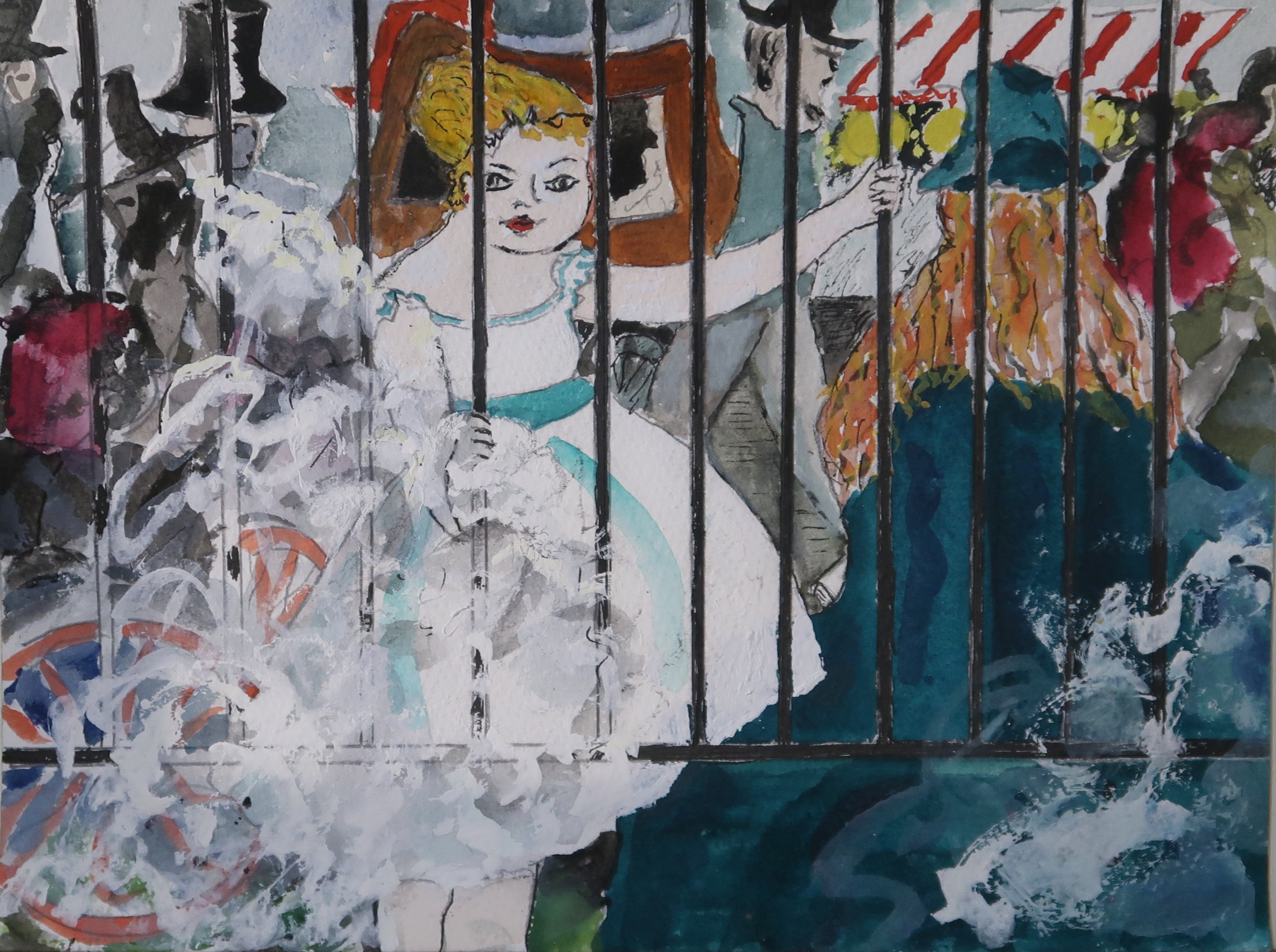
There are the poets of the canon, and then there are the poets you think with. I mean, poets whose method has a bearing on your own. They are often to be found not on the highroad of literature but on some byway, off the beaten track. Richard Lovelace has always been such a poet for me. A precocious young man, member of parliament at fourteen, a cavalier aristocrat who once wore cloth of gold and silver, but who, after the execution of Charles 1, was so poor that he was forced to eat his boots. He died young, in squalor. He is best known for his lyrical poem To Althea, from Prison, which has the lines: “Stone walls do not a prison make, nor iron bars a cage.”
The elegance of his lyric poems, often set to music, is indisputable. But the reversal of fortune he underwent was a formative influence on his writing. A key poem to understanding this is his Advice to my Best Brother – Francis Lovelace – who was sent out across the Atlantic to become the second Governor of New York in 1668. The editions of Lovelace’s poems are unfortunately littered with errors – especially the poems published posthumously (and probably over-hastily). For instance, the first line of this poem is supposed to read – “Frank, wil’t live unhandsomely? Trust not too far…” Well, I’m pretty sure the “un” has crept in by error, as it makes no sense and it ruins the scansion – so I have removed it.
Frank, wil’t live handsomely? trust not too far
Thy self to waving seas: for what thy star,
Calculated by sure event, must be,
Look in the glassy-epithete, and see.
x
Yet settle here your rest, and take your state,
And in calm halcyon’s nest ev’n build your fate;
Prethee lye down securely, Frank, and keep
With as much no noyse the inconstant deep
As its inhabitants; nay, stedfast stand,
As if discover’d were a New-found-land,
Fit for plantation here. Dream, dream still,
Lull’d in Dione’s cradle; dream, untill
Horrour awake your sense, and you now find
Your self a bubbled pastime for the wind;
And in loose Thetis blankets torn and tost.
Frank, to undo thy self why art at cost?
x
Nor be too confident, fix’d on the shore:
For even that too borrows from the store
Of her rich neighbour, since now wisest know
(And this to Galileo’s judgement ow),
The palsie earth it self is every jot
As frail, inconstant, waveing, as that blot
We lay upon the deep, that sometimes lies
Chang’d, you would think, with ‘s bottoms properties;
But this eternal, strange Ixion’s wheel
Of giddy earth ne’er whirling leaves to reel,
Till all things are inverted, till they are
Turn’d to that antick confus’d state they were.
x
Who loves the golden mean, doth safely want
A cobwebb’d cot and wrongs entail’d upon’t;
He richly needs a pallace for to breed
Vipers and moths, that on their feeder feed;
The toy that we (too true) a mistress call,
Whose looking-glass and feather weighs up all;
And cloaths which larks would play with in the sun,
That mock him in the night, when ‘s course is run.
x
To rear an edifice by art so high,
That envy should not reach it with her eye,
Nay, with a thought come neer it. Wouldst thou know,
How such a structure should be raisd, build low.
The blust’ring winds invisible rough stroak
More often shakes the stubborn’st, prop’rest oak;
And in proud turrets we behold withal,
‘Tis the imperial top declines to fall:
Nor does Heav’n’s lightning strike the humble vales,
But high-aspiring mounts batters and scales.
x
A breast of proof defies all shocks of Fate,
Fears in the best, hopes in worser state;
Heaven forbid that, as of old, time ever
Flourish’d in spring so contrary, now never.
That mighty breath, which blew foul Winter hither,
Can eas’ly puffe it to a fairer weather.
Why dost despair then, Frank? Aeolus has
A Zephyrus as well as Boreas.
x
‘Tis a false sequel, soloecisme ‘gainst those
Precepts by fortune giv’n us, to suppose
That, ’cause it is now ill, ‘t will ere be so;
Apollo doth not always bend his bow;
But oft, uncrowned of his beams divine,
With his soft harp awakes the sleeping Nine.
x
In strictest things magnanimous appear,
Greater in hope, howere thy fate, then fear:
Draw all your sails in quickly, though no storm
Threaten your ruine with a sad alarm;
For tell me how they differ, tell me, pray,
A cloudy tempest and a too fair day?
x
I’m sure W B Yeats had this poem to hand when he wrote The Second Coming. It’s worth noting that Lovelace is the supreme poet of falconry, and has a poem describing a falcon ascending so high that it cannot be seen by the falconer.
Lovelace is the master of the oxymoron: “a figure of speech that juxtaposes concepts with opposite meanings within a word or in a phrase that is a self-contradiction. As a rhetorical device, an oxymoron illustrates a point to communicate and reveal a paradox.” Such contradiction permeates his verse. His poems are essentially paradoxical – indeed he has a poem entitled A Paradox – and it’s entertaining. Oxymoronic usage is everywhere:
x
I cannot tell who loves the Skeleton
Of a poor Marmoset, nought but boan, boan.
Give me a nakedness with her cloaths on.
(second half of La Bella Bona Roba)
So scattering to hord ‘gainst a long day,
Thinking to save all, we cast all away.
(conclusion of The Ant)
This couplet is complex. It brings to mind the action of sowing: the sower scattering the grain in order to hoard the harvest later.
Within the formal elegance of Lovelace’s poetic architecture, nothing is out of bounds – prostitution, pubic hair (the hidden muffe), contempt for the powerful (Against the Love of Great Ones). I think the neglect that his work labours under is evidence of the shallowness of generalisation that the notion of a canon of literature exemplifies.
What have I got from him? Lovelace’s world was turned upside-down by the civil war. His poems succeed in expressing that topsy-turviness. Now that sense of a reversal of viewpoint is very much a factor in my own imaginative process. Inside the Castle – the title poem of my first collection – written when I was nineteen – was a reaction to reading Kafka. I was inspired by the notion that if K could find no way of getting into the castle, then its inhabitants could find no way out. The Temptation – included in the same collection – circles around the idea that Christ is the tempter. I enjoy the educational illustrations that were associated with “The World Turned Upside Down”. What is wrong with this picture – the butcher is butchering the butcher, the wife is beating her husband, the horse is riding the man? I have created performance art revolving around this idea. I have stood on my head wearing my underpants inside-out outside my inside-out shirt and suit, all worn back-to-front. Such behaviour has not endeared me to the poetry world which is generally strait-laced. My interest in oxymorons and reversals has led me to the work of Robert Browning and Andre Gide. Browning’s My Last Duchess is a poem which is the key to unlocking the notion of a persona, of empathy with a character who proves to be vicious. Gide’s novel The Immoralist also explores this idea, which was the dynamic behind my long poem The Ogre’s Wife (title poem of a collection published by Anvil in 2009), which speaks through the voice of a woman married to a serial killer. A recent poem – The Warrior – seeks to explore the psychology of a soldier serving in the IDF.
x
I am not suffering, me, from post-traumatic stress disorder.
There is a reason for what we do. Their wives have weaponised
Their wombs. Our problem is our democracy.
We call it mowing the lawn, think of it as a cull
To keep their population down. For this is our land explicitly.
Well, that’s how I see it, me, and I’m not one to over-ride
The will of God – nor will I commit the sin of suicide,
Since it would be a crime to reduce the number of those
Fighting for our cause. So you can stuff your PTSD
Up your sanctimonious arse. Back at home, my wife demands
That I get out the mower. For all flesh is grass.
I have shot little girls in the head before, and mothers
In the belly. I remember what was taught in class.
You reap what you sow! the righteous angel
Calls out to each pregnant cow, tightening the trigger-finger.
Imagine a serial killer who’s a magnificent poet.
A genocidal composer. An artist who can paint in blood
Without it turning brown whose work is pretty good.
I know a supporter of causes whose art is actually shit.
And casualties who can’t write for toffee. There is an art
To what we do. Inevitably, since there have always
Been skirmishes and sieges, scorched earth and the need
To see things through. Marley put it best you know: Get up,
Stand up. Stand up for your rights. So don’t you lecture me.
I drop the visor down, you see, when I prepare for the slaughter.
But when command rotates our squad and I return from the front,
I am no different to any of you. You should see me with my daughter.
x
For tell me how they differ, tell me, pray,/A cloudy tempest and a too fair day? There is such unease expressed in that last phrase. Some of Lovelace’s lyrics seem consoling – Stone walls do not a prison make…But much of his poetry eschews consolation. I know that there is a current desire to see poetry as essentially reassuring. But for me this reduces the art to the triteness of a ‘Get well soon’ card.






 anthonyhowelljournal