Charybdis

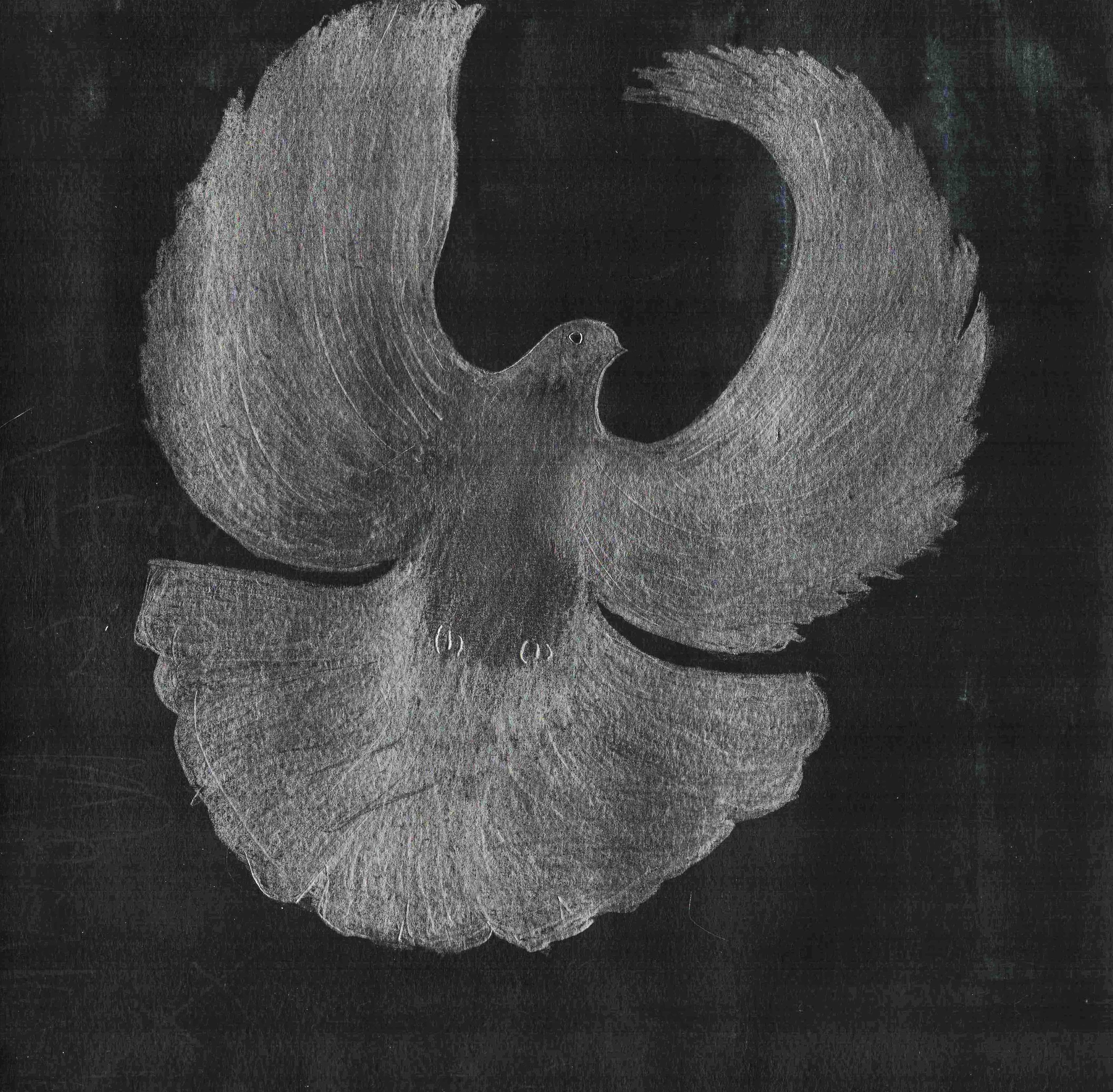
Charybdis swallowing a ship – drawn with the eyes closed.

Bayesian, the name of that yacht. Elementary, my dear Wat!

Scilla and Charybdis frequent the strait at Messina.

Water-spouts round Sicily are nothing new, it seems to me.

Another old dilemma has still to be resolved in the wake

Of any revolt – as is suggested by Percy Bysshe Shelley’s

Returning to the idiom in his essay A Defence of Poetry –  

Put with some pith, and still as true as it was in 1820:

“The rich have become richer, and the poor have become

Poorer; and the vessel of the state is driven between

The Scylla and Charybdis of despotism and anarchy.”

Analysis in Bayesian ways factors in advertisement,

Codifies prior knowledge in the form of a predicted

Distribution – so you know what profit you might make

Given you promote the item, even if it proves a fake.

And yet the best of plans may go awry and splendid lies

Go bottom up, just as extravagent yachts may capsize.

MK Ultra’s agents, unaware of their acts, morph into maniacs.

When entities arrive at their extreme, they turn into

Their opposite. Freud observed this in the way a dream

May substitute wet for hot, sour for the forbidden sweet

We each of us long to consume. Entanglement of true crime

And mythology? The yacht with the tallest mast in the world

Appears to have been sucked under by a water spout.

I turn in early, much new stuff to dream about.

The dream I have however, delves with some nostalgia

Into my lecturer days to earn my bread. And Jason arrives for a tutorial.

Since leaving art-school he has been afflicted by a

Wasting disease. Now he exists within a glass case

With circular holes to respire. His brain’s enclosed in chicken-wire;

His one remaining arm extending out of the case

So that his hand can caress the stalk of a dandelion.

Jason waxes lyrical about its ephemeral sphere

That can be dispersed as easily as a cloud into the air

And I say, from now on you can do anything, Jason,

Argue for the King’s assassination, shit on the floor

(I’m actually not so sure Jason does shitting any more).

No one is going to tell you what you are doing is crap,

They will do nothing but praise you. Not to do so would be

Anti-freakist. Next there is this girl who wants to perform

With a sheep, but the sheep’s no pet, and keeps wandering

Off the set. Clearly she was looking for a lamb. I get friendly

With the sheep which is dirty, but so what? Didn’t I

Grow up on a farm? The sheep is content to be my pillow

As I dream about going back into performance for a spell,

Recalling all my actions with a pig. A Tamworth sow.

Am I dreaming about a sheep because wolves are supposed to make

An appearance again in this book? I dreamt I had mislaid

My old jacket after a fatal row with my old friend.

It’s all very well remembering them, but dreams are supposed

To happen in one’s sleep. Should you recall

Such a detail, that detail from a dream can depress you

By leaving its dark trace through the hours of your day.

Better put all recollection away. But that gets you stuck on

Darktrace, cybersecurity company founded by the Brit tycoon

Mike Lynch – one of the six missing in the shipwreck

That occurred off Porticello, round the head from Palermo –

Darktrace has consolidated relations with the deep state rabbis

Of Mossad. And Darktrace is known to secret services,

Including Italian ones, but has close relationships in particular

With Tel Aviv who, according to a source interviewed

By Nova Agency, used Darktrace’s systems to locate

Leaders of Hamas. Lynch, also known as the

“British Bill Gates”, played a role in the birth of Darktrace.

From The Runiad, Book 12. The completed poem may by read for free on this Heyzine link.

Book 12 can be found on page 272, so move along the bar below the text to get to any specific page.
Posted in art, Poetry, The Runiad | Tagged , , , , | 1 Comment

More on Victor Hugo

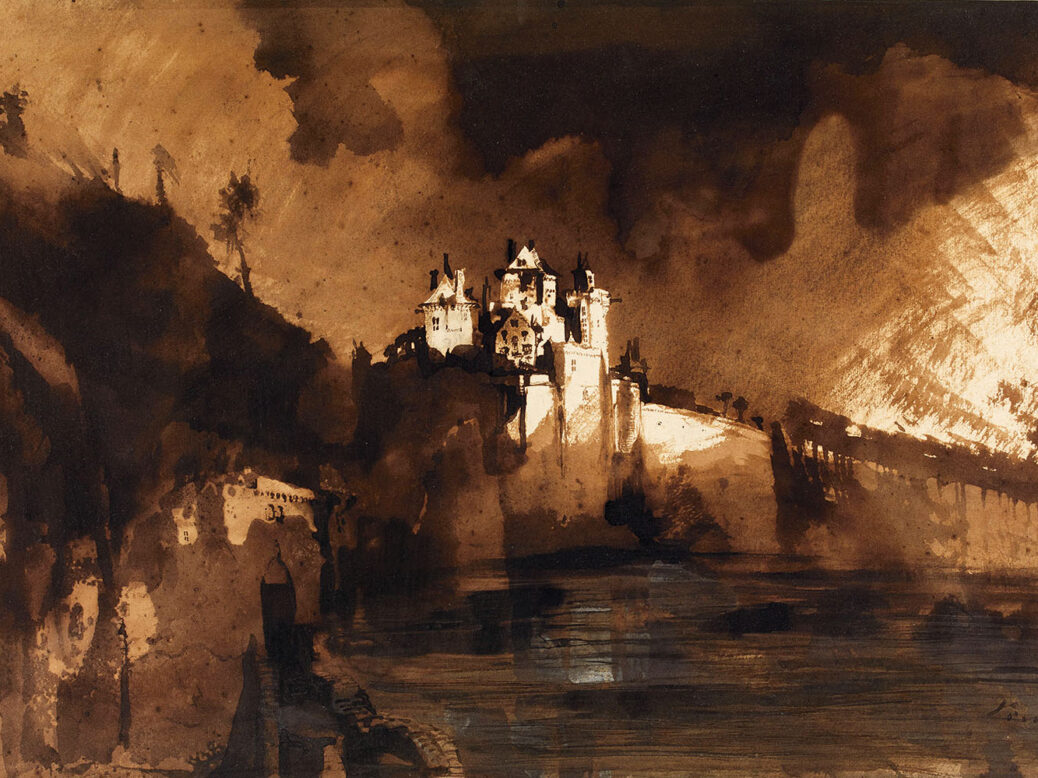
I am fascinated by the art of Victor Hugo, recently seen at the RA. Here is a link to my essay on his work and that of Alexander Cozens. Modern Art is Over: Embrace Deep Art

There is also an article about his work in the New Statesman.

https://www.newstatesman.com/culture/art-design/2022/01/the-sinister-art-of-victor-hugo

I don’t see Hugo’s work as “modern art”. The first use I can find of the word “modern”, applied to a creative act, is George Meredith’s brilliant sequence of sonnets – “Modern Love”.

This is a sequence of fifty 16-line sonnets about the failure of a marriage, an episodic verse narrative that has been described as “a novella in verse”. It first appeared in 1862. I get the sense that it was Meredith’s intention to bring love “up to date”. This notion has persisted. Modern art is up to date – it’s the latest thing, and it always has been. Neither Cozens nor Hugo seem to have been interested in being up to date. If anything their work is nostalgic, harking back to a more gothic age, a romantic notion that had already faded.

The trouble is, today, being up to date is in itself dated. Modern art has simply come to mean trendy art; more aligned to the world of fashion than to artistic aspiration. Today, genuine originality will often seem unfashionable, out on its own bizarre limb.

And this is precisely why deep art appeals to me.

Posted in art | Tagged , , | 1 Comment

Posted in Uncategorized | Leave a comment

Digital Masks

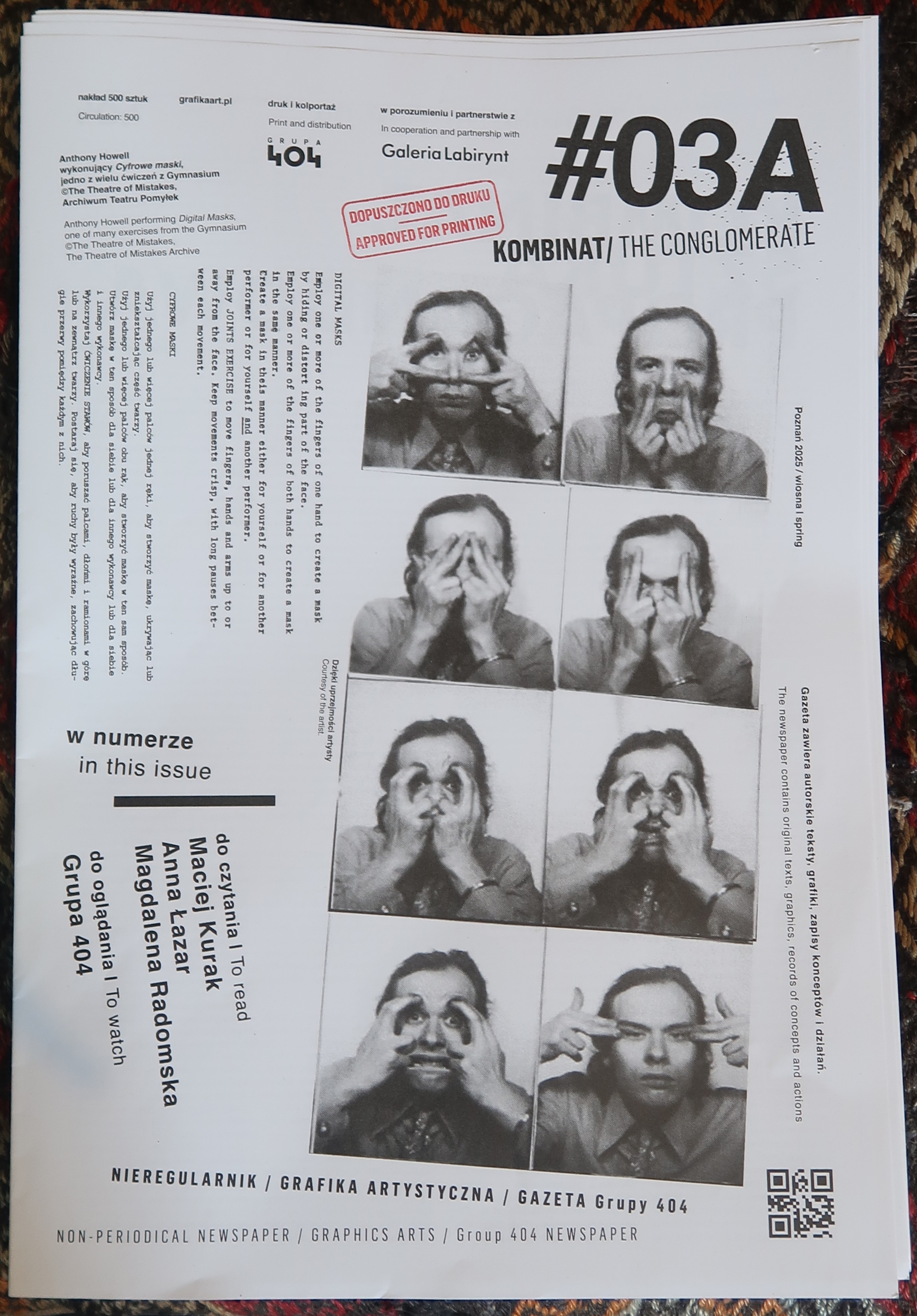
Very pleased to see this work by The Theatre of Mistakes on the front cover of Gazeta Grupy 404 – an arts magazine from Poznan in Poland.

Design by Maciej Koziowski.

It features a brilliant article on the relationship of art and propaganda, as well as poetry and other great pieces of writing, much of it in English as well as in Polish.

Posted in art, Politics | Tagged , , , | Leave a comment

Why “Runiad”?

Why Runiad as the title of the epic poem I have just completed?

Rune is a word which may be translated as ‘a secret, a mystery, a rumour or a whisper’. It can also suggest an enigmatic or incantatory line of verse. I chose Runiad as a contrast to the term “Ruliad” – which is a mathematical term defined as the sum of all possible theorems. My Runiad is therefore intended as an imaginary sum, the sum of all possible rumours, spells and charms. I wrote the poem over the years 2023 to 2025. It traces certain of my own experiences during that time, as well as the gossip heard, the rumours circulating during that time, the so-called conspiracy theories (as opposed to provable theorems).

When I began it, I had no further clue as to what its content might be. I knew that there would be twenty-four books, each twenty-three pages long, with three seven-line verses per page (except for the last page, which could have between one to three verses on it). This would bring it out to being the same length as the Odyssey. It was clear that I needed to know no more than this structure, to have no preconceived notion as to the poem’s content and to only “half-know” what it was I was writing. I wanted the poem to discover its content as it was being written. In a sense I wrote it as if I were a ‘seer’, or, in the sense used by William Burroughs, an antenna; picking up the lines as if they were vibrations or airwaves.

Shiva, the god of balance, was a guiding force – so I tried to balance art with science, legend with fact, love with war, dryness with juiciness, journalism with conjecture. It is intended to be read aloud, and to be read on the page.

The complete poem can be found by clicking on this Heyzine link.

It can be read from start to finish, or it can be read by choosing a book – or even a page – at random. John Ashbery referred to a system of prognostication called “Sortes Virgilae” – by which a personal reading was obtained by opening a page of Virgil’s Aeniad at random. The same method could be applied to the Runiad.

Posted in Poetry, The Runiad | Tagged , , , | Leave a comment

Earth Day 2025 – Kristian Evans and Nathan Roach

 https://www.youtube.com/watch?v=JPkBj7X1dfQ

A Film by Kristian Evans & Nathan Roach

This is one of the best poem/films I have come across. It often uses a constant moving image (reeds moving, waves breaking etc) which I have always found the ideal backdrop for focusing on the language, and Kristian Evans – who I have never heard of before – seems to me an excellent poet.

Posted in art, Poetry, Video | Tagged , , , , | Leave a comment

Gaza

See also WAR

Posted in art, war | Tagged , , | Leave a comment

The Runiad – books 1 – 24 – Updated Update

The final draft of my epic poem the Runiad is now completed. Click on the link to read Books 1 to 24:

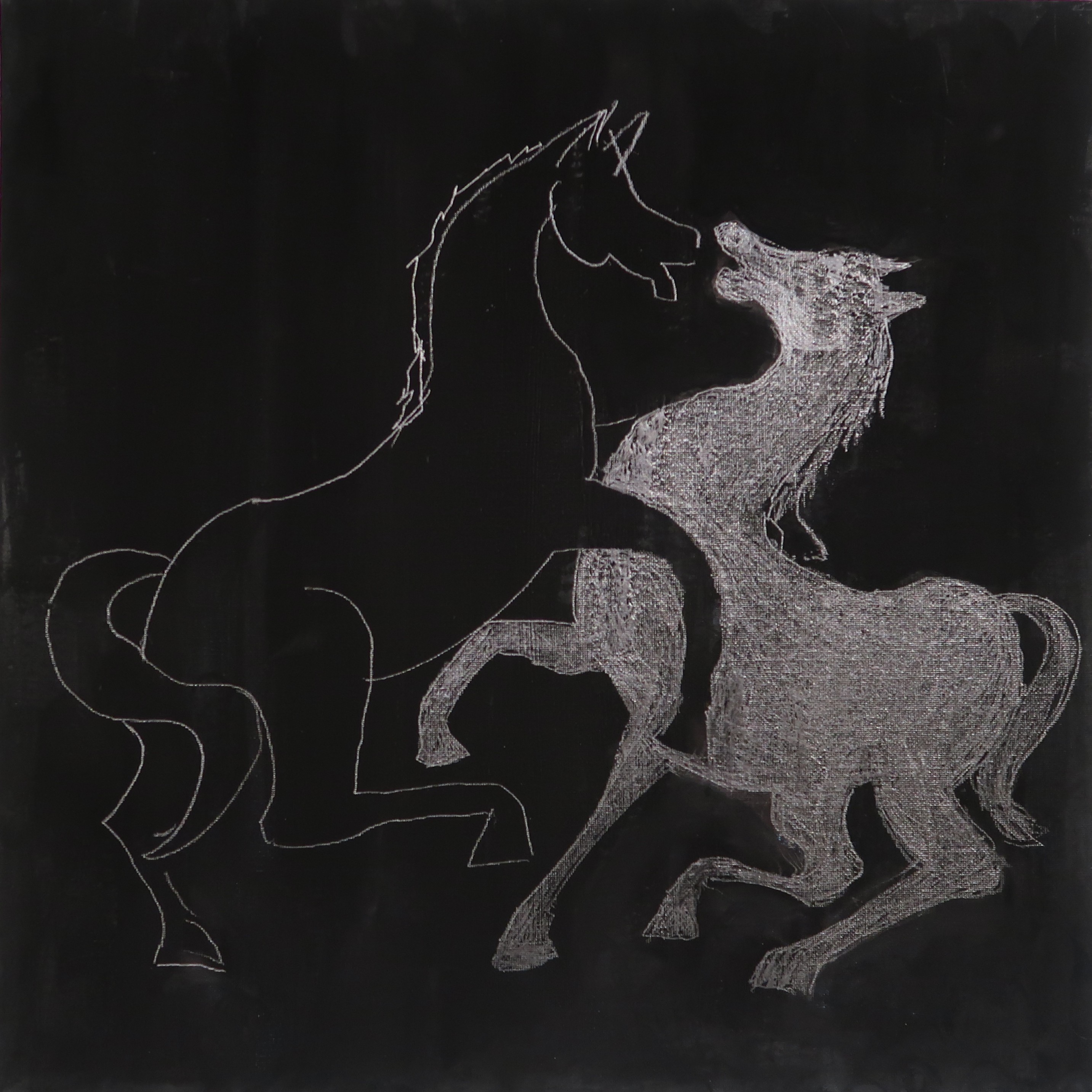
This link above opens the final version with my own illustrations. Since they are done with graphite on a black ground, these illustrations will be difficult to reproduce in book form.

Thank you to the 2000 readers who have accompanied me as I have been writing it.

I suggest expanding the image and turning off the sound. Click the bottom corner of the page to turn the pages, and the bar below the book allows you to scroll to whichever book you want to read. Contents pages at the beginning tell you the page number of each book.

It’s great to read aloud, and I welcome invitations to come and read from it. Peter Jay is designing a printed version which will be available in 2026.

Posted in Key Links, Poetry, The Runiad | Tagged , , | 1 Comment

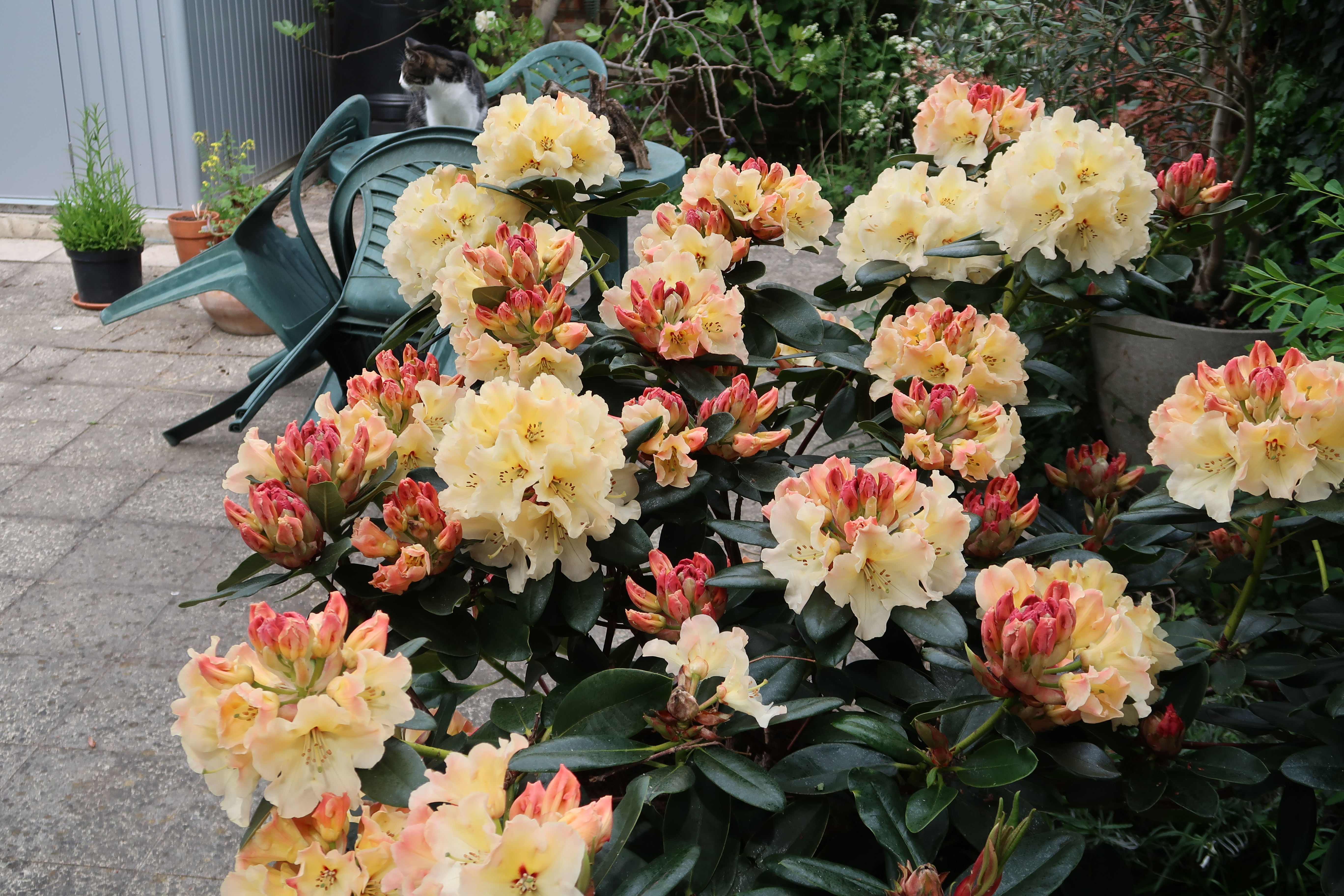
Rhododendron

It is always the same window, one out of which they have climbed

Into the garden; leaving the house to its dreams at the fringes of sleep:

Out of it by the back stairs or in by my half of the bedroom;

Always the same low window in a corner of that parlour into which

And out of which they have climbed in bare feet in the moonlight.

Water their dreams in the back of the parlour with its low window

Opening onto that wing of the garden which has the forest branches hanging over it.

That aria in the parlour which is climbing up and up to the bedroom

By the window then opening so freshly onto that sleep into which they glide

Is climbing in through a low window and then up the back stairs

To the door of the guest bedroom or to that of the Moorish bedroom

Next to it. The window-sill is merely a “has been” following the secluded smells

With the same edge of that water which Boy and then Igor, Burhardt, Rudi and Eric

All pronounce bare to the moonlight. The back door of the garden

The guest so obscured is through the next window up the stairs.

Jenny and Arja – all pronounce it “Aria” – wash their feet in the house, or wash my feet

Where the smells of the wing in the moonlight are hung

In the parlour opening onto that secluded corner half obscured

By a rhododendron. Always the same back window climbed. Always,

Always the same low pair of branches out of which they wing,

To glide up the stairs and into the forest. Burhardt is bare and, boy,

They are in through that window, getting their legs over Arja and Jeanne;

Rudi is hanging over the stairs next to the Moorish ghost which hides in the wall.

The lawn slopes up to the edge of the low brickwork where the window

Is always the same; the opening, out of which they have climbed onto the fringes

Of kilims where the lawn slopes up to it, a window into and

Out of which they have climbed, Giacomo and Jeanne, getting

Their legs over the sill, or following a ghost which is merely a pair

Of split pantaloons up the back stairs to the guest bedroom which has been

Freshly decorated or to the Moorish one next door where the walls are hung

With kilims, one of which hides the door to the bedroom. Which? The one

Next door. Then it is Igor and Eric, at wing in the moonlight, is bare brickwork

Which has feet in it, low in the wall where the walls of the house are hung

With decorated Moorish pantaloons, and into the garden next door

To the window Jenny and Giacomo climbed through – or they split a guest in.

This is a poem I call a “Statheron”. In it all the words must be used an equal number of times – that is, a word cannot be used once, or an odd number of times. Here, “rhododendron” is used once, but also appears as the title. The poem can be found in my collection “ABSTRACTIONS” – which is published on this Heyzine link and can be read for free

Posted in Poetry | Tagged , , , , | 2 Comments

From Book 7 of The Runiad

Sasseta

At a time when St. Francis was staying in the town of Gubbio,

There appeared in that region a wolf so maddened by lack of a meal

It took to devouring humans as well as beasts in the wild.

The townsfolk deemed it a scourge of the greatest magnitude

— because it came hungrily near the town— so that they had to forgo

Tilling the fields and ventured into the country only if armed

As if they were going to war. However their weapons alarmed

The wolf not at all, and few who went forth were able to escape

Its teeth and its appetite, were they so unfortunate

As to meet it. Everyone was terrified of coming across this snouted bandit.

No one dared to walk outside the city gate. But God decided to show

The strength of love to the people there, employing as his instrument,

Saint Francis. For the people’s sake, the Saint resolved to go

And meet the wolf in the wooded crags that were its natural element.

On hearing this the citizens said: “Look out, Brother Francis.

Don’t go outside the gate because the wolf which has already

Devoured so many will certainly attack and make a meal of you.”

St. Francis placed his hope in Jesus Christ, Master of all creatures.

Protected not by shield or helmet, but by the Sign of the Cross,

He went out of the town with his friend, putting all his faith

In the Lord who makes those who believe in Him feel safe,

Whether they walk among asps or tread upon a basilisk,

Overcoming not just wolves but even lions and chimeras

Terrifying to behold. His faith in love made Francis bold,

So that he went calmly forth to make the acquaintance of the wolf.

Some locals chose to go with him, but after a league they said:

“We won’t go further, Brother Francis, since that wolf is ferocious

And anyone who nears his lair will probably wind-up dead.”

St. Francis answered: “Just stay here. But I am going on

To where the wolf has made his home.” Then, in the sight of those

Who had climbed up into the trees to see how things would go,

The wolf came loping with its mouth open toward St. Francis

And his friend. The Sign of the Cross was made, and the sacred strength

Surging forth from himself and from his friend checked the wolf

And slowed its pace. Perplexed, it came to a halt in front of the Saint.

“Come to me, Brother Wolf. In the name of Christ,

I ask you not to hurt me or anyone.” As soon as he had made

The Sign of the Cross, the wolf had closed its jaws,

And, as he made that request, it lowered its head

And lay down at his holy feet, as though it had become tame.

And St. Francis said to it as it remained there before him:

“Brother Wolf, you have mercilessly perpetrated crimes

By hunting humans in this region. Lacking sane reserve,

You have been devouring more than some poor beast.

You have had the brazenness to slaughter and to feast

On beings made in the image of God. Clearly you deserve

To be put to death like any common murderer,

And everyone is right in swearing that is what you are.

You have filled this little town of Gubbio with hostility.

But now there shall be peace between you and the community.

You may seize on no one nor devour them anymore.

Then, when they’ve forgiven you all your past offences,

Neither men nor dogs will hunt you down.” Acquiescing

With its tail, moving its ears and at last by bowing its head

The wolf revealed that it accepted what the Saint had said.

St. Francis spoke again: “Brother Wolf, since you agree

To keep this peace pact, I will undertake to have the people

Of this town give you food each day for as long as you remain,

So that you will never again experience hunger, for I know

That whatever mischief you did was done because you needed to be fed.

But, my Brother Wolf, since I am obtaining for you such a favour

Promise me in the Saviour’s name that you will never again

Endanger beast or man.” The wolf gave an emphatic nod,

And then St. Francis said: “Brother Wolf, I want you to give me a pledge

So that I can confidently trust in what you promise me.”

And as the Saint held out his hand, the creature raised its paw

And put it in St. Francis’ hand as a sign that the pledge was secure.

“Brother Wolf, come with me now, without fear, into the town

Of Gubbio to make this peace pact in the Almighty’s name.”

And the wolf began to walk along beside him, gentle as a lamb.

When the people heard of this, they were amazed, and the news

Spread quickly through the town, so that men and women,

Young and old, poor and wealthy, gathered in the marketplace,

Because the Saint was coming with the wolf. Then he gave

A sermon, showing how such grave calamities as predators

Were brought about because of sin, and how the fire of hell

By which the damned must be devoured for all eternity

Is far worse than the raging of a wolf which can bring agony

Only to the flesh, and how much more they should fear

To be emptied into hell, given one mere animal

Could keep the lot of them in such a state of terror and anxiety.

He continued, “Listen, people. Brother Wolf has come to pay

His respects to you. He’s given me a pledge that he is willing to

Make peace with you if you agree to feed him every day.

And I, Francis, pledge myself as bondsman for our Brother Wolf

That he will staunchly keep this pact.” Then all who were assembled

There promised with one voice to feed the creature as required.

Again the Saint sought surety of how the wolf would act.

“Brother Wolf, do you agree to venerate this pact?”

The wolf knelt and bowed its head; next it wagged its tail

To indicate it would not fail to keep the peace agreed.

“Brother Wolf, just as you gave a sign outside the gate

That you would keep your word, here before the people now

Please demonstrate again that this command you understand,

Since I am pledged your bondsman.” And so, in the presence of all,

The wolf again held out its paw and put it in St. Francis’ hand,

And then surprise and joy so occupied the watching crowd

That they all shouted to the sky, and praised the Lord aloud.

And from that day, the wolf and the people kept the pact

And the wolf would go from door to door for food.

Hurting no one, no one hurt it. People fed it courteously.

And it is a striking fact that not a single dog ever barked at it.

When the wolf grew old and died, the people there were sad,

Because its peaceful manner reminded them of how the Saint enticed

A wolf with loving kindness. Praised be Our Lord Jesus Christ.

The Runiad is an epic poem completed June 2025. Books 1-24 can be read on this Heyzine Link

Posted in art, Poetry, The Runiad | Tagged , , , , | Leave a comment