I met a traveller from an antique land
Who said: “Two vast and trunkless legs of stone
Stand in the desert. Near them on the sand,
Half sunk, a shattered visage lies, whose frown,
And wrinkled lip, and sneer of cold command,
Tell that its sculptor well those passions read
Which yet survive, stamped on these lifeless things,
The hand that mocked them, and the heart that fed.
And on the pedestal these words appear:
‘My name is Ozymandias, King of Kings:
Look upon my works, ye Mighty, and despair!’
Nothing besides remains. Round the decay
Of that colossal wreck, boundless and bare
The lone and level sands stretch far away.”
(Percy Bysshe Shelley, Ozymandias)
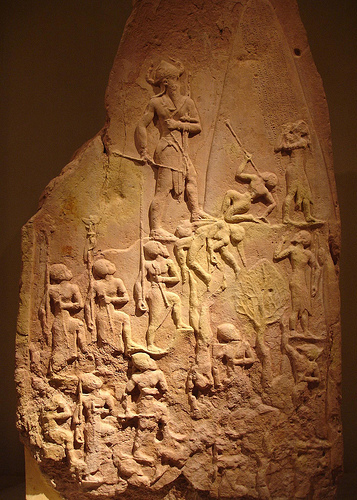
Some four thousand years ago, in Mesopotamia, a stone stele was erected to the Akkadian king Naram-Sin to commemorate his victory over the Lullubi. The stele is now in the Louvre. Naram-Sin ruled for thirty-seven years. He introduced two innovations to royal inscriptions. He took the title ‘king of the four quarters’, which suggests dominion over the whole world, and he favoured the use of the determinative hitherto reserved for the writing of divine names. The stele is of particular interest because on it the king is depicted as being twice the size of anyone else. Neither the defeated king nor his own troops can approach his stature. He stands on the horizon, while otherwise only some spear-tips and a single helmet rise above it, and he shares this empty space with a tall mountain and with the stars. This is one of the very first times that scale is used to denote mightiness. And it is appropriate that this visual solution coincides with the adoption of an elevated tone where verbal reference to his majesty was concerned.
Two issues are at stake here: what you describe and how you describe it. They are issues which have always been associated with each other. Grandeur itself has impressed us long before we built edifices of our own. In the gorge of the Ardèche, the enormity of the natural stone arch known as the Arc de Vallon seems to have astounded people some 21,000 years ago, since a number of painted caves have been discovered in its vicinity including the Chauvet cave – which was only found in 1994. This contains stunning drawings, of mammoths, and rhinos and lionesses, among other animals, and it is easy to imagine that these were inspired by suggestive outlines and bulges in the rock itself – just as Leonardo was inspired by blotches and blemishes on old walls. The possibility of visualising these beasts in its crannies still haunts the massive bridge of rock spanning the river here.

We do not know very much about these people of the caves. Did they send up chants to their gods or did they sing of their lives and their loves? Their drawings are remarkable for their accuracy. The attributes of the beasts seldom seem exaggerated and there is an absence of stylisation – as if these were representations rather than symbols – which leads one to doubt the religious significance usually foisted upon them. The drawings appear abandoned rather than finished. Created perhaps in an hour, they have a quality of nonfinito about them, despite the immense time-scale which has to be taken into account when considering life in the caves between ice-ages – but nevertheless the drawings remain stubbornly and remarkably akin to some modernist process – an act of perception rather than some sacred duty. So perhaps their songs described life in a down-to-earth way. Can we not be permitted to imagine the cave-people as being free of religion? Why should we assume that religion is endemic to our condition? Perhaps, like completion or perfection, religion is a secondary notion not a primary one. Perhaps the assertion that there exists some superhuman power is a late development in the long history of man – an abstraction evolving out of his capacity to imagine himself as larger than life.
In the Chauvet cave, it looks as if the rhinos were wearing belts. We are taught to think of the cave-people as girding up their loins to kill such beasts. But plenty can happen in several thousands of years. Perhaps they had tamed these rhinos. Did they perhaps place their bets on them at organised rhino tournaments? Plenty of grandeur in that idea. But apart from a few hand-prints, the image of man is not evident in the cave. As the stele of Naram-Sin shows, the aggrandizing of man into god grows out of a stylization which creeps into the business of depicting his own image. It occurs when man himself begins to think of himself as sublime, i.e. as something astonishing, something beyond his own grasp.
And then, beyond man, there is his mind. When man moves into abstraction, he may merely be making a negative presentation of his own notional sublimity. In his “Analytic of the Sublime”, Immanuel Kant saw it like this:
We need not fear that the feeling of the sublime will lose by so abstract a mode of presentation – which is quite negative in respect of what is sensible – for the imagination, although it finds nothing beyond the sensible to which it can attach itself, yet feels itself unbounded by this removal of its limitations; and thus that very abstraction is a presentation of the Infinite, which can be nothing but a mere negative presentation, but which yet expands the soul. Perhaps there is no sublimer passage in the Jewish law than the command, ‘Thou shalt not make to thyself any graven image, nor the likeness of anything which is in heaven or in the earth or under the earth,’ etc. This command alone can explain the enthusiasm that the Jewish people in their moral period felt for their religion, when they compared themselves with other peoples, or explain the pride which Mahommedanism inspires.
(Immanuel Kant, Critique of Judgement, p. 115)
Kant points out how easily we rise to enthusiasm, under the impetus of an unbounded imagination, when figurative symbols turn abstract in this way. But enthusiasm may give way to obsession – in the eighteenth century it meant just that. The more recent the religion, the more abstract its terms and its symbols, the more tyrannical its manifestations, and the more fanatical its followers.
It is this stele of Naram-Sin which introduces piety into the act of the sculptor. Since the ruler has adopted the divine determinative, he must be shown in his representations to be above other men, larger than life. By being enlarged he has become abstracted, a symbol, towering over the heads of his people. To be larger than life is to be sublime. As Rilke has it, “Every angel is terrible.” Naram-Sin is an early hero, one of the first objects of hero-worship. Now grandeur concerns our approach to the heroic. Long before Kant put it so succinctly, there have been philosophers who have recognised that grandeur can convey a sense of the infinite, and this is why it gets associated with the sublime. At the same time, though, on a more mundane level, we use grandeur to support our own confidence and to impress other people. It is said that the Egyptians were accustomed to marching into battle very slowly, but still, with their chariots dripping gold, with their elephants ponderously swaying and their beast-headed effigies carried aloft on the shoulders of enslaved cohorts, they overwhelmed their enemies with awe and usually secured a surrender before any battle was joined. This strategy failed against the Scythians, who rode as near as they dared towards this display army and then turned their horses away and galloped off, firing their arrows behind them. Pretty soon it became obvious that the Egyptians were not as immortal as they appeared.
Kant agreed with other thinkers, and associated grandeur with the sublime, but, noting that size was always comparative, he considered sublimity to be a matter of the sensation aroused rather than a property of the object. This sensation depends on the subject’s approach. Only if the approach is right, will heroic scale deliver its grandiose goods. Kant realised how crucial that approach can be when he differentiated between apprehension and comprehension, noting that we may sometimes perceive that which we cannot grasp. Commenting on a certain traveller’s remarks on Egypt, he said:
…we must keep from going very near the pyramids just as much as we keep from going too far from them, in order to get the full emotional effect from their size. For if we are too far away, the parts to be apprehended (the stones lying one over the other) are only obscurely represented, and the representation of them produces no effect upon the aesthetical judgement of the subject. But if we are very near, the eye requires some time to complete the apprehension of the tiers from the bottom to the apex, and then the first tiers are always partly forgotten before the imagination has taken in the last, and so the comprehension of them is never complete.
(Ibid, p. 90)
It could be argued that incompleteness of comprehension, or our apprehending something that evades our ability to grasp the whole of it, is precisely what causes the spasm of awe and astonishment that should properly be identified as the sublime. Here is the difference between what Edmund Burke calls a clear expression and a strong expression:
These are frequently confounded with each other, though they are in reality extremely different. The former regards the understanding; the latter belongs to the passions. The one describes a thing as it is; the other describes it as it is felt…
(Edmund Burke, A Philosophical Enquiry…. ‘How words influence the passions’, p. 159).
From the difference between thing as is and thing as felt, a more recent thinker, Jean Francois Lyotard develops his 1988 notion of “the differend”. It is not an analogue relationship. If a thing cannot fully be grasped ‘as is’, it may ‘as felt’ beget disproportionate wonder. This is why we see so much of Godzilla’s foot, and the foot alone. It is the “shattered visage” of Ozymandias, and the “two vast and trunkless legs of stone” that Shelley uses as the triggers to arouse in us a sense of a sublime humiliation meted out by the omnipotent force of time. The same sensation affects us when we wander into the vast ruins of the Colosseum.
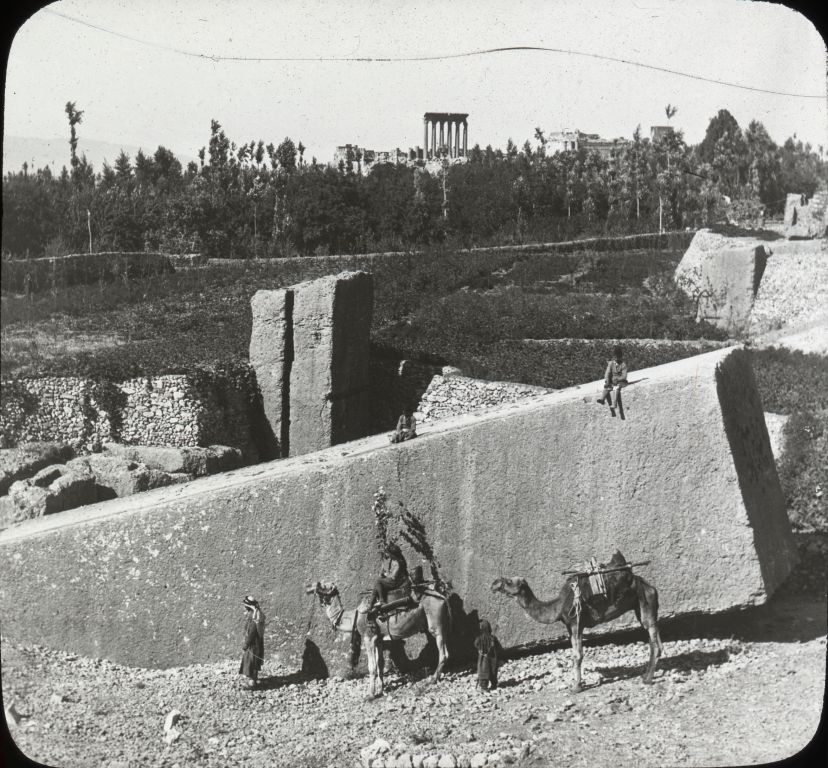
This brings us back to a more mundane reading of grandeur. The Romans were rather small compared to many of the barbarians they conquered, and they seem to have compensated for any sense of inferiority this engendered by valuing enormity in buildings. Just as their battle-formations defeated the individual opponent by disciplined use of group strategies such as the “tortoise” shield formation, so they impressed the shackled thousands they led in triumph back to Rome by an en masse approach to the manifestation of power. Even today, the immensity of the Colosseum imposes on its surroundings: when sold-out, it inspired such terror in its carnivores they were often incapable of mauling any victims. By contrast, a Greek temple, such as that at Bassai, seems to work harmoniously with the landscape, indeed the vicinity has been taken into account, for often a Greek temple will be built in relation to a niche in the hills behind it, a cleft considered sacred. However, the scale of Hellenic temples at Baalbek in the Lebanon, very much contrived by Rome, is intended to impress us, not to please us – and the columns do so even in the ruinous state they present to us today. In the quarry at Baalbek, there is a rectangular cube of marble so massive that it could never be lifted out of that quarry – so that is where it remains.
The architectural orders which kept Greek architecture in harmony with musical resonances and poetic measures are distorted and finally abandoned by the Romans. And so it is that a time-honoured disjuncture in the arts – which differentiates the beautiful from the sublime – can be epitomised by this difference between Greek and Roman architecture. Greek architecture epitomises beauty, and lies at the root of formalism. It incorporates a world-view which supposes a coherent progression from what they perceived as harmonious relationships in nature to constructions such as temples; relationships such as the chords they discovered when they swept the strings of their lyres. An elegant mathematics unified music, poetry and buildings, and the terms for their poetry also related back to the human shape – since the measure was the “foot” and the foot related to steps in the dance done to the sound of the lyre being swept. The foot is an analogue measure, traced from our form. We have lost such a relationship in our own measurements with the demise of the yard and the inch – the yard relating to our stride, the inch relating to our thumb. The Roman centurion, in command of one hundred men, is an early product of digital, as opposed to analogue, thinking: he is, as his name implies, a number in a world divisible into numbers divisible by ten. Decimation, killing one out of ten of your enemies, is another Roman characteristic. Later theoreticians of the beautiful and the sublime relate beauty to pleasure and the sublime to pain. But beauty also concerns the appropriate. It never sticks out like a sore thumb. The pleasure to be derived from it consists in their being some perceived coherence which can place an object and its making within some wider system which concerns the natural world.
The Romans had no qualms about embracing decimalisation. They worshipped efficiency rather than proportion since their own thumbs were, in all likelihood, too short to constitute an adequate measurement. They favoured tens and tens of tens. Buildings such as the Colosseum were designed to overwhelm and astonish other people. Beauty was not the aim. Grandeur was. Longinus, the Romanised Greek who became the first theorist of grandeur, set down his thoughts on the subject in the time of the Antonine emperors, around 100 AD. In his treatise On the Sublime, we find elevation clearly associated with an elevated tone, just as we do some two-thousand years earlier, in the time of Naram-Sin. Yet more often than not Longinus eschews Roman “aggrandisement” and chooses instead to cite a passage from his compatriot Homer’s Iliad as a truly resonant example of the grand manner; for instance, how Hector rushed at the Greek fleet:
And fell upon it like a wave high raised that then doth stoop
Out from the clouds, grows as it stoops with storms. Then down doth come
And cuff a ship, when all her sides are hid in brackish foam,
Strong gales still raging in her sails, her sailors’ minds dismayed,
Death being but little from their lives…
(The Iliad, Chapman’s 1611 translation)
Homer’s similes refer us away from the sphere of manly doings into the phusis. This is often rather lazily translated as ‘nature’. Phusis, the etymological ancestor of our ‘physics’, was defined by Aristotle as a “self‑blossoming emergence, opening up, unfolding: that which manifests itself in such unfolding and preserves and endures in it” (Metaphysics 11‑12). This wonderful word epitomises unceasing change, and it is similar to the tao, the Chinese notion of the ‘profound creative impulse of the universe’. It constitutes the “absolute flow of becoming” which, according to Friedrich Nietzsche, existed before substance came into being.
In The Gay Science, Nietzsche asserted that “We are not subtle enough to perceive that probably absolute flow of becoming; the permanent exists only thanks to our coarse organs which reduce and lead things to shared premises of vulgarity, whereas nothing exists in this form. A tree is a new thing at every instant; we affirm the form because we do not seize the subtlety of an absolute moment.” We can see what affinities this Heracleitan reading of the word has with the movement of atoms. For the Greek poets, the notion was the source of similes that dealt with the turmoil of natural forces, crashing of waves, trees buffeted by tempests, swirling of clouds. The similes in the Iliad become the protean substance, later, of the Romantic impulse in poetry. In a sense, by the eighteenth century, the simile is reversed, and the roaring of the cataract is perceived as some rage in the doings of man.
But Homer’s poem is naive rather than sentimental in the romantic sense put forward by the German critic Schiller in his essay on Naive and Sentimental Poetry; that is, it concerns a straight-forward account of an action, not the poet’s “sentiment” concerning that action. Its similes enhance the description, and the feeling of that description, not the poet’s feeling about what went on. The “I” of the narrator has as yet no role to play in the homeostatic unity of the poem, and the simile is a straightforward likeness between dissimilar things, not some subjective comment. Homer’s epic is considered a primary one, in the sense that it is, so far as we know, the original source of its story, though it may well have been the culmination of some bardic tradition – primary as opposed to secondary in the sense that Virgil’s Aeneid is secondary, that is, derivative, drawn from Homer’s tales and others, or as Milton’s Paradise Lost, or indeed Joyce’s Ulysses, is secondary – Milton’s magnificently grand epic being derived from the bible and other sources, Joyce’s large, rather mannered novel being an ironic retelling of the Odyssey as if it all happened in Dublin to a little man called Bloom.
Of the two epics known to Longinus, Homer is more prone to the use of simile than Virgil and more likely to return to some key phrase or allusion – such similes and allusions are meant to amplify the narrative in an epic, and amplification is very much a prerequisite for grandeur according to Longinus. Virgil sticks more closely to his story, delighting in a close description of an action and how it unfolds – Pandarus drawing his bow, for instance – cited by Lessing as the example of subject matter that is appropriate to the art of poetry (see my essay on Quietism). Virgil’s metaphors are not always drawn from the phusis of natural phenomena, but from other events observed in daily life: for instance, this is how he describes Neptune quelling the winds that have caused a storm at sea:
“Just as so often happens, when a crowd collects, and violence
Brews up, and the mass mind boils nastily over, and the next thing
Firebrands and brickbats are flying (hysteria soon finds a missile),
That then, if they see some man whose goodness of heart and conduct
Have won their respect, they fall silent and stand still ready to hear him.”
(Virgil, The Aeneid, Book I, )
With an urban readership in mind, Virgil’s simile brings an up-to-date allusion to bear on the divine occurrence. Homer would be more likely to compare a heroic action to some elemental force. Thus Virgil prepares the ground for the novel. His epic is less ornamental than Homer’s, and, while at times still elaborate, in general the style is more down to earth and less ornate. Homer uses ornament to elevate the tone. However, what Longinus seems to appreciate about the earlier author is that he never oversteps the mark, at least in the Iliad (Longinus is less favourably disposed towards the Odyssey which he sees as inclined towards the far-fetched and fantastic – in contradistinction to the gritty accuracy employed to speak of the fall of Troy). The similes in the Iliad are to the point: they magnify the action but do not carry it to such a pitch of extravagance that the language topples over into bombast or absurdity. Even in the time of Longinus it was recognised that the sublime was not far removed from the ridiculous. And incidentally, the difference between the two books is so striking that some critics have maintained that they are in fact written by different authors. Robert Graves has made a case for claiming that the Odyssey was written by a woman, since it abounds in tales of shipwrecked sailors being welcomed at island courts presided over by women, and may have been popular with the ladies who stayed at home weaving and supervising the household, while the warriors went about their grim business somewhere across the sea.
* * * *
The Iliad is written with the accuracy about wounds one might expect from the pen of an army surgeon. The Odyssey is, as Longinus points out, a collection of fairy tales. The Iliad has a dramatic unity, while the Odyssey is a picaresque stitching together of unrelated adventures. Where the Iliad is a testament of life “in the trenches”, the Odyssey concerns court-life and court-intrigues and women managing state affairs in the absence of marauding husbands. In all likelihood, one is the outcome of a male and one the outcome of a female tradition of recitation: or one is for a male and the other for a female audience. Longinus clearly thought that the Iliad had more grandeur than the Odyssey, and he has a pretty clear idea of what constitutes the literary grandeur he dubs, for ensuing time, “sublimity”:
Sublimity is a kind of eminence or excellence of discourse. It is the source of distinction of the very greatest poets and prose writers and the means by which they have given eternal life to their own fame. For grandeur produces ecstasy rather than persuasion in the hearer; and the combination of wonder and astonishment always proves superior to the merely persuasive and pleasant. This is because persuasion is on the whole something we can control, whereas amazement and wonder exert invincible power and force and get the better of every hearer.
(Classical Literary Criticism, page 143)
It is this matter of ecstasy versus persuasion which has highjacked any sober discussion of grandeur, I feel, for it leads us on into ever greater spasms of subjectivity. Grandeur, it might be argued is perceptible, something that concerns the nature of the object, whereas, as Kant has pointed out, the sublime is not an attribute of the object itself, instead it is a sensation experienced by the beholder – though grandeur might give one an intimation of the infinite and thus give rise to the sublime affect – that is to the emotion associated with the idea of the sublime. In these terms, grandeur can be conceived as an effect, whereas the sublime is more genuinely an affect.
It should be noted also that Longinus speaks about the “grandeur, magnificence and urgency…” of the sublime. Here we should remind ourselves that poetry is an art which occurs in time, as Gothold Lessing emphasises in his Laocoon. As greatness of scale is to space – in painting and sculpture – are we now able to associate grandeur with a certain quickening of pace when it relates to poetry and diction? Paul Virilio’s studies of the power and influence of speed are of relevance here. Virilio recognises the significance of speed in relation to heroic attitude:
For the Italian fascist passing directly from the athletic record to absolute war, the intoxication of the speed-body is total; it’s Mussolini’s ‘Poetry of the bomber’. For Marinetti, after d’Annunzio, the ‘warrior-dandy’ is the ‘only able subject, surviving and savouring in battle the power of the human body’s metallic dream’.
(Paul Virilio, Speed and Politics, p. 116-7)
Other nations had built buildings as big as or bigger than those of the Romans – the Babylonians, for instance, and the Egyptians. But in addition to building immense edifices the Romans moved faster than anyone had before. Their roads are as significant as their amphitheatres – indeed they are more significant. Speed of transport enables the rapid accumulation of materials in one place which produces architectural grandeur in a relatively short space of time. My earlier, quite possibly apocryphal story, about the Egyptians suggests that another species of grandeur moved more slowly, and perhaps built more solidly, but built what? A triangular edifice with no purpose to it beyond entombment. The god within the Egyptian pile was a hidden one, a god of within-ness, esoteric and dysfunctional. Roman grandeur was supremely functional: you could bathe in it, your omnipotence could be displayed in it, you could be entertained by it, and you could provide its bloody entertainment.
But the issue of speed brings other aspects of grandeur to the surface. While Edmund Burke may define the sublime as “a sort of delightful horror, a sort of tranquillity tinged with terror; which, as it belongs to self-preservation, is one of the strongest of all passions,” the sublime may as well consist of several sensations at variance with this, as Francis Spufford points out in I May Be Some Time, an account of Edwardian polar exploration which adumbrates some of the varieties:
In the first half of the eighteenth century, the sublime meant a rush of noble emotion; you felt it when a play, or a poem, or a human action, displayed qualities so admirable that it became irrelevant to ask whether whatever-it-was had been well-expressed, or neatly bundled into a couplet of verse. From the 1750s to the 1790s, partly because of Burke, it more often meant a sensation of wonder mixed with fear, a pleasurable encounter with forbidding landscape or the darker passions. Among the Romantic poets, sublimity labelled the most elevated moments in the transactions between Nature and the human soul; while for the German philosopher Kant, increasingly important in England at the beginning of the nineteenth century, human reason generated the sublime as it reached for absolute ideas beyond the grasp of the senses. Yet even these disgraceful summaries of complicated positions only hint at the wealth of different sublimes. Over the period, besides the ‘natural sublime’, there were a negative, a positive, a mathematical, an ethical, a psychological, a religious, an egotistical, a rhetorical, an aesthetic, and a dynamic sublime – to name only some…
(Francis Spufford, I May Be Some Time, p.)
But if we turn in exasperation from the use of this term, and employ grandeur instead, as I keep intending to do in this essay, we will need to admit that grandeur itself can have several contrasting qualities. It may be awesome, and evoke the terror which Burke takes as an initial prerequisite for the sublime; it may be fused with speed, as when the inundation supposed to have caused the Black Sea overwhelmed the Bosphorus in a flood equal to 10,000 Niagara Falls, its cascade of water travelling at 80 kilometres an hour. But equally, grandeur may be serene. The great sand-dunes of the Sahara move slowly and constantly, burying whatever lies in their path, it is true, but doing this at an Egyptian pace. Greatness of size may evoke the body of the mother, not the abject taboo body, the ‘bad’ mother cited by Kristeva, but the good mother, the benign earth. Grandeur here induces that sensation of beneficent generosity which we recall as a comfort because it was truly much larger than we were when we were infants. We can fall asleep in a Jumbo jet. The pyramids may seem astonishing at first sight, but were we to live in their proximity they might cease to be astonishing without losing much of their grandeur.
The urgency of tone Longinus refers to as an aspect of grandeur relates particularly to a quickening of the pace required in drama and dramatic poetry; a breathlessness which suggests that the thoughts are simply tumbling out of one and that one is overwhelmed by the experience one is attempting to describe. However, Longinus deals with this in a perfectly cold-blooded way, asserting that such dramatic greatness was not entirely ineffable or innate. On the contrary, much of it could be taught, being largely a matter of rhetorical tropes. He listed the attributes necessary for dramatic greatness as the power to conceive great thoughts, and the possession of a strong and inspired emotion, which were both natural attributes: these however went hand in hand with certain specified figures of speech and thought; with noble diction, including an adept use of metaphor, and with elevated word arrangement. Such touches all required art. Longinus was well-aware too of the dangers of melodrama:
Some people often get carried away, like drunkards, into emotions unconnected with the subject, which are simply their own pedantic invention. The audience feels nothing, so that they inevitably make an exhibition of themselves, parading their ecstasies before an audience which does not share them.
(Classical Literary Criticism, page 146)
Longinus also warns us that over-contrived metaphor leads to absurdity – often through anthropomorphism – though he blames this on the poet’s desire for novelty of thought. Nevertheless, he is hardly against artifice and the list required for a successful elevation of tone is quite mind-boggling. As well as the figures already described, it takes emulation, phantasia or visualisation (think of Walt Disney!), a quality of exaggeration, tropes which need to be drenched in emotional intensity if they are not to seem shallow and artificial, apostrophe, question and answer, and making the issue more actual, more credible, if you like, by sometimes letting the words tumble out without connection, in a kind of stream (asyndeton), as if hurried, by a certain disorder, and by an absence of conjunctions – causing a rapid fire of phrases, periphrasis, metaphor, hyperbole and so on. Hyperbole, by its very nature, epitomises aggrandisement.
Still, there is one key sentence in his essay on the sublime which shows that despite his admiration for distinctly tumultuous scenes – raging seas and volcanoes, mighty rivers, monumental deeds – Longinus was clear about the need to give such effects some human purchase: “Homer, or so it seems to me, has done his best to make the men of the Trojan war gods, and the gods men” (ibid, page 151). Surely this is where the story of the grandeur parts company with that of the post-Kantian notion of the sublime? Kant was intrigued by the problem of how we could manage to conceive of something beyond our perceptual comprehension. In this sense he really was dealing with the absolute, and with our ability to at least posit the infinite. Longinus is keen to point out that the brilliance of Homer consists in his ability to give the very gods a tangible humanity. He manages to place them on the scale of things – very high up on that scale, it is true, but not actually beyond it. Now the sublime in the sense of the infinite is outside scale, outside bigness or smallness, and while it can be sought at either end of that scale – it can never finally be found. Nor has the sublime a place on the scale of fast or slow, for absolute stillness and infinite velocity oblige us to try to come to terms with our own inability to grasp their nature or non-nature, whereas the measurable can always elicit in us a sense of serene control, however infinitesimal or monstrous it may be.
Longinus is right to emphasise that in art, at least, it takes art to convey immensity. Take the cadences which inform the loftiest passages of the Book of Job, or, to return to the Romans, the remarkable technique of Publius Papinius Statius. In his more private poems, Statius is a quietist, making poetry for poetry’s sake. He deals in innocuous subjects such as the opening of a friend’s swimming-pool, his own insomnia or his wish to retire to the country. However, being active in Rome in 96 AD, he became a competition poet, and got taken up by the emperor Domitian. This emperor was a competent bureaucrat, so far as the empire at large was concerned, but was also notorious for assassinating his dinner-guests. Imagine how Statius must have felt when he got invited to a feast at the palace! Statius was renowned for his improvisations on grand occasions. But in this instance he was obliged to ad lib about a scene of imposing and gloomy splendour, without offending his host in the least particular. It’s difficult to convey the gist of his poem without guying it:
The Royal feast of Sidonian Dido is sung
By him who brought great Aeneas
By the meadows of the Laurentine,
The banquet of Alcinous is recalled
In deathless verse by him who told the return
Over the seas of Ulysses, the wind-weathered one,
But I – to whom Caesar has only just now,
For the first time ever, afforded the right
To partake of the bliss of his holy banquet
In my own lifetime, and rise still alive,
From an Emperor’s table – how shall I sing
My resounding thanks, for the supper, I mean,
How tune my lyre to the theme of it? Nay,
Though my brow be bound and blessed
With the fragrant bays of Smyrna and of Mantua,
Not even so shall my strains be enough.
I seem to be feasting right in the heart of
Heaven with Jove. From the Trojan’s hand,
And not in mime, I receive immortal wine.
Eternal time! How barren now the years
Before this! Here am I announced! My days begin.
This is the threshold of my life.
Ruler of the conquered planet, Father
Hope of mankind, love-object
Of the gods, dost thou appear to me
As I recline here? Is is really thou?
And dost thou suffer me to see thy face,
Thy face, which is actually there, above the wine…
(Statius, Silvae IV, II – version by A.H.)
The poem continues for some time, ending with copious thanks of course (and the poet survived the meal). But several of the tropes adumbrated by Longinus can be observed at work in it, and, more to the point, the grandeur described has nothing extra-terrestial about it – the knights and nobles seated at a thousand tables, the aura of power surrounding their host, the ceiling so high it vanishes into obscurity – this is mortal grandeur, and, despite the vaunted title, the only absolute is the absolutely corrupting power of the listening emperor. The length of the poem is another prerequisite for grandeur, or so Longinus maintains. At the same time as Statius was delivering his wordy addresses, another poet, Martial, was having a popular success with his terse, and often pretty caustic epigrams. About these squibs, the humour is the only attribute anyone would care to term sublime.
Grandeur is one of the widest rivers of art. It informs the work of the architects of the middle-ages, the gloomy and stupendous prisons celebrated in the prints of Piranesi. We find very distinctly refined in the imaginary architecture of Giovanni Pannini, that master of caprice. Consider his Imaginary Museum, where fantastic architecture secretes imaginary paintings that abet its heights with illusory ones – in the manner of the trompe l’oeil favoured by baroque churches in Austria, where a column may begin in stone, and end in paint.

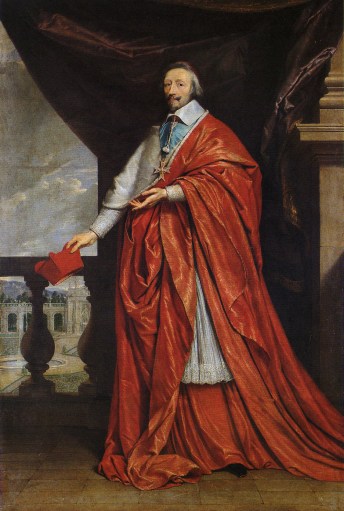
Foreshortening can have a role to play in attributing grandeur to a subject. Consider the portrait of Cardinal Richelieu by Philippe de Champaigne (1602-1674). It’s worth noting that we never see reality as it is: we see reality as it appears, and the ruling classes of the ancien regime were well aware of the need to exaggerate appearances. The great cardinal, virtual ruler of France, insists that the artist should view him from his feet up, as if sitting in the front row of the stalls before a raised stage. Thus the hem of his red robe is near enough for an appropriate kiss, but his head is, like a mountain peak, remote from the viewer, unreachable (and actually ridiculously tiny) – but Richelieu knew exactly what the message was that he wanted this portrait to get across.
Grandeur is very evident in the sheer scale evoked in the poetry of Milton with its decidedly Latinate construction and elongated sentences which are paragraphs in themselves; and this is felt especially in the exhaustive catalogue of beasts – on land, in the sea, in the sky – as the poet describes the sheer wealth of creation. Here is just one sentence from Book VI:
Forthwith the sounds and seas, each creek and bay,
With fry innumerable swarm, and shoals
Of fish that with their fins, and shining scales,
Glide under the green wave, in sculls that oft
Bank the mid sea: part single, or with mate,
Graze the sea-weed their pasture, and through groves
Of coral stray; or, sporting with quick glance,
Show to the sun their waved coats dropt with gold;
Or, in their pearly shells at ease, attend
Moist nutriment; or under rocks their food
In jointed armour watch: on smooth the seal
And bended dolphins play: part huge of bulk
Wallowing unwieldy, enormous in their gait,
Tempest the ocean: there leviathan,
Hugest of living creatures, on the deep
Stretched like a promontory sleeps or swims,
And seems a moving land; and at his gills
Draws in, and at his trunk spouts out, a sea.
We should understand, that any emotion may be aggrandised. We witness grandeur of retribution when we view the giants overwhelmed by the ceiling at the Palazzo de Te in Mantua and the grandeur of vengeful patriotism in the terrifying close-ups of decapitations depicted by Artemesia Gentilleschi. Meanwhile, natural grandeur is celebrated in paintings of ships crushed by ice, such as that of Caspar David Friedrich, and a host of polar and Alpinist painters. Designed to take our breath away, the grandeur of fate and despair operates in The Raft of the Medusa by Géricault, and it is achieved by canvas scale, which emphasises the scale of the ocean, as well as by the desperation of its subject-matter. A grand roguishness is instilled into the character of Mozart’s Don Giovanni: for here we have arrogance on a heroic scale. Grandeur inspires the symphonies of Beethoven, Bruckner and Mahler and informs the sheer size of tomes by literary giants: think of War and Peace, or La Recherche du Temps Perdu. And when Victor Hugo’s misshapen bell-ringer of Notre Dame leaps on the bells, in Notre Dame de Paris (1831), we experience one of the grandest passages ever put down in words:
All of a sudden, the frenzy of the bell seized upon him; his look became extraordinary; he lay in wait for the great bell as it passed, as a spider lies in wait for a fly, and flung himself abruptly upon it, with might and main. Then, suspended above the abyss, borne to and fro by the formidable swinging of the bell, he seized the brazen monster by the ear‑laps, pressed it between both knees, spurred it on with his heels, and redoubled the fury of the peal with the whole shock and weight of his body. Meanwhile, the tower trembled; he shrieked and gnashed his teeth, his red hair rose erect, his breast heaving like a bellows, his eye flashed flames, the monstrous bell neighed, panting, beneath him; and then it was no longer the great bell of Notre‑ Dame nor Quasimodo: it was a dream, a whirlwind, a tempest, dizziness mounted astride of noise; a spirit clinging to a flying crupper, a strange centaur, half man, half bell; a sort of horrible Astolphus, borne away upon a prodigious hippogriff of living bronze.
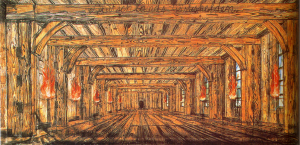
Today, we can experience grandeur in the ironically monumental sculptures and installations exhibited by Thomas Schutte. Grandeur enthralled the Nazis, who celebrated it in the flaxen-haired character of their adopted “ancient hero” Armenius, at the sacred site of the Externstein, in itself a grand locale, with tales of knightly deeds resounding in the depths of the Teutoberg forest. Terrible atrocities are committed in the name of grandeur when it comes decked in sublime ideals. Grandeur in the guise of a racially pure heroics, an endorsement of uplifting myth, was the grail the Nazis hunted in their archeological and genetic researches – one can see it operating on their architects in the German pavilion at Venice. Here, in the nineteen-eighties, Anselm Keifer plastered the enormous walls with prints which amounted to one giant woodcut depicting a vast wooden hall, an Asgard, legendary home of the Norse gods: an illusory hall far larger than the dimensions of the pavilion itself, the envisioned pavilion of fascist aims. In 1999, Hans Haacke demanded that for his exhibition at the Biennale every single paving stone of the floor of this pavilion should be smashed to pieces. In both cases, the artists were utilising grandeur to comment on its ominous heritage, the repercussions which have been so devastating that, for thinkers such Hannah Weil and Lyotard, we find ourselves rendered speechless by our inability to grasp the absolute of atrocity – or at least we must acknowledge that whatever is said about it can only be apprehensive, never comprehensive. In this sense the Holocaust is sublime.
But to me this only serves to show that we should identify the word sublime as an adjective rather than a noun. Kant is right to claim that it has no material substance. As “the sublime”, it assumes a spurious quantity whereas, as I have pointed out, in reality there is no quantifiable sublime. As an adjective, it denotes a quality which can be applied to anything – from Martial’s humour to the unspeakable horror of Auschwitz. However, there is nothing grand about either of these examples.
Adjectives are much resorted to by sentimental and affected writers. In most cases they accentuate a quality already to be found in the noun they modify. It is from its association with this melodramatic adjective – and perhaps most adjectives tend towards melodrama – that grandeur gets its reputation for descending into bombast. Triumphalism always betrays itself by resorting to paroxysms of inflated rhetoric. Freud has pointed out how exaggeration of something often veils an inclination towards its opposite.
However the material of grandeur can be turned against the totalitarian sublime. And Keifer and Haacke are not the first artists to use grandeur itself to comment on the overweening attitude to be detected in that sublimity associated with conquerors. Paulo Veronese’s great painting The Family of Darius before Alexander utilises all the techniques of grandeur.

The canvas is an extensive panorama – similar to a cinemascope screen – 475 centimetres long and 236 centimetres high. The work itself has a low viewing angle, the line of the edge of the terrace where the major figures of the subject are grouped at a shallow height above the lower edge of the painting. This implies that our eyes are on a level with the knees of the principle characters. The scene before us shows the wife of Darius, who Alexander has defeated at the battle of Issus, kneeling in subjugation before their conqueror. We therefore share her view of him, as if we were kneeling beside her, as are her three daughters. The elevation of this terrace where the mighty are gathered is further emphasised by the fact that the courtyard beyond is obviously some four feet below it, for only the helmeted head of a guard standing nearby, on the floor of this courtyard, can be seen above the terrace edge. Underlings, henchman and horses in the background are practically transparent, insubstantial. Clutching the stone globe terminating the parapet of the terrace a monkey glances down at the entourage of the suppliants – which includes a dwarf and some kneeling slaves with lap-dogs in their arms. These are grouped to the left, behind the Persian princesses. From the feet of the dwarf in the left hand bottom corner to the ear-tips of a horse raising its proud head in the right hand top corner of the foreground runs a diagonal that increasingly builds up the pomp and power of the occasion. But the treatment of this subject is far from unambiguous.
Take the event itself. The story goes that the terrified empress hastily knelt and made obeisance to Hephaistion, Alexander’s favourite, rather than to Alexander himself. Hephaistion pointed out the real Alexander, but the great man diffused the embarrassment of the situation by gesturing back to Hephaistion, saying the Hephaistion was ‘another Alexander’. Veronese shows an elegant young man in crimson and gold, whose cuirass looks more suitable for the court rather than for the battlefield, arresting the Empress’s entreaty with one hand while he gestures to the man beside him with his other hand. This man wears a more sombre cloak and much more business-like armour. Nevertheless, the finely-garbed young man seems to be the painting’s focus. Even so, we cannot swear that he is Alexander and not Hephaistion, since we remain uncertain about who may be gesturing to whom. Is this the moment of mistaken identity, or the moment when the mistake is rectified? Confusion now impinges on the seeming simplicity of the subject. How can we tell who is truly great? Is showiness of dress a reliable indication? Both knees of the resplendent young man are shown, one of his less showy companion. Whose knees should she clasp?
Meanwhile much in the painting contrives to augment the splendour and power of these two prominent male figures. A page to the right bends over a shield, his eyes on the trio of knees. Pikes and hauberks rise above the two mens’ heads, above them and between them – does this indicate future rivalry and conflict between the two? But at the same time a distraction to this main theme provides it with its counterpoint. The youngest of the princesses has turned her head to look warily at the misshapen dwarf behind her or perhaps at the two lap-dogs he shrinks back against. Here again, there are confused tensions. Is she worried about the fate of the little dogs? Has she always been rather frightened by the dwarf? Yet he is a more lowly figure than her, as much beneath her, in rank and in form, as she is below the man who holds her fate, and the fate of her pets, in his hands. At the same time, the monkey just above her head seems to be making a curious obeisance of its own – towards the dwarf! The painting is in a sense Darwinian, pace the anomaly of its dating. It constitutes a wry comment on the entire notion of superiority, since a fine chain of implications links the monkey to Alexander.
* * * *
Having brought our attention to bear on the material qualities which make for grandeur in painting, we can return to the serenity it can evoke just as well as it may deal with the doings of the mighty. In my essay on formalist art, which I described as innocuous, alluding to that quietness which often informs the subject-matter of the formalist, I have mentioned a species of void created in the works of Claude Lorraine. Claude’s formalism very much concerns the art of invoking that serenity I see as an attribute of a calm and maternal grandeur. He seldom allows his small figures to appear as silhouettes interrupting the horizon line. If they did, they might interfere with the lure of the suggested distance. An exception occurs in The Shooting of the Deer, where a small caravan of pack-animals can be discerned crossing a ridge in the middle distance beyond the stretch of water in the foreground. But these animals are far smaller than the already small figures of the main protagonists of the subject in the lower left and the lower right of the painting, and so they serve to indicate the considerable stretch of space which separates them from the foreground, which in turn pushes the tiny sails in the gulf beyond further back – as these push the dim blue mountain beyond the gulf into a further realm of space which then transmutes and becomes another time.

But height is protracted in his works as much as depth. In the same painting, the columns of the temple behind the hunters get their length elongated, so that the portico of the temple disappears out of the picture. Here we see, in painting, the same level of artifice used to create grandeur as Longinus requires for the creation of elevated poetry. This is the nub of my topic, for I am not dealing with the natural grandeur of the world at large but with the question of how grandeur is achieved in art. This alone would separate the issue from any in-depth analysis of the sublime. Sublimity clouds the subject with its enthusiasm: but we need to approach grandeur in the spirit of nil admirari. Our concern is with the illusion of the large. And what makes Claude so interesting is that the essential ingredient he uses to achieve grandeur is smallness. Unlike the sublime, the successful evocation of grandeur in art must concern comparison and scale. Claude’s paintings resemble a visual wedge that reverses the wedge of perspective. A section of its thin end is presented to us, while its wide end amounts to the vast backdrop of the work. Small figures inhabit the foreground to give us the sense of the immensity of the background. They serve as its witnesses. Exaggerated columns also in the foreground help to inform us that the mythic antiquity these figures inhabit is everywhere larger than they are.
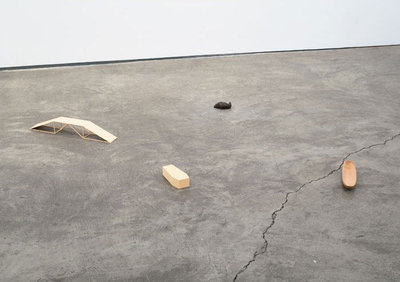
In the nineteen-seventies, James Collins created minute villages meticulously constructed from minuscule bricks – primitive villages, often half ruined, suggesting habitations in South America perhaps. These would be set into some cranny in actual masonry, as if they balanced precariously above precipices which also extended above them. This made the ordinary brickwork of the real world seem immense. A similar impulse informs some of the work of Joel Shapiro: in particular I recall a tiny bridge on the comparatively “vast” floor and a little ladder of his, leant up against the “huge” wall of a gallery.
Claude’s interest in a serene species of grandeur also finds plenty of contemporary echoes – in particular in the work of James Turrell. Turrell has constructed a building in a desert renowned for the azure emptiness of its sky. Within this building, there is a roofless room, opening, above one’s head, onto a square of indescribable blueness. He has also purchased a crater. To lie down in this crater and look up at the sky, one’s vision encircled by the widest possible circumference takes grandeur into the realm of the conceptual. For here, the division between natural phenomena and art is annulled. We are not entirely in the condition of being steeped in actuality, we may feel, since Turrell has identified the crater as his artwork, yet at the same time it is hard to be certain that here we are experiencing a ‘piece of art’. The Spiral Jetty built in a lake by Robert Smithson has disappeared under water now, but was so large that it had a grandeur we would normally associate with some natural phenomenon in the landscape, and Richard Serra may have attempted to achieve a similar effect when he placed his monumental sculptures in the Bilbao Guggenheim. The joke here is that the building which contains them is so big in itself that when one looks down on these sculptures from a balcony they appear quite petite. This museum makes the paintings by Julian Schnabel, which appeared huge in the South London gallery, look a bit like postage stamps! Derrida would probably make the point here that the grandeur implied by the work itself can easily be overwhelmed by the context it is placed in. Kant makes a similar observation about natural phenomena in The Analytic of the Sublime.
Grandeur can be mingled with abundance – to offer us up the lavish flesh of a Rubens, as well as to engage us in the orgiastic sumptuousness of Fellini’s Satyricon. It may sweep us away in some opera by Wagner, or captivate us with its resonance – as in Wordsworth’s ode – Intimations of Immortality from Recollections of Early Childhood:
What though the radiance that was once so bright
Be now for ever taken from my sight,
Though nothing can bring back the hour
Of splendour in the grass, of glory in the flower…
(Wordsworth, Poetical Works, p. 460-2)
This is very much the elevated tone of a philosophic grandeur working through ideas rather than things. Its reality is its words…radiance, splendour, glory – to fit these into two couplets is truly a feat. But what precisely is the “splendour in the grass”? Is it a biblically inspired reference to the flesh? Who cares? Elia Kazan perhaps, who took it as the title for a steamy-enough tale of small town Kansas passion, in a film he directed starring Warren Beatty and Natalie Wood. The phrase intrigues and inspires, and it partakes of the obscurity which Edmund Burke, in his Philosophical Enquiry, saw as practically a prerequisite for the sublime. Despite my unwillingness to engage with the sublimity, I must pay some small obeisance to Burke, for his enquiry is full of empirical observations which hold true for grandeur:
…too great a length in buildings destroys the purpose of greatness which it was intended to promote; the perspective will lessen it in height as it gains in length; and will bring it at last to a point; turning the whole figure into a sort of triangle, the poorest in its effect of almost any figure, that can be presented to the eye. I have ever observed, that colonnades and avenues of trees of a moderate length, were without comparison far grander, than when they were suffered to run to immense distances…
(Edmund Burke, A Philosophical Enquiry… p. 70)
He goes on:
A true artist should put a generous deceit on the spectators, and effect the noblest designs by easy methods. Designs that are vast only by their dimensions, are always the sign of a common and low imagination. No work of art can be great, but as it deceives; to be otherwise is the prerogative of nature only.
(Ibid)
Burke also asserts that sublime feeling is a species of tension, a tension not quite amounting to pain, brought on by our senses “straining” to accommodate some excessively large phenomenon – often one consisting of “a uniform succession of great parts” which Burke terms the artificial infinite. A repetition which pauses, and hesitates before continuing, increases the tension. You could call that tension suspense. For Burke this has to be achieved through succession and variation, since: “the view of a bare wall, if it be of a great height and length, is undoubtedly grand: but this is only one idea, and not a repetition of similar ideas; it is therefore great, not so much upon the principle of infinity, as upon that of vastness.” (Ibid, p.129)
A sense of the grandeur achieved through repetition is well epitomised by the work of Colum McKinnon. A few years ago, this artist exhibited a very large table at the Serpentine Gallery. On it were placed thousands upon thousands of small grenade-like plastic shapes. No single shape was exactly the same as any other. A very small number of moulds were juxtaposed to create the upper and lower portions of each particular shape – and these produced a seemingly infinite variety in the array presented to the viewer. Another fine use of repetition in this way, and this time on a more than monumental scale, is Walter de Maria’s Lightning Field.
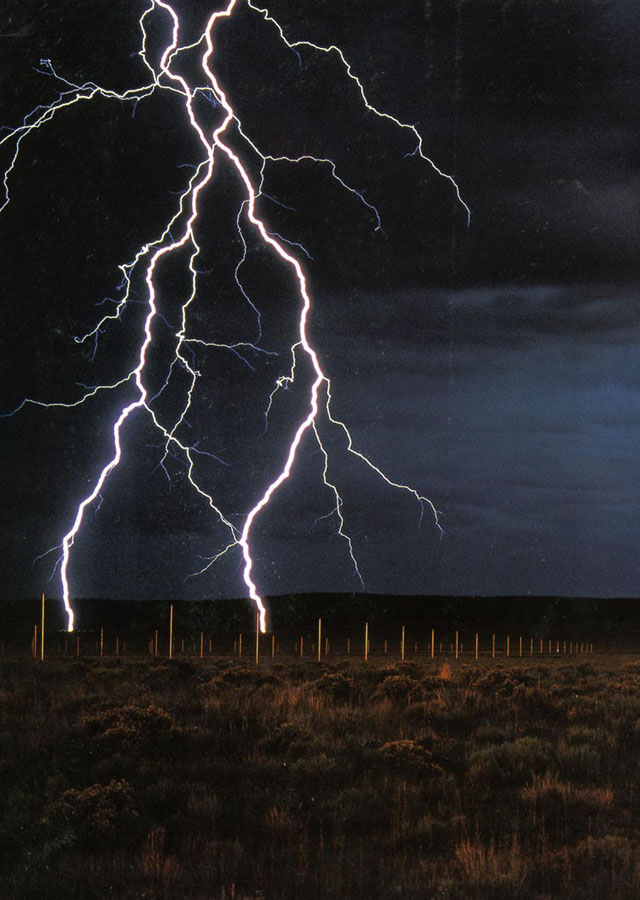
Tall metal spikes are placed in the ground in a grid over a vast area. If a storm brews up, lightning is supposed to strike these poles – a caustic Richard Serra observed that they never did though, or so I have heard. However, if it does, no jagged crackle down the sky will ever be quite the same as the next – as in the plastic shapes on McKinnon’s table. Repetition creates a stupendous result in a photograph of an Atlanta hotel, taken in 1996 by Andreas Gursky.
Another good use of grand repetition creates the optical hum in the work of Bridget Riley, though perhaps her work is better considered as an exposition of formalism rather than of grandeur. However, with her larger pieces, an abstract of grandeur may result. But Burke’s sense that greatness can come about “not so much upon the principle of infinity, as upon that of vastness” holds true of the blue paintings of Yves Klein and for some of the extra-large works of American Abstract painters – Ellsworth Kelly may deal in serene tracts of unvaried colour seemingly cut into a large single shape. There’s a similar tendency in certain pieces by Barnett Newman, and, occasionally by Rothko, though in the latter’s case, it is almost as if the wedge-strategy of Claude had been inverted and then projected out of the picture, as swathes of colour overwhelm the eyes.
But what of the elevated tone in poetry? Grandeur abounded in the Victorian age, and can be excellently handled by Shelley, and by Keats – look, for instance, at Keats’s Sonnet on First Looking into Chapman’s Homer. There are magnificent passages of grandeur in the Choric Song of the lotus-eaters in Tennyson’s Ulysses. But all too extensively, the high-flown style became a fashionable mannerism, the very tone of the age. Those artful disjunctions advocated by Longinus were abandoned in favour of regular verse-forms, often elaborate, almost always long-winded. Some of Swinburne is worth reading, Laus Veneris, for instance, but he wrote too much ‘of the same’, and the metaphors grow so conflated that it is hard to tell whether the poet is writing about a sunset or a sultry kiss – everything is bathed in the same roseate luminosity, and expression is drowned in orthometry. Content suffered as well. Pompous endorsements of imperialism gave way later to the over-rich lasciviousness of Georgian poetry. With all of it, a little goes a long way.
It was left to an American to rescue grandeur and ensure its authenticity. Walt Whitman maintains an elevated tone which retains the grittiness Longinus called attention to in the Iliad. Whitman eschewed elaborate stanza-forms and the ‘trudgery’ of those conventional “Anglifications” of Greek metre which have subsequently doomed so many of his British contemporaries to oblivion. Instead, he learnt much from biblical cadence. His style is genuinely declamatory, and paved the way for the open form of free-verse and the inspired ranting of Allan Ginsberg:
I sing the body electric,
The armies of those I love engirth me and I engirth them,
They will not let me off till I go with them, respond to them,
And discorrupt them, and charge them full with the charge of the soul.
Was it doubted that those who corrupt their own bodies conceal themselves?
And if those who defile the living are as bad as they who defile the dead?
And if the body does not do fully as much as the soul?
And if the body were not the soul, what is the soul?
(‘Children of Adam’ – Walt Whitman, Leaves of Grass, p. 81)
or, he can approach the sublime by building up to it through a steady accumulation of phrases:
Out of the cradle endlessly rocking,
Out of the mocking bird’s throat, the musical shuttle,
Out of the nine-month midnight,
Over the sterile sands and the fields beyond, where the child leaving his bed wander’d alone, bareheaded, barefoot,
Down from the shower’d halo,
Up from the mystic play of shadows twining and twisting as if they were alive…
(‘Sea-Drift’ – Walt Whitman, Leaves of Grass, p.196)
But Whitman’s incantations and innovations proved unwelcome to everyone but Swinburne, who was a large enough writer to recognise the quality in a poetry which effectively destroyed his own. Whitman ended his days as a custom-inspector, and voiced his bitterness over his rejection in “A Backward Glance O’er Travel’d Roads”, an essay appended to Leaves of Grass:
That I have not gain’d the acceptance of my own time, but have fallen back on fond dreams of the future – anticipations – (‘still lives the song, though Regnar dies’) – That from a worldly and business point of view Leaves of Grass has been worse than a failure – that public criticism on the book and myself as an author of it yet shows mark’d anger and contempt more than anything else – (‘I find a solid line of enemies to you everywhere,’ – letter from W. S. K., Boston, May 28, 1884) – And that solely for publishing it I have been the object of two or three pretty serious official buffetings – is all probably no more than I ought to have expected…
(Walt Whitman, Leaves of Grass, p. 433)
In the final years of the nineteenth century, a pioneer in Britain also attempted to challenge the conventional mode. This exceptional poet was Gerald Manley Hopkins, whose long poem The Wreck of the Deutschland is a work of genuine pathos as well as of grandeur. The twists and upheavals of the innovative ‘sprung verse’ that Hopkins favoured seem, as much as the tumultuous content, a verbal material instilled with the phusis of the Greeks. The language is wrenched out of the ruts of ordinary usage by rhyme and by rhythmic necessity. It becomes difficult and urgent at the same time. His poetry influenced the protean incantations of Dylan Thomas, though to my mind Thomas softens the intensity of Hopkins to the point of mawkishness.
But the poetry of this pioneer remained unpublished, and it took the Great War to properly knock the stuffing out of conflated grandeur. The “War Poets” – Owen, Sassoon et alia – eschewed all jingoism and returned to the scrupulous description of what war is actually like – taking their lead from Homer – in order to express the horrors of the trenches. And so grandeur in the Victorian sense was as much a vanquished adversary of the period as anything else. A new age finally dawned with the publication after the war of the poems of Manley Hopkins.
Ezra Pound could certainly muster up a depth of tone worthy of Homer, but his was not the tone which came to dominate the century. Rather it was the dry, downbeat, rather light verse of Auden and his friends which became the new mannerism. This is neatly descriptive, politically committed poetry, with down-to-earth, prosaic subjects rather than high-flown, celebratory ones. It often uses a satirical clinching to make its point, while, with a retrograde Britishness, giving up on the rambling of free-verse in favour of a fairly regular stress, a fairly regular line-length, and the occasional use of silvery verse-forms similar to those used by light-hearted poets such as Carew and Prior, a couple of centuries earlier. Ubiquitous today, this ‘standard modernism’ has none of the spirit of making it new that Pound demanded for genuine modernity.
In addition, the expression of meaning is now laden with ambiguities – William Empson described the varieties of such usage in his book Seven Types of Ambiguity. Vaunted endorsement of high ideals is generally distrusted today, except when put to humorous or sarcastic use – thus irony has surfaced as the spirit of the our age.
* * * *
So has the irony so prevalent in the twentieth century destroyed grandeur in poetry? I think not. Harte Crane has some poems which aptly convey the power of authentic grandeur. But the grandeur here is, as with Hopkins, often tempered by difficulty:
– And yet this great wink of eternity,
Of rimless floods, unfettered leewardings,
Samite sheeted and processioned where
Her undinal vast belly moonward bends,
Laughing the wrapt inflections of our love;
x
Take this Sea, whose diapason knells
On scrolls of silver snowy sentences,
The sceptred terror of whose sessions rends
As her demeanors motion well or ill,
All but the pieties of lovers’ hands.
x
And onward, as bells off San Salvador
Salute the crocus lustres of the stars,
In these poinsettia meadows of her tides, –
Adagios of islands, O my Prodigal,
Complete the dark confessions her veins spell…
x
(‘Voyages II’ – Harte Crane, The Complete Poems… p. 36)
Crane is forever seeking the sublime phrase – through the use of an astonishing vocabulary, or through placing the verb at the end of a phrase, thus allowing descriptive words to impact and accumulate before it – “Her undinal vast belly moonward bends.”
Grandeur, like the other rivers of art, becomes a process in the twentieth century, becomes a way of doing, a ceremony of saying. We feel this in the work of Harte Crane’s Australian equal Francis Webb. And the elevated ceremony of the tone may be asserted when the content concerns the humility of our position in the face of the full might of phusis. There is still difficulty too, but here, in a Burkian sense, the sense of life overwhelmed may be enhanced by a certain obscurity in the poem which is not in fact obscurity so much as density. The twentieth century reacted to the profligate verse of its predecessor by a tendency towards linguistic economy, so even when grandeur was sought after it had to come about through some condensation of intensity:
Seventy-six lives foundered on this corner of the coast,
The lucky ones pulped on the rocks, the others pushing
At the soft clinging evil of water with flapping hands;
Their screams needled the drumming bass of the breakers,
Wild counterpoint of distress under a calm sky,
As the Ly-ee Moon, little forsaken nation
With a fool at the helm, went down. You look for tempests,
Guns, red abrasions notched on the sky,
Some camouflage drawn tightly as a skin,
The pinchbeck halo of a kind untruth,
When fire rubbles a city or a ship gives in,
Moulded to the trough of a wave, drifts limp and relaxed
As a fan spread out or a broken basket on the water.
But this, as our own disasters, comes unnamed.
Ungarnished by thunder, current or chivalry
To lift heroic capitals in a text.
There’s nothing to tower or dwarf the seventy-six,
Life-sized, huddled in their gulf – yet so close to us,
So slick and fine this molten barrier called life,
That imagination, that memory, like a huge bubble,
Brings a giant slow rupture and cleavage, and their gulf
Shakes open. Our eyes, timeless as stars,
Peer down again at their restless agonies…
(‘Disaster Bay’ – Francis Webb, Cap and Bells, p. 24)
Another poet who achieves grandeur in the twentieth century is Wallace Stevens. His is of a serene nature, and this is a quality as much achieved through an agglomeration of words and phrases as through some transparent relationship to the subject-matter. Have a look at his poem entitled Sea Surface full of Clouds, where each section seems almost to mirror the section before it, though the content of each line has been changed – while the length of its words and its rhythm remains the same. Here the serene event of the title is returned to again and again, but described in new ways each time, thus gaining its power from the accumulation of images – very much as Longinus might have advocated. Stevens’s Anecdote of the Jar begins “I placed a jar in Tennessee.” The jar placed there seems to occupy the entire state. It’s the metonymy of the words, their proximity to each other, which creates this sensation, and it acts like a linguistic version of the miniature village placed in a gap in a real wall by James Collins. But Stevens is well aware that grandeur is under attack. It cannot be allowed to gain impact from its obscurity as Burke would have it do. Lofty ideals expressed in a fuzzy way have too much to answer for still – the vagaries of the class-system, imperialism, religion and nationalism must now be dispelled by a bracing tonic:
Call the roller of big cigars,
The muscular one, and bid him whip
In kitchen cups concupiscent curds.
Let the wenches dawdle in such dress
As they are used to wear, and let the boys
Bring flowers in last month’s newspapers.
Let be be finale of seem.
The only emperor is the emperor of ice-cream…
(‘The Emperor of Ice-Cream’ – Wallace Stevens, Collected Poems, p. 64)
Despite the poem’s attempt to derogate grandeur, the hortatory tone it uses, together with its imperative tense and the repeat of “let” in the fourth, fifth and seventh line, generate a strong sense of mightiness. Here we can see how irony has been brought to bear on the elevated tone. But we should remember that this strategy can also be seen at work in the Renaissance – as I showed when discussing Veronese. Dramatic irony was also employed by Robert Browning – see my essay on ‘Immoralism’. So it’s not entirely a mode invented by the twentieth century, rather it has become prevalent since the Great War.
Nevertheless I can think of other poets who have retained a quality of elevation in their language – Edith Sitwell, for one, in her elegiac poem Colonel Fantock, for instance – though the veracity of what I am saying about contemporary taste can be judged by the extent to which her formidable oeuvre is out of fashion today. Another unfashionable poet who deserves far more recognition than is extended to him is F. T. Prince. Prince has several poems which employ grandeur in an convincing way. An Epistle to a Patron is a fine example. This is, in effect, a paraphrase of a letter sent to the duke of Milan by Leonardo da Vinci:
My lord, hearing lately of your opulence in promises and your house
Busy with parasites, of your hands full of favours, your statutes
Admirable as music, and no fear of your arms not prospering, I have
Considered how to serve you and breed from my talents
These few secrets which I shall make plain
To your intelligent glory. You should understand that I have plotted,
Being in command of all the ordinary engines
Of defence and offence, a hundred and fifteen buildings
Less others less complete: complete, some are courts of serene stone,
Some the civil structures of a war-like elegance as bridges,
Sewers, aqueducts and citadels of brick, with which I declare the fact
That your nature is to vanquish…
(F.T. Prince, Collected Poems 1935-1992, p.13)
Mentioned elsewhere in the poem is the proposal for the colossal bronze horse Leonardo finally completed in clay in 1490 – but never managed to cast. A version of this ambition was finally realised in 1999 and erected in Milan, though it wasn’t cast in its entirety upside-down in a pit, as Leonardo planned, so it remains doubtful whether Leonardo himself would feel satisfied with the result, since he could easily have cast it in parts, but casting it whole was integral to his conception of the grandeur of the undertaking.
Prince has another marvelous early poem called Words from Edmund Burke which glories in grand sentences which flow on and on, piling up ever more elevated phrases – Burke was not only an analyst of the sublime, he was also the most celebrated orator of his day. Prince is astute is recognising the connection between Burke’s philosophical enquiry into sublimity and the sublimity of his oration. Other grandiose poems of Prince’s deal with Apollo and the sibyl, the annals of the Zulu king Chaka and the old age of Michelangelo. Many of these poems are, like the Epistle to a Patron, derived from historical texts – so in this sense, his work is very much a precursor of post-modernism.
How does grandeur affect the novel? We have already mentioned some of the more grandiose exploits of the field. But the question is daunting, since to admit the novel into my inquiry would necessitate a far longer essay than is intended. Perhaps I can get round this by denying its relevance to the issue – if only to indulge in Mephistophelean advocacy rather than answer the question with the comprehension it deserves. But it could be argued that where the use of words is concerned, grandeur, according to Longinus, has to do with his notion of the ‘elevated tone’. This lifts speech above the ordinary – into high-flown poetry, in the case of Manley Hopkins – into oratory, or bombast in the case of Geoffrey Archer’s speech at the Tory party conference when seeking support for election as Lord Mayor of London.
While novels may seem grand in terms of their scope, or their sheer length, the novel is a form that has emerged largely as a reaction to such elevation of tone as was prescribed by Longinus. Victor Hugo’s description of Quasimodo is exceptional – a poem in prose inset into more sober material. Prose is chosen by fiction writers precisely because it is ‘prosaic’, down-to-earth, emancipated from the sublime. Rabelais reveled in the language of the market-place, the gutter and the criminal fraternity, and he mixed this up with the grand Latin tags and nasal tones of the priesthood, the age-lasts and the pompous academics. His street slang pulls down the trousers of the elevated. His use of language is very often grotesque. Cervantes’s Don Quixote may address his windmills in the grand manner, but the down-to-earth prose which describes what ensues has more in common with the view of Sancho Panza. The novels of the romantic era are like the grand tours which inspired them – they proceed from low ground to high ground, and during some passage over the Alps of their emotional and dramatic engagement we may come across sublime passages, so in this context it’s worth reading Ann Radcliffe’s The Mysteries of Udolpho, first published in 1794. Mrs Radcliffe had a talent for creating rebels in the grand manner, sublime criminals such as the monk Schedoni in The Italian, which she brought out, by popular demand, only three years later:
His figure was striking… it was tall, and, though extremely thin, his limbs were large and uncouth, and as he walked along, wrapt in the black garments of his order, there was something terrible in its air; something almost superhuman. His cowl, too, as it threw a shade over the livid paleness of his face, increased its severe character, and gave an effect to his large melancholy eye, which approached to horror. His was not the melancholy of a sensible and wounded heart, but apparently that of a gloomy and ferocious disposition. There was something in his physiognomy extremely singular, and that cannot easily be defined. It bore the traces of many passions, which seemed to have fixed the features they no longer animated. An habitual gloom and severity prevailed over the deep lines of his countenance; and his eyes were so piercing that they seemed to penetrate, at a single glance, into the hearts of men, and to read their most secret thoughts; few persons could support their scrutiny, or even endure to meet them twice.
(Ann Radcliffe, The Italian, or the Confessional of the Black Penitents, p.)
A debased version of this sort of writing is the model for the ubiquitous schlock saturating the contemporary market. The film industry has taken it for its own, and its heroic contemporary equivalent is Ayn Rand’s right-wing block-buster The Fountainhead. The grandeur of fiction seems to have no authenticity – it lacks irony, can only shudder in horror or gasp in admiration. It is flagrantly adjectival. On the other hand, Mary Shelley’s Frankenstein is an anti-hero, his monster is a really a poignant failure – the book succeeds because it constitutes an attack on grandiose ambition. For great novelists such as Hugo, Dostoevsky and Zola, a character may have grand passions, but the language utilised to describe them must be matter-of-fact, otherwise these passions will fail to convince us. It seems to me that the novelists tend to substitute scope for grandeur – rather than adopt an artificial intonation, they expand the breadth of the canvas they choose to cover – as in Zola’s marvelous La Terre (Earth, Penguin Classics, 1986), or Balzac’s sequence of some thirty novels, La Commedie Humaine.
* * * *
Nevertheless, through most other defiles, the river of grandeur flows on: at a stupendous scale in the war-memorials of Yugoslavia; humorously, in the house-sized reclining figures of Niki de Saint Phalle – figures one can walk inside – far more interesting than the spurious monumentalism we’re subjected to inside the Millennium dome. Another marvellously realised massive figure is Fernando Botero’s Broadgate Venus.

She is so huge that it seems as if she has fallen out of the sky, as if the sky could no longer sustain her on its clouds. At the same time she is herself as pneumatic as the most inflated cloud, and so she still partakes of the sky she gazes at from a site above the platforms of Liverpool Street Station. She’s as large as any steam-engine, and her grandeur can be touched – there’s a distinct pleasure to fondling the plump monumentality of her toes and the soles of her stupendous feet. Richard Serra’s Fulcrum is installed in the same complex. This comprises five enormous metal rectangles which are upended and balanced against each other apparently hap-haphazardly but in fact they form a regular five-sided aperture far overhead. This piece is far more impressive than his installation in Bilbao.
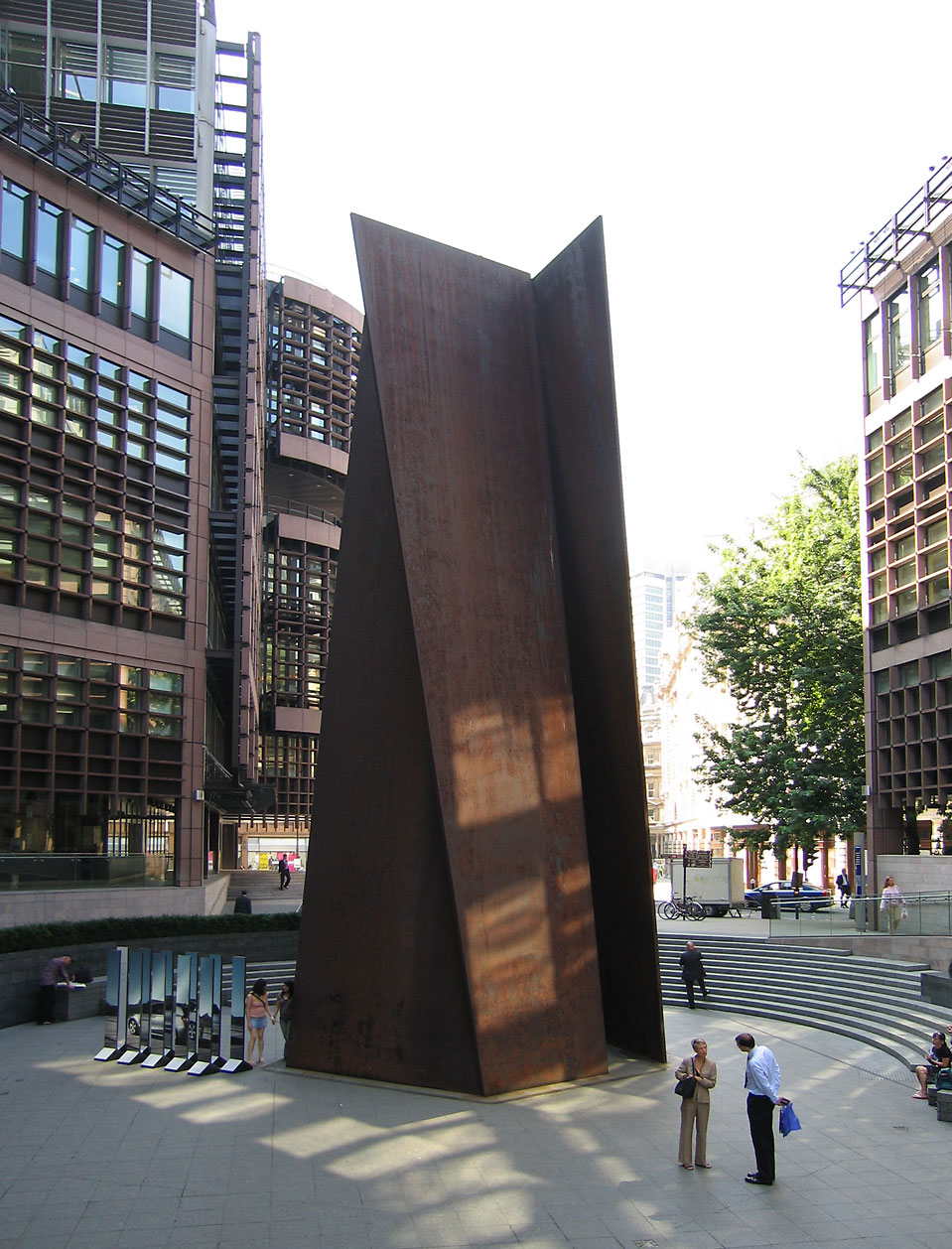
Serra is one of America’s monumental minimalists. Others include Walter de Maria, creator of the Lightning Field, and Robert Smithson, whose land art piece, the Spiral Jetty could be seen from space – until the waters in which it was located rose and hid its existence. And no discussion of grandeur would be complete without mention of the justly celebrated projects of Christo which include his Valley Curtain and The Running Fence; projects which have already elicited plenty of commentary.
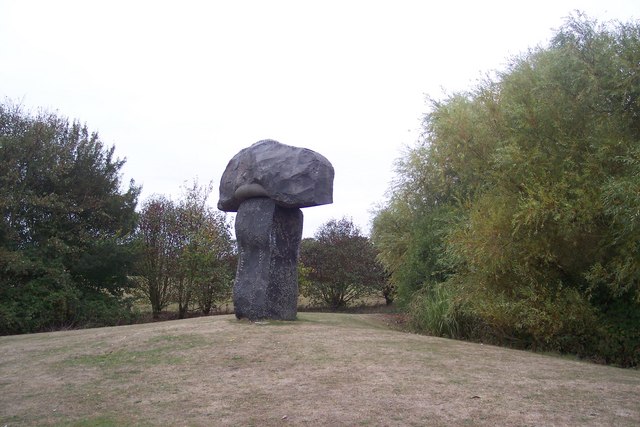
Stephen Cox’s Ganapathi and Davi is also at Broadgate: two massive blocks of stone, on the scale of Stonehenge. They face each other, rough-hewn and massive-shouldered: two eternal lovers, duly annointed. One imagines them standing here, or perhaps one of them will have been toppled over, when the city is reduced to weeds and inchoate rubble. Somehow one senses that they will remain intact. Their grandeur is enhanced by the fact that that we get this strong intuition that they will endure, whatever may befall. Even more impressive is his Hymn Sculpture in the grounds of Kent University.
Grandeur strikes us, with a certain morbidity, in the shark pickled in formaldehyde by Damian Hirst – which boasts the grandiose title The Physical Impossibility of Death in the Mind of Someone Living. And I find that grandeur figures serenely in the photographs of the astronauts walking on the surface of the moon in the Apollo Mission photographs of the lunar landscape. As images, these may appear less stupendous than some digitally enhanced fantasy, but they seem inscribed with the clumsiness, the slight tackiness of their own authenticity: this actually happened. A similar sense of grandeur being convincing because the experience recorded is actual rather than invented affects us when we watch the video of the performance artist Stelarc suspended by hooks which pierce his skin swinging through the air from a crane some forty metres above the roofs of Copenhagen in his Copenhagen Suspension (Grey Suit Video for Art & Literature, Issue no 3), or above the breakers, off the coast of Japan.

Here it may seem that I have started to deviate from my resolve to limit my discussion to the manifestation rather than the feeling, for when we allow the consideration of an image’s authenticity to have weight with us, don’t we admit that the force of the image is being enhanced by our subjective understanding of it? It’s certainly true that most people experience a profound astonishment, the very emotion that associates the sublime with grandeur, when they see a photograph of Stelarc actually suspended by hooks through his flesh above a busy street or a raging sea. In my defence I might argue that the affect of the veracity of this action is the reason why a performance such as this should actually be seen at first hand. And perhaps, even in a photograph or on video, its authenticity can be detected – it’s the lack of slickness which tells us that it is real. The trouble is, that’s a naive assumption. In these days of the dominance of Baudrillard’s hyper-reality, it is all too easy for the fantasy industry to contrive a clumsiness, a slight tackiness in the image – to manufacture fictive “authenticity”.
We can appreciate a ridiculous aspect to the ineffable awe of grandeur’s association with the sublime, albeit a trifle intellectually, in Joan Key’s painting entitled Boo (II) – where the second O seems to fade away – just as the word Boojum fades in the mouth of the swiftly and silently vanishing beholder at the end of Lewis Carroll’s The Hunting of the Snark – in itself a nonsensical critique of the quest for the sublime. This painting by Key was exhibited in a recent exhibition on the sublime which featured works from the Arts Council Collection – Sublime: The Darkness and the Light.
Hollywood has redefined the epic in its own terms, and the size of the budget is reflected in the size of the mass of viewers for any spectacle. But grandeur in film is so much the financial property of Hollywood that I prefer to pass over it; for here the grandeur seems conflated, and loosely humanist also. Hollywood remains stuck in the aesthetic condition of the nineteenth century with its vast narratives larded with popular sentiment dressed up in togas or tinsel. Mention should be made however of the films of Douglas Sirk, whose opulence appears so exaggerated that it comes over now as a critique of its subject: the oil-tycoon in Written on the Wind, with the scale model of an oil-derrick on his enormous desk which he sits behind, below an even more enormous portrait (in oils) of himself surrounded by his derricks – the scale model is later fondled by Dorothy Malone.
Sirk is much admired by the painter David Salle, who can convey a sense of grandeur in his own work – particularly perhaps in the sets he painted for the dancer Karole Armitage, where hugely magnified portraits or isolated eyes may serve as a back-drop to the dancers who are easily dwarfed by the scene behind them – yet the set is so flagrantly not some illustrative accompaniment to the action that a strong tension gets set up between set and choreography, and this tension certainly has impact.
* * * *
Finally to the architecture of Rem Koolhaas. Airports built on artificial islands. Buildings no longer things one has to go round but things which part automatically allowing you to pass through them, thus enhancing your sense of your own urgency and importance. Swimming-pools neatly fitted onto domestic roof-tops: celebrations of each citizen’s private grandeur. Each of us expending more horse-power in a day than Julius Caesar in his lifetime. Acres of perpetually replenished sunlight. A celebration of the to-hand requirements of urbanite sophistication rather than the uniform idealism of socially leveled modernism. Micro-technology guiding smooth robotics. Cities built to accommodate future population explosions. The rural subsumed into the urban in a single recreational and industrial suburbia. His book Delirious New York repentantly celebrating traffic-flow, escalator-flow. And as for the future of the sky, let’s have some outright piercers now – rather than those humble scrapers of the twentieth century.

Another of his books, Small, Medium, Large, Extra Large is grand itself in the sheer quantity of its pages, diagrams, diatribes. Koolhaas is an advocate of bigness. He’s an architectural maestro, orchestrating international mega-centres at the nexus of tunnels, chunnels and flyovers; or museums designed to accommodate the most succinct electronic miniature, the new monument, the latest projection; or stations welcoming the arrival of speed-of-light express-trains to Gargantuan silvery malls. His shells of clear polyester flecked with aluminum cover millions and millions of square feet at Euralille at the chunnel’s end; hard and reflective on the outside, translucent on the inside. His work is neither modern nor post-modern, for while in many cases it exemplifies a disavowal of references to all previous models, it also does away with formalist dogma in order to deal head-on with the brute reality of our needs. In a landscape of “increasing expediency and impermanence”, Koolhaas speaks of “the integration of the notion of cheapness to create sublime conditions” and perceives “the client as chaos”:
If there is to be a “new urbanism” it will not be based on the twin fantasies of order and omnipotence; it will be the staging of uncertainty; it will no longer be concerned with the arrangement of more or less permanent objects but with the irrigation of territories with potential; it will no longer aim for stable configurations but for the creation of enabling fields that accommodate processes that refuse to be crystallized into definitive form; it will no longer be about meticulous definition, the imposition of limits, but about expanding notions, denying boundaries, not about separating and identifying entities, but about discovering unnameable hybrids; it will no longer be obsessed with the city but with the manipulation of infrastructure for endless intensifications and diversifications, shortcuts and redistributions ‑ the re-invention of psychological space. Since the urban is now pervasive, urbanism will never again be about the “new”, only about the “more” and the “modified”. It will not be about the civilized, but about the underdevelopment. Since it is out of control, the urban is about to become a major vector of the imagination. Redefined, urbanism will not only, or mostly, be a profession, but a way of thinking, an ideology: to accept what exists. We were making sandcastles. Now we swim in the sea that swept them away.
To survive, urbanism will have to imagine a new newness. Liberated from its atavistic duties, urbanism redefined as a way of operating in the inevitable will attack architecture, invade its trenches, drive it from its bastions, undermine its certainties, explode its limits, ridicule its preoccupations with matter and substance, destroy its traditions, smoke out its practitioners. The seeming failure of the urban offers an exceptional opportunity, a pretext for Nietzschean frivolity. We have to imagine 1,001 other concepts of city; we have to take insane risks; we have to dare to be utterly uncritical; we have to swallow deeply and bestow forgiveness left and right. The certainty of failure has to be our laughing gas/oxygen; modernization our most potent drug. Since we are not responsible, we have to become irresponsible.
(Rem Koolhaas, What Ever Happened to Urbanism?)
This is grandeur perceived as non-finito – phusis with a vengeance – an urban phusis – for as Michael Craig-Martin once pointed out to me, the city is as much nature as any other nature. Such an evolving, fluxile species of greatness is an adequate one for a century coming into being as the ‘gay science’ of process and transformation, re-emergent in the twentieth century, gains momentum in this new one, and grandeur moves into a state of mutability, preparing us for a flight into the stars when we finally abandon a planet ruined by our own small-mindedness…
Anthony Howell, December, 2003
Click the link for an Introduction and a list of all eight essays in this series “the rivers of art”