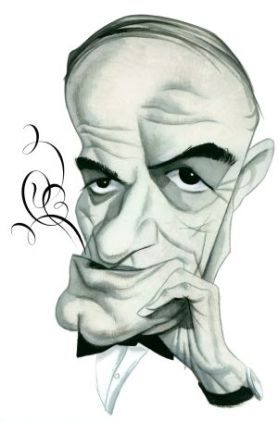
This essay has been a major influence on my work and my thought. I read it in my twenties, and still value it greatly. Ortega has always been appreciated by US intellectuals, but is hardly ever cited by writers on art and literature here in the UK. He is also worth reading for his understanding of the effect of “mass society” and of the notion of “generations”. The version here has been shortened (not by me)- the full essay can be found in “The Dehumanization of Art and Other Writings on Art and Culture” Doubleday Anchor 1956. See also the note at the end of this essay.
The study of art from the sociological point of view might at first seem a barren theme, rather like studying a man from his shadow. At first sight, the social effects of art are so extrinsic, so remote from aesthetic essentials, that it is not easy to see how from this viewpoint one can successfully explore the inner nature of style. But the fruitful aspects of a sociology of art were unexpectedly revealed to me when, a few years ago, I happened to be writing about the musical era which started with Debussy. My purpose was to define as clearly as possible the difference between modem and traditional music. The problem was strictly aesthetic, yet I found the shortest road towards its solution started from a simple sociological phenomenon: the unpopularity of modem music.
I should now like to consider all the arts which are still thriving in Europe: modem music, painting, poetry, and theatre. The unity that every era maintains within its different manifestations is indeed surprising and mysterious. An identical inspiration is recognizable in the most diverse arts. Without being aware of it, the young musician is attempting to realize in sound exactly the same aesthetic values as his contemporaries, the painter, the poet and the dramatist. And this identity of artistic aspiration must, necessarily, have an identical sociological effect. The unpopularity of today’s music is equalled by the unpopularity of the other arts. All new art is unpopular, necessarily so, and not by chance or accident.
It will be said that every new style must go through a period of quarantine, and one may recall the conflicts that accompanied the advent of Romanticism. The unpopularity of modem art, however, is of a very distinct kind: we would do well to distinguish between what is not popular and what is unpopular. An innovatory style takes a certain time in winning popularity; it is not popular, but neither is it unpopular. The example of the public’s acceptance of Romanticism was the exact opposite of that presented by modem art.
It made a very rapid conquest of the ‘people’, whose affection had never been deeply held by the old classical art. The enemy with which Romanticism had to contend was precisely that select minority who had remained loyal to the archaic structure of the poetic ancien régime. Romantic works were the first – since the invention of printing – to enjoy large editions. Above all other movements Romanticism was the most popular. The first-born of democracy, it was treated by the masses with the greatest affection.
Modern art, on the other hand, has the masses against it, and this will always be so since it is unpopular in essence; even more, it is anti- popular. Any new work whatsoever automatically produces a curious sociological effect on the public, splitting it into two parts. One, the lesser group, is formed by a small number of persons who are favorable to it; the other, the great majority, is hostile. (Let us leave aside those equivocal creatures, the snobs.) Thus the work of art acts as a social force creating two antagonistic groups, separating the masses into two different castes of men.
What is the principle that differentiates these two classes ? Every work of art awakens different responses: some people like it, others do not; some like it less, others more. No principle is involved: the accident of our individual disposition will decide where we stand. But in the case of modern art the separation occurs on a deeper plane than the mere differences in individual taste. It is not a matter of the majority of the public not liking the new work and the minority liking it. What happens is that the majority, the mass of the people, does not understand it.
In my opinion, the characteristic of contemporary art ‘from the sociological point of view’ is that it divides the public into these two classes of men: those who understand it and those who do not. This implies that the one group possesses an organ of comprehension denied to the other; that they are two distinct varieties of the human species. Modern art, evidently, is not for everybody, as was Romantic art, but from the outset is aimed at a special, gifted minority. Hence the irritation it arouses in the majority. When someone does not like a work of art, but has understood it, he feels superior to it and has no room for irritation. But when distaste arises from the fact of its not having been understood, then the spectator feels humiliated, with an obscure awareness of his inferiority for which he must compensate by an indignant assertion of himself. Modern art, by its mere presence, obliges the good bourgeois to feel what he is: a good bourgeois, unfit for artistic sacraments, blind and deaf to all aesthetic beauty. Obviously this cannot happen with impunity after a hundred years of all-embracing flattery of the masses and the apotheosis of ‘the people’. Accustomed to dominate in everything, the masses feel that their ‘rights’ are threatened by modern art, which is an art of privilege, of an aristocracy of instinct. Wherever the young muses make their appearance, the crowd boos.
For a century and a half ‘the people’ have pretended to be the whole of society. The music of Stravinsky or the drama of Pirandello obliges them to recognize themselves for what they are – one ingredient among many in the social structure, inert material of the historical process. On the other hand, modern art also helps the élite to know and recognize each other amid the greyness of the crowd, and to learn their role which consists of being the few who have to struggle against the many.

The time is approaching when society, from politics to art, will once more organize itself into two orders: that of the distinguished and that of the vulgar. The undifferentiated unity – chaotic, amorphous, without an anatomical structure or governing discipline cannot continue. Beneath all contemporary life lies a profound and disturbing misconception: the assumption that real equality exists among men. While every step we take plainly shows us the contrary.
If the new art is not intelligible to everybody, this implies that its resources are not those generically human. It is not an art for men in general, but for a very particular class of men, who may not be of more worth than the others, but who are apparently distinct.
There is one thing above all that it would be well to define. What do the majority of people call aesthetic pleasure? What goes on in their mind when a work of art ‘pleases’ them? There is no doubt about the answer: people like a work of art that succeeds in involving them in the human destinies it propounds. The loves, hates, griefs and joys of the characters touch their heart: they participate in them, as if they were occurring in real life. And they say a work is ‘good’ when it manages to produce the quantity of illusion necessary for the imaginary characters to rate as living persons. In poetry, they will look for the loves and griefs of the man behind the poet. In painting, they will be attracted only by those pictures where they find men and women who would be interesting to know. A landscape will appear ‘pretty’ to them when the scene represented merits a visit on account of its pleasant or emotive characteristics.
This means that for the majority of people aesthetic enjoyment is not an attitude of mind essentially different from the one they habitually adopt in other areas of life; but it is perhaps less utilitarian, more compact, and without unpleasant consequences. In essence, the object which concerns them in art, which serves as the focus of their attention and the rest of their faculties, is the same as in everyday life; human beings and their passions. And they will call art that which provides them with the means of making contact with human things. Thus they will tolerate certain forms of unreality and fantasy only to the extent that they do not interfere with their perception of human forms and situations. As soon as the purely aesthetic elements become dominant and detached from the human story, the public loses its way and does not know what to do before the stage, the book, or the picture. Understandably, people know of no other attitude when faced with such objects than that of habit, the habit of always becoming sentimentally involved. A work which does not invite this involvement leaves them without a role to play.
Now this is a point on which we must be clear. To rejoice or suffer with the human destinies which a work of art may relate or represent, is a very different thing from true artistic enjoyment. Indeed, such concern with the human element of the work is strictly incompatible with aesthetic gratification.
It is a perfectly simple matter of optics. In order to see an object we have to adjust our eyes in a certain way. If our visual accommodation is inadequate we do not see the object, or we see it imperfectly. Imagine we are looking at a garden through a window. Our eyes adjust themselves so that our glance penetrates the glass without lingering upon it, and seizes upon the flowers and foliage. As the goal of vision towards which we direct our glance is the garden, we do not see the pane of glass and our gaze passes through it. The clearer the glass, the less we see it. But later, by making an effort, we can ignore the garden, and, by retracting our focus, let it rest on the window-pane. Then the garden disappears from our eyes, and all we see of it are some confused masses of colour which seem to adhere to the glass. Thus to see the garden and to see the window-pane are two incompatible operations: the one excludes the other and they each require a different focus.
In the same manner, the person who seeks to involve himself, through a work of art, with the destinies of John and Mary or of Tristan and Isolde and adjusts his spiritual perception to these matters, will not see the work of art. The misfortunes of Tristan, as such, can only move us to the extent that they are taken for reality. But the artistic object is artistic only to the extent that it is not real. In order to enjoy Titian’s equestrian portrait of Charles v, it is a necessary condition that we do not see the authentic, living Charles v but only a portrait of him, that is, an unreal image. The man portrayed and his portrait are two completely distinct objects: either we are interested in the one or in the other. In the former case, we ‘associate’ with Charles V; in the latter, we ‘contemplate’ the artistic object as such.
Now the majority of people are incapable of adjusting their attention to the window-pane which is the work of art; instead, their gaze passes through without lingering and hastens to involve itself passionately in the human reality to which the work alludes. If they are invited to let go this prize and focus their attention on the actual work of art, they will say they see nothing in it, because in fact they do not see in it human things, but only an ‘artistic’ nothingness.
Artists during the nineteenth century strayed too far from artistic purity, reducing to the minimum the strictly aesthetic elements and making their works consist almost entirely of this fictionalized version of human reality. In this sense it is therefore accurate to say that all the normal art of the past century has been realistic. Beethoven and Wagner were realists; Chateaubriand, like Zola, was a realist. Romanticism and naturalism, seen from the viewpoint of today, come closer together and reveal their common root in realism.
Works of this nature are only partially works of art. In order to enjoy them we do not have to have artistic sensitivity. It is enough to possess humanity and a willingness to sympathize with our neighbour’s anguish and joy. It is therefore understandable that the art of the nineteenth century should have been so popular, since it was appreciated by the majority in proportion to its not being art, but an extract from life. Remember that in all ages which have had two different types of art – one for the few and another for the many – the latter has always been realistic. In the Middle Ages, for example, corresponding to the twofold structure of society there was both an aristocratic art which was ‘conventional’ and idealistic, and a popular art which was realistic and satirical.
We will not discuss now whether pure art is possible. Perhaps it is not, but the reasons are somewhat tedious and in any case do not greatly affect the matter under discussion. Although a pure art may not be possible, there is no doubt that there is room for a movement towards it. This would lead to a progressive elimination of the human or too human elements characteristic of romantic and naturalistic works of art, and a point will be reached in which the human content of the work diminishes until it can scarcely be seen. Then we shall have an object which can be perceived only by those who possess that peculiar gift of artistic sensitivity. It will be an art for artists and not for the masses; it will be an art of caste, not demotic.
Here perhaps we have found the reason why the modern artist is dividing the public into two classes, those who understand and those who do not, that is artists themselves and those who are not. For modern art is an artistic art.
I am not seeking to extol this new manner of art and still less to denigrate the custom of the last century. I am limiting myself to classifying them. Modern art is a universal fact. During the last twenty years the most avant-garde of two successive generations in Paris, Berlin, London, New York, Rome, and Madrid have found themselves struck by the ineluctable fact that traditional art not only does not interest them; they actually find it repugnant. With these modern artists it is possible to do one of two things: either shoot them or make an effort to understand them. As soon as one decides in favour of the latter course one immediately notices a new conception of art germinating in their work which is quite clear, coherent and rational. Far from being a caprice, their striving is shown to embody the inevitable, and indeed fruitful outcome of all previous artistic evolution.
It is merely capricious, and thus sterile, to resist this new style and persist in immuring oneself within forms that are already archaic and hidebound. We have to accept the imperative of work which our era imposes; submissiveness to his own period offers the individual his only chance of achievement. Even so he may still attain nothing; but his failure is much more certain if he were to compose one more Wagnerian opera or yet another naturalistic novel.
In art all repetition is valueless. Each style in the history of art is able to engender a certain number of different forms within a generic type. But there comes a day when the rich mine is completely worked out. This has happened, for example, with the romantic and naturalistic novel and play. It is an ingenuous error to believe that the present-day sterility in both fields is due to lack of personal talent. What has happened is that all possible permutations have been exhausted. It is fortunate that the emergence of a new awareness capable of exploring unworked veins should coincide with this exhaustion.
Analysing the new style, one finds in it certain closely connected tendencies: it tends towards the dehumanization of art; to an avoidance of living forms; to ensuring that a work of art should be nothing but a work of art; to considering art simply as play and nothing else; to an essential irony; to an avoidance of all falsehood; and finally, towards an art which makes no spiritual or transcendental claims whatsoever.
With vertiginous speed modem art has diverged into a great variety of directions and intentions. It is easy to emphasize the differences between one work and another. But this will be valueless unless we first determine the common basis which, at times contradictorily, modem art shares. The specific differences in the arts today are of only moderate interest to me, and, apart from some exceptions, I am concerned still less with any one work. The important thing is that there is this new artistic awareness revealed not only in the artists themselves but also in some members of the public. When I said today’s art exists primarily for artists, I meant not only those who produce it but also those who have a capacity for appreciating it. Now I shall outline which single characteristic of modem art seems to me to be of greatest importance: the tendency to dehumanize art.
If we compare a modem painting with one painted in, say, 1860, we can start by contrasting the objects represented in both works – perhaps a man, a house, or a mountain. We soon notice that the artist of 1860 has above all intended the objects in his picture to have the same air and aspect as when they form part of living reality. Possibly, also, the artist of 1860 may have sought other aesthetic implications, but the important thing to note is that he began by making sure of this external likeness. Man, house and mountain are immediately recognizable: they are our old friends. On the other hand, these things in the modem painting require some effort before we can recognize them. The spectator may think that this painter is incapable of achieving a likeness. But the picture of 1860, too, may be ‘painted badly’ – that is to say, there may be a gulf between the objects in the picture and the reality they represent. Nevertheless, that reality is the goal towards which he stumbles. In the later painting, however, everything is the opposite: it is not a case of the painter making mistakes and so failing to achieve the ‘natural’ resemblance (natural here equals human): his deviations follow a road leading directly away from the human object.
The painter, far from stumbling towards reality, is seen to be proceeding in the contrary direction. He has set himself resolutely to distort reality, break its human image, dehumanize it. It is possible to envisage living in the company of the things represented in a traditional picture; association with the things shown in the new picture is impossible. In ridding them of their aspect of living actuality, the painter has severed the bridge and burnt the boats which might connect us with our customary world. He leaves us imprisoned in an abtruse world and forces us to confront objects impossible to treat humanly. We not only have to approach these paintings with a completely open mind; we have to create and invent almost unimaginable characteristics which might fit those exceptional objects. This new, invented life to which no spontaneous response can be gained from previous experience, is precisely what artistic comprehension and enjoyment is about. There is no lack in it of feelings and passions, but they belong to a psychic flora quite distinct from that which covers the landscapes of our primary and human life. They arouse secondary emotions which are specifically aesthetic.
It will be said that it would be simpler to dispense altogether with those human forms – man, house, mountain – and construct utterly original figures. But this, in the first place, is impracticable. In the most abstract ornamental line a dormant recollection of certain ‘natural’ forms may linger tenaciously. In the second place – and this is more important – the art of which we are speaking is not only not human in that it does not comprise human things, but its active constituent is the very operation of dehumanizing. In his flight from the human, what matters to the artist is not so much reaching the undefined goal, as getting away from the human aspect which it is destroying. It is not a case of painting something totally distinct from a man or a house or a mountain, but of painting a man with the least possible resemblance to man; a house which conserves only what is strictly necessary to reveal its metamorphosis; a cone which has miraculously emerged from what was formerly a mountain. The aesthetic pleasure for today’s artist emanates from this triumph over the human; therefore it is necessary to make the victory concrete and in each case display the victim that has been overcome.
It is commonly believed that to run away from reality is easy, whereas it is the most difficult thing in the world. It is easy to say or paint a thing which is unintelligible, completely lacking in meaning: it is enough to string together words without connection, or draw lines at random. But to succeed in constructing something which is not a copy of the ‘natural’ and yet possesses some substantive quality implies a most sublime talent.
‘Reality’ constantly lurks in ambush ready to impede the artist’s evasion.
* * *
In works of art popular in the last century there is always a nucleus of living reality which ultimately forms the substance of the aesthetic body. It is upon this substance that art operates, embellishing that human nucleus, giving it brilliance and resonance. For the majority of people this is the most natural, indeed the only possible, structure of a work of art. Art is a reflection of life, it is nature seen through a temperament, it is the representation of the human, etc., etc. But the fact is that, with no less conviction, today’s artists insist on the opposite. Why must the old always be counted right today, when tomorrow always agrees with the young against the old? Above all, it is useless to become indignant or make an outcry. Our most rooted and unquestioned convictions are those most open to suspicion. They demonstrate our limits and our confines. Life is of small account if it is not instinct with a formidable eagerness to extend its frontiers. One lives in proportion as one yearns to live more. The obstinate desire to remain within our habitual horizon points to a decadence of vital energies. The horizon is a biological line, a living organ of our being; while we enjoy plenitude the horizon stretches, expands, undulates elastically almost in time with our breathing. On the other hand, when the horizon becomes immovable it is a sign of a hardening of the arteries and the entry into old age.
It is not quite as evident as the academics assume that a work of art must necessarily contain a human nucleus for the Muses to bedeck and embellish. This would be to reduce art to mere cosmetics. I have already pointed out that the perception of living reality and the perception of artistic form are, in principle, incompatible since they require a different adjustment of our vision. An art that tries to make us see both ways at once will be a cross-eyed art. The works of the nineteenth century, far from representing a normal art, are perhaps the greatest anomaly in the history of taste. All the great periods of art have avoided making the human element the centre of gravity in the work of art. That demand for exclusive realism which governed the tastes of the past century precisely demonstrates an abberation without parallel in the evolution of aesthetics. Whence it follows that the new inspiration, so extravagant in appearance, is again treading the true road of art, the road called ‘the desire for style’. Now, to stylize is to distort the real, to make un-real. Stylization implies de-humanization. And, vice versa, there is no other manner of dehumanizing than stylization. Realism, on the other hand, invites the artist to follow docilely the form of things, invites him to abandon style. A Zurbaran enthusiast says that his pictures have ‘character’, just as Lucas or Sorolla, Dickens or Galdos, have character and not style. The eighteenth century, on the contrary, which has so little character, possesses style to saturation point.
* * *
Modernists have declared that the intrusion of the human in art is taboo. Now, human contents, the component elements of our daily lives possess a hierarchy of three ranks. First comes the order of persons, then that of other living creatures, and finally, that of inorganic things. Art today exercises its veto with an energy in proportion to the hierarchial altitude of the object. The personal, by being the most human of the human, is what is most shunned by the modem artist.
This can be seen very clearly in music and poetry. From Beethoven to Wagner, the theme of music was the expression of personal feelings. The lyric artist composed grand edifices of sound in order to fill them with his autobiography. Art was more or less confession. There was no otherway of aesthetic enjoyment other than by contagion of feelings. Even Nietzsche said, ‘In music, the passions take pleasure from themselves’. Wagner injects his adultery with La Wesendonck into Tristan, and leaves us with no other remedy, if we wish to enjoy his work, than to become vaguely adulterous for a couple of hours. That music fills us with compunction, and to enjoy it we have to weep, suffer anguish, or melt with love in spasmodic voluptuousness. All the music of Beethoven or Wagner is melodrama.
The modern artist would say that this is treachery; that it plays on man’s noble weakness whereby he becomes infected by the pain or joy of his fellows. This contagion is not of a spiritual order, it is merely a reflex reaction, as when one’s teeth are set on edge by a knife scraped on glass, an instinctive response, no more. It is no good confusing the effect of tickling with the experience of gladness. Art cannot be subject to unconscious phenomenon for it ought to be all clarity, the high noon of cerebration. Weeping and laughter are aesthetically fraudulent. The expression of beauty never goes beyond a smile, whether melancholy or delight, and is better still without either. ‘Toute maîtrise jette le froid’ (Mallarmé).
I believe the judgment of the young artist is sound enough. Aesthetic pleasures may be blind or perspicacious. The joy of the drunkard is blind; like everything, it has its cause, which is alcohol, but it lacks motive. The man who wins a prize in a lottery also rejoices, but in a different manner: he rejoices because of something definite. He is glad because he sees an object in itself gladdening.
All that seeks a spiritual, not a mechanical being will have to possess this clear-sighted character, intelligently motivated. Yet the pleasure a romantic work excites has hardly any connection with its content. What has the beauty of music to do with the melting mood it may engender in me? Instead of delighting in the artist’s work, we delight in our own emotions; the work has merely been the cause, the alcohol, of our pleasure. And this will always happen when art is made to represent living realities; they move us to a sentimental participation which prevents our contemplating them objectively.
Seeing is action at a distance. A projector is operating within a work of art both moving things further away and transfiguring them. On its magic screen we contemplate them banished from the earth, absolutely remote. When this de-realization is lacking it produces in us a fatal vacillation: we do not know whether we are living the things or contemplating them.
We have all felt a peculiar unease in front of wax figures. This arises from the insistent ambiguity which inhabits them and which prevents our adopting a consistent attitude towards them. Treat them as living beings and they mock us by revealing their cadaverous and waxen secrets, yet if we look on them as dolls they seem to protest. There is no way of reducing them to mere objects. Looking at them, we become uneasy with the suspicion that it is they who are looking at us. And we end up by feeling loathing towards this species of hired corpses. The wax figure is pure melodrama.
To me it seems that the new attitudes are dominated by a loathing for the human in art very similar to the way in which discriminating men have always felt towards wax figures. These macabre mockeries, on the other hand, have always roused the enthusiasm of the common people. And, in passing, let us ask a few random questions, with the intention of leaving them unanswered for the time being. What does it signify, this loathing for the human in art? Is it by any chance a loathing of the human, of reality, of life – or is it perhaps the opposite, a respect for life and a repugnance for seeing it confused with anything as inferior as art ? But what is all this about art being an inferior function – divine art, the glory of civilization, the pinnacle of culture, and so forth? I have said, these are random questions not pertinent to the immediate issue.
In Wagner, melodrama reaches its highest exaltation. And as always happens, when a form attains its maximum its conversion into the opposite at once begins. Already in Wagner the human voice is ceasing to be a protagonist and is becoming submerged in the cosmic uproar of the other instruments. A conversion of a more radical kind was inevitable; it became necessary to eradicate personal sentiments from music. This was the accomplishment of Debussy. Since his day it has become possible to hear music serenely, without rapture and without tears. All the variations and developments that have occurred in the art of music in these last decades tread upon that extra-terrestrial ground brilliantly conquered by Debussy. The conversion from the subjective to the objective is of such importance that subsequent differentiations disappear before it. Debussy dehumanized music, and for that reason the era of modem music dates from him. His was the art of sound.
The same conversion took place in poetry. It was necessary to liberate poetry, which, weighed down with human material, was sinking to earth like a deflated balloon, bruising itself against the trees and rooftops. In this case it was Mallarmé who liberated poetry and gave it back its soaring power and freedom. Perhaps he himself did not quite realize his ambition, but as captain of the new space explorations he gave the decisive command: throw the ballast overboard.
Recall what used to be the theme of poetry in the romantic era. In neat verses the poet let us share his private, bourgeois emotions: his sufferings great and small, his nostalgias, his religious or political preoccupations, and, if he were English, his pipe-smoking reveries. On occasions, individual genius allowed a more subtle emanation to envelope the human nucleus of the poem – as we find in Baudelaire, for example. But this splendour was a by-product. All the poet wished was to be a human being.
When he writes, I believe today’s poet simply proposes to be a poet. Presently we shall see how all modem art, coinciding in this with modem technologies, science and politics, in short with life as it is today, loathes all blurred frontiers. It is a symptom of mental elegance to insist on clear distinctions. Life is one thing, poetry another, the young writer thinks – or, at least, feels. The poet begins where the man stops. The latter has to live out his human destiny; the mission of the former is to invent what does not exist. In this way the function of poetry is justified. The poet augments the world, adding to the real, which is already there, an unreal aspect. Mallarmé was the first poet of the nineteenth century who wanted to be nothing but a poet. As he himself says, he rejected ‘nature’s materials’ and composed little lyrical objects, distinct from human fauna and flora. This poetry does not need to be ‘felt’, because, as there is nothing of the human in it, there is nothing of pathos in it either. If he speaks of a woman it is ‘any woman’, and if the clock strikes it is ‘the missing hour on the clock face’. By a process of denial, Mallarmé’s verse annuls all human echoes and presents us with figures so far beyond reality that merely to contemplate them is a delight. Among such inhuman surroundings what can the man officiating as poet do? One thing only: disappear, volatilize and be converted into a pure, anonymous voice, which speaks disembodied words, the only true protagonists of the lyrical pursuit. That pure anonymous voice, mere accoustic carrier of the verse, is the voice of the poet, who has learnt how to isolate himself from the man he is.
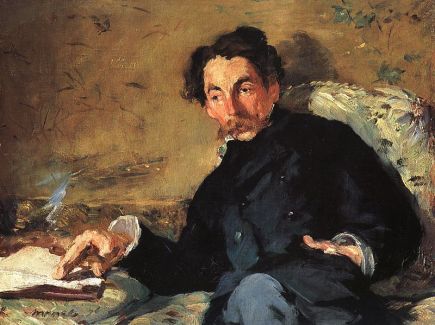
From every direction we come to the same conclusion: escape from the human person. The processes of dehumanization are many. Perhaps today very different processes from those employed by Mallarmé dominate, and I am aware that even in his own works there still occur romantic vibrations. But just as modern music belongs to the era that starts with Debussy, all new poetry advances in the direction pointed out by Mallarmé. The link with both names seems to me essential if we wish to follow the main outline of the new style.
Today it is difficult for anyone under thirty to become interested in a book describing under the pretext of art, the behaviour of specific men and women. He relates this to sociology and psychology, and would accept it with pleasure if, not to confuse things, it were referred to as such. But art for him is something different:
Poetry today is the higher algebra of metaphors.
* * *
Metaphor is probably the most fertile of man’s resources, its effectiveness verging on the miraculous. All other faculties keep us enclosed within the real, within what already is. The most we can do is add or subtract things to or from others. Only metaphor aids our escape and creates among real things imaginary reefs, islands pregnant with allusion.
It is certainly strange, the existence of this mental activity in man whereby he supplants one thing by another, not so much out of eagerness to achieve the one as from a desire to shun the other. Metaphor palms off one object in the guise of another, and it would not make sense if, beneath it, we did not see an instinct which leads towards an avoidance of reality.
A psychologist recently enquiring into the origin of metaphor discovered that one of its roots lay in the spirit of taboo. An object of ineffable importance would be designated by another name. The instrument of metaphor came later to be employed for the most diverse ends, one of them, the one that has predominated in poetry, being to ennoble the real object. Similes have been used for decorative purposes, to adorn and embroider the beloved reality. It would be interesting to find out whether, in modern art, on turning the metaphor into substance and not ornament, the image has not acquired a curiously denigrating quality, which, instead of ennobling and enhancing, diminishes and disparages poor reality. A little while ago I read a book of modem poetry where lightning was compared to a carpenter’s rule and winter’s leafless trees to brooms sweeping the sky. The lyrical weapon is turned against natural things and damages, even assassinates them.
But, if metaphor is the most radical instrument of dehumanization, it cannot be said to be the only one. There are countless others of varying range.
The simplest consists in a mere change of the customary perspective. From the human point of view things have an order, a determined hierarchy. Some seem very important, others less so, others totally insignificant. In order to satisfy the urge to dehumanize it is not, therefore, necessary to alter the inherent nature of things. It is enough to invert this order of importance and make an art in which, looming up monumentally in the foreground, appear the events of minimum importance in real life.
This is the latent connection uniting apparently incompatible forms of modern art: the selfsame instinct of flight from the real is satisfied both in the surrealism of metaphor and in what might be called infra-realism. Reality can be overcome, not only by soaring to the heights of poetic exaltation, but also by paying exaggerated attention to the minutest detail. The best examples of this – of attending, lens in hand, to the microscopic aspects of life – are to be found in Proust, Ramón Gómez de la Serna, and Joyce.
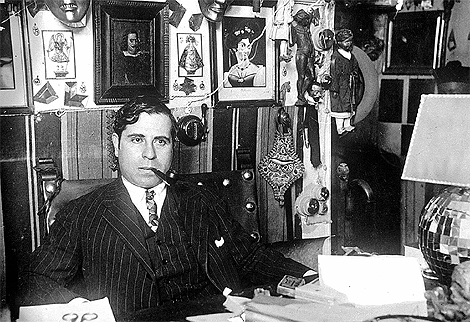
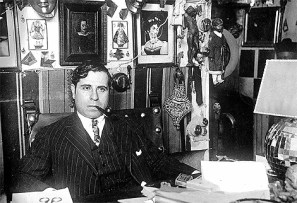 Ramon
Ramon
Ramón can compose an entire book on bosoms – somebody has called him a new Columbus discovering hemispheres – or on the circus, or on the dawn, or on the Rastro and the Puerta del Sol. The procedure simply consists in letting the outskirts of attention, that which ordinarily escapes notice, perform the main part of life’s drama
* * *
As I have said, the purpose of this essay is merely to describe modern art by means of some of its distinctive features. But, in its turn, this intention finds itself serving a curiosity broader than these pages could satisfy, so that the reader is left to his private meditation. I refer to the following considerations.
Elsewhere (Ortega y Gasset’s The Modem Theme, London 1931, New York 1961) I have pointed out that art and pure science, precisely by being the freest of activities, and less dependent on social conditions, are the first fields in which any change in the collective consciousness can be seen. When man modifies his basic attitude to life he starts by manifesting this new awareness in both artistic creation and in scientific theory. The sensitivity of both areas makes them infinitely susceptible to the lightest breath of the winds of the spirit. As in a village, on opening the windows in the morning, we look at the smoke from the chimneys in order to see which way the wind is blowing so we can look at the arts and sciences of the younger generations with a similar meteorological curiosity.
But in order to do this it was essential to define the new phenomenon. Having done so, only now can we ask what new life-style modern art heralds for the future? The reply would entail investigation into the causes of this strange change of direction which art is making, and this in turn would be an enterprise too weighty to undertake here. Why this urge to dehumanize, why this loathing of living forms? Probably, like every historical phenomenon, its roots are so tangled only the subtlest detection could unravel them.
Nevertheless, one cause stands out quite clearly, although it cannot be regarded as the decisive one.
The influence of its own past on the future of art is something that cannot be over-stated. Within the artist there goes on a constant battle, or at least a violent reaction, between his own original experiences and the art already created by others. He does not find himself confronting the world on his own; artistic tradition, like some middleman, always intervenes. He may feel an affinity with the past, regarding himself as the offspring who inherits and then perfects its traditions – or, he may discover a sudden indefinable aversion to the traditional and established artists. Should he fall into the first category he will experience pleasure in settling into the conventional mould and repeating most of the sacred rituals: if in the second he will find the same intense pleasure in giving his work a character aggressively opposed to established standards.
This is apt to be forgotten when people talk of the influence of yesterday upon today. It is not difficult to recognize in the work of one period the desire to resemble that of the preceding one. On the other hand, almost everybody seems to find it difficult to see the negative influence of the past, and to note that a new style is often formed by the conscious and complicated negation of traditional modes.
And the fact is that one cannot understand the development of art, from Romanticism to the present day, unless one takes into account that negative mood of aggressive derision as an ingredient of aesthetic pleasure. Baudelaire praises the black Venus precisely because the classical one is white. From then on, successive styles have been progressively increasing the negative and blasphemous content-in things that tradition once delighted in, up to the point where today the profile of modem art consists almost entirely of a total negation of the old. That this should be so is understandable. Many centuries of continuous evolution in art, unbroken by historical catastrophes or other serious interruptions, produce an ever-growing burden of tradition to weigh down inspiration. Or, to put it another way: an ever-growing volume of traditional styles intercept direct communication between the emergent artist and the world around him. One of two things may happen: either the tradition will end by overwhelming all original talent – as was the case in Egypt, Byzantium, and the East in general – or the burden of the past upon the present will be thrown off, followed by a long period in which the arts gradually break free from the traditions that were smothering it. This has been the case in Europe, where a futurist instinct is overthrowing a positively oriental reverence for the past.
A large part of what I have called ‘dehumanization’ and the loathing of human forms arises from this antipathy to the traditional interpretation of reality. The vigour of the attack is in indirect ratio to the distance in time: what most repels the artists of today is the predominant style of the past century, despite the fact that it contained its own measure of opposition to older styles. On the other hand, the new artist apparently feels an affinity towards art more distant in time or space – the prehistoric the primitive and exotic. What is probably found pleasing in these primitive works is – more than the works themselves – their ingenuousness and the absence of any recognizable tradition in them.
If we now consider what attitude to life this attack on the artistic past indicates, we are confronted by a revelation of immense dramatic quality. Because, ultimately, to assault the art of the past is to turn against art itself; for what else in actual fact is art, but a record of all that the artist has achieved up to the present ?
Is it then the case that, under the mask of love there is hidden a satiety of art, a hatred of art ? How would that be possible ? Hatred of art cannot arise except where there also prevails hatred of science, hatred of the state, hatred, in short, of culture as a whole. Does Western man bear an inconceivable rancour towards his own historical essence? Does he feel something akin to the odium professionis of the monk, who, after long years in the cloister, is seized with an aversion to the very discipline which has informed his life ?
It would be interesting to analyse the psychological mechanisms by means of which the art of yesterday negatively influences the art of tomorrow. One of these – ennui – is clearly evident. The mere repetition of a style blunts and wearies the senses. Wolfflin has shown, in his Fundamental Concepts in the History of Art, the power that fatigue has had time and again in mobilizing and transforming art.
* * *
Earlier on it was said that the new style, taken in its broadest general aspect, consists in eliminating ingredients that are ‘too human’, and retaining only purely artistic material. This seems to imply a great enthusiasm for art. But, on contemplating this same fact from another angle, we discover in it a contradictory aspect of loathing or disdain. The contradiction is obvious, and must be stressed. Apparently, modern art is full of ambiguity – which is not really surprising, since almost all important contemporary issues have been equivocal. One has only to do a brief analysis of the recent European political in them the same intrinsic ambiguity. However, this paradoxical love and hate for the selfsame object is somewhat easier to understand if we look more closely at contemporary works of art.
The first result of art’s withdrawal into itself is to rid it of all pathos. Art, with its burden of ‘humanity’, used to reflect the grave character of life itself. Art was a very serious matter, almost hieratic. At times it aspired to nothing less than saving the human species – as in Schopenhauer or Wagner. Anyone bearing these examples in mind cannot but find it strange that modem inspiration is always, unfailingly, comic. The comic element may be more or less refined, it may run from frank buffoonery to the subtle wink of irony, but it is never absent. It is not that the content of the work is comic – that would be to fall back into the category of the ‘human’ style – but that art itself makes the jest, whatever the content. As previously indicated, to look for fiction as nothing else but fiction is an intention that cannot be held except in a humorous state of mind. One goes to art precisely because one recognizes it as farce. This is what serious people, less attuned to the present, find most difficult to understand in modem art. They think that modem painting and music are pure ‘farce’ – in the pejorative sense of the word – and cannot admit the possibility that art’s radical and benevolent function might lie in farce itself. It would be ‘farce’ – again in the bad sense – if the artist of today pretended to compete with the ‘serious’ art of the past, or if, say, a cubist painting attempted to solicit the same type of emotional, almost religious admiration as a statue of Michelangelo. But the modem artist invites us to contemplate an art that is a jest in itself. For from this stems the humour of this inspiration. Instead of laughing at any particular person or thing – there is no comedy without a victim – modern art ridicules art.
One need not become too alarmed at this. Art has never better demonstrated its magical gift than in this mockery of itself. Because it makes the gesture of destroying itself, it continues to be art, and, by a marvellous dialectic, its negation is its conservation and its triumph.
I very much doubt if young people today could be interested in a verse, a brushstroke or a sound which did not carry within it some ironic reflection.
After all, this is not a completely new theory. At the beginning of the nineteenth century a group of German romantics led by the Schlegels proclaimed irony as the highest aesthetic category, and for reasons which coincide with the intentions of modern art. Art is not justified if it limits itself to reproducing reality, to vain duplications. Its mission is to conjure up an unreal horizon. To achieve this we can only deny our reality and by so doing set ourselves above it. To be an artist is not to take man as seriously as we do when we are not artists.
Clearly, this quality of irony gives modem art a monotony which is highly exasperating. But, be that as it may, the contradiction between hate and love, surfeit and enthusiasm, now appears to be resolved. Hate is aroused when art is taken seriously, love, when art succeeds as farce, laughing at everything, including itself.
There is one feature of great significance which seems to symbolize all that modem art stands for – the fact that it is stripped of all spiritual content. Having written this sentence, I am astonished to find the number of different connotations it carries. The fact is not that the artist has little interest in his work, but that it interests him precisely because it does not have grave importance, and to the extent that it lacks it. The matter will not be properly understood if it is not considered together with the state of art thirty years ago, indeed, throughout the past century. Poetry and music were then activities of immense importance: little less was expected of them than the salvation of the human species amid the ruin of religions and the inevitable relativism of science. Art was transcendent in a noble sense. It was transcendent by reason of its themes, which included the most serious problems of humanity, itself lending justification and dignity to humanity. This was to be seen in the solemn stance adopted by the great poet or musician, the posture of a prophet or the founder of a religion, the majestic attitude of a statesman responsible for the destiny of the universe.
I suspect that an artist of today would be appalled to see himself appointed to such an enormous mission and thus obliged to deal with matters of comparable magnitude in his work. He begins to experience something of artistic value precisely when he starts to notice a lightness in the air, when his composition begins to behave frivolously, freed of all formality. For him, this is the authentic sign that the Muses exist. If it is still proper to say that art saves man, it is only because it saves him from the seriousness of life and awakens in him an unexpected youthfulness. The magic flute of Pan which makes the Fauns dance at the edge of the forest is again becoming the symbol of art.
Modern art begins to be understandable, acquiring a certain element of greatness when it is interpreted as an attempt to instill youthfulness into an ancient world. Other styles insisted on being associated with dramatic social or political upheavals or with profound philosophical or religious currents. The new style, on the contrary, asks to be associated with the triumph of sports and games. It shares the same origins with them.
In the space of a few years, we have seen the tidal wave of sport all but overwhelming the pages of our newspapers that bear serious news. Articles of depth threaten to sink into the abyss their name implies, while the yachts of the regattas skim victoriously over the surface.’ The cult of the body eternally speaks of youthful inspiration, because it is only beautiful and agile in youth, while the cult of the mind implies an acceptance of growing old, because it only achieves full maturity when the body has begun to fail. The triumph of sport signifies the victory of the values of youth over the values of old age. The same is true of cinema, which is par excellence a group art.
In my generation the manners of middle-age still enjoyed great prestige. A boy longed to stop being a boy as early as possible and preferred to imitate the jaded airs of the man past his prime. Today, little boys and girls try hard to prolong their infancy, and the young strive to retain and accentuate their youthfulness.
This should cause no surprise. History moves in accord with great biological rhythms, its greatest changes originating in primary forces of a cosmic nature. It would be strange if the major and polar differences in human beings – the differences of sex and age – did not also exercise an influence upon the times themselves. And, indeed, it can be clearly seen that history swings rhythmically from one to the other pole, at certain times stressing the masculine qualities, in others the feminine, at certain times exalting the spirit of youth and at others that of maturity.
Today, the predominant aspect in all stages of European existence is one of masculinity and youth. Women and the elderly must for a period yield the government of life to the young men, and it is no wonder that the world appears to be losing formality.
All the characteristics of modem art can be summed up in these basic attitudes, which in their turn are responding to art’s changed position in the hierarchy of human preoccupations. I would say that art, previously situated, like science or politics, very close to the hub of enthusiasm, that chief support of our personal identity, has moved out towards the periphery. It has lost none of its exterior attributes, but has made itself secondary, less weighty, more remote.
The aspiration to pure art is not, as is often believed, an act of arrogance, but, on the contrary, of great modesty. Art, having been emptied of human pathos, remains without any other meaning whatsoever – as art alone, with no other pretension. Isis of a myriad names, the Egyptians called their goddess. All reality has a myriad aspects. Its components, its features, are innumerable. It would be a remarkable coincidence if, out of an infinity of possibilities, the ideas we have explored in this essay, should turn out to be the correct ones. The improbability increases when we are dealing with a new-born reality, one only at the beginning of its journey through space.
It is, therefore, highly probable that this description of modem art contains nothing but errors. Having concluded my attempt, I am curious and hopeful to find whether others of greater accuracy will follow it. It would only confuse the issues if I were to try to correct any errors I have made by singling out some particular feature omitted from this analysis. Artists are apt to fall into this error when they talk about their art and do not stand far enough away to take a broad view of the facts. I have been moved solely by the pleasure of trying to understand – not by anger or enthusiasm. I have endeavoured to seek the meaning of the intentions of modem art, and this obviously pre-supposes a benevolent state of mind.
It is surely not possible to approach a theme in any other manner without condemning it to sterility ?
It will be said that the new art has not produced anything worthwhile up to now, and I come very close to thinking the same. From existing works I have been trying to extract an intention and I have not concerned myself with their fulfilment. Who knows what will come out of this new order! The enterprise is fabulous – it seeks to create out of nothing. I hope that later on it will be content with less and achieve more.
But, whatever its errors may be, there is in my opinion one immovable point in the new situation: the impossibility of going back. All the objections levelled at the inspiration of these artists may be correct, but they still do not contribute sufficient reason for condemning it. Something positive would have to be added: the suggestion of another road for art which would neither dehumanize nor retravel the roads already used and abused.
It is very easy to cry that art is always possible within the tradition. But this comforting phrase is useless for the artist who awaits, with brush or pen in hand, a concrete inspiration.
A further note: J-K Huysmans wrote seminal essays on modern art back in 1883 – and they are available to read in French online at this link
Most of Huysmans essays on art are available from Flammarion. It would be wonderful if these could be translated into English.
Readers who enjoyed this essay may find my essays on Art and its Dark Side interesting. These are a fresh approach to the analysis of art history.











 anthonyhowelljournal