I love Russia. Wonderful people, wonderful dancers, wonderful minds. I am sickened by Western hate-propaganda instigated by the mass media and by our corrupt leaders. I recall with huge fondness my one performance in Russia:
Homage to the Horses of Saint Petersburg. Please click the link for the video of this performance.
Everyone was so helpful, even the police. When I initially suggested that I wanted to bring horses into the Imperial Riding School for the first time since the Revolution, the police, who administered the building said No. When I said we would take the shoes off the horses so as not to damage the marble floor, they said Yes.
When I informed the police that later we would be naked while leading the horses around the columns of the facade, they said No. Public nudity had been disallowed by a law that came in after Glasnost! When I said, well, technically under the facade, according to classical law, we were within the precincts of the building, they said Yes!
Reason thus prevailed. Imagine if that had been the UK police or the US police.
Featuring a grumpy old git’s thoughts on what we can and what we cannot say, as well as the writing of Stewart Home, Mr Fish, Dana Gillespie, Catherine Millet, Takako Arai, Holly Howitt, Elizabeth Jenkins, Tom Bland and Joelle Taylor.
I am an admirer of good abstract poetry, and yet I felt drawn to satire after teaching in jails for several years. Now I find the tension between intention and unintentionality something that can provoke strong satirical writing. Ultimately even writing critical of society must be free to veer off in any direction – with verve! This is well demonstrated in Richard Lovelace’s “On Sanazar’s Being Honoured” – the most devastating satire on poetry competitions ever written. The full title is “On Sanazar’s being honoured with six hundred Duckets by the Clarissimi of Venice, for composing an Eligiack Hexastick of The City“. Here is the link.
Lovelace has always been one of my favourite poets, and he knew just what jail was!
His favourite trope is the oxymoron. I wrote an epigram in his honour:
OXYMORON
It was this device
Which appealed to Lovelace
Ruined by war.
Everything blown.
x
Finding the topsy-turvy
Through his syntax,
He juggled with a world
Turned upside down.
*
Some of my own satirical poetry can be found here at this link – Dick – and here at this link – Diatribe. More of my own satirical writing can be found in From Inside,published by the High Window Press.
And Statius, Dante’s guide through Purgatory, deftly juggles flattery and satire. Here is the link to a selection of his Silvae.
Discussing the medium itself, together with my view of who might be the most significant still life artists of the 20th century. Braque is certainly one of them.
And all our books (Grey Suit, Theatre of Mistakes, High Window, Odd Volumes etc) are available on ebay at tangoshiva. My own, older, Anvil Press Poetry titles are available here at Carcanet. Just add Anthony Howell when on the link.
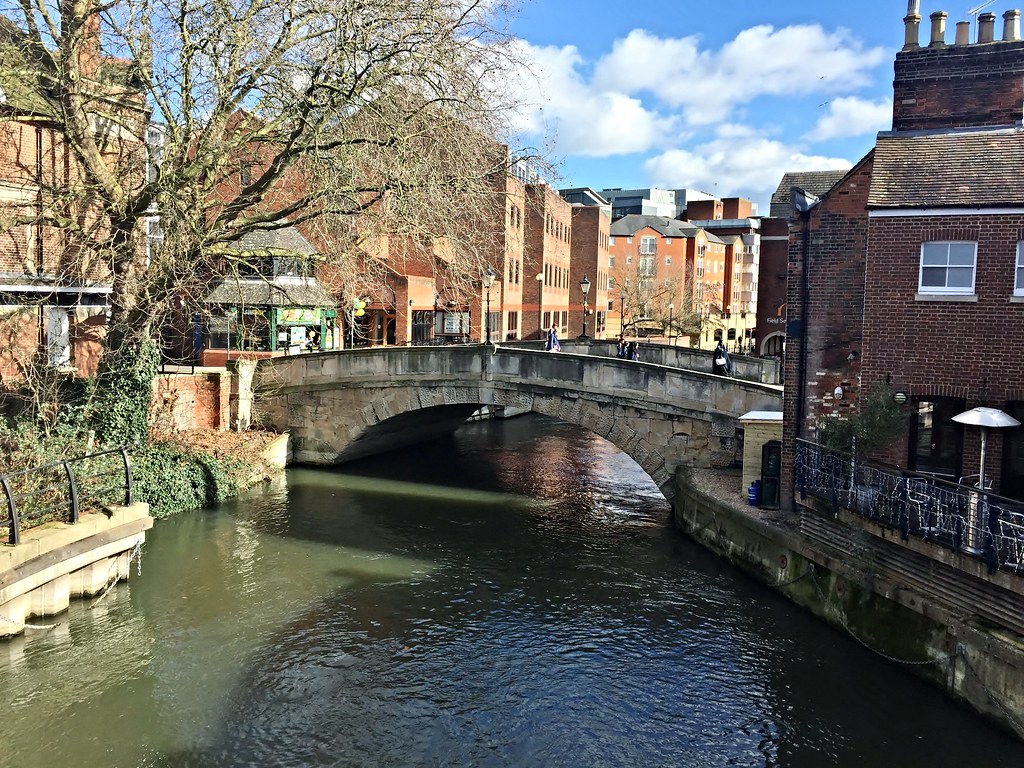
I was just six years old. My mother dropped me off at school in Caversham, and then I found my own way home by boarding the bus near Saint Peter’s Hill that would take me to its terminus in Shinfield. The hump-backed bridge on Duke Street marked the half-way point of this journey. I always tried to sit at the front on the upper deck of the bus (as I still do). As we approached the bridge, I would begin having a thought – perhaps the first I thought of as a thought. I thought to myself, I’m thinking, therefore I am thinking about thinking, so now I am thinking about thinking about thinking.
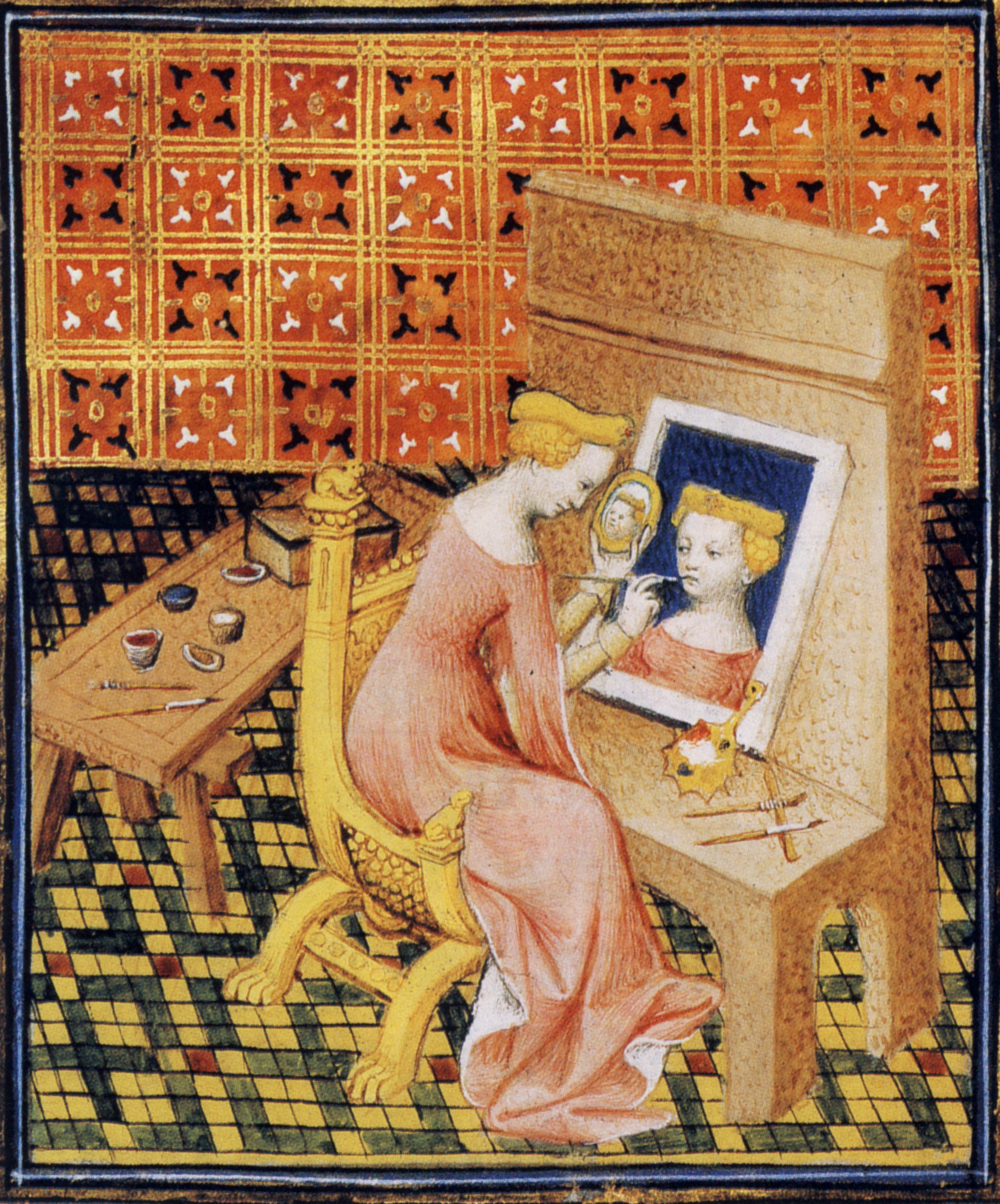
This was my first experience of a regressive series – almost my first experience. I had also travelled in a lift with parallel sides covered with mirrors. Mirrors and regression are inextricably linked. In his pioneering work On Famous Women, Giovanni Boccaccio credits Marcia the daughter of Varro with having invented the self-portrait. A note below her entry in my Italica Press translation points out that this was actually Lala of Cyzicus, who lived in Rome at the time when Varro was a young man, around 74 B.C. Misreading Pliny’s account of this painter (Historia Naturalis xxxv.11.40), Boccaccio asserts that she was Varro’s daughter. On the cover of my edition, a medieval manuscript in the Bibliothéque National, dated 1402, shows us the lady peering into her hand-held mirror, as she puts the finishing touches to her lips in the portrait she is painting of herself – we see her face, her face in the mirror, and her face in the portrait.
Marcia, alias Lala, is surrounded by her paints, her brushes and her palette. She is working at a sturdy easel. The argument for the self portrait’s female origin seems convincing when one considers how many women have been depicted with mirrors in hand – usually to symbolise vanity – whereas with Marcia we sense industry and accuracy – and note the little dogs carved on her paw-footed chair, watching her paint the painting of herself! But then, we should not dismiss turning our thoughts to reflection as it was seen in classical mythology. At the least, we should recall the fate of Narcissus, and how Echo was more than willing to save him, but unfortunately she could only repeat his complaints about the reflection that he had fallen in love with – for an echo is no more than an audible reflection. Both can be seen in the pre-Raphaelite painting by John William Waterhouse.
The painter painting a picture of herself is clearly the start of a regressive series. And this can be localised – down to the hand drawing a picture of the hand as it draws the hand, as can be seen in the symmetrical work of M.C. Escher, who deals in graphic conundrums.
But the conundrum can also give rise to philosophical and to mathematical enquiry – as can be found in the work of J.W. Dunne. Writing in the 1920s and 30s, it is my belief that Dunne had a considerable influence on René Magritte, who would have been thirty when Faber & Faber brought out Dunne’s An Experiment with Time. Here is what he has to say about Generic Images:
‘When a number of partly similar impressions have been attended to at different times, there is observable, besides the several memory images pertaining to those several impressions, a vague, general image comprising nothing beyond the key elements which are common to all those separate images. For example, the images of the hundreds of tobacco pipes which I have seen, smoked, and handled, all contain a common element which is now apparent to me as an ill-defined image of ‘ pipe ’ in general. It presents all the essential characteristics which serve to distinguish a pipe from any other article such as, say, an umbrella. Such characteristics are: hollow bowl, tubular stem – in short, an appearance of utility for the purpose of smoking. But this indefinite image does not exhibit any indication of specific colour or precise dimensions. It seems, however, to be the nucleus of all the definite images of particular pipes to be found in my mental equipment; for, if attention be directed to it, there will quickly become observable the image of sometimes one and sometimes another of such particular pipes.
These vague, almost formless general images are called ‘Generic Images’, and they appear to be analogous to a central knot to which the specific, definite images are in the relation of radiating threads.’
An Experiment with Time, p.34
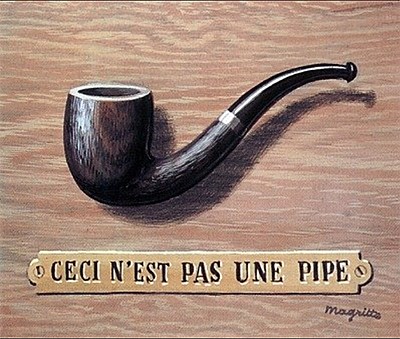
Magritte would have been thirty when this book appeared, and his biographers tell me that he was a visitor to the home of Edward James in London. Edward James was reputedly fathered by the Prince of Wales (later Edward VII). He was a patron of the surrealists. Salvador Dali put James in touch with Magritte, and thus it was that James hosted Magritte for three weeks at his home on 35 Wimpole Street, in February and March 1927, the year in which An Experiment with Time came out from Faber. The book was popular, and Edward James would certainly have had a copy of it in his library. In certain versions of Ceci N’est Pas Une Pipe by Magritte, the words are depicted as a label, as if to a painting – here painting and label amount to a picture within a picture. Magritte also signs this work, adding a further layer, a layer of self-consciousness. Well-known versions of this work, do not have a signature, and I might have my doubts as to the authenticity of this attribution, were it not for the fact that on the following page Dunne goes on – A definite image of a particular wooden pipe-bowl may pertain, on one side, to the generic image ‘pipe’, and, on another, to the generic image I call ‘grained wood’.
The main concern of An Experiment with Time is Dunne’s suspicion that we dream of the future as often as we dream of the past, and in the book he sets out to prove it. It is moot whether he succeeds or not, but his combination of up-to-date physics – including Einstein’s relativity and wave particle theory – with a mystic impulse towards a notion of time as an eternal continuum makes for irresistibly heady reading, as if he were the Alan Watts of his day (Watts would have been in his teens when An Experiment appeared).
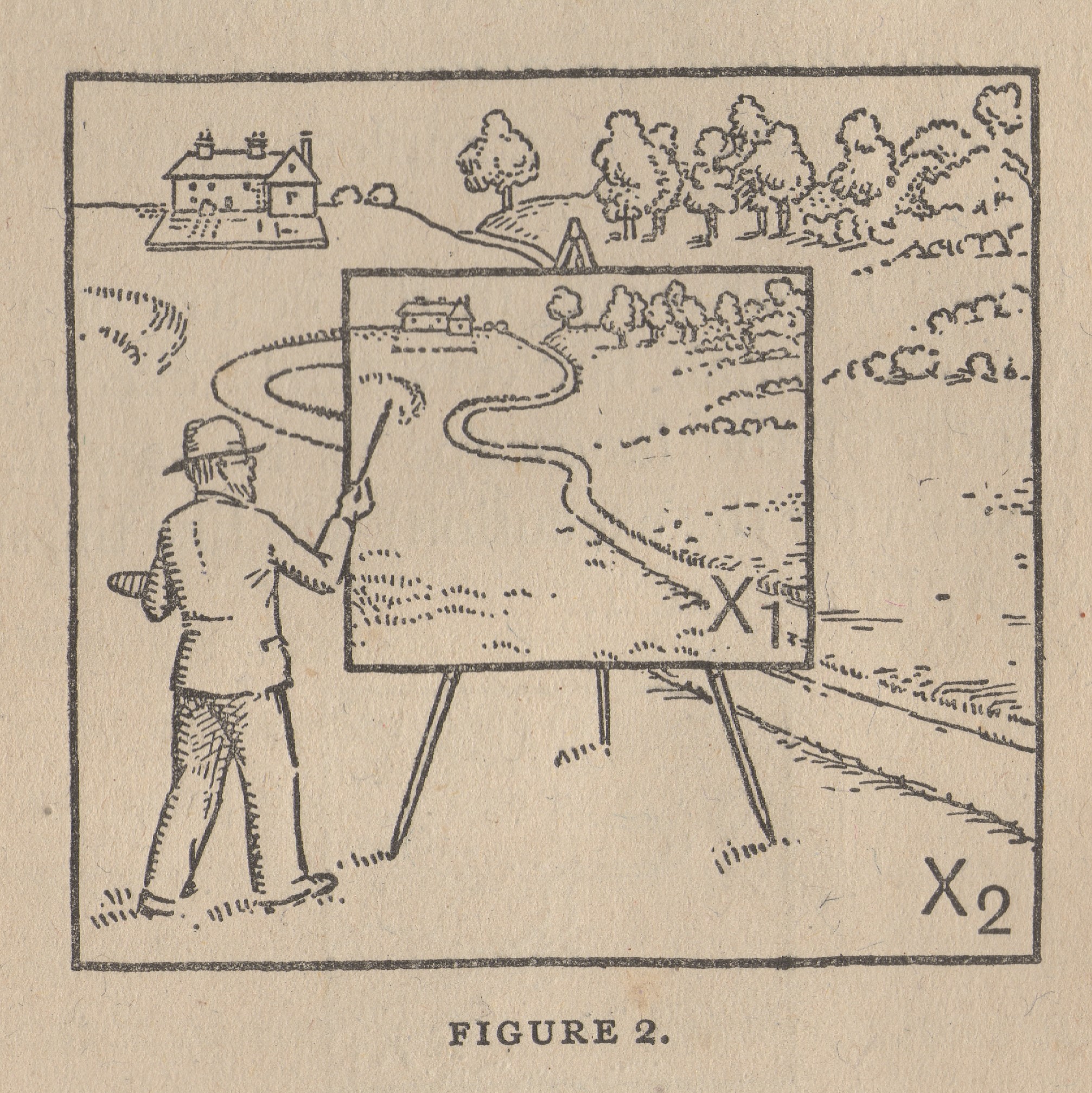
There are three illustrations in Dunne’s second book, The Serial Universe, which are worthy of note in the context I am trying to map out for my reader. The book was first published, again by Faber, in 1934. Every simple series to infinity is the expression of some logical fact which is asserted in the second term but not in the first is a phrase which appears in italics on page 25, and the exploration of the regressive series and its implications is the concern of the chapters here, one of which is called simply ‘Now’. Here is his illustration of the ‘first term’.
And here is the second term:
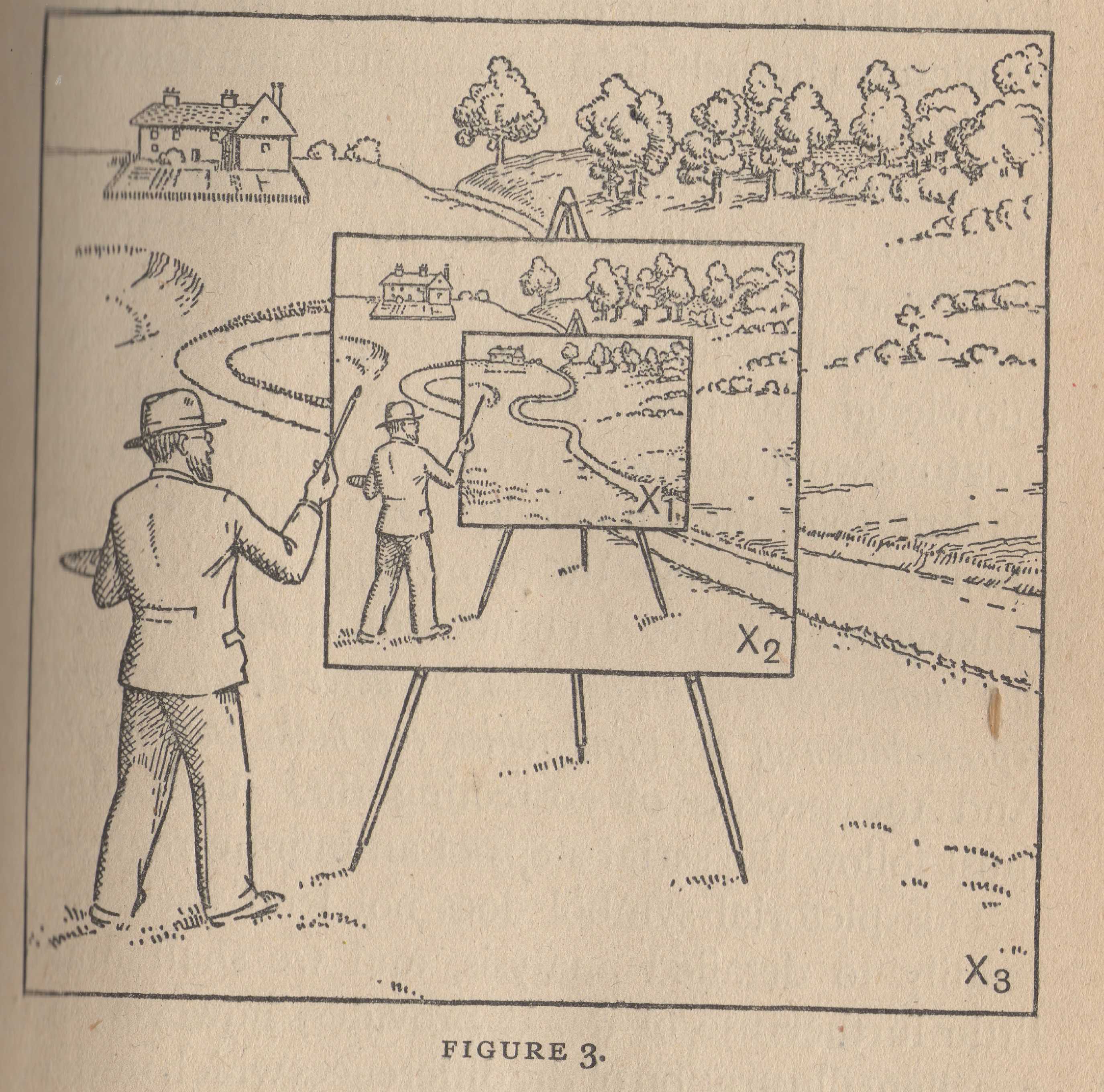
And he illustrates regression as it gathers momentum in his third illustration:
For Dunne, time itself is a regressive series, since every ‘now’ was once a ‘will be’ and becomes a ‘then’. Every son has a father, and every father is the son of a father who is the son of a father. I take issue with the latter example as it seems to simplify this particular regression, as if it were a single flight of stairs leading us back through the generations.
I would say that, ‘Every son is the son of a mother and a father, and every mother and father is the son or daughter of a mother and a father,’ goes further towards indicating the proliferation of regressions that occurs at every stage. I had a history teacher who maintained that family trees were, misleadingly, presented as if in descent from some legendary ancestor, but actually – if you want to understand the complexity of the mix – it is better to start with yourself. You had a father and a mother, each of your parents had a father and a mother. It is clear that very rapidly you acquire a vast number of antecedents. And so it is highly likely that you are descended from William the Conqueror!
It is stated that Magritte’s painting, The Human Condition, was completed in 1933, but note that, if so, it predates the publication of The Serial Universe by just one year. I don’t buy that. My hunch is that Magritte tweaked the date, in order to lay claim to some originality of concept. But it should be noted that there is a fundamental difference between Dunne’s diagrams and the famous work by Magritte. In the Magritte, no artist is present.
The regression only goes as far as the second term. Ian Bourn suggested to me that the mystery is that we do not know for sure that it is an accurate picture, since the picture itself hides a certain amount of the view! So it’s not so much about infinite regression. Putting the canvas inside a house, where the view is seen through a window, also limits the progression and distances the work from Dunne’s diagrams. So here the path forks – one fork leads to ‘the painting of a painting – a time-honoured theme – while the other leads to ‘the artist painting a picture of the artist painting a picture – adding self-portraiture to the mix. Magritte finds some mediation of this divergence by having recourse to the surreal (after all there is nothing surreal about The Human Condition, it is simply a picture within a picture).
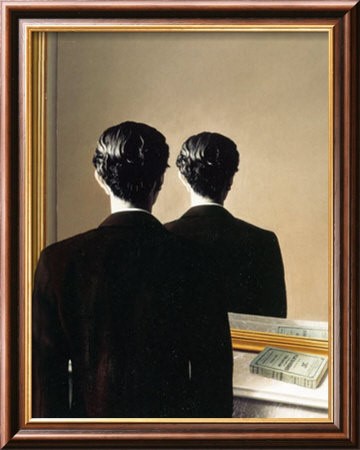
Not to Be Reproduced (La reproduction interdite, 1937) was commissioned by Edward James and is considered a portrait of James although James’s face is not shown. It purports to show a man looking into a mirror, but instead of his face the man sees the back of his own head, which is the view of him presented to any viewer of the picture.
This surreal ‘mirror’ rests on a mantlepiece-like ledge, and a book is shown lying face-up on this ledge. The book is the French edition of The Narrative of Arthur Gordon Pym of Nantucket by Edgar Alan Poe. Gordon Pym stows away aboard a whaling ship called the Grampus. Various upsets befall Pym, including shipwreck, mutiny, and cannibalism, before he is saved by the crew of another vessel. And now Pym and a sailor named Dirk Peters continue their adventures farther south and on land. They encounter hostile natives before escaping back to the ocean. The novel ends abruptly as Pym and Peters continue toward the South Pole.
While it influenced writers such as Melville and Verne, the book is essentially one long meander, without the doubling back, or the exploring of implications of earlier actions on outcomes, which distinguishes most tightly-plotted works. Life is not constructed as farce or a tragedy. Basically a book like this, it’s not even picaresque, it just describes one damn thing after another. So why is it there – in La reproduction interdite? What role has it to play in what might be called a tightly-plotted painting that emphatically refers back to itself? It’s my view that the book represents the painting’s antithesis, and by placing it in the painting, Magritte’s work achieves that marriage of thesis and antithesis which is considered synthesis.
When giving a lecture to the cast of J.B. Priestley’s play Time and the Conways, in 1937, J. W. Dunne used the analogy of a keyboard, and compared a simple progression of one moment after another, one event after another, to a finger moving up the piano from left to right, striking one note at a time in the order in which they are arranged, Dunne includes this lecture in his third book, The New Immortality (1938), and states that the result is that you experience merely a sequence of single events.
‘That life, certainly,’ he goes on, ‘Is not worth preserving. Lord Dundreary was perfectly right when he described it as just one thing happening after another.’ Dunne argues that what distinguishes consciousness is that we direct our attention to certain notes, events and moments, and that attention focuses our lives, rendering certain events significant – for instance, think how we edit out our hand on the red plush of the balcony as we give our full attention to the stage. Thus consciousness edits space and time to concentrate on appropriate concerns.
Painters, from Sickert to Bratby, have exploited the restoration of these edited areas of the self by including the hand of the artist, or his knee. What interests me here, though, is the mention of Lord Dundreary’s remark.
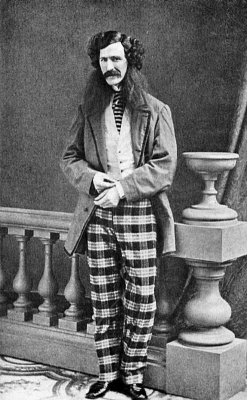
Dundreary is a character whose buffoonery steals the limelight in Tom Taylor’s play, Our American Cousin. He is an upper-class nincompoop, sporting plaid trousers and “Piccadilly Weepers” – huge sideburns that dangle down well below his cravat. I’ve read the play, and cannot find the phrase mentioned by Dunne. But Lord Dundreary was immortalised by the comic actor E.A. Sothern – who ad libbed through many of the scenes (where it simply says, ‘business’) – and he also appeared in various vaudeville spin-offs of his famous role. Dunne bowdlerises the phrase, for what was popular was actually, One damn thing after another. But I’m pretty sure the phrase did indeed originate with Dundreary – and perhaps evolved over time. The words boil down to an acronym that was much in favour after the First World War – ODTAA.
John Masefield was fascinated by the notion of stories within stories, as well as pictures within stories. In the Box of Delights (first published in 1935) an old Punch-and-Judy man pursued by evil forces escapes into a picture hanging on the wall of a cosy study. He does so in front of the eyes of Kay, a small boy: his character cast here in the role of a spectator:
“Master Harker, what is the picture yonder?”
“It is a drawing of a Swiss mountain,” Kay said. “It was done by my grandfather. It is called The Dents du Midi, from the North.”
“And do I see a path on it?” the old man said. “If you, with your young eyes, will look, perhaps you will kindly tell me if that is a path on it.”
There was indeed a path:
“….Down the path… a string of mules was coming…The first mules turned off at a corner. When it came to the turn of the white mule to turn, he baulked, tossed his head, swung out of the line, and trotted into the room, so that Kay had to move out of his way. There the mule stood in the study, twitching his ears, tail and skin against the gadflies, and putting down his head so that he might scratch it with his hind foot.
“Steady ther,” the old man whispered to him. “And to you, Master Kay, I thank you. I wish you a most happy Christmas.”
At that, he swung himself onto the mule, picked up his theatre with one hand, gathered the reins with the other, said, “Come, Toby,” and at once rode off with Toby trotting under the mule, out of the room, up the mountain path, up, up, up, till the path was nothing more than a line in the faded painting, that was so dark upon the wall. Kay watched him till he was gone, and almost sobbed, “O, I do hope you’ll escape the wolves.”
A very, very faint little voice floated down to him from the mountain tops. “You’ll see me again”; then the mule-hoofs seemed to pass onto grass. They could be heard no more…
(The Box of Delights, pages 59-61)
So here we have a picture within a story, and a creature from the picture enters the story, enabling the character in the story to get on its back and be taken into the picture. Something similar happens in the movie, Sherlock Jr. (1924), in which Buster Keaton plays a neighborhood projectionist whose dream is to be a detective.
‘As he falls asleep in the projection booth, his dream-double fantasizes the characters of the film he is projecting—“Hearts and Pearls”—into his real-life girlfriend and playboy enemy. Imagining the heroine’s honour threatened, the somnambulant Buster rushes down the aisle, scrambles over the orchestra pit and, after several failed attempts, manages to penetrate the screen world, where he is transformed into the redoubtable son of Sherlock Holmes. Although framed as a comedy, Sherlock Jr. constitutes a profound meditation on the film/dream analogy.’(Robert Stam, Reflexivity in Film and Literature – from Don Quixote to Jean-Luc Godard, 1992, p 37)
So Masefield was intrigued by this notion of one subject framed within another, and when you have a subject framed within itself, we experience the uncanny – which sets J. W. Dunne off into his exploration of the regressive series. This is seen as “reflexivity” in film theory, so Robert Stam cites instances of where the medium of film refers back to itself. But what is intriguing is that in 1926 Masefield also wrote a book called ODTAA – one damn thing after another – presumably inspired by Lord Dundreary’s phrase – his catchphrase perhaps.
No reflexivity here. The book is a rambling yarn – similar to The Narrative of Arthur Gordon Pym. A young man arrives in South America, falls in love with a girl who is betrothed to a revolutionary leader. The girl is imprisoned by the authorities, and the protagonist sets out to rescue her by seeking the help of her revolutionary who lives out in the wild. But his journey encounters delays and misadventures, he never reaches the man he felt destined to encounter and the girl is executed in jail. It can’t be said to have a plot, this book. It is just ‘one damned thing after another.’
Writers and artists concerned with reflexivity, with repetition, mirrors and the notion of the regressive series in all its myriad varieties, seem equally intrigued by what is clearly the opposite of this impulse, as is shown by Magritte’s inclusion of a rambling book on the ledge of the forbidden image with its precise but contradictory structure. A sense of things simply drifting apart is wonderfully expressed in the one novel Jane Bowles wrote – Two Serious Ladies. Repetition yearns for inconsistency and vice versa, as is so brilliantly explored by Deleuze in Difference and Repetition.
The significance of form that we witness in paintings of regressions and reflections seems to prompt antithetical impulses: stories which would rid themselves of any plot or structure, recording insignificant events – as if significance itself should be dismissed as something concocted by the clichés of tradition, fuelled by propaganda – and that it would be worth trying to write or paint as if you had no idea of what you were doing or where you were going.
But structure has a way of asserting itself, and significance may be bestowed without intention. Abraham Lincoln was watching Our American Cousin at Laura Keene’s Theatre in New York, in 1858. A note suggests that the shot occurred in Act III, halfway through Scene 2, when Dundreary is offstage. In the biopic inspired by Gore Vidal’s novel about Lincoln, the shot happens as Asa the American cousin twirls his stick in irritation and begins:
Don’t know the manners of good society, eh? Well, I guess I know enough to turn you inside out, old gal— you sockdologizing old man-trap. Wal, now, when I think what I’ve thrown away in hard cash to-day I’m apt to call myself some awful hard names, 400,000 dollars is a big pile for a man to light his cigar with. If that gal had only given me herself in exchange, it wouldn’t have been a bad bargain. But I dare no more ask that gal to be my wife, than I dare ask Queen Victoria to dance a Cape Cod reel.
No gunshot occurs in that scene.
But, as my memory served it, badly, having drowsed through it a month ago (it is very long), in Vidal’s version, the assassin shoots just as a colt is spun or aimed at the audience by an actor – thus confusing the actual bullet with some business onstage, enabling the assassin’s initial chance at escape. Another scene in the film seems to bear out J.W. Dunne’s earliest theories, since it shows the president waking from a nightmare – in which, of course, he is being assassinated. You might say he was dreaming of his future. But perhaps all US presidents dream of that.