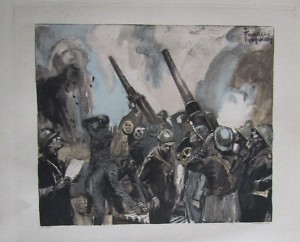
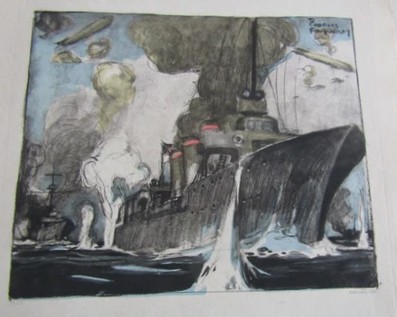
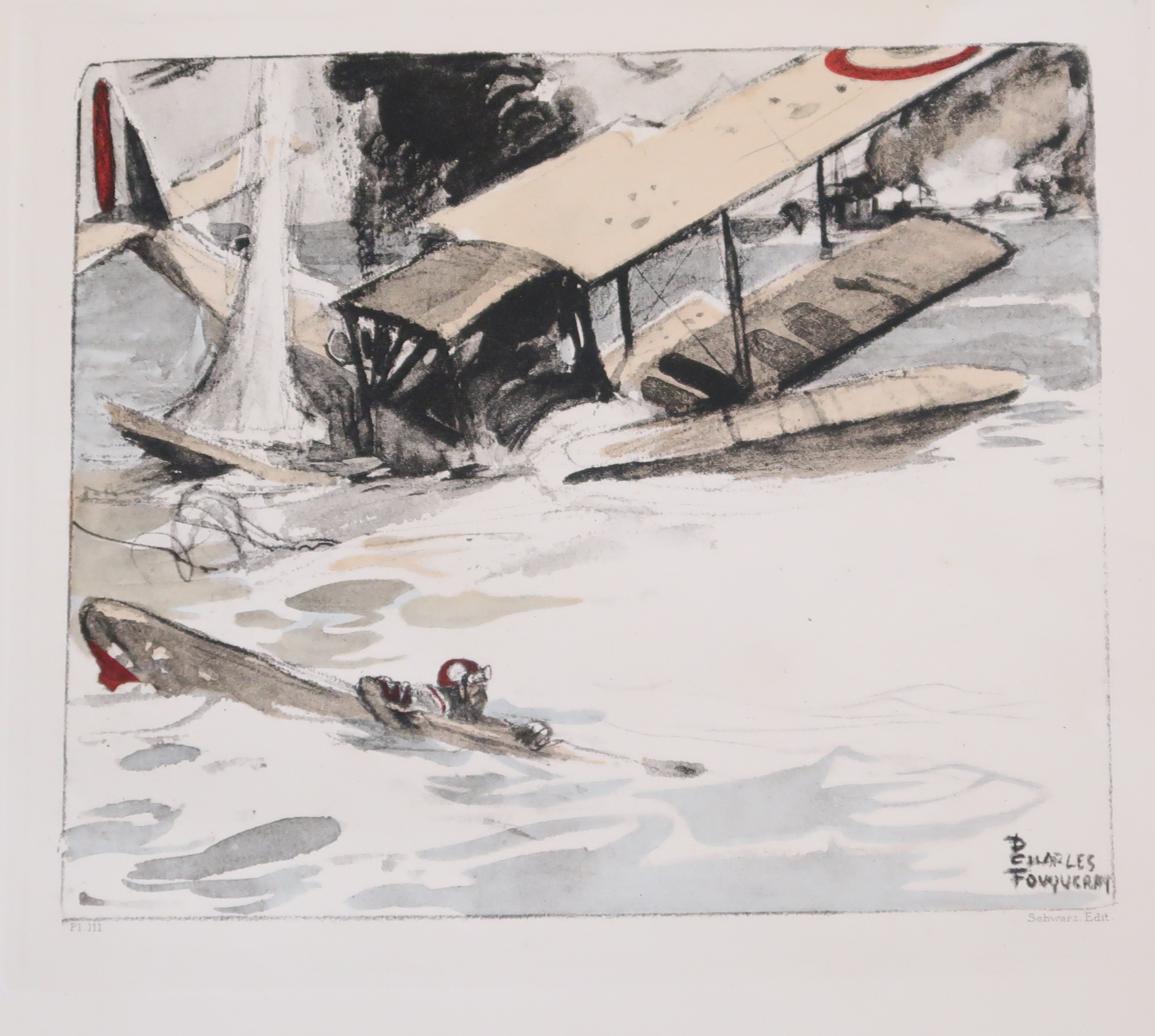
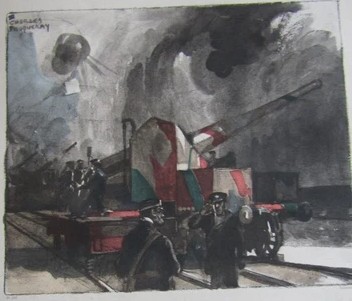
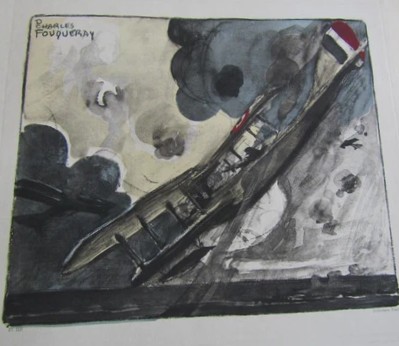
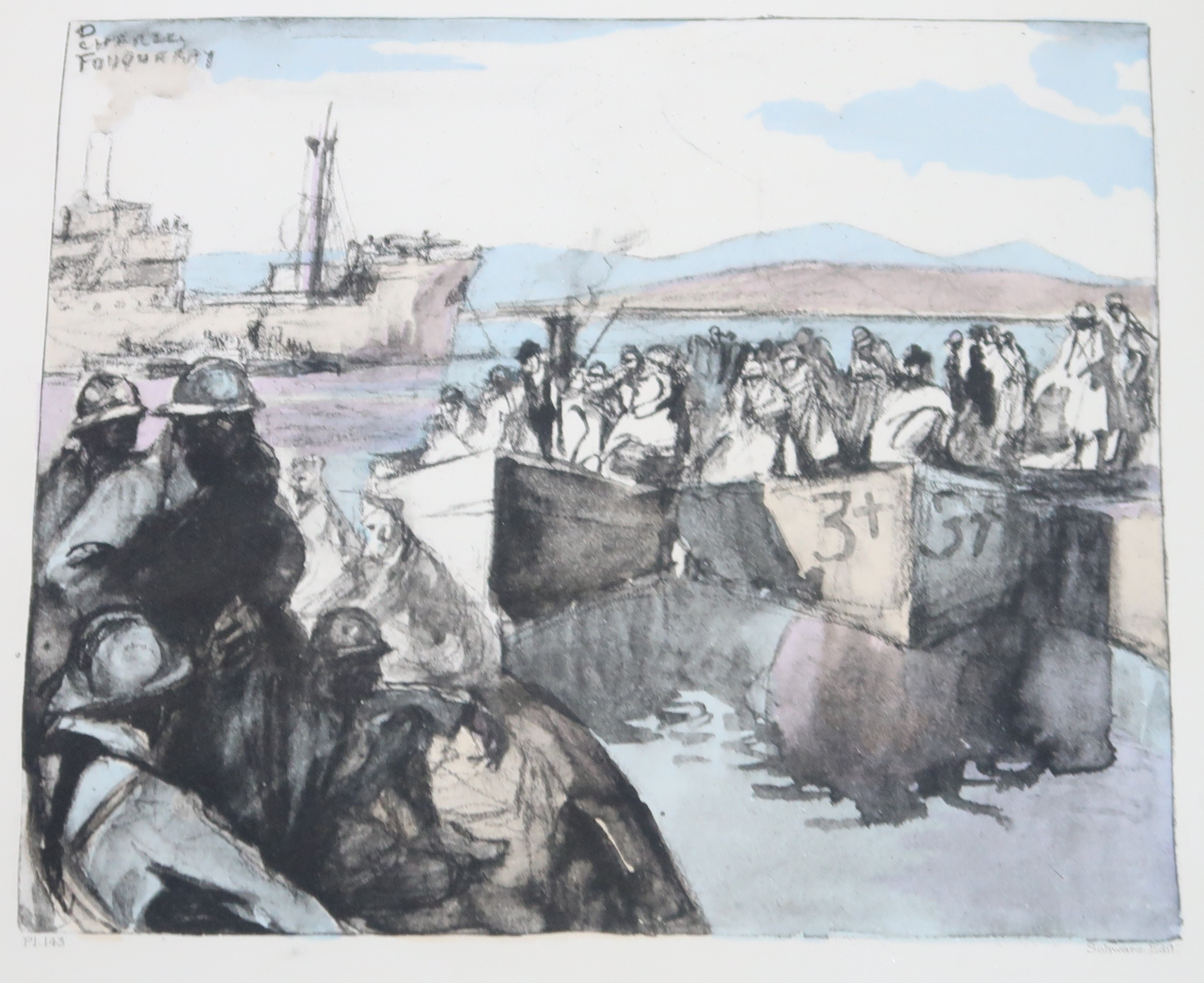
I just acquired 9 wonderful prints by Charles Fouqueray – a war artist I had never heard of.
Charles Dominique Fouqueray (Le Mans, 23 April 1869 – 28 March 1956) was a French painter. He studied at the École des Beaux Arts in Paris under Alexandre Cabanel and Fernand Cormon. From 1908 he was Peintre de la Marine, following the career of his father, a naval officer. He was recipient of the 1909 Prix Rosa Bonheur, then in 1914 the first Prix de l’Indochine.
My father returned from internment in Australia and immediately trained as an engineering officer and joined REME – the Royal Electrical and Mechanical Engineers. He married my mother, and was sent out to Naples towards the end of 1944, leaving her pregnant with me. To learn more about their story, read The Best Deborah Stories
He was very proud of his bike with its side-car and travelled on it into Naples from the camp where he was stationed to go to the Teatro di San Carlo, having fallen in love with Italian Opera. Bikes with sidecars were notoriously dangerous. In Naples, most officers issued them died on them. My father was no exception. Bear in mind one was riding through traffic in a country one was occupying, so most truck drivers had been enemy combatants until a few months before. My father was squashed between two lorries. I was born a few weeks later. I used to love watching the zoetrope he had made out of a biscuit-tin, especially one animation of a naked girl walking towards one.
And wow! I can’t complain! Another review out today! This one for AUTUMN, a novel-length poem I published as a Manubook back in 2017. It’s here in CHAINLINK JOURNAL
PLUS, also in this issue, an interview I did with its editor, Neil Fulwood. My thanks to him. What a nice New Year’s day!
Harley Schlanger is a prominent figure associated with the Schiller Institute, a political and economic think tank founded in 1984. He is known for his updates and newsletters related to the institute’s activities and its connection to the LaRouche movement.
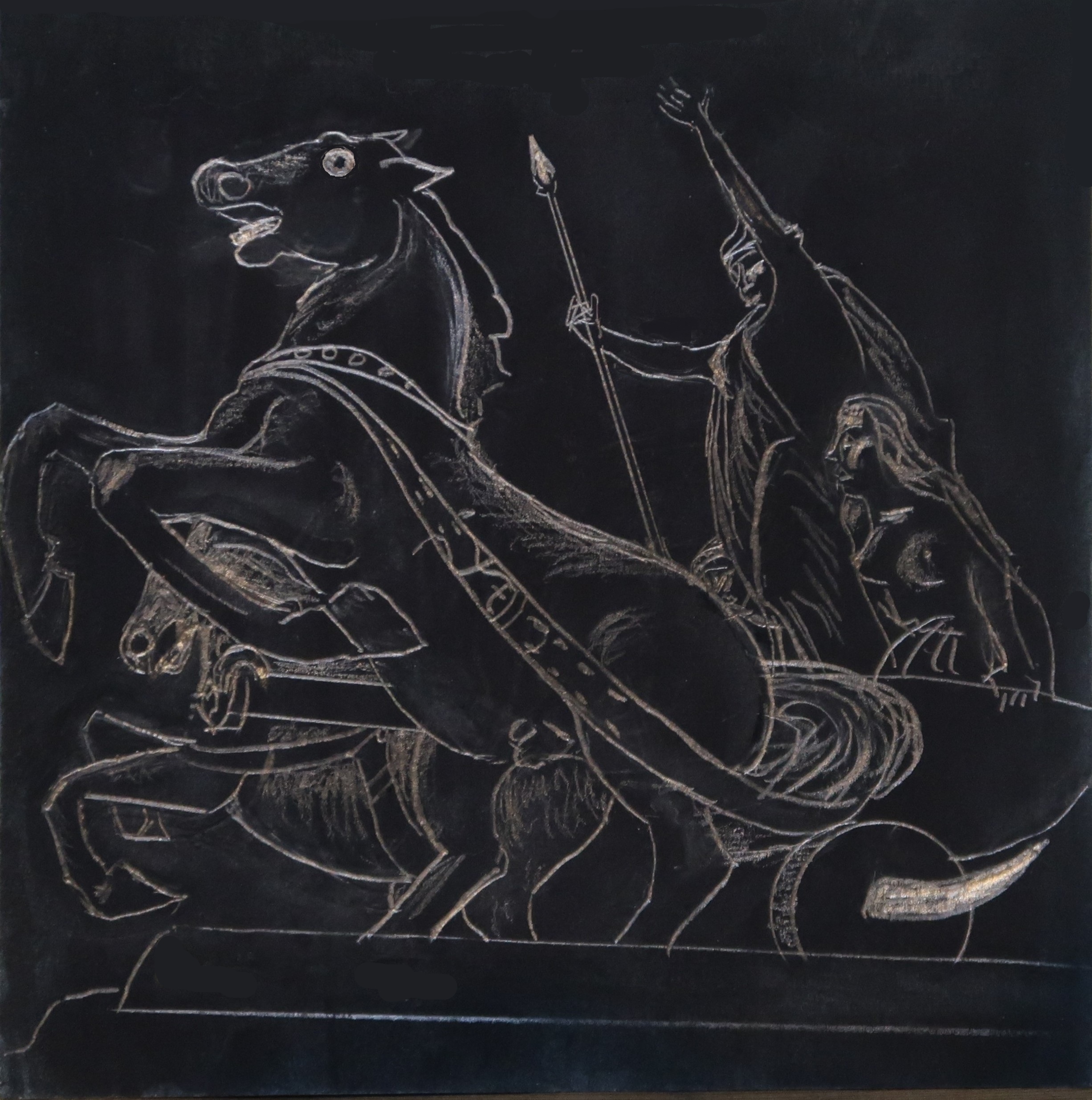
The concept of inheritance tax, specifically the vicesima hereditatum, was introduced by the Romans under Emperor Augustus, making them one of the first to implement such a tax. I checked this out because Boadicea complains about it.
x
…Hence, although, before, some among you may,
Through ignorance of what was best for you, have been deceived
x
By the perfidious pledges of Rome, yet now that you have tried
Both freedom and servitude, grant me how great a mistake you made
In choosing an imported dictatorship over your ancestral way of life,
For you have now come to realize how much better is poverty
With no master to wealth within the shameful bonds of slavery.
For what treatment is there of the most grievous sort that we
Have not suffered ever since these monsters came to Britain?
x
Have we not been robbed of most of our property,
And that the most precious, while for what is left we pay taxes,
Besides pasturing and tilling for them all remaining land?
Do we not pay a yearly tribute for our very bodies?
How much better it would be to have been sold to masters
Once and for all, than, while clinging to mere titles of nobility,
To have to ransom ourselves every year! How much better
x
To have been attacked and finished off than to go about
Weighed down by taxes! And yet, why do I mention death?
For even dying is not free of cost with them; no, you know
What duties we deposit for our dead. Death should be no tythe.
Death frees even those who toil in slavery to others;
Only in the case of these Romans do the very dead remain alive
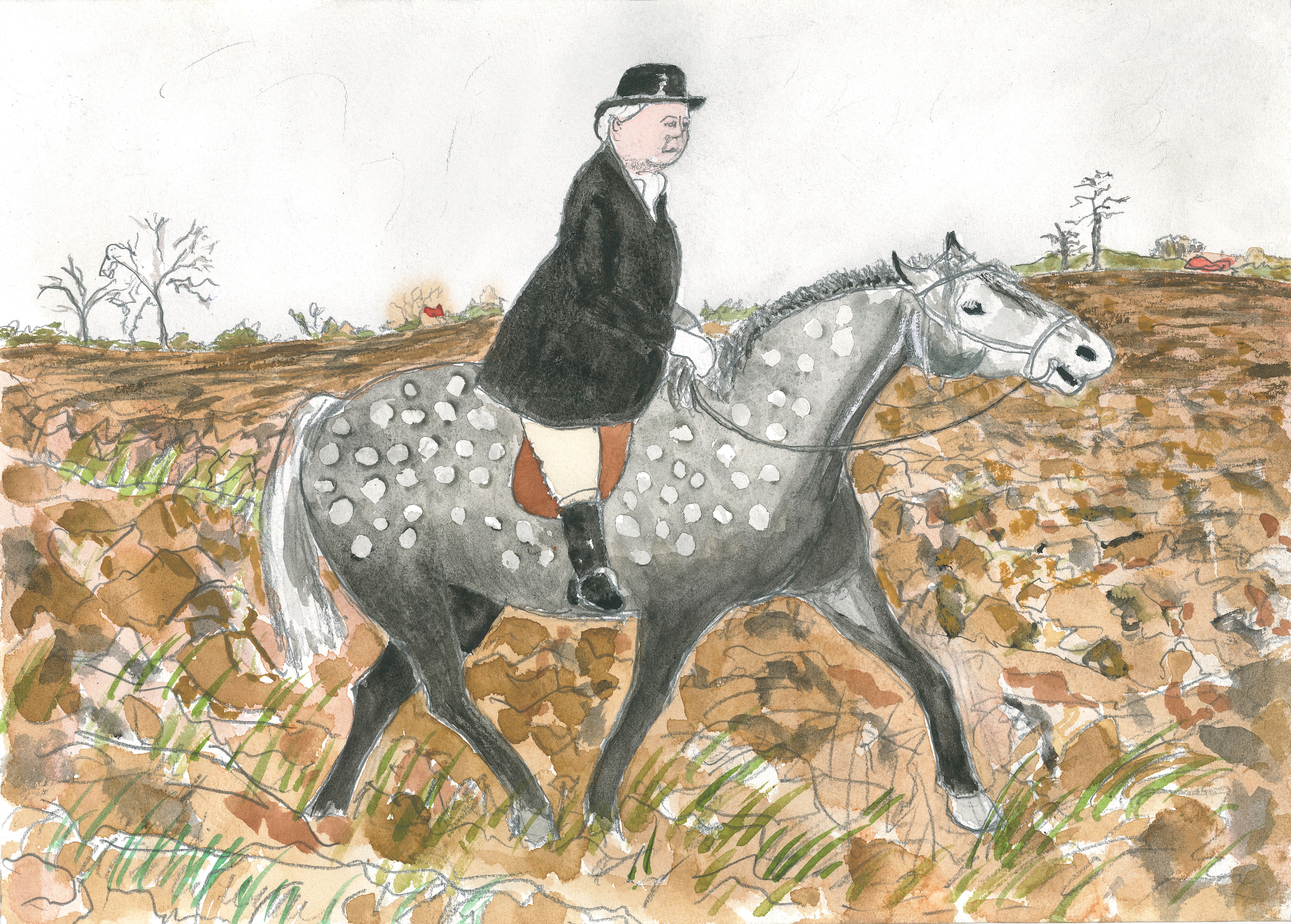
My mother was a child prodigy as an artist. On one of her paintings my grandmother has written in pencil, “asked for by Sickert”. I am pleased with this painting of her crossing a ploughed field in full hunting kit as I feel I have managed it in my mother’s style.
ANIMAL CRACKERS
Anchored on the stumps of mountains,
Up soars Manhattan, that glittering assemblage;
A giant barge, steel-sided,
Cleaving rivers apart, and yet,
Wherever it can, nature insinuates itself.
Weeds negotiate cracks – even Manhattan
Almost approaches wilderness at
Inwood Hill, perched on its northern tip,
Where pheasants nest, foxes prowl
On slopes once occupied by the Indians.
Off its shore there are forests and wetlands,
Including the ponds of Jamaica Bay,
Breeding baldpates, pintails,
Greater and lesser scaup, skimmers, terns,
Glossy ibises, egrets, and even visited
By the bald eagle. All the same, New Yorkers
Would not know from watching it on the box
Whether a cow was sick or not
As any hillbilly might. To the urbanite,
Farm animals are desirable, with more correspondence
Concerning them than any other perversion.
You see less of animals than people. People
Give you diseases. Animals do not sue
For alimony, nor can they get you pregnant.
x
Recently my mother visited New York.
She cannot see what she looks directly at,
Yet at seventy-six she managed to get
From Gramercy Park to the Bronx Zoo and back.
Having been a vet, she was more alert
To Fragonard’s cow at the Met
Than handling and stuff like that.
The same was true for Dubuffet’s cow at MoMA.
Seated in the sculpture garden
Next to a Maillol, off to her right
She could see a goat. Picasso’s goat, I said.
Then I headed for the bookshop,
Telling her to stay put.
Back with a cut-price Muybridge,
I caught sight of her straightening up
Behind its metal rump.
Mother had goosed the goat,
Establishing when her kids would drop.
Luckily there were no guards about.
x
Read my book about my mother – The Best Deborah Stories – here
Nicholas Lafitte (1943-1970) and George Pitts (1951-2017)
There are two poets who should not be forgotten, one British and the other American. Here, I want to share my thoughts about their work.
*****
Poet of light, of the sea remembered behind clouds, where all water is one divine plasma imbued with light, Nicholas Lafitte, although at times deranged, could speak of madness with peculiar clarity:
Disintegration of the psyche
Proceeds along familiar paths;
The only therapy most likely
To succeed is a succession of hot baths
And early nights, good food and lots .
Of exercise . . .
‘Seven Last Words’
Breakdown is often accompanied by rant, and this is true of Nick, but some of his poems are fine rants – truly elevated ranting, as in other sections of his ‘Seven Last Words’. His poetry may be compared to that of Veronica Forrest-Thomson. It has the same wit, the same mischievous enjoyment of high-flown academic gamesmanship (although they differ in tone – Nick tending to the sonorous, Veronica to the chatty). They never met, so far as I know, – Nick was dead by 1970, the year she brought out her first book, Twelve Academic Questions. In her introduction to On The Periphery, published posthumously in 1976, she describes the theme of her book as the chart of three quests:
The quest for a style already discussed, the quest for a subject other than the difficulty of writing, and the quest for another human being. Indeed such equation of love with knowledge and the idea of style as their reconciliation is as old as art itself.
Nick’s aims were similar, though unlike Veronica he attempted a fusion of these three quests through a highly individual espousal of religion which he related to T.S. Eliot’s ‘Anglo-Catholicism’, albeit with the ‘Anglo’ taken out.
His early poems include exercises in sprung rhythm, villanelles in the manner of Empson, poems reminiscent of Charles Madge and Pound. They utilise phrases which echo Eliot and Wallace Stevens – and Nick died too young to step entirely clear of these voices, nor was it his intention to do so, for the ironic appropriation of a master’s voice was part of his poetic programme – as it was Eliot’s and, later, Veronica Forrest-Thomson’s.
Another major influence was the work of the German refugee, Fred Marnau, whose Wounds of the Apostles Nick translated forcefully but very freely indeed, perhaps improving on the originals.
Beyond these influences, what Nick had got was passion. His talent was for the Dithyramb – that choric hymn, in honour of Dionysus, vehement and wild in character. Nick’s Dionysus was Jehovah. This might have been his tragedy, for the stern God disapproved where the other might have laughed. Nothing could stem the torrent though. Even his most intensely worked poems convey an impression of haste which is quite likely deliberate: commas are often used instead of full stops, and there are gaps like pauses for swift intakes of breath – sometimes even the most crucial comma may be missing. This makes for a vulnerable ability so far as stylistic decorum may be concerned – after all, his entire oeuvre is in a sense juvenilia – yet the headlong pace aptly conveys the velocity at which ideas came to him, his keyed-up, sharp-nosed intellect – on to the next idea almost before the present one had registered.
Out of this torrent, like twigs thrown to the surface by the current, metaphors emerge with suddenness, each surprisingly precise. Take the start of one of his best poems, To the Rebellious Dead:
Ignore the sky this harvest, ignore the cry
Of the lapwing piercing shrivelled seed pods
For water, and the grasshopper’s freak
Mechanism unwinding on a summer log
Like a child’s toy, try to see the springtime
Amidst the energy and falseness of rebellion, standing
Like a helpless judge, time’s minister
On the seasonal circuit.
That the complex wiring of the intellect, lighting up at dialectical proposition, should not only respond to theory rejected or upheld but also be affected by fluctuations in the mere weather like a cheap watch, this struck Nick as some inexplicable rebuff, an unacceptable cock-up. With Quixotic zeal he tilted at this quandary, arming himself with dogma against any depression introduced by the rain.
Sometimes, to trap the beast of its argument, his poem will cast a net of words, enmeshing us and it in the jargon of logic, as in his Homage to Wallace Stevens. There is certain skill in the way deliberately convoluted syntax and polysyllabic vocabulary will be offset by simple images. These image intervals rescue poems which would otherwise strike us having clapped on too much rhetorical canvas. In this his style, or the stylistic query aroused, corresponds to the query meant – can ordinary things prove the salvation of the system-embroiled intellect? Thus the poems unify method and content.
Again and again, as one reads through his poems in chronological order, one is struck by the recurrent cycle of his torment: breakdown, then a period when the verse is little better than doggerel, possibly in the wake of ECT. Then gradually his mind returns to him, and a clutch of down-to-earth and often very moving poems materialises. Then, like a quasar, the brilliance intensifies; religious mania or passion, depending on one’s view, attains white heat, and becomes rant as his illness interferes with his poetics. Breakdown is again the result. This was the route which led perennially to his ‘interior Calvary’ – and perhaps the saddest thing about some of the later poems is the sense that he knew they were written on borrowed time.
What astonishes me is that he managed to express this personal torment in such universal terms. Light is the key metaphor here. His intuitive grasp of its significance, revealed in early poems written in Italy, becomes more defined after the agonies of hospital:
Light is that aweful
Organising concept that makes mockery
Of the rage for order, the fine frenzy For precision.
‘The Madman compares God to a Great Light’
‘ Rage for order’ is a recurrent phrase – taken from Wallace Stevens’s Idea of Order at Key West-a poem which serves as a theme for many of Nick’s variations, just as the melodies of earlier composers are elaborated upon by Brahms and Vaughan Williams. With Nick though the phrase takes on the aspect of an obsession and eventually stands for the obsession which is madness itself.
To return to his notion of light; it is the ease with which the light presents that which is seen, the light in a sense organising the display; stage-managing the show without difficulty, which his intellect found lough to acknowledge. Either you flick a switch, or the sun rises and only the clouds interfere. It is the simplicity of this operation which so scandalised this poet of passionate, complex ontology who demanded that his salvation prove more intricate than any advanced manipulation in higher mathematics. The same problem of some facile order, of an organising simplicity at loggerheads with the arduousness he demanded of his ardour, is expressed in his Poem for Jay:
Why do I connect at mind’s
Point rather than under heart’s or soul’s or spirit’s axis?
In another version of The Madman compares God to a Great Light (entitled In the Clinic, but not included in this selection since it repeats much of the verse of the former poem) there is this passage:
A dry time, season of blown
Branches and returning birds.
Beyond the routine agonies I watched
The awakening gardens. Natural
Beauty alarmed me, induced reactions
Simplified too far to confront the
Complex soul; I could not countenance
Simplicity. . .
In Nick’s view, modern man is pathetically bound to the complex; his demand being for the fiendishly difficult answer, his pose Lisztean, his strategy the intellectual snob’s. It is this clever, show-off’s attitude which forever debars him from an admission to the world of simple being, to a sensible caring for one’s body or the easy clarity of light; values which might save him if only he would deign to appreciate them. The egghead’s contempt for physical exercise or for hedonistic sun-bathing must cause some internal cancer of the spirit, eventually manifested as groundless anxiety. Nick sensed that such a neurosis was auto-generated. In Homage to Wallace Stevens man is shown to be trapped within solipsism. In a world made out of signs being can never be ‘the finale of seem’, as Stevens would have it. The very existence of the signified is called into doubt, with the ‘rage for order’ becoming no more than a semantic process, its urgency contrived by language. The irony of this situation is put over with force:
Why should I
Have melancholies which are unsayable and yet meaningful?
For example,
Depressions sombre the typewriter, the bowl of ash, the
Arc of space.
In this solipsistic construct masquerading as a world, his ‘God’ is himself, and yet, due to a theory of opposites compounded from a notion that ‘p and not-p’ are equally true in a universe contrived by language alone, also not-himself. And therefore he may be appalled by this inner God – and also cry out to him for salvation. It is the cry of the madman, beseechingly, to his own sanity.
I cannot go through
The jaws of my fierce God me,
he says in The Night of the Iguana, an impressive poem for which he shared the Birmingham Post Poetry Prize in 1965. And later,
Lord, hear my words. And let my cry enter your womb.
his God at this point becoming female and ‘other’.
Beyond this ratification of the schizoid state conceived as a dilemma of intelligence, an abiding quality in his writing is ultimately that of voice, or of voices I should say – for Nick could manipulate personae with the mastery ol a puppeteer. In his best work, the initially rather formal address conjures up an academically argumentative speaker. Then the voice changes and the speaker becomes less formal, yet somehow extraordinary; able to keep hold of some labyrinthine thread and keep hold of the accompanying listener – I say listener because the poems strike me as very much to be heard as well as read. Sometimes – engagingly to my mind – he lets his thoughts run on too fast for a tidy-up of the resulting lines, as in The Night of the Iguana:
Assume that all that
Matters, is the strength of, of the bond. . .
Such hesitations are the pauses of one thinking on his feet, speaking out as he thinks. They lend the voice a reality which is very much his own:
A
Silly point is that the unconsciousness is
a built-in tautologiser
i.e., compatibilises any statement with any state of the world.
The difficulty, the point of the logic of opposites, is
that it is not
Logical; the idea of ambivalence makes P and Not -P
Simultaneously true. Not just affectively but bonkerswise.
(And anyhow the image is a feel-see-think-judge filter).
The metalogic behind the logic of opposites is (for
Instance) that love-acts prevent you from admitting hatred, or
That the hypermanic reassures himself by saying:
“Look at me look at me i’m not depressed i’m not depressed”.
Ingenious, this metalogic, metacrap.
This was my Introduction to Near Calvary – Selected Poems 195-1970 – by Nicholas Lafitte – published by The Many Press 1992 (thanks to John Welch – another fine poet no longer with us). Next I am going to reprint a portion of my essay on the longer line that was first published in the Fortnightly Review:
I come now to Partial Objects by George Pitts, published by Jerkpoet in 2016. This is one of the most original books of poetry that I have come across. John Ashbery introduced me to this poet. Extracts from the title poem have appeared in the Partisan Review and in the Paris Review, but Pitts remains relatively unknown. This should not be the case. Pitts has made the longer line his own — taking it far beyond anything anyone else has ever done and freeing it from any equation with the sentence. This ambitious, longer work might be an elegy for his mother — who appears to have been a photographer’s model. Pitts himself has made a career in the fashion world and has made notable photographs of the female nude.
The book is dedicated to his mother’s memory, and the title is a Freudian term — to the infant the mother may be the breast at first, rather than her whole being — a part object. Equally, the penis may seem an object separated from the person — a part object again. But the poem can’t be pinned down to one subject — perhaps it’s a part poem — part the author, part the mother:
…She made a wish,
And there before her was her revised body, capable of ambiguity, and
Sharp discourse on the company of wolves. Nothing got past her,
____except the
Ellipsis of the day, the hollowing out of shed skin, and the subsequent
____coat
Of many colours of emotion.
Someone put a match to that coat, during the time period when we were
____ men.
And we weren’t crazy about being on fire for a cause, even though
It felt better without a coat on in the summer heat. It was the principle
____ of
The thing, to disintegrate in summer, to burn, to take leave
Due to the sweltering metamorphosis, one honestly needed more time
For a sex change, in order to inspect all the technology that would
Go into altering one’s view outside the eyes. But there was no allowance
For that, the clock was running, and the ambivalence that was widely
Documented, called on some thugs to smack you around a little bit,
Not to hurt you, but to bring you back to the bravery of making a stand.
(Partial Objects 1)
Pitts has a very good ear, and loves to mingle elaborate abstractions with simple terse phrases. There is a confident beauty that resonates throughout his poem, and he seems to relish the twists and turns of syntax. As the poem progresses, its lines and its sentences get longer and longer and one finds oneself immersed, drowning in its confident, surprising language, and happy to drown that way.
….Appearing armless by
Hiding her arms strenuously behind her back, was a pose she enjoyed
____ doing, and
She would do it whether the picture called for it or not. It was like being
____sculpture,
And being abject, both agreeable to her interior script, fussy with the
____ way her body
Presented itself, better strange or estranged, than to go through the
____ motions of cuteness
Or pander to the lowest rung in the bleachers. Fights always happen
____ there, fights with
The heckler who knows your name, and who knows a hundred ways to
____pronounce it badly,
Like a parrot with a vendetta….
(Partial Objects VI)
Sometimes, when reading the poem, I get the sensation that it is written by a hermaphrodite. Pitts is a respected photographer working for Vibe Magazine and for LIFE Magazine, and he seems to have grown up within the world of fashion. I suggest that the poem is womanly at times, as he seems to get inside a vocabulary of the opposite sex, whatever sex that might be that is opposite to anyone’s sex, if anything ever is. If I sound sexist this is not my intent: I am simply trying to convey the sensual ambivalence I feel in the poem’s passionate core. While the part object may be perceived as separated from the rest of the body, I also sense a fusion, this time of the breast and the suckling mouth. A lady told me recently that she is always being told how like her father she is. Here, in this poem, we experience the son as the mother. So the breast may be separate from both infant and mother, or all three may be fused into one.
The poem seems to slip categories, and its androgynous writing could be thought of as abstract, could be read as a story. Rather than residing utterly in language or, conversely, letting the narrative lead the reader on, there’s a sense of being inside a passage without anxiety about where it may be going, but then the passage does seem to be going somewhere; so it’s like playing ducks and drakes, skipping between language and event.
My copy of this book is 175 mm wide by 215 mm in height. So the ends of its long lines never need to be carried over onto a new line. I note that it has been reprinted and now the book is 205 mm wide by 205 mm in height — a square. Innovation such as this presents a problem for conventional publishers, who are now at threat from self-publication. I sense that longer lines are “in the air”. Both Carcanet and Faber have reduced the size of their fonts. This is not the answer. To accommodate the longer line, we need wider books.









 anthonyhowelljournal