This is a question asked, but never answered, by Daniil Kharms (1905-1942), the extraordinary Russian writer who is the master of the inconsequential. I don’t want to label him “absurd” as that would suggest that he was part of a school that would include Eugène Ionescu and his “Theatre of the Absurd” – whereas Kharms is an eccentric, an outlier; often writing simply for the drawer, as they say in Russia when they talk of someone who was deemed increasingly unpublishable – although, earlier, his children’s books were popular, and I believe they still are.
Kharms believed that a poem should be so made that if flung against a window-pane that pane would be shattered. For this to be the case, the poem had to become an object created so thoroughly out of words that all significance, all reference to the normal meaning of those words, had to be removed. Here is ‘An Evil Gathering of Infidels’ (1930):
Not I, Lord, is it? – thought the apostles.
Here are the signs:
a face like a mouse,
a wing like a knife,
a little steamship foot,
a house like a family,
a rope-ladder bridge,
a robe like atlas’ brow.
And only one’s a genius. Yes, but which?
One’s smart, another is a dullard, the third is a dolt.
But who’s the genius? Oh Lordy, Lordy!
All people are poor. I am a sheepskin coat.
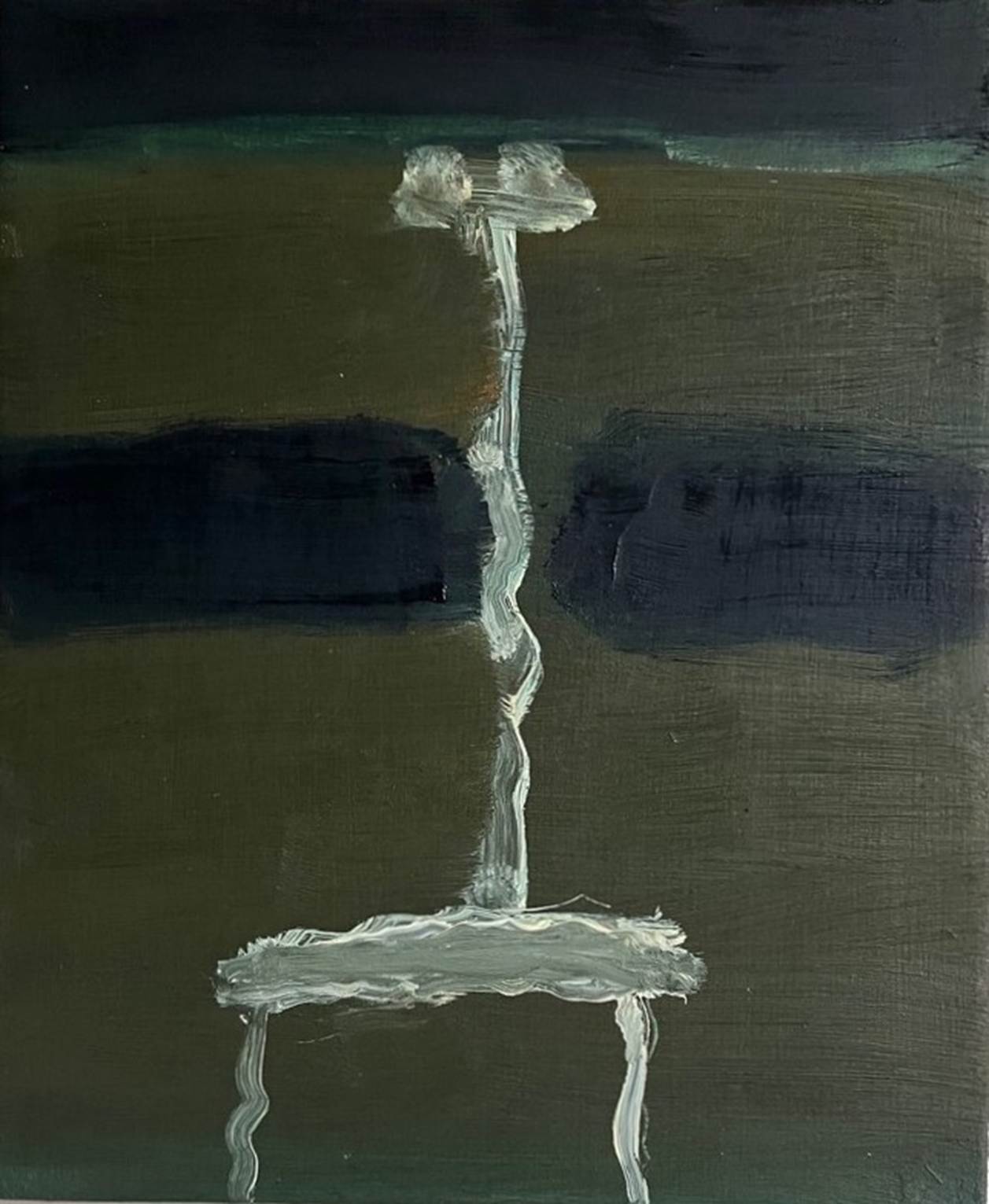
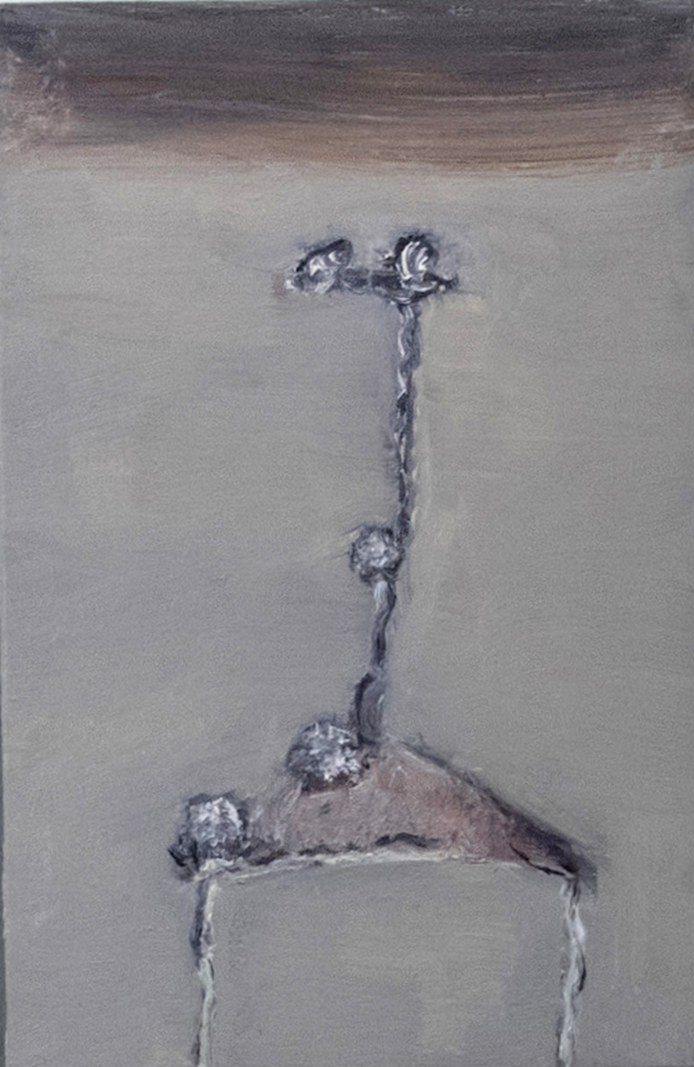
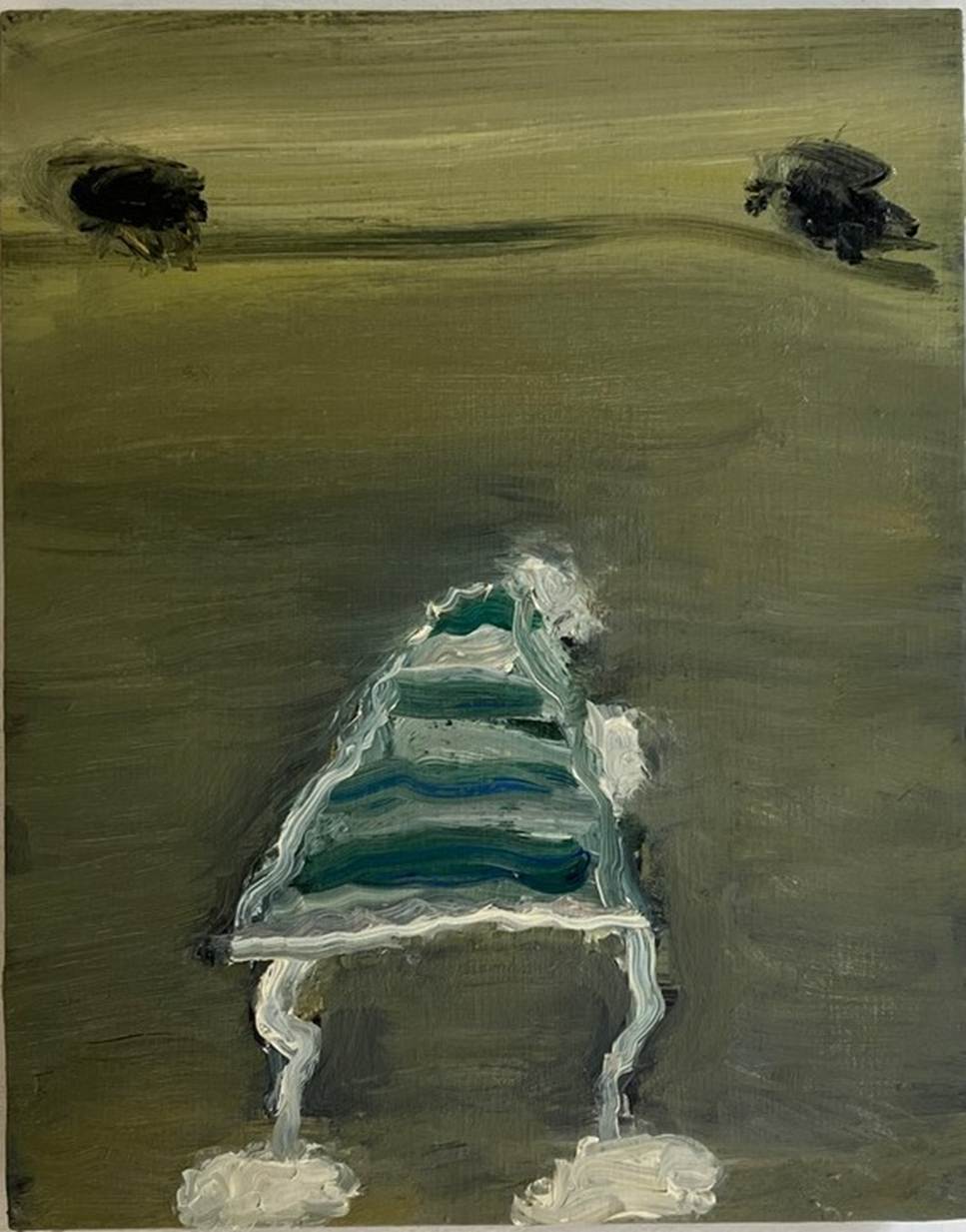
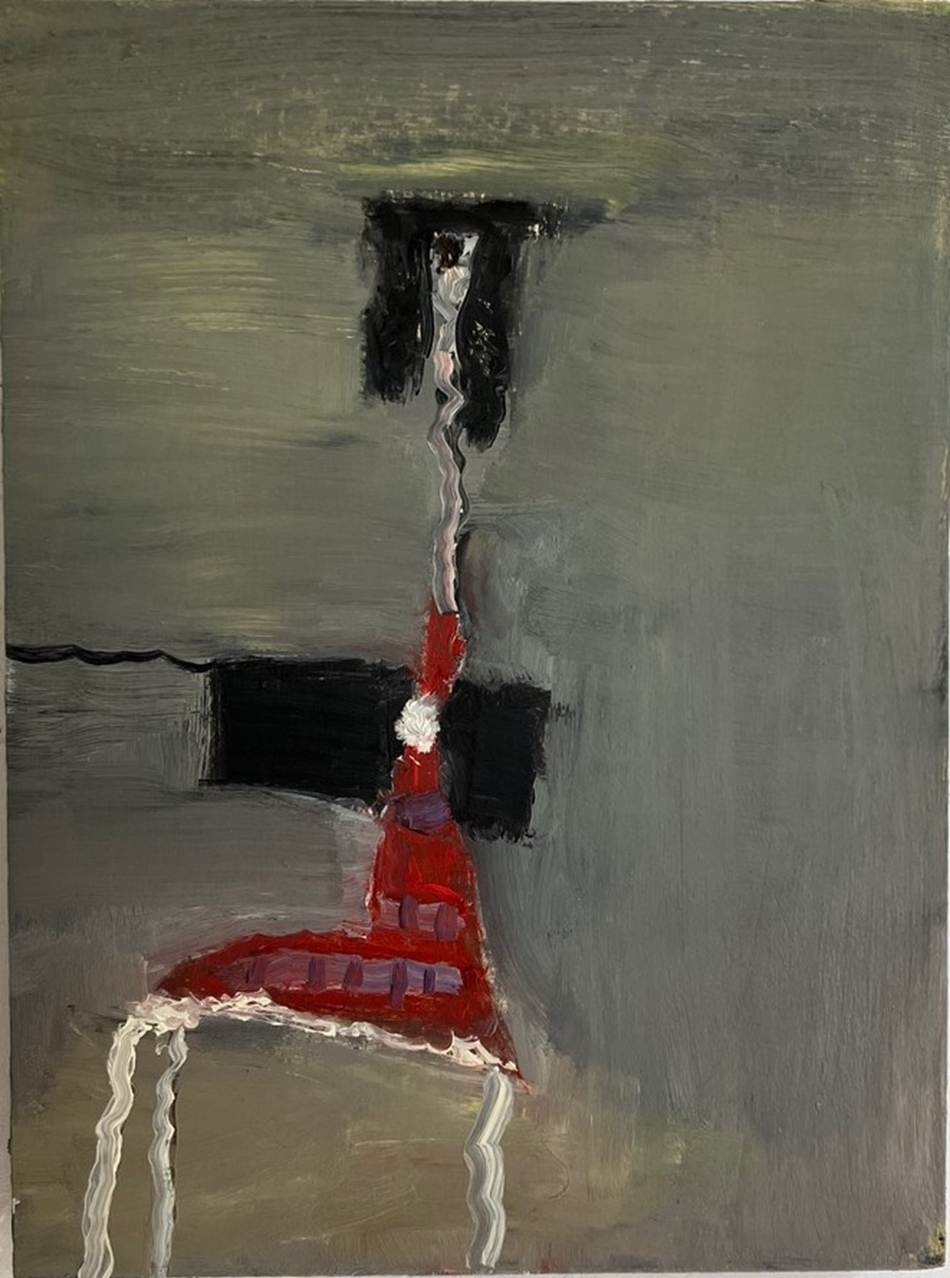
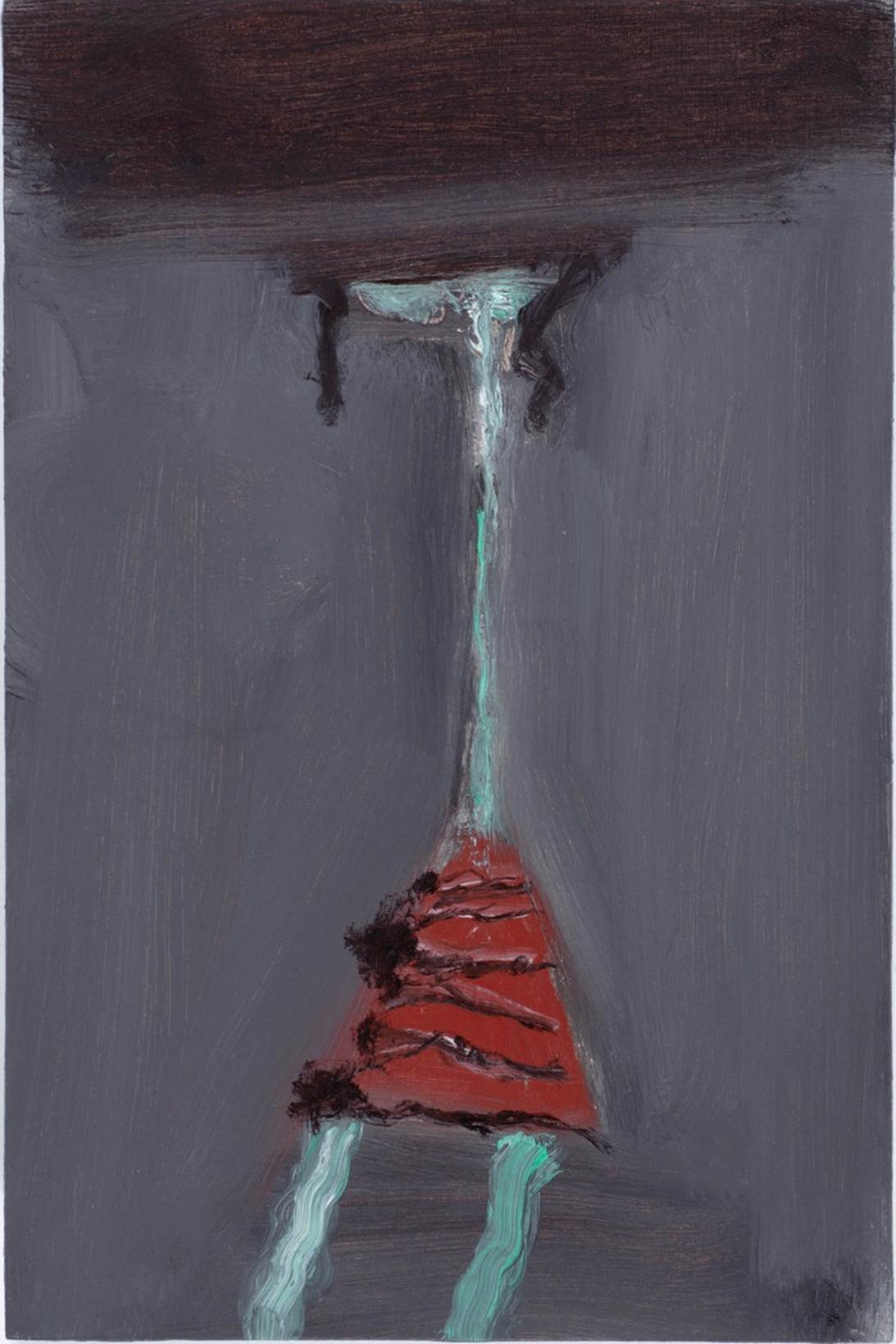
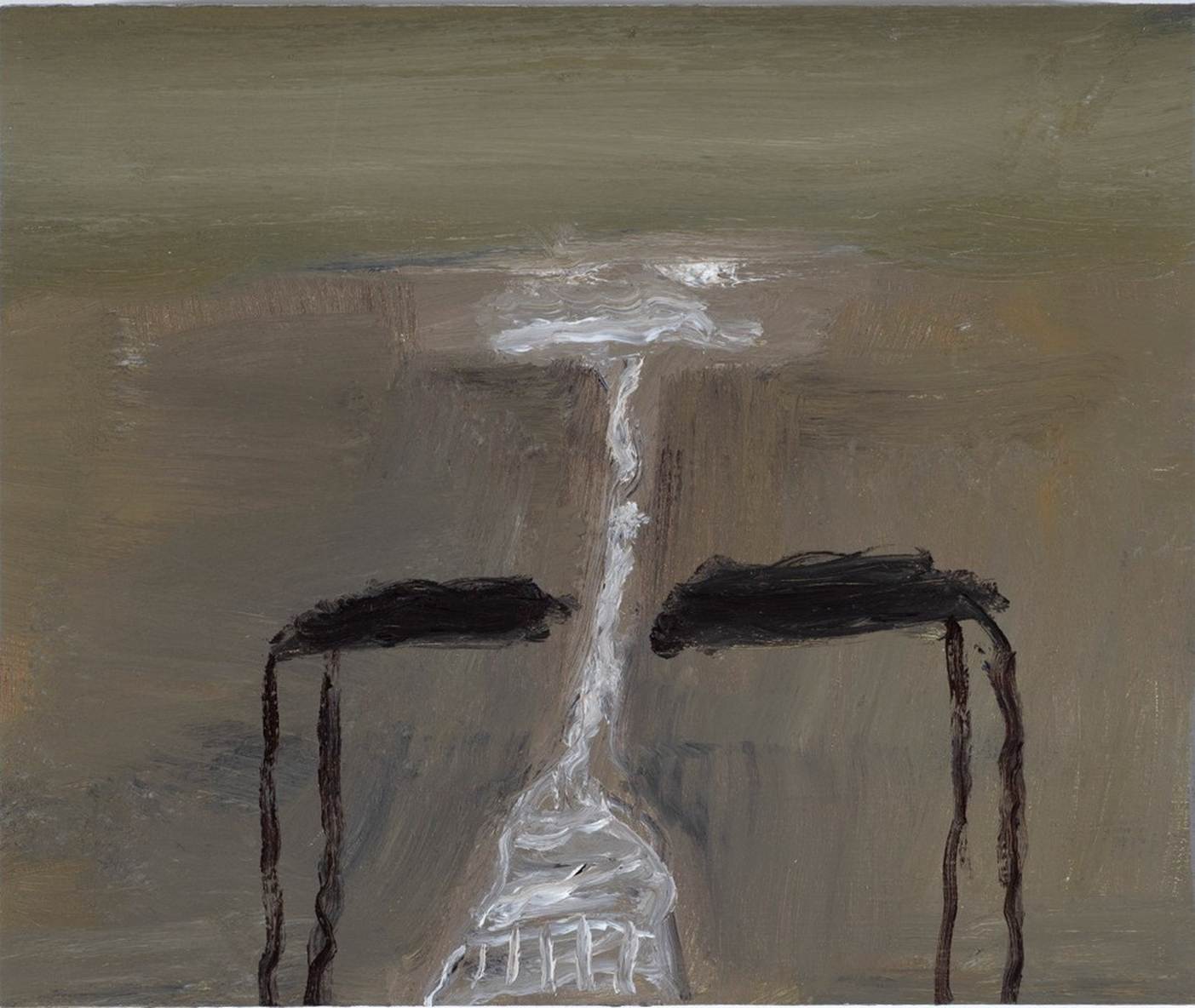
This defies any attempt to discover what it signifies. It exists solely as an object made out of words. That is why it can shatter the window-pane. Read a conversation from “Party Going” by Henry Green. Consider the “plot” of “Two Serious Ladies” by Jane Bowles. One realises that an absence of significance is as crucial to the advanced art of the twentieth century as abstraction: it allowed for a modernism that could even be achieved in a perfectly narrative or figurative way. Italo Svevo’s writing is another example. These days, artist Michael Crowther makes objects out of paint, and I am going to let his images accompany this text:
Silly Quid, Nov ‘24, Michael Crowther
But I’ve turned my back on modernism, or so I say to myself. The idea of Mondrian beginning with an apple tree and gradually abstracting from it in order to derive a set of lines and coloured blocks; that no longer has any appeal. Art is not necessarily concerned with truth, so however true this felt for Mondrian, for me, today, it has become a cliché – and the cliché is anathema in both art and literature.
Instead, I am investing in Deep Art. What is Deep Art? Look at the visual work of Victor Hugo or Alexander Cozens. I call what they do, and what I attempt to do, Deep Art. To some extent Deep Art has been anticipated by the surrealists, though it is actually earlier than surrealism. Basically it is going in the opposite direction to modernism – begins with some involuntary chaotic action, splotches, blots, found chaos, even a confused photograph, then works into that chaos to attempt to get somewhere – to create a work that has presence. Not necessarily to achieve a figurative result (Cozens goes too far in this regard) but to a feeling of resolution in the artist’s mind.
Off, July ‘23
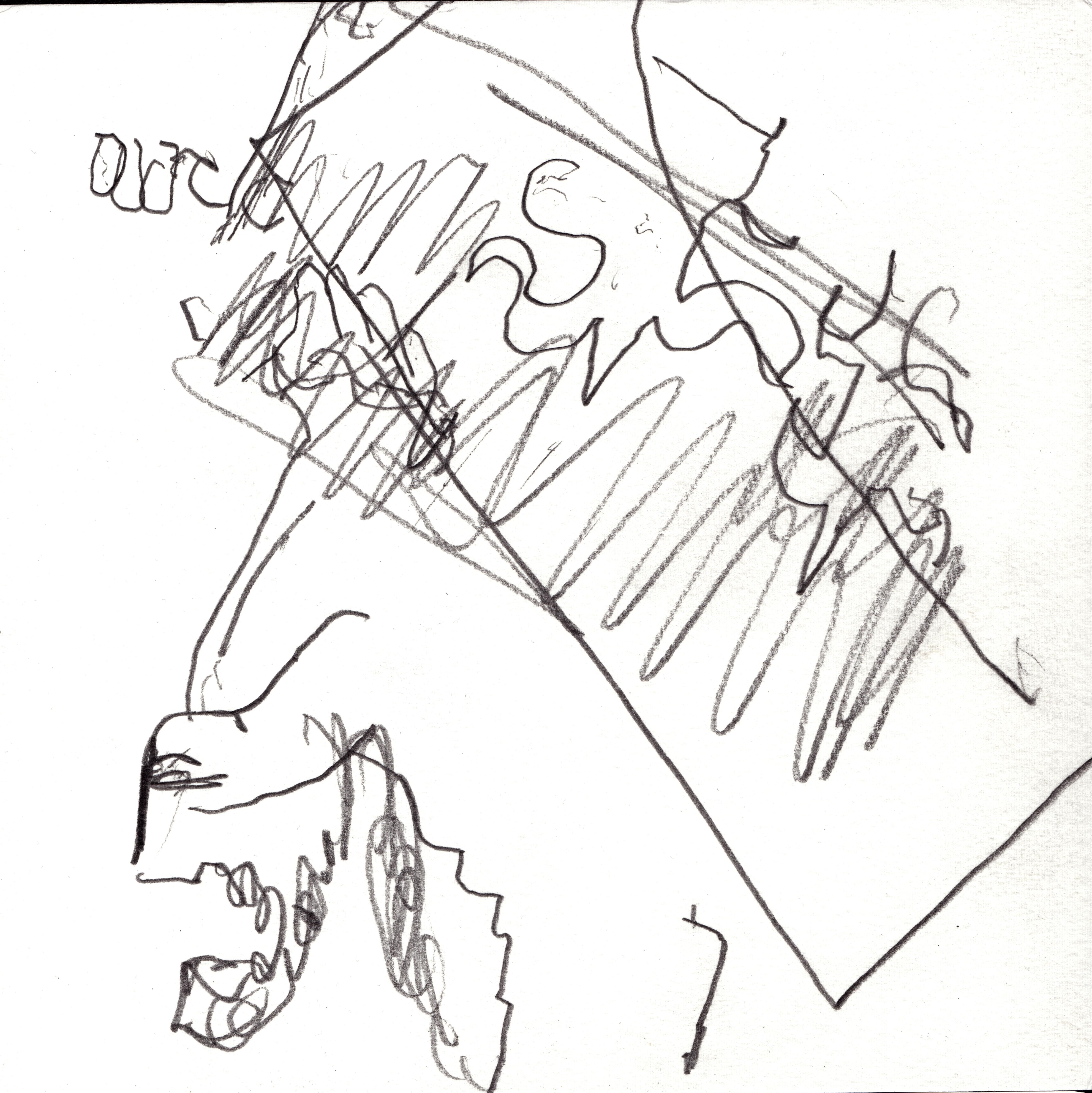
Deep Art is a departure. It is alchemy. Its primary aim is for the artist to lose consciousness of the self in the engrossment of making art. This also reminds me of Leonardo da Vinci’s advice: to look at a wall – at its blotches and imperfections, and see what image you might discover there. Deep Art is done as a form of personal meditation. This is the only response to an “artworld” flooded by ambitious practitioners.
So Deep Art emerges from chaos. Happy with this mantra, I set out. But as is often the case when intuition wears off, doubt sullenly emerges. I cannot help but ask, are there a variety of forms of chaos? “Forms of Chaos” – there’s an irony. No chaos should be the same as another. If two sorts of chaos were the same, they would be considered a pair, and not chaos therefore. Repetition is order. It turns out that chaos is not that easy to generate.
Harthope, May ‘26
I would like to start in chaos and arrive somewhere. Achieve a goal, when, at the start, I had no goal. Actually, I do not need to arrive anywhere. I don’t have to have a goal. I would like to start in chaos and achieve presence.
Presence is what I find in the paintings of Michael Crowther. They are done on wood. They make a nice clunk when set onto the pins which place them on the wall. If you threw one at a window, it would definitely shatter the pane.
Bollihope May’25
Throughout history, each independent mind struggles to emancipate itself from the fixed ideas it has inherited. For artists of Crowther’s generation and my own, abstraction was very much the order of the day. For a host of non-practioners, modern art looked abstract or surreal. Even more naively (and this is particularly true of British pundits) art had to be significant, resolved: it had to accomplish its meaning. Take Peter Fuller in art, and F.R. Leavis in literature. The one expressed admiration for the aesthetic principles of John Ruskin, the other championed seriousness and moral depth in literature. Their naivety would have appalled Schopenhauer. But for pundits such as this unremarkable twain, only through significance could art achieve its true equilibrium – which brings us, at last, back to Kharms.
Bollihope,’24
Yes, it is necessary to get out of equilibrium. Because there is so much art that is resolved, very much so, but in ways which are trite: it’s art that’s too easily read, whereas I struggle with the paintings of Michael Crowther. I am told that they are figurative. But they are not like anything I’ve seen. At the same time, abstraction isn’t a term that I would apply to them. These paintings are elsewhere. An object is suggested, in the foreground. This is the case because there is clearly a background. But as to what that object is, or what is in the background… There I have to use guesswork, and this only helps a little bit. If these works are figurative, what they figure ought to be my prerogative. Thus I am led into each one by hint and by intuition. That could be a distant clump of trees, that could be one of those barns you see on farms with open sides, that could be a barbecue set up on spindly legs, but it might not be, it might be a creature with spindly legs.
Farmer’s Boy 2024
Getting out of equilibrium, getting out of a comfily resolved idea of what art might be. Going off at a tangent, as in this essay. Getting away from some received idea about what art is supposed to be. Somehow Philip Guston achieved this, when he broke with abstraction. Michael Crowther achieves it in these small intense paintings shown by Benjamin Rhodes at his gallery in Old Nichol street. They provoke uncertainty and achieve presence. And what do I mean by presence? That is for you to decide.
Anthony Howell, 28/08/2026
***
“Crowther’s book-sized panels are imbued with thinking about painting, writing, history and landscape, each its own work of visual poetry – we continue from his brilliant solo-installation of last year: Bollihope and Others which loudly declared an integrated vision at home in an enigmatic and painterly strangeness.”
It takes you to several performance art videos and videos of the slideshows I made a few years ago – many drawn with the eyes closed. There are also slideshows which accompany readings and videos of my poems.
The French invented impressionism and modernism: the British invented children’s literature and nonsense poetry. Zola’s Nana can say, Fuck me! to a young man paying her a surprise visit. For a British writer of the same period, that is quite impossible to say. In Britain, women do not have bottoms, they have bustles. They do not give birth, according to J.M. Barrie: babies are birds. Other birds hatch them, and they fly off to mothers and become children. France and Britain have a relationship which is similar to a difficult marriage. The two countries are very close, and many British people aspire to speak French, far more than aspire to speak Spanish and more also than aspire to speak German, though German is also fairly popular. However, in my own schools, only Latin and French were taught. Like husband and wife, we are familiar with each other’s ways, but the husband’s way is not the wife’s and vice versa.
The French woman is the comrade of the French man, thanks to their revolutions, though the man can be a brute and beat the woman savagely, and the wife can be a whore or a courtesan. I am speaking in the language of generalisations here, because in what we call “The Victorian Age” such generalisations seem to have affected the production of literature, though George Meredith can be pretty direct, as in his novel The Difficult Marriage. The British paid little heed to the realism promoted by French writers. More often, appalled by the promiscuity of the Georgians who dressed in full fig and fucked everything above and below stairs, the staid, mercantile Victorians reinvented womanhood as a sexless willow, wearily drooping, or faintly floating away like Ophelia on some water-lily stream. Famously, it was Ruskin who was appalled to discover that his wife had pubic hair. The Edwardian reaction was savage. People have been justifying our new terrorist laws designed to suppress protests against weapons factories by citing the demonstrations of the suffragettes as if these were genteel. This is false history. The suffragettes were genuine revolutionaries. They had to be. In Great Britain and Ireland, between the years 1912 and 1914, the suffragettes orchestrated a violent bombing, assassination and arson campaign.
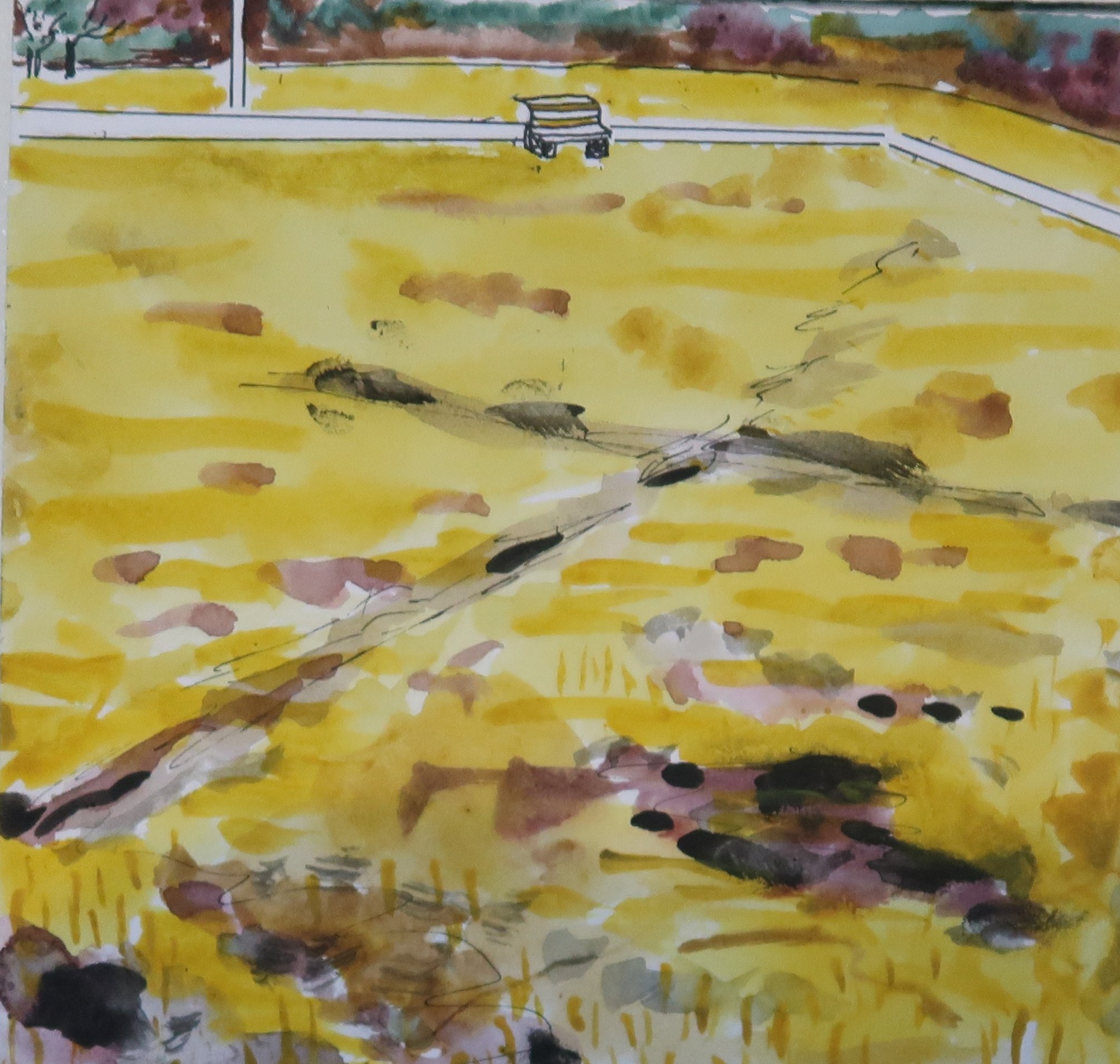
Now John Ashbery always said that he preferred the byways of literature to its highways, and I have tended to agree with him. Indeed, I enjoy the ultra-esoteric. You could say I like to follow some goat track of literature. It’s fun to explore wherever such a track may lead. Being the only person on the planet to be reading a particular book is to me a greater pleasure than that of reading a best seller. It makes me feel unique. Recently I began painting water-colours of London’s statues, and visited Kensington Gardens, where Peter Pan stands on top of a magical tree-stump piping to the fairies who clamber up to listen to his piping (and to peep under his smock). The statue is placed on the very spot where Peter landed in his mud-lined thrushes nest on his first excursion from Bird Island. In the way of quantum connections, this led me to recall a book I had seen in my childhood but never read. I managed to find a copy, and found myself alone on a goat-track.
J.M. Barrie’s Peter Pan in Kensington Gardens is to my mind an eccentric masterpiece. The writing is just different to anything I have ever read – it’s a grown up book for a child or vice versa. There is great sadness too, although it can be very funny. But in those days, children often died, and parents and siblings were often traumatised. Barrie is no exception. His mother was clearly traumatised.
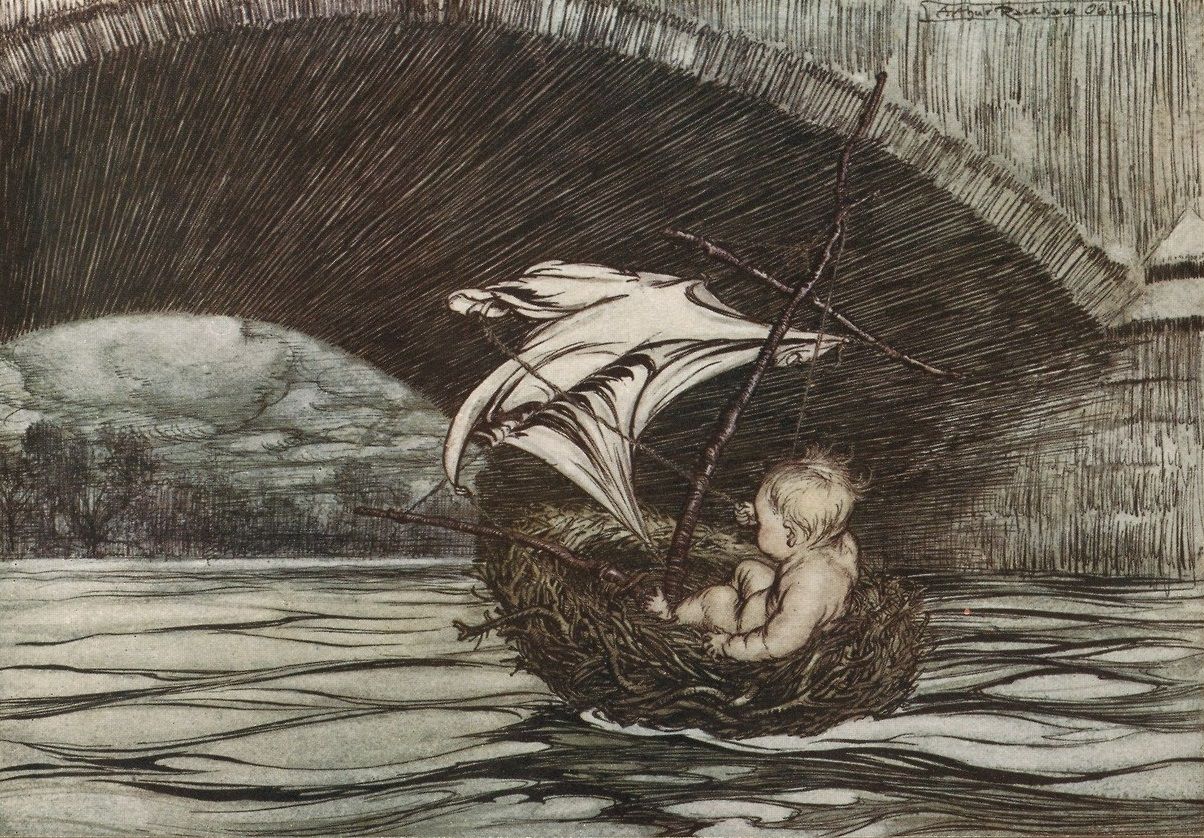
Illustration for the First edition of Peter Pan In Kensington Gardens, 1906.
The question is, Who is a children’s book written for? It is easy to respond, For the child. But if the book is being read to the child by the parent, or the uncle or the nurse, especially in those Victorian times, such a response is suspect. Books for children which are expected to be read by children are one thing – Treasure Island and The Lion, the Witch and the Wardrobe were written to be read by children. I grew up reading Puffin Books, some of which were quite haunting and politically questionable – A Moor of Spain; the Story of a Rogue being one (written by Richard Parker in 1953 – who seems to have written no other book).
So there is already a split between books written for children who cannot yet read and books written for children who can. The books written for children who cannot yet read are actually being written for the reader who is a grown-up, and this is the case, I believe with Peter Pan in Kensington Gardens.
Peter is of course the archetype of the lost child, and that child is epitomised in the book with this title, which, though published later, must have preceded Barrie’s popular West End play featuring Wendy, Captain Hook and Neverland. This earlier version is a far more surreal story, tragic, and hauntingly written, and with the strangest of all Arthur Rackham’s illustrations to accompany the writing. The tale is a creation engendered by the Victorian unsayable, as is the case with Charles Kingsley’s TheWater Babies.,
If I shut my eyes, you’re not there. While the Victorians could deny the existence of sex (which never stopped boys getting erections or girls going about their explorations), what they could not do was to deny the existence of death, and we remember death. When I was seven I recall that our school library had a bookshelf dedicated to a boy called Peter, who had died. A few years later, a boy I knew died of leukaemia. Deaths in childhood were far more common in the nineteenth century than in my own time or now.
According to Andrew Birkin’s J. M. Barrie and the Lost Boys: The Real Story Behind Peter Pan published in 2003:
‘When James Barrie was six years old, his elder brother David (their mother’s favourite) died in an ice-skating accident on the day before his 14th birthday. This left his mother devastated, and Barrie tried to fill David’s place in his mother’s attentions, even wearing David’s clothes and whistling in the manner that he did. One time, Barrie entered her room and heard her say, “Is that you?” “I thought it was the dead boy she was speaking to”, wrote Barrie in his biographical account of his mother Margaret Ogilvy (1896) “and I said in a little lonely voice, ‘’No, it’s not him, it’s just me.’” Barrie’s mother found comfort in the fact that her dead son would remain a boy forever, never to grow up and leave her.’
At the beginning of the book under discussion, the original story of Peter Pan, we are given a tour of Kensington Gardens as the author, who is the narrator, takes David, a toddler, and one of the sons of Sylvia and Arthur Llewelyn Davies, for a stroll around them:
We are now in the Broad Walk, and it is as much bigger than the other walks as your father is bigger than you. David wondered if it began little, and grew and grew, until it was quite grown up, and whether the other walks are its babies, and he drew a picture, which diverted him very much, of the Broad Walk giving a tiny walk an airing in a perambulator. In the Broad Walk you meet all the people who are worth knowing, and there is usually a grown-up with them to prevent them going on the damp grass, and to make them stand disgraced at the corner of a seat if they have been mad-dog or Mary-Annish. To be Mary-Annish is to behave like a girl, whimpering because nurse won’t carry you, or simpering with your thumb in your mouth, and it is a hateful quality; but to be mad-dog is to kick out at everything, and there is some satisfaction in that.
The tone may appear somewhat arch to us now, but the matter of the book is very particular: there is use of the sort of private language that families use among themselves, particularly with children. I am reminded of the “personism” manifesto put forward by Frank O’Hara – which stated that one should write a poem as if writing a letter to an intimate friend, where references that may not be available to the reader are simply communicated because the person to whom you are writing understands. The text is also, like Alice in Wonderland, a fusion of nonsense and children’s book – which is as near as the Victorians ever got to the surreal.
Moreover, the book is not as misogynist as this passage above suggests. One girl defeats an entire cricket team of boys with her unassailable Yorkers. However, the personism is so intense that I get the feeling that I am reading a work of outsider literature (“outsider art” being a term for art made by clinically obsessed or unhinged types). Such art is often naïve, but not always. Richard Dadd, the artist who murdered his father, was technically accomplished as a painter (and as obsessed by fairies as Barrie and his illustrator Arthur Rackham). Obsessive writing can be powerful and frightening and is often recognised as being great literature. Kafka comes to mind as an example. In Kafka, very often, a paragraph will begin with optimism, only to conclude in disappointment. A piece of obsessive “outsider” writing which has had a strong influence on my own work is Nijinsky’s diary – written as he descended into catatonic silence. When speaking of his feelings, Nijinsky can contradict himself in the same paragraph. This has always impressed me. I guess my feelings are often like that.
Peter lives on Bird Island at the far end of the Serpentine. He flew there when he was a week old, and could still remember how to fly. When he gets there, the birds point out that he wearing a nightgown and has therefore become a boy. This awareness destroys Peter’s ability to fly. And so he is stuck among the birds on the island. The story of how he manages to visit the distant shore of the Serpentine beyond the bridge, and therefore continue to play in Kensington Gardens, and the poignant story of the two times when he manages to visit his mother make up a large part of the matter of the book.
Kensington Gardens is portrayed as a place of delight during the day. At night, after the gates are closed, it becomes a dark and deadly location infested by fairies. Traditionally, from Elizabethan times, fairies have been small; usually no larger than one’s thumb. Shakespeare lied about them, when he made Titania large enough to embrace Bottom with his ass’s head – but this was dramatic licence. Michael Drayton’s wonderful poem Nymphidia: The Court of Fairy is a far more accurate account of their nature. For instance, the chariot of the Queen of the fairies is a “snail’s fine shell”, the seat “the soft wool of the bee”, the wheels “composed of crickets’ bones.” Drayton also points out that fairies tend to be malicious:
These, when a child haps to be got,
Which after proves an idiot,
When folks perceive it thriveth not,
The fault therein to smother:
Some silly doating brainless calf,
That understands things by the half,
Say that the fairy left this aulf,
And took away the other.
Barrie’s fairies in Kensington Gardens are no less dangerous, and no child should venture into the gardens, or stay in them after dark, when the gates are shut. So now it should be clear that the delightful Tinkerbell is simply a light cast around the stage and no real fairy, and that Neverland never existed. Kensington Gardens is the true repository of ominous secrets and these gardens can tell us all there is to know about the dangers surrounding childhood.
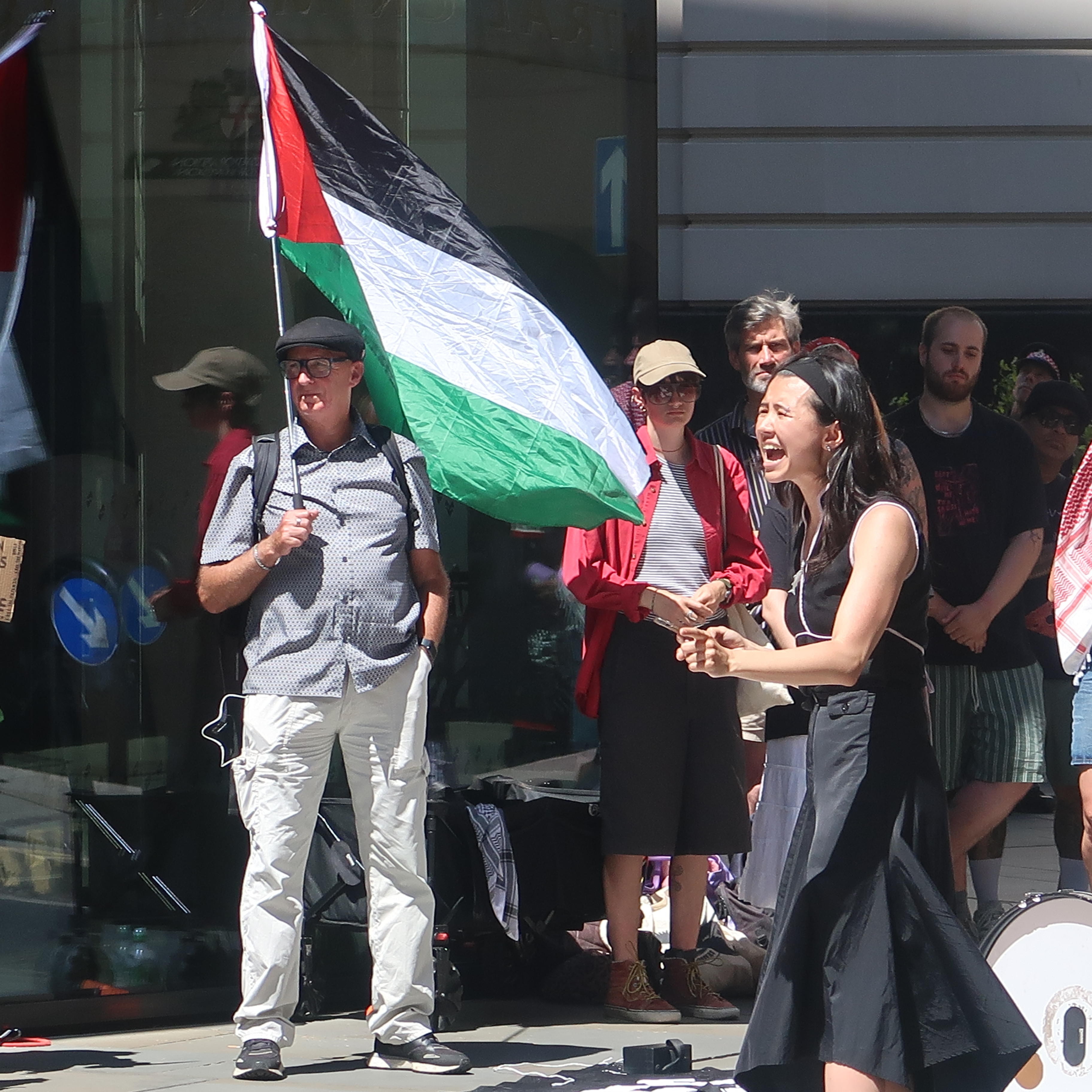
These brilliant chant-leaders inspired my full-throated responses outside the Old Bailey today, demonstrating for true justice for the Filton 25. I have to say this chanting at demonstrations has become a new sort of poetry, and these young people led us into chanting encouragement for those arrested in a truly wonderful way. The chants are important, because those facing years of imprisonment can hear us. It matters.
More than five years ago, a group of young English artists formed a workshop in London under the direction of Anthony Howell. This group, eventually to be known as the Theatre of Mistakes, uses improvisational exercises -strictly controlled by formal structure- to develop performances.
Howell concedes that he was influenced in particular by an exercise of the Living Theatre, used in Paradise Now, in which one person performed an action and another copied it. The interaction was far more interesting to Howell than anything the traditional theatre could offer. And he also felt that this exercise was more significant than the “histrionics” of the Living Theatre because it implied a new means of working in a group to create performance art.
For the next two years, such concepts as repetition of each other’s actions were used as the basis for exercises for the group, and performances were built from chosen exercises.
The Theatre of Mistakes’ first major performance was Preparation and Displacement, constructed for the Cambridge Poetry Festival in England, 1975. The Street, a work of sixty performers done environmentally on a street in Kentish Town, London, was performed in July 1975. This was followed by Ascent of the Stedelijk in Amsterdam, 1976, and Scenes at a Table: Homage to Pietro Longhi (Serpentine Gallery) in 1977. A Waterfall, a 48-day presentation, was done at the Hayward Gallery in London in 1977. And Going-which has toured Scotland, Paris, Belgrade, Bristol and Pittsburgh-was most recently seen at the Theatre for the New City in New York in late 1978. The group plans to perform works in America, Australia, Europe, and England in the next two years.
A conceptual approach to performance art has been important to the Theatre of Mistakes. Space, time, and movement are the themes that come out of the exercises. Rarely have nonconceptual ideals infiltrated the performances of the group. Rather than telling stories or stating themes, their work presents ideas. For example, a performance might be constructed from actors copying each other’s walks, speaking very quickly, using a round performance space-“rules” determined before work began.
The basic units of performance, the exercises developed in their first two years of working together, were catalogued by Anthony Howell and another member of the company, Fiona Templeton. In Elements of Performance Art, a few hundred copies of which were published for use by the company, simple “building blocks” are listed with suggestions about how they may be constructed into performances.
For example, the booklet suggests ways that people can relate to physical space: horizontally, vertically; moving fast, moving slowly. Improvisations are constructed when a group chooses which exercises are allowed in the improvisation. The rules are set up before the performance.
Elements of Performance Art is a reduction of improvisation rules to their simplest for·m. The rules of the exercises are extremely.varied. Before any workshop or performance there are many options open to the group.
A section called “Body Speed and Travelling Speed” sets down two continua: Slow
Fixed Spot— Travelling
Fast
Four rules can be constructed:
Perform any body exercise slowly as a means of travelling across any distance.
Perform any body exercise fast as a means of travelling across any distance.
Perform any body exercise slowly while remaining at a fixed spot in space.
Perform any body exercise last while remaining at a fixed spot in space.
Two possible solutions to the problem of staying on a fixed spot in space are offered:
Keep at least one part of the body at an’,’time in contact with a fixed spot (e.g. if leaning away from that spot).
Keep the center of gravity above a fixed spot (e.g., jumping off that spot or standing with one foot on either side of that spot, etc.).
And the guide book offers two further bits of advice:
Perform the possibility that best expresses the exercise, and perform it consistently.
Remember that the body can move fast while one is travelling slowly and move slowly while one is travelling fast.
Elements of Performance Art offers exercises for body positions as well. In an exercise called “Angles/Curves,” which was useful especially in Homage to Pietro Longhi, Howell and Templeton suggest to performers:
Take up any position that employs one angle (and_ its complement). One at a time, add angles equal to the original angle.
OR
Take up any position that employs one curve (and its complement). One at a time, add curves equal to the original curve.
They add, “Equal angles or curves may be two-dimensional-parallel or symmetrical limbs viewed from one sightline-or three dimensional-in any direction from any sightline.”
Another exercise that is often used in the work is called “Horizontal and Vertical Exercise,” in which any number of performers choose between two options:
Be horizontal, either on your back or on your front, legs together, arms by sides.
Be vertical, feet together, arms by sides.
A performer is instucted to do only 1 (i.e., use only horizontal positions), or only 2 (i.e., use only vertical positions), or to alternate between the two (quickly switching from vertical to horizontal), or to use several positions from 1 and from 2, (using several horizontal positions then several vertical).
The body positions are set in space with two further choices:
Be horizontal and parallel or at 90° to any edge or straight demarcation of the performance space or along any radius of a circular performance space.
Be vertical at any space that is on an imaginary line between you and another performer …, the line to run parallel or 90° to any edge or straight demarcation of the performance space or along any radius of a circular performance space.
Two other suggestions are made for the exercise:
If changing from a horizontal to a vertical position (or vice versa), employ a consistent method of moving for the transition.
Choose a“trigger”inordertodecidewhento startandwhento cease performing this exercise, or when to start and when to cease performing any or all parts of this exercise.
This canon of possibilities covers use of body, sounds, time and space, equipment, and “manifestation,” or approaches to performance. The catalog of choices has been used to generate thousands of exercises and variations. All of the performances of the Theatre of Mistakes have been based on work with such exercises. But they have been extremely varied in their presentation and in their content.
The Theatre of Mistakes suggests measurements of time and space within a performance be measured in terms of the performance itself. For example, yards can be measured as performers’ strides and feet by their steps; minutes are replaced by the time perod one can hold one’s breath; seconds are measured by counting beats or speaking metrical lines. “A company of artists,” Howell and Templeton write, “may perform below an oak tree, in the shade cast by that oak tree, for as long as it takes for one of them to climb up to the top of that oak tree.”
The use of the measurements of time within the performance itself has led the Theatre of Mistakes to develop the use of performers “as metronomes.” “A performance may last the time it takes for one performer to move along a set route,” they say, “each turn that the performer makes may constitute the end of one act and the beginning of another.” In such works as Table Piece, Homage to Pietro Longhi and Going, and act was defined as the period of time it took one performer-the metronome-to walk the sides of the square performance space.
• • •
The Theatre of Mistakes does not feel any compulsion to act. The “drama” of their performance comes from each performer’s efforts at “extending” his or her own behavior by using exercises. The plays are “about” their real lives dealing with the exercises during any given performance for as long as it lasts. Their goal is action, not acting as if.
“Amplification of the present” demands that actions not be preconceived but spontaneous; yet they must stay within established rules, such as time, space, number of performances, number of exercises, etc. For example, a rule might be made that men would have to walk backwards whenever a woman was speaking. Or a scene would end as soon as an actress finished counting backwards from one thousand, or performers could only speak in French if a passerby happened to be wearing red.
One of the most important exercises became “being someone else.” “Let one performer attempt to repeat the behavior of another,” one reads in Elements of Performance Art. This is “an attempt ‘to be each other,’ rather than acting and pretending to enact a character.” The activity of building performances by repeating actions set down by an “instigator” (the term used by the group to describe the person who introduces new material to a performance), became a central concept for most of the Theatre of Mistakes’ presentations.
The Theatre of Mistakes worked at first with very simple actions that could easily be imitated. As they became more adroit at copying one another’s actions, they used increasingly complicated behavior. Chains of actions became longer, and there even entered into the exercises the possibility for sabotage of the other performers (i.e., a performer would initiate extremely complicated actions, for example, singing a high note for 35 seconds, and the other actors would not be able to repeat the action), and the probability that there would be “mistakes” (not being able to sing the note, for example)-hence, the Theatre of Mistakes.
Mistake-making became an integral part of the performances. Various signals were developed for use after mistakes were made. The signals would both alert a performer to his error and lend drama to the performance. One of the common signals that a mistake was made was a swoon. If a sequence of actions became impossible, a performer would simply cry out and fall lifeless to the floor. In Homage to Pietro Longhi, for example, a malevolent instigator set down actions that were to be performed on tiptoe. Many a “swoon” resulted after twenty minutes when other performers could not keep up the rigorous demands of the instigator.
Signals were developed to let performers correct mistakes made by others. In Going, someone who detected an error in structure would cry out, “Hold it!”, at which point all performers froze; the critical performer would physically carry their frozen bodies to their correct positions. Then they would shout “Okay!” to signal the others to continue the performance.
Form is strictly adhered to (the form is the sum total of rules of time, space,
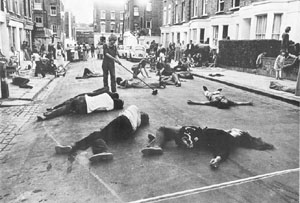
words, etc. established before the performance), without regard to the effect on the audience. The structure is more important than communication of themes to the audience. Although narrative is never preplanned, if it should flow from the exercises, the Theatre of Mistakes will let it develop (so long as all performance rules are maintained). For example, in The Street a rule was made that if a passerby walked in a particular direction on the street, everyone would swoon and fall to the street. Many Londoners felt there was a “theme” of violence, which was not planned but left in the performance nonethelesss.
The Street
An early work of the Theatre of Mistakes, The Street concentrated on simple structures for performance by many people in the London neighborhood where Anthony Howell lived in July of 1975. They worked on the performance for six months.
The Street was a chain of exercises performed outdoors. There was no theme, except perhaps time, space and flow patterns. The only “contents” of the performance were the comings and goings of Ascham Street itself. There was no story or plot to The Street. It was an improvisatory performance that used only elements found in the neighborhood. No extraneous information was allowed to enter the performance: it was “about” the street. For example, the actions performed were such things as sweeping, carrying groceries, watering flowers, and other things that would be seen on a typical day in London.
The sixty performers were free to improvise but only when it was their turn. A very complicated chart was constructed by Howell so that each performer knew when he or she would enter the performance. The actions, which at first were very simple (long-held freezes, many repetitions, etc.), became increasingly complex because the “ordinary people” became more and more skillful.
All of the words that were used in the piece were spoken on the street during the first ten minutes of the performance. Performers placed in windows along the street wrote down what they heard: neighborhood banter, questions about the performance, compliments and pleasantries, obscenities when an angry neighbor yelled out his window one day. Then the writers of the text structured the words into fourteen-line sonnets, canons, and other verse forms. Thus the first ten minutes of the play were used to gather words and gestures and the rest to recreate them in new forms: the people of the neighborhood acted as initiators of actions that were copied by the company. All of the performances were different because different words were overheard each day.
Rules set down before the performance gave it structure. For example, performers always walked on the left side of the street. Some performers acted only in the street and others stayed in windows along the side. The performance was limited to one full block of the street, so neighbors and passersby would be involved unwittingly in the performance. As the group worked out their actions and gestures, people would shout at them or come up and interrupt to see what was happening; they would walk through the street and thus were sometimes part of the performances.
To the spectators, there was a feeling of genuine order, but this order was too complicated to figure out unless one had been in contact with the group. Neighborhood people became increasingly friendly. Even the hostile ones often warmed to the group when they realized their insults had become sonnets repeated throughout the piece.
The Waterfall
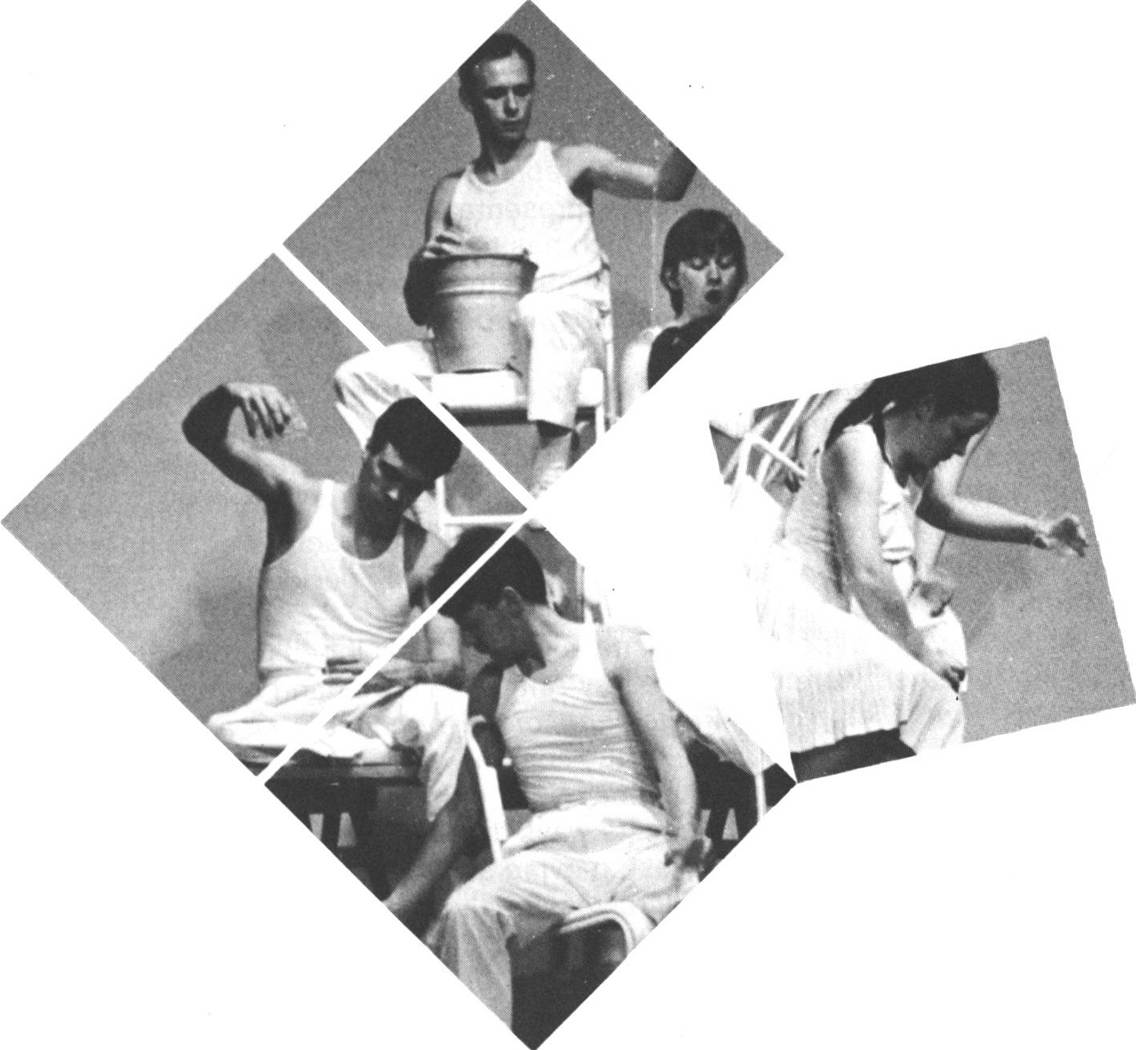
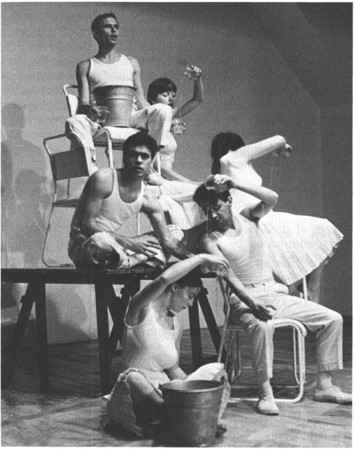
TheWaterfallwas performed over a forty-eight day period at the Annual Exhibition of the Hayward Gallery in London in 1977. The action was to raise water from a bucket on the ground to another empty, elevated bucket, one cup at a time. Each performer used two cups to transfer the water upward, each pouring his or her water into another performer’s cup simultaneously with the others. The performance ended as all the water was poured carefully into the bucket left on the qround.
Each day the piece became more complex by adding performers, increasing the height of the set, and expanding the verse that was used. The performance also grew longer each day it was performed. It took about thirty minutes to fill the top bucket with water on the forty-eighth day.
Scenes at a Table: Homage to Pietro Longhi, a piece begun in the summer of 1975, was a series of improvised actions and words. Performers took turns inventing actions (which included gestures and words). Each performance was therefore different.
In each act, the instigator (i.e., the actor who improvised actions for the others to copy) performed what the group calls “Primary Scenes.” The audience would never know what to expect, since there was no restriction whatsoever on what actions actors could initiate. Then other performers, one at a time, would copy the instigator’s actions.
The audience felt as if a fugue were playing. In other words, after Performer One had created action A, he would invent action 8. Meanwhile, Performer Two would join the scene, recreating action A. Then three actors would be involved, then four. One performer always moved around the outside boundaries of the square performance space. He or she, a different performer in each act, would usually stare at the actions being performed by the others. This person was the Metronome, who controlled the length of the scene. He or she would indicate when the scene was over by reaching the starting place on the square. This function, however, was unclear to the audience. The Metronome seemed to be a strange spectator moving about the space.
Since actors were not limited in what they improvised, they used exaggerated postures and gestures, which changed from performance to performance. There were many awkward positions that were obviously very difficult to mimic, postures that were off balance or done on tiptoe, for example. In some performances, there were numerous costume changes, involving many hats, coats, gloves, and other articles of clothing. Each performer would execute exactly the same complicated sequence of costume changes as the others.
No consideration was taken of whether the audience could see all of the actors at any given moment. Many times the spectators would not be able to see all the performers because they would stand in front of each other. There was, however, a strong feeling of three-dimensions in the work. A viewer had a sense of performers being close by, far away, and in between. The feeling of depth created was reminiscent of Pietro Longhi’s paintings.
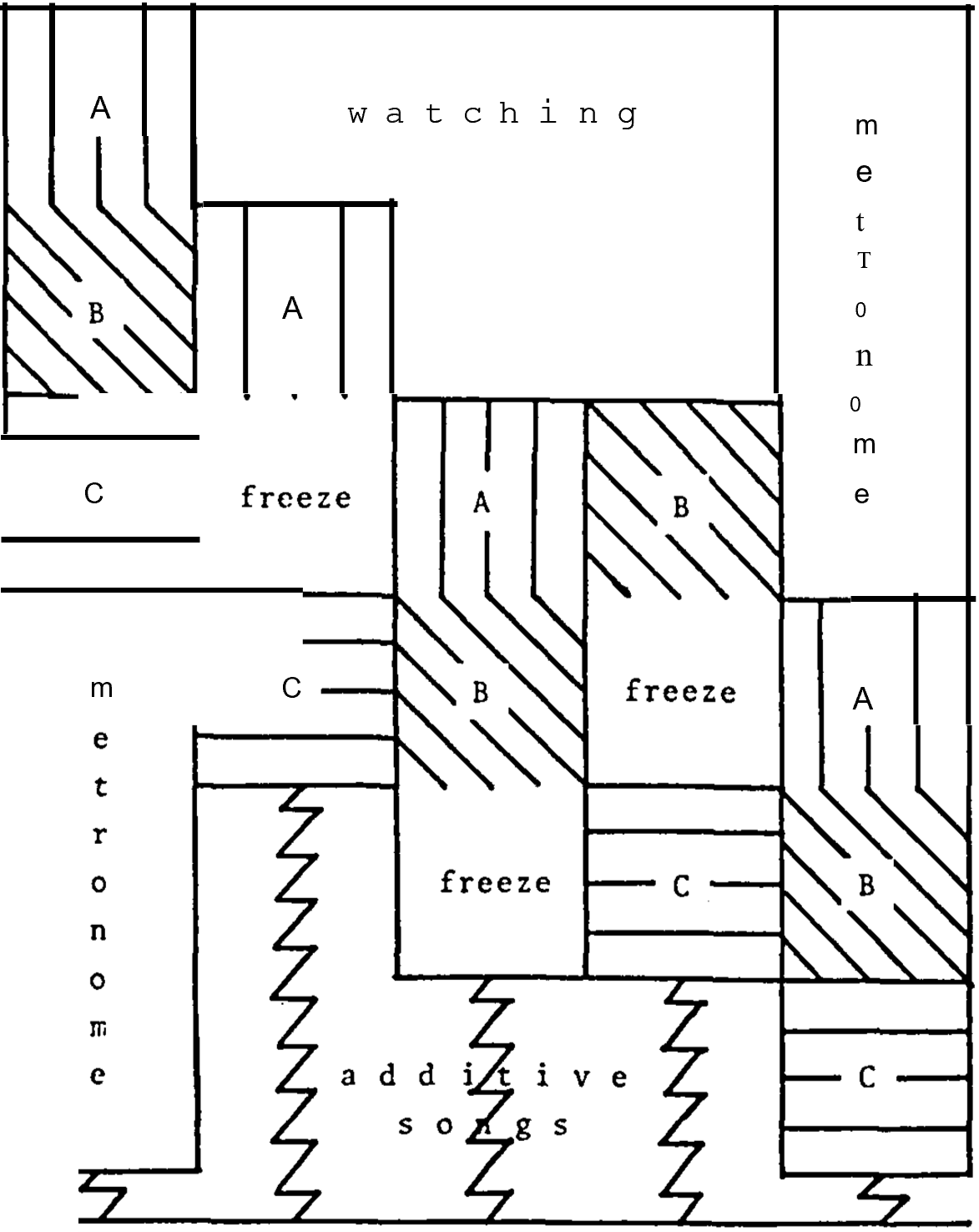
The way in which the performance was constructed was extremely complex. (There was a strong clash between rigid structure and improvisation). A diagram is very helpful:
Performers:
The horizontal blocks represent the five performers, the vertical blocks represent scenes 1 to 6. A, B & C = actions & words
ONE ACT
To imitate other actor’s actions, the performers needed moments when they were not doing anything, “spaces” during which they could stand still and watch segments they would have to imitate. That is why watching is included in the diagram.
“A”, “B”, and “C” indicate actions and words. The five performers in turn
improvise new actions and dialog for the drama. Thus, the audience sees what might be called a rehearsal process.
In Scene 1, Performer One improvises a series of words and/or actions. These are called “A”. Performers Two, Three and Four watch carefully, for they must repeat
“A”. Performer Five is the “metronome”: he or she walks around the performance space to control the length of the scene.
Scene 2. Performer Two recreates” A” as One did it. One improvises or instigates “B” (words and actions). Three and Four watch. Five is still the metronome.
Scene 3. Three and Four enter the scene. One improvises “C” (words and actions). Two must freeze to watch One’s actions. Three repeats “A”. Four repeats “B”. Five is still the metronome.
Scene 4. One becomes the metronome. Two repeats “C”. Three repeats “B”. Four freezes to watch Two doing “C”. Five does “A”, which he or she has watched while being the metronome.
Scene 5. Two does “additive songs” while Three freezes and Four repeats “C”. Five repeats “B”. (No one does “A”.)
Scene 6. Two continues additive songs. Three and Four begin additive songs. Five repeats “C”.
This diagram represents one act. For the next four acts, the performers changed their starting positions onstage (and on the diagram).
The same diagram is pertinent for The Table, a piece performed about the same time, and for Going. The three works are thought of by the group as a trilogy.
In Homage to Pietro Longhi, a scene has taken place, in effect, among three characters played by five people. One can never know who is playi_ng whom, for everyone “plays” at being everyone else. Hence, the structure has superceded the individual performers and the individual characters.
In developing Homage to Pietro Longhi, the Theatre of Mistakes used the Angles/Curves exercise of Howell and Templeton’s book. Performers used angular postures inspired by the 18th-Century paintings of Pietro Longhi, who is known for creating many variations of a single posture in many different paintings. He has been the inspiration for much of the work done by the Theatre of Mistakes. He is especially useful also because many of his paintings are studies of people seated around tables and he often painted Goldoni’s commedia dell’Arte characters, capturing the postures of the actors of the day.
Going
Going was a direct response to Homage to Pietro Longhi. The group decided to create an idealized performance that would use the same structures but which was fully rehearsed and choreographed to minute details. Even some “mistakes” would be performed intentionally-showing what happened when the structures broke down. The Time Diagram for Homage to Pietro Longhi also applies to Going; the basic structure is the same, with performers adding scenes and “copying” each other in the same way.
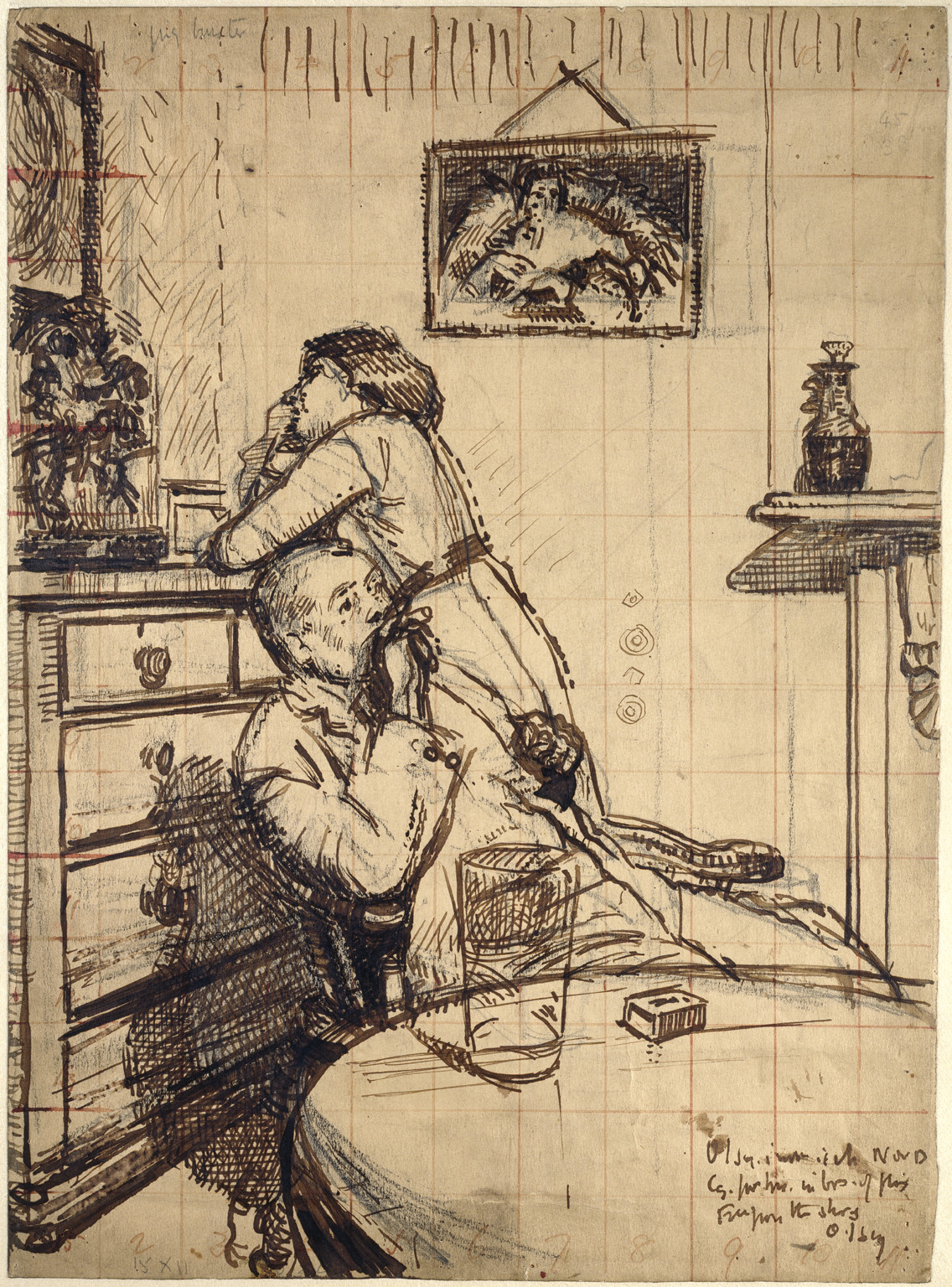
Like Homage to Pietro Longhi, Going is played on square marked out on the floor. The setting is very simple: two chairs and a table. A cigarette packet and a book of matches lie on the table. Above each corner of the square hangs a light fixture with an on/off cord dangling from it. These are the only illumination for the performance, and only one of the lights is on in each act.
As successive lights are used, progressing clockwise, the table and chairs are turned to face them, so that the relationship between the furniture-one chair behind the table and one to its right-and the illuminated corner of the square remains the same. The blocking of actors relates to the furniture rather than to the audience. Thus the setting and the performers orient successively toward a different
corner of the square in each act; Act 5 faces in the same direction as Act 1-toward the single audience section if a proscenium arrangement is used.
The text of Going contains three characters. This is the complete dialog:
I do think I’d better be going now because I… Oh, don’t be so silly.
Really, I must go.
Tell her she ought to stay. Ahem.
I do have to go now. You don’t have to go. Are you sure?
She doesn’t have to go, does she? ‘Fraid so.
I can’t stand it.
Tell me, does she have to go? I just think it’s better to.
Why do you have to go? If you must, you must. Good bye.
Bye.
Really.
I can’t stand it either. That’s why I have to go.
Do you think I ought to stay? Are you just afraid to tell me? Oh don’t be so silly.
However, these lines and the movements and gestures that relate to them are never given in t!”le “correct” order. Various elements are instigated-presented by one actor for copying by others-at different points in the hour-long performance. Bits of dialog and action are added, and therefore repeated, as the performance progresses. The gestures are simple and few: waves, leaning on the table, turning to say goodbye, covering the mouth for·an aside, and so on. Often actors remain motionless, frozen in position.
While some phrases and gestures are repeated from the beginning, the lines “I do think I’d better be going now because I…”, “Really, I must go”, “Tell her she ought to stay”, “Are you sure?”, “If you must, you must”, and “Goodbye” are not heard for the first time until halfway through Going; “Ahem”, “I have to go now”, “Fraid so”, “I just think it’s better to”, “Bye”, and the last five lines of the text are heard for the first time in the last scene. Going feels like a puzzle, all the pieces of which are not immediately apparent. The actions seem to make sense but they are out of order, repeated many times, put together in strange ways. If the puzzle is to be solved, the solution lies in the mind of the spectator.
Robb Creese is a New York writer/director who is currently producing the first program ever designed exclusively for videodisc. His piece on Anthroposophical Performance appeared in T78.•