
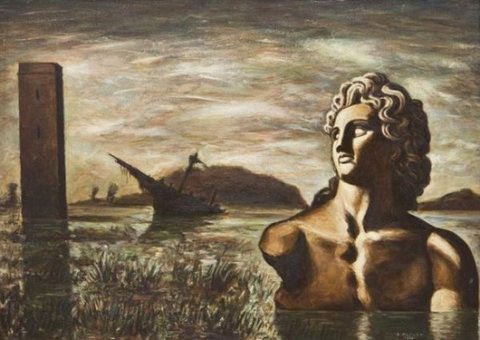
Hugely pleased that these six metaphysical sonnets by Arturo Nathan have appeared in The Fortnightly Review
Intrigued to discover a metaphysical painter I had not heard about, I bought several catalogues of Arturo Nathan’s work. In one I found these “Six Metaphysical Sonnets”. I was excited to find examples of metaphysical writing – since I already knew the paintings of De Chirico, Carra, Morandi, Paul Nash, but I had not found much metaphysical writing.
I’m not referring to the metaphysical poets of 17th century Britain, but to the modernist metaphysical movement in painting. Of course I knew “Hebdomeros” – the novel by De Chirico – but I didn’t know of any poetry, apart from that of Quasimodo, whose earlier work may be considered metaphysical. So I was all the more intrigued to find a metaphysical painter who wrote what he considered to be a poetic equivalent to his visual preoccupation.
I was richly rewarded. Take this example – Sonnet 3 – it has an eerie sense about it of immutability. That, and a powerful “clunkiness”. It reminds me of the later paintings of Philip Guston:
Ancient convoy on an immense plain.
x
An ancient train advances on its rails,
Indentured to an endless plain;
Its route’s forever straight, without a curve.
Strictly forbidden to venture anywhere else.
x
Never a pause, a scene that cannot change.
Characteristic of that plain
Coated in dark slag, hard and red,
Is that it all seems motionless, eternal.
x
An aged engine tugs this train along
On rusted wheels towards its destination.
Smoke trails from sturdy funnel.
x
Rust-corroded carriages, most empty.
In one sits a sunburnt type.
Where’s he going? What if there’s no station?


