
Is it necessary to get out of equilibrium?
This is a question asked, but never answered, by Daniil Kharms (1905-1942), the extraordinary Russian writer who is the master of the inconsequential. I don’t want to label him “absurd” as that would suggest that he was part of a school that would include Eugène Ionescu and his “Theatre of the Absurd” – whereas Kharms is an eccentric, an outlier; often writing simply for the drawer, as they say in Russia when they talk of someone who was deemed increasingly unpublishable – although, earlier, his children’s books were popular, and I believe they still are.
Kharms believed that a poem should be so made that if flung against a window-pane that pane would be shattered. For this to be the case, the poem had to become an object created so thoroughly out of words that all significance, all reference to the normal meaning of those words, had to be removed. Here is ‘An Evil Gathering of Infidels’ (1930):
Not I, Lord, is it? – thought the apostles.
Here are the signs:
a face like a mouse,
a wing like a knife,
a little steamship foot,
a house like a family,
a rope-ladder bridge,
a robe like atlas’ brow.
And only one’s a genius. Yes, but which?
One’s smart, another is a dullard, the third is a dolt.
But who’s the genius? Oh Lordy, Lordy!
All people are poor. I am a sheepskin coat.
This defies any attempt to discover what it signifies. It exists solely as an object made out of words. That is why it can shatter the window-pane. Read a conversation from “Party Going” by Henry Green. Consider the “plot” of “Two Serious Ladies” by Jane Bowles. One realises that an absence of significance is as crucial to the advanced art of the twentieth century as abstraction: it allowed for a modernism that could even be achieved in a perfectly narrative or figurative way. Italo Svevo’s writing is another example. These days, artist Michael Crowther makes objects out of paint, and I am going to let his images accompany this text:
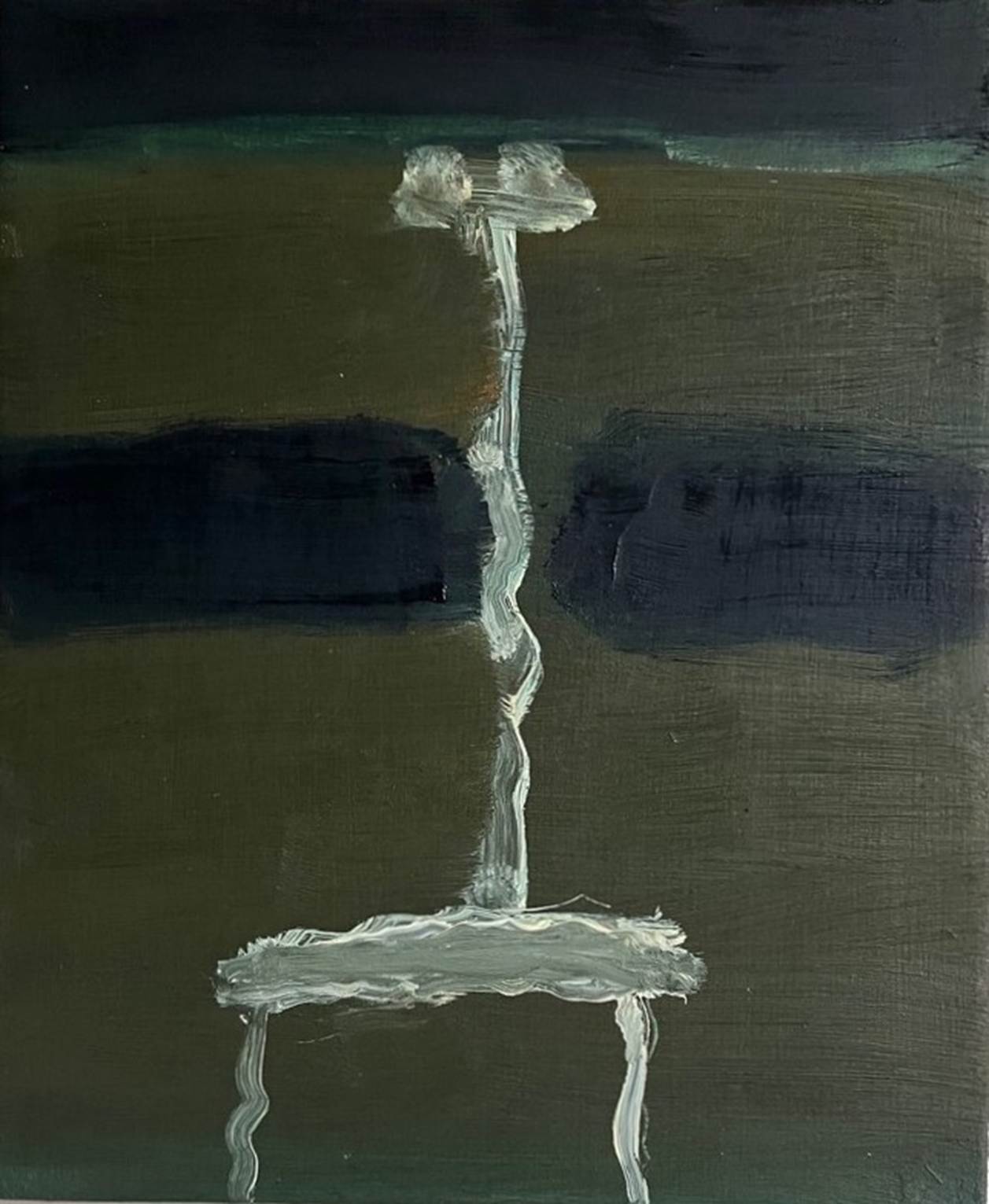
Silly Quid, Nov ‘24, Michael Crowther
But I’ve turned my back on modernism, or so I say to myself. The idea of Mondrian beginning with an apple tree and gradually abstracting from it in order to derive a set of lines and coloured blocks; that no longer has any appeal. Art is not necessarily concerned with truth, so however true this felt for Mondrian, for me, today, it has become a cliché – and the cliché is anathema in both art and literature.
Instead, I am investing in Deep Art. What is Deep Art? Look at the visual work of Victor Hugo or Alexander Cozens. I call what they do, and what I attempt to do, Deep Art. To some extent Deep Art has been anticipated by the surrealists, though it is actually earlier than surrealism. Basically it is going in the opposite direction to modernism – begins with some involuntary chaotic action, splotches, blots, found chaos, even a confused photograph, then works into that chaos to attempt to get somewhere – to create a work that has presence. Not necessarily to achieve a figurative result (Cozens goes too far in this regard) but to a feeling of resolution in the artist’s mind.
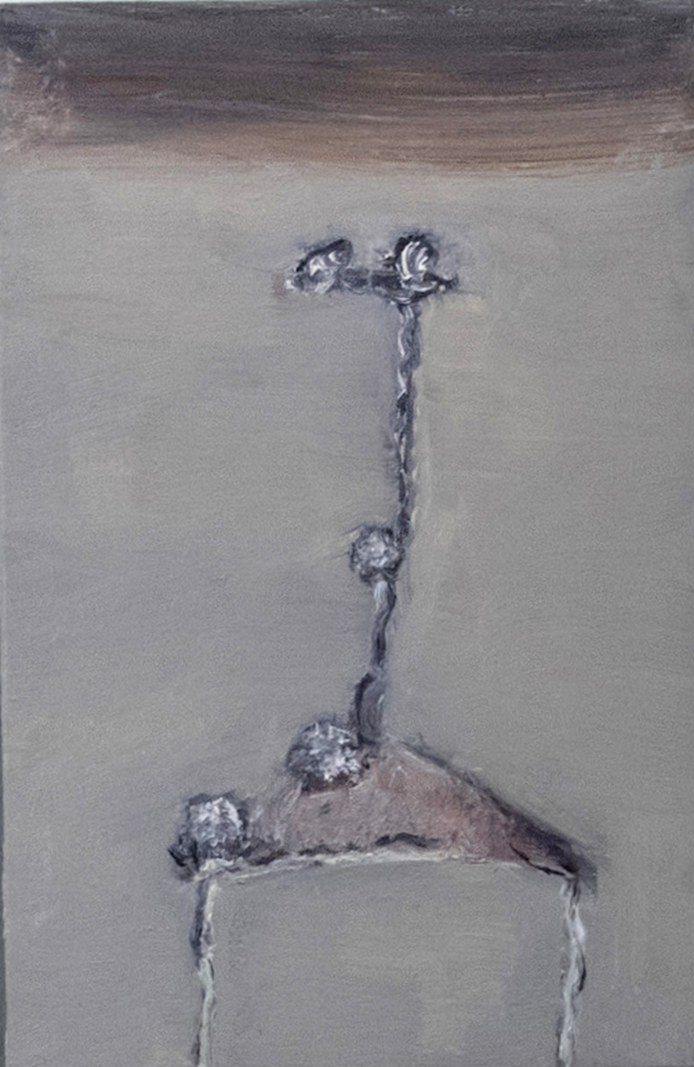
Off, July ‘23
Deep Art is a departure. It is alchemy. Its primary aim is for the artist to lose consciousness of the self in the engrossment of making art. This also reminds me of Leonardo da Vinci’s advice: to look at a wall – at its blotches and imperfections, and see what image you might discover there. Deep Art is done as a form of personal meditation. This is the only response to an “artworld” flooded by ambitious practitioners.
So Deep Art emerges from chaos. Happy with this mantra, I set out. But as is often the case when intuition wears off, doubt sullenly emerges. I cannot help but ask, are there a variety of forms of chaos? “Forms of Chaos” – there’s an irony. No chaos should be the same as another. If two sorts of chaos were the same, they would be considered a pair, and not chaos therefore. Repetition is order. It turns out that chaos is not that easy to generate.
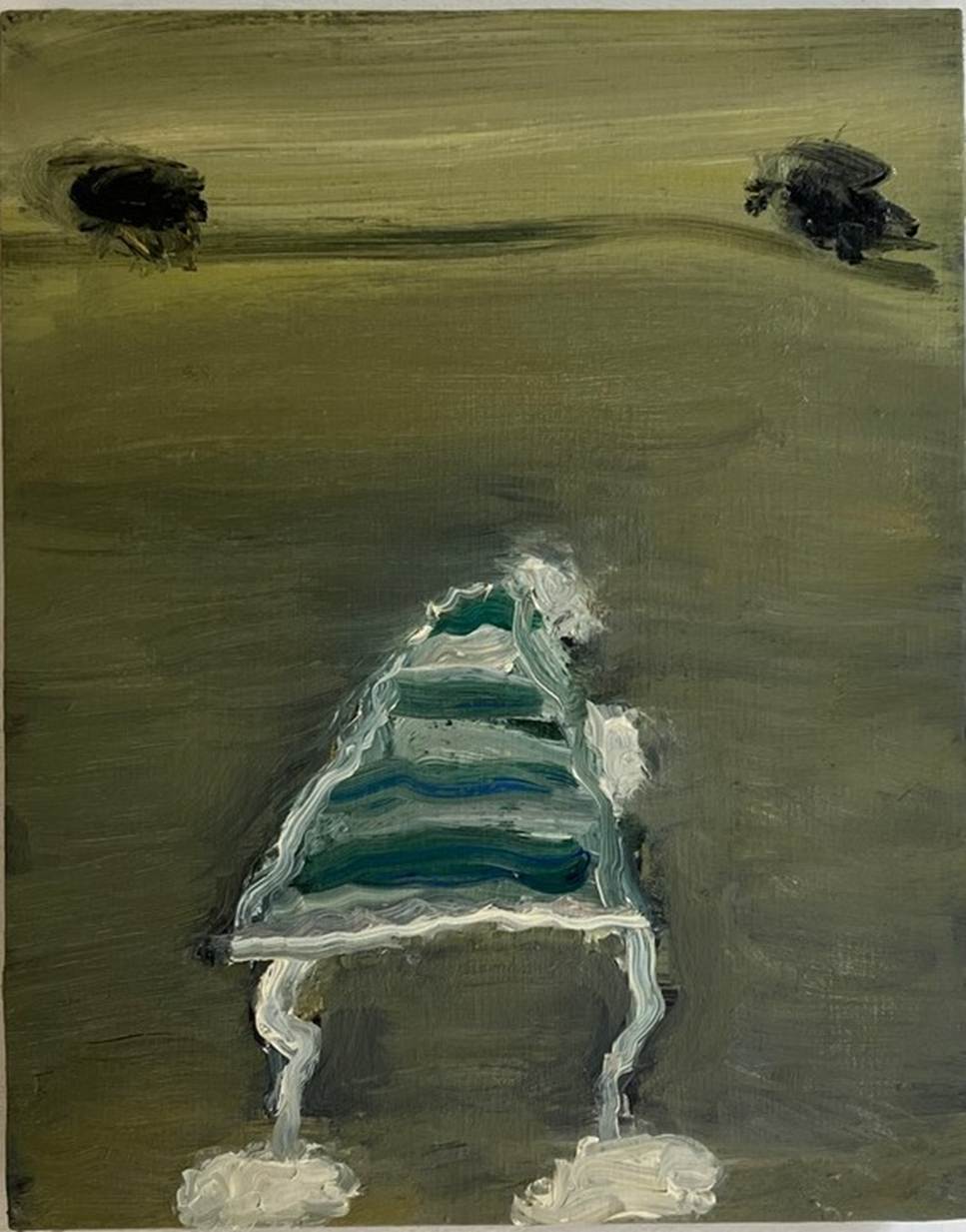
Harthope, May ‘26
I would like to start in chaos and arrive somewhere. Achieve a goal, when, at the start, I had no goal. Actually, I do not need to arrive anywhere. I don’t have to have a goal. I would like to start in chaos and achieve presence.
Presence is what I find in the paintings of Michael Crowther. They are done on wood. They make a nice clunk when set onto the pins which place them on the wall. If you threw one at a window, it would definitely shatter the pane.
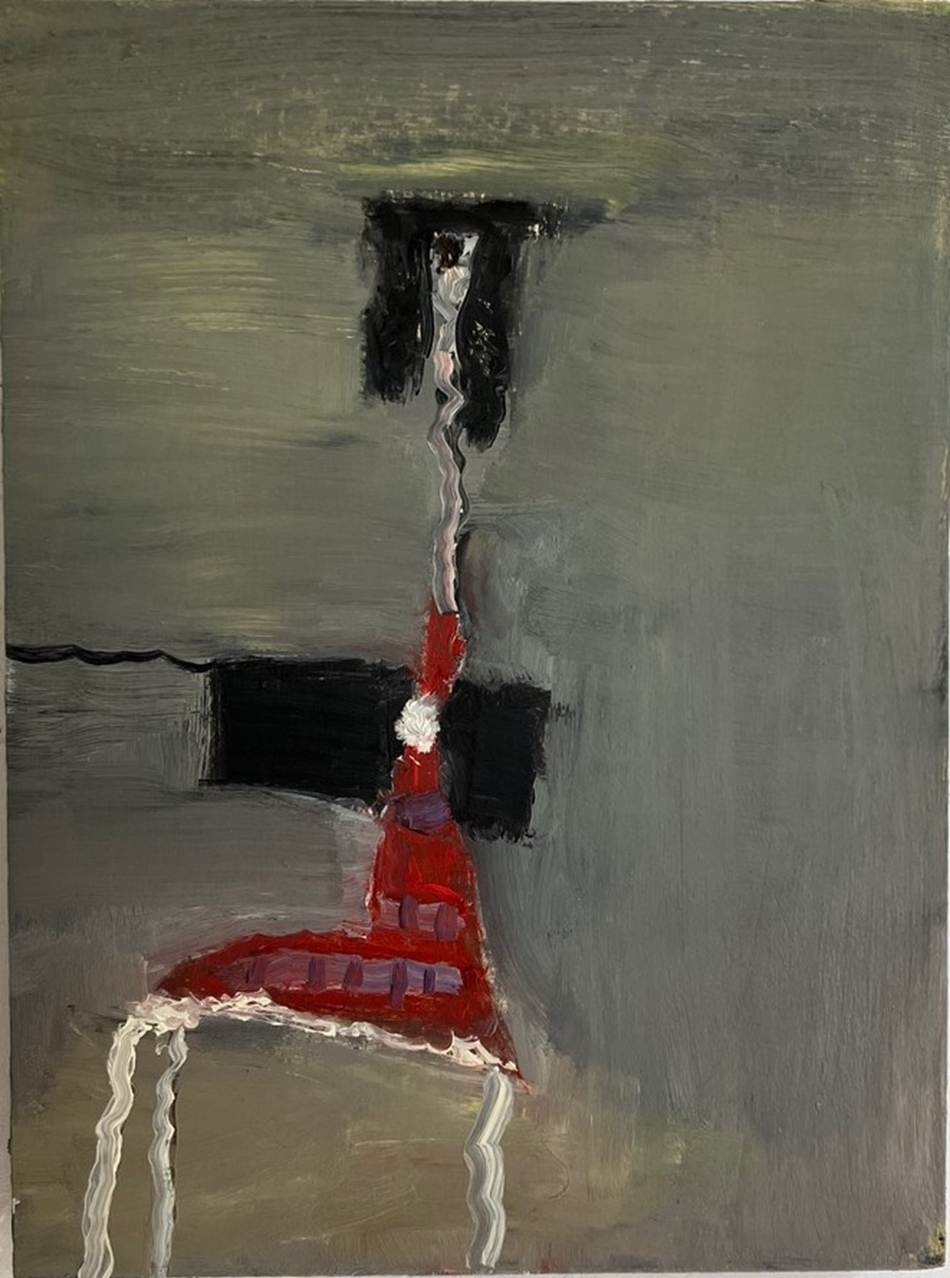
Bollihope May’25
Throughout history, each independent mind struggles to emancipate itself from the fixed ideas it has inherited. For artists of Crowther’s generation and my own, abstraction was very much the order of the day. For a host of non-practioners, modern art looked abstract or surreal. Even more naively (and this is particularly true of British pundits) art had to be significant, resolved: it had to accomplish its meaning. Take Peter Fuller in art, and F.R. Leavis in literature. The one expressed admiration for the aesthetic principles of John Ruskin, the other championed seriousness and moral depth in literature. Their naivety would have appalled Schopenhauer. But for pundits such as this unremarkable twain, only through significance could art achieve its true equilibrium – which brings us, at last, back to Kharms.
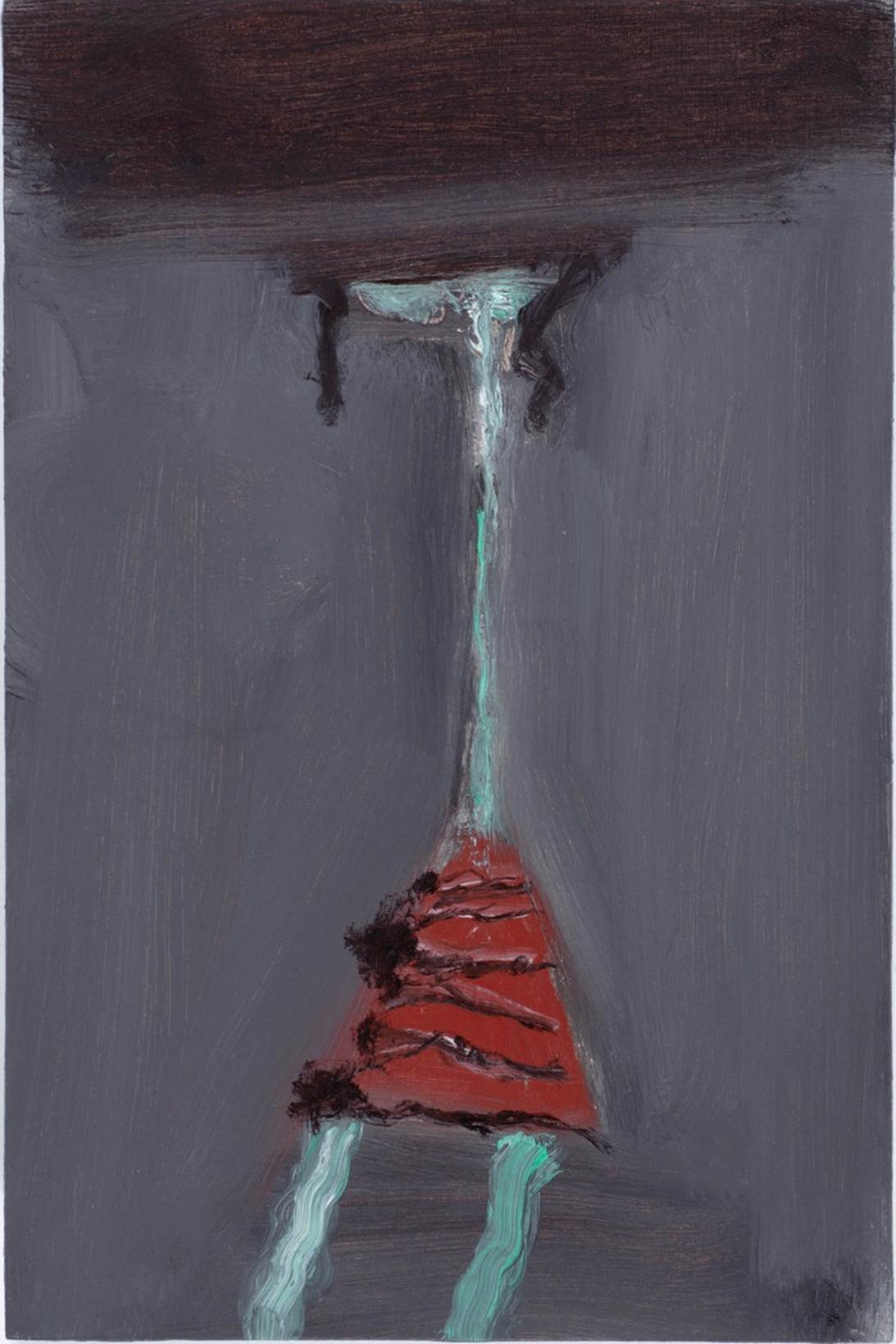
Bollihope,’24
Yes, it is necessary to get out of equilibrium. Because there is so much art that is resolved, very much so, but in ways which are trite: it’s art that’s too easily read, whereas I struggle with the paintings of Michael Crowther. I am told that they are figurative. But they are not like anything I’ve seen. At the same time, abstraction isn’t a term that I would apply to them. These paintings are elsewhere. An object is suggested, in the foreground. This is the case because there is clearly a background. But as to what that object is, or what is in the background… There I have to use guesswork, and this only helps a little bit. If these works are figurative, what they figure ought to be my prerogative. Thus I am led into each one by hint and by intuition. That could be a distant clump of trees, that could be one of those barns you see on farms with open sides, that could be a barbecue set up on spindly legs, but it might not be, it might be a creature with spindly legs.
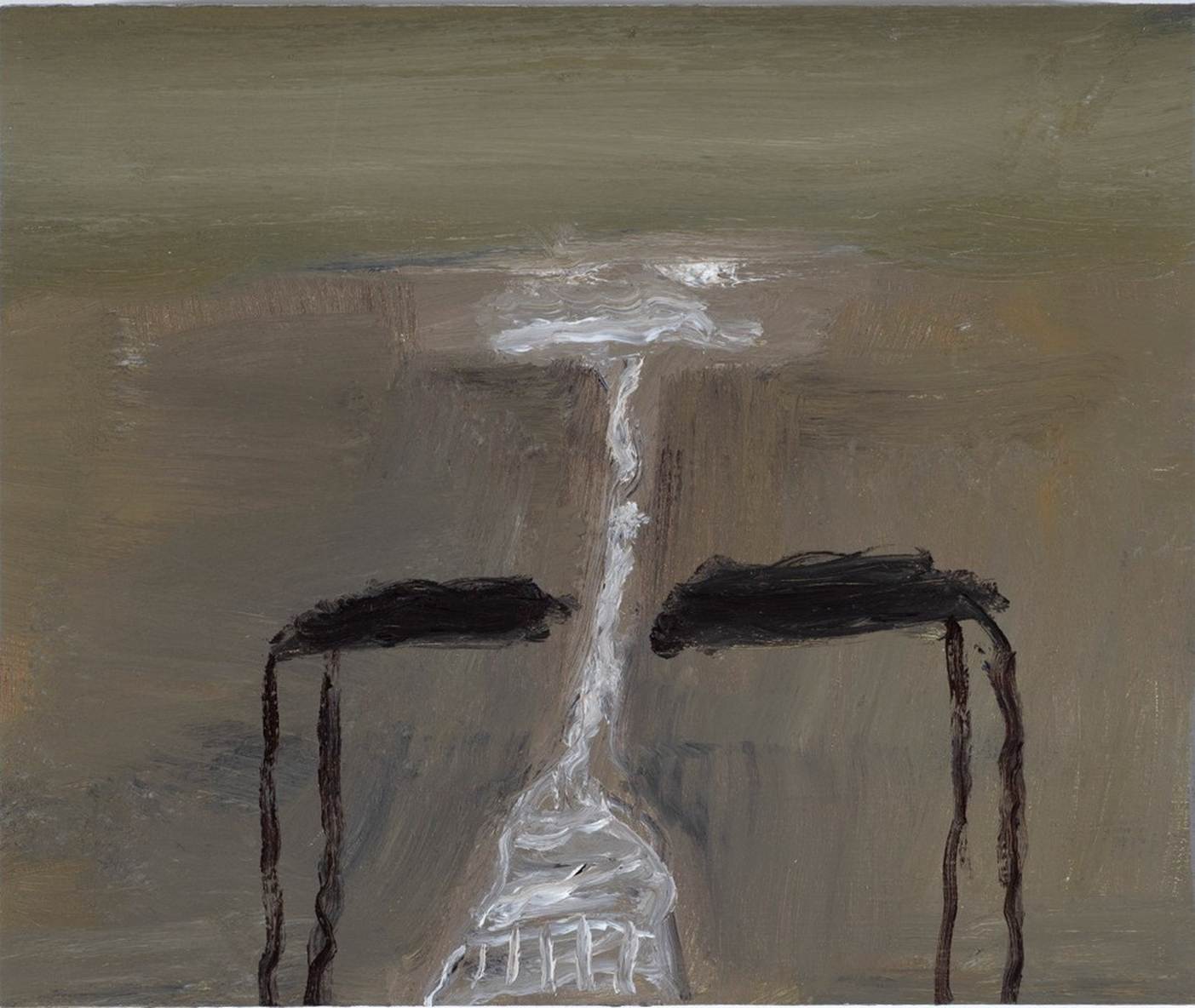
Farmer’s Boy 2024
Getting out of equilibrium, getting out of a comfily resolved idea of what art might be. Going off at a tangent, as in this essay. Getting away from some received idea about what art is supposed to be. Somehow Philip Guston achieved this, when he broke with abstraction. Michael Crowther achieves it in these small intense paintings shown by Benjamin Rhodes at his gallery in Old Nichol street. They provoke uncertainty and achieve presence. And what do I mean by presence? That is for you to decide.
Anthony Howell, 28/08/2026
***
“Crowther’s book-sized panels are imbued with thinking about painting, writing, history and landscape, each its own work of visual poetry – we continue from his brilliant solo-installation of last year: Bollihope and Others which loudly declared an integrated vision at home in an enigmatic and painterly strangeness.”
Benjamin Rhodes


Beautiful. You have hit the nail on the head without a nail or something to hit it with
LikeLiked by 1 person