

The French invented impressionism and modernism: the British invented children’s literature and nonsense poetry. Zola’s Nana can say, Fuck me! to a young man paying her a surprise visit. For a British writer of the same period, that is quite impossible to say. In Britain, women do not have bottoms, they have bustles. They do not give birth, according to J.M. Barrie: babies are birds. Other birds hatch them, and they fly off to mothers and become children. France and Britain have a relationship which is similar to a difficult marriage. The two countries are very close, and many British people aspire to speak French, far more than aspire to speak Spanish and more also than aspire to speak German, though German is also fairly popular. However, in my own schools, only Latin and French were taught. Like husband and wife, we are familiar with each other’s ways, but the husband’s way is not the wife’s and vice versa.
The French woman is the comrade of the French man, thanks to their revolutions, though the man can be a brute and beat the woman savagely, and the wife can be a whore or a courtesan. I am speaking in the language of generalisations here, because in what we call “The Victorian Age” such generalisations seem to have affected the production of literature, though George Meredith can be pretty direct, as in his novel The Difficult Marriage. The British paid little heed to the realism promoted by French writers. More often, appalled by the promiscuity of the Georgians who dressed in full fig and fucked everything above and below stairs, the staid, mercantile Victorians reinvented womanhood as a sexless willow, wearily drooping, or faintly floating away like Ophelia on some water-lily stream. Famously, it was Ruskin who was appalled to discover that his wife had pubic hair. The Edwardian reaction was savage. People have been justifying our new terrorist laws designed to suppress protests against weapons factories by citing the demonstrations of the suffragettes as if these were genteel. This is false history. The suffragettes were genuine revolutionaries. They had to be. In Great Britain and Ireland, between the years 1912 and 1914, the suffragettes orchestrated a violent bombing, assassination and arson campaign.
Now John Ashbery always said that he preferred the byways of literature to its highways, and I have tended to agree with him. Indeed, I enjoy the ultra-esoteric. You could say I like to follow some goat track of literature. It’s fun to explore wherever such a track may lead. Being the only person on the planet to be reading a particular book is to me a greater pleasure than that of reading a best seller. It makes me feel unique. Recently I began painting water-colours of London’s statues, and visited Kensington Gardens, where Peter Pan stands on top of a magical tree-stump piping to the fairies who clamber up to listen to his piping (and to peep under his smock). The statue is placed on the very spot where Peter landed in his mud-lined thrushes nest on his first excursion from Bird Island. In the way of quantum connections, this led me to recall a book I had seen in my childhood but never read. I managed to find a copy, and found myself alone on a goat-track.
J.M. Barrie’s Peter Pan in Kensington Gardens is to my mind an eccentric masterpiece. The writing is just different to anything I have ever read – it’s a grown up book for a child or vice versa. There is great sadness too, although it can be very funny. But in those days, children often died, and parents and siblings were often traumatised. Barrie is no exception. His mother was clearly traumatised.
The question is, Who is a children’s book written for? It is easy to respond, For the child. But if the book is being read to the child by the parent, or the uncle or the nurse, especially in those Victorian times, such a response is suspect. Books for children which are expected to be read by children are one thing – Treasure Island and The Lion, the Witch and the Wardrobe were written to be read by children. I grew up reading Puffin Books, some of which were quite haunting and politically questionable – A Moor of Spain; the Story of a Rogue being one (written by Richard Parker in 1953 – who seems to have written no other book).
So there is already a split between books written for children who cannot yet read and books written for children who can. The books written for children who cannot yet read are actually being written for the reader who is a grown-up, and this is the case, I believe with Peter Pan in Kensington Gardens.
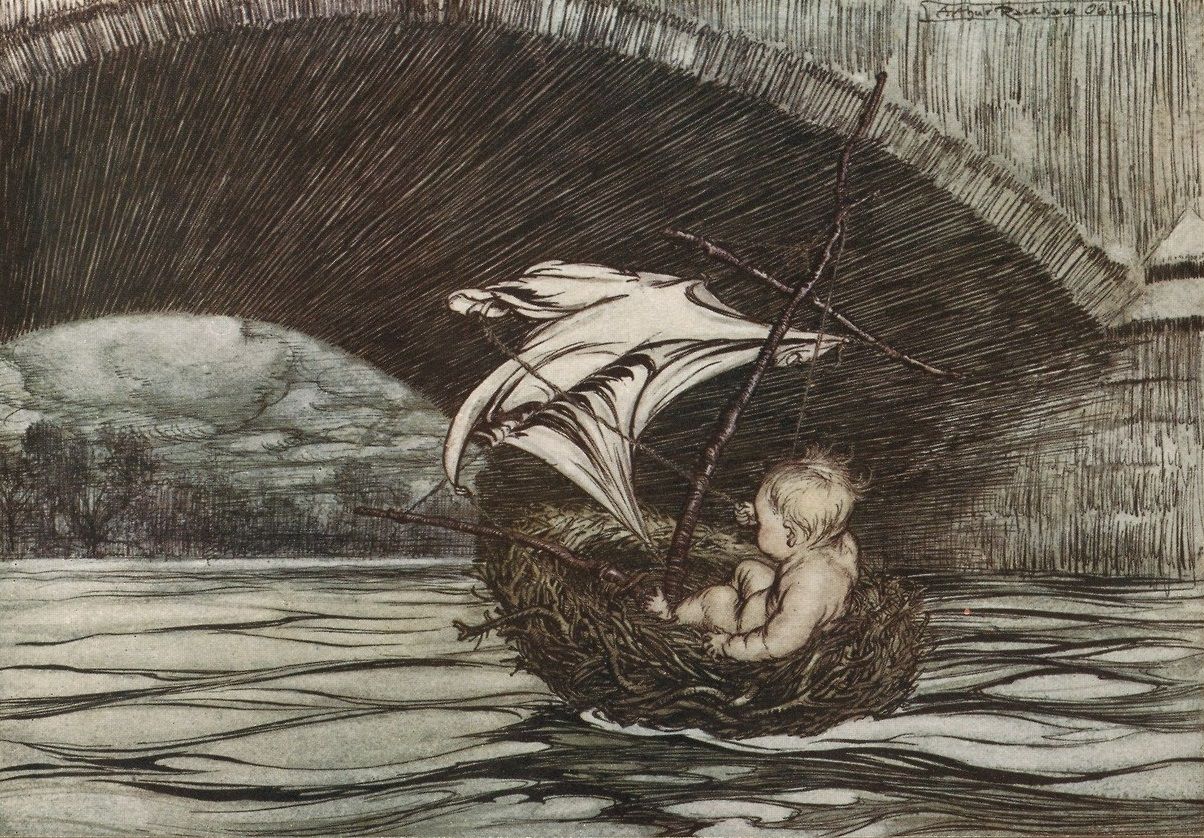
Peter is of course the archetype of the lost child, and that child is epitomised in the book with this title, which, though published later, must have preceded Barrie’s popular West End play featuring Wendy, Captain Hook and Neverland. This earlier version is a far more surreal story, tragic, and hauntingly written, and with the strangest of all Arthur Rackham’s illustrations to accompany the writing. The tale is a creation engendered by the Victorian unsayable, as is the case with Charles Kingsley’s The Water Babies.,
If I shut my eyes, you’re not there. While the Victorians could deny the existence of sex (which never stopped boys getting erections or girls going about their explorations), what they could not do was to deny the existence of death, and we remember death. When I was seven I recall that our school library had a bookshelf dedicated to a boy called Peter, who had died. A few years later, a boy I knew died of leukaemia. Deaths in childhood were far more common in the nineteenth century than in my own time or now.
According to Andrew Birkin’s J. M. Barrie and the Lost Boys: The Real Story Behind Peter Pan published in 2003:
‘When James Barrie was six years old, his elder brother David (their mother’s favourite) died in an ice-skating accident on the day before his 14th birthday. This left his mother devastated, and Barrie tried to fill David’s place in his mother’s attentions, even wearing David’s clothes and whistling in the manner that he did. One time, Barrie entered her room and heard her say, “Is that you?” “I thought it was the dead boy she was speaking to”, wrote Barrie in his biographical account of his mother Margaret Ogilvy (1896) “and I said in a little lonely voice, ‘’No, it’s not him, it’s just me.’” Barrie’s mother found comfort in the fact that her dead son would remain a boy forever, never to grow up and leave her.’
At the beginning of the book under discussion, the original story of Peter Pan, we are given a tour of Kensington Gardens as the author, who is the narrator, takes David, a toddler, and one of the sons of Sylvia and Arthur Llewelyn Davies, for a stroll around them:
We are now in the Broad Walk, and it is as much bigger than the other walks as your father is bigger than you. David wondered if it began little, and grew and grew, until it was quite grown up, and whether the other walks are its babies, and he drew a picture, which diverted him very much, of the Broad Walk giving a tiny walk an airing in a perambulator. In the Broad Walk you meet all the people who are worth knowing, and there is usually a grown-up with them to prevent them going on the damp grass, and to make them stand disgraced at the corner of a seat if they have been mad-dog or Mary-Annish. To be Mary-Annish is to behave like a girl, whimpering because nurse won’t carry you, or simpering with your thumb in your mouth, and it is a hateful quality; but to be mad-dog is to kick out at everything, and there is some satisfaction in that.
The tone may appear somewhat arch to us now, but the matter of the book is very particular: there is use of the sort of private language that families use among themselves, particularly with children. I am reminded of the “personism” manifesto put forward by Frank O’Hara – which stated that one should write a poem as if writing a letter to an intimate friend, where references that may not be available to the reader are simply communicated because the person to whom you are writing understands. The text is also, like Alice in Wonderland, a fusion of nonsense and children’s book – which is as near as the Victorians ever got to the surreal.
Moreover, the book is not as misogynist as this passage above suggests. One girl defeats an entire cricket team of boys with her unassailable Yorkers. However, the personism is so intense that I get the feeling that I am reading a work of outsider literature (“outsider art” being a term for art made by clinically obsessed or unhinged types). Such art is often naïve, but not always. Richard Dadd, the artist who murdered his father, was technically accomplished as a painter (and as obsessed by fairies as Barrie and his illustrator Arthur Rackham). Obsessive writing can be powerful and frightening and is often recognised as being great literature. Kafka comes to mind as an example. In Kafka, very often, a paragraph will begin with optimism, only to conclude in disappointment. A piece of obsessive “outsider” writing which has had a strong influence on my own work is Nijinsky’s diary – written as he descended into catatonic silence. When speaking of his feelings, Nijinsky can contradict himself in the same paragraph. This has always impressed me. I guess my feelings are often like that.
Peter lives on Bird Island at the far end of the Serpentine. He flew there when he was a week old, and could still remember how to fly. When he gets there, the birds point out that he wearing a nightgown and has therefore become a boy. This awareness destroys Peter’s ability to fly. And so he is stuck among the birds on the island. The story of how he manages to visit the distant shore of the Serpentine beyond the bridge, and therefore continue to play in Kensington Gardens, and the poignant story of the two times when he manages to visit his mother make up a large part of the matter of the book.
Kensington Gardens is portrayed as a place of delight during the day. At night, after the gates are closed, it becomes a dark and deadly location infested by fairies. Traditionally, from Elizabethan times, fairies have been small; usually no larger than one’s thumb. Shakespeare lied about them, when he made Titania large enough to embrace Bottom with his ass’s head – but this was dramatic licence. Michael Drayton’s wonderful poem Nymphidia: The Court of Fairy is a far more accurate account of their nature. For instance, the chariot of the Queen of the fairies is a “snail’s fine shell”, the seat “the soft wool of the bee”, the wheels “composed of crickets’ bones.” Drayton also points out that fairies tend to be malicious:
These, when a child haps to be got,
Which after proves an idiot,
When folks perceive it thriveth not,
The fault therein to smother:
Some silly doating brainless calf,
That understands things by the half,
Say that the fairy left this aulf,
And took away the other.
Barrie’s fairies in Kensington Gardens are no less dangerous, and no child should venture into the gardens, or stay in them after dark, when the gates are shut. So now it should be clear that the delightful Tinkerbell is simply a light cast around the stage and no real fairy, and that Neverland never existed. Kensington Gardens is the true repository of ominous secrets and these gardens can tell us all there is to know about the dangers surrounding childhood.
Anthony Howell, 30/06/26


Great article. Interesting observations about who actually is the audience of such books, and also how fairies have been depicted.
LikeLike