
A draft recording on YouTube of the short opera I wrote the libretto for – with music by Robert Stuckey.
There are five songs, one for each singer. Each has its own melody which nevertheless dovetails with each of the other melodies. Each song is written to be sung from the first line to the last or from the last line to the first. All possible configurations of solo, duet, trio, quartet and quintet are explored by the libretto.
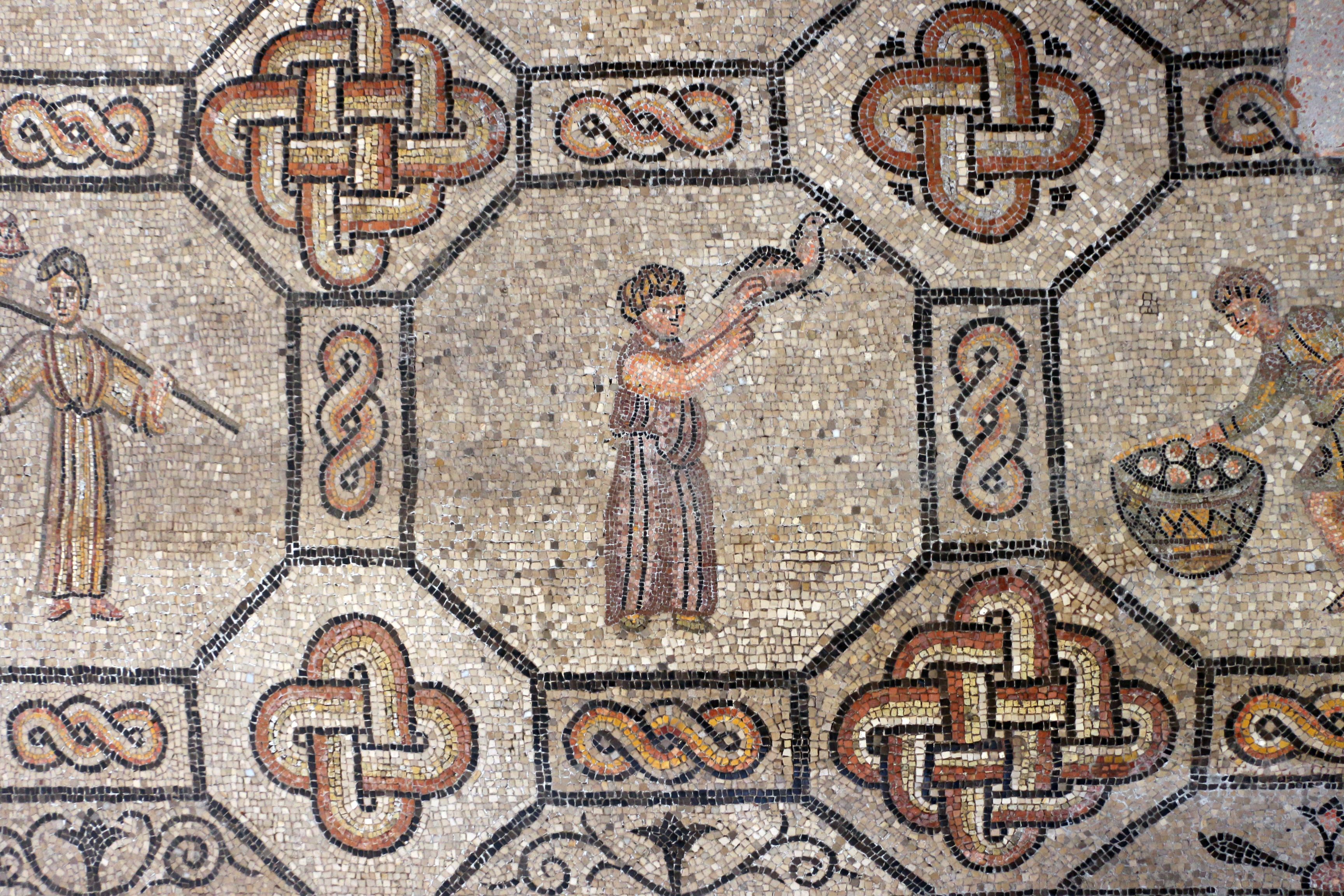
Anthony Howell (Writer): A few years ago, Alessandro Cortello introduced me to the colossal church at Aquileia with its stunning early Christian mosaics. Only a few houses remain in what was once a city second only to Rome. Willows and cypresses adorn the countryside. The walls of the great church are lined with images of martyrs from Nero’s holocaust. Its tower scrapes the blue Italian sky. I became fascinated by the mosaic and by the patterns of the knots that appeared on the floor at intervals, often separating one image from another. Some of these knots were two-stranded, sometimes four-stranded. I imagined these as walking patterns, and envisaged 5 singers, one acting as a metronome as the others traced the knot-patterns, each pursuing a melody of their own, accompanied only by the occasional sound of a bell and the smell of incense – a tower, a knot, a willow, a cypress, a martyr – drama as landscape: a fusion of opera and performance art. I conceived the piece as similar to a medieval mystery play – created with contemporary means, perhaps to be performed in churches such as the Round Chapel in Bow, and at Aquileia itself. It has proved too complicated for the singers to perform this knot-walking as well as sing the complex libretto, so we now envisage this as a concert performance with an audio-visual accompaniment.
Robert Stuckey (Composer): Rather unusually for music in the 21st century there are no sharps or flats, only white notes. Yet each white note has a unique position and creates a unique scale when it becomes the viewpoint from which the others notes are heard. Each of the five characters from a different note creates a scale that resonates with its mood, a mode for a mood. The five characters are thus in competition with each other creating a distinctive grammar of harmony: who will win? A cappella means without accompaniment, no orchestra, no piano, and the singers must fend for themselves: only the tolling of the Cypress’ bell is sometimes heard.
Alessandro Cortello (Tenor): To me, a classical-trained opera singer accustomed to deal with music written by long-gone composers, this new work represents the uncommon chance to see an artwork coming to life under my eyes. The opportunity of working so close to the creators and taking an active part in the genesis of a new composition is priceless. The poet and the composer took an original approach to the traditional idea of ‘opera’ and its characters, combining it with the polyphonic Renaissance madrigal, the ancient ‘modes’ and the modern concept of performance art, in a fascinating distillation of different traditions and different classical vocal styles. Moreover, I am very pleased to see how the town of Aquileia, a place so dear to me just a few miles from my birthplace, can still inspire artists’ work as it did in its multi-millennial history.


