The Net

afence-barrier-garden-fence-wire-mesh-fence-wire-fr-4685

The net contains the sky.

It is more than that:

The net impresses itself on the sky

And prevents it from getting in.

The sky wants in: the cons want out

– Some of them – others can’t handle it.

x

On the out, their women are like clouds,

They create wonderful shapes for themselves

And then evaporate. And yes,

We pride ourselves that we are not amputated

From the eyes down or glued

To some remorseless, telling screen.

*

Our screens are interactive.

And yet, we are hooked, online,

Caught in the net: it’s a dragnet,

Where, like fish, we flap

Against each other vainly,

Since we’re not actually there.

*

We’re each in our own small cell,

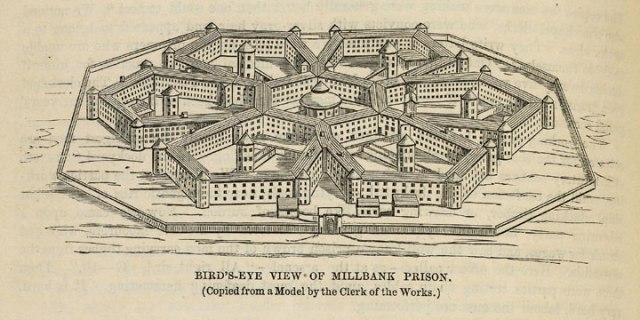
Imprisoned in a place

Where people don’t break up,

Where they don’t even meet.

They make love through the cloud,

Then simply delete.

*

(Read this and other poems in From Inside – a new collection to be published by The High Window Press in March 2017)724377f69a46a8224a1aad8ad5ab31eb

Posted in Uncategorized | Leave a comment

Chilcot

anthonyhowelljournal's avataranthonyhowelljournal

Demonstrators-Protest-At-The-Chilcot-Inquiry-Publication-Launch

Westminster bells overwhelm our chants and slogans.
Anyway the commentators aren’t here to listen to us.
On temporary platforms constructed out of scaffolding,
They’re holding forth under listless Union Jacks.

They’re putting the network spin on events as they unfold,
While the flaky plane-trees leaning over everything
Will be here longer than any demonstration, even one that invites
Fluffy microphones and big no-nonsense cameras

Hoisted on shoulders to take a good look at its placards.
Interviews generate ribbons of vehemence soon for the cutting-room floor.
But here we are, the veterans of legendary marches,
The passionate old birds who have given up on appearance,

The leprechaun whose protest is peculiar to himself,
The young ones pitching whole-heartedly into the responses:
We’re here. We’re making our presence felt.
Some of us have brought our own megaphones

And seem dedicated to bursting the eardrums of the constables
In yellow over-jackets who keep…

View original post 65 more words

Posted in Uncategorized | Leave a comment

No Selection for Old Farts

poor-poet-starving-artist

Every single submission of mine to poetry magazines has been rejected – to date, for the last three years; but acceptance had become a rarity since 2010. A list of repeated rejections includes all the standard, Arts Council subsidised, UK journals, and all US magazines and reviews. Only those poems that have been specifically invited by editors have been published. I conclude that submission is a scam. Submissions that demand payment are a cash cow for the magazine. I have heard the same story from many older poets. Complaints to editors have been ignored. A bas les magazines. Poets, never submit!

rejection

26/09/16
To The Poetry Review:
Dear Sarah and Maurice
Your last communication brings the number of my poems that have been rejected for publication by your review to twenty-six. This is since 2014.
The Castaway
Scrabble
The Glider
Birth of the Dance
Lord of Storms
Silent Highway
The Frustrated Poltergeist
Dear Cashmere
Partnerless Dancer
Flesh and Blood
Depressions
Python
Architects
From Inside
Association
Out of Touch
Not Chaos
The Gorgon
Cuntaholic
Homily
Soma
Dues
Beyond Unreasonable Doubt
How I am
LMFAO
Angry Anthill
It appears that you feel that my writing is inappropriate, which is sad, since I first published in The Poetry Review when I was twenty-two and Derek Parker was its editor. I also had a long poem accepted when Eric Mottram was the editor. I acknowledge that, appended to your rejections, there are invariably kind words about how much you enjoyed reading what I sent you. Perhaps you feel that my work will discomfort your readers, who are less sophisticated than you are when it comes the cutting edge. But what an indictment that would be of your subscribers. Anyway, I am sure you feel, as I do, that enough is enough. I will not call upon you to again go to the effort of mustering the blandishments that accompany your rejections.
Sincerely
Anthony Howell

The list of shame includes: Ambit (multiple rejections), Granta, London Magazine, Poetry London, Poetry Review (multiple rejections), Magma, Poetry, Seneca Review, Nashville Review, Paris Review, Watershed Review, Ponder, Poached Hare and many others.

I have been able to publish in The Wolf, Poetry Salzburg Review, the Spectator, The High Window, Journal of Poetics Research (Australia), The Fortnightly Review and others – in each case, at the invitation of the editor in the first instance.

Posted in Essays, Uncategorized | Tagged , , , , | Leave a comment

No Posts for Old Farts

pen-and-ink

Hi Anthony

I’m sorry that you weren’t shortlisted for the vacant post here in Creative Writing. I know how much effort and emotional energy goes into a job application, and how disappointing it is not to get an interview. There was a strong field for this post and we carefully scored the applications in relation to each section of the job description. What held you back, I’m afraid, was your lack of qualifications. At least a Masters degree was needed for this post.

Lack of qualifications! Pooh. I have published more than twenty titles. I was invited to the University of Iowa as a Visiting Writer – not a course but a series of lectures successful writers from all over the world gave to the other visitors. I ran a fucking department for twenty years as a senior lecturer at UWIC. A masters! You must be joking.

Posted in Essays, Uncategorized | Tagged , , , | Leave a comment

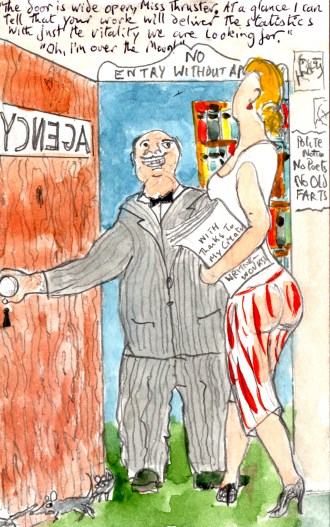
NO AGENTS FOR OLD FARTS

agency001

“…..Wherever there was a gentleman of renown

in his home I had silver and a mount.

From whomsoever some had greatness and gifts,

greatness and gifts had I from the house of Saman.

The Prince of Khorassan gave me forty thousand dirhems,

Prince Makan more by a fifth,

and eight thousand in all from his nobles

severally.  That was a fine time!

When the Prince heard a fair phrase he gave, and his men,

each of his nobles, as much as the Prince saw fit.

Times have changed. I have changed. Bring me my stick.

Now for the beggar’s staff and wallet.”

*xxxxxxxxxRudaki, from the Odes of Basil Bunting

“Thank you for your reply.    You are so right when you say that when we are young we may have plenty of champions – and then time passes and things change.   I know only too well what you mean.  So it makes it all the harder for me to tell you that I don’t see any of my fellow agents here wanting to get involved with your project.   To be honest with you, they are either not accepting new authors and majoring on their well established and high earning ones, or if they are, they are on the look-out for young debut novelists with a view to career building from the beginning.   In other words I can’t recommend any colleagues, and I am so sorry about this.    Poetry doesn’t make money, to be brutally frank.   You know this!

As for me – well I am playing my way out and have very little spare time.  Caring for my small handful of authors takes up a full three days a week and a lot more.

I regret writing in this disappointing way……”

And another and and another and another. Now “I” responds – Thank you for sending me material from your works, which I was grateful to have the opportunity to consider. I’m afraid it’s not right for my list, so I’m going to pass, but wish you the best of luck with your writing.

I reply: Dear I  – Well, thank you very much for reading what I sent, but you must admit there is something deeply wrong with how UK publishing works these days. Of the eight agents I sent the work to, you were the only one to reply. A year ago I sent work out to eight other agents and got no response at all, except from one person who told me I was too old.

There is just no way that someone of my age with a serious reputation, an individual style and more than fifty years dedicated to writing can get anywhere in contemporary publishing. So by all means wish me luck, but it is ironic that someone who was published by Calder & Boyars alongside Beckett and Borges finds himself unable even to secure an agent in the current climate.

I told you that I would be interested in your response to my work, and any advice as to securing representation. Are there no agents you know with a sense of adventure, or a desire to promote genuine literature? As you can imagine, I am disappointed by your response (although it must be said that I predicted it), and I’m sickened by the state of affairs here – Sincerely etc.

Response: Dear Anthony, I understand your frustration, but to take it out on me as the one agent who has so far responded, seems unreasonable.

Many agents take 8 weeks minimum to respond, some now have a rule that if they haven’t responded in x weeks/months, it’s a pass. My personal feelings about that rule aside, you cannot fathom how many submissions we receive, on top of how much work we have to do for our actual clients, which of course has to be our priority. We are stretched very thin – you might have noticed I sent that email at 7am. If your original email to agents followed their submission guidelines (or even just followed the gist more broadly, including material from one book), you might find you get a better response rate.

Age is not an issue, but your emails suggest an attachment to heritage literature. As agents we have to be very focused on the contemporary market, as that is what we, and onward publishers, are selling into.

At the end of the day, this is a subjective business, and neither I nor any other agent can take on an author we don’t feel confident of selling.

Best wishes,

I

Dear I – I was not taking it out on you. I was responding. At least I goaded you into a more cogent and informative reply. The phrase ‘heritage literature’ is intriguing, as is ‘onward publishers’. The only reference to ‘onward publishing’ I can find is for publishers of avowedly Christian literature. The danger with only taking on authors you are ‘confident of selling’ is that it suggests that there is a formula you recognise as saleable. Well, if you had James Joyce as a client, would you be confident of selling his work? It is sad that contemporary agents seem to stick with a jargon they have concocted so as to feel ok about only promoting books which adhere to some cliched recipe. You say, this is a subjective business. From the scant responses I’ve had, over the last twenty years, I would say you all respond in the same objective way. So why not be more subjective, and less confident?

The contemporary market could do with a kick up the bum.

The West used to pride itself on freedom of expression, as opposed to the censorship of the Soviet Union, for example. A famous Ethiopian writer at the International Writers’ Program at Iowa University once said to me rather accusingly, I cannot mention ‘old man’ in my books, because the Emperor is old, but you, in the UK, you have freedom of speech. I replied (and this was back in the 60s), that in the UK everything was dependent on ‘commercial viability’ – and this was actually far worse than state censorship. What was true 50 years ago is even more the case today.

I’m sorry, but age, colour and sex are definitely issues. I am white, 78 and male – and discriminated against on all three counts.

I assure you, I bear you no resentment. Actually I am very grateful to receive your response, and that you took the time to read some of my work. But I also think it’s important to give you feedback about how neglected many older writers of originality tend to feel. And it is a fact that their work is ignored by contemporary literary agents. My own press, Grey Suit Editions UK, tries to redress this injustice. We will be publishing David Plante soon; a successful novelist in the 70s, published by Bloomsbury then, and still writing today.

With best wishes – Anthony

Posted in Essays, Poetry | Tagged , , , , | 4 Comments

Basil Bunting – a review

Basil Bunting

My Review of Basil Bunting here

in the Fortnightly

Posted in Essays | Tagged , , , , , , , | 3 Comments

Reviews of Poets and other Articles in The Fortnightly Review

newbanner_900


Here is a link to Against Pound a brief new essay in the Fortnightly.

And here is an earlier review of several poets published back in November 2013 in The Fortnightly Review

It featured four poets: Kathryn Maris, Jackie Wills, George Elliott Clarke, Donald Gardner and Todd Colby.

For a complete list of links to other reviews of poets and my previous articles click here: The Fortnightly


Posted in Essays | Tagged , , , | 3 Comments

Chilcot

Demonstrators-Protest-At-The-Chilcot-Inquiry-Publication-Launch

Westminster bells overwhelm our chants and slogans.
Anyway the commentators aren’t here to listen to us.
On temporary platforms constructed out of scaffolding,
They’re holding forth under listless Union Jacks.

They’re putting the network spin on events as they unfold,
While the flaky plane-trees leaning over everything
Will be here longer than any demonstration, even one that invites
Fluffy microphones and big no-nonsense cameras

Hoisted on shoulders to take a good look at its placards.
Interviews generate ribbons of vehemence soon for the cutting-room floor.
But here we are, the veterans of legendary marches,
The passionate old birds who have given up on appearance,

The leprechaun whose protest is peculiar to himself,
The young ones pitching whole-heartedly into the responses:
We’re here. We’re making our presence felt.
Some of us have brought our own megaphones

And seem dedicated to bursting the eardrums of the constables
In yellow over-jackets who keep trying to herd us back onto the
Pavement while remaining professionally aloof. To them
We’re simply a gathering their duty is to control; but actually

We are a groundswell, raising our banners, proud of our t-shirts;
Epithets grandly proclaimed on pieces of cardboard floating
Above our rucksacks, bringing our dogs to bark out our messages.
Masked in a leader’s likeness, we are waving bloody hands.

Written in July 2016 and published in From Inside – by The High Window Press

Posted in Poetry | Tagged , , , | 1 Comment

George Pitts and the Longer Line in Poetry

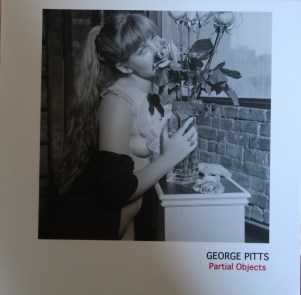
This page is a link to my essay on the longer line, and it is also a homage to the brilliant poet George Pitts, who died sadly in 2015. John Ashbery was a great admirer of George’s work and introduced me to him.

George Pitts

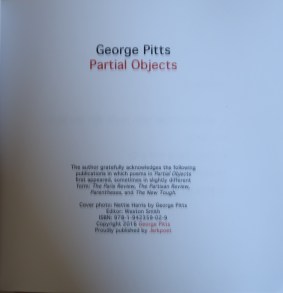
Partial Objects cover    Partial Objects inside

As well as being an innovator who worked with the longer line, George worked in the NY fashion industry, and he features in the film below:

gpitts George Pitts

So following on from my essay on The Prose Poem, here is my Fortnightly Review essay on The Longer Line which includes my thoughts about George’s poetry.

Partial Objects, George’s book of poems, ISBN 978-1-942359-02-9, NY 2016, published by Jerkpoet.


Posted in Essays, Poetry | Tagged , , , , , , , , , , | 2 Comments

IRIS

1

The phrase, My garden is wanton, comes to me as I weed.

It feels somewhat Sitwellian.  Later, I’m off to a launch.

It’s one of my own generation who’ll hold forth: he’ll bring the league


Of greybeards out in force. The girls who used to get me

Into bed, quite willingly, by citing Jean Garrigue,

Sylvia Plath, John Berryman, they’re also past their prime,


Wrinkled, wrinkled as I am. Nowadays, I’m off the booze

And don’t want to talk to anyone who isn’t fresh, who

Doesn’t jog my memory of how the eyes would widen, widen,


Smitten by the synergy of intellectual chat.

But now I need a chair, no way am I going to manage listening

While standing up, ah, but what luck! One of the rarities


Actually sits down beside me. She leans to me for a word

And she is a joy forever, just as entirely engaged in what

Words are and what they do as I was at her age and am again


As we discuss the longer line and her notion of inventing some

New punctuation – I suggest an anti-exclamation mark.

We laugh together and her lovely eyes widen, widen.


I am far from dignified, my hollyhocks are mating with

The foxgloves. My garden is wanton, my garden is wanton…

And what is your name? I ask as we rise. Iris, she says.


Posted in Poetry | Tagged , , , , | Leave a comment