Olivia Clementine has recorded a marvellous conversation with Andrea; informative and truly intriguing. “You will hear about Andrea’s path from being a 19-year-old student in Paris, to journeying to the Himalayas to study with yogic masters, including her teacher the 16th Karmapa, to becoming one of the few Western women to live and practice at Indian cremation grounds. Andrea speaks with the directness of someone who has spent decades facing what most avoid—death, darkness, and the dissolution of the boundaries between pure and impure at what she calls: the gates of liberation.”
Andrea talks about skulls. I remember seeing skulls when I was seven years old placed in the porch of a church in Galtür in the Austrian Alps. Andrea is Austrian. I find it interesting how a quantum connection seems to link Alpine and Himalayan ritual.
I wrote my very first story inspired by these skulls when I got back from that holiday. It was a ghost story. I stayed in the church one night, and I watched as a ghost rose from his tomb, collected his skull in the moonlight and returned to his tomb. It was very badly spelt and my hand-writing was awful (still is), but my English teacher praised the story. I will try and find it. I think at some point it was typed out.
Andrea is the sister of Gwendolyn Leick – the mother of my son. Gwendolyn was a well-known scholar as well, and two of her literary works are published by Grey Suit Editions
PS About the skulls in the church, Andrea comments, “Anthony, that’s what we call a carner. Skulls digged up from abandoned graves kept in the church sanctuary. It also fascinated me a child.”
NEW YORK, NEW YORK – MAY 02: Hillary Rodham Clinton attends “In America: An Anthology of Fashion,” the 2022 Costume Institute Benefit at The Metropolitan Museum of Art on May 02, 2022 in New York City. (Photo by Taylor Hill/Getty Images)
Story worthy of the wife of Bath: What do women want?
Well, take the case of Mrs C. She and Bill come to mind, for me.
If that was your own White House, this is my own war.
I can be more brutal than you ever were, my dear.
Is that it? Outmuscle the muscle, then outman the male state,
All in the name of liberation, ladies proving tough instead of nice?
Is it to come out on top, even if you cheat, since crime doesn’t actually play?
x
The Rothschilds’ rattler-potion uncle used to fleece the brothers
Of their candy, hone them into sharpsters. What is the crime today
Most women want to commit? To have the last word, however absurd?
Or is it to input a foot, at whatever cost, even if it thus destroys
The harmony of your act? Mrs C, most probably became infected
By being a wife. It’s thought that this illness that ruined her life
Was brought on by the Billness of the Oval Office. Schadenfreude.
x
Schadenfreude. Look, because he’s sat there, she has to.
Put in that extra flag-pole. Make a decision for herself,
Linger over the button, like when she barged in on Bill and Monica
There on the couch where they used to do it. Ouch!
It is not something she can let go. Dumbfounded, heart-broken,
Bruised by that filthy young cow, boy, has she an itch to scratch!
Funds are needed for her campaign. There are plots to hatch.
x
When it comes to earmarked billions, what’s the cunning plan?
For Bill it boils down to his grin, one hand extending its
Common touch; behind the back, that Midas clutch.
Costs so little to kowtow to issues now for which they’ve badgered
That she may profit from what power femininity may gift her.
Profit, Hillary, profit! Where there’s a will there’s an underhand way.
Since there’s no gain without pain, bring earthquakes into play.
x
Put your faith in your own Foundation. There, between lip and cup,
Many a slip can be set up, many a straw inserted
So as to siphon off the cash while Haitians clutch at straws.
She will show that such as she is capable of waging mayhem,
Boosting the survival of its industry, albeit hastily,
Yes, and on the wrong side: she came, she saw, he died;
Thus yanking out the stopper that had heretofore
x
Denied the overcrowded dinghies of exodus a chance
To leave by Libya. Voted into potentatehood, she’ll become superior –
And an even bigger bitch than she ever was in Arkansas,
If she’s to realise her dream: win the House for all bitches everywhere.
Should this mean kids suffocating in the back of trailers next to over-
Zealous cub reporters, bring it on. Compromise that trust in how right
Your causes seem. Power and Light, Mrs C. Power and Light.
“Like the Idalian queen, Her hair about her eyne, With neck and breast’s ripe apples to be seen, At first glance of the morn In Cyprus’ gardens gathering those fair flowers Which of her blood were born, I saw, but fainting saw, my paramours. The Graces naked danced about the place, The winds and trees amazed With silence on her gazed, The flowers did smile, like those upon her face; And as their aspen stalks those fingers band, That she might read my case, A hyacinth I wished me in her hand.”
Madrigal by William Drummond of Hawthornden.
Galileo, apparently, was no slouch when it came to literary criticism. He calls into question the courtly style of heroic poetry derived from Petrarch, as exemplified by Tasso’s Gerusalemme Liberata, where a new rhetorical figure or device is introduced with each line:
“One defect is especially common in Tasso as a result of a great lack of imagination and a poverty of ideas: it is that, as he is often short of matter, he is forced to proceed by piecing together ideas having no dependence on or connection with one another; whence his narrative appears more often like a picture in inlaid woodwork than in oil colours. For inlaid work being a placing together of little pieces of diverse colours, which cannot be joined together or combined so smoothly that their edges do not remain sharp and harshly distinct, necessarily makes the patterns dry and crude, without fullness or relief.”
Elsewhere in his commentary on the poem he observes:
“…This great pedant clings to this anchor, that verba transposita non mutant sensum, and takes no account of the dangers; indeed the greater the obscurity, the more beautiful the artifice appears in his eyes…”
Concerning the flow of the narrative that should grease the wheels of the heroic epic Tasso and his emulators are aiming for, Galileo goes on to say, “we may take pleasure in various ‘figures’ in a ballet or in a dancing school; but on the other hand it would seem highly unsuitable if a gentleman on his way to church or to the law-courts were to change his pace every hundred yards or so by cutting one or two capers, leaping into the air, and then proceeding on his journey.”
I glean these gems of perception from The Italian Element in Milton’s Verse – an essay written by F.T. Prince and published in 1954 (and withdrawn from Nottingham City Libraries in 1998 – and probably from other libraries – as being of no relevance to the new millennium).
Taking his lead from Bembo, an earlier literary pundit, Tasso, prefers Petrarch – and pure style – over Dante’s robust narration in The Divine Comedy. Bembo advocated a poetry of decorum. To me, it’s the style of the court, versus rapportage, and as such essentially abstract and “mannered.” It’s a style that might have been booted out by republicanism – with the French Revolution ushering in the realism of La Comédie Humaine, but then, in a rakish Bonny Prince Charlie sort of way, doesn’t it re-surface as an emphasis on wordplay, abstraction and the material qualities of the form – rather than urgency of meaning – in the Bohemia of the Salon des Refuses, which paved the way for modernist abstraction?
For all Galileo’s opprobrium, new rhythms and inventive elisions had been introduced that would transform verse making, particularly by Giovanni Della Casa (1503-1556). His verse is distinctive because of his use of asprezza, ‘roughness’ or ‘difficulty’ – which Tasso considers an essential quality for achieving the high style of the heroic epic. Della Casa may be a mannerist poet, and out of fashion today (he wrote an amusing and universally popular treatise called The Galateo – on good manners!), but I find this notion of asprezza intriguing.
In poetry, it denotes a difficulty, even an obscurity in the sense and an equivalent difficulty of disjunctive aspect in the style. Prince elaborates:
“The word asprezza, ‘roughness’, represents one of Tasso’s overriding principles. The style he delineates aims at difficulty. Sense and metre have to be preserved; but all the devices of language and versification described by Tasso are intended to produce a certain difficulty, even an obscurity, in the sense, and an equivalent difficulty, even a roughness, in the sound.”
Roughness or difficulty or sourness. Can it be associated with Shibusa, the notion of roughness in Japanese aesthetics? This is a healthy roughness of texture and a sense of irregular asymmetrical form – which allows the potter to “slip the grid” of some binding overall concept.
Acerbic good taste, this roughness or “effort”, may be contrasted and placed in opposition to sprezzatura – a quality cited by Baldassare Castiglione in his Book of the Courtier, where it is defined as “a certain nonchalance, so as to conceal all art and make whatever one does or says appear to be without effort and almost without any thought about it”. It suggests a certain smoothness in the diction. You can see how Dryden rejects Donne’s harsher tones for increased sprezzatura, nonchalant flow. But perhaps this only succeeds in making his verse more bland. Think of the easy curves – almost a “sweetness” – to be found in English idealised landscape versus the roughness, brooms and buckets as evidence of hard work, to be seen in some Dutch yard painted by Pieter de Hooch. Perhaps what may be required is an equilibrium – a balance to be struck between these forces – not so much in terms of a middle ground as using one to offset the other.
John Ashbery expresses something related to this in a poem about the writing of poetry:
……Now one must Find a few important words, and a lot of low-keyed, Dull-sounding ones. She approached me About buying her desk. Suddenly the street was Bananas and the clangor of Japanese instruments.
(And Ut Pictura Poesis Is Her Name, from Houseboat Days)
Bembo and Tasso wrote treatises concerning the devices appropriate for a “magnificent” style, and Milton drew on these and on the poetry of Della Casa. F. T. Prince mentions a few of these devices: the accumulation of elisions, the transposition of words and phrases, a distortion therefore of natural word order, the suspension of sense, possibly placing the resolution of an idea, its predicate, at the start of the next verse, (Tasso admires Della Casa for “separating the words that are commonly placed together”), and adding into the poem the name of the person to whom it is addressed (a trait that persists in the poems of Frank O’Hara).
Prince shows how, for Tasso, difficulty, or roughness, in the sound of the verse may be “due to accumulated consonants, to the collision of open vowels which must be elided to give an acceptable rhythm, or to the collocation of open vowels which are given their full value… Asprezza ‘is also a common cause of greatness or gravity’, because such effects ‘are like one who stumbles, walking through rough paths: but this roughness suggests I know not what magnificence and grandeur’.”Another quality to be found in Tasso and Della Casa is the use of complex stanzas, in particular the madrigal form, which Milton developed in his poem On Time :
FLY envious Time, till thou run out thy race, Call on the lazy leaden-stepping hours, Whose speed is but the heavy Plummets pace; And glut thy self with what thy womb devours, Which is no more then what is false and vain, And meerly mortal dross; So little is our loss, So little is thy gain. For when as each thing bad thou hast entomb’d, And last of all, thy greedy self consum’d, Then long Eternity shall greet our bliss With an individual kiss; And Joy shall overtake us as a flood, When every thing that is sincerely good And perfectly divine, With Truth, and Peace, and Love shall ever shine About the supreme Throne Of him, t’whose happy-making sight alone, When once our heav’nly-guided soul shall clime, Then all this Earthy grosnes quit, Attir’d with Stars, we shall for ever sit, Triumphing over Death, and Chance, and thee O Time.
This madrigal-based poem utilises pentameter with trimeter (proof that prime number feet may be scanned). And look at the ‘difficult’ elision “t’whose”. It also ‘suspends the sense’ to its very last word – so it’s taking its cue from Tasso and Della Casa. But Milton must also have read Ben Jonson’s friend William Drummond of Hawthornden, who, according to Prince, was:
“the only poet writing in English who had closely imitated the madrigals and epigrams of Tasso and his followers; Milton was not likely to be impressed by his pedestrian versions of these witty trifles. Yet his own more ambitious use of the form follows its essential features. In both these poems (On Time and At a Solemn Musick) he builds up a triumphant epigrammatic close, which is marked by an Alexandrine; both have an element of ‘wit-writing’, though this is outweighed by a religious gravity and fervour.”
Here, I must part company with Prince. Unlike him, I am no Catholic, and while I admire Lycidas, when it comes to madrigals I yawn at Milton and prefer the ‘wit-writing’ more deliciously revelled in by Drummond.
It seems to me that Drummond is the Della Casa of English literature. He is a poet that I return to again and again, and surely Keats did too?
World, plain no more of Love, nor count his harms; With his pale trophies Death hath hung his arms.
Thus ends one of Drummond’s sonnets, which is imbued with a melancholy that prefigures Keats. Another one of his melancholy sonnets is a fine version of Statius’s poem about insomnia:
Sleep, Silence’ child, sweet father of soft rest, Prince, whose approach peace to all mortals brings, Indifferent host to shepherds and to kings, Sole comforter of minds with grief opprest; Lo, by thy charming rod all breathing things Lie slumb’ring, with forgetfulness possest, And yet o’er me to spread thy drowsy wings Thou spares, alas! who cannot be thy guest. Since I am thine, O come, but with that face To inward light which thou art wont to show, With feigned solace ease a true felt woe; Or if, deaf god, thou do deny that grace, Come as thou wilt, and what thou wilt bequeath, I long to kiss the image of my death.
But Drummond was by no means an inveterate depressive. He entertained Ben Jonson at Hawthornden when he walked to Scotland, and jotted down the views of this eminent Londoner in conversations to be found in the Oxford complete edition of Jonson which offer a veritable cornucopia of pure chit-chat:
“Being at the end of Lord Salisbury’s table with Inigo Jones, and demanded by my Lord why he was not glad, ‘My Lord’, said he, ‘You promised I should dine with you, but I do not’, for he had none of his meat…He hath consumed a whole night in lying looking at his great toe, about which he hath seen Tartars and Turks, Romans and Carthaginians, fight in his imagination…”
The influence of Della Casa’s devices and Italian theory can be sensed in the following sonnet:
ALEXIS, here she stayed; among these pines, Sweet hermitress, she did alone repair; Here did she spread the treasure of her hair, More rich than that brought from the Colchian mines; She set her by these muskéd eglantines.— The happy place the print seems yet to bear;— Her voice did sweeten here thy sugared lines, To which winds, trees, beasts, birds, did lend their ear: Me here she first perceived, and here a morn Of bright carnations did o’erspread her face; Here did she sigh, here first my hopes were born, And I first got a pledge of promised grace; But ah! what served it to be happy so, Sith passéd pleasures double but new woe?
The poem starts, in the della Casa tradition, by naming the person to whom it is addressed. He does it in a very Frank O’Hara way, for he is clearly writing about lovers (like “Flore”in a couple of other poems) and friends (like “Alexis”) – his poet sparring-partner – referring elsewhere to “those madrigals we sung amidst our flocks.” The names are pseudonyms or keys rather than mere classical references. And it is pleasant to think that in all probability Hawthornden was then seen as a writers’ retreat, just as it is in reality today.
One can also get hold of a thread running from the Shakespeare of A Midsummer Night’s Dream right through to Keats in those ‘muskéd eglantines’. Then there is the Drummond trade-mark build-up of nouns – in the eighth line of the poem above – taking words out of their common order. But to get the full Italianate flavour, turn to the poet’s Madrigals and Epigrams. Here we can find examples of Asprezza in English together with most of the devices utilized by Della Casa.
This is a poetry made out of word-music – by which I mean, a music which requires no change in tone, a music made out of words, not notes. Its values have sunk so far under the radar these days that you have to inform yourself as to what these might be (but this was always the case with a poetry of decorum). Drummond’s poetic madrigals should be recognised as masterpieces. Mind you, their decorum is all about literary innovation – he is quite happy for the sense to refer to the snot dripping from Camilla’s nose – in the most perfect style!
But take The Quality of a Kiss:
The kiss with so much strife Which I late got, sweet heart, Was it a sign of death, or was it life? Of life it could not be. For I by it did sigh my soul in thee; Nor was it death, death doth no joy impart. Thou silent stand’st, ah! what thou didst bequeath To me a dying life was, living death.
3, 3, 5, 3, 5, 5, 5, 5. That’s the stresses per line, the juxtaposition of rhythms characteristic of a madrigal (though the order can be varied). Note the collocation of similar vowel sounds in line 5, the inversion of the rhythm in line 6 that brings two strong stresses together – death, death – in this five stress line, and do recognise the asprezza of line 7 – it is really quite difficult to say, with no stress being placed on the ah.
The more I have got into picking up on these things, thanks to Prince’s perceptive essay, the more they resonate as values to be appreciated. I add them to my list of plastic values in verse making – already I try never to follow a word which ends in an s with a word which begins with another, I take due care balancing definite and indefinite pronouns, I am wary of excessive use of plurals, and where Yeats would repeat a word if he meant the same thing, I am likely to look for an alternative. Many of my younger contemporaries go all out for expressionism and pungency of subject. This leads to an impoverishment of our art.
The choice of three stresses and five is intriguing in the madrigal. Since they are both primes, a doubling of the one does not create the other. This releases a unique interplay. Take Upon a Bay Tree, Not Long Since Growing in the Ruins of Virgil’s Tomb:
Those stones which once had trust Of Maro’s sacred dust, Which now of their first beauty spoil’d are seen, That they due praise not want. Inglorious and remain A Delian tree, fair nature’s only plant, Now courts and shadows with her tresses green: Sing Iö Paean, ye of Phoebus train, Though envy, avarice, time, your tombs throw down, With maiden laurels nature will them crown.
Here again, in the eighth line we get asprezza as a collocation of vowels – as I read it, two I sounds, followed by two E sounds, followed by a final A. I also get an image, and Drummond is a master of images. Madrigals were by tradition often inspired by works of art – one senses that Drummond had made the grand tour, and his imagistic force is best seen in the most anthologised of his madrigals: “Like the Idalian queen…” My guess is that Botticelli’s Primavera was its subject. The imagery is powerful too in his magnificent madrigal-based song, “Phoebus, arise”:
Night like a drunkard reels Beyond the hills to shun his flaming wheels…
There is also an interesting tension between the clichés of Renaissance usage and what is observed. His poem Upon a Glass begins:
If thou wouldst see threads purer than the gold, Where love his wealth doth show, But take this glass, and thy fair hair behold: The poem continues in this conventional vein, but ends No, planets, rose, snow, gold, cannot compare With you, dear eyes, lips, brows, and amber hair.
But he never said the threads of her hair were gold! Is this what Prince means by ‘wit-writing’? This could be interpreted as the play of the mind in a poem – since wit meant ‘mind’ as well as clever quippery. The poems are actually packed with concepts. One senses the desire to break with protocol at the same time as one writes “with decorum”. Let me conclude with a sonnet – Beauty’s Idea:
Who would perfection’s fair idea see, Let him come look on Chloris sweet with me. White is her hair, her teeth white, white her skin, Black be her eyes, her eyebrows Cupid’s inn; Her locks, her body, hands do long appear, But teeth short, belly short, short either ear; The space ‘twixt shoulders, eyes, is wide, brows wide, Strait waist, the mouth strait, and her virgin pride; Thick are her lips, thighs, with banks flowing there, Her nose is small, small fingers; and her hair, Her sugared mouth, her cheeks, her nails be red; Little her foot, pap little, and her head. Such Venus was, such was the flame of Troy. Such Chloris is, my hope and only joy.
Am I right in thinking this is one of the oddest poems in our language? It feels like a fight between metaphor and clinical description. It touches on the proportions of some antique canon of beauty – but cannot resolve how to describe Chloris, and concludes pretty lamely on a cliché. Nevertheless one senses an intellectual struggle, a willingness to attempt something new. Drummond should be recognised as a pioneer: a poet prepared to experiment in his day, who made the madrigal his own. He is far more than a footnote in criticism devoted to Milton or Jonson. And his willingness to engage with the difficulty of asprezza has only been equalled here in England in more recent times by the poetry of Charles Madge and William Empson.
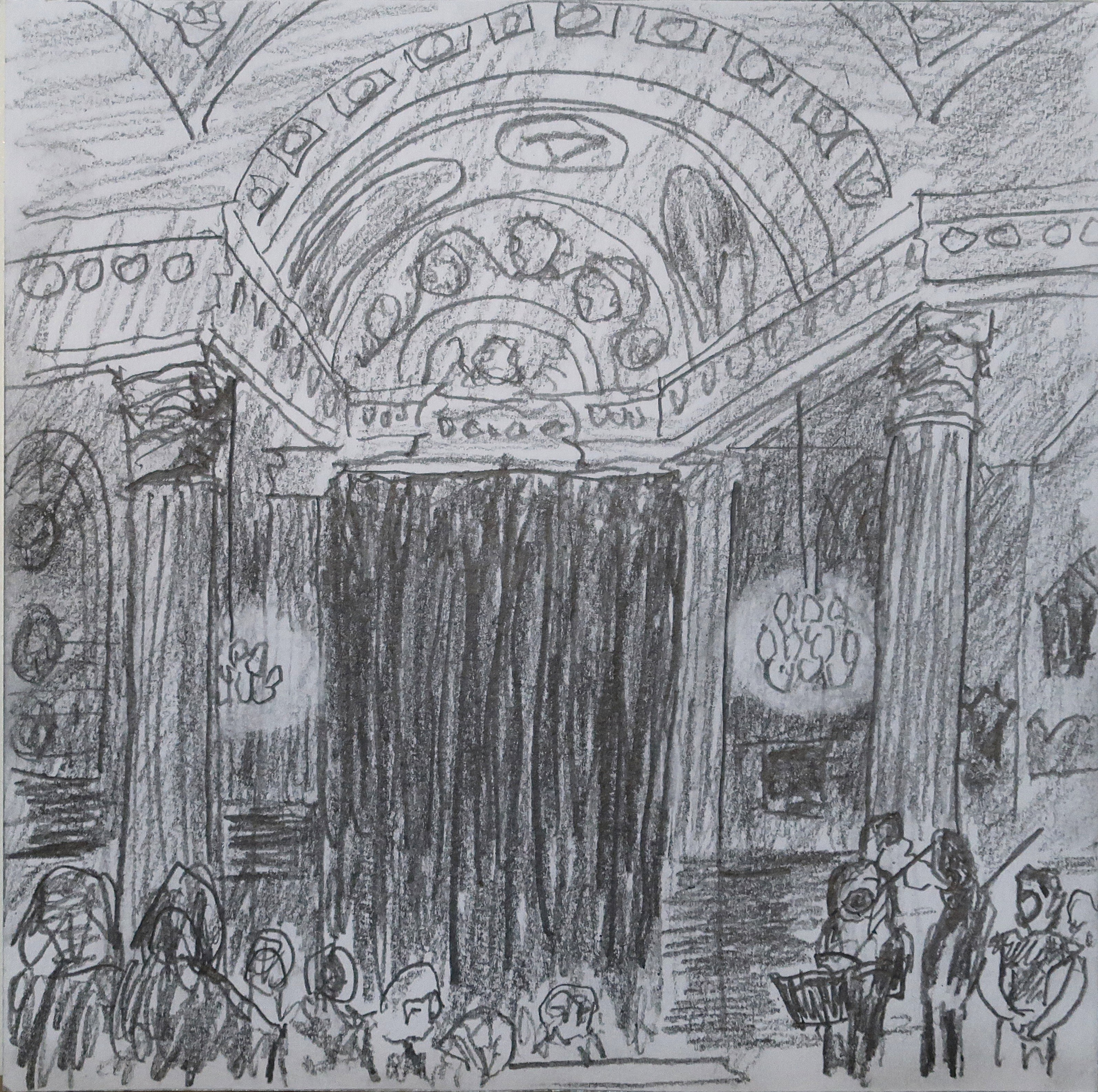
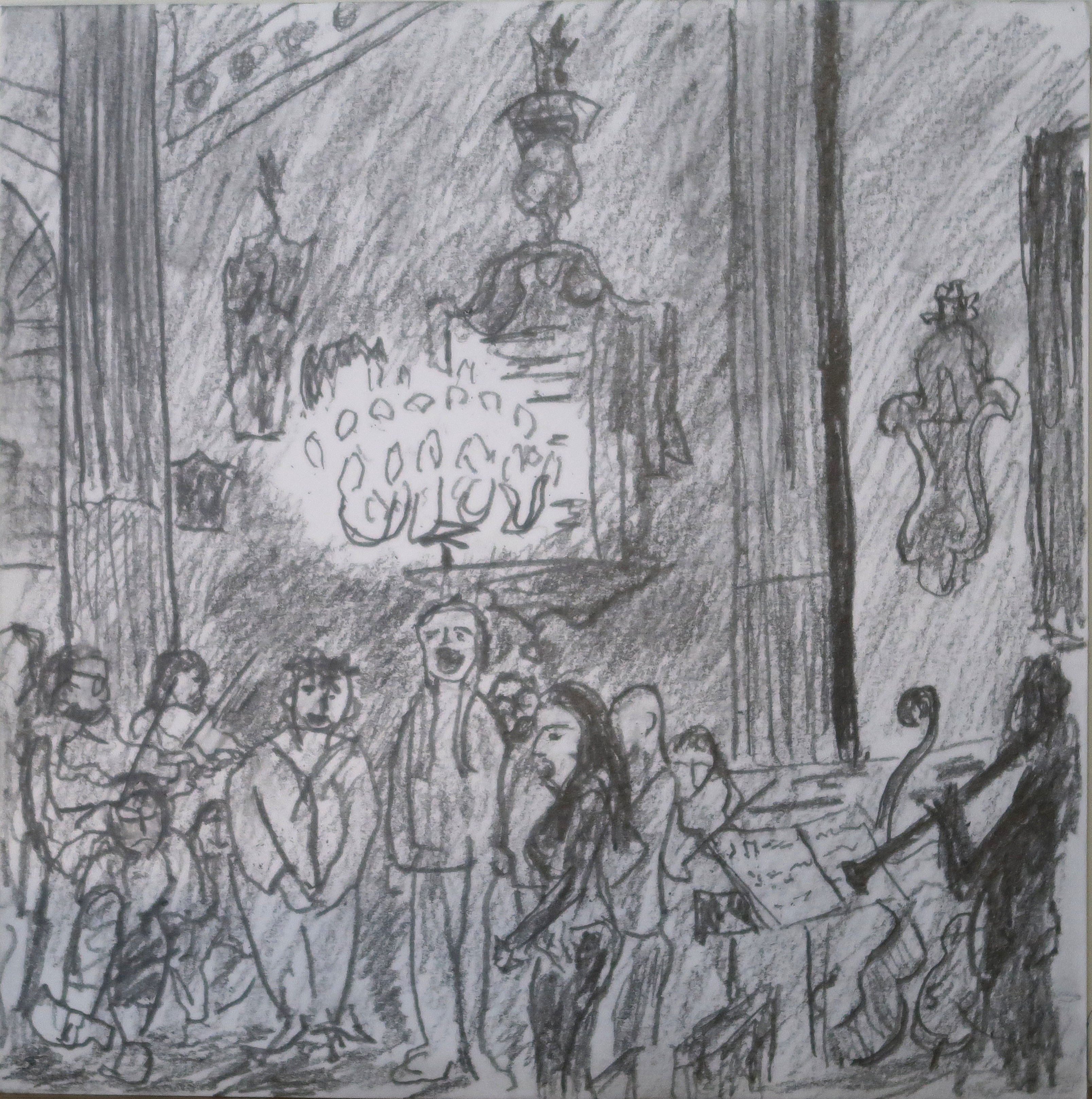
Solomon’s Knot performing Handel’s “Israel in Egypt” in St Mary-at-Hill for the 80th birthday of Alan Moses.
x
x
Sir Alan George Moses (born 29 November 1945) is a former Lord Justice of Appeal, a Court of Appeal Judge and the former chairman of Independent Press Standards Organisation (IPSO). He is joint Chair of the United Kingdom’s Spoliation Advisory Panel.In 2003 he was the judge in the high-profile Soham murders case which led to the imprisonment of Ian Huntley.
x
Solomon’s Knot is a baroque and early music vocal & instrumental ensemble, based in the United Kingdom. Described as “one of the UK’s most innovative and imaginative ensembles”, they work without a conductor and sing from memory.[4]
Hugely impressed with the Library of New South Wales catalogue to the exhibition about the internment camp in Hay, Australia where my father and other jews were interned as “enemy aliens” for the first years of WW2. My father kept a diary, which is part of this exhibition – and I have added the catalogue and the diary to the post about my father (who died before I was born) that is here on my journal. Scroll down to the foot of the post for the catalogue and the diary. My thanks to Andrew Trigg, librarian at NSW and to the curators of this extraordinary exhibition.
Collected Longer Poems Anthony Howell Grey Suit Editions Paperback ISBN 978-1-903006-37-5 e-Book ISBN 978-1-903006-37-5 280pp £20.00
Anthony Howell, 80, has a Wikipedia page showing his many achievements. He worked for the Royal Ballet before concentrating on writing poems, novels, plays and translations. He is also a visual artist, publisher and has run poetry events at The Room.
Howell’s Collected Longer Poems consists of 22 poems of varying lengths and styles written over 50 years with praises by Donald Gardner, Sylvia Kantaris, Robert Nye and John Ashbery. Regarding longer poems Howell says, “the longer poem invites the reader to become immersed in the flow of a process and as such it is less dependent on that lyrical emphasis on beginnings and ends – which may seem to lend significance to a fragment or an anecdote”.
While I cannot do justice to this major collection in a short review I will make a few observations. Hopefully, the lines I quote to illustrate these will show the range of Howell’s writing. Several of Howell’s poems tend toward a maximalist style with much detail. According to Auerbach in his book Mimesis this foregrounding of detail is more characteristic of classical writing than that of the biblical tradition. Following the former tradition is perhaps unsurprising for someone who has received critical acclaim for his versions of poems by the Latin poet Statius. Statius appears in ‘Dancers in Daylight’ “looking up in awe/At rafters there no longer.’ Howell has also been influenced by the abstract poet John Ashbery whose poetry puts the emphasis on language rather than meaning. We are told that “Ashbery approves of the results” of Howell’s version of Fawzi Karim’s ‘Empyrean Suite – Poems from the Afterlife’. Howell describes his own technique as “description without motive” with the emphasis on detailed description rather than narrative meaning.
Let us look at the beginning of ‘Boxing the Cleveland’.
A coach-built lorry, several metres long, Is backing down the grass-bound lane between The weather-boarded shack where clothes are hung And that old shed for wood. The lane leads on Past chicken runs behind a criss-cross fence On the woodshed side, beyond the much-decayed Remains of a kennel, overgrown with dense Nettles and docks, and then on past those frayed Rails the horses gnaw through the winter, bordering The sunset paddock, there on the laundry side.
Notice also how each line begins with an initial capital. Howell’s reason for doing this can be found in an article he wrote for The High Window. One of the poets Ashbery admired was F.T. Prince and in the poem ‘The Ballad of the Sands’ Howell follows a verse form pioneered by F.T. Prince which uses a six-line stanza with two rhymes and two unrhymed lines. As Howell says, “the form mediates admirably between stricture and freedom.” The following stanza shows Howell’s skill in formal writing.
Her footprints are soon Smoothed over by the wind And you lose their descent In some crater of the dune Where the shades crescent Enlarges afternoon.
Some of Howell’s poems are meditations such as the ‘Songs of Realisation’. Here is an extract.
But what fills space, if anything? Emptiness I disown. I sit beneath the fig, look upwards at the sun, Gazing through a leaf as I turn brown. From some other view, the leaf is simply green; From underneath, a filigree of tributaries, a delta flooding Backwards on itself, feeding on light while drinking moisture.
The disowning of emptiness shows Howell’s original mind. Seeing things from different perspectives which Howell often does can have a certain danger. In ‘Heron of Hawthornden’ he writes wittily
It’s my fault. Haven’t the sense to keep My mouth shut. Cultural ladies and gents Like nothing better than to bathe together in agreement’s glow…
More wit can be found in his versions of Fawzi Karim’s ‘Empyrean Suite: Poems from the Afterlife’
Basil sat by my grave today, reading me my poems. I must say it was difficult to hear, Being far above, rather than below and near. He then began to write himself.
While the title of Howell’s poem ‘My Part in the Downfall of Everything: A Satire on Deceit’ is witty the subject of the satire is grim as the following stanzas show.
My Jewish ‘Opa’ cooled his hands In an anteroom as General Goering addressed The rest of a Zionist delegation. Brandishing a wad of clippings, Goering
Launched into a harsh denunciation Of those among the populace responsible For spreading anti-Nazi propaganda In Britain and America – gross exaggerations,
Detailing atrocities that constituted Fabrications. ‘Put a stop to these Libellously false reports immediately Or I shall not be able (or inclined)
To guarantee the safety of the Jews.’
Opa means grandfather. Howell’s interest in the bleak may be suggested by the last line of ‘The Photographer’, ‘Then for something utterly ugly makes for the perfect shot’.
The following lines in ‘A walker on the wall’ give a visual description of everyday ugliness.
Broken, where the wall surveys the sea, And left as flotsam shored against its mound, Lie jerry-cans, the torn hoods off prams And ruptured tires distorted by their scorching:
The poem ‘Silent Highway’ about the history and mythology of the Thames begins with a description of what would normally be seen as ugly in a celebratory tone.
Heraclitus
Apotheosis! Arsenals of the sky Ablaze, exploding, crimsoning the crowns
Of storm clouds over Woolwich with its furnaces Producing the great barrels of our guns.
Throughout the book are many references to poets of the past and adaptations of famous lines. One example also comes from ‘Silent Highway’, this time in the ‘Windrush’ section.
Sweet Thames, run softly, till me end I song, Me quit the West Indies and the journey be long.
This adaptation of a line by Spenser and borrowed by Eliot introduces the speech of newcomers. I would highly recommend Collected Longer Poems as Howell gives the reader, through his skilful and wide-ranging writing, much knowledge and an original way of seeing the world.







 anthonyhowelljournal