I’m very grateful to the Fortnightly for being able to publish extracts from each book as each clean draft gets completed, and of course I am still at work improving what I have already got down. I am also pleased that the Heyzine book has now attracted over 500 readers. So I’m sending out a big thank you to these readers. It is definitely encouraging to know that I am being accompanied as I continue my project.
Kazuko Shiraishi has died aged 93. She was, to my mind, the most significant Japanese poet of her generation. She was a modernist, outsider poet who got her start in Katsue Kitazono’s avant-garde “VVOU” poetry group, which led Shiraishi to publish her first book of poems in 1951, a book packed with vivid and surreal imagery. A first book of her poems translated into English by several writers was edited with an introduction by Kenneth Rexroth, who also translated several of her poems.
Here is Rexroth’s introduction to that book – Seasons of Sacred Lust – first published in Japan in 1968 and by New Directions in 1975:
“Kazuko Shiraishi is certainly the outstanding poetic voice of her generation of disengagement in Japan. And there is certainly no woman poet of this kind anywhere near as good elsewhere in the world. Joyce Mansour in France is far inferior and Lenore Kandel in the United States equals her only in one or two poems. Her work has a fierceness and an exaltation that makes most of her Western colleagues in disaffiliation seem positively mellow. In the final analysis of course, what makes her preeminent is sheer poetic ability. If you hear her read aloud, with or without jazz accompaniment, you know that, even if you don’t speak a word of Japanese, Shiraishi is the last and the youngest and one of the best of the generation of the Beats in America, the Angry Young Men in England, Voznesensky in the U.S.S.R.
Shiraishi has often been compared to the novelist of extreme alienation Osamu Dazai or to Celine, but there is a most decided difference. Dazai and Celine were corrupted and eventually destroyed by their alienation. Shiraishi, like Henry Miller, is a remarkably clean liver. She doesn’t take drugs, even alcohol, nor smoke either marijuana or the more dangerous tobacco. She stays up late, goes to discotheques and jazz clubs and loves to dance—hardly very vicious vices. Although sex enters into many of her poems and she has the reputation of being a very erotic poet, as a matter of fact her sexual life and attitudes differ little from those of any other liberated young woman in any of the major capitals of the world and it is very far from the random promiscuity of the hippie generation. Again, in this, she resembles Henry Miller. It’s not just a moral difference. Shiraishi simply believes in keeping herself efficient as spokeswoman and diarist of what the French call the “métier.” In this she resembles the great modern prose writer of the similar world of two generations ago, Nagai Kafu and Ihara Saikaku (1642-1693), the erotic writer of the métier of genroku—the brilliant period at the turn of the seventeenth to eighteenth centuries.
Similar, perhaps, but vastly changed. Kafu wrote of the last of the pleasure quarters of disintegrating Tokyo, the aging geisha and lonely prostitutes of seedy Shimbashi and the poorly paid actresses of the cheap theaters and satirical theater restaurants of Asakusa where he himself, even in old age, often acted. Saikaku wrote of a world of secular splendor.
Shiraishi’s métier is something else. Modern Tokyo in the third quarter of the twentieth century is the international megalopolis pushed to the extreme. One cannot say to the ultimate, for God knows what the ultimate may be. Shiraishi does not write of the ukiyo, The Floating World, now utterly gone, but of a maelstrom, a typhoon, in which lost men and women whirl through toppling towers of neon. Shiraishi’s Tokyo is straight out of Dante, but Paolo and Francesca seem only to get together for a moment to realize estrangement. Music—jazz and rock—and poetry provide something resembling values. Sex only seems to ease the pain and fear.
Poetry read to jazz had only a brief popularity in America. It was ruined by people who knew nothing about either jazz or poetry. Japanese, young and not so young, people have an astonishing musical knowledge of jazz and Shiraishi is certainly the best poet ever to use the form. Her poetry can be soft and sweet at times, but mostly it has a slashing rhythm read in what she refers to as her “Samurai movie voice.” Her effect on audiences is spectacular. There is the secret of Shiraishi as a person and poet. She is a thoroughly efficient performer, and her poetry projects as does that of very few other poets anywhere. Her peers are Dylan Thomas and Voznesensky. She is also a woman of spectacular beauty.
Translation of Shiraishi presents very considerable problems. First, Japanese doesn’t sound anything like American. A series of short lines beginning with “I” sounds nothing like the Japanese beginning “watashi.” Second, a translator must be hip, able to identify with this special world of Outsiders and familiar with their special languages in both Japanese and English. It’s no job for squares or straights. This selection is the work of five people who constantly consulted one another. The principal initial translator of these poems was Ikuko Atsumi, a close friend of Shiraishi’s, who herself writes poetry in both Japanese and English, assisted by John Solt of whom the same may be said. The translations were then revised by the American poet Carol Tinker, and by Yasuyo Morita and by me. I also translated several additional poems.”
Kenneth Rexroth
Born in Vancouver in 1931, Shiraishi was taken to Japan by her parents just prior to World War 2, and when I met her in Iowa City in 1970/71 – where we were both on an International Writers’ Program – she told me that she had felt alienated from Canadian society because she was seen to be Japanese, and then alienated from Japanese society – because she was seen to be Canadian. Mutually estranged, poetry became her nation. She was a pioneer of performance poetry who might be likened to the late Christopher Logue here in the UK (a poet who has never been accorded his due, in my opinion).
John Solt went on to publish another volume of his translations of Shiraishi’s poetry – Burning Meditation and other poems – which came out in 1991 in Japan, published by Pink Sand Studio and in 2017 – Yumiko Tsumura brought out more translations of Shiraishi in a New Directions Poetry Pamphlet (number 23) entitled Sea, Land, Shadow. Both these books contain stunning poetry.
Kazuko Shiraishi’s daughter Yuko Shiraishi is an internationally known artist who exhibits with the Annely Juda Gallery and has shown her work in Japan and elsewhere around the world.
MONKEYS
x
“It doesn’t matter that we will never become human beings.
Here are the conventional terms for metrical feet in poetry.
a line with two feet is a dimeter;
a line with three feet is a trimeter;
a line with four feet is a tetrameter;
a line with five feet is a pentameter;
a line with six feet is a hexameter;
a line with seven feet is a heptameter.
However, it is worth noting that the most interesting meters are those of the primes 5 and 7.
Verse can also be trochaic (falling foot) or iambic (rising foot), and there are other types such as dactyls, but that is not the topic currently under discussion.
Because of four-line stanzas in tetrameter, heroic Augustan couplets and conventional sonnets, we tend to think of verse as always having a regular stress – “written in iambic pentameter” for instance. However, this is not the only way to write verse which scans.
A madrigal such as many of those written by William Drummond of Hawthornden will scan the prime numbers:
x
Like the Idalian queen,
Her hair about her eyne,
With neck and breast’s ripe apples to be seen,
At first glance of the morn
In Cyprus’ gardens gathering those fair flowers
Which of her blood were born,
I saw, but fainting saw, my paramours.
The Graces naked danced about the place,
The winds and trees amazed
With silence on her gazed,
The flowers did smile, like those upon her face;
And as their aspen stalks those fingers band,
That she might read my case,
A hyacinth I wished me in her hand.
x
Here Drummond scans trimeter with pentameter. But all primes scan, so the madrigal form could use pentameter juxtaposed with heptameter. Heptameter will scan with trimeter as well and with Endekameter (an eleven-foot line). I have written poems making use of such an extended madrigal structure.
But what makes the primes of particular interest is the irregularity of the caesura. A caesura is a pause that occurs within a line of poetry, and in my view, strictly speaking, it needs to be more than one foot long. Modernists may bend such a rule, fair enough. But if we stick with the rule some interesting ratios become evident.
The caesura on 5 (Pentameter)
3:2
The caesura on 7 (heptameter)
5:2
4:3
The caesura on 11 (Endekameter)
5:6
3:8
9:2
7:4
Of course the ratios can be reversed. But it is the inequality of the caesura which makes pentameter so vital to English poetry.
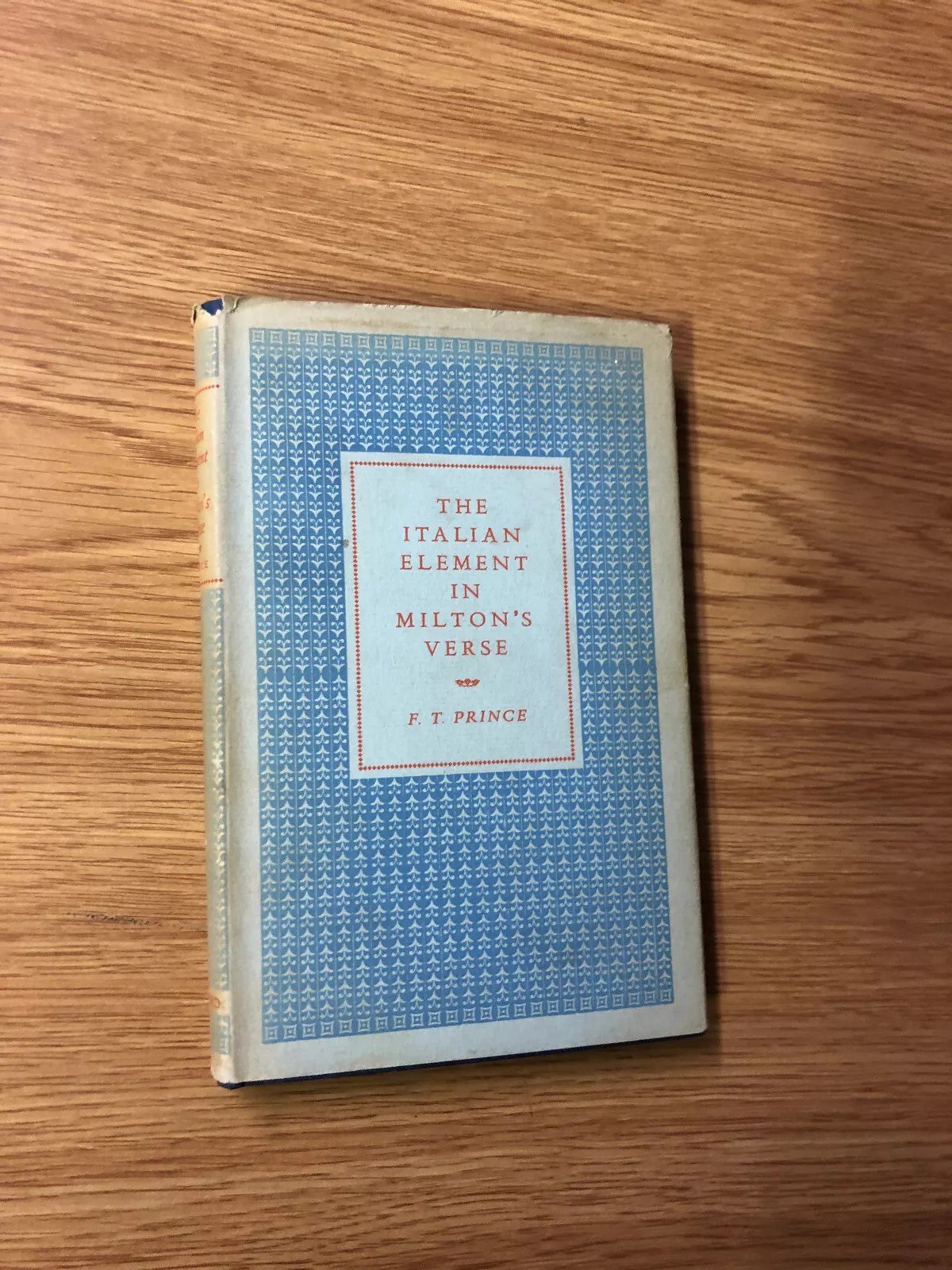
I am writing my epic THE RUNIAD in a meter that is loosely heptameter, because I enjoy the possibility of using two caesurae. A great book dealing with these niceties of the metrical foot in English verse is F T Prince’s “The Italian Element In Milton’s Verse” Pub: Oxford – 1954.
Edward Field, in my opinion, one of the great poets of his time. His poem about World War 2 and being shot down in a bomber is probably the best poem of that war. And there is plenty of other work just as great. He has been overlooked because he was a narrative writer in a very “languagey” context. Fuck that! His work will never be forgotten.
Click on the link for a free online copy of this collection of my abstract poems.
“I consider as ‘abstract’ my writings and paintings which are generated by some conceptual or plastic process – such processes may generate narrative or figurative suggestions but these are incidental rather than deliberate. The paintings which accompany these poems are not intended to illustrate the text, rather they are juxtaposed with the text, and any connection between text and image is again incidental. I feel that my notion of abstraction is a reversal of a modernism that moves away from the figurative into abstraction, a reversal of language departing from narrative to find release in syntax. Rather, I begin from some chaotic concept, then allow accident and inconsistency to take me wherever the poem finds its route, which may well prompt a sense of meaning. I readily invite the reader to invent the ghosts of stories, glimpses of scenes discovered by the process.” (author’s note)
This collection includes certain long poems which have not been included in “Collected Longer Poems” because it seemed more appropriate to keep them with my other abstract poems.
On the Heyzine site, my advice is to turn off the sound and expand the page. Click on the arrow at the foot of the right hand page to turn to the next page.
Very pleased that my review of The Indian Jungle: Psychoanalysis and Non-Western Civilizations (published by Karnac) has just come out in The Fortnightly.
Sadly the author Sudhir Kakar has recently passed away. A link to a website related to his work – the Kakar Art Collective – can be found in the heading to my essay.





 anthonyhowelljournal