
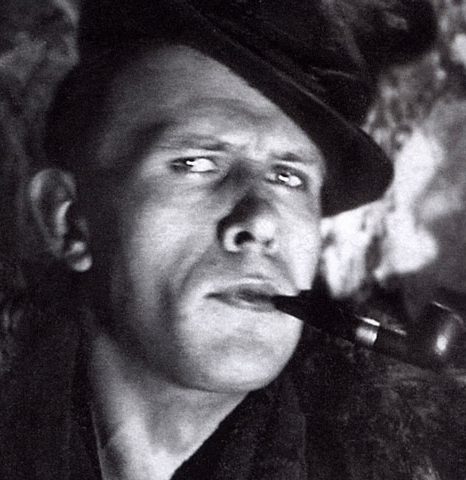
I am a huge admirer and an avid reader of the work of Daniil Kharms – the Russian absurdist writer and pioneer of micro-fiction. Kharms was a Russian avant-gardist and absurdist poet, writer and dramatist in the early Soviet era.
Kharms was born as Daniil Yuvachev in Saint Petersburg, then the capital of the Russian Empire, into the family of Ivan Yuvachev, a member of the revolutionary group Narodnaya Volya. By the time of his son’s birth, Ivan Yuvachev had already been imprisoned for his involvement in subversive acts against Tsar Alexander III and had become a philosopher.
Daniil invented the pseudonym Kharms while attending Saint Peter’s School. While at Saint Peter’s, he learned the rudiments of both English and German, and it may have been the English words “harm” and “charm” that he incorporated into “Kharms”. His pseudonym might have been also influenced by his fascination with Arthur Conan Doyle’s Sherlock Holmes, as the two words (Holmes and Harms) start and end similarly; but there are a number of other theories regarding the pseudonym. Throughout his career, Kharms used variations on this name and the pseudonyms DanDan, Khorms, Charms, Shardam, and Kharms-Shardam, among others.
In 1924, he entered the Leningrad Electrotechnicum, from which he was expelled for “poor attendance,” “not participating in community service,” and not “fitting into the class physiologically”.
After his expulsion, Kharms gave himself over entirely to literature. He joined the circle of Aleksandr Tufanov, a sound-poet, and follower of Velimir Khlebnikov’s ideas of zaum (or trans-sense) poetry. He met the young poet Alexander Vvedensky at this time, and the two became close friends and collaborators.
In 1927, the Association of Writers of Children’s Literature was formed, and Kharms was invited to be a member. From 1928 until 1941, Kharms continually produced children’s works, to great success.
In 1928, Kharms founded the avant-garde collective Oberiu, or Union of Real Art. He embraced the new movements of Russian Futurism laid out by his idols, Khlebnikov, Kazimir Malevich, and Igor Terentiev, among others. Their ideas served as a springboard. His aesthetic centered around a belief in the autonomy of art from real world rules and logic, and that intrinsic meaning is to be found in objects and words outside of their practical function.
More at https://en.wikipedia.org/wiki/Daniil_Kharms
Kharms believed that a poem should be made so entirely of itself that it would be an object that would shatter a pane of glass if it was thrown against a window. He is the master of the 90 degree turn and of the non sequitur. Such mastery is not easy to achieve. Most poets strive for resolution, for tying things up neatly, for a significant ending. Kharms stands for uncertainty, instability and surprise. He was admired by John Ashbery and many others.
The best anthology of his writings is Today I Wrote Nothing – the selected writings of Daniil Kharms translated from the Russian by Matvei Yankelevich (the Overlook Press, New York).


