
THE FALSE AND FAITHFUL GREEN
x
You no longer await me with a heart
Mean as a clock’s. Doesn’t matter if you broach
The misery or just stare it out. Hours remain,
Bristly, bleak, with branches that drub
Impulsively against the panes of your window,
High as it is, above two streets of cloud.
What’s left me is the slowness of a smile,
The dark sky of a dress, the rust-coloured
Velvet wrapping you up to the hair
Which melts around your shoulders, and that face of yours
Sunk as in a brook that hardly moves.
x
The flap of coarsely yellowed leaves…
Birds of soot. Other leaves
Chafe at the branches, fretful to slip off
In some entanglement: the false and faithful green
Of April, with an open sneer
Assured of its own flowering. You don’t flower.
Your days don’t sprout nor does one dream
Remain of our “once”… over there.
You have lost your child eyes, gone the tender hands
Reaching for my face which still evades me.
Left is the shame of writing notes in the diary now,
Or chucking out a yell into the void
Of that implausible heart which
Wrestles still with its own precarious time.
O MIEI DOLCI ANIMALI
x
Now that autumn spoils the hillside’s greenery,
Oh my darling beasts, once more
We listen, at the start of dusk, to all the final sorrows
Of the birds, feel the smoky plain’s allure
That leads us to its rendezvous
With the deep’s murmur, the odour
Of rain-drenched timber, odour of each den.
How lively it is among houses,
Amid men, my darling beasts…
This face that slowly rolls an eye,
This hand that gestures to a sky
Where thunder rumbles; these are yours,
My wolves, my burnt, my bloodied foxes.
Every hand is yours, each face.
You’ve taught me just how pointless
It has been – days washed away by
Relentless waters while some children’s song
Issues from the gardens – its hour
A long way from us though. Hardly even its shadow
In the air. Here is your voice – though I may guess
That maybe all of this has never happened.
AGRIGENTO’S ROAD
x
That wind persists which I recall obliquely afire in the manes
Of racing horses viewed from afar; wind that stains and gnaws
At the sandstone hearts of these lugubrious columns
Flung down on the grass. Ancient soul, grey with rancour,
Turn to that wind, inhale the delicate scent of moss
Coating the giants horizontal to the heavens here.
x
In the space still left to what remains, how alone they are!
This is all the more poignant should you hear the detonations
From the distant sea which Hesperus already streaks with dawn.
The Jew’s harp sadly twangs in the carter’s mouth as we
Make slow progress up the slope cleansed by the light of the moon
While the Saracen olive boughs continue with their murmuring.
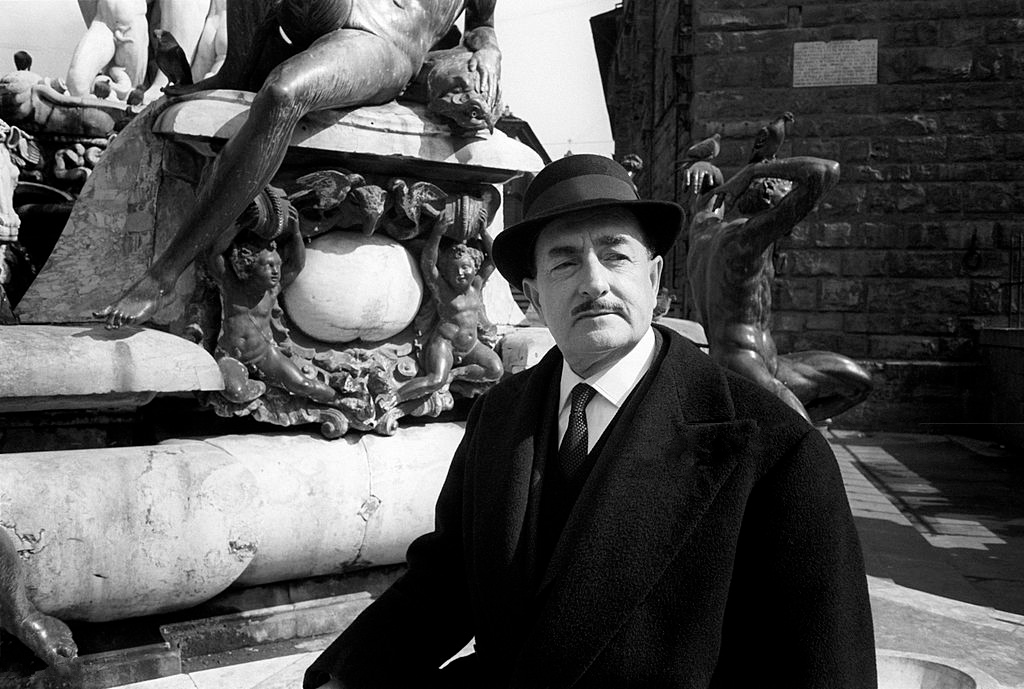
Salvatore Quasimodo
I guess it was in 1966 that Salvatore Quasimodo invited me for tea in his apartment in Milan. I was twenty-one, had left the ballet suffering from a broken heart, my love unrequited. An Italian boy who had been on an exchange at Leighton Park, the school I went to before the Royal Ballet School, had welcomed me to his home in Mantua, and when we visited Madrid had found the poet’s number, and so my visit came about. I was already an admirer of Quasimodo’s hermetic, abstruse yet mysteriously compelling verse, and I appreciated its subtle musicality. The renowned poet was affable, and, as I recall, extremely proud of his art collection, and of the well-known artists who had made sketches of him. I returned rejuvenated from Italy, and thus began my career as a poet.


