
Luciano Borzo
Zios want to erase all trace of Palestinian identity . Ironically , they must admire them otherwise why steal EVERYTHING from them from the garments, koffiye to the food …pretty soon it will be the dabke dance too . Does Freud have a name for that !?
So posted Kenza Ma on social media recently. But I don’t think it is Freud who can provide us with an explanation. I would identify René Girard, the French historian, as a thinker who might supply the answer to this interesting phenomenon. Girard is the originator of the mimetic theory of desire. The name of the theory is derived from the philosophical concept mimesis – which includes a wide range of meanings. In mimetic theory, mimesis refers to human desire, which Girard thought was not linear but the product of a mimetic process in which people imitate models who endow objects with value. Girard called this phenomenon mimetic desire. Girard described mimetic desire as the foundation of his theory:
“Man is the creature who does not know what to desire, and he turns to others in order to make up his mind. We desire what others desire because we imitate their desires.”
Girard’s is a refreshing antidote to Freudian theory.
A child’s reality is scarcely existent. The strongest desire is imaginative: not to be a child, to be a grown up. But not an ordinary grown up. A cowboy, a gangster, a pirate. And then the younger boy may admire his older brother. His older brother has a girlfriend. When he is older, the younger boy will have a girlfriend. But growing up renders this imitative process more complex. For children there is the primal intrigue of parts – the youngest admires a part of the eldest. Her breasts, say. And so, when she ‘grows up’ she must have breasts. This imitative ‘instinct’ removes the accepted notion of intrinsic leanings, i.e. that our leanings are innate, that we are biologically hetero or homo. Older people are role models. Aspiration. Teen desire is for the being as a whole: a crush. It may be for a girl a desire to be the girl she admires in a higher class or to possess a boy like the boy that girl goes out with on dates.
For Girard we imitate our role models and follow in the footsteps of their desire. His mimetic theory is an explanation of human behavior, attraction and culture.
Mimetic desire leads to natural rivalry and eventually to scapegoating. This Girard called the scapegoat mechanism. In his study of history, Girard formed the hypothesis that societies unify their imitative desires around the destruction of a collectively agreed-upon scapegoat.
His theory goes a considerable way to describing the predicament of the Israelis. No amount of propaganda claiming that Palestine was a desert before they arrived can save Israelis from losing their Jewish identity, the identity of the wanderer, whose ties to family and family customs are the real home – which is why the Rothschilds were able to open banks in five major European cities a short while after the Napoleonic wars – the first branch banks. Now, Israelis strive to ‘put down roots’. But who are the people with roots in soil of this territory? The Palestinians.
I’ll share a post from Lowkey here:
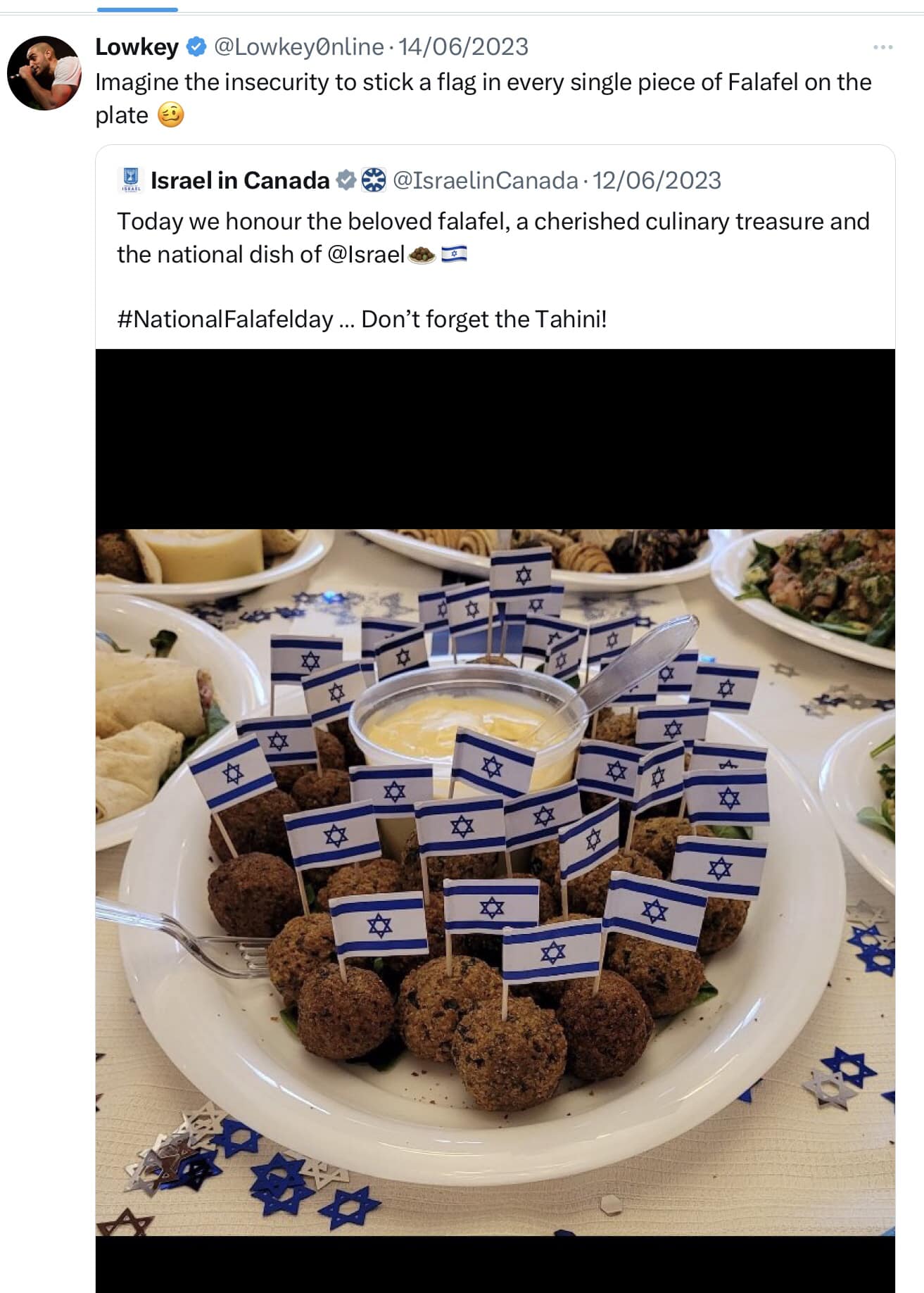
When I was in Israel in 1955, falafel was absolutely something Arab, sold only by vendors with tiny street set-ups, not even stalls. Lowkey is spot-on.
There is nothing innate about the existence of the Jews in the territory they have appropriated for themselves with the blessing of the West and its affluent wandering bankers. They have settled without right on Palestinian land. They want the territory for themselves. However, they also seek to ‘be’ the rustics of this land.
The fellahin, a word I recall hearing in Israel, has become synonymous with ‘terrorist’ – and for years I thought that is what it meant. Actually, it means ‘countryman’. Israeli fighters identify with the sabra – the prickly pear indigenous to the Middle East. They want to be indigenous to their new ‘home’ – to be as tough as the prickly pear – to dissociate from the meek millions who went to their fate in war-torn Europe. Girard’s mimetic theory shows how psychologically the Israelis desire to be Palestinians; that is, indigenous to Palestine – cultivating orange groves, herding goats, simmering falafel.
A fair number will find a Palestinian partner, and endeavour to integrate with some chance of success. For the frustrated majority, as Girard so shrewdly realises, the answer is to unify behind the notion that the Palestinians themselves are what obstructs the Israelis becoming true Fellahin. And so the Palestinian people become their scapegoat, their rivals. This unifies the star-of-David mob. And if such scapegoating ceases to hold sway over the new recruit to the IDF, then the only recourse may seem to be suicide, and their army has the highest suicide rate in the world.
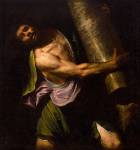
What is frightening in this context is the fact that the Israelis have nuclear weapons, and that one of the most potent of Old Testament stories is that of Samson.


 anthonyhowelljournal
A problem with your analysis is the ongoing tiny communities of say Safed, where Rabbi Yosef Karo codified Jewish law by 1575. I can assure you he would have had no desire at all to be a ‘fellahin’ or put down roots, having wandered across Europe to get there. Nor will most Israelis find Palestinian partners – both communities frown upon those of their children who take this hard road. Girard’s theory will take you so far – a lot of early Israelis loved taking on Arab customs – but it is a very poor tool for prophecy.
LikeLiked by 1 person
My post is a comment on the photo with falafel pinned with Star of David flags. You have to admit that this is an attempt at appropriation.
LikeLike