

x
x
x

x

And to this post I am now adding a section from Book 23 of my poem The Runiad:
x
Now here seems far away from the pressing urgency
Experienced in the West. Sure it’s an illusion, but the heat
Seems to mellow their poverty, nobody wears more
Than one layer anyway. And anyhow, life is cheaper.
There’s no shortage of coconuts, plenty of bananas.
You don’t have to be all that investigative. You don’t
Have to dedicate your hours to unearthing things.
x
Things that prefer to be hidden from us, without the effrontery
Of the small seven-coloured birds that flit through the quiet,
Perch for a sec on the branch of the Bougainvillea, then dart
Into the house. Things better left unsaid. Better not disturb
Their inertia. The boy inhabits the hammock immersed
In his App. Why is that fan of stripes called a dentist fish?
Picasso said something like “I find. I do not seek.”
x
Those who grow up among palms inherit an aesthetic
Radically different to that of persons accustomed to the blurry
Vagaries that epitomise European foliage. Rather it’s
An aesthetic in silhouette; crisper, more graphic, suited
To the precise woodcut. Each climate asserts its own particular ethic.
Our autumn mists of melancholy, clumping of oaks, ivy-ridden
Walls inspire the generalisations of our romantic tendency.
x
Here though, against the honed precision of an outline’s
Bladed fans, only the sea comes shambling in, yawning, stretching,
Breathing out, re-inhaling. But someone has drawn back the curtains
Of bougainvillea so that the garden below the veranda becomes
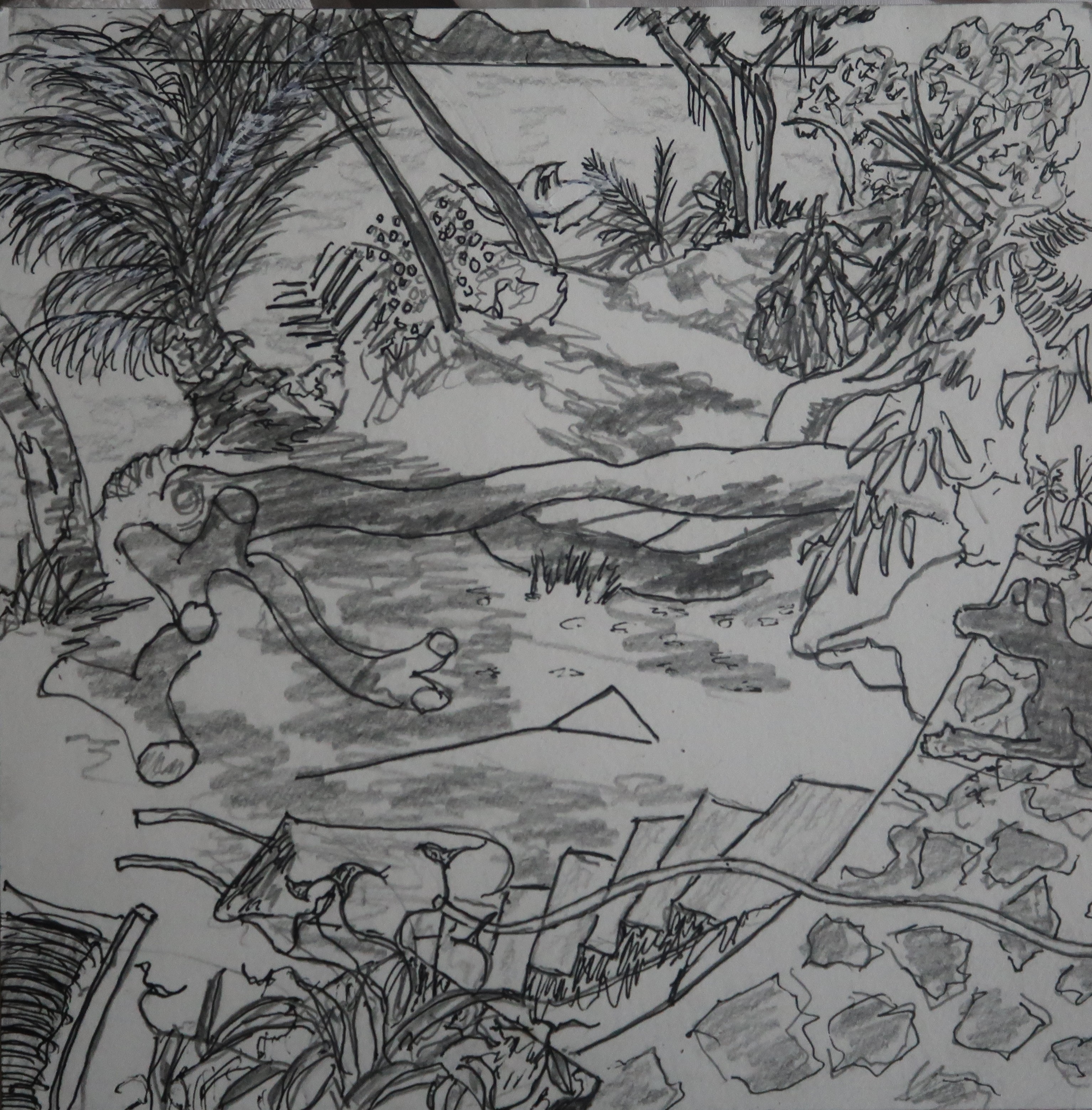
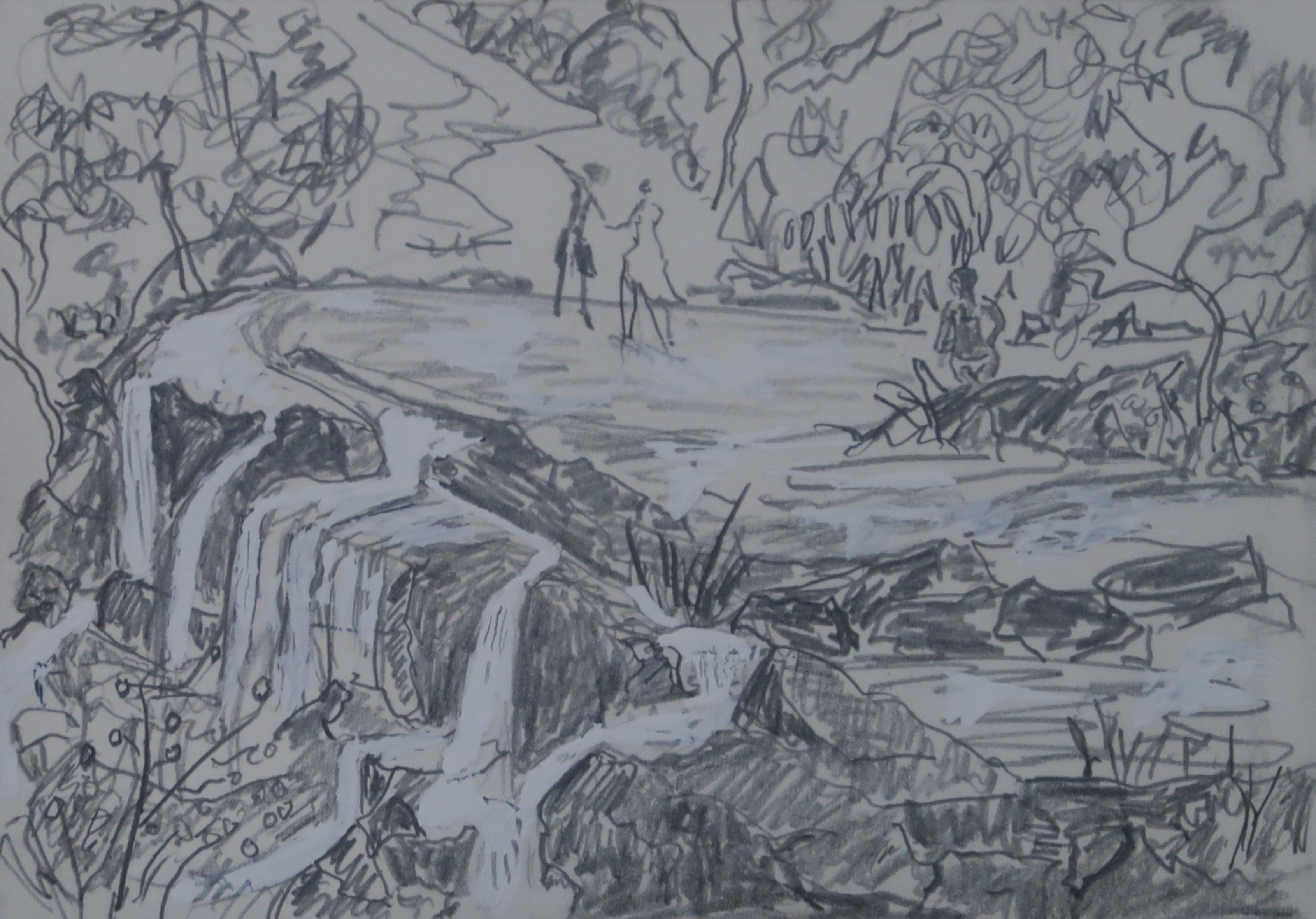
A theatre. Two gentleman, a fallen tree, and the single prop
A chain-saw. One man positions the bough, and intermittently
Now the saw does its biting, interrupting the surrounding sea.
x
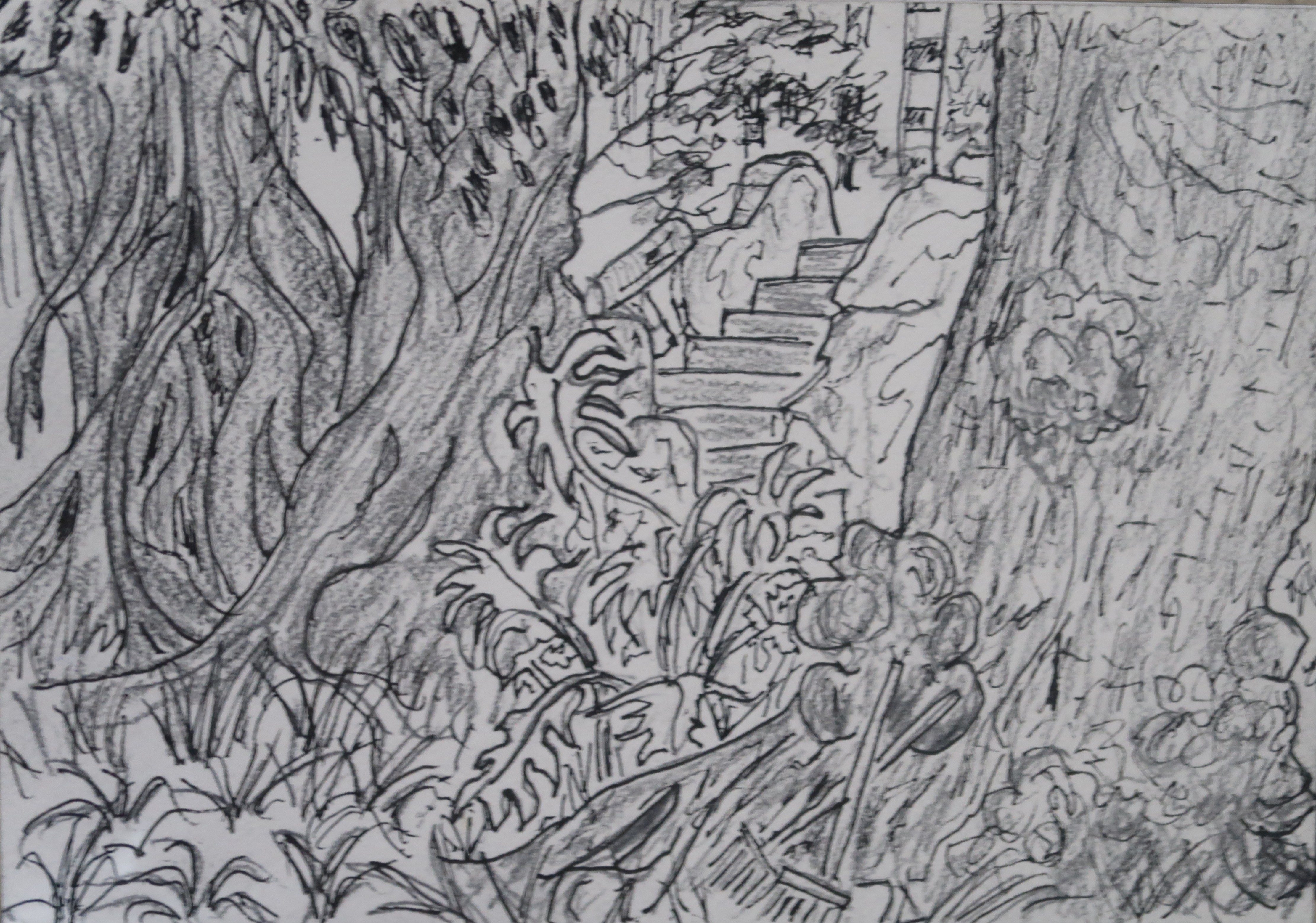
All that is over though. The logs stashed away to the bank
Underneath the suggestion of a crag, among some variegated leaves,
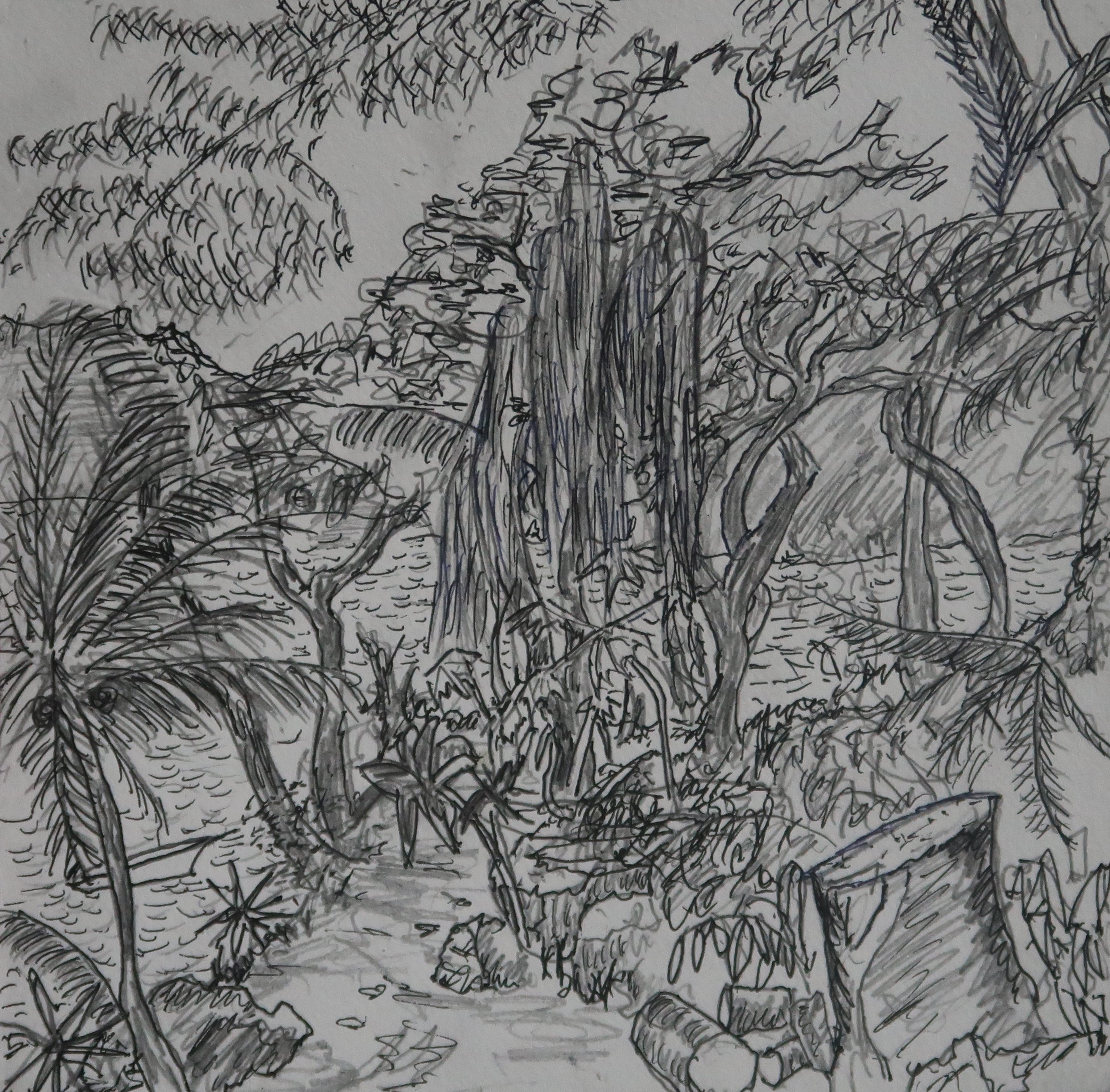
While the tree removed reveals a view of one magnificent stand
Of bamboo, its stout poles ending in spray after spray
Of calligraphy written by delicate leaves. And now the cicadas
Compete with the sea from within the bamboo, sounding
As dry as the sea is wet, abuzz with the gossip that informs
x
The overgrown bank with its several giant leaves, pots with exotics,
Favoured perches for these tiny, seven-coloured birds
That flit through the house, perch on plates for seeds,
While fireflies kindle instants of light later, in the dark.
Gone before seen, and there’s no way of knowing what
You’ll bequeath, what will persist, what will vanish
Down time’s throat, lives being less than a firefly’s flash.
x
Seven colours to each of them. From the Bougainvillea with
Impunity they flit, everywhere; emerald, another green as well.
Black and yellow, white, all on one little bird, and more tints
Than that, the male by a trifle more decorated than his spouse.
Tiny feasts of colour, reminding me that birds have other ways
Of appealing to us, from the long elegance on high of those Magnificent
Frigate Birds to the beady intelligence of the crow family.
x
Mozart enjoyed employing a starling as a prompter
And as a “creative aid” to composition. One day
The starling repeated the 17 opening notes of the Piano
Concerto No. 17 in G major, adding its own variations;
In particular by inserting a coda on the last bar
Of the first complete measure and singing a G♯
Instead of a natural G in the following measure.
xx
It was the starling’s version that became the definitive
Version of Mozart’s concerto. In June 1787,
The starling passed away. For him, Mozart organized
A sumptuous funeral and a worthy burial in the garden
Of his home, even dedicated a passionate elegy
To his feathered co-composer. Don’t allow a cat onto this isle.x
Or that’ll be the end of all the birds, the blue ones as well.
x
There’s a plague of Brazil’s most dangerous snake here
Due to a South African Ridgeback’s hunting down of the Coypu.
You just better look where you’re going for once
And check where you sit before settling to do a sketch.
Be mindful of the sun, as one day on a Rio beach did you in
Badly on the back, because when it comes to lotion, you are slack
To use it at first, and thus you almost always end up toast.
x
Below the tossed palms that slide precise blades against
Blades from another palm, washing through the alleys
And lapping at the hollows of the ear, flexing then relaxing
Its attacks, the surge laps at the rocks by the shore, swollen
Only to subside. It wells up and sinks back again, and I could
Watch it forever, lashing itself into a froth, then
Splashing all the coast within earshot of the open house.
x
It sinks then wells up again, foaming, awash, pouring
Its current into each hollow before retreating, leaving a
Fleur-de-Lys residue that sinks back from all crevices.
Heard through open rooms in the night as the breeze tosses
The bamboo sprays above our heads, throughout the day,
Then each and every night, not to be turned off;
Foam dissolving into froth. Reassuring that it never ceases….
x
Now and forever smoothing out its each and every crease,
Then it either fizzes as it pleases or is wounded by a cruiser
Almost lifting out of the water; curls itself about, to dash
Against the shore again before restoring the calm needed
To saunter breezily back but then retire, having healed
Each suture, into a mere background sound, choosing
Again to expand, or encroach on the slab of a point,
x
Dark now where the wet comes sliding over it,
Only so as to subside all along the shore. The mobile sound of this
Eternal liquid! Maybe it pauses sometimes, but it never
Stops; a power which may not be argued with for long.
Now the sea reminds me of an elephant and how one elephant
I met casually wielded the inexorable power of its trunk
To move what it willed which was me where it wished.
x
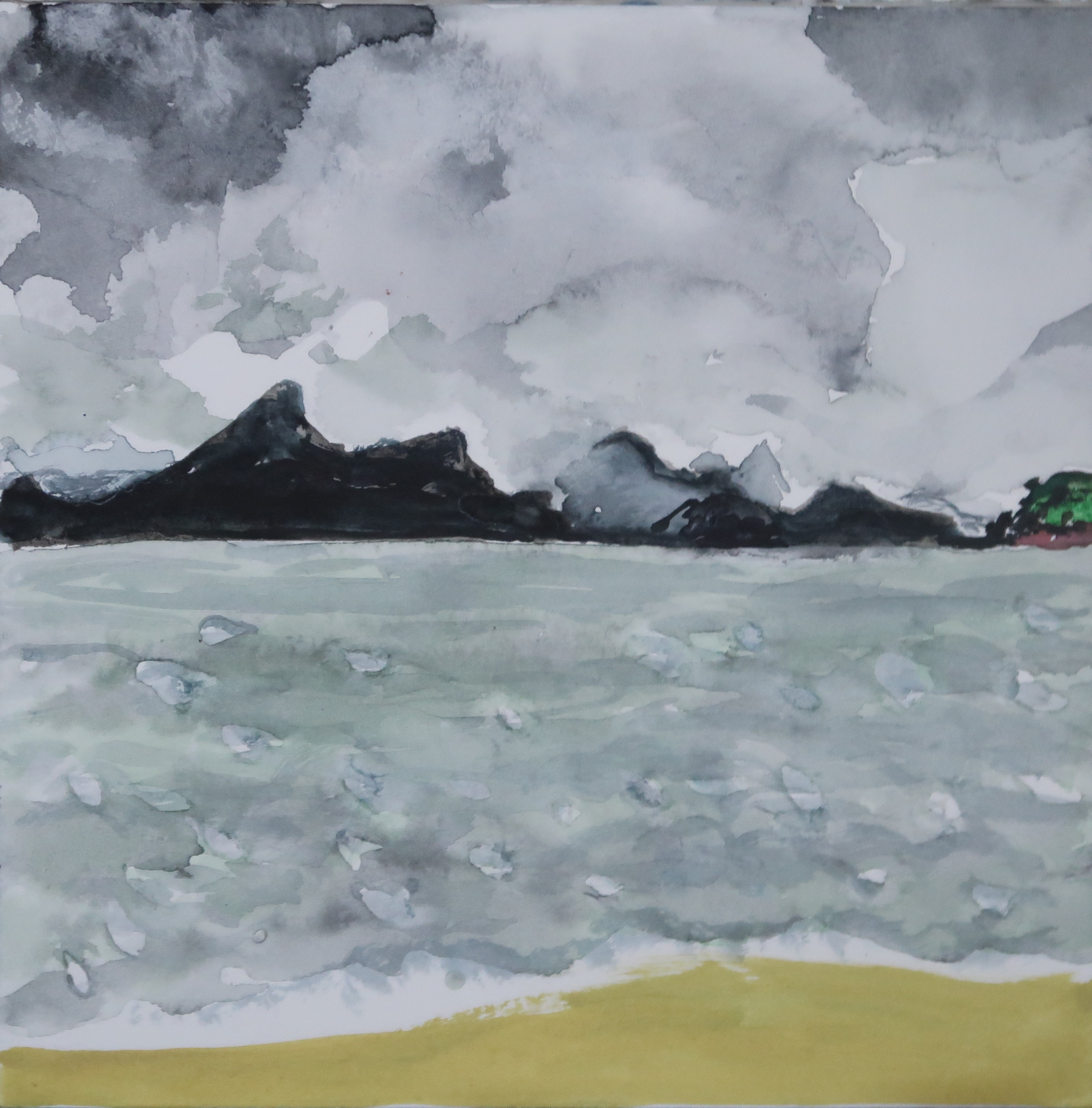
The ocean’s quest for utter peace – entire release from
Restlessness – is a peace near achieved this silvery dawn.
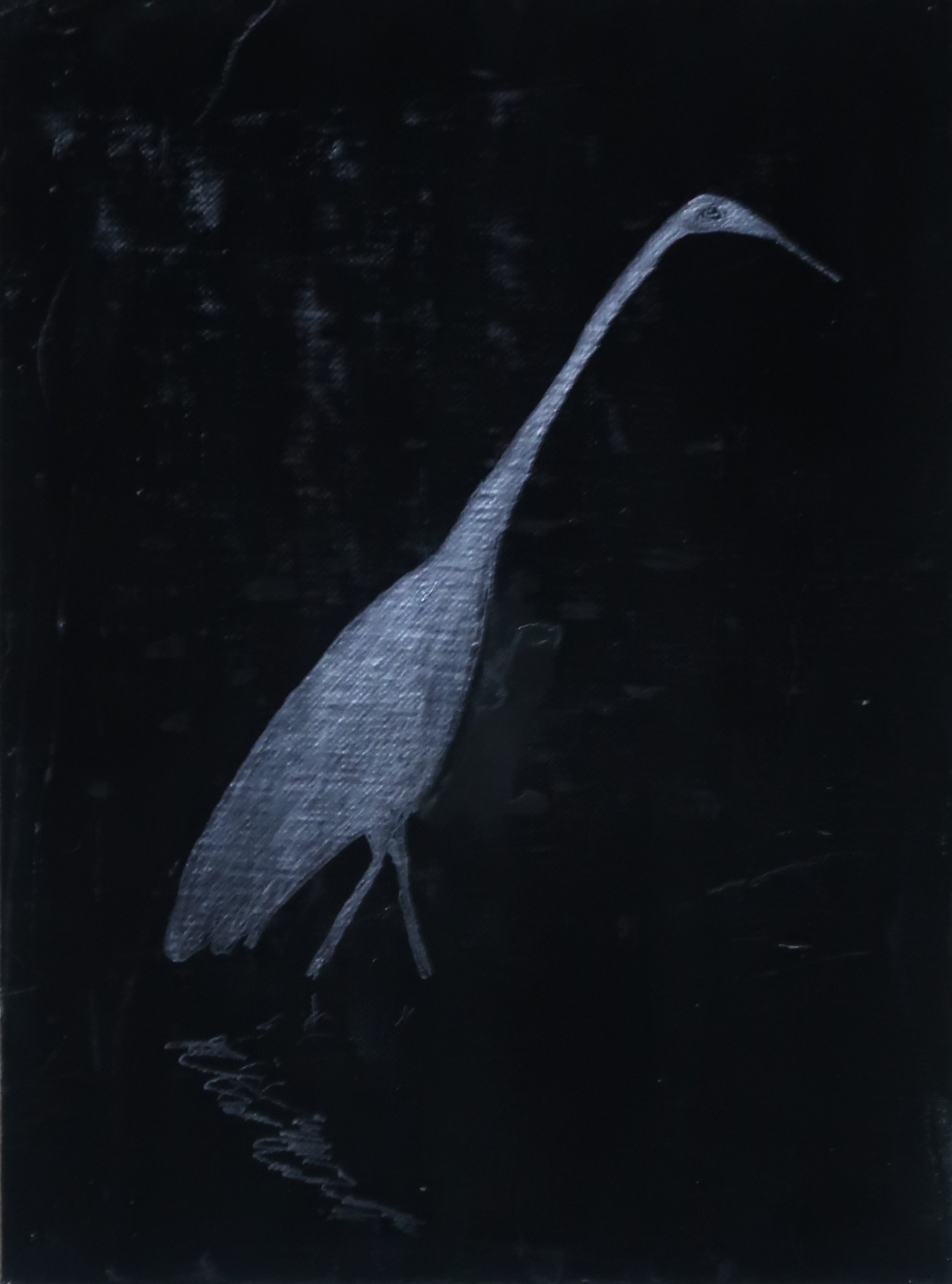
A white heron perches on the prow of a fishing-boat
As the net is drawn in by a man and a boy at the stern.
Some sanctuaries are commonplace, a few far less commonplace
Than others. On this island now, quite content to stare out
At the sea here, I could die. The wave collapsing on its curve;
x
The next wave relapsing into others, out of which sprout eddies
Whitely fizzing down their ephemeral fringes. What says
The staghorn, the tree-fern? If we can harness the energy
Latent in the banana’s formulation. What of walls made
Out of maize? Staghorn latching on to a cocoanut palm.
Each tree has a different texture to its bark, its leaves as well.
Soft as hair, hard as cardboard, Spanish moss hung everywhere.
x
Old Man’s Beard they call it here. The Play Love Hotel
Is what this old man notices, as we head back to Rio that night,
Having crossed from the island by boat. Moving in a dark
Fast car – a Casanova outlet, brightly lit with neon on the edge
Of every city. Oklahoma Love Hotel. The Innisfree.
If she agrees to go with you, that is where you’ll go with her.
“I very deliberately stuck my tongue out, teasing Mrs Turner,”
x
Comments the girl on the screen in the opening scene
You are now watching together. “Touched myself quite visibly for her.”
“Goodness, I am finding it hard to resist being all greedy with you.
But I love us just standing here in our knickers…talking like this,
And getting ready to show my husband everything, so that we
Can be bad together before long. Being your teacher makes it even better.”
Very deliberately she rubbed the front of her knickers.
x
But just then her husband came in, poured himself a cup
Of tea and sat down heavily near the kitchen table.
Mr Turner was burly, stout in a muscular way. He had
A craggy face and rather full lips for a man of his age.
I liked that. I imagined his kiss. He looked appreciatively
At us in our knickers. I felt a bit embarrassed in a hot
And excited way. He was wearing loose soft pyjamas…
x
I was acutely aware of how my about-to-bloom breasts
Were exposed. I felt I should hide my nipples in my hands
As I glanced shyly up at him. Then I blushed and did just that.
“Put your hands down, Joanna.” Mrs Turner pulled my hands
Away from what they were trying to hide. There’s no need
To be shy, young lady, about how pronounced your breasts
Are beginning to get, have already got indeed.”
x
She flicked my tits with the backs of her nails. “Let him see.”
I dropped my hands. Looked up at him with face down.
But I was too far gone. I had to touch myself a bit.
“Let her begin by attempting to hide them, then she can start
Fingering those nicely sprouting tips,” he said,
Countermanding her orders. I duly returned my hands
To my breasts but this time as if they were feathers…
x
The Runiad, books 1-23 can now be read here on this Heyzine link.










 anthonyhowelljournal