
Homage to the Horses of St Petersburg
Originally performed in August 1998 as “The Return of the Horse to the Riding School” in the Manège – Saint Petersburg’s Central Exhibition Hall, formerly the Imperial Riding School, during the Second Festival of Experimental Art and Performance.
Sculptures: The Dioskouri
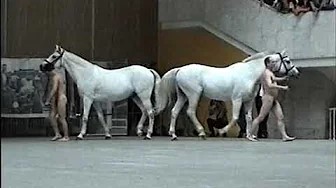
Horses: Baikal and Pirat of Ekatherinehoff (Catherine Park)
Performers: Anthony Howell and Dimitry Samsankov
The video of the performance can be watched here.
with thanks to Larissa Skobkina, Oleg Janouchewski, Yaroslava Polskaya, Emmanuelle Waeckerly, Tim Gadaski, Vladimir Yaremenko-Tolstoy, Paul Granjon and The University of Wales Institute Cardiff
Homage to the Horses of St Petersburg – August 1998.
They can’t be rid of the hammer and sickle without knocking down the airport building. And now there are newly wedded couples hurrying towards the 1940-45 monument for a photograph and colossal dormitories in the distance, where the couples will live perhaps beneath their framed apotheoses. The plump lady who has met me steps off the bus and laden with bags I follow her down the deep escalator to the metro. Funnel like lights and no adverts, then an avenue of candelabra along the platform and a large tondo of Lenin at the end of it. We emerge onto the scruffy grandeur of Nevsky Prospect. Curving colonnades flank the dome of a great church on one side of this eight lane boulevard, while at the end of a canal another church sprouts onion domes in whirling ice-cream colours. Everything comes with columns attached, with added statuary too, and later the Neva glitters in front of me and the hoof of Peter the Great treads on a snake. Here more brides queue up to blush as their grooms pop corks and cameras click. It is leafy too. And the girls have fine long necks and buxom mothers. Three old ladies in tight knee-socks lean on their sticks as again we roar through the dark earth. Lovers bump each other’s foreheads on the long ride up or down from the open air. Here she straightens his lapel as she passes me. Angels encircle golden domes; naked youths restrain mettlesome equestrian marbles. These are the Dioskouri flanking the classical portico of the Imperial Manège, now the Central Exhibition Hall. Bride after bride arrives for her captured moment. Here and there revolutionaries have been executed and czars have been blown up with bombs. In the now excessively expensive Astoria, Yesenin committed suicide. Clapped out vehicles sport pink and yellow ribbons. Is this the season of weddings, or is everybody perpetually getting married in Saint Petersburg? Father Neva poses with one neatly cropped groom. As rivers go, he is portly and looks fairly affable in a genuine beard, a blue dressing-gown, a cardboard crown and rubber boots. But he sports a serious metal trident. Bouquets are left underneath Peter for luck. And the next day you fly away to the Black Sea. I drink meat soup, eat caviare blinis. Silver flowing river. Coach-loads of shirt-sleeved soldiers. Metal ladies overlook the prospect. Elegant lamps flank leafy walks where the cops relax on white wooden benches. Then two bombshells in black miniskirts and white blouses stroll past us and a combo strikes up under a lime tree: a drum-kit with fleshy neck and walrus moustache, an accordion with bushy eyebrows, cap turned wrong way round, together with a balding, rat-faced saxophone. They rattle away at John Coltrane as the bombshells bypass the horse-dung in the avenue across from the Manège.

Where we sleep at the end of some long metro line there is endless woodland. Silver-legged birches and motionless poplars. Cèpes and girolles are on sale in the markets. But out this far from the centre, I feel some lack of horse-power in myself, a sluggishness in the close mosquito heat. It is just no use expending any energy attempting to alter some authority. The city seems so grand on the face of it, so distant and so stately. And the tourist horses are dogs. They hang their heads, lank and skinny flanked. I count their ribs as they doze by the column with the high cross in the huge square behind the Hermitage. Then I sit for ages with the curator and get nowhere. To move from my seat to the door brings out a sweat. You pick up the phone as if buried in mud. The curator is a blank wall. The policewoman closes the entrance at five and throws out those inside at six. Tiny tired horses move like enslaved fleas as they tug their carriages across great squares the size of Steppes. Under parasols there’s only Pepsi by the Neva. The lingerie of Charme on the Nevsky is of course imported and expensive. Shall we sleep on the island? Shall we watch the bridges rise in moonlight? Ancient as modernism, the constructed tower’s reflection stagnates in the circular scum-sullied pool below it. Rubbish is dumped here, and great ambitious blocks made of dusty glass and cracked sheets of plastic have aged considerably more than Stalinist granite. Everyone has a husband or a wife – mostly from the west. Sometimes the husband is a removed film-star. The children speak beautiful English. Thank you. Where will I find my strong white horses? The Dioskouri and their prancing steeds represent a homage to the genitals. Breeding was good in the old days, or monstrous. Now there are shabby anoraks and cheap synthetic frocks and if you wear nylons you flaunt them. The mushrooms are like lovely loaves of bread. Brown as the crust of good bread, they lie on their sides like tops in cardboard boxes, offered for kopeks in markets close to the fringes of enormous forests. Here there are bunches of pungent dill and the purple leaves of lettuces as well as chives and spring onions. The plum tomatoes are dry and tasty. I slice cold meat off the bone. Good cheese. We inspect apartments with meandering corridors as in dreams, apartments high in the eaves of enormous buildings, their stairwells and lift shafts out of Piranesi. Then there are roads so wide here that you can’t see across to the other side. So have another vodka. Downed in one. And another. Downed. You wake to the whir of the fridge, the whine of the mosquito, the wail of the train with a long way to go, the cough of some dilapidated bus. If the mosquitoes let you sleep, you sleep to the forest’s inhalation.
A night later there is the glitter of the moon on the sea. We are high in a tower above it with an owl skimming from the bannister to the rail below the ceiling. The owl lives under the stairs, and flies around the room fairly anxiously after the detonation of a cork. We drink interminable toasts. The woman from Culture TV is a pig. Only she’s more loathsome than a pig, and far more plump, and she keeps asking her idiot sickly questions very softly. What if a child had seen you naked and become frightened? She starts singing old Russian songs. These she sings weakly, before trying to sleep with Emmanuelle, stroking her hair – so pudgy, drunk and nasty. Peter from the Saint Petersburg Times is forced to translate her journalist queries and of course resents it. All this in the luxurious penthouse of the famous Oleg, hippie and painter, with a lovely wife, his fourth. Oleg is pint-sized, very nice, and trying to be nice to the frump from TV. Raw fish: slices of sturgeon, tench and trout. Gherkins to die for. I maintain each borscht is like a fingerprint – unique to the household or to the restaurant that creates it.
Then a taxi takes us to Catherine’s park – Dimitry who will run with me, and Yaroslava, my Siberian friend. We go to inspect the horses she has found for me. Baikal and Pirat. Baikal like the lake larger than England somewhere in Siberia. These are fine white creatures, and quite as Greek as the statuary they will emulate. We trot them round and round, Dimitry and me, then wind them through the trees. Baikal flexes his hog-maned neck. Dimitri needs to be more assertive with Pirat. There’s a long wait for a bus on the way back on a broad street by a canal. At last we reach the Moscow gate – a chariot surmounted monument to some triumph over Napoleon painted green and quite like Marble Arch. After this we sail down to the fantastic Marxist Marbles underground, paean to the Soviets, sculpted airmen and sailors on every column and on into a kaleidoscope of fine canals still sunlit at nine, palaces of the Stroganovs, Molotovs and Yusupovs. Saint Petersburg as opulent as Venice. And I step into the Idiot Cafe, close to Dostoevsky’s haunts, for beer and honeyed cheesecake with diminutive Dimitri and extended Yaroslava. But the next day it is Dimitry who asks whether he will get paid as well as the horses. Not as well. He won’t get paid at all. I feel that he should be doing this for the glory of it. Isn’t he an artist?
Black clouds sail like furies over turbulent canals. After five, as an artist tries to push past her, our female Cerberous reaches for her gun. None of the authorities ranked above the curator want my horse performance to go on. No shoes, no dung, no genitals. Red and white chimneys strangle the onion spires. And the water comes cascading down some lift-shaft, pouring over the lights, turning the stairs into waterfalls. It smells of mold and piss. A gross misconception about money surely sapped the vigour of this society – that and the colossal extravagence of the arms race whose radioactive junk now rots worse than corrosively in the Arctic. Slowly the poison the whole blood-stream fills. The waste remains, the waste remains and kills. And the sea here, even the sea, is dying since they built the dam which fucks up their ecology. We too, we too will be fucked up, fucked up by our very triumph over this ourness. An ourness which sought the otherthrow of otherness and lost. Nowadays in the deep, deepest shafts in the world – our engineers were proud men – we listen to audio advertisments as we ride the escalators. Commercials are blared over a system which used to encourage an identification with the mass, its exhortations urging on a triumph over all private ownership. Yet the city is a testament to privacy on a lavish scale. Palaces rub shoulders with proud horses. And now the downpour forces me into MacDonalds. The palaces crumble. Everything rots. Slime slicks the windfall dropped from the rotten bough of communal ourness. Maggot infested, its bruises darkening and expanding; its centre corrupt, hollowing, hollowing out into nothingness. The water floods the lights in trams. Everything short-circuits. And now they come to remove the electricity in our exhibition hall. Nobody has paid the bill. Collective spirits lie around in big dirty puddles, puddles of our melancholia, as we tramp across the city lugging our possessions along with us. Today a beefeater stands outside the BHS instead of the slender redcoat in the busby. Come on, Barbie, let’s go party. In my superior way, I complete my press-ups. Dr Finlay! Only the horses in Catherine’s park have pride. And a Garfield clock. The naked poets mooch off to make love in their Dacha. They live only for pleasure. 101 Dalmatians. Others celebrate their traditional lethargy. Ringo Starr and Hugo Boss. Only the white horses and the white busts of the Romans in the Hermitage exhibit any arrogance, firmness of jaw, virility. Leonardo da Vinci. Leonardo di Caprio. Now we are in the No-Man’s-Land of neitherness. Neither the other nor ourness. Nivea Cream. Nowhere to go-ness. Nothing to do-ness. Nicholas II. This is the dank and lugubrious end to the white nights. The summer rains turning autumnal. The year straining towards October. God knows what hell this place must be in winter. Only the churches are leaved with gold – and that gives me no comfort. Ineluctably the world has turned, and now we are rolling backwards. Only consider the freshness of the sunset, or the tartly perrenial qualities of the caviar. Or sour cream. Or pungent dill. Or crisp parsley. I lie in bed imagining the bulbous erections of mushrooms, girls with lots of legs, boys built like tanks or willow wands.
Pushkin is celebrated at one underground station while Lenin is celebrated at another. In this apartment run by the mosquitoes the ripped wallpaper is an abstraction by Tatlin. You need to be philosophical to live here but I am not a philosopher. I notice when my feet swell in my shoes, or when my shoulder aches beneath the bag-strap. And I can’t help but lie awake waiting for the next vicious attack, cannot simply ignore it and make instead castles of dreamy thought modulated by the plashing of the rain in the afternoon or evening. Oh I would like to have more lovely thoughts. But everything peels and cracks, grows sodden, stings. An acrid stench sweeps out of the tunnel and everyone gags on it, tears in their eyes. Fungus spreads on warped working surfaces. They have sunk a nuclear sub in the water supply. And I am more interested in the muscular movements of my horses now than in the furry hollows of not-so-available females. Their softnesses are for another time. I have only myself to blame for being alone. The police know all about my intentions and intend to suppress them. They disapprove of energy since this is opposed to authority. The gods we know from the Hermitage prefer their clouds to the world below them which is a world where cabs crash heavily through pot-holes and the clouds become huge puddles on the ground. Pass me the revolver. It is hopeless. The country is in a mess but would you like a cognac? No, Vladimir, I would not like a cognac. Not at eleven o’clock in the morning. Me, I would appreciate a fierce, full-blooded attack of Soviet athleticism – proud chests, parallel faces, firm jaws and noses. These are in disgrace – relegated to the back of the hut behind the manure heap at the stables – a bold young sailor and a vibrant female diver. No such celebration of simple vigour is possible now. And Lenin’s mummified corpse cannot be permitted not to rot just for the sake of some jaundiced pensioners. Put it in the ground. Long live the dollar, the mark and the pound. And yet my nostrilled Baikal paws the ground. The sailor and the strong young diver share the yard with several broken troikas. Everyone is tired, exhausted by incompetence, intransigence. No one knows quite what to do, but a vet says well we need autocracy, it’s just how things work around here. The Russian soul is stimulated by terror. Terror, not vodka, keeps the head clear. Pray for this in the Church of the Saviour of the Blood. Think of the bust of Philip the Arab and hope for such a leader. Who was Alexander Herzen? How was the anti-corrosion conference? Where can I buy me a Fabergé egg?
The water of the canals is black, for storm clouds seep into them and dark thoughts are entertained above them. The bridges lift at night to let in boats. No, Emmanuelle, we are neither nomads nor homeless. We are tourists. And now there are vague affirmations – my plans may well succeed – if anyone remembers what they are. We are welcomed into a salon filled with beds, built-in sleeping platforms, and one huge bed with wall to wall mirrors creating an infinity of huge beds at either end of it, some exhausted boy asleep in each of them. The owner is pudgy; friendly yet phlegmatic in his bare feet. I am making here a centre of mystical sex. He plays video tapes to illustrate this: body-painting done to fake flamenco. The wallpaper is loud glitz, imposing on the eyes. Water-colours copulate on this. We leave him to his shiftless, tacky tangos and Yaroslava rescues me from the drab mosquito appartment on the island. No more rusted baths, flushless loos and crockless kitchens. She lives with her mother in a leafy suburb. These monumental yellow blocks, Egyptian in scale, are Joseph Stalin’s palaces for the people. They loom above the trees in sunlight. Under the trees there are puddles and slides, and girls sitting on the tops of the slides with long legs in the evening smoking lights. Birds float down, flap up. I’ve a nice clean bathroom to myself, a bedroom with a polished floor of parquet, a Russian Blue called Gosha, few mosquitoes and a cooked breakfast. Masha used to own a timber factory. Cat goes nuts now – heavily well fed.
Back in Saint Petersburg proper the black water cannot reflect the flushed sky an hour before sunset, the heavy flotilla of clouds. These deep canals run coldly beneath tall spires of gold; each street made up of truly massive palaces since Peter the Great gave noblemen plots of land by the Neva provided they built palaces of stone there. I am sitting with the curator and a lovely arse comes in now – Anna. Black culottes, black boots, black hair and glasses. Presumably with two hundred servants you had no problem making an arrangement, and no call to protect yourself. On Nevsky there are low-ceilinged shops with second-hand books, good prints. They still use the abacus to calculate. I buy two etchings by Alfred Kubin. Very cheap. I walk and walk. Back in the exhibition hall our nudities are disapproved. Especially the nudity of statuesque Emmanuelle performing body cubism high on the tower across from the tower where I perform. The artists at the Manège come into conflict with each other. Sounds clash with sounds. Performances impinge on performances. Still there’s applause for my workshops and collaborations. Not for naked cubism. But there’s lovely cold Ockroshka soup and red caviare in the Idiot where Emmanuelle and I commiserate. One afternoon later, we go up onto the roofs to inhale the sight of Saint Issak’s cathedral. Metal roofs, painted with red lead. And Russian hippies among metal chimneys rolling up on one side of the ridge while a single worker renovates the other incline. Rain forces us down to meet the fashionable Nadia who won’t go up there and ruin her slacks. She is sheltering in an arched gateway. We troop into a tall, dark building, take the lift up several flights, then wander past an old woman who nods some affirmation as we head down her gloomy corridor, then turn corners in darkness. Nervous laughs. And faint music we trace finally to a small cafe deep in the heart of this building. Here Nadia presides, regal as Catherine, aimiable in the grand style, despite the shabby ambience. We speak in French as Catherine would have spoken. She’s more French than Emmanuelle, yet entirely, absolutely Russe. I remark that Dostoievski would have eaten here, not at the expensive, obvious Idiot. Nadia considers it ill-bred of me to have alternated beds with E in the suburbs. No sense of gallantry. But who needs it, says E, we’re working artists. No one who didn’t know could become aware of this convivial corner’s existence hidden in such a monolith. Is it a sign that winter drives everyone into the interior here? And is the town thus honeycombed with pleasures? Does each grim facade, its loggias held up by griffons or river-gods, darkly secrete within its labyrinths barbers and massage parlours, galleries and boutiques? Yes, and miniature theatres, and indeed treacherous cellars as in the Yusupov Palace. This is the palace where Rasputin was murdered and murdered and murdered again. It floats above a canal close to the Marinsky. The prince had his own small theatre modelled on the Marinsky. It’s tiny, and quite lovely. Here I could declaim the Silvae of Statius. Declaim in a toga worn over a business suit, and thus entertain a small audience seated in resplendent gold and red plush velvet. Meanwhile thousands more could fit into the massive ballroom where the vast candelabra are of papier maché so as not to bring down the lofty ceilings as they did after the reconstruction of the Winter Palace, minutes after the Czar had inspected it. Here in the Yusupov there’s a brilliant private hammam next to the library. They must have read books in the bath. Yusupov was proud of his Moorish ancestry as indeed was Pushkin. The sybaritic bedroom suites are closed for renovations. Rasputin built like a bear was something that smelled like a goat, a figure out of the grotesque carnival of folk myth. This was his fecundity, his power, which he wielded over effete haemophiliac scions. Gnarled logs covered in fungi jerk their bark-covered knees out of the ground in neighbouring forests. It is as if Rasputin came in answer to Peter’s decree concerning monsters.
Behind prestigious street-lamps the clouds roll past the long facade of the Hermitage, a sky webbed by tramlines. I watch it from beneath a red parasol in a windy cafe located across the Neva. Now a coach called Skorpion obscures the view and arrows flap in the sky. The green gods lounge on the roofs, sharing their realm with urns and chimneys. The Hermitage is green and white and gold, the clouds are grey and white, and the sky you glimpse behind the clouds is blue. Inside the majestic building, a mechanical peacock flexes its neck then fans its actual feathers. It eyes the mechanical cock askance, likewise the automated owl. Everything is of gold and there’s a fascination with curiosities: paintings made out of tiny bits of mosaic. The marble busts of Moors here and in the Yusupov constitute the only blacks I’ve seen. Also a black attendant in a Cuyp. I must do something with Lot and his daughters – as has Francois de Troy and others – it’s a theme twinned with Susannah and the elders. Thorthaldsen, the academic classicist, looks better here, and more austere than Canova. I like Santerre’s young woman in a veil. Did Guillaume Cousteau sculpt the fine horses held by boys on the Anichkov Bridge over the Fontanka River? I think so. Falconet’s naughty sculpture of Flora is the only girl with a cunt in the entire Hermitage. This is my second visit and I’m onto the paintings having spent hours before among the Romans. Accurate portrait busts of Caracalla, Philip the Arab, Domitia. And I sensed an intense interest in collecting works emulating the sinewy Lyssipos, who Statius loved, although there are none left now, and precious few in the time of Statius – and later there were only copies and supposed versions by Renaissance Italians. Lyssipos was Alexander the Great’s favourite sculptor. He influenced Pollaiuolo, although there were none left, and became the favourite sculptor of Peter the Great who was striving to emulate Alexander, although there were still none to be found and what his style was could only be gleaned from emulations, copies, versions. It is the thought that counts. Most of the boys are shielded by fig-leaves. But Boilly’s women playing billiards are here, and there are striking works by Perroneau. Of course the Claudes are wonderful, and the Dutch masters, Gerrart Dou, Metsu etcetera, not to mention Breughel and the best Cezannes and Matisses but still, still it’s the curios which prevail as the city’s epitome: Peter issuing his decree, and filling his cabinet of curiosities with freaks, aberrations, monstrosities. He pulled people’s teeth out and kept them did Peter the Great. And he said, All prodigies and freaks of nature must be sent to me, for these are not the Devil’s work, nor due to the hexes of some witch, but the natural product of an expectant mother’s ill-feelings towards her progeny.
This is a notion Cronenburg might appreciate. Next to Peter’s smithy tools, behind the hand imprint and death mask of the Chinese giant but beyond the branch which grows back into being a trunk, we find the heart and skeleton of another giant, no, it’s not Rasputin, who should really be included here, but the giant Bourgois, and then strange toads and lizards. Laevenhoek the microscopist noticed that a dash of cochineal in the preservative made everything more life-like – placentae, arteries, blood vessels. This explains the vivacity of pickled specimens with glass eyes, ruddy cheeks and sanguine brains. Then we have mummified Siamese twins and Siamese twins in formaldehyde, multiple foetuses, skulls with holes in craniums, midget frames, hare lips, flat heads, obscure cysts, double heads, faces with four eyes, legs with two feet each, double headed calves, all of these the fetishes of Peter, kept along with the fetishes found by other, worthier ethnographers. And there are still some scalps here, unlike New York’s Museum of the American Indian in Harlem which thinks it politically incorrect to display them. They hang here in the Kunst Kamera, across the Neva from the Hermitage, along with jews’ harps, rams’ horns, mbiras, coins, sextants and compasses. Here we find alchemical dioramas, immense magnifying glasses, and though he could examine them poor Laevenhoek confused sperm with bacteria. Boil them up together in alembics, shake them in flasks. Here are revolving drums of glass, lightning conductors, sundials – all the sad accoutrements of Durer’s Melancholia. Let us consider our horoscopes and horrors under the microscope. But the foetuses all wear nice little hats of lace, and the isolated arms and the little feet born without bodies have very fine cuffs and sit happily cushioned on their placentas. Cunts without legs, eyeless, noseless, headless, armless concoctions of conceived matter. And in the engravings of the time, pathetic homunculus skeletons dry their tears on their placenta hankies. Outside the building a sweet little thing, all complete in a shortish polka-dot dress, hangs about by the souvenir stall with her granny. Less than a nymphette as yet, nearly plump, but not quite. Honey-coloured skin, lovely calves and above her knees the delicious start of her thighs. You can see what Nabokov was getting at.

Feeling a bit like Balthus must have felt when he saw such a sight, I go by tube and taxi-bus now to a boulevard of tall residential blocks stretching to infinity in the sunset. Every Westerner’s image of Communist Russia. And the next day my horses have their shoes removed outside the Manège by a farrier, and Dimitry and I strip out of our clothes before leading these beauties into the riding-school which has become the exhibition hall. In the days of the czars, the Cossacks would gallop the length of it, halting an inch away from the nose of their ruler. Now the live figures echo the statues outside it. And the horses dung in the hall symmetrically and simultaneously for the first time since before the revolution. We trot them in circles on the marble floor and then take them out of the building and around it and up the ramps onto the floor below the portico, naked once more and walking the horses. Gravely we circle the columns in symmetry. Ghosts of czars and horses nod approval. There’s applause. And I must say I’m pleased with these horses. Ultimately everyone including the police intended this sublime event to happen. The curator wrote a letter and the space was cleared and the clashing sounds were turned off so that the hooves of the horses could appropriate their building as was proper. The pair of them have proved I think that the world can be a better place, for no one got in the way and nothing was forbidden at the last minute. Our nudities stopped the traffic. We were at one with ancient Greece and Russia. Ha ha ha. But Russia was truly at one with her horses. Everyone was pleased with them. Sometimes at work in the world are beneficent forces.
Anthony Howell


 anthonyhowelljournal